
South Korea Smart Street Lighting Market Size & Forecast:
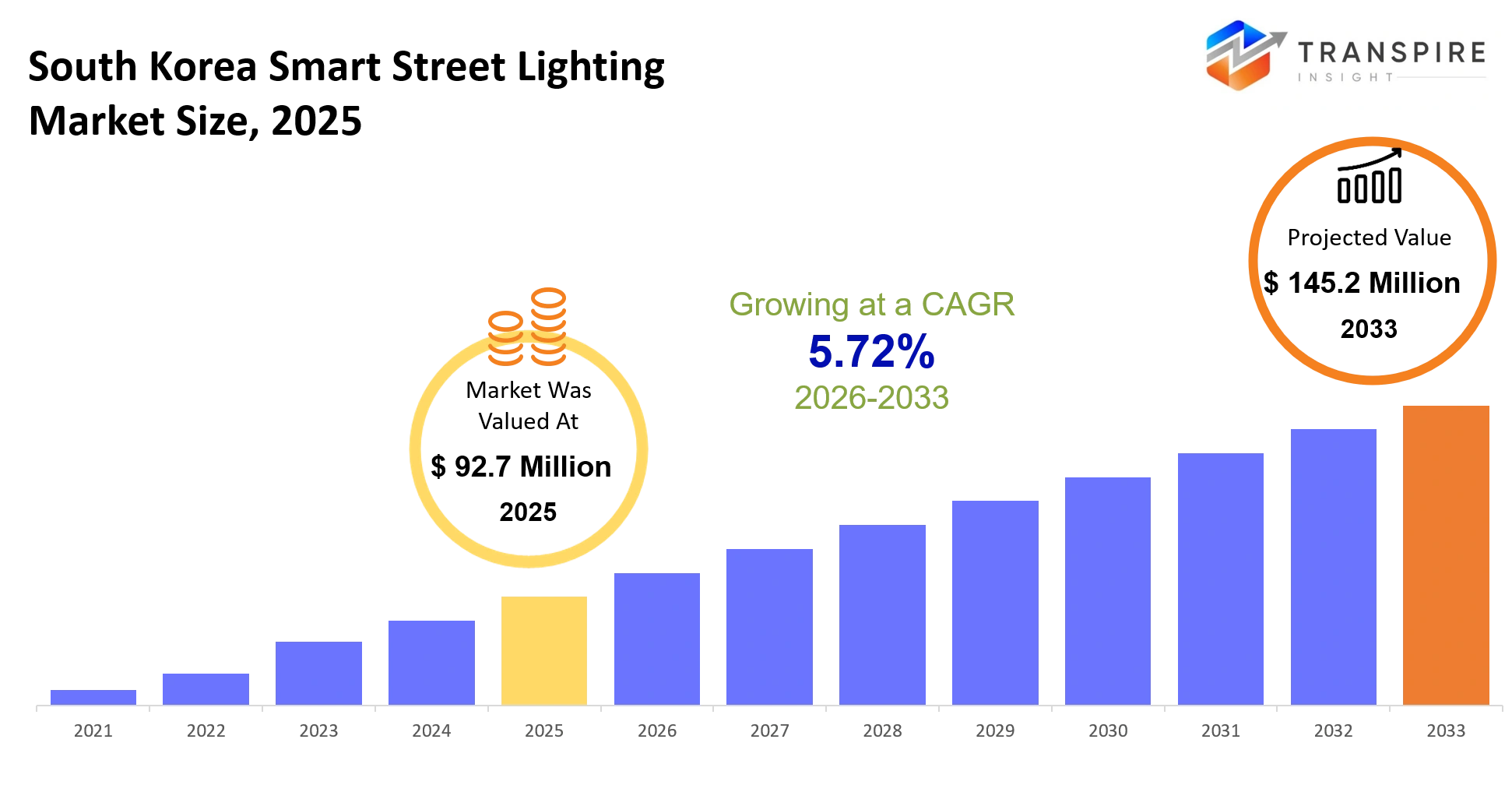
- South Korea Smart Street Lighting Market Size 2025: USD 92.7 Million
- South Korea Smart Street Lighting Market Size 2033: USD 145.2 Million
- South Korea Smart Street Lighting Market CAGR: 5.72%
- South Korea Smart Street Lighting Market Segments: By Component (Smart Luminaires, Sensors, Controllers, Gateways, Software Platforms, Communication Modules, Smart Poles, Others); By Connectivity (Wi‑Fi, Zigbee, LoRaWAN, NB-IoT, Cellular, Bluetooth, RF Mesh, Others); By Application (Roadways, Highways, Smart Cities, Parking Areas, Public Parks, Industrial Zones, Campuses, Others); By End User (Municipalities, Utilities, Government Agencies, Real Estate Developers, Industrial Parks, Transport Authorities, Educational Campuses, Others)
South Korea Smart Street Lighting Market Summary
The South Korea Smart Street Lighting Market was valued at USD 92.7 Million in 2025. It is forecast to reach USD 145.2 Million by 2033. That is a CAGR of 5.72% over the period.
In South Korea, smart street lighting systems kinda manage urban illumination by automatically shifting brightness based on pedestrian movement, traffic density and environmental conditions, while also allowing remote monitoring for municipal operators. In practice they address that everyday problem of cutting electricity spending and upkeep costs, yet improving night-time safety and service reliability across the dense city blocks.
Over the last 3 to 5 years, the market moved in a more structural way from plain LED retrofit programs to genuinely networked IoT-enabled lighting infrastructure that is tied in with citywide data platforms. A major trigger was the jump in electricity prices after the global energy crisis back in 2022, which basically caused local governments to lean harder into adaptive dimming and predictive maintenance to keep operating budgets under control. So procurement behavior has been reshaped too, with municipalities now favoring connected solutions that can show lifecycle savings in measurable terms, rather than simply doing upfront hardware replacement.
Key Market Insights
- Seoul kind of dominates the South Korea Smart Street Lighting Market , with an estimated 35–40% share, mostly because it has more advanced smart city infrastructure deployment happening early on.
- Meanwhile Busan is showing the fastest growth through 2026, and that’s pulled by port modernization , plus upgrades for intelligent coastal safety lighting.
- If we look at the “thing you install” side, hardware-led lighting fixtures take the leading portion , supported by big LED retrofit rollouts across municipal roads nationwide.
- On the other hand, software and control platforms make up the second-largest segment, since they let operators do centralized monitoring , and adaptive dimming.
- Connectivity modules and IoT sensors are the fastest-growing segment through 2028, largely due to the growing need for network integration .
- In terms of where it’s used , urban roadways dominate overall usage , with nearly 50% share, driven by traffic optimization and public safety needs in dense cities.
- Smart parking zones and pedestrian pathways are emerging fastest too, especially as cities build out micro mobility infrastructure.
- Municipal governments still act as the leading end users , holding more than 55% share because they manage large-scale public lighting procurement budgets.
- And smart city developers along with private infrastructure operators are growing the quickest among end users, helping accelerate PPP-based deployments.
What are the Key Drivers, Restraints, and Opportunities in the South Korea Smart Street Lighting Market?
The main driver of the South Korea Smart Street Lighting Market is that shift, kind of towards energy spend optimization, sparked by rising electricity tariffs and municipal budget pressure after 2022. Local governments are rolling out adaptive LED lighting with IoT control, to cut power use by tuning brightness on the fly based on traffic density, and also the pedestrian flow. It sort of improves operating efficiency right away and it lets authorities plan for longer term public infrastructure cost savings , which in turn makes cities move faster on connected lighting system procurement rather than just doing conventional upgrades.
A key restraint however is the heavy upfront integration complexity. This is especially true when it comes to the price of retrofitting legacy lighting grids, with IoT sensors, communications modules, and centralized control software. In practice, many municipalities run split, sometimes fragmented infrastructure setups, and that makes interoperability hard. So large scale deployment ends up being slower, and revenue realization for vendors gets delayed too, because procurement stays cautious, and is phased, rather than being a full system wide replacement.
There’s also a meaningful opportunity showing up, via 5G enabled smart city corridors being built in Seoul, and Busan. With ultra-low latency connectivity, real time adaptive lighting becomes more reliable, and integrated urban analytics can be tied in cleanly. Those corridors make it possible to combine traffic data, surveillance systems, and environmental sensor outputs into one unified platform, so vendors that can deliver cross platform smart infrastructure solutions stand a better chance of winning higher value contracts plus recurring, software based revenue streams.
What Has the Impact of Artificial Intelligence Been on the South Korea Smart Street Lighting Market?
Artificial intelligence is kinda reshaping the South Korea Smart Street Lighting Market , not just in theory, but with autonomous control systems that tune the light level in real time, depending on where pedestrians are, how crowded traffic feels, and even weather conditions. AI based platforms, which companies like Samsung Electronics and LG CNS have been rolling out, let city operators basically automate the lighting timetables and watch the whole grid from a central view, usually through a centralized dashboard .
Predictive analytics models are also getting used to estimate equipment aging, so maintenance teams can swap LED modules or controllers before a failure shows up. This helps cut down on unplanned blackouts , and supports better asset uptime, plus it reduces lifecycle maintenance costs by making repair cycles more efficient. In a few deployments, people mention directional drops of around 15–25% in operational maintenance spend, mostly because predictive scheduling and fault detection run earlier than usual.
Still, take-up is not fully smooth since the integration costs are high and the data quality can be inconsistent from older street infrastructure . A lot of legacy lighting setups don’t offer standardized sensor outputs , so AI model accuracy becomes limited. That, in turn, pushes municipalities to invest in retrofits first, before the full automation benefits can actually land .
Key Market Trends
- From 2021 to 2025, municipal upgrades sort of moved away from LED-only retrofits, and kind of toward IoT enabled adaptive lighting systems across the big Korean cities. It was more than just swapping fixtures, it felt like a gradual drift.
- In 2024, Seoul expanded the integrated smart lighting corridors, tying traffic analytics together with energy optimization platforms, basically in real time. After that, the whole “lights” thing acted more like a signal, not just a lamp.
- Adoption of edge computing in the lighting nodes jumped sharply after 2023, mostly to cut down latency in traffic responsive brightness control systems. That part, made control faster, and less laggy than before.
- Also since 2022, public procurement policies leaned toward performance based contracts. Instead of obsessing over initial installation costs, they started prioritizing lifecycle energy savings, which sounds obvious but it took time.
- Meanwhile telecom operators like SK Telecom expanded into smart lighting infrastructure, to exploit 5G urban connectivity networks. It was not only communications anymore, it became an enabling layer.
- Integration with surveillance and public safety systems increased after 2023, turning lighting poles into multifunctional smart city assets. So now the pole does more than illuminate, it also “observes”, indirectly.
- Busan’s port modernization projects brought in adaptive coastal lighting, aimed at improving maritime safety and logistics efficiency. The ports needed reliability, especially with shifting conditions.
- Hardware suppliers shifted toward modular lighting designs in 2025, to make upgrades simpler and to reduce long term municipal maintenance costs.
- And competitive pressure got stronger too, because global players like Signify focused more on software led lighting ecosystems rather than standalone luminaires.
South Korea Smart Street Lighting Market Segmentation
By Component:
Smart luminaires, sensor controllers, gateways, software platforms, communication modules, smart poles, others: smart luminaires really sit at the base of the South Korea Smart Street Lighting Market, basically swapping the usual fixtures with adaptive LED systems. These units should handle brightness control depending on traffic movement, and also weather shifts. Municipal upgrades, especially in dense urban zones will keep pushing installation demand, not only on fresh projects but also through upgrades to existing infrastructure networks.
Sensors, controllers and gateways help the setup by capturing real time data and coordinating the lighting networks as one. They will back motion detection, fault alerts, and remote command features. Software platforms plus communication modules act like the glue, tying the hardware into a single system, so cities can steer energy use and plan maintenance with more precision, and with less manual effort.
Smart poles and their supporting components will push the value further than lighting alone. They can host cameras, environmental sensors, and other connectivity devices. The need for these solutions should keep rising because city planners seem more focused on multi-use infrastructure. As connected street systems expand, maintenance may become more efficient, and long-term cost control for public lighting operations should improve too.
By Connectivity:
Wi-Fi, Zigbee, LoRaWAN, NB-IoT, Cellular, Bluetooth, RF Mesh, Others: Wi‑Fi and Zigbee kind of will cover the short-range communication needs, in those localized setups across the South Korea Smart Street Lighting Market. They will let you do basic automation in neighborhoods and campus zones, where the data traffic is low, and stable control stays important.
LoRaWAN and NB-IoT should ramp up more quickly, because they fit the long-range, low-power communication needs across big city grid systems. In practice, these networks will help keep street lighting assets under continuous monitoring, and at the same time cut down on frequent maintenance stops and visits. Cellular connectivity will also play a role, especially for higher-data use cases in crowded urban corridors, where quicker response matters and centralized control has to stay in place.
RF mesh and Bluetooth will be used for particular deployment situations, where flexible node‑to‑node dialog is needed. Basically, these setups will work as a backup pathway, and they improve localized network resilience. Growth is expected to keep moving forward as municipalities put more focus on stable communication layers, so lighting keeps running uninterrupted and remote diagnostics can happen without delays.
By Application:
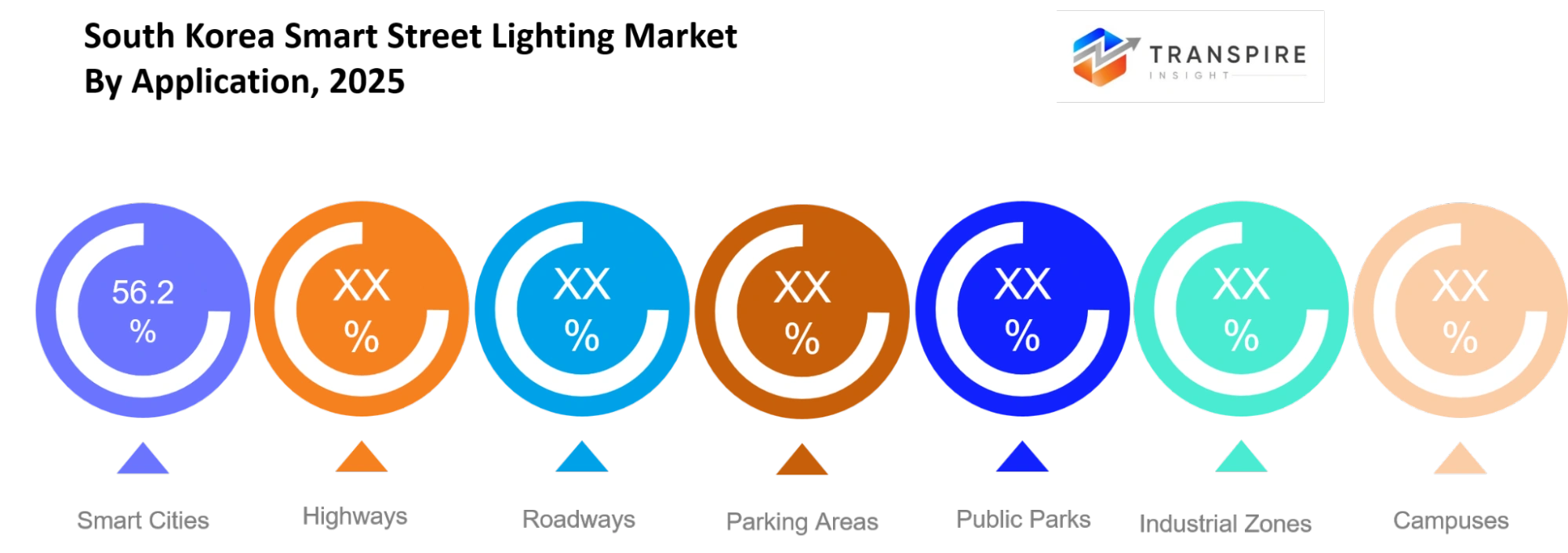
Roadways, Highways, Smart Cities, Parking Areas, Public Parks, Industrial Zones, Campuses, Others: Roadways will stay the largest application space in the South Korea Smart Street Lighting Market, mostly because of heavy traffic density and strong safety requirements. Adaptive illumination setups will back accident prevention and better sightlines across urban, plus suburban road networks, even when conditions change.
Highways and Smart city initiatives will show stronger ties between connected lighting and traffic control systems. Parking areas and public parks will lean on motion-activated lighting to cut electricity use during quiet hours, when people move less. These use cases will largely aim at efficiency gains and user protection in shared public spaces.
Industrial zones and campuses will roll out smart lighting for day-to-day operational safety and more predictable energy consumption. The solution, or at least the implementation, will be aligned with security systems to help with surveillance and access control functions. In addition, expansion of mixed use infrastructure projects will broaden deployment across several application categories, not just one area.
By End User:
Municipalities, Utilities, Government Agencies, Real Estate Developers, Industrial Parks, Transport Authorities, Educational Campuses, Others: Municipalities are likely to dominate the South Korea Smart Street Lighting Market, mainly because they carry big responsibility for urban lighting infrastructure. So procurement programs will, in practice, keep centering on energy savings, trimming maintenance, and pushing long-term operational efficiency across city networks.
Utilities and government agencies will help with funding and also with integrating smart lighting into wider infrastructure modernization efforts. Real estate developers, meanwhile, tend to lean on connected lighting systems for both residential as well commercial projects, to boost safety and keep long-term operational costs under control.
Industrial parks, transport authorities, plus educational campuses will probably expand adoption too , because there is growing need for regulated lighting settings and safety monitoring. Overall deployment is expected to rise when smart infrastructure standards become a normal requirement in new build and redevelopment projects across many sectors.
What are the Key Use Cases Driving the South Korea Smart Street Lighting Market?
Core demand in the South Korea Smart Street Lighting Market comes mostly from roadway illumination where municipalities rely on adaptive LED systems to make night visibility better, cut electricity costs, and push traffic safety forward on congested city roads and highways, all while meeting strict energy efficiency rules. This whole use case tends to pull the most demand because road networks get constant traffic load and they need lighting that stays steady, for public safety and also for day to day operations.
Next expansion areas show up in smart city corridors and transport hubs where real estate developers together with transport authorities roll out connected lighting for parking management , pedestrian safety, and industrial park monitoring. That approach improves operational control and cuts down the amount of manual maintenance across wide distributed infrastructure networks, more or less.
For emerging use cases, 5G-enabled smart poles are starting to matter for environmental sensing and emergency response coordination, plus infrastructure readiness for autonomous vehicles. This is happening in regulated urban pilot zones, along with public safety analytics integration that utilities and government agencies can actually use.
|
Report Metrics |
Details |
|
Market size value in 2025 |
USD 92.7 Million |
|
Market size value in 2026 |
USD 98.4 Million |
|
Revenue forecast in 2033 |
USD 145.2 Million |
|
Growth rate |
CAGR of 5.72% from 2026 to 2033 |
|
Base year |
2025 |
|
Historical data |
2021 - 2024 |
|
Forecast period |
2026 - 2033 |
|
Report coverage |
Revenue forecast, competitive landscape, growth factors, and trends |
|
Country scope |
South Korea |
|
Key company profiled |
Signify, Acuity Brands, Zumtobel, Hubbell, Current Lighting, Samsung SDS, LG CNS, Cisco, Telensa, Itron, Siemens, Schneider Electric, Honeywell, Eaton, Legrand |
|
Customization scope |
Free report customization (country, regional & segment scope). Avail customized purchase options to meet your exact research needs. |
|
Report Segmentation |
By Component (Smart Luminaires, Sensors, Controllers, Gateways, Software Platforms, Communication Modules, Smart Poles, Others); By Connectivity (Wi‑Fi, Zigbee, LoRaWAN, NB-IoT, Cellular, Bluetooth, RF Mesh, Others); By Application (Roadways, Highways, Smart Cities, Parking Areas, Public Parks, Industrial Zones, Campuses, Others); By End User (Municipalities, Utilities, Government Agencies, Real Estate Developers, Industrial Parks, Transport Authorities, Educational Campuses, Others) |
Which Regions are Driving the South Korea Smart Street Lighting Market Growth?
Seoul Capital Area, kind of leads the South Korea Smart Street Lighting Market, because of dense city traffic networks and overall smart city governance that stays pretty strong. Local municipal offices in Seoul deploy big scale adaptive lighting systems to handle energy use across busy districts and public safety corridors, not just the obvious places. Integrated control hubs help with real time watching of lighting performance, for thousands of nodes at once. And the policy enforcement around energy efficiency plus modernization of digital infrastructure keeps going, so the procurement budgets stay large and the long term deployment programs keep rolling.
Incheon along with the nearby Gyeonggi zones, forms what feels like a stable second region, pushed mostly by industrial clusters and port linked logistics infrastructure. This area is different from the capital’s more policy heavy approach, it leans toward operational efficiency for warehouses, industrial parks, and those transport routes that never really sleep. Lighting upgrades here support safer freight movement and also cut maintenance disruptions across high usage corridors. Regular spending from logistics operators and utilities helps keep the connected lighting systems rollout on track, across industrial zones without big gaps.
Busan looks like the fastest growing region, mainly due to port modernization that is ongoing and coastal infrastructure upgrades that keep stacking up. Recent spending on smart port systems plus maritime safety infrastructure has lifted demand for adaptive lighting near docks, terminals, and coastal roads. Local authorities have added digital monitoring systems, to improve visibility, and operational safety around the shipping zones. So overall this growth hints at strong chances for vendors, since infrastructure expansion is expected to continue through 2026–2033.
Who are the Key Players in the South Korea Smart Street Lighting Market and How Do They Compete?
The South Korea Smart Street Lighting Market shows this moderately consolidated competitive landscape, where global tech providers run up against pretty solid domestic electronics and telecom firms. In practice competition is less about pure hardware pricing and more about how well the solution does software integration, energy efficiency performance, and how easily lighting systems connect into broader smart city platforms. Municipal buyers are increasingly thinking in terms of lifecycle savings, and also interoperability, so vendors are basically pushed to come with end-to-end solutions rather than stand alone lighting products.
Signify leans in with energy efficient lighting systems, paired with advanced control software, to enable citywide dimming and predictive maintenance features. Siemens, meanwhile, emphasizes infrastructure grade control platforms that can tie lighting into traffic and utilities management systems for big municipal engagements. Samsung Electronics boosts its stance by focusing on smart sensors and IoT enabled hardware that is then folded into wider digital city solutions. LG CNS grows through smart city platform rollouts, plus government partnerships, linking lighting networks with data analytics systems. SK Telecom also drives adoption by mixing 5G connectivity with edge computing, which supports real time adaptive lighting and urban monitoring use cases.
Company List
- Signify
- Acuity Brands
- Zumtobel
- Hubbell
- Current Lighting
- Samsung SDS
- LG CNS
- Cisco
- Telensa
- Itron
- Siemens
- Schneider Electric
- Honeywell
- Eaton
- Legrand
Recent Development News
In January 2026, SK Telecom announced collaboration with Arm and Rebellions to develop next-generation AI infrastructure solutions. The partnership focuses on integrating advanced processors with smart city systems, enabling real-time data processing for connected lighting networks and improving energy optimization in urban infrastructure.
Source https://www.sktelecom.com/
In April 2026, LG CNS unveiled a new logistics and smart automation solution during its global expansion push in North America. The company highlighted AI-driven operational systems that support smart infrastructure use cases, including city-scale monitoring and connected systems relevant to intelligent street lighting deployments. Sourcehttps://www.lgcns.com/
What Strategic Insights Define the Future of the South Korea Smart Street Lighting Market?
The South Korea Smart Street Lighting Market is moving steadily toward fully autonomous, software-defined city lighting systems where the hardware is basically a passive layer and the real value shifts into data based control platforms. This shift is being pushed by municipal needs for verifiable energy cutbacks and also the tighter linkage of streetlight infrastructure with wider smart city networks. Over the next 5–7 years deployment will more and more lean on interoperable setups that connect lighting with things like traffic, public safety, and even environmental monitoring.
There’s also a quieter kind of risk in play, platform concentration. In other words a smaller cluster of telecom firms and industrial tech providers could end up steering the data layers, which can reduce vendor flexibility and slowly raise long term reliance for municipalities. That situation can make innovation slower and it can squeeze margins for smaller suppliers, not exactly in a dramatic way but enough to matter.
At the same time, an emerging opportunity is showing up in AI enabled predictive urban upkeep, especially when it’s tied to 5G edge networks. This could be especially relevant across secondary cities that are building smart corridor projects beyond Seoul. Vendors who can merge lighting hardware with real time analytics will likely end up with better contract leverage. Market players should focus on open architecture designs, so they avoid lock in and keep stronger long run competitiveness through public procurement cycles.
South Korea Smart Street Lighting Market Report Segmentation
By Component
- Smart Luminaires
- Sensors
- Controllers
- Gateways
- Software Platforms
- Communication Modules
- Smart Poles
By Connectivity
- Wi‑Fi
- Zigbee
- LoRaWAN
- NB-IoT
- Cellular
- Bluetooth
- RF Mesh
By Application
- Roadways
- Highways
- Smart Cities
- Parking Areas
- Public Parks
- Industrial Zones
- Campuses
By End User
- Municipalities
- Utilities
- Government Agencies
- Real Estate Developers
- Industrial Parks
- Transport Authorities
- Educational Campuses
Frequently Asked Questions
Find quick answers to common questions.
The South Korea Smart Street Lighting Market size is USD 145.2 Million in 2033.
Key segments for the South Korea Smart Street Lighting Market are By Component (Smart Luminaires, Sensors, Controllers, Gateways, Software Platforms, Communication Modules, Smart Poles, Others); By Connectivity (Wi‑Fi, Zigbee, LoRaWAN, NB-IoT, Cellular, Bluetooth, RF Mesh, Others); By Application (Roadways, Highways, Smart Cities, Parking Areas, Public Parks, Industrial Zones, Campuses, Others); By End User (Municipalities, Utilities, Government Agencies, Real Estate Developers, Industrial Parks, Transport Authorities, Educational Campuses, Others).
Major South Korea Smart Street Lighting Market players are Signify, Acuity Brands, Zumtobel, Hubbell, Current Lighting, Samsung SDS, LG CNS, Cisco, Telensa, Itron, Siemens, Schneider Electric, Honeywell, Eaton, Legrand.
The South Korea Smart Street Lighting Market size is USD 92.7 Million in 2025.
The South Korea Smart Street Lighting Market CAGR is 5.72% from 2026 to 2033.
- Signify
- Acuity Brands
- Zumtobel
- Hubbell
- Current Lighting
- Samsung SDS
- LG CNS
- Cisco
- Telensa
- Itron
- Siemens
- Schneider Electric
- Honeywell
- Eaton
- Legrand
About the Authors

Chetan Dhatrak
I’m Chetan Dhatrak, a Senior Research Analyst at Transpire Insight, specializing in the Consumer Goods, Foods and Beverages industry. I focus on analyzing market trends, consumer behavior, competitive landscapes, and industry developments to deliver accurate, data-driven insights. My research at Transpire Insight is built on credible sources and in-depth analysis, helping businesses and readers better understand market dynamics, emerging opportunities, and evolving consumer preferences. I’m committed to creating reliable, well-researched content that supports informed decision-making and reflects the latest developments in the consumer goods and food & beverage sectors.

Chakradhar Khansole
Chakradhar serves as the Research Director at Transpire Insight, bringing over 8 years of experience in technology, innovation, and strategic market intelligence. He specializes in transforming complex market data into actionable business insights that enable organizations to make informed, growth-oriented decisions. Recognized for his strategic vision and analytical expertise, Chakradhar leads high-impact research initiatives, delivering comprehensive market assessments, competitive intelligence, and forward-looking industry analysis.
Recently Published Reports
-
Apr 2026
Bottled Water Market
Bottled Water Market Size, Share & Analysis Report By Product Type (Still Bottled Water, Carbonated Bottled Water, Functional Bottled Water, and Others), By Packaging (PET, Cans, and Others), By Sales Channel (Supermarkets/Hypermarkets, Convenience Stores/Drug Stores, Grocery Stores/Club Stores, Foodservice, and Others) and Geography (North America, Europe, Asia-Pacific, Middle East and Africa, South and Central America), 2021 - 2032
-
Apr 2026
Color Cosmetic Packaging Market
Color Cosmetic Packaging Market Size, Share & Analysis Report By Application (Mascara Packaging, Liquid Packaging, and Liquid Face), By Type (Tubes & Bottles, Pens & Markers, Compacts & Containers, and Droppers & Pumps), and Geography (North America, Europe, Asia-Pacific, Middle East and Africa, South and Central America), 2021 - 2031
-
Apr 2026
External Microphone For Camera Market
External Microphone For Camera Market Size, Share & Analysis Report By Type (Shotgun Microphone, Lavalier Microphone, and Others), By Application (Digital Camera, Professional Video Camera, and Others), and Geography (North America, Europe, Asia-Pacific, Middle East and Africa, South and Central America), 2021 - 2031
-
Apr 2026
Foot Orthotic Insoles Market
Foot Orthotic Insoles Market Size, Share & Analysis Report By Type (Pre-fabricated, and Custom-made), By Material (Thermoplastic, Composite Carbon Fiber, and Others), By Distribution Channel (Drug Stores, Hospitals & Clinics, and Others), and Geography (North America, Europe, Asia-Pacific, Middle East and Africa, South and Central America), 2021 - 2031