
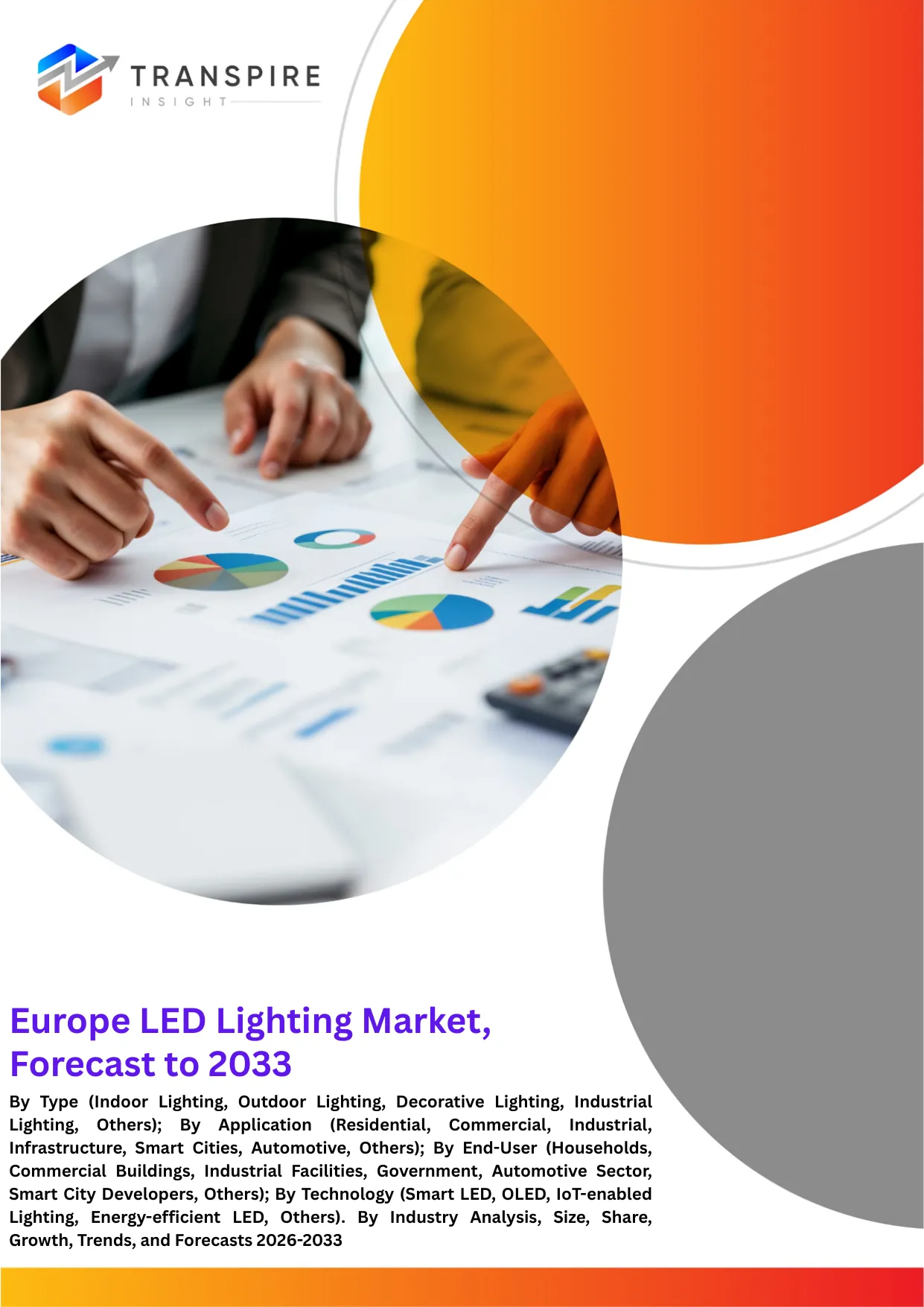
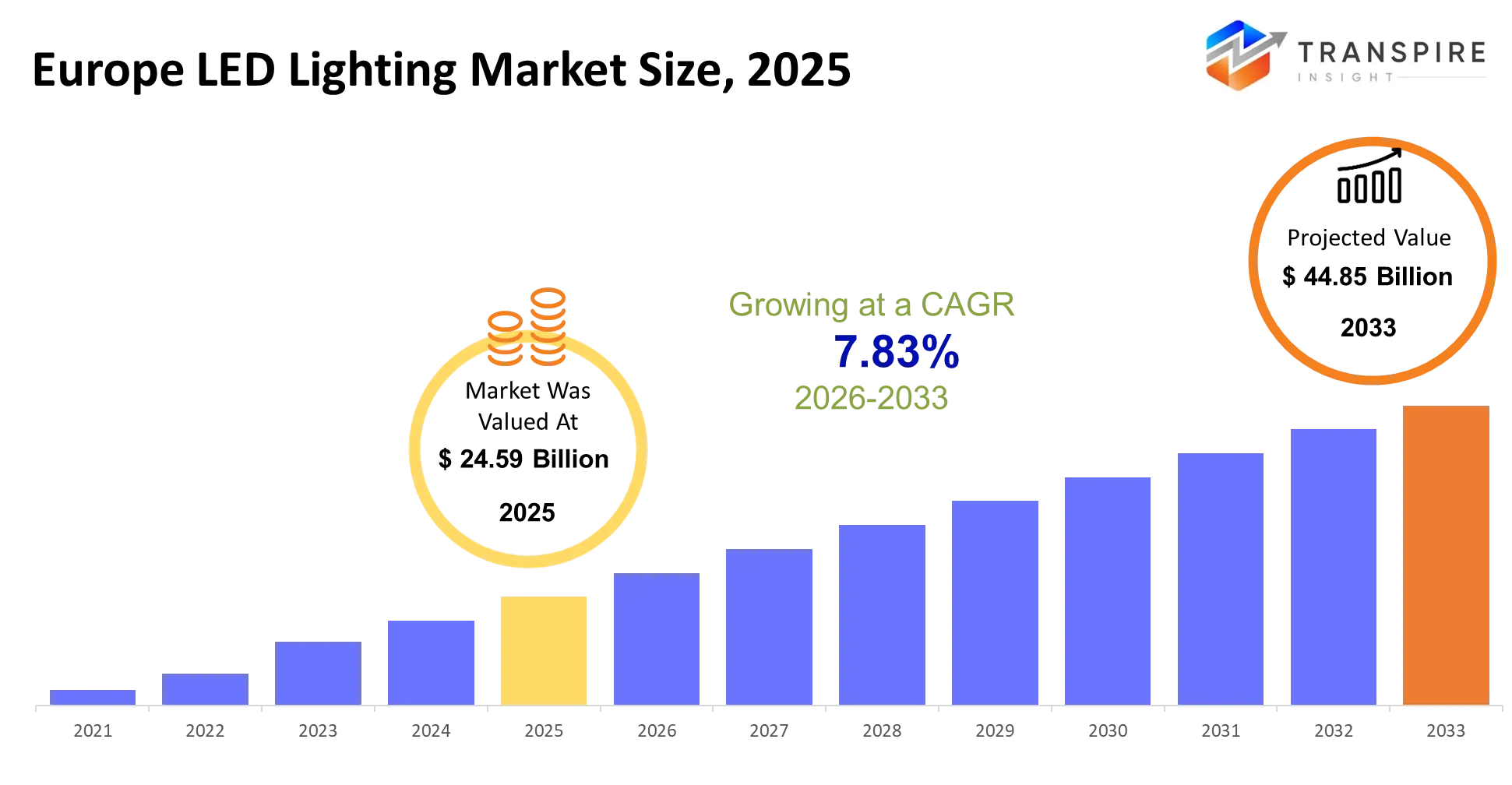
Europe LED Lighting Market Size & Forecast:
- Europe LED Lighting Market Size 2025: USD 24.59 Billion
- Europe LED Lighting Market Size 2033: USD 44.85 Billion
- Europe LED Lighting Market CAGR: 7.83%
- Europe LED Lighting Market Segments: By Type (Indoor Lighting, Outdoor Lighting, Decorative Lighting, Industrial Lighting, Others); By Application (Residential, Commercial, Industrial, Infrastructure, Smart Cities, Automotive, Others); By End-User (Households, Commercial Buildings, Industrial Facilities, Government, Automotive Sector, Smart City Developers, Others); By Technology (Smart LED, OLED, IoT-enabled Lighting, Energy-efficient LED, Others)
To learn more about this report,  Download Free Sample Report
Europe LED Lighting Market Summary:
The Europe LED Lighting Market size is estimated at USD 24.59 Billion in 2025 and is anticipated to reach USD 44.85 Billion by 2033, growing at a CAGR of 7.83% from 2026 to 2033. European leadership in the global market of lighting technology within the context of the electricity and lighting industry will change the face of light design, distribution, and use in urban areas. The traditional focus on reducing energy consumption will be transformed into an intelligent system that accounts for user activity, sunlight, and interaction with other infrastructures. Lighting equipment will be required to satisfy consumers' expectations for a balance between functionality and appearance. Manufacturers will pay more attention to the development of color tunability features and form-factor solutions. Moreover, there will be more requirements for the creation of energy-saving lighting products because of regulation efforts in all European countries.
What Has the Impact of Artificial Intelligence Been on the Europe LED Lighting Market?
The role of artificial intelligence in the europe led lighting market industry is becoming increasingly crucial by revolutionizing the core process of analyzing market dynamics and adopting a data-centric business approach that impacts how the firms operate within this landscape. By incorporating AI into their operations within the europe led lighting market industry, companies are benefiting from enhanced market analysis using advanced data analytics techniques that are allowing them to detect micro trends within commercial, residential, and public infrastructure segments.
In terms of operational efficiencies, the use of artificial intelligence within the europe led lighting market environment is making processes of manufacturing more efficient by utilizing advanced machine learning algorithms and smart automation techniques that help to optimize production process and improve product quality. Moreover, supply chain management within this industry sector is also being enhanced through the implementation of advanced predictive analysis software and algorithms.
Apart from enhancing efficiency, artificial intelligence is helping in innovating and personalizing the european led lighting industry. With intelligent lighting solutions, manufacturers have been able to develop lighting systems that change according to the user's preferences and conditions as well as the energy needs. The incorporation of smart automation not only raises customer expectations but also creates a competitive advantage for firms that embrace artificial intelligence.
Key Market Trends & Insights:
- The European LED lighting market distribution shows Western Europe as the dominant region which will have approximately 45% market share during 2025.
- The market shows rapid expansion in Eastern Europe which will experience nine percent annual growth from 2025 until 2030 because its infrastructure undergoes modernization.
- The market will reach 60% share in 2025 through LED luminaires which achieve high popularity among commercial and industrial users.
- LED lamps hold the second-largest market share because European residential customers need to replace their existing lamps during home renovations.
- The smart lighting systems segment will emerge as the fastest-growing one during 2025 to 2030 due to increased Internet of Things (IoT) applications.
- The European LED lighting market distribution shows commercial applications as the largest segment which holds approximately 40% market share because of demand from offices and retail and hospitality businesses.
- The two fastest-growing application areas will be smart city and outdoor lighting because digital technology and sustainable city development initiatives will support their growth.
- The commercial sector holds a major share of the market because businesses pursue energy savings through cost-effective solutions.
- Advanced home automation systems and personal lighting options will drive residential users to become the fastest growing user group.
- The major companies in this industry include Signify N.V., OSRAM GmbH, Zumtobel Group, Acuity Brands, and Panasonic Corporation.
- The two main trends show development of AI-based intelligent lighting systems together with human-centered LED lighting systems.
Europe LED Lighting Market Segmentation
By Type
Indoor lighting will become prominent because of its common use in households, workplaces, and shopping spaces, with consistent lighting and energy efficiency being significant considerations. Outdoor lighting will be in demand because of the construction of cities, with streets, highways, and public safety lights being among those required. Decorative lighting will be sought after by the hotel and home industries because of new designs and tastes. The industrial sector will be supplied with durable industrial lights.
Design and energy efficiency will make improvements in all types of lights, resulting in better quality while using less energy. Indoor and outdoor lights will have smart controls that can manage their lighting automatically and efficiently. Decorative lights will include color changes and adjustable brightness to suit new designs.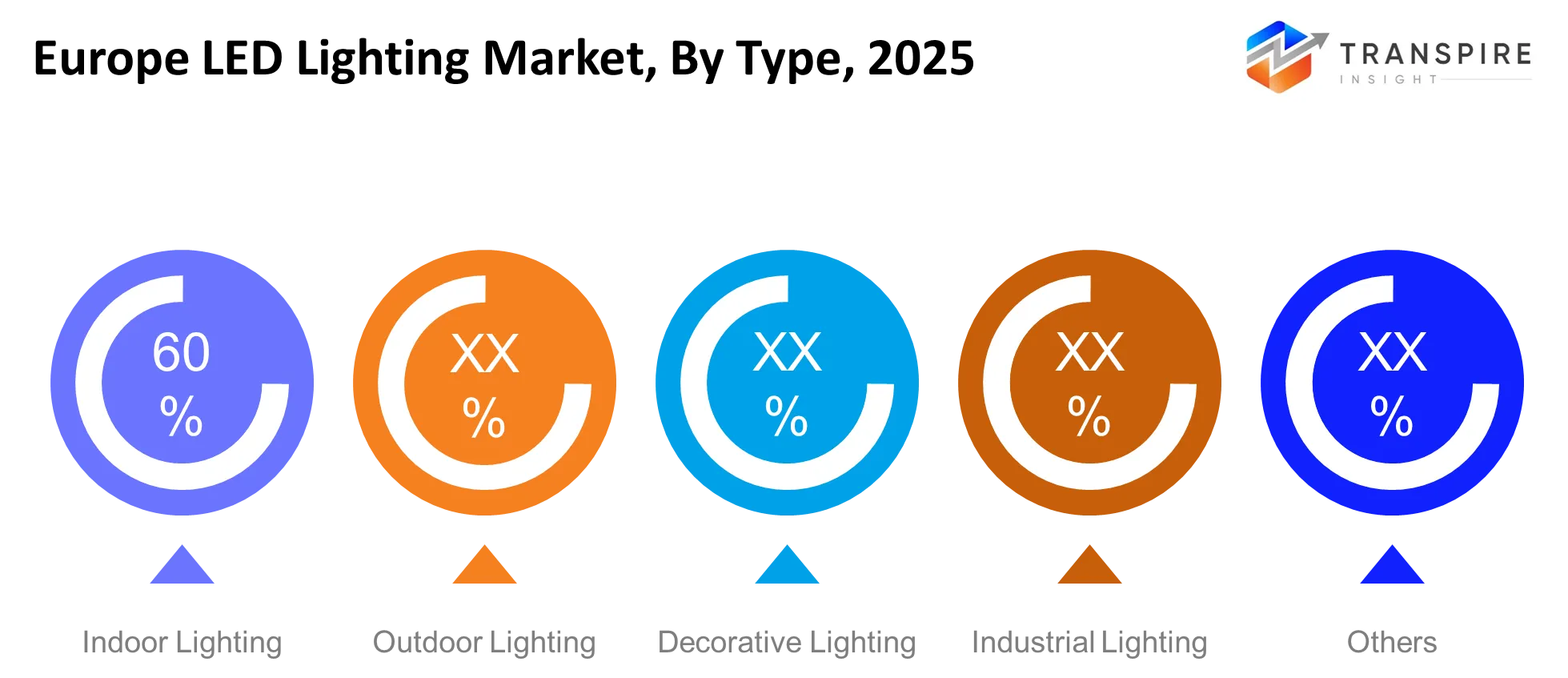
To learn more about this report, Download Free Sample Report
By Application
The residential segment will grow continuously owing to the growing acceptance of energy-efficient lighting for use at home. The commercial sector will be the main application market because of high energy usage within office buildings, shopping centers, and hotels where lighting quality determines the experience of the customers. The industrial sector will facilitate industries through robust and reliable lighting fixtures.
Another emerging market segment where LEDs can find applications is smart city lighting due to digitization and connectivity features. The automotive sector would also undergo transformation due to the advent of LEDs that can enhance the visibility and beauty of cars. Sustainability issues would drive the demand for LEDs in all sectors..
By End-User
The residential sector will be a stable source of demand owing to their replacement cycle and consciousness about saving energy. The commercial buildings will be the dominant segment because of its huge consumption and high efficiency standards. The industrial sector will demand lighting systems that are robust and can work for extended hours. Government works will make significant contributions by virtue of public infrastructure and energy-saving campaigns.
Another key industry where such lighting products will be employed is going to be the automotive industry. Smart cities would require smart lighting solutions. The constant investments in the infrastructure would contribute to sustaining market demand.
By Technology
The LED technology which is very energy efficient will continue being the backbone for the reason that of its cost effectiveness and long-lasting nature. Smart LEDs will take off as a result of their capability to be controlled from a distance as well as adjust the brightness accordingly. The OLED technology will find applications when flexibility and slimness of designs are demanded.
The technological development will lead to higher performance in terms of energy-efficiency and better lighting results. IoT technologies can make the lighting smart in the sense that it will have the capability of being monitored and even predictively maintained. Smart LEDs will provide personalization of light conditions in both private residences and businesses.
What are the Main Challenges for the Europe LED Lighting Market Growth?
There exist several difficulties within the europe led lighting market concerning technology and operations that continue to affect its performance and growth potential. The issue of product reliability amid different environmental conditions is one problem; this is especially the case with products intended for use outdoors or in industrial settings where durable products are expected. The process of integration with other technology is not without difficulty since some of these products may be incompatible with IoT systems and the control software available. Further, supply chain issues such as those related to semiconductors can affect timely product delivery.
On the other hand, there are other difficulties associated with manufacturing and marketing. Manufacturing processes tend to involve advanced engineering techniques that make it costly to produce products, and as such limits price competitiveness. Regulatory restrictions within Europe regarding energy efficiency and the environment are stringent and affect product approval times. Cost considerations are always important in this market due to limited price competitiveness.
Moreover, obstacles related to the adoption of lighting solutions pose yet another limitation on the rate of market expansion under consideration. The initial cost of installing such equipment remains high, which is likely to be off-putting for many small companies and cost-conscious customers, regardless of the long-term benefits. The lack of the necessary infrastructure to use smart lighting solutions in developing areas poses yet another barrier. In addition, a shortage of experts to install and maintain the equipment may hinder market expansion as well.
Country Insights
The European market for LED lighting products will undergo persistent changes which result from energy efficiency requirements and evolving consumer preferences. The market demand will continue to depend on three factors which include infrastructure improvements and business growth and the implementation of intelligent systems. The development of products will follow regulatory frameworks which promote energy-efficient products with extended durability. The market will operate according to two trends which include sustainability objectives and the advancement of digital technologies.
The growth patterns of the market will demonstrate equal distribution between developed areas and developing areas because public lighting systems and urban development projects continue to attract funding. The introduction of technological advancements will enable organizations to achieve improved operational efficiency while decreasing their operational expenses. The competitive market environment will continue to function because companies will use pricing methods together with new product development to establish their market presence. The market will achieve stability when various industries maintain their purchasing needs.
Western Europe will maintain its leadership position because its advanced infrastructure together with its stringent energy efficiency standards and its early adoption of new lighting technologies. The commercial upgrades and smart city projects in Germany, France, and the UK will drive demand from these three countries. The market in this area will experience continuous product replacement cycles because of established market practices which lead to high-value product adoption.
The future outlook for Eastern Europe would indicate that it will become a faster growing region owing to the development of its infrastructure, coupled with investments in public lighting systems. The need for these lighting fixtures will arise on account of increased urbanization and developments being undertaken.
Recent Development News
In April 2026, Sanan Optoelectronics faced a blocked acquisition attempt of Lumileds. The proposed $239 million deal was halted due to U.S. national security concerns over advanced semiconductor technology.https://www.tomshardware.com
In April 2026, Leyard and Planar Systems announced an acquisition of eyevis to strengthen European market presence and expand integrated LED visualization solutions.https://www.ledinside.com
|
Report Metrics |
Details |
|
Market size value in 2025 |
USD 24.59 Billion |
|
Market size value in 2026 |
USD 26.46 Billion |
|
Revenue forecast in 2033 |
USD 44.85 Billion |
|
Growth rate |
CAGR of 7.83% from 2026 to 2033 |
|
Base year |
2025 |
|
Historical data |
2021 - 2024 |
|
Forecast period |
2026 - 2033 |
|
Report coverage |
Revenue forecast, competitive landscape, growth factors, and trends |
|
Regional scope |
Europe (Germany, United Kingdom, France, Italy, Spain, Rest of Europe) |
|
Key company profiled |
Signify, Osram, Cree, GE Lighting, Acuity Brands, Zumtobel, Eaton, Hubbell, Panasonic, Samsung, LG, Schneider Electric, Thorn Lighting, Dialight, Syska |
|
Customization scope |
Free report customization (country, regional & segment scope). Avail customized purchase options to meet your exact research needs. |
|
Report Segmentation |
By Type (Indoor Lighting, Outdoor Lighting, Decorative Lighting, Industrial Lighting, Others); By Application (Residential, Commercial, Industrial, Infrastructure, Smart Cities, Automotive, Others); By End-User (Households, Commercial Buildings, Industrial Facilities, Government, Automotive Sector, Smart City Developers, Others); By Technology (Smart LED, OLED, IoT-enabled Lighting, Energy-efficient LED, Others) |
How Can New Companies Establish a Strong Foothold in the Europe LED Lighting Market?
The Europe LED lighting market offers new market entrants an opportunity to build strong businesses through their expertise in specialized market segments which established companies do not serve. New companies will solve performance defects through their development of healthcare lighting systems and precision manufacturing solutions and smart city infrastructure systems. Sustainable product design which adheres to energy regulations and sustainability requirements will establish credibility for products in the Europe LED lighting market.
The application-specific solutions which emerging companies develop will create distinct market advantages which enable them to compete against established players. The Europe LED lighting market requires companies to adopt innovation methods which enable them to establish market presence. Companies which provide intelligent automation and Internet of Things systems and human-focused lighting solutions will achieve their business goal through the increasing need for customized and connected spaces. The partnership between construction companies and municipal organizations and technology vendors will fast-track market entry while enhancing distribution capabilities. The Europe LED lighting market benefits from collaboration because it decreases business risks and enables access to extensive infrastructure operations and commercial activities.
The emerging companies which operate in their specialized markets demonstrate that innovation which focuses on specific areas leads to business expansion. Startups such as LimeLite AI Lighting are developing AI-based adaptive lighting systems that adjust brightness based on occupancy and daylight conditions. UrbanRay Technologies develops street lighting systems which combine modular design elements with sensors that monitor traffic and environmental conditions. The new companies in the Europe LED lighting market use their technological advantages to develop market access strategies which help them create competitive advantages.
Key Europe LED Lighting Market Company Insights
The European market for lead lighting will experience steady growth because of two factors: energy-saving regulations and consumer demand for design-oriented products. The industry will develop according to efficiency standards and digital technologies which will be used in both commercial and residential spaces. Companies will develop products which combine long-lasting materials with advanced technology and affordable pricing. The market will maintain its competitive nature because ongoing innovations will determine which companies succeed in the future.
The need for infrastructure improvements together with urban areas installing more connected lighting systems will boost demand. Manufacturers will enhance product performance while decreasing energy consumption to fulfill their regulatory obligations. The growth of the market depends on all sectors including commercial buildings and public infrastructure to maintain their current usage rates. The market outlook will stay unchanged but technology improvements will bring about slow changes.
Global and regional businesses will compete intensely because they want to gain market share through their product innovation efforts and pricing tactics. To maintain their market leadership position top companies will dedicate resources to smart lighting systems and automation technologies and energy-efficient products. European businesses will use product differentiation strategies to attract commercial customers and infrastructure projects throughout the region.
The company will use strategic partnerships with regional expansion efforts to boost its competitive strength. The companies will allocate their resources to research and development initiatives which will enable them to create better products with higher performance standards. The company will achieve success in the future through effective control of expenses and efficient management of its supply chain operations. Market competition will push companies to develop new products which will enhance overall product quality in the industry.
Company List
- Signify
- Osram
- Cree
- GE Lighting
- Acuity Brands
- Zumtobel
- Eaton
- Hubbell
- Panasonic
- Samsung
- LG
- Schneider Electric
- Thorn Lighting
- Dialight
- Syska
What are the Key Use-Cases Driving the Growth of the Europe LED Lighting Market?
The Europe LED lighting market shows growth because businesses in commercial buildings adopt LED systems which help them achieve energy efficiency and lower their operational costs. The commercial sector which includes offices and retail chains and hospitality spaces now uses LED systems as their replacement for conventional lighting because LEDs provide extended product lifetimes and reduced service expenses. The European LED lighting market benefits from advanced lighting controls which boost workplace productivity through their ability to control light levels and integrate natural daylighting while improving overall business results.
The European LED lighting market gains importance through healthcare applications which require precise lighting to ensure proper patient treatment and accurate clinical work. Hospitals are adopting human-centric lighting systems which adjust color temperature to improve patient recovery and staff efficiency. Manufacturing facilities use high-performance LED systems to create better visibility which helps them decrease workplace accidents and fulfill safety requirements. The industry-specific applications create higher market demand while companies fulfill exact regulatory standards.
The Europe LED lighting market benefits from smart city development which creates multiple new business opportunities in both street lighting and public infrastructure development. LED systems which use both sensors and IoT technology their users for the purpose of monitoring their energy consumption while they conduct predictive maintenance. The automotive sector benefits from advanced LED lighting systems which improve vehicle safety through their flexible design options. The development of new use cases demonstrates that market growth will continue to increase through innovative solutions which different industries adopt.
Europe LED Lighting Market Report Segmentation
By Type
- Indoor Lighting
- Outdoor Lighting
- Decorative Lighting
- Industrial Lighting
- Others
By Application
- Residential
- Commercial
- Industrial
- Infrastructure
- Smart Cities
- Automotive
- Others
By End-User
- Households
- Commercial Buildings
- Industrial Facilities
- Government
- Automotive Sector
- Smart City Developers
- Others
By Technology
- Smart LED
- OLED
- IoT-enabled Lighting
- Energy-efficient LED
- Others
Frequently Asked Questions
Find quick answers to common questions.
The Approximate Europe LED Lighting Market size for the Market will be USD 44.85 Billion in 2033.
Key Segments for the Europe LED Lighting Market are By Type (Indoor Lighting, Outdoor Lighting, Decorative Lighting, Industrial Lighting, Others); By Application (Residential, Commercial, Industrial, Infrastructure, Smart Cities, Automotive, Others); By End-User (Households, Commercial Buildings, Industrial Facilities, Government, Automotive Sector, Smart City Developers, Others); By Technology (Smart LED, OLED, IoT-enabled Lighting, Energy-efficient LED, Others).
Major Europe LED Lighting Market Players are Signify, Osram, Cree, GE Lighting, Acuity Brands, Zumtobel, Eaton, Hubbell, Panasonic, Samsung, LG, Schneider Electric, Thorn Lighting, Dialight, Syska.
The Current Europe LED Lighting Market size is USD 24.59 Billion in 2025.
The Europe LED Lighting Market CAGR is 7.83%.
- Signify
- Osram
- Cree
- GE Lighting
- Acuity Brands
- Zumtobel
- Eaton
- Hubbell
- Panasonic
- Samsung
- LG
- Schneider Electric
- Thorn Lighting
- Dialight
- Syska
Recently Published Reports
-
Apr 2026
Fiber Optic Faceplates Market
Fiber Optic Faceplates Market Size, Share & Analysis Report By Type (< 300 mm2, 300-350 mm2, and > 350 mm2, By Application (Night Vision, Holographic Imaging, Medical, and Others), and Geography (North America, Europe, Asia-Pacific, Middle East and Africa, South and Central America), 2021 - 2031
-
Apr 2026
High Temperature Superconductors Market
High Temperature Superconductors Market Size, Share & Analysis Report By Type (1G HTS, and 2G HTS), By Application (Power Cable, Fault Current Limiter, and Transformer), and Geography (North America, Europe, Asia-Pacific, Middle East and Africa, South and Central America), 2021 - 2031
-
Apr 2026
Industrial Plugs and Socket Market
Industrial Plugs and Socket Market Size, Share & Analysis Report By Type (Industrial Plugs, Industrial Sockets), By Current (Up to 32 A, 32 to 125 A, Above 125 A), By Protection (Dustproof and Splash Proof, Waterproof, Explosion Proof), By End User (Heavy Industries, Oil and Gas, Chemicals and Pharmaceuticals, Power Generation, Others), and Geography (North America, Europe, Asia-Pacific, Middle East and Africa, South and Central America), 2021 - 2031
-
Apr 2026
InGaAs Avalanche Photodiodes Market
InGaAs Avalanche Photodiodes Market Size, Share & Analysis Report By Type (1100 - 1700 nm, and 1000 - 1600 nm), By Application (Missile Warning System, Muzzle Flash Detection, Wafer Defect Inspection, Laser Rangefinders, and Others), and Geography (North America, Europe, Asia-Pacific, Middle East and Africa, South and Central America), 2021 - 2031