
Asia Pacific Eco-friendly Food Packaging Market Size & Forecast:
- Asia Pacific Eco-friendly Food Packaging Market Size 2025: USD 34.8 Billion
- Asia Pacific Eco-friendly Food Packaging Market Size 2033: USD 65.2 Billion
- Asia Pacific Eco-friendly Food Packaging Market CAGR: 7.47%
- Asia Pacific Eco-friendly Food Packaging Market Segments: By Material (Paper, Bioplastics, Bagasse, Bamboo, Recycled Plastic, Compostable Materials, Others); By Product Type (Containers, Trays, Cups, Wraps, Pouches, Boxes, Others); By Application (Fresh Food, Bakery, Dairy, Beverages, Ready Meals, Others); By End User (Foodservice, Retail, Food Manufacturers, Others)
Asia Pacific Eco-friendly Food Packaging Market Summary
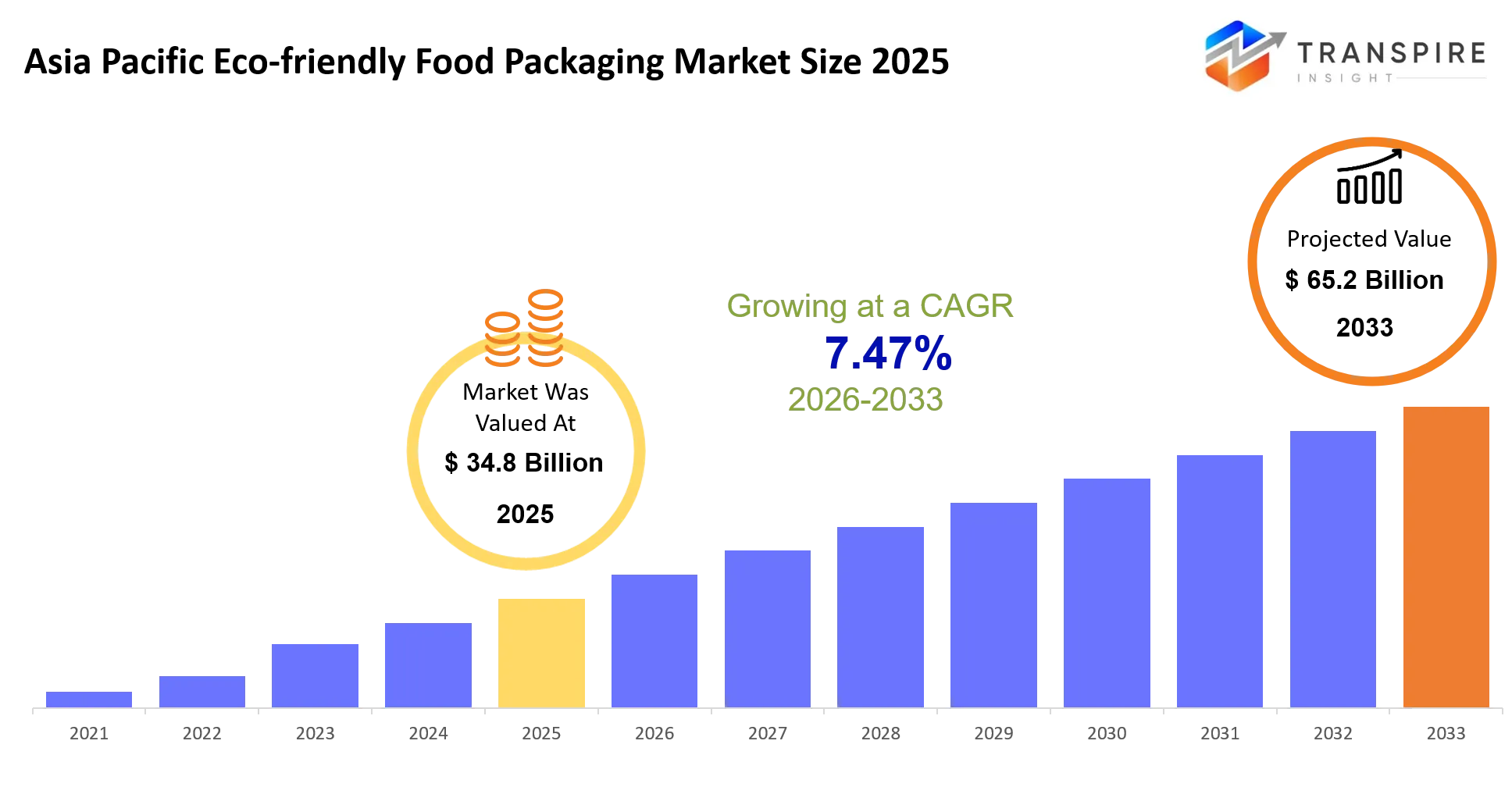
The Asia Pacific Eco-friendly Food Packaging Market was valued at USD 34.8 Billion in 2025. It is forecast to reach USD 65.2 Billion by 2033. That is a CAGR of 7.47% over the period.
The Asia Pacific sustainable food packaging market provides solutions to food manufacturers, retailers, and food delivery services attempting to manage two difficult and opposing problems: ensuring food quality while shifting away from the single-use plastics which are a source of long-term waste and regulatory liability. These single-use plastics are being replaced by paper, molded fiber, biodegradable and compostable films and others in the contexts of food service, grocery retail, and manufactured foods.
This structural shift in the Asia Pacific market-from niche corporate sustainability initiatives to regulatory driven procurement-has taken place over the last 5 years. Regulations aimed at single-use plastics have now driven sourcing and operational responsibility away from the marketing department and toward the corporate supply chain. COVID-19 was another factor, illustrating the fragility of the global supply chain, and encouraging investment in packaging production capabilities within Asia Pacific. With expanding networks for food delivery and an increasingly strong regulatory stance on environmental issues, packaging producers that are capable of optimizing cost and performance, and creating value across circular economic systems are able to win significant contracts and develop profitable revenue sources.
Key Market Insights
- Key factors like stricter plastic regulation, and increasing food delivery networks across developed economies in APAC drive the Asia Pacific Eco-friendly Food Packaging Market.
- Major recyclable paper, molded fiber and bio-based polymers manufacturers aim to increase their market share in this sector for long term competition.
- East Asia holds major market share in the regional market, over 45% share in 2025 due to higher manufacturing capabilities.
- The fastest developing market from Asia Pacific through 2032 is Southeast Asia driven by retail evolution and government sustainability goals.
- Paper and paperboard products hold the largest share, above 40% in the product segment due to high recycle rates and available supply chain.
- Biodegradable plastics have the second largest share as food brands are in search of light weight materials with better environment profiles.
- The compostable packaging category will grow the fastest through 2032 due to reduction in prices, as the technology advances will enhance wider commercial utilization.
- Fresh food packaging and fast food packaging currently account for nearly 35% market revenue with support from supermarkets and quick service restaurants.
- The E-commerce food delivery sector, as an application, shows rapid growth due to increasing utilization of sustainable packaging material by online food service providers in order to comply with stringent governmental regulations.
- The food service sector continues to lead the end-use industry segment with over 38% market share in the entire Asia Pacific sustainable packaging market.
What are the Key Drivers, Restraints, and Opportunities in the Asia Pacific Eco-friendly Food Packaging Market?
The largest driver fueling market growth is government regulation of single-use plastics. China, India, South Korea and Australia among others have implemented gradual bans, recycling requirements and Extended Producer Responsibility policies that directly impact packaging purchasing decisions. This has driven food producers, restaurants and retailers to reform packaging assortments and to enter into long-term agreements with material suppliers to guarantee supply of recyclable and compostable products. As sustainable packaging becomes a "must-do" rather than a marketing campaign, packaging providers with robust, cost-effective and scalable supply solutions have gained higher revenue and a broader regional reach.
The cost and performance differential between green and conventional packaging materials represent the largest structural impediment to growth. Specialised production capacity will be necessary to produce bio-polymers and compostable plastics, while recycling and industrial composting infrastructure vary significantly across Asian Pacific markets. A lack of relevant infrastructure hinders uptake of these materials particularly for small and medium sized food producers, ultimately capping revenue potential of mass market adoption.
A large, long-term opportunity can be captured through fiber-based technologies. Investments in molded fiber trays, hydrophobic paper-coatings and agricultural waste-based packaging solutions are ramping up across Southeast Asia. As manufacturing capacity expands and performance characteristics increase, these will begin to open-up market access in the cold storage, ready to eat food and food delivery segments.
What Has the Impact of Artificial Intelligence Been on the Asia Pacific Eco-friendly Food Packaging Market?
The development and adoption of Artificial Intelligence have profoundly reshaped the Asia Pacific green food packaging market in terms of manufacturing efficiency, material selection, and quality management. More and more food packaging companies are installing vision systems that utilize AI for inspection of paper-based food packaging, compostable films, molded pulp products, etc. Real-time automated inspection and quality control of product defects can reduce the waste of packaging materials, improve efficiency, and maintain consistency at a massive manufacturing plant.
Machine learning (ML) helps improve material formulation and predict equipment breakdown before the manufacturing process is interrupted. ML algorithms recommend to modify processing parameters based on inputs regarding temperature, moisture and production rate to produce stronger packaging material with reduced use of raw materials. Predictive maintenance of the production lines increases uptime and prolongs the life of equipment in addition to helping cut operating expenses. Advanced data analytics and digital twins enable better management of supply chain planning, forecast raw material availability and optimize warehouse stock levels. Nevertheless, High upfront investment in AI systems, fragmented production networks, lack of historical data on newer biodegradable materials pose significant adoption challenge for small-and medium-sized packaging producers across developing Asia Pacific economies.
Key Market Trends
- From 2020 onwards, China, India, and Australia have increased regulations regarding single-use plastic items, making the supply of packaging turn towards recyclable and compostable alternatives.
- To satisfy the growing concerns of regulators and food service chains for low carbon footprint packaging waste, food delivery companies have shifted from cheap plastic containers to fibre based packaging.
- Since 2021, paper based and molded fibre packaging have emerged as highly popular options with packaging manufacturers enhancing the barrier properties and moisture resistance of the paper for ready-to-eat foods.
- After two years of extensive supply chain disruption due to the COVID-19 pandemic, purchasing firms began relying on local procurement of raw materials to mitigate risks associated with resin import.
- Global packaging players such as Amcor, Huhtamaki, and Mondi are increasing their production capacities in Asia Pacific from 2022 to 2025 to meet increasing demand and cut down lead times.
- While cost was the top parameter five years ago, purchasing firms today evaluate packaging from a viewpoint of its recyclability certification and total emissions throughout its lifecycle.
- Agricultural by-products have become promising sources for feedstocks with both sugarcane bagasse and rice husk replacing virgin plastics in food packaging applications.
- With increased use of AI-based quality inspection in the manufacturing lines, material waste in sustainable packaging has decreased considerably owing to the implementation of smart manufacturing processes.
- The push by local governments for extended producer responsibility programs encouraged packaging firms to invest in the infrastructure required to support circular packaging and recycling.
- Strong partnerships between food producers and packaging vendors have allowed for a faster uptake and commercialization of compostable films and water-resistant papers for their products.
Asia Pacific Eco-friendly Food Packaging Market Segmentation
By Material:
Renewable resource, ease of recyclability: These two factors make paper the leading material choice in various food packaging applications. Enhanced performance from barrier coatings, as well as from increased durability, has opened new windows in usage for fresh foods, bakery goods and meals consumed while traveling, across Asia Pacific nations.
Bioplastics: An alternative to petroleum based plastics, that fulfills the desire for waste reduction, bagasse & bamboo, renewable, and strength together with compostable features, recycled plastic: It still holds key value as it contributes towards virgin plastic reduction and packaging performance is not compromised.
Compostable: Growing importance in terms of acceptance as food companies seek solutions that decompose naturally under correct conditions. Plant fibers and hybrid materials, other materials: In an effort to enhance product shelf-life and offer reduced environmental impact, also considering the evolving legislation of packaging in the Asia Pacific regions.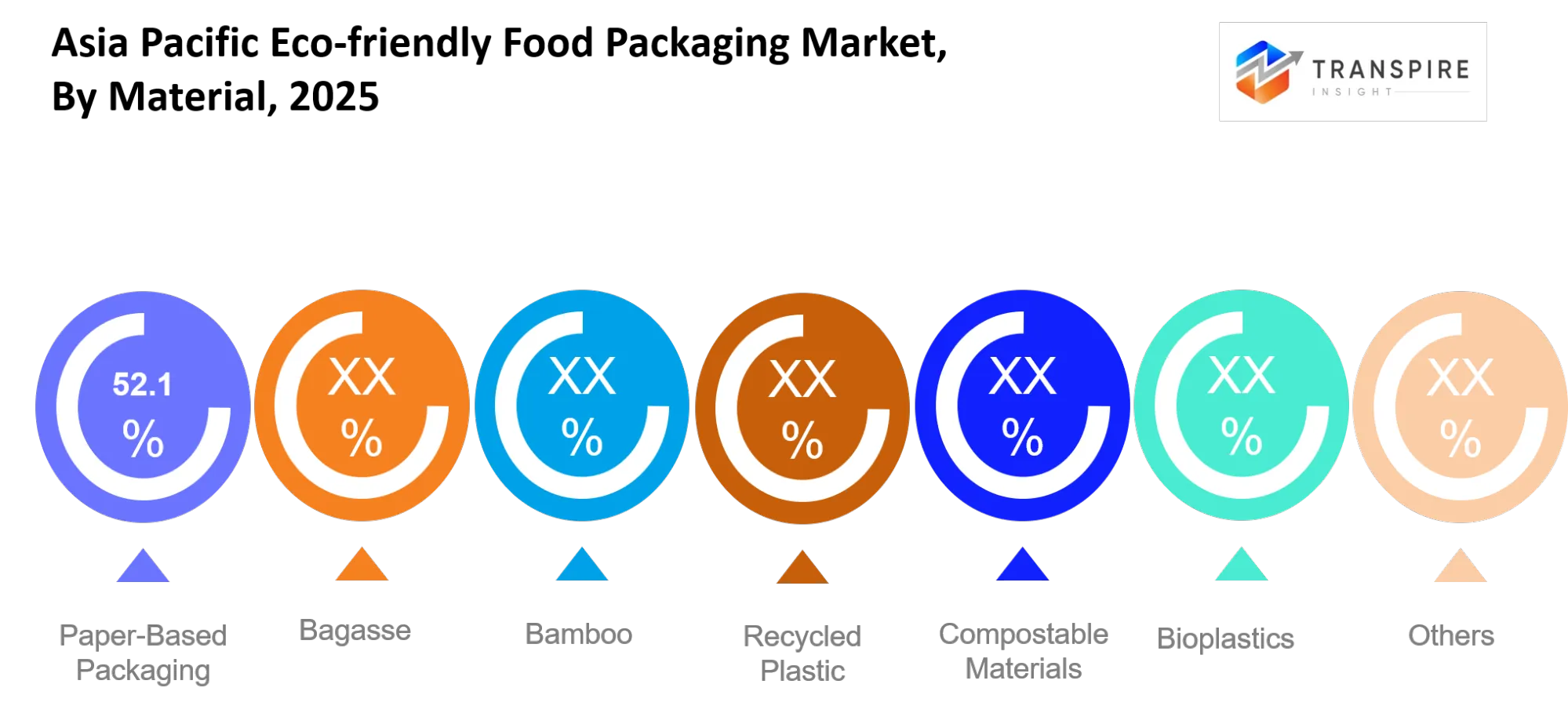
By Product Type:
Containers provide an important product category, where their main role is to maintain and preserve the quality of food and preserve freshness while in transport and storage. Trays are common for the preservation of fruits, vegetables, meat products, ready-to-eat and pre-prepared foods where the trays ensure convenient access to product.
Cups and wraps continue to find food and drink, dairy and fast-food packaging applications where they deliver lightness and easy use in a lightweight application. Pouches remain popular for the food industry due to the reduction in materials and transport costs associated with flexible packaging, whilst ensuring integrity and excellent sealing capabilities.
Boxes, alongside a vast array of other formats, are essential in serving a diverse variety of foods from luxury confectionery through to ready meals. Design evolution aims to improve durability, recyclability and ease of use for the consumer whilst meeting the business and environmental objectives of manufacturers.
By Application:
Demand from fresh food packaging contributes heavily to eco-friendly packaging demand as products such as fruits, vegetables and meat require protection from contamination and moisture. Eco-friendly packaging keeps foods at quality by using more sustainable materials, saving on waste throughout the chain.
Bakery and dairy packaging move towards the use of compostable and recyclable packaging, aiming to optimize display and meet targets for waste reduction. Packaging for drinks continues to focus on paper-based and bio-based packaging to address the desire by manufacturers to minimize use of plastic in bottles, cups and cartons.
A growing demand from convenience/ready meals also influences the use of eco-friendly packaging. Convenience/ready meals packaging demands performance based materials with resistance to heat and durability. Other application areas include confectionery, frozen foods and specialty products, where both performance and sustainability factors are crucial.
By End User:
Food service companies will be a dominant end-user industry due to growth in sustainable packaging adoption from restaurants, cafes and takeaways under both government regulation and increased consumer preference. This demand will favor recyclable, compostable and economical solutions.
Retail will make sustainable packaging investment to bolster brand images and minimize environmental impact at supermarket and convenience store level. Food manufacturers will grow adoption to comply with their corporate sustainability goals and retailer mandates.
Other end-users such as catering companies and niche food producers will rely on this sustainable packaging demand to find workable, sustainable solutions for their packaging needs. Continued investment in material development and manufacturing capability will drive adoption through varied end user industries in Asia Pacific.
What are the Key Use Cases Driving the Asia Pacific Eco-friendly Food Packaging Market?
Fresh food packaging will continue to be the biggest segment within the Asia Pacific Eco-friendly Food Packaging Market, due to supermarkets, grocers and food companies seeking effective packaging that can maintain product quality but also fulfill the desire to reduce the amount of plastic packaging. Paper-based trays, compostable wrappers and molded fiber packaging are more preferred for supermarkets as it meets the market's requirements, such as performance, recyclability, cost efficiency and safety.
Rapid growth for food delivery and bakery is due to rapid adoption of conventional plastic replacement by the restaurant chains and quick service restaurants (QSRs). The replacement includes compostable cups, boxes, wrappers and pouches. Other emerging segments are dairy & beverage which use the latest recyclable packaging formats to adhere to regional regulations and commitments.
Future segments are for frozen foods and gourmet ready meals using biodegradable barrier coatings and bio-based raw materials for extending product life. Additionally, reusable packaging systems and smart compostable packaging materials are becoming a high area of investment.
|
Report Metrics |
Details |
|
Market size value in 2025 |
USD 34.8 Billion |
|
Market size value in 2026 |
USD 37.5 Billion |
|
Revenue forecast in 2033 |
USD 65.2 Billion |
|
Growth rate |
CAGR of 7.47% from 2026 to 2033 |
|
Base year |
2025 |
|
Historical data |
2021 - 2024 |
|
Forecast period |
2026 - 2033 |
|
Report coverage |
Revenue forecast, competitive landscape, growth factors, and trends |
|
Regional scope |
Asia Pacific (India, China, Japan, Australia, South Korea, Rest of Asia Pacific) |
|
Key company profiled |
Amcor, Huhtamaki, Tetra Pak, Mondi, Stora Enso, DS Smith, UPM, Smurfit Westrock, Vegware, Genpak, Sealed Air, BioPak, Berry Global, Sonoco, Pactiv |
|
Customization scope |
Free report customization (country, regional & segment scope). Avail customized purchase options to meet your exact research needs. |
|
Report Segmentation |
By Material (Paper, Bioplastics, Bagasse, Bamboo, Recycled Plastic, Compostable Materials, Others); By Product Type (Containers, Trays, Cups, Wraps, Pouches, Boxes, Others); By Application (Fresh Food, Bakery, Dairy, Beverages, Ready Meals, Others); By End User (Foodservice, Retail, Food Manufacturers, Others) |
Which Regions are Driving the Asia Pacific Eco-friendly Food Packaging Market Growth?
East Asia has continued to be the leading market for the Asia Pacific Eco-friendly Food Packaging Market. Combining a substantial manufacturing capability with stringent government regulations regarding the environment China, Japan and South Korea continue to pave the way. China has intensified its regulations concerning single-use plastic consumption while Japan continues to increase the demand for recyclable products in a growing circular economy, while large paper mills, modern converters and vertically integrated supply chains provide for rapid scale production. As such, product innovation and reliable supplies to the food producers are assured.
South Asia, although the second largest regional supplier, has shown different dynamics from East Asia, relying not so much on manufacturing as on rapidly growing Indian retail, burgeoning cities, an increase in the processed food segment, combined with government regulations concerning the decrease of waste and domestic production. This environment of sustained expenditure from the food producers and restaurant chains has guaranteed consistent growth and sustained investment.
Southeast Asia, on the other hand, is the fastest growing market. Increased regulation concerning plastic waste and investment in modern sustainable production processes can be observed throughout Indonesia, Thailand, Vietnam and Malaysia. Food producers and food delivery services have begun to rapidly adopt compostable and fiber based products, to meet local demand and export requirements and local governments are investing in the production of recyclables and biodegradable packaging materials and recycling networks. Between 2026-2033, this region is therefore bound to offer numerous opportunities to packaging suppliers and investors.
Who are the Key Players in the Asia Pacific Eco-friendly Food Packaging Market and How Do They Compete?
The Asia Pacific Eco-friendly Food Packaging Market is somewhat fragmented. This segment comprises global packaging companies along with local manufacturers and niche material producers. The level of competition within this sector is defined by technological innovation and the scale of operations. Firms compete for share in this market segment through the development of biodegradable and recyclable food packaging materials; advancements in their barrier properties and expansion of their production capacities within close proximity to key food processing regions. New firms continue to enter this market; established manufacturers maintain their positions through their long-term customer relations and an integrated supply chain.
Amcor- A prominent global packaging company, Amcor is focused on material innovation and heavily invested in lightweight recyclable packaging alternatives that aim at cutting down plastic use while maintaining product performance. Their innovation in terms of barrier performance and continued expansion of their Asian production capacities differentiate it in this market. Huhtamaki-specializes in fiber-based packaging and compostable food service products and possesses a competitive edge over restaurant and takeaway businesses seeking to switch from plastics.
Mondi- competes in the Eco-friendly Food Packaging Market on the grounds of sustainably paper packaging materials, and has a vertical supply integration which allows for better raw material procurement processes and ultimately a control over the market share. Tetra Pak- A leading provider of renewable and recyclable food packaging solutions, Tetra Pak's efforts for sustainable food and beverage packaging contribute significantly to this segment. Sealed Air- the focus of this global supplier is on digital manufacturing and developing of protective packaging solutions; which allow its customers to improve efficiency while minimizing waste in the production chain throughout the region.
Company List
- Amcor
- Huhtamaki
- Tetra Pak
- Mondi
- Stora Enso
- DS Smith
- UPM
- Smurfit Westrock
- Vegware
- Genpak
- Sealed Air
- BioPak
- Berry Global
- Sonoco
- Pactiv
Recent Development News
In March 2026, Amcor invested in a new production line, laboratory, and warehouse expansion at its Lugo facility to increase recycle-ready packaging output. The investment strengthens supply capacity for high-barrier recyclable films used across food packaging applications and supports the shift toward circular packaging systems. Sourcehttps://www.amcor.com/
In December 2025, Tetra Pak launched the world's first paper-based barrier for juice packaging in partnership with García Carrión. The technology reduces reliance on aluminum layers and fossil-based materials, advancing recyclable carton packaging and accelerating sustainable packaging adoption across food and beverage markets. Sourcehttps://www.tetrapak.com/
What Strategic Insights Define the Future of the Asia Pacific Eco-friendly Food Packaging Market?
The Asia Pacific Eco-friendly Food Packaging market is increasingly moving toward an environmentally conscious, performance-driven system of packaging, with solely meeting environmental requirements no longer being enough to secure market leadership. For the next 5–7 years, competitors will need to excel in achieving a combination of recyclability, barrier properties, and cost-effectiveness at scale. A stricter regulatory environment, corporate carbon neutrality goals, and increasing consumer demand for low-waste alternatives are key drivers to this trend.
A less obvious threat is the concentration of raw material inputs. Heavy reliance on paper pulp, agricultural fiber, and bio-feedstocks could leave manufacturers subject to supply chain fluctuations, as the climate crisis impacts yields in farming and forest production. Firms with weak sourcing diversification plans are at risk of increasing cost pressures and weakening profit margins.
A developing opportunity is in enabling and scaling up sophisticated fiber-based packaging with waterproof and oxygen-barrier coatings across Southeast Asia. Market participants need to invest early in regional supply chains and materials R&D partnerships because domestic manufacturing capabilities and unique technologies will drive leadership in the long term.
Asia Pacific Eco-friendly Food Packaging Market Report Segmentation
By Material
- Paper
- Bioplastics
- Bagasse
- Bamboo
- Recycled Plastic
- Compostable Materials
By Product Type
- Containers
- Trays
- Cups
- Wraps
- Pouches
- Boxes
By Application
- Fresh Food
- Bakery
- Dairy
- Beverages
- Ready Meals
By End User
- Foodservice
- Retail
- Food Manufacturers
Frequently Asked Questions
Find quick answers to common questions.
The Asia Pacific Eco-friendly Food Packaging Market size is USD 65.2 Billion in 2033.
Key Segments for the Asia Pacific Eco-friendly Food Packaging Market are By Material (Paper, Bioplastics, Bagasse, Bamboo, Recycled Plastic, Compostable Materials, Others); By Product Type (Containers, Trays, Cups, Wraps, Pouches, Boxes, Others); By Application (Fresh Food, Bakery, Dairy, Beverages, Ready Meals, Others); By End User (Foodservice, Retail, Food Manufacturers, Others).
Major Asia Pacific Eco-friendly Food Packaging Market Players are Amcor, Huhtamaki, Tetra Pak, Mondi, Stora Enso, DS Smith, UPM, Smurfit Westrock, Vegware, Genpak, Sealed Air, BioPak, Berry Global, Sonoco, Pactiv.
The Current Asia Pacific Eco-friendly Food Packaging Market size is USD 34.8 Billion in 2025.
The Asia Pacific Eco-friendly Food Packaging Market CAGR is 7.47% from 2026 to 2033.
- Amcor
- Huhtamaki
- Tetra Pak
- Mondi
- Stora Enso
- DS Smith
- UPM
- Smurfit Westrock
- Vegware
- Genpak
- Sealed Air
- BioPak
- Berry Global
- Sonoco
- Pactiv
About the Authors

Kartik bhong
I am Kartik Bhong, a Senior Research Analyst at Transpire Insight, specializing in the Packaging, Manufacturing, and Construction industry. My work focuses on analyzing market trends, emerging technologies, industry regulations, and competitive landscapes to deliver accurate, data-driven insights. I am passionate about transforming complex industry information into clear, practical content that helps businesses, professionals, and decision-makers stay informed and make confident strategic decisions. Through continuous research and a strong commitment to accuracy, I strive to create reliable, well-researched content that reflects the latest developments across these dynamic industries and supports the vision of Transpire Insight in delivering valuable market intelligence.

Chakradhar Khansole
Chakradhar serves as the Research Director at Transpire Insight, bringing over 8 years of experience in technology, innovation, and strategic market intelligence. He specializes in transforming complex market data into actionable business insights that enable organizations to make informed, growth-oriented decisions. Recognized for his strategic vision and analytical expertise, Chakradhar leads high-impact research initiatives, delivering comprehensive market assessments, competitive intelligence, and forward-looking industry analysis.
Recently Published Reports
-
Apr 2026
Pharmaceutical Cold Chain Packaging Market
Pharmaceutical Cold Chain Packaging Market By Material (Plastic,(Polyethylene (PE), Polypropylene (PP), Polyethylene Terephthalate (PET), Expanded Polystyrene (EPS), Polyurethane (PU),Others), Paper, Metal, Others), By Product (Small Boxes, Pallets, Large Sized Pallet Containers, Others), By End Use (Biopharmaceutical Companies, Clinical Research Organizations, Hospitals, Research Institutes, Logistics and Distribution Companies, Others)”, By Industry Analysis, Size, Share, Growth, Trends, and Forecasts 2026-2033
-
Apr 2026
Active & Intelligent Packaging Market
Active & Intelligent Packaging Market By Type (Active Packaging, Smart Packaging), By Material (Polymer-Based, Paper & Board-Based, Metal-Based, Glass-Based), By Technology (Time-Temperature Indicators, Freshness Indicators, RFID, Antimicrobial Packaging, Modified Atmosphere Packaging), By Application (Food & Beverages, Pharmaceutical, Cosmetics & Personal Care, Electronics & Consumer Goods, Others), By Industry Analysis, Size, Share, Growth, Trends, and Forecasts 2026-2033
-
Apr 2026
Biodegradable Cut Flower Packaging Market
Biodegradable Cut Flower Packaging Market By Material Type (Paper & Paperboard, Biodegradable Plastics, Natural Fibers, Molded Pulp, Others), By Product Type (Sleeves, Wraps, Boxes & Cartons, Bags & Pouches, Inserts & Holders), By Application (Roses, Carnations, Tulips, Chrysanthemums, Mixed Flowers, Others) and By Distribution Channel (Direct Sales, Distributors & Wholesalers, Online Channels), By Industry Analysis, Size, Share, Growth, Trends, and Forecasts 2026-2033
-
May 2026
Pharmaceutical Packaging Market
Pharmaceutical Packaging Market By Material Type (Plastic, Glass, Metal, Paper & Paperboard, Others), By Packaging Type (Bottles, Blister Packs, Vials, Ampoules, Pouches & Sachets, Others) and By End User (Hospitals & Clinics, Retail Pharmacies, Online Pharmacies, Pharmaceutical Manufacturers), By Industry Analysis, Size, Share, Growth, Trends, and Forecasts 2026-2033