
South Korea Eco-Friendly Bitumen Market Size & Forecast:
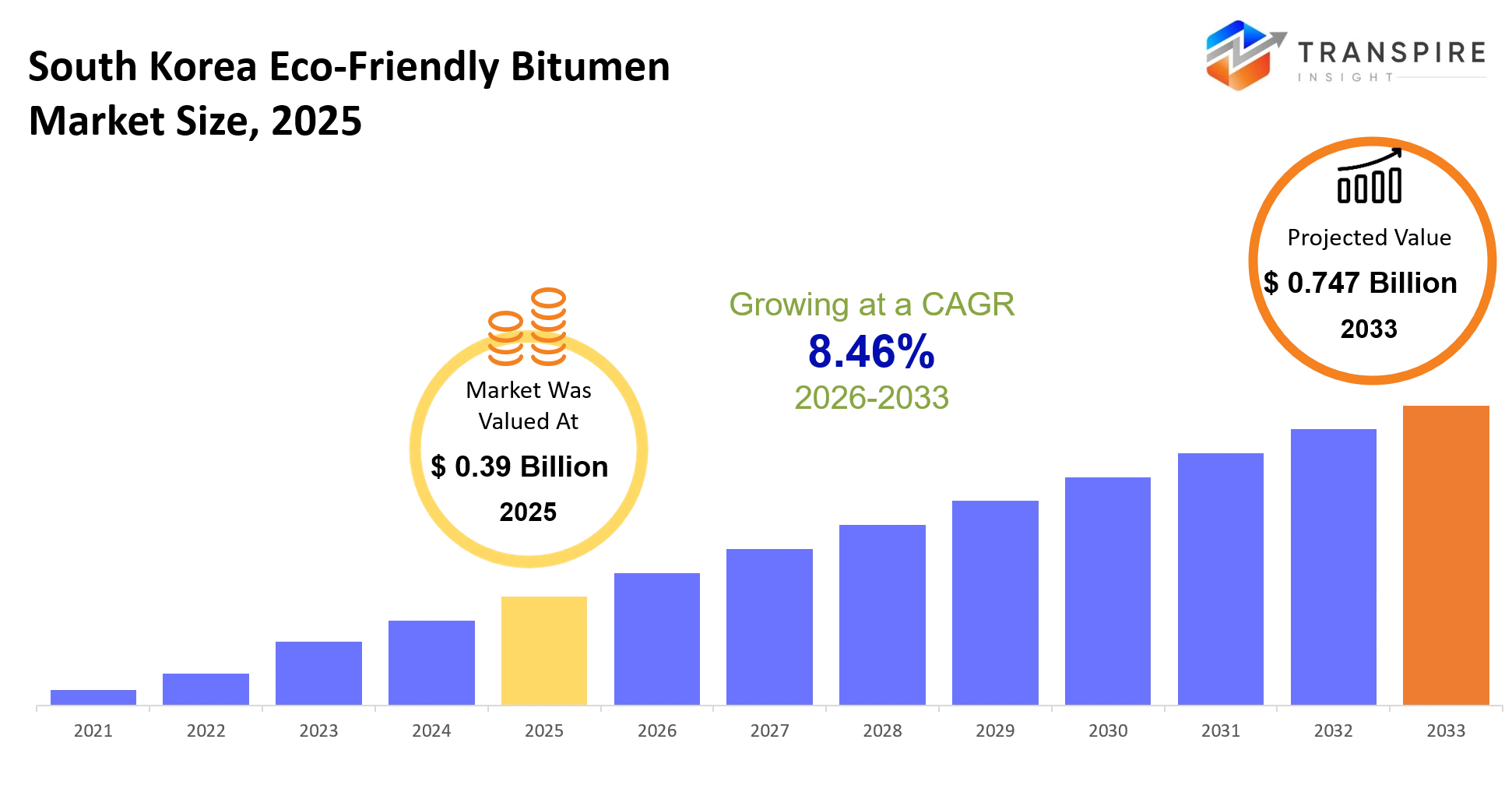
- South Korea Eco-Friendly Bitumen Market Size 2025: USD 0.39 Billion
- South Korea Eco-Friendly Bitumen Market Size 2033: USD 0.747 Billion
- South Korea Eco-Friendly Bitumen Market CAGR: 8.46%
- South Korea Eco-Friendly Bitumen Market Segments:By Type (Bio-Based Bitumen, Polymer Modified Bitumen, Recycled Bitumen, Others); By Application (Road Construction, Roofing, Waterproofing, Others); By End User (Infrastructure, Commercial, Residential, Others)
To learn more about this report,  Download Free Sample Report
South Korea Eco-Friendly Bitumen Market Summary
The South Korea Eco-Friendly Bitumen Market was valued at USD 0.39 billion in 2025. It is forecast to reach USD 0.747 billion by 2033. That is a CAGR of 8.46% over the period.
The Eco-Friendly Bitumen Market in South Korea plays an important role in reducing the environmental impacts of road construction and maintenance while increasing pavement durability and lifespan. Eco-friendly bitumen products provide contractors with new opportunities to conserve energy, reduce the carbon footprint of asphalt production, and utilize recycled materials within their infrastructure projects resulting in longer-lasting roads that still meet performance and quality standards of pavements.
There has been a transition away from traditional petroleum-based paving materials to producing warm-mix-asphalt technologies and to using bio-based and recycled asphalt paving products over the last three to five years. The introduction of stricter carbon reduction goals, an increasing number of sustainable infrastructure policies, and a requirement for both contractors and public agencies to employ lower-emission construction practices have all greatly accelerated these changes in construction practices. As the use of environmental performance measures continues to rise during procurement processes, the use of eco-friendly bitumen in both the rehabilitation of existing roads as well as the construction of new infrastructure projects continues to increase.
This change is producing revenue growth because contractors are able to comply with sustainability criteria while lowering both fuel and manufacturing expenditures. Consequently, the use of eco-friendly bitumen is moving away from being a specialty material for construction purposes to becoming a preferred choice in infrastructure investment programs, resulting in greater commercial opportunities for suppliers of materials and technology.
Key Market Insights
- With an estimated 40% of the South Korea Eco-Friendly Bitumen market in 2025, Seoul's metropolitan area leads the country in market share thanks to large investments in transportation infrastructure.
- The southern industrial sectors will be the most rapidly expanding segment by 2026–2033 due to the many highway improvements and procurement policies for sustainable construction.
- Approximately 45% of the product market share consists of warm-mix asphalt products, which are produced at low temperatures and consume less fuel.
- Recycled asphalt pavement solutions continue to have the second largest market share, primarily through cost savings and circular economy initiatives related to road rehabilitation projects.
- Contractors will desire alternatives for bio-based bitumen that allow them to reach long-term carbon reduction goals between now and 2033. As a result, this segment will be the fastest growing in the construction industry.
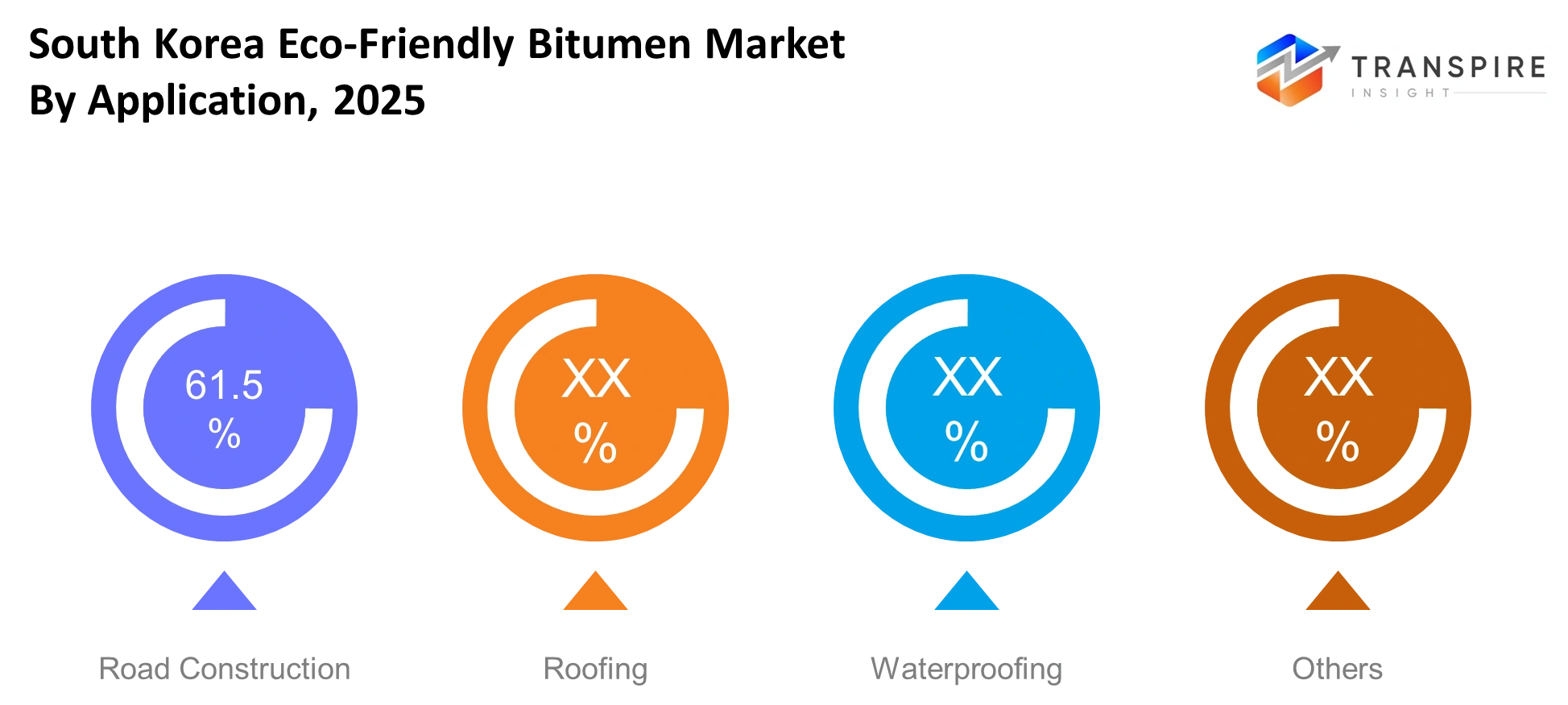
- Road construction will remain the largest application area, accounting for about 60% of total demand, because there are continuous highway modernization programs.
- Road maintenance and resurfacing will be the fastest growing segment as recycled materials improve life cycle cost efficiency.
- Both government agencies and public infrastructure contractors comprise the largest end-user segment, accounting for over 55% of total consumption.
- Private infrastructure developers are expected to be the fastest growing end-user segment as more and more green building standards are being applied to material selections during their construction projects.
- Companies like SK Energy, GS Caltex, S-OIL, ExxonMobil, and Shell will gain competitive advantage through innovative, recycled-bitumen applications, strategic alliances, and low-emission paving equipment.
What are the Key Drivers, Restraints, and Opportunities in the South Korea Eco-Friendly Bitumen Market?
In 2023, the most significant influence on the demand for environmentally friendly bitumen in South Korea will be the implementation of carbon reduction criteria in government-funded building projects. Furthermore, a growing number of transportation agencies and construction authorities are beginning to measure the emissions produced by their projects throughout the life cycle of a project, rather than simply considering the up-front cost of the materials. As such, many contractors are using more warm-mix asphalt (asphalt produced at lower temperatures) and recycled asphalt paving (RAP) materials, which reduce the amount of fuel used during both production and installation. With more contractors meeting their sustainability goals through the use of these types of materials, many contractors are also benefiting from reduced operations costs, resulting in an increased use of these products on both new construction projects and reconstruction of existing highways. As a result of the increased use of environmentally safe bitumen throughout the construction industry, there is now ample opportunity for manufacturers and technology providers who manufacture such products to generate new revenue streams.
The primary constraint to the growth of the eco-friendly bitumen market is the shortage of specialized production capacity for large-scale manufacture of eco-friendly bitumen. Many asphalt plants are designed for traditional bitumen production, which requires large capital expansions to efficiently process recycled materials or advanced binders. The challenge is structurally related because the turnover cycle of the infrastructure is very long and the decisions regarding capital expenditures are based on pipeline construction projects that are publicly funded. As a result, the penetration of eco-friendly bitumen into the marketplace is much slower than the capacity; therefore, it will take longer to commercialize eco-friendly bitumen and generate revenue in certain regions of the country.
In the near future, there is immense potential for the large volume production of biobased binders from renewable feedstocks in the United States. By proving durability through studies and demonstration projects, these types of products will see demand and acceptance as environmentally safe alternatives to traditional petroleum-derived binders in public works projects. With a trend toward funding of infrastructure projects utilizing environmentally friendly products, there will be tremendous potential for companies who bring environmentally friendly biobased binders to market.
What Has the Impact of Artificial Intelligence Been on the South Korea Eco-Friendly Bitumen Market?
Using innovative digital technologies and artificial intelligence (AI), the green bitumen industry has experienced significant changes in the way its products are manufactured, the efficiency with which they're produced and monitored for quality and the length to which infrastructure can be maintained using the latest methods and best practices available today. AI-enabled control systems monitor the temperature, materials, and energy consumption associated with warm-mix asphalt production in real-time at both warm-mix asphalt plants and warm-mix asphalt facilities, allowing operators to produce consistently high-quality products while using less fuel and producing less waste.
In addition to monitoring production processes, digital monitoring tools can be used to verify compliance with local and national regulatory agencies by recording emissions, operational performance, and other metrics during production.
Predictive maintenance of asphalt plants, storage facilities, and vehicles is also becoming more common using machine learning models. Machine learning models allow operators to analyze the vibration and temperature of their equipment as well as past maintenance records to detect possible failures before they impact production. Advanced forecasting tools can also help asphalt manufacturers forecast energy consumption, optimize material composition, and forecast carbon emissions based on various production scenarios, improving plant productivity, reducing the costs associated with maintenance, and increasing resource use efficiency for large-scale infrastructure projects.
Despite the benefits of AI and advanced digital technologies, the costs associated with integration into existing production processes are frequently a deterrent to adoption. Many facilities are still utilizing outdated equipment that is not equipped with digital connectivity, making the integration of AI more difficult. Additionally, the lack of standardization of data creates difficulties in providing accurate AI models, prolonging the time required for wider adoption of AI systems.
Key Market Trends
- Incorporating criteria for carbon performance into construction tenders for public infrastructure has enabled the transition to lower emission asphalt on more roadways beginning in 2021.
- The broad adoption of warm mix asphalt by contractors starting in 2022 provides a reduction in fuel used in production of 20-40 degrees Celsius (e.g., for construction) and results in lower temperatures at which warm mix asphalt is produced.
- The use of recycled asphalt pavement (RAP) in rehabilitation efforts has greatly increased among contractors since 2021, allowing contractors to be less reliant on virgin materials and reduce the total lifecycle costs associated with their projects.
- Beginning in 2023, infrastructure agencies are increasingly prioritizing evaluation based on lifecycle emissions rather than up-front costs for assessing proposed major highway projects.
- As SK Energy and GS Caltex improve their sustainability specifications, they are increasing their investment in advanced bitumen formulations.
- Digital monitoring systems have been adopted more widely than before 2022 as a means for asphalt producers to utilize energy more efficiently and provide a more consistent, high-quality product.
- Asphalt manufacturers' research on bio-based binders has increased since 2023 as a way to find alternatives to petroleum-based materials to meet long-term decarbonization goals.
- Construction companies increasingly seek suppliers who provide evidence of environmentally responsible manufacturing processes and recycled material usage through their procurement strategies.
- Road modernization programs in specific regions have expanded the use of environmentally friendly pavement technologies and created new business opportunities in addition to traditional metropolitan roadway corridors.
- The importance of competitive differences is changing from pricing alone to technologic effectiveness, emissions reduction, and durability of pavement over time.
South Korea Eco-Friendly Bitumen Market Segmentation
By Type
Bio-based asphalt options offer you a chance to reduce your dependency on petroleum-derived products. Polymer modified asphalt still maintains a considerable market share because it provides excellent durability, flexibility, and ability to withstand the high weight of trucks driving over them. The use of recycled asphalt continues to grow because more and more road agencies are now using reclaimed asphalt pavement in their rehabilitation projects. Manufacturers of bituminous materials are also working diligently to develop state-of-the-art formulations that provide an acceptable compromise between environmental performance and providing long-term pavement sustainability. As more emphasis is placed upon lifecycle cost efficiency, more affordable, sustainable types of binder technology will become available for use in construction projects.
By Application
The primary use of bitumen products is for road construction, because there is always an enormous quantity of paving materials needed for transportation infrastructure projects. With highway reconstruction projects and ongoing road rehabilitation programs still taking place, there continues to be an increasing demand for advanced bitumen products used for these projects and thus paving needs. There is an increasing demand for roofing projects to use an asphalt product because building owners want to achieve higher-quality materials that will last longer and provide better thermal properties. Additionally, the waterproofing industry is benefiting from advancements that improve the moisture and weather resistance of asphalt products. A wider variety of applications helps provide greater volume of purchase orders from both the infrastructure and building construction industries, leading to more market stability across both sectors.
To learn more about this report, Download Free Sample Report
By End-user
The vast majority of future consumption for bitumen will come from the infrastructure sector because of the current high level of funding for highway/road/bridge/public transportation infrastructure projects. Increased investment in infrastructure also generates increased sustainable procurement requirements for government-funded construction projects. Commercial end-use sectors are using newer and more advanced technologies to produce bitumen products such as those used in constructing buildings, logistics facilities, and large-scale development projects. Also, there is growing demand for bitumen products, such as those used in roofing and waterproofing, associated with the construction of residential buildings. Due to the fact that many end-use sectors are participating in the current trend toward the use of environmentally friendly products to construct buildings, it is expected that bitumen products will continue to be used at an accelerated rate for the foreseeable future.
What are the Key Use Cases Driving the South Korea Eco-Friendly Bitumen Market?
Bitumen will continue to be primarily used in the road construction industry; the large-scale expansion of highways, as well as urban areas upgrading their roads and the improvements made to public transportation infrastructure, have increased the demand for paving materials that emit fewer greenhouses gases when produced digitally and have greater lifecycle characteristics than traditional asphalt. Furthermore, there are strong federal government procurement requirements promoting the use of lower carbon-paving materials, provided that these materials meet the criteria established by the federal government for large construction infrastructure projects.
Commercial roofing and waterproofing applications are increasing in popularity within industrial buildings, logistics buildings and large commercial buildings. Construction companies are now utilizing improved formulations of bitumen in an attempt to improve the long-term durability, thermal resistance and maintenance of these applications. This has occurred because many jurisdictions have implemented more stringent building performance requirements and because the specifications for new sustainable projects have changed.
New market opportunities are being created by the development of bio-based paving materials and low-carbon smart infrastructure projects. Several pilot road programs have successfully utilized renewable feedstock-derived binders for constructing and maintaining roadways. Therefore, because of the increasing focus on carbon accounting and sustainable infrastructure investments, the accelerated adoption of these next-generation applications is expected to occur rapidly during the forecast period.
|
Report Metrics |
Details |
|
Market size value in 2025 |
USD 0.39 Billion |
|
Market size value in 2026 |
USD 0.423 Billion |
|
Revenue forecast in 2033 |
USD 0.747 Bn |
|
Growth rate |
CAGR of 8.46% from 2026 to 2033 |
|
Base year |
2025 |
|
Historical data |
2021 - 2024 |
|
Forecast period |
2026 - 2033 |
|
Report coverage |
Revenue forecast, competitive landscape, growth factors, and trends |
|
Regional scope |
South Korea |
|
Key company profiled |
Shell, TotalEnergies, ExxonMobil, BP, Nynas, Colas, Eurovia, CEMEX, Heidelberg Materials, Holcim, Sika, BASF, Kraton, Tarmac, Aggregate Industries |
|
Customization scope |
Free report customization (country, regional & segment scope). Avail customized purchase options to meet your exact research needs. |
|
Report Segmentation |
By Type (Bio-Based Bitumen, Polymer Modified Bitumen, Recycled Bitumen, Others); By Application (Road Construction, Roofing, Waterproofing, Others); By End User (Infrastructure, Commercial, Residential, Others) |
Which Regions are Driving the South Korea Eco-Friendly Bitumen Market Growth?
The South Korean Eco-Friendly Bitumen Market is primarily controlled by the Seoul Capital Area because of its abundance of transportation-related construction projects, public investment, and the adoption of environmentally-friendly procurement policies (those requiring purchase/installation of environmentally-friendly goods). As a result, there is a great deal of demand for sophisticated pavement materials that are lower in emissions due to large-scale road rehabilitation projects and urban mobility-related construction. In addition to all of this, there is also a mature base of contractors, suppliers of paving materials, engineering companies, and research institutions in the Capital Region that can easily support the implementation of advanced paving technologies. The Capital Region's strong alignment between infrastructure development initiatives and carbon reduction goals continues to support this position.
The Busan-Ulsan-Gyeongnam Region ranks as the second-largest contributor to South Korea's Ecologically-Conscious Bitumen Market; however, the growth patterns of the Busan-Ulsan-Gyeongnam Region do not mirror those of the Capital Region. Unlike the Capital Region, where urban redevelopment is the primary way in which construction activity is stimulated, the Busan-Ulsan-Gyeongnam Region benefits from stability in the industrial sector, a strong logistics infrastructure, and ongoing investment in the construction of transportation corridors to support and grow its manufacturing industry. As a result of this, long-term infrastructure planning is creating predictable project pipelines that allow contractors to build-in sustainable paving technologies over long time frames. There is also a high level of ongoing capital funding and an established construction industry ecosystem, both of which support the Busan-Ulsan-Gyeongnam Region's ability to be a dependable source of revenue for the immediate future.
Emerging inland regions such as Daegu, Daejeon, and Chungcheong have also seen rapid growth, and as these areas modernize their existing infrastructure, the rate of growth will accelerate over the next several years. Increased governmental funding of regional connectivity, highway reconstruction projects, and smart transportation networks have led to
Who are the Key Players in the South Korea Eco-Friendly Bitumen Market and How Do They Compete?
The Market for Eco-Friendly Bitumen in South Korea is Concentrated on Several Large Suppliers Which are Supported by Refineries, in Terms of Market Share and Production Capacity; they Dominate the Market With Respect to Distribution Networks. Competition is Transitioning From Traditional Consumer Pricing to Performance-Based Evaluations. Contractors are Now Analyzing Reductions in Their Carbon Footprint and The Number of Recycled Materials That Will Be Used and Overall Lifecycle Cost to Evaluate Suppliers. Many Incumbents Have Maintained Their Market Share By Their Relationships with The Infrastructure and Technical Support Provided To Contractors. Recipients Have Found Themselves Able to Compete Against A Few Large Suppliers Due to Their Focus on Niche Formulations Such as Bio-Based Binders and Recycled Asphalt Materials. In Addition to Geographic Proximities To Major Construction Corridors and Access To Feedstock, Technology Is Becoming Increasingly Important To Position A Supplier As Premium.
The Most Significant Developments in The Current Marketplace Reported Upon Are The Technology Associated With The Production of Low-Emissions Bitumen and Digital/Automated Manufacturing Processes; As A Result, Both Companies Are Working Closely Together On Projects To Create Innovative Future Alternative Bituminous Solutions. SK Energy’s Strategy Is To Differentiate Its Operating Practices By Integrating Them With Their Refinery Operations and Enhancing Their Domestic Coverage; This Strategy Will Provide Additional Resources To Large Infrastructure Contractors. GS Caltex Is Differentiating Its Offerings By Developing Products That Extend The Life of The Pavement and Reduce Resources Needed To Maintain The Pavement Through Product Development. The Primary Focus Of All Manufacturers Is The Development Of Partnerships With Contractors Or Public Infrastructure Programs Which Utilize Advanced Performance-Based Specifications.
S-OIL’s Business Strategy Is To Continuously Build Its Brand Courtesy Of The High-Quality Binders They Utilize With A Focus on Transportation Infrastructure Projects That Emphasize Durability & Environmental Performance. ExxonMobil Is Differentiating Itself From Other Manufacturers By Its Ability To Use The Above-Highlighted Technology To Reduce Pollution.
Company List
- Shell
- TotalEnergies
- ExxonMobil
- BP
- Nynas
- Colas
- Eurovia
- CEMEX
- Heidelberg Materials
- Holcim
- Sika
- BASF
- Kraton
- Tarmac
- Aggregate Industries
Recent Development News
In October 2025, Nynas entered a partnership with Skanska and Swedavia to deploy Nypol RE, a recycled-content and biogenic-component binder, in a sustainable runway project at Stockholm Arlanda Airport. The project reduced carbon dioxide emissions by approximately 120 tonnes while meeting stringent infrastructure performance requirements, demonstrating the commercial viability of advanced eco-friendly bitumen technologies.https://www.nynas.com)
In July 2025, Holcim entered a partnership with Gautam ZEN UK, National Highways, and AtkinsRéalis for the first surface-course trial of XyloBIND bio-based asphalt technology on the Strategic Road Network. The project validated the use of renewable lignin-based binders as a partial replacement for conventional bitumen, supporting lower-carbon road construction and improved pavement durability.https://www.gautamzen.co.uk
In 2026, TotalEnergies expanded deployment of its Styrelf® ECO² warm-mix asphalt technology portfolio. The technology enables asphalt production and application at temperatures up to 40°C lower than conventional methods, helping contractors reduce energy consumption and emissions while accelerating adoption of sustainable paving practices.https://ecosolutions.totalenergies.com
What Strategic Insights Define the Future of the South Korea Eco-Friendly Bitumen Market?
The South Korea eco-friendly bitumen market is evolving into a performance-based sustainability approach in which material selection will rely more on lifecycle carbon reductions, utilization of recycled content, and long term pavement durability instead of just upfront procurement costs. This change is being driven by increased sustainability requirements for infrastructure projects, increased carbon accountability across all construction projects, and continual investments to modernize transportation. In the next 5 to 7 years, the use of eco-friendly bitumen will most likely change from being viewed as an alternative option for public infrastructure specifications to being viewed as a standard part of these specifications.
There is also a more hidden risk associated with the availability of appropriate recycled feedstocks and bio-based sources of raw materials. As the market for eco-friendly bitumen expands, there may be a heightened level of competition for these inputs, which can lead to increased production costs and create supply chain constraints that limit the scalability of the eco-friendly bitumen market. Another emerging opportunity is the commercialization of advanced bio-based binders supported by regional infrastructure modernization and more stringent carbon reporting systems. Even though the amount of time that bio-based binders have been deployed is limited, continued advancements in technology and coinciding policy frameworks will create a more favorable environment for continued use of bio-based binders.
To gain a stronger competitive advantage as procurement standards become increasingly performance based, all participants in the eco-friendly bitumen market should invest in recycling infrastructure, develop feedstock partnerships, and develop proprietary low-carbon formulations. Successful procurement of long-term raw materials while demonstrating a measurable reduction in their carbon footprint will allow participants in the eco-friendly bitumen market to achieve a stronger competitive advantage.
South Korea Eco-Friendly Bitumen Market Report Segmentation
-
By Type
- Bio-Based Bitumen
- Polymer Modified Bitumen
- Recycled Bitumen
- Others
-
By Application
- Road Construction
- Roofing
- Waterproofing
- Others
-
By End User
- Infrastructure
- Commercial
- Residential
- Others
Frequently Asked Questions
Find quick answers to common questions.
The expected South Korea Eco-Friendly Bitumen Market size for the market will be USD 0.747 Billion in 2033.
Key segments for the South Korea Eco-Friendly Bitumen Market are By Type (Bio-Based Bitumen, Polymer Modified Bitumen, Recycled Bitumen, Others); By Application (Road Construction, Roofing, Waterproofing, Others); By End User (Infrastructure, Commercial, Residential, Others) .
Major South Korea Eco-Friendly Bitumen Market players are Shell, TotalEnergies, ExxonMobil, BP, Nynas, Colas, Eurovia, CEMEX, Heidelberg Materials, Holcim, Sika, BASF, Kraton, Tarmac, Aggregate Industries.
The South Korea Eco-Friendly Bitumen Market size is USD 0.39 Billion in 2025.
The South Korea Eco-Friendly Bitumen Market CAGR is 8.46% from 2026 to 2033.
- Shell
- TotalEnergies
- ExxonMobil
- BP
- Nynas
- Colas
- Eurovia
- CEMEX
- Heidelberg Materials
- Holcim
- Sika
- BASF
- Kraton
- Tarmac
- Aggregate Industries
About the Authors

Avinash Kumar
I’m Avinash Kumar, a Senior Research Analyst at Transpire Insight, with expertise in the Electronics and Semiconductor and Energy & Power industry. My work focuses on analyzing emerging technologies, market trends, industry developments, and innovation across these sectors. I specialize in transforming complex technical and market insights into clear, research-backed content that helps professionals, businesses, and decision-makers stay informed. Through continuous industry research and data-driven analysis, I strive to deliver accurate, reliable, and practical perspectives on the latest advancements shaping the semiconductor and energy landscape.

Chakradhar Khansole
Chakradhar serves as the Research Director at Transpire Insight, bringing over 8 years of experience in technology, innovation, and strategic market intelligence. He specializes in transforming complex market data into actionable business insights that enable organizations to make informed, growth-oriented decisions. Recognized for his strategic vision and analytical expertise, Chakradhar leads high-impact research initiatives, delivering comprehensive market assessments, competitive intelligence, and forward-looking industry analysis.
Recently Published Reports
-
Apr 2026
Active Power Filter Market
Active Power Filter Market Size, Share & Analysis Report By Type (Shunt Active Power Filters, Series Active Power Filter, Hybrid Active Power Filter), By Application (Harmonics Mitigation, Reactive Power Compensation, Voltage Regulation, Power Factor Correction), By Phase (Single Phase, Three Phase), By End-User Industry (Manufacturing, Healthcare, Commercial, Automotive, Oil and Gas, Others), and Geography (North America, Europe, Asia-Pacific, Middle East and Africa, South and Central America), 2021 - 2031
-
Apr 2026
Electrical Transformer Market
Electrical Transformer Market Size, Share & Analysis Report By Core (Closed, Shell, and Berry), By Insulation (Gas, Oil, Solid, Air, and Other), By Phase (Single, and Three), By Rating (100 MVA to 500 MVA, 501 MVA to 800 MVA, and 801 MVA to 1200 MVA), and Geography (North America, Europe, Asia-Pacific, Middle East and Africa, South and Central America), 2021 – 2031
-
Apr 2026
Hydraulic Piston Pumps Market
Hydraulic Piston Pumps Market Size, Share & Analysis Report By Type (Axial Piston Pumps, Radial Piston Pumps), By Operating Pressure (Low Pressure, Medium Pressure, High Pressure), By Application (Construction, Mining, Agriculture, Automotive, Oil & Gas, Industrial Machinery, Others), By End-User (OEMs, Aftermarket), and Geography (North America, Europe, Asia-Pacific, Middle East and Africa, South and Central America), 2021 – 2031
-
Apr 2026
Laboratory Gas Generators Market
Laboratory Gas Generators Market Size, Share & Analysis Report By Product (Nitrogen Gas Generator, Hydrogen Gas Generator, Zero Air Gas Generator, Purge Gas Generator, TOC Gas Generators, Others), By Application (Gas Chromatography, Liquid Chromatography-mass Spectrometry (LC-MS), Gas Analyzers, Others), By End-user (Life Science, Chemical & Petrochemical, Food & Beverage, Others), and Geography (North America, Europe, Asia-Pacific, Middle East and Africa, South and Central America), 2021 – 2031