
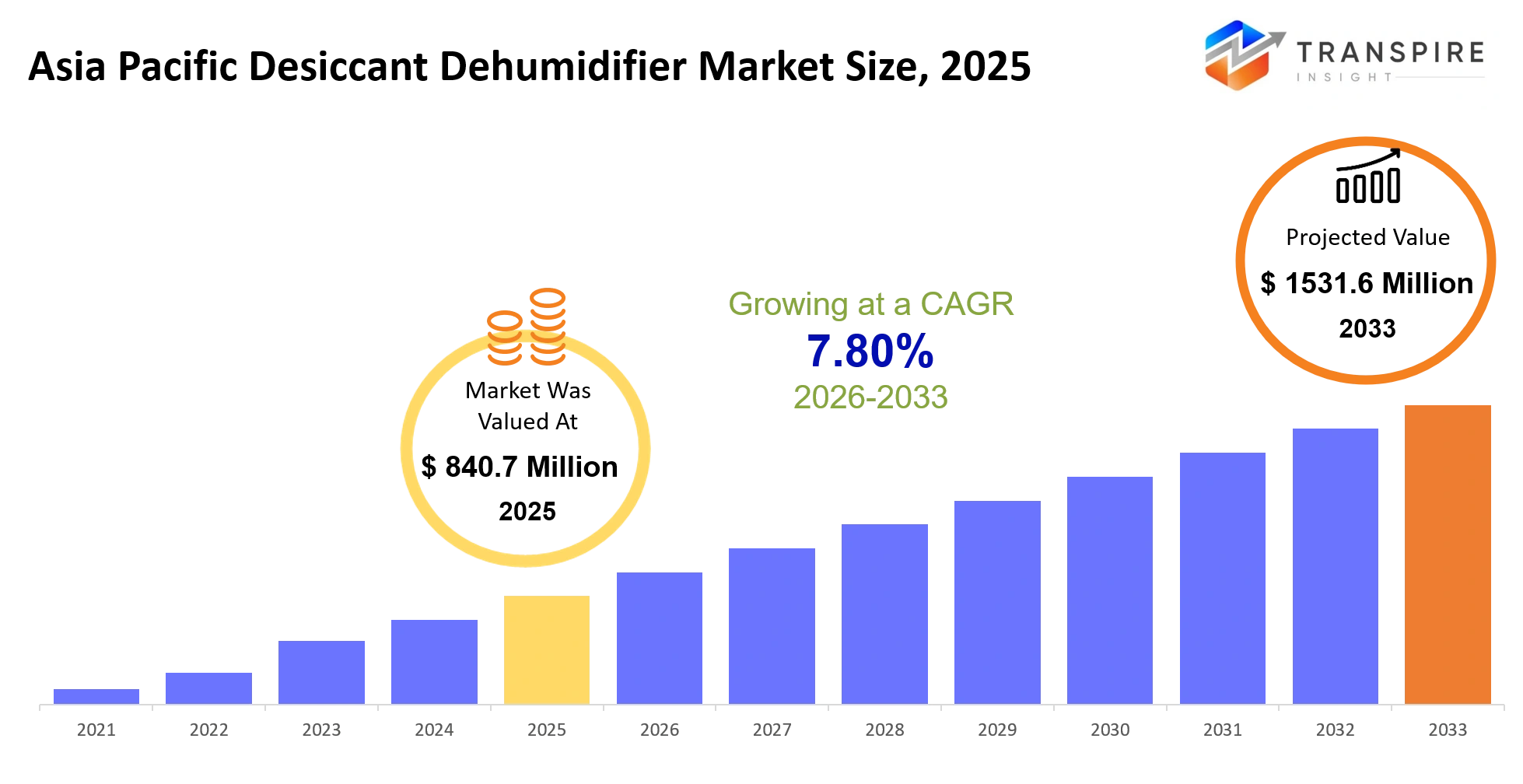
Asia Pacific Desiccant Dehumidifier Market Size & Forecast:
- Asia Pacific Desiccant Dehumidifier Market Size 2025: USD 840.7 Million
- Asia Pacific Desiccant Dehumidifier Market Size 2033: USD 1531.6 Million
- Asia Pacific Desiccant Dehumidifier Market CAGR: 7.80%
- Asia Pacific Desiccant Dehumidifier Market Segments: By Product Type (Portable Dehumidifiers, Industrial Dehumidifiers, Fixed Desiccant Systems, Smart Dehumidifiers, Others); By Application (Industrial Facilities, Warehouses, Pharmaceutical Storage, Food Processing, Residential Use, Others); By End User (Industrial Sector, Commercial Sector, Residential Sector, Others).
To learn more about this report,  Download Free Sample Report
Asia Pacific Desiccant Dehumidifier Market Summary
The Asia Pacific Desiccant Dehumidifier Market was valued at USD 840.7 Million in 2025. It is forecast to reach USD 1531.6 Million by 2033. That is a CAGR of 7.80% over the period.
Asia Pacific desiccant dehumidifiers play a key role in keeping humidity under control , since too much moisture can end up hurting products , causing corrosion on equipment, reducing manufacturing precision, or even degrading what’s stored. You see them pretty much everywhere, like pharmaceuticals, food processing, electronics manufacturing, cold storage sites, warehouses, and marine environments, where standard cooling based dehumidification often just doesn’t work well enough.
In the last five years , the market has kind of shifted in a more structural way toward energy efficient units and automated moisture-control systems that come with digital monitoring platforms. This change got even stronger due to tougher quality control demands in areas like semiconductors, battery manufacturing, and healthcare. One big trigger was the supply chain disruption during and after the COVID-19 period , it highlighted how moisture-sensitive inventories are vulnerable, and it also pushed companies to invest faster in controlled storage and production environments.
Now market growth is being pulled forward by the region’s expanding advanced manufacturing footprint and higher spending on high value industrial assets. When manufacturers aim to cut product losses, stay aligned with regulations, and improve day to day reliability, desiccant dehumidifiers are moving away from being just another facility-level utility. Instead they’re treated like strategic infrastructure investments, which helps higher equipment utilization and supports long term revenue growth for the solution providers.
Key Market Insights
- China kind of dominates the Asia Pacific Desiccant Dehumidifier Market, with roughly 38% of the regional share in 2025. It’s mostly because the manufacturing base is huge , and well, very established.
- Meanwhile, a few Southeast Asian countries are showing an emerging appetite , as electronics and semiconductor production capabilities keep on expanding . You see more investment there, year after year.
- When it comes to the product side , desiccant rotor dehumidifiers are the ones leading the market. They will take close to 55% market share in 2025, mostly for their stronger low-humidity performance which is hard to beat.
- Compact industrial desiccant systems sit in the second place. This segment is backed by warehouse and storage facility use, so it’s not just a niche thing.
- If we talk about growth , energy-efficient smart dehumidifiers are moving the quickest through 2030, since industries want to keep operating costs under control, kind of optimizing the whole running expense.
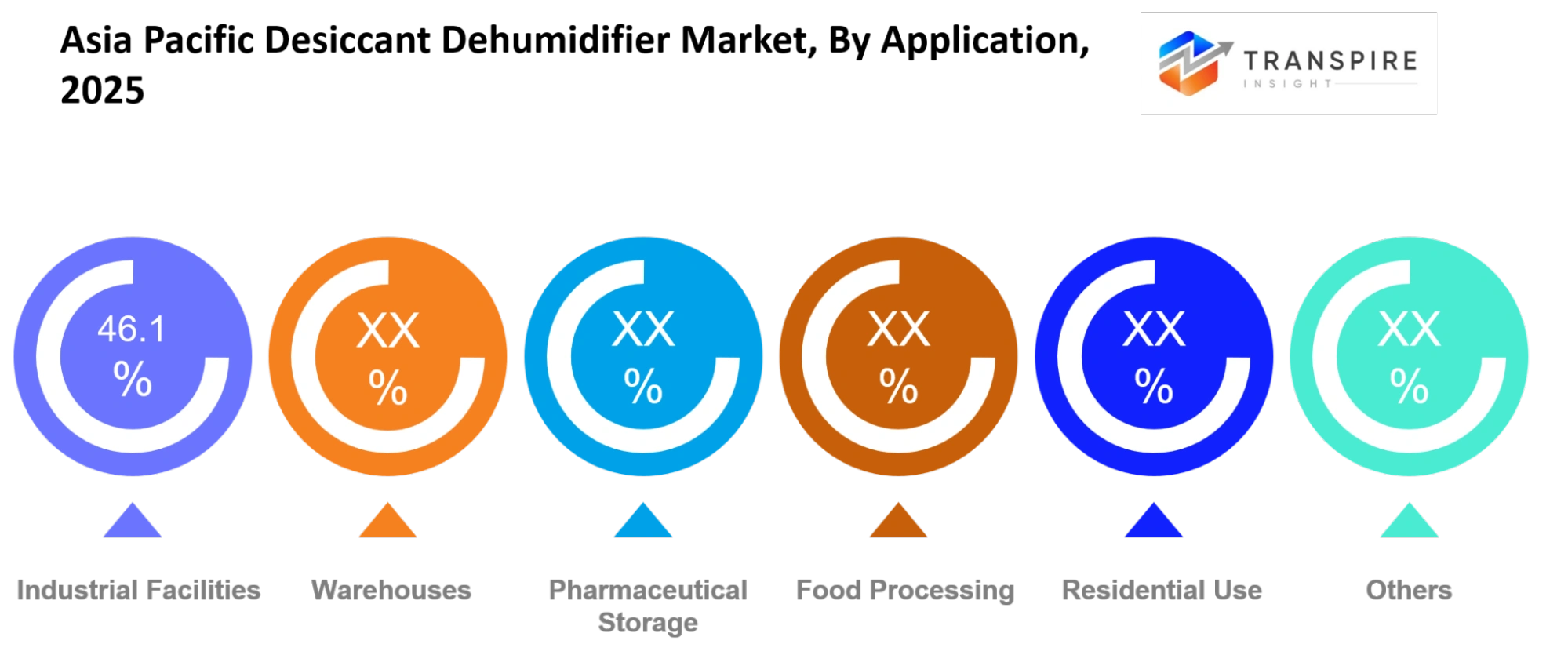
- On applications, industrial manufacturing is still in front, contributing about 42% of Asia Pacific Desiccant Dehumidifier Market revenue in 2025.
- Electronics and semiconductor facilities are the fastest-growing application group, mainly because moisture-control requirements are getting stricter all the time, especially for quality outcomes.
- For end users , manufacturing facilities remain the largest , at nearly 45% of total market demand in 2025.
- Healthcare and pharmaceutical firms are the fastest-growing end-user category across the forecast window.
- And food processing companies keep on expanding their adoption efforts , aiming to improve product quality, shelf life, and even production consistency.
What are the Key Drivers, Restraints, and Opportunities in the Asia Pacific Desiccant Dehumidifier Market?
In the Asia Pacific Desiccant Dehumidifier Market, the most powerful push for growth is basically the fast expansion of moisture-sensitive production, especially in semiconductors, lithium-ion batteries, pharma, and precision electronics, but it’s not only that. The pace really picked up when governments in China, India, South Korea, and parts of Southeast Asia started offering incentives to bring advanced manufacturing closer to home , and to cut the reliance on imported parts. In those plants, production steps need very steady humidity control, because otherwise you get product issues, contamination, and gradual material breakdown. So when companies pour money into fresh facilities, plus capacity growth, desiccant dehumidification systems are more and more added early, like from the beginning of the plant layout. That means industrial capex and market revenue tend to rise together.
On the other side, the biggest brake is the relatively high upfront setup plus the lifecycle expense for industrial desiccant dehumidification. This is kind of a structural problem, since it comes from specialized rotor materials, regeneration steps that use a lot of energy, and the fact that engineering has to be tuned to each facility’s conditions. Smaller manufacturers can find it hard to see the value, even if the long run operational gains look good. Because of that, usage stays mostly with big industrial operators, and broader manufacturing groups enter the picture much later. In practice, this slows market penetration and keeps the addressable revenue base smaller than it could be.
A big opportunity seems to be forming within the region’s budding battery manufacturing ecosystem. Big investments in electric vehicle battery plants across India, Indonesia, and parts of Southeast Asia are starting to drive strong needs for ultra low humidity conditions, not just mildly dry spaces. Battery cell production really depends on careful moisture control so the product stays reliable and meets the safety rules that matter. With regional battery supply chains getting more mature and production capacity continuing to ramp up, desiccant dehumidifier providers that can deliver energy efficient units, plus digitally monitored systems, should be in a good spot to grab this next round of market growth.
What Has the Impact of Artificial Intelligence Been on the Asia Pacific Desiccant Dehumidifier Market?
Artificial intelligence together with advanced digital tech is quietly reshaping the Asia Pacific Desiccant Dehumidifier Market. It does so by bumping up system efficiency, trimming downtime, and also making data driven facility management feel more “automatic”. In practice, manufacturers are adding AI enabled control platforms that work alongside humidity sensors, building management systems, and industrial IoT networks, so the dehumidifier isn’t just running, it’s kind of adapting all the time. Basically they keep tuning airflow, rotor speed, and regeneration cycles according to what’s happening right now in the environment, which helps sites keep humidity at the right level while energy use goes down.
At the same time, machine learning is being rolled out for predictive maintenance. These models look at vibration patterns, temperature swings, pressure differentials, and even equipment runtime logs. From that, they can catch early signals of component wear or slow performance decline. Then operators can plan service tasks before a failure shows up. That improves equipment availability and reduces those annoying, unplanned shutdowns. In sectors like pharmaceuticals, semiconductors, and battery production, predictive optimization can also strengthen process steadiness, and cut back product losses linked to moisture issues.
Digital monitoring platforms also give extra support for regulatory compliance and clearer operational visibility across more than one facility. Still, there’s a big hurdle for AI adoption. A lot of existing industrial sites run on older equipment, and that equipment often doesn’t include the sensors or connectivity needed for serious analytics. So the integration costs pile up, and the data ends up scattered across different systems, which can slow deployment. During the early stages, that fragmentation can also make predictive models less accurate than expected.
Key Market Trends
- Since 2021, semiconductor and battery investments across China, India, and Southeast Asia have, sort of shifted the buying toward ultra low humidity industrial dehumidification systems, really not just one thing.
- Manufacturers are more and more often naming desiccant dehumidifiers during the building or facility design phase, instead of trying to retrofit later after production issues pop up.
- From 2020 to 2025, digital monitoring adoption picked up fast as operators asked for real-time humidity control, plus centralized facility management, like they wanted everything in one place.
- Energy pricing has nudged buyers toward advanced rotor technologies that can lower regeneration energy use compared with older generation systems, which is a big deal.
- Pharmaceutical producers also tightened their humidity-control requirements after those pandemic era supply chain disruptions showed how exposed moisture-sensitive stocks can be.
- Since 2022, major suppliers Munters, Bry-Air, Condair and others have expanded local service coverage across fast-growing Asian manufacturing hubs, almost everywhere they can reach.
- Industrial buyers increasingly look at total lifecycle cost rather than just the equipment price at first, so the vendor choices across the region are changing, step by step.
- AI enabled predictive maintenance tools moved from a few niche setups into mainstream review by large manufacturing plants in 2023, even when budgets are tight.
- Southeast Asia has pulled in more supplier investment as electronics production slowly spreads out beyond the usual China manufacturing centers.
- Overall, competition is shifting away from pure hardware performance, toward integrated solutions that bundle dehumidification equipment, sensors, analytics, and remote monitoring platforms, together not separately.
Asia Pacific Desiccant Dehumidifier Market Segmentation
By Product Type :
Portable dehumidifiers are used in places where flexibility, mobility is kind of a must. Their compact builds let people handle moisture levels in temporary storage spots, smaller retail or office areas, and typical home settings. More and more people are paying attention to indoor air quality along with humidity management, so the adoption has been picking up across different types of spaces.
Industrial dehumidifiers, on the other hand, handle big time moisture control needs, think manufacturing sites, big warehouses, and processing locations. These fixed desiccant systems keep humidity stable, so operations that need steady conditions can just run without interruptions. Smart dehumidifiers bring in digital monitoring, remote operation, and automated tweaks, which can make it easier for facilities to boost efficiency ,and cut down on energy use. The other category is where you’ll find specialized units that are made for particular industrial and commercial needs within the Asia Pacific Desiccant Dehumidifier Market.
By Application :
Industrial facilities are a major application area, mainly because many production processes rely on controlled humidity levels to safeguard equipment, keep product quality intact, and maintain operational consistency. Moisture control also lowers the chances of corrosion, and helps avoid production losses in general, across manufacturing environments.
Warehouses often rely on desiccant dehumidification systems to keep stored goods from getting moisture damage during long term storage. Pharmaceutical storage sites need very tight humidity oversight so products stay stable and still match regulatory expectations. In food processing, dehumidification gets used to support better product quality and hygiene conditions. Residential use keeps growing too, since consumers want more comfortable indoor environments, while the others segment covers more niche applications where you need a more specific moisture control approach.
To learn more about this report, Download Free Sample Report
By End User :
The industrial sector is still a major end user, because in manufacturing , electronics, pharmaceuticals, and processing plants there’s a lot of humidity-managed spaces. When moisture is handled in a dependable way, it tends to help overall production efficiency, keeps products safe, and also improves equipment life span.
The commercial sector covers offices, retail locations, healthcare facilities, hospitality venues, and storage centers too where humidity control really supports building performance, and it keeps occupant comfort steady. In the residential sector, people usually see better indoor air conditions, plus less mold growth and fewer moisture related headaches. And then there’s the other category, which is basically for specialized end users with separate environmental control requirements. That, in turn, opens up extra chances for customized dehumidification solutions across the Asia Pacific market.
What are the Key Use Cases Driving the Asia Pacific Desiccant Dehumidifier Market?
In industrial manufacturing , that’s still the main kind of situation behind why desiccant dehumidifiers keep getting adopted across Asia Pacific, honestly. Electronics, semiconductor, pharmaceutical , and precision engineering sites all seem to need humidity levels that are kept really tight, because otherwise you get product defects, material degradation , and sometimes production interruptions. With continuous moisture control in place, product quality and operational efficiency stay in a good place too, so this is basically the biggest driver of market demand, like by far.
But adoption isn’t stuck there. It’s also spreading into warehouse storage, and especially food processing operations, where the whole goal is protecting goods from excess dampness. Logistics operators more and more are using dehumidification systems to safeguard moisture-sensitive products during storage. Meanwhile food manufacturers lean on controlled environments to keep product consistency, support hygiene standards , and hit shelf-life requirements. These kinds of uses have become more important as regional supply chains become more and more sophisticated, which makes sense.
On top of that , there are emerging opportunities in lithium-ion battery manufacturing and advanced data center infrastructure. For batteries, you basically want ultra-low humidity so cell performance and safety don’t get compromised. For data centers, humidity management matters because sensitive equipment needs protection, even when demand for higher density keeps rising. With investment growing in both of those areas, new demand is expected to show up over the forecast period.
|
Report Metrics |
Details |
|
Market size value in 2025 |
USD 840.7 Million |
|
Market size value in 2026 |
USD 905.4 Million |
|
Revenue forecast in 2033 |
USD 1531.6 Million |
|
Growth rate |
CAGR of 7.80% from 2026 to 2033 |
|
Base year |
2025 |
|
Historical data |
2021 - 2024 |
|
Forecast period |
2026 - 2033 |
|
Report coverage |
Revenue forecast, competitive landscape, growth factors, and trends |
|
Regional scope |
Asia Pacific (India, China, Japan, Australia,South Korea, Rest of Asia Pacific) |
|
Key company profiled |
Munters, Bry-Air, Seibu Giken, Condair Group, DehuTech, Atlas Copco, Honeywell, Panasonic, LG Electronics, Daikin, Trane Technologies, Trotec, Fral, Ebac, DST America. |
|
Customization scope |
Free report customization (country, regional & segment scope). Avail customized purchase options to meet your exact research needs. |
|
Report Segmentation |
By Product Type (Portable Dehumidifiers, Industrial Dehumidifiers, Fixed Desiccant Systems, Smart Dehumidifiers, Others); By Application (Industrial Facilities, Warehouses, Pharmaceutical Storage, Food Processing, Residential Use, Others); By End User (Industrial Sector, Commercial Sector, Residential Sector, Others). |
Which Regions are Driving the Asia Pacific Desiccant Dehumidifier Market Growth?
East Asia kind of leads the Asia Pacific Desiccant Dehumidifier Market, and China has the big chunk of regional demand. There’s a lot of government support behind semiconductor production , electronics manufacturing , and that more advanced industrial push, so the demand for precise humidity-control setups keeps climbing. You also have those extensive manufacturing clusters, solid industrial infrastructure, and a serious amount of capital going into battery production, and that combination makes adoption feel a bit easier. On top of that, the supplier ecosystem is already mature, with a strong footprint from both global and regional equipment makers, which really helps lock in the region’s position.
Japan is usually seen as the second-biggest regional contributor, but the market strength is built on a somewhat different logic. Instead of rapid capacity expansion, demand is carried by steady replacement cycles, strict quality requirements , and long-horizon investment in high-precision manufacturing. Sectors like pharmaceuticals, specialty chemicals, and advanced electronics keep stressing dependable environmental regulation to help safeguard product quality. That kind of consistent “keep investing” pattern brings steadier revenue prospects, and it also limits the risk tied to sudden short-term industrial swings.
South Asia, with India in front, is starting to look like the fastest-growing regional market. Lately the rise has been fueled by production-linked incentive programs, growing pharmaceutical output, and fresh investments in electronics plus battery facilities. Industrial developers are increasingly planning for humidity-control systems during the facility design stage, rather than treating them like a late add-on. From 2026 to 2033, this momentum is expected to open up appealing opportunities for suppliers, service providers, and technology companies that are aiming to expand across those high-growth industrial segments
Who are the Key Players in the Asia Pacific Desiccant Dehumidifier Market and How Do They Compete?
In the Asia Pacific Desiccant Dehumidifier Market, competition is fairly consolidated, but you still see a blend of worldwide firms mixed with regional specialists, all of them pushing into industrial , pharmaceutical, electronics, and storage use cases. What matters now is not just the cost of the equipment anymore. Performance, energy efficiency, customization know-how, and the after service experience have started to weigh more heavily than pricing alone. The bigger, established suppliers keep defending their position by leaning into application specific setups and building up their service coverage. Meanwhile regional players are going after smaller, more specific industrial needs, also leaning on closer local relationships. Since industrial buyers are focusing more on total operating spend and on process reliability, the fight is increasingly about system efficiency, digital monitoring options, and lifecycle support.
Munters basically plays the innovation side, especially with energy saving desiccant rotor systems built for tough humidity control conditions. They stand out because of a deep background in semiconductor, battery, and pharmaceutical environments where tight climate control is non negotiable. Their growth plan is tied to reinforcing service capacity in each region and helping with large production programs across Asia. Bry-Air, on the other hand, leans into customization first, providing tailored dehumidification systems for industries that run under unusual or tightly defined operating demands. With strong engineering backing and designs that are tuned for the application, the company tends to lock in longer term industrial agreements.
Company List
- Munters
- Bry-Air
- Seibu Giken
- Condair Group
- DehuTech
- Atlas Copco
- Honeywell
- Panasonic
- LG Electronics
- Daikin
- Trane Technologies
- Trotec
- Fral
- Ebac
- DST America
Recent Development News
In July 2025, Modine announced the acquisition of Climate by Design International. The deal expanded Modine’s commercial indoor air quality portfolio and strengthened its capabilities in desiccant dehumidification and critical-process air handling, supporting growth in pharmaceutical, healthcare, and industrial humidity-control applications.
Source: https://investors.modine.com/
In November 2025, Bry-Air launched the P80x dehumidifier based on Metal-Organic Framework (MOF) technology. The new pharmaceutical-focused desiccant dehumidifier delivers higher moisture-removal performance and significant energy savings versus conventional silica-gel systems, advancing next-generation humidity-control solutions in Asia-Pacific manufacturing sectors.
Source: https://www.industrialautomationindia.in/
What Strategic Insights Define the Future of the Asia Pacific Desiccant Dehumidifier Market?
The Asia Pacific Desiccant Dehumidifier Market is starting to drift toward a point where humidity control turns into a main, day to day production need rather than just a “supporting” facility function. In the next five to seven years, the momentum will be pulled forward by more semiconductor fabrication plants, more battery manufacturing sites, pharmaceutical output, and other high precision industries that really can’t afford moisture related quality losses. Because of this, buyers will tend to lean more toward integrated systems that bundle dehumidification with digital monitoring and even predictive maintenance features, all in the same package.
There’s also a less obvious risk, it’s kind of hiding in plain sight—market concentration is clustering around a smaller set of advanced manufacturing industries. If the investment rhythm in semiconductors, or electric vehicle batteries, slows down even slightly then equipment procurement may swing around more sharply than what current growth forecasts are assuming. A second issue is the availability and price of specialized desiccant rotor materials, that can bring supply side stress right when capacity expansion is happening fast.
On the opportunity side, one thing to watch is the push toward localized battery supply chains across India and Southeast Asia. New manufacturing facilities are being planned at scale, so demand patterns could move earlier than expected. Market players should think about partnerships with engineering contractors and industrial facility developers pretty early in project timelines, so the dehumidification solution is specified during the plant design phase rather than treated like a later add on.
Asia Pacific Desiccant Dehumidifier Market Report Segmentation
By Product Type
- Portable Dehumidifiers
- Industrial Dehumidifiers
- Fixed Desiccant Systems
- Smart Dehumidifiers
By Application
- Industrial Facilities
- Warehouses
- Pharmaceutical Storage
- Food Processing
- Residential Use
By End User
- Industrial Sector
- Commercial Sector
- Residential Sector
Frequently Asked Questions
Find quick answers to common questions.
The Asia Pacific Desiccant Dehumidifier Market size is USD 1531.6 Million in 2033.
Key segments for the Asia Pacific Desiccant Dehumidifier Market are By Product Type (Portable Dehumidifiers, Industrial Dehumidifiers, Fixed Desiccant Systems, Smart Dehumidifiers, Others); By Application (Industrial Facilities, Warehouses, Pharmaceutical Storage, Food Processing, Residential Use, Others); By End User (Industrial Sector, Commercial Sector, Residential Sector, Others).
Major Asia Pacific Desiccant Dehumidifier Market players are Munters, Bry-Air, Seibu Giken, Condair Group, DehuTech, Atlas Copco, Honeywell, Panasonic, LG Electronics, Daikin, Trane Technologies, Trotec, Fral, Ebac, DST America.
The Asia Pacific Desiccant Dehumidifier Market size is USD 840.7 Million in 2025.
The Asia Pacific Desiccant Dehumidifier Market CAGR is 7.80% from 2026 to 2033.
- Munters
- Bry-Air
- Seibu Giken
- Condair Group
- DehuTech
- Atlas Copco
- Honeywell
- Panasonic
- LG Electronics
- Daikin
- Trane Technologies
- Trotec
- Fral
- Ebac
- DST America
About the Authors

Chetan Dhatrak
I’m Chetan Dhatrak, a Senior Research Analyst at Transpire Insight, specializing in the Consumer Goods, Foods and Beverages industry. I focus on analyzing market trends, consumer behavior, competitive landscapes, and industry developments to deliver accurate, data-driven insights. My research at Transpire Insight is built on credible sources and in-depth analysis, helping businesses and readers better understand market dynamics, emerging opportunities, and evolving consumer preferences. I’m committed to creating reliable, well-researched content that supports informed decision-making and reflects the latest developments in the consumer goods and food & beverage sectors.

Chakradhar Khansole
Chakradhar serves as the Research Director at Transpire Insight, bringing over 8 years of experience in technology, innovation, and strategic market intelligence. He specializes in transforming complex market data into actionable business insights that enable organizations to make informed, growth-oriented decisions. Recognized for his strategic vision and analytical expertise, Chakradhar leads high-impact research initiatives, delivering comprehensive market assessments, competitive intelligence, and forward-looking industry analysis.
Recently Published Reports
-
Apr 2026
Bottled Water Market
Bottled Water Market Size, Share & Analysis Report By Product Type (Still Bottled Water, Carbonated Bottled Water, Functional Bottled Water, and Others), By Packaging (PET, Cans, and Others), By Sales Channel (Supermarkets/Hypermarkets, Convenience Stores/Drug Stores, Grocery Stores/Club Stores, Foodservice, and Others) and Geography (North America, Europe, Asia-Pacific, Middle East and Africa, South and Central America), 2021 - 2032
-
Apr 2026
Color Cosmetic Packaging Market
Color Cosmetic Packaging Market Size, Share & Analysis Report By Application (Mascara Packaging, Liquid Packaging, and Liquid Face), By Type (Tubes & Bottles, Pens & Markers, Compacts & Containers, and Droppers & Pumps), and Geography (North America, Europe, Asia-Pacific, Middle East and Africa, South and Central America), 2021 - 2031
-
Apr 2026
External Microphone For Camera Market
External Microphone For Camera Market Size, Share & Analysis Report By Type (Shotgun Microphone, Lavalier Microphone, and Others), By Application (Digital Camera, Professional Video Camera, and Others), and Geography (North America, Europe, Asia-Pacific, Middle East and Africa, South and Central America), 2021 - 2031
-
Apr 2026
Foot Orthotic Insoles Market
Foot Orthotic Insoles Market Size, Share & Analysis Report By Type (Pre-fabricated, and Custom-made), By Material (Thermoplastic, Composite Carbon Fiber, and Others), By Distribution Channel (Drug Stores, Hospitals & Clinics, and Others), and Geography (North America, Europe, Asia-Pacific, Middle East and Africa, South and Central America), 2021 - 2031