

Asia Pacific Dark Factories Market Size & Forecast:
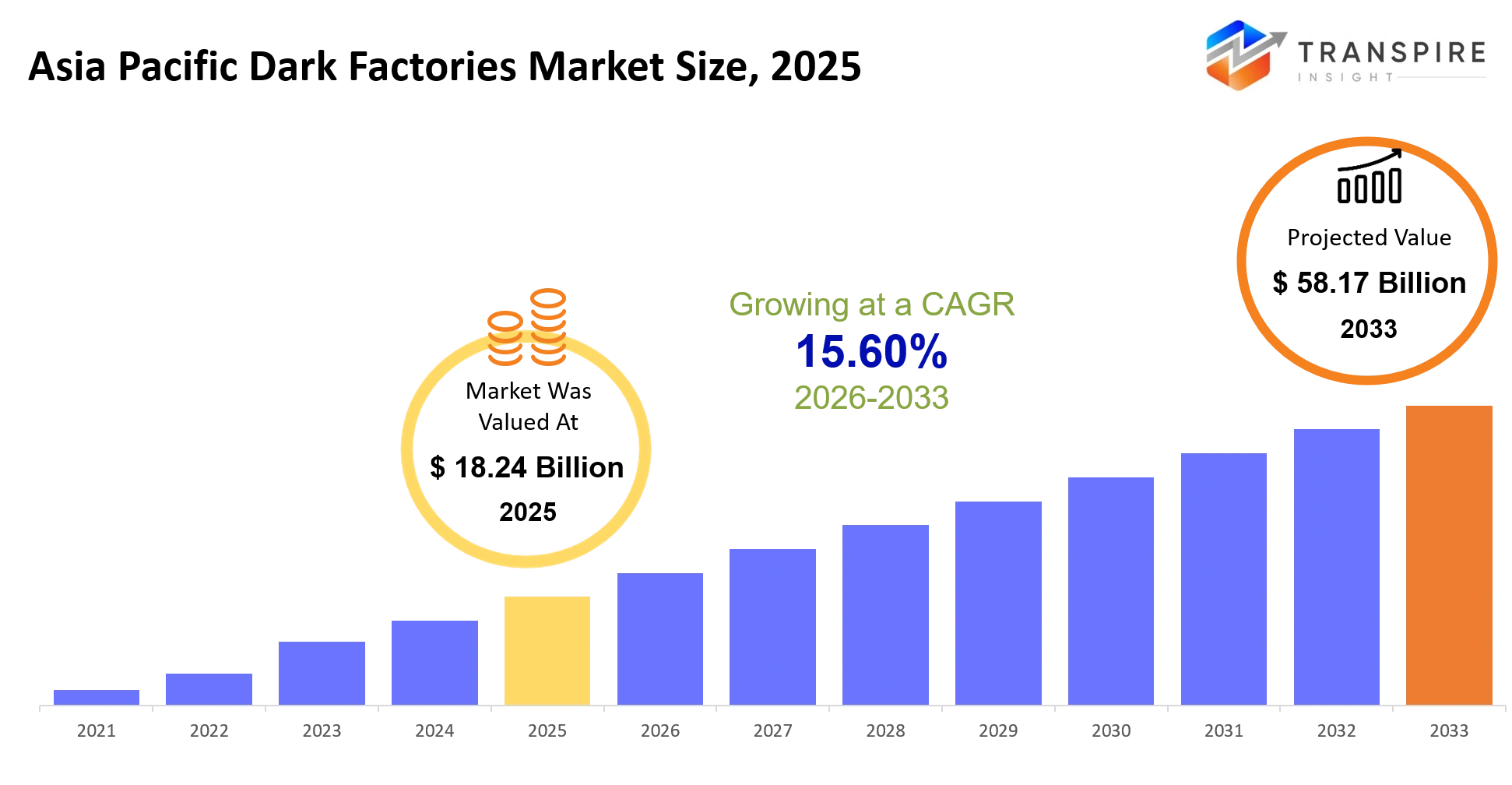
- Asia Pacific Dark Factories Market Size 2025: USD 18.24 Billion
- Asia Pacific Dark Factories Market Size 2033: USD 58.17 Billion
- Asia Pacific Dark Factories Market CAGR: 15.60%
- Asia Pacific Dark Factories Market Segments: By Technology (Industrial Robots, AI Systems, Machine Vision, IoT Platforms, Digital Twins, Autonomous Vehicles, Predictive Analytics, Others); By Application (Automotive Manufacturing, Electronics Manufacturing, Consumer Goods, Pharmaceuticals, Food Processing, Semiconductor Production, Aerospace Manufacturing, Others); By Component (Hardware, Software, Services, Sensors, Controllers, Robotics Platforms, Connectivity Solutions, Others); By End User (Automotive, Electronics, Semiconductor, Pharmaceutical, Food & Beverage, Aerospace, Logistics, Others).
Asia Pacific Dark Factories Market Summary
The Asia Pacific Dark Factories Market was valued at USD 18.24 Billion in 2025. It is forecast to reach USD 58.17 Billion by 2033. That is a CAGR of 15.60% over the period.
The Asia Pacific Dark Factories market is making it possible for factories to run on their own without people. Machines, sensors and artificial intelligence systems work together to make things with human help. This makes production more consistent and cost effective in industries like electronics and car manufacturing.In terms the Asia Pacific Dark Factories market is replacing old ways of supervising production with new ways that use data to control everything. This means that machines can handle all parts of production from getting materials to checking quality.
Over the few years the Asia Pacific Dark Factories market has changed a lot. It used to be about automating parts of factories but now it is about making entire factories work together seamlessly using artificial intelligence, robotics and internet connected devices. One big reason for this change is that there have been problems with getting parts and supplies from countries. This has made manufacturers want to find ways to make things that do not rely much on people or on getting parts from other countries. As a result companies are now focusing on making their production lines more resilient and able to keep running on what. This has made them more likely to adopt autonomous manufacturing systems and invest in production infrastructure that can improve itself. The Asia Pacific Dark Factories market is about making production more efficient and cost effective and it is changing the way factories work.
Key Market Insights
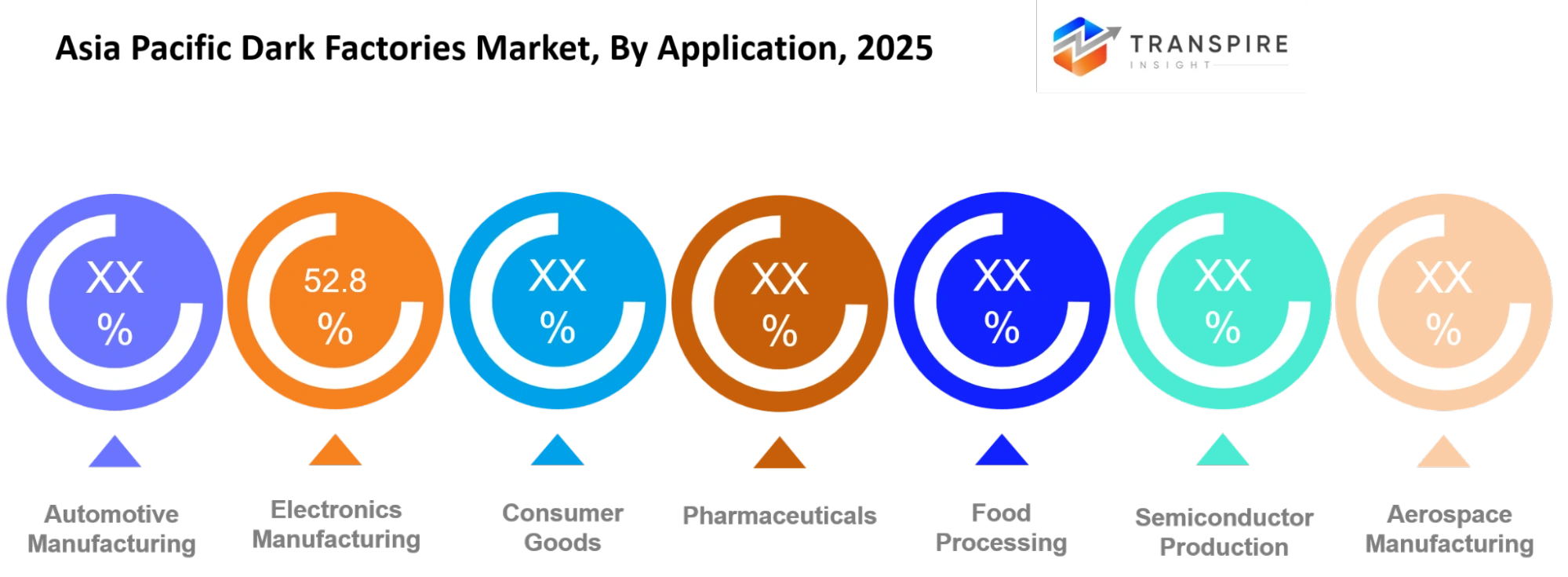
- The Asia Pacific Dark Factories Market is about making electronics and it will have a big part of the market about 34 percent by 2025. This is because there is a demand for automation in semiconductors.
- The automotive segment is growing fast and will keep growing quickly from 2026 to 2032. This is happening because of the automation used in making vehicles.
- China is the leader in the Asia Pacific Dark Factories Market with 40 percent of the market share. This is because the government is supporting the use of intelligence in industries.
- India is growing fast because the government is giving incentives for smart manufacturing and the cost of automation is low.
- Industrial robots are the most used in the market because they are used a lot in assembly automation systems.
- Systems that use intelligence and machine vision are growing very fast because factories want to use autonomous inspection to find defects.
- Making electronics is the application of the Asia Pacific Dark Factories Market with over one-third of the market share. This is because electronics manufacturing needs to be very precise.
- Automotive manufacturing is growing fast because companies are investing a lot in automation for electric vehicle supply chains.
- Big companies have a share of the Asia Pacific Dark Factories Market because they have a lot of money to invest in new technologies.
- Medium-sized enterprises are growing fast because they can now use automation without spending too much money thanks to modular retrofit solutions.
- Some of the companies in the market are ABB, Siemens, FANUC, Mitsubishi Electric, Rockwell Automation and Schneider Electric.
- These companies are getting stronger in the Asia Pacific Dark Factories Market by using intelligence innovating in robotics and expanding their digital twin technologies.
- Companies are also forming partnerships. Making products locally to have an advantage over others, in the smart factory ecosystem.
What are the Key Drivers, Restraints, and Opportunities in the Asia Pacific Dark Factories Market?
Drivers
The Asia Pacific Dark Factories Market is growing fast because more manufacturers are using AI robots and industrial internet systems. They want to get rid of production problems that need a lot of workers.This change happened because wages have been going up in manufacturing places and supply chains have been getting disrupted a lot.As a result companies are spending a lot of money on automatic production lines.These lines help them make products have less downtime and save money.This has helped automation companies that offer robotics, machine vision and edge AI platforms make money.
Restraint
The biggest problem is that it costs a lot to change from factories to fully automatic ones.This is a barrier because it requires completely changing how production works not just making small changes.Many sized manufacturers do not adopt this because it takes a long time to get their money back and it is hard to integrate with old systems.This means that solution providers do not make much money in the short term even in areas where there is a lot of demand.
Opportunity
There is an opportunity in automation systems for old factories especially, in India and Southeast Asia.New plug-and-play robotics and AI systems allow some automation without rebuilding the factory.Some electronics assembly places are already using this. It is helping them automate more and grow their market.This can help more manufacturers adopt automation and grow the market.
What Has the Impact of Artificial Intelligence Been on the Asia Pacific Dark Factories Market?
The Asia Pacific Dark Factories Market is changing because of intelligence and advanced digital technologies. These technologies are making production environments that can work on their own. This means that machines are making decisions in time instead of people supervising them.
In factories artificial intelligence is used to control systems. This helps robots work together better. It also helps with the flow of materials and energy use. This reduces the amount of time that machines are not working. It helps the production line work better in places that make electronics and cars. The Asia Pacific Dark Factories Market is using machine learning models to predict when maintenance is needed. These models use data from sensors on robots and other devices to find problems before they happen. This helps manufacturers avoid shutdowns and makes equipment last longer.Artificial intelligence is also used to make copies of factories. These digital copies help optimize performance by simulating how the factory works and making adjustments to improve production and reduce defects. The Asia Pacific Dark Factories Market has seen benefits from these systems including more time when equipment is working, more consistent production and lower costs.
However there is a problem with artificial intelligence systems. They are hard to integrate with factory equipment. Many factories have systems that do not work well with new artificial intelligence platforms. This makes it hard to deploy these systems fully. The Asia Pacific Dark Factories Market also needs data to train artificial intelligence models. This is because the data from factories is not always good enough especially when production conditions are changing a lot.
Key Market Trends
- The way things are made changed a lot from 2020 to 2022 and by 2025 most factories in the APAC area were using AI to make things from start to finish.
- Companies that make electronics started using dark factories after 2023, which meant they did not need as many people to check things and this reduced the number of people working in these roles by almost 30 percent in places where things need to be made very precisely.
- Car manufacturers changed their factories from being partly automated to trying out automated electric vehicle production lines between 2024 and 2026 in China and Japan.
- ABB and Siemens started offering AI services for factories in 2025, which changed the way companies compete with each other from just selling equipment to making whole systems that can run on their own.
- After 2024 a lot of factories started using something called maintenance, which helps prevent unexpected stops in production and this reduced the number of times things broke down by up to 25 percent in factories that use advanced robots.
- The use of twins, which are like virtual copies of real things expanded from just a few test projects to being used by entire companies by 2026 and this made planning and production more efficient.
- When there were problems with getting things from one place to another in 2022 and 2023 factories that use a lot of technology started moving to places that're closer to where people are buying things and this happened a lot in Southeast Asia.
- Smaller companies started using a kind of dark factory system after 2024, where they can add new technology a little at a time instead of spending a lot of money all, at once to automate everything.
- In 2025 the government started paying attention to how AI is used in factories, which meant companies had to follow more rules to make sure their systems are safe and work well.
Asia Pacific Dark Factories Market Segmentation
By Technology
Industrial automation is changing the way things are made. It is using robots and smart software to make things on its own. Industrial robots are being used more and more to put things with precision. Artificial intelligence systems are helping to make decisions and find mistakes in the production line. Machine vision is making sure the quality of things is good by checking them. This means people do not have to check them much. The internet of things is helping to monitor equipment in time. This means machines can talk to each other and to the people in charge. Digital twins are being used to test how things will work before they are actually made. Predictive analytics is helping to predict when things will break down. This means maintenance can be scheduled and downtime can be reduced. Autonomous vehicles are being used to move things around inside factories.All these technologies are being used together to make production more efficient. They are also reducing the differences in how things are made from one factory to another.
By Application
The way things are being made is changing. More and more things are being made with automation. Car makers are using automation to make cars and batteries. Electronics makers are using robots to handle parts and put circuits together. Companies that make things for people to use are using automation systems to make many different products. Pharmaceutical companies are using automation to make sure their products are safe and comply with rules. Food companies are using automation to sort and package food. They are also using automation to check the quality of food. Semiconductor companies are using automation to make sure their products are perfect. Aerospace companies are using automation to make parts for planes.People want to use automation to make things because it's more consistent and efficient.
By Component
The components used in automation are changing. People are not just buying hardware anymore. They are buying systems that include software and services. Hardware is still important because robots and machines are still needed.. Software is becoming more important because it helps to optimize production. Services are also becoming more important because people need help to install and maintain their automation systems. Sensors are being used to monitor things in time. Controllers are being used to make sure machines work together. Robotics platforms are being used to make it easier to deploy robots. Connectivity solutions are being used to make sure machines can talk to each other.All these components are being used together to make automation systems that're more efficient and smarter.
By End User
The people who use automation are changing the way they work. Car makers are using automation to make cars. Electronics makers are using automation to make parts. Semiconductor companies are using automation to make sure their products are perfect. Pharmaceutical companies are using automation to comply with rules and make sure their products are safe. Food companies are using automation to make food safer and more efficient. Aerospace companies are using automation to make parts for planes. Logistics companies are using automation to sort and handle packages.All these companies are using automation to make their production more efficient and consistent. They want to reduce the amount of work that people have to do and make their products better.
What are the Key Use Cases Driving the Asia Pacific Dark Factories Market?
The Asia Pacific Dark Factories Market is really taking off when it comes to core adoption. This is because a lot of companies in this market are doing high-volume precision manufacturing. They use robots and special control systems that are enabled by Artificial Intelligence to keep production going all the time with very little help from people.
The companies that make electronics and semiconductors are the ones that use this kind of manufacturing the most. This is because they cannot have any defects in their products and they need to make sure that everything is very accurate. They use automated systems to check for mistakes and move materials around. This helps to make sure that the products are all the same and that the companies can make a lot of them.We are also seeing this kind of manufacturing being used in areas like making electric vehicles and industrial machinery. In these areas companies are using robots to weld things, put batteries in and test parts. They are also using systems that can see things and help to make sure that everything is working correctly.Big companies are the ones that are using this kind of manufacturing the most because they have a lot of money to spend on it and they already have the systems in place to support it.
There are also some areas where this kind of manufacturing is being used, like in pharmaceutical companies where they need to keep everything very clean. They are using Artificial Intelligence to help them follow the rules and make sure that everything is working correctly. They are also using systems to move things around inside the factories.We think that this kind of manufacturing will become more popular in the future because companies will need to make sure that they are following all the rules and that their products are perfect. The Asia Pacific Dark Factories Market and the use of core adoption will be very important in this. Core adoption in the Asia Pacific Dark Factories Market will continue to grow as companies look for ways to improve their manufacturing processes.
|
Report Metrics |
Details |
|---|---|
|
Market size value in 2025 |
USD 18.24 Billion |
|
Market size value in 2026 |
USD 21.08 Billion |
|
Revenue forecast in 2033 |
USD 58.17 Billion |
|
Growth rate |
CAGR of 15.60% from 2026 to 2033 |
|
Base year |
2025 |
|
Historical data |
2021 - 2024 |
|
Forecast period |
2026 - 2033 |
|
Report coverage |
Revenue forecast, competitive landscape, growth factors, and trends |
|
Regional scope |
Asia Pacific (India, China, Japan, Australia, South Korea, Rest of Asia Pacific) |
|
Key company profiled |
ABB, Siemens, FANUC, Mitsubishi Electric, Rockwell Automation, Schneider Electric, Bosch, Omron, Yaskawa, Honeywell, Hitachi, Foxconn, Huawei, Advantech, Keyence. |
|
Customization scope |
Free report customization (country, regional & segment scope). Avail customized purchase options to meet your exact research needs. |
|
Report Segmentation |
By Technology (Industrial Robots, AI Systems, Machine Vision, IoT Platforms, Digital Twins, Autonomous Vehicles, Predictive Analytics, Others); By Application (Automotive Manufacturing, Electronics Manufacturing, Consumer Goods, Pharmaceuticals, Food Processing, Semiconductor Production, Aerospace Manufacturing, Others); By Component (Hardware, Software, Services, Sensors, Controllers, Robotics Platforms, Connectivity Solutions, Others); By End User (Automotive, Electronics, Semiconductor, Pharmaceutical, Food & Beverage, Aerospace, Logistics, Others). |
Which Regions are Driving the Asia Pacific Dark Factories Market Growth?
China leads the Asia Pacific Dark Factories Market due to its strong industrial automation ecosystem, large-scale manufacturing base, and continuous policy support for smart factory upgrades. Heavy investment in robotics, AI-enabled production systems, and semiconductor manufacturing has created a highly integrated supply chain that supports fully autonomous production environments. Strong presence of domestic automation providers and global technology partnerships strengthens deployment speed across electronics and automotive plants. Well-developed industrial zones and advanced logistics networks further support rapid scaling of dark factory infrastructure across coastal manufacturing hubs.
Japan holds a stable and technologically mature position in the Asia Pacific Dark Factories Market, driven by its focus on precision engineering and long-term industrial modernization strategies. Unlike China’s scale-driven expansion, Japan emphasizes incremental automation improvements, high reliability standards, and workforce optimization in advanced manufacturing. Strong collaboration between robotics manufacturers and automotive OEMs supports consistent investment in smart production systems. A highly disciplined regulatory environment and strong industrial quality culture ensure steady adoption of autonomous manufacturing technologies without disruptive shifts in production structures.
India represents the fastest-growing region in the Asia Pacific Dark Factories Market, supported by recent policy initiatives promoting smart manufacturing, digital industrial corridors, and foreign direct investment in electronics and EV production. Rapid expansion of industrial parks and increasing adoption of modular automation systems have accelerated deployment in mid-sized factories. Unlike mature markets, India’s growth is driven by greenfield factory development and cost-efficient automation adoption rather than legacy upgrades. This momentum creates strong opportunities for automation providers and investors over 2026–2033 as manufacturing capacity expands and digital infrastructure strengthens across emerging industrial clusters.
Who are the Key Players in the Asia Pacific Dark Factories Market and How Do They Compete?
The Asia Pacific Dark Factories Market shows a moderately consolidated competitive structure where global industrial automation leaders compete with regional robotics specialists and fast-scaling technology firms. Competition is increasingly defined by end-to-end automation capability rather than standalone equipment supply. Incumbents are defending share by expanding integrated ecosystems that combine robotics, AI software, and industrial IoT platforms. New entrants are disrupting segments through lower-cost modular automation systems and AI-driven manufacturing solutions tailored for mid-sized factories. Technology integration capability and interoperability with legacy systems have become the primary basis of competition, followed by deployment speed and lifecycle service support.
Siemens and ABB compete through high-end industrial automation platforms that integrate digital twins, AI-enabled control systems, and advanced robotics. Siemens differentiates through its strong industrial software ecosystem, particularly in smart factory orchestration and simulation-based production optimization. ABB focuses on robotics-led automation with strong adoption in electronics and automotive assembly lines. Both companies expand through strategic partnerships with semiconductor and EV manufacturers across APAC, strengthening their presence in high-precision production environments.
FANUC and Mitsubishi Electric focus on robotics specialization and high-reliability manufacturing systems for large-scale production environments. FANUC differentiates through its precision robotics and long operational lifecycle, which reduces downtime in continuous manufacturing. Mitsubishi Electric expands through integrated factory automation systems combining PLCs, sensors, and motion control technologies. Rockwell Automation emphasizes software-driven industrial control solutions, particularly in North American and APAC joint manufacturing projects. Schneider Electric strengthens its position through energy-efficient automation systems and grid-integrated smart factory solutions, targeting sustainability-driven industrial upgrades.
Company List
- Rockwell Automation
- Schneider Electric
- Bosch
- Omron
- Yaskawa
- Honeywell
- Hitachi
- Foxconn
- Huawei
- Advantech
- Keyence
Recent Development News
“In April 2026, Schaeffler entered into a strategic partnership with VinDynamics to co-develop humanoid robotics technologies and supply high-precision actuators for advanced automated manufacturing systems. The collaboration enables real-time industrial data sharing to improve predictive maintenance and supports the broader shift toward fully autonomous, AI-driven ‘dark factory’ environments across Asia Pacific.”
Source: https://www.schaeffler-industrial-drives.com
“In January 2026, Bharat Forge announced a strategic MoU with Agile Robots to jointly develop and deploy AI-led industrial automation solutions aimed at enabling fully autonomous ‘dark factories’ across India and Southeast Asia. The partnership focuses on integrating vision-based robotics and intelligent manufacturing systems to reduce human intervention in production environments.”
Source: https://www.icicidirect.com
“In March 2026, Foxconn entered into a strategic partnership with SAP to accelerate AI-powered manufacturing and supply chain transformation across Asia Pacific. The collaboration strengthens Foxconn’s ‘AI Factory’ initiative by advancing intelligent automation capabilities that support highly digitized and increasingly autonomous production ecosystems aligned with dark factory development trends.”
Source: https://www.honhai.com
What Strategic Insights Define the Future of the Asia Pacific Dark Factories Market?
Over the next 5–7 years, the Asia Pacific Dark Factories market will structurally shift toward fully autonomous, AI-orchestrated production ecosystems, where robotics, edge AI, and industrial IoT converge to enable near-zero human intervention manufacturing. This transformation is driven by persistent labor cost escalation, reshoring of critical supply chains, and rising demand for ultra-precision, high-throughput production across electronics, automotive, and semiconductor sectors. A less visible risk is growing dependency on a narrow set of robotics and AI platform providers, which could create systemic concentration risk and operational fragility if technology access is disrupted or standards diverge. Meanwhile, a strong emerging opportunity lies in modular retrofit solutions for brownfield SMEs in India and Southeast Asia, enabling incremental adoption of lights-out manufacturing without full plant replacement. Market participants should prioritize interoperable, cybersecurity-first automation architectures and build localized OEM partnerships to capture fragmented demand while reducing platform dependency risk.
Asia Pacific Dark Factories Market Report Segmentation
By Component
- Industrial Robots
- Autonomous Mobile Robots (AMRs)
- AI & Machine Vision Systems
- Industrial IoT Platforms
- Edge Computing Systems
- Control Systems & PLCs
- Sensors & Actuators
- Software Solutions
By Automation Level
- Semi-Autonomous Manufacturing
- Highly Automated Manufacturing
- Fully Autonomous (Dark Factories)
By Deployment Type
- Brownfield Automation (Retrofit)
- Greenfield Smart Factories
By Technology
- Artificial Intelligence & Machine Learning
- Industrial Internet of Things (IIoT)
- Digital Twin Technology
- Edge & Cloud Computing
- Robotics Process Automation (RPA)
- 5G-Enabled Industrial Connectivity
By End-Use Industry
- Automotive
- Electronics & Semiconductors
- Industrial Machinery
- Aerospace & Defense
- Pharmaceuticals
- Consumer Goods
- Logistics & Warehousing
- Others
By Enterprise Size
- Large Enterprises
- Small & Medium Enterprises (SMEs)
Frequently Asked Questions
Find quick answers to common questions.
The expected Asia Pacific Dark Factories Market size for the market will be USD 58.17 Billion in 2033.
Key segments for the Asia Pacific Dark Factories Market are By Technology (Industrial Robots, AI Systems, Machine Vision, IoT Platforms, Digital Twins, Autonomous Vehicles, Predictive Analytics, Others); By Application (Automotive Manufacturing, Electronics Manufacturing, Consumer Goods, Pharmaceuticals, Food Processing, Semiconductor Production, Aerospace Manufacturing, Others); By Component (Hardware, Software, Services, Sensors, Controllers, Robotics Platforms, Connectivity Solutions, Others); By End User (Automotive, Electronics, Semiconductor, Pharmaceutical, Food & Beverage, Aerospace, Logistics, Others).
Major Asia Pacific Dark Factories Market players are ABB, Siemens, FANUC, Mitsubishi Electric, Rockwell Automation, Schneider Electric, Bosch, Omron, Yaskawa, Honeywell, Hitachi, Foxconn, Huawei, Advantech, Keyence.
The Asia Pacific Dark Factories Market size is USD 18.24 Billion in 2025.
The Asia Pacific Dark Factories Market CAGR is 15.60% from 2026 to 2033.
- ABB
- Siemens
- FANUC
- Mitsubishi Electric
- Rockwell Automation
- Schneider Electric
- Bosch
- Omron
- Yaskawa
- Honeywell
- Hitachi
- Foxconn
- Huawei
- Advantech
- Keyence
About the Authors

Kartik bhong
I am Kartik Bhong, a Senior Research Analyst at Transpire Insight, specializing in the Packaging, Manufacturing, and Construction industry. My work focuses on analyzing market trends, emerging technologies, industry regulations, and competitive landscapes to deliver accurate, data-driven insights. I am passionate about transforming complex industry information into clear, practical content that helps businesses, professionals, and decision-makers stay informed and make confident strategic decisions. Through continuous research and a strong commitment to accuracy, I strive to create reliable, well-researched content that reflects the latest developments across these dynamic industries and supports the vision of Transpire Insight in delivering valuable market intelligence.

Chakradhar Khansole
Chakradhar serves as the Research Director at Transpire Insight, bringing over 8 years of experience in technology, innovation, and strategic market intelligence. He specializes in transforming complex market data into actionable business insights that enable organizations to make informed, growth-oriented decisions. Recognized for his strategic vision and analytical expertise, Chakradhar leads high-impact research initiatives, delivering comprehensive market assessments, competitive intelligence, and forward-looking industry analysis.
Recently Published Reports
-
Apr 2026
Handling and Lifting Equipment Market
Handling and Lifting Equipment Market Size, Share & Analysis Report By Product (Cranes and Hoists, Forklifts, Conveyor Systems, Aerial Work Platforms, Others), By Application (E-Commerce, Automotive and Railway, Food and Beverages, Aviation, Others), and Geography (North America, Europe, Asia-Pacific, Middle East and Africa, South and Central America), 2021 - 2031
-
Apr 2026
HVAC Equipment Market
HVAC Equipment Market Size, Share & Analysis Report By Heating Equipment Type (Boilers and Furnaces, Heat Pumps, and Unitary Heaters), By Ventilation Equipment (Air Handling Units, Humidifiers and Dehumidifiers, Air Filters, and Fan Coiling Units), By Air Conditioning Equipment (Unitary Air Conditioners, Room Air Conditioners, Packaged Terminal Air Conditioners, and Chillers), By End User (Commercial, Residential, Industrial, and others), and Geography (North America, Europe, Asia-Pacific, Middle East and Africa, South and Central America), 2021 – 2031
-
Apr 2026
Refrigeration Valves Market
Refrigeration Valves Market Size, Share & Analysis Report By Type (Solenoid Valves, Expansion Valves, Check Valves, Service Valves, Others), By Application (Commercial Refrigeration, Industrial Refrigeration, Transport Refrigeration, Residential Refrigeration, Air Conditioning Systems), By End User (Food and Beverage Industry, Pharmaceutical Industry, HVAC Industry, Chemical Industry, Others), and Geography (North America, Europe, Asia-Pacific, Middle East and Africa, South and Central America), 2021 – 2031
-
Apr 2026
E-Commerce Packaging Materials Market
E-Commerce Packaging Materials Market By Material Type (Corrugated Boxes, Paper & Paperboard, Foam & Cushioning Materials, Plastic Packaging, Flexible Packaging, Protective Packaging, Others), By Product(Primary Packaging, Secondary Packaging, Tertiary Packaging), By Packaging Function (Protective Packaging, Branding & Presentation Packaging, Transit & Logistic Packaging, Sustainable Packaging, Tamper Evidence Packaging), By End-User (Retail & Consumer Goods, Electronic Appliances, Food & Beverages, Healthcare & Pharmaceutical, Fashion & Apparel, Home & Furnishing, Others); By Industry Analysis, Size, Share, Growth, Trends, and Forecasts 2021-2033