

Japan Dark Factories Market Size & Forecast:
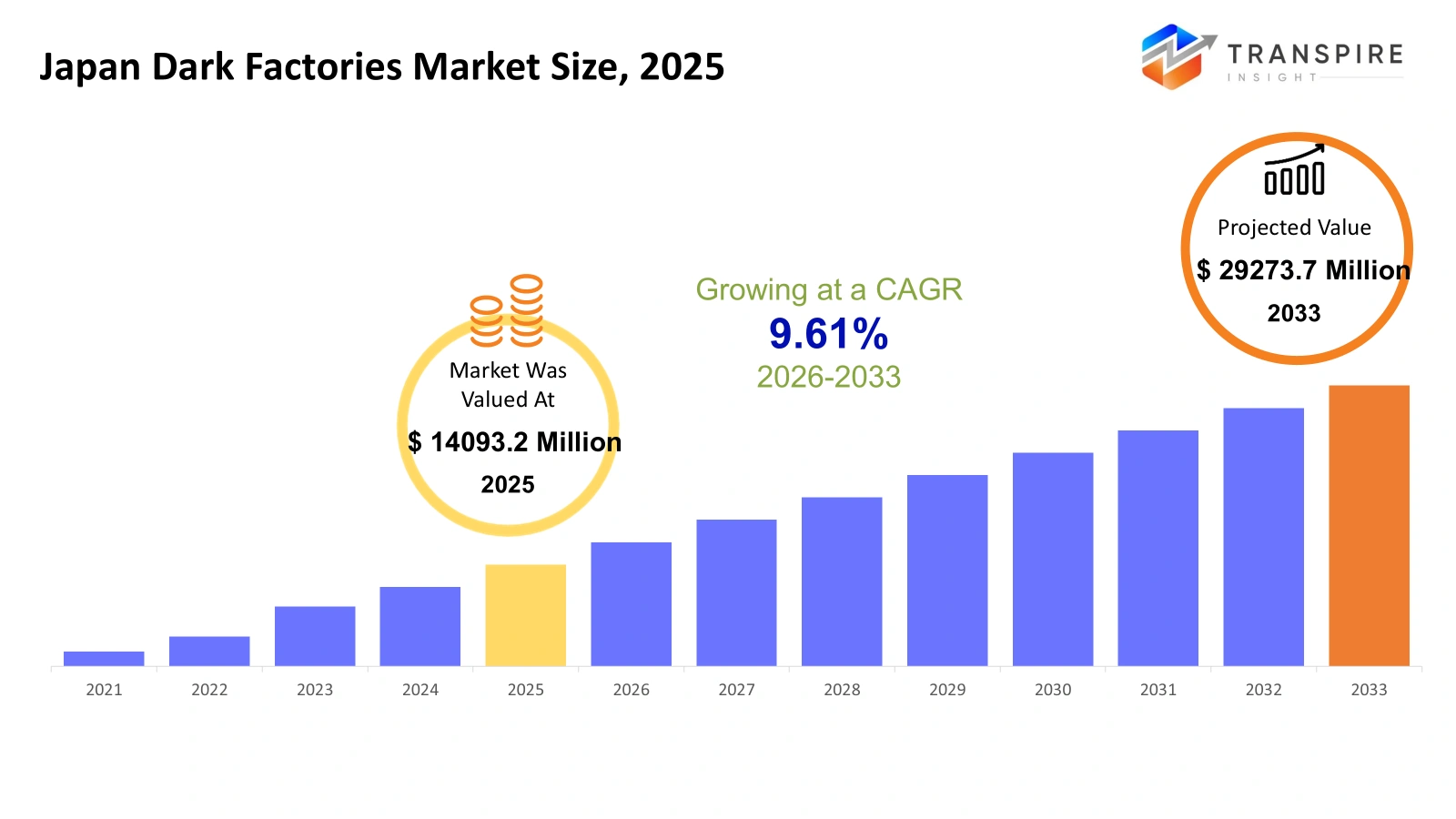
- Japan Dark Factories Market Size 2025: USD 14093.2 Million
- Japan Dark Factories Market Size 2033: USD 29273.7 Million
- Japan Dark Factories Market CAGR: 9.61%
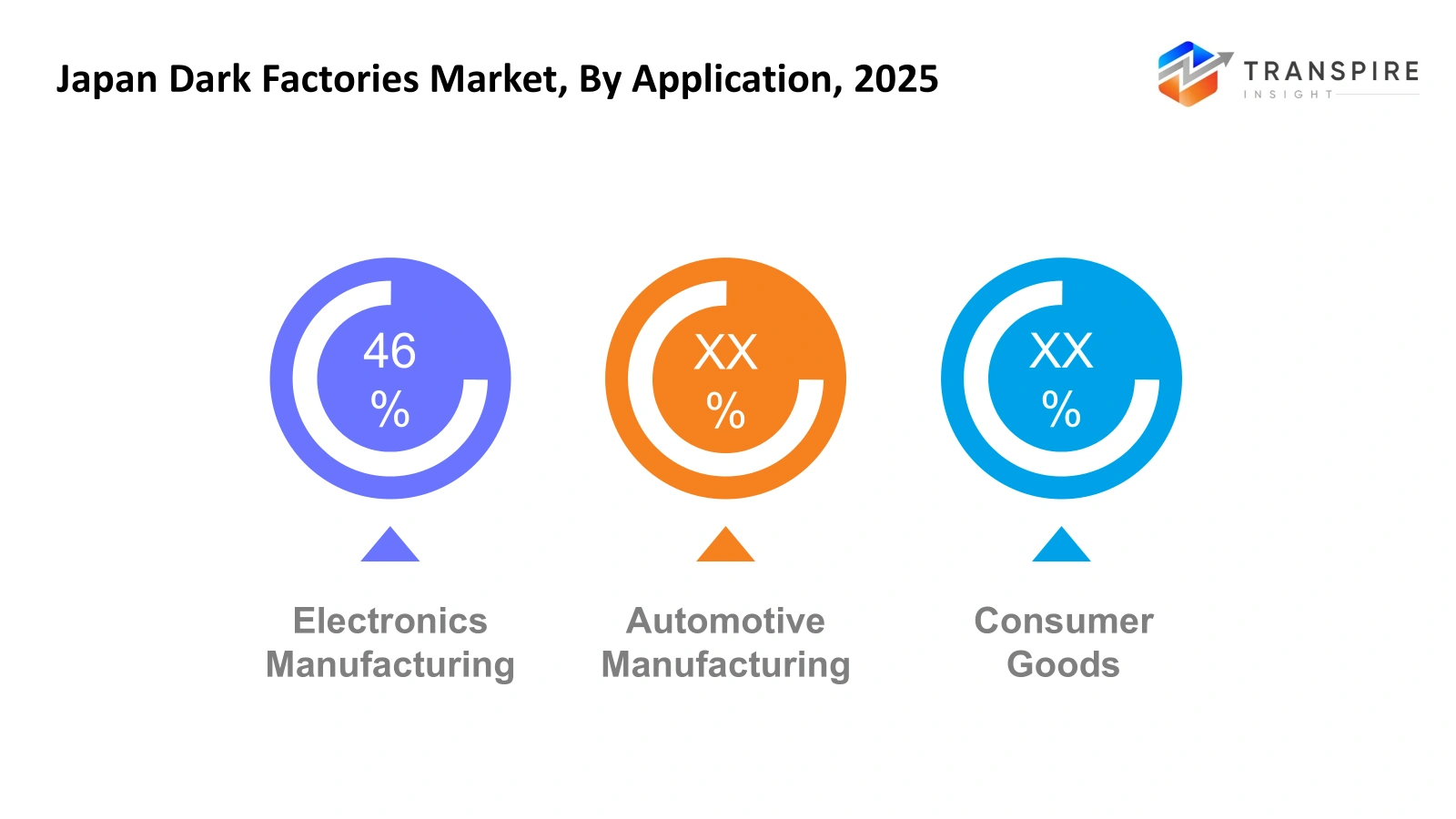
- Japan Dark Factories Market Segments:By Technology (Industrial Robots, AI Systems, IoT Sensors), By Application (Automotive Manufacturing, Electronics Manufacturing, Consumer Goods).
To learn more about this report,  Download Free Sample Report
Japan Dark Factories Market Summary:
The Japan Dark Factories Market size is estimated at USD 14093.2 Million in 2025 and is anticipated to reach USD 29273.7 Million by 2033, growing at a CAGR of 9.61% from 2026 to 2033. The Japan Dark Factories Market is experiencing substantial changes because automation together with AI technologies is transforming manufacturing operations. The "lights-out" factories function with reduced human involvement, which results in improved operational efficiency and precise results and reduced operational expenses. Japanese companies are increasing their investments in robotics and IoT systems and smart monitoring technologies to achieve continuous production while maintaining safety and quality standards. The growing need for advanced electronics and automotive parts drives companies to implement automated manufacturing systems, which establish Japan as a worldwide leader in intelligent production technologies.
Key Market Trends & Insights:
- Japanese manufacturers are now operating their factories with robotic systems and artificial intelligence systems which require less human operation because these technologies improve their operational efficiency while decreasing their operational expenses.
- The deployment of advanced IoT sensors and monitoring tools enables real-time production tracking, which enhances predictive maintenance capabilities while decreasing operational downtime.
- Dark factories control their energy use through automatic systems, which enables companies to achieve cost reductions and fulfil Japan's environmental sustainability targets.
- The manufacturing industry needs fully automated production facilities because of the increased demand for semiconductors and automotive parts and precision manufacturing equipment.
- Companies receive governmental assistance through Industry 4.0 programmes which create policies that support smart manufacturing and technological development to promote investments in lights-out factory operations.
- Japanese manufacturing companies require automation systems that protect workers from dangerous tasks while delivering stable product quality which meets their manufacturing quality standards.
- Japanese companies are joining forces with technology providers and startup businesses to create automated systems which will drive innovation in dark factory operations.
Japan Dark Factories Market Segmentation
By Technology
- Industrial Robots: Industrial robots operate continuously in Japan's dark factories because they execute standardised tasks which require high accuracy during all hours of the day. The system implementation leads to decreased workforce requirements, which boosts production capacity while maintaining uniform product standards in the automotive and electronics industries, thus enabling factories to operate as advanced intelligent systems.
- AI Systems: AI-driven systems manage workflow optimisation, predictive maintenance, and quality inspection in dark factories. AI technology enables organisations to make intelligent decisions by processing real-time data, which decreases operational errors and boosts work efficiency in Japan's development of fully autonomous high-tech manufacturing systems.
- IoT Sensors: The IoT sensors provide continuous monitoring of equipment performance and production flow and environmental conditions. The sensors enable machines to communicate without interruption, which allows predictive maintenance, energy optimisation and process transparency to operate as crucial elements for sustainable operation in Japan's dark factories.
By Application
- Automotive Manufacturing: Directing automotive production operations, dark factories automatically combine robotic systems with artificial intelligence technology to achieve vehicle assembly and component welding and inspection processes that need little human participation. The system delivers exceptional operational performance because it enables rapid processing times while maintaining compliance with Japan's strict quality standards that are essential for success in worldwide markets.
- Electronics Manufacturing: Semiconductor production, circuit board manufacturing and precision device creation require automation systems in electronics factories. Dark factory configurations increase production efficiency while decreasing operational mistakes and enabling factories to run their operations without interruption to produce products that satisfy the rising demands of both consumer electronics and industrial needs.
- Consumer Goods: Consumer goods manufacturing in Japan achieves operational advancement through dark factory systems that use automation for assembly work and packaging tasks and quality assessment procedures. The system achieves operation efficiency through speedier production processes and stable product quality and decreased staff expenses while maintaining flexibility to handle market fluctuations and different product requirements.
To learn more about this report, Download Free Sample Report
Country Insights
Japan leads the global dark factory movement because its technological expertise and industrial strength and research-based development drive its progress. The advanced manufacturing sector of the country, which includes automotive and electronics and precision machinery, has developed systems that operate continuously with minimal human need by using automation and artificial intelligence and Internet of Things monitoring technologies. Government initiatives that support Industry 4.0 and smart manufacturing technologies have increased the use of lights-out factories, which deliver efficient, sustainable and cost-effective operations. Japanese companies are making substantial investments in industrial robots and intelligent production systems to fulfil the increasing demand for high-quality precision products that exists both domestically and internationally. The energy-efficient production methods of the country and its predictive maintenance system both work to decrease equipment downtime and decrease environmental effects. Japan maintains its status as a worldwide leader in completely automated intelligent manufacturing systems through its technological advancements and skilled workforce and policies that support research and development, which establish standards for global dark factory operations.
Recent Development News
Japan’s smart manufacturing market is poised to reach $130.21B by 2035.
Japan’s automotive sector records the highest robot installations in five years.
|
Report Metrics |
Details |
|
Market size value in 2025 |
USD 14093.2 Million |
|
Market size value in 2026 |
USD 15402.5 Million |
|
Revenue forecast in 2033 |
USD 29273.7 Million |
|
Growth rate |
CAGR of 9.61% from 2026 to 2033 |
|
Base year |
2025 |
|
Historical data |
2021 – 2024 |
|
Forecast period |
2026 – 2033 |
|
Report coverage |
Revenue forecast, competitive landscape, growth factors, and trends |
|
Country scope |
Japan |
|
Key company profiled |
FANUC Corporation, Yaskawa Electric Corporation, Mitsubishi Electric Corporation, Omron Corporation, ABB Ltd., KUKA AG, Siemens AG, Bosch Rexroth AG, Schneider Electric SE, Rockwell Automation Inc., Hitachi Ltd., Toshiba Corporation, Foxconn Technology Group, Samsung Electronics, Intel Corporation. |
|
Customization scope |
Free report customization (country, regional & segment scope). Avail customized purchase options to meet your exact research needs. |
|
Report Segmentation |
By Technology (Industrial Robots, AI Systems, IoT Sensors), By Application (Automotive Manufacturing, Electronics Manufacturing, Consumer Goods). |
Key Japan Dark Factories Company Insights
Japanese manufacturers lead the development of dark factories through their strategic investments in robotics and AI systems and IoT-enabled solutions. Companies work to improve their operational efficiency while maintaining product quality and decreasing their need for employees. The partnership between technology providers and startups enables organisations to develop new solutions for automation and predictive maintenance and smart monitoring. Major companies in the automotive, electronics and consumer goods industries prioritise energy efficiency and sustainable practices while they increase their production capacity. Japan establishes itself as a worldwide centre for complete automated intelligent manufacturing systems through its active development efforts.
Company List
- FANUC Corporation
- Yaskawa Electric Corporation
- Mitsubishi Electric Corporation
- Omron Corporation
- ABB Ltd.
- KUKA AG
- Siemens AG
- Bosch Rexroth AG
- Schneider Electric SE
- Rockwell Automation Inc.
- Hitachi Ltd.
- Toshiba Corporation
- Foxconn Technology Group
- Samsung Electronics
- Intel Corporation.
Japan Dark Factories Market Report Segmentation
By Technology
- Industrial Robots
- AI Systems
- IoT Sensors
By Application
- Automotive Manufacturing
- Electronics Manufacturing
- Consumer Goods
Frequently Asked Questions
Find quick answers to common questions.
The Approximate Japan Dark Factories Market size for the Market will be USD 29273.7 Million in 2033.
The key Segments of the Japan Dark Factories Market are By Technology (Industrial Robots, AI Systems, IoT Sensors), By Application (Automotive Manufacturing, Electronics Manufacturing, Consumer Goods).
Major Players in the Japan Dark Factories Market are FANUC Corporation, Yaskawa Electric Corporation, Mitsubishi Electric Corporation, Omron Corporation, ABB Ltd., KUKA AG, Siemens AG, Bosch Rexroth AG, Schneider Electric SE, Rockwell Automation Inc., Hitachi Ltd., Toshiba Corporation, Foxconn Technology Group, Samsung Electronics, Intel Corporation.
The Current Market size of the Japan Dark Factories Market is USD 14093.2 Million in 2025.
The Japan Dark Factories Market CAGR is 9.61%.
- FANUC Corporation
- Yaskawa Electric Corporation
- Mitsubishi Electric Corporation
- Omron Corporation
- ABB Ltd.
- KUKA AG
- Siemens AG
- Bosch Rexroth AG
- Schneider Electric SE
- Rockwell Automation Inc.
- Hitachi Ltd.
- Toshiba Corporation
- Foxconn Technology Group
- Samsung Electronics
- Intel Corporation.
Recently Published Reports
-
Apr 2026
Handling and Lifting Equipment Market
Handling and Lifting Equipment Market Size, Share & Analysis Report By Product (Cranes and Hoists, Forklifts, Conveyor Systems, Aerial Work Platforms, Others), By Application (E-Commerce, Automotive and Railway, Food and Beverages, Aviation, Others), and Geography (North America, Europe, Asia-Pacific, Middle East and Africa, South and Central America), 2021 - 2031
-
Apr 2026
HVAC Equipment Market
HVAC Equipment Market Size, Share & Analysis Report By Heating Equipment Type (Boilers and Furnaces, Heat Pumps, and Unitary Heaters), By Ventilation Equipment (Air Handling Units, Humidifiers and Dehumidifiers, Air Filters, and Fan Coiling Units), By Air Conditioning Equipment (Unitary Air Conditioners, Room Air Conditioners, Packaged Terminal Air Conditioners, and Chillers), By End User (Commercial, Residential, Industrial, and others), and Geography (North America, Europe, Asia-Pacific, Middle East and Africa, South and Central America), 2021 – 2031
-
Apr 2026
Refrigeration Valves Market
Refrigeration Valves Market Size, Share & Analysis Report By Type (Solenoid Valves, Expansion Valves, Check Valves, Service Valves, Others), By Application (Commercial Refrigeration, Industrial Refrigeration, Transport Refrigeration, Residential Refrigeration, Air Conditioning Systems), By End User (Food and Beverage Industry, Pharmaceutical Industry, HVAC Industry, Chemical Industry, Others), and Geography (North America, Europe, Asia-Pacific, Middle East and Africa, South and Central America), 2021 – 2031
-
Apr 2026
E-Commerce Packaging Materials Market
E-Commerce Packaging Materials Market By Material Type (Corrugated Boxes, Paper & Paperboard, Foam & Cushioning Materials, Plastic Packaging, Flexible Packaging, Protective Packaging, Others), By Product(Primary Packaging, Secondary Packaging, Tertiary Packaging), By Packaging Function (Protective Packaging, Branding & Presentation Packaging, Transit & Logistic Packaging, Sustainable Packaging, Tamper Evidence Packaging), By End-User (Retail & Consumer Goods, Electronic Appliances, Food & Beverages, Healthcare & Pharmaceutical, Fashion & Apparel, Home & Furnishing, Others); By Industry Analysis, Size, Share, Growth, Trends, and Forecasts 2021-2033