

Asia Pacific Cork Building Materials Market Size & Forecast:
- Asia Pacific Cork Building Materials Market Size 2025: USD 486.5 Million
- Asia Pacific Cork Building Materials Market Size 2033: USD 687.4 Million
- Asia Pacific Cork Building Materials Market CAGR: 4.35%
- Asia Pacific Cork Building Materials Market Segments: By Product Type (Cork Insulation, Cork Flooring, Cork Wall Panels, Cork Underlayment, Cork Roofing, Cork Acoustic Panels, Cork Tiles, Others); By Application (Residential Buildings, Commercial Buildings, Industrial Buildings, Renovation Projects, Green Buildings, Hospitality Projects, Institutional Buildings, Others); By Distribution Channel (Direct Sales, Distributors, Online Retail, Specialty Stores, Builders Merchants, Wholesale Suppliers, Retail Chains, Others); By End User (Construction Companies, Architects, Homeowners, Interior Designers, Real Estate Developers, Contractors, Facility Managers, Others)
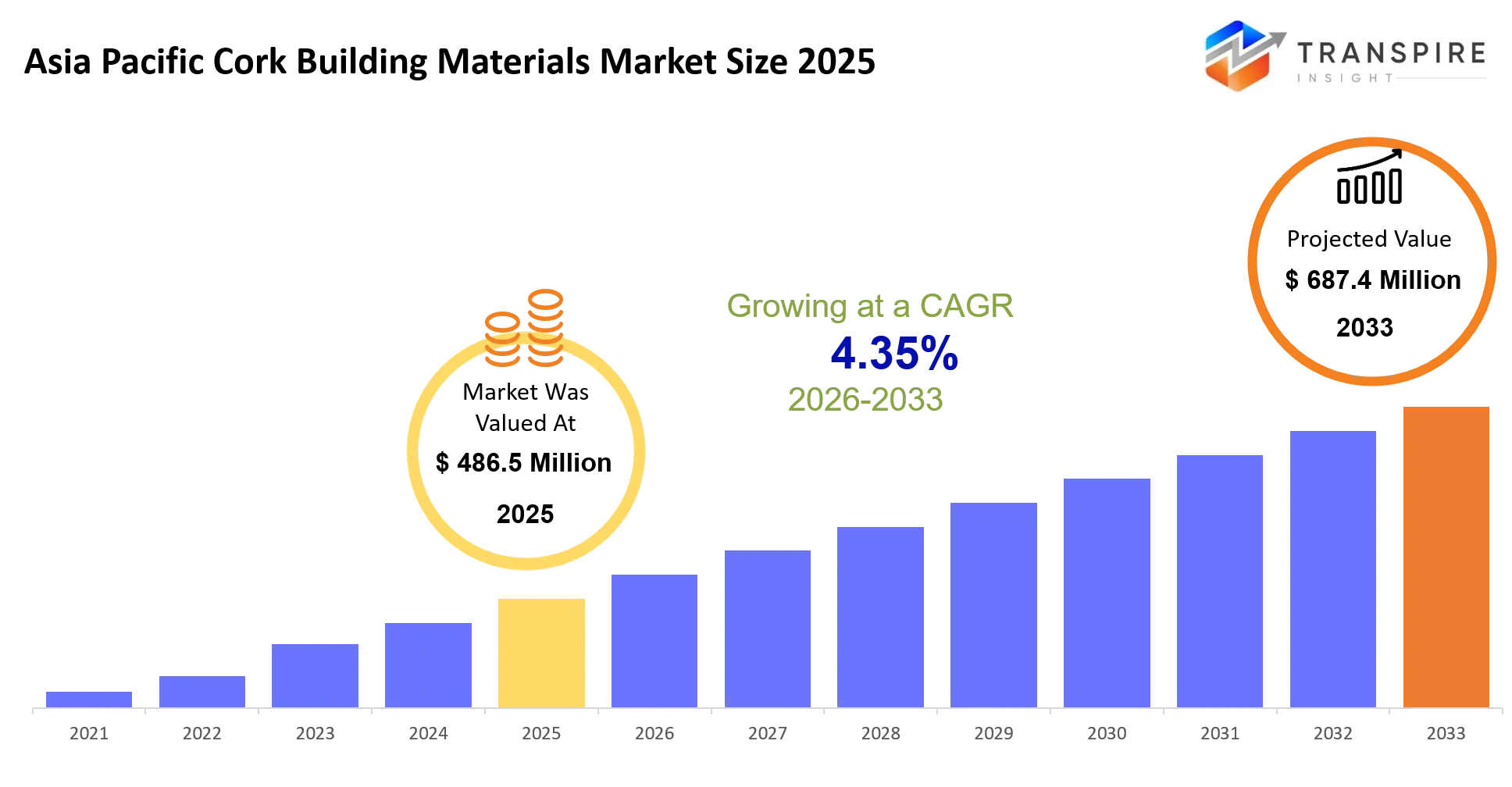
Asia Pacific Cork Building Materials Market Summary
The Asia Pacific Cork Building Materials Market was valued at USD 486.5 Million in 2025. It is forecast to reach USD 687.4 Million by 2033. That is a CAGR of 4.35% over the period.
Applications for cork building materials in Asia Pacific were mostly as sealing, insulation, damping and expansion control products used in buildings, transport structures, and in marine assemblies. Specifically the applications are to help structures withstand thermal strain, to insulate against unwanted noise transfer, to cushion against vibrations, and to accommodate expansion, in moving joints and at stress points, predominantly in commercial building projects and inside vessels.
In the last 3-5 years, the market has moved from specific architectural niches to systemic integration into green construction, as structural movement out of petrochemical foams and synthetic rubbers to bio-based, low-emission products became a trend. Post pandemic supply chain disruption and demonstrated price and availability fluctuations in synthetic insulation inputs were major triggers for this accelerated substitution during project procurement.
Consequently, cork composites are now being integrated into design specifications and procurement frameworks in support of margin growth for suppliers, enabling fuller penetration into standard construction and marine engineering processes rather than discrete specialist applications.
Key Market Insights
- Asia Pacific Cork Building Materials Market is undergoing structural change with replacement of synthetic foams with bio-based insulation systems across construction and marine industries.
- Growth in Green building codes across the region in 2024 led to an increase in adoption of cork with China and India witnessing demand increase, as the low-VOC compliance mandates toughened the procurement process for inputs.
- Supply chain disruptions through the 2020-2022 period pushed developers to broaden the sources for their building materials and enhance development of hybrid composite material and cork as input from the region.
- Regional Analysis: China accounted for almost 42% share in 2025 backed by the massive construction projects related to infrastructure and commercial retrofit.
- Southeast Asia is expected to witness the highest CAGR over 2032 driven by the demand from coastal infrastructure development and marine engineering.
- Segment Analysis: Cork insulation boards captured nearly 36% share in Asia Pacific Cork Building Materials Market backed by growing demand from the sector on the back of thermal efficiency.
- Cork flooring accounted for the second-highest share that is widely used across the commercial interior designs to attain acoustic efficiency and green building credentials.
- Application Insight: Building insulation application secured over 45% share with increased adoption among urban building retrofits that focused on energy efficiency in 2025.
- Marine vibration and expansion control application registered the highest CAGR driven by modern shipbuilding processes and revised emission regulation for vessels in 2032.
- End User Insight: Residential construction has the largest share of nearly 38% of the Asia Pacific Cork Building Materials Market backed by expansion of mid-income housing in China and India.
What are the Key Drivers, Restraints, and Opportunities in the Asia Pacific Cork Building Materials Market?
Green construction regulatory policies in China, India and Southeast Asia requiring the use of low-VOC and recyclable insulation materials in public/commercial projects. The policy shifts will spur additional demand for cork products due to the need to substitute existing synthetic foams which do not meet the new regulations. As regulations penetrate into retrofit applications and become established in marine construction guidelines, design specifications now include cork-based panels/composites, rather than merely replacing the original synthetics. These predictable contract revenues will drive stable market expansion in Asia Pacific Cork Building Materials Market.
Underdeveloped regional infrastructure for cork processing, thereby increasing reliance on imported raw cork from European sources. This will raise landed costs and supply lead-time variability in large infrastructure projects. The geographically concentrated supply (and long growth cycles of cork) will not be sufficient for abrupt, construction industry-led demand spikes. This will likely lead procurement managers to prefer local alternatives, constraining potential market expansion even when sustainable materials demand is high, in the Asia Pacific Cork Building Materials Market.
Application of cork-based hybrid composites in marine and transport engineering, especially in the shipbuilding centers like South Korea and coastal China. Research & development in polymer-bounded cork panel technologies will enhance load-bearing and durability properties of these composites to substitute existing rigid insulation materials and allow integration into vibration damping systems. Initial pilot projects using these cork composites in naval retrofits and offshore platforms prove high performance vibration damping and low lifetime costs. As Asian shipyards update fleet efficiency to satisfy stricter regulations, these materials could tap into an expanded addressable market.
What Has the Impact of Artificial Intelligence Been on the Asia Pacific Cork Building Materials Market?
The role of AI is growing in optimizing production processes and life cycle of cork-based building materials and marine insulation systems. During the production process in cork-based building materials and marine insulation systems, AI-based process control systems are used in the real-time tracking of cork granulation, glue curing, and density calibration. This helps in reducing material scrap and improves the consistency of batches produced. Predictive analytics models are being developed to predict tool wear for presses and molds and to optimize planned maintenance of equipment, therefore lowering idle time of insulation production.
In the latter part of the life cycle of cork-based building materials and marine insulation systems, the AI-based building management system collects the performance characteristics of the cork-based insulation panels to analyze thermal loads and energy use in the building. ML models are being piloted for simulations to predict how cork-polymer composite structures under irregular sea conditions will behave due to vibration. Long-term performance is being predicted to prevent excess engineering. However, small manufacturers face the challenge of the scarcity of fragmented production data and poor standardization in sensor integration. Such factories lack the digital infrastructure that can enable sufficient data for model training, and it will take longer for predictive models to be utilized in the field. Thus, the utilization of AI technology continues to optimize production costs, quality of the materials and the life cycle across the Asia Pacific Cork Building Materials Market and related marine emission control and insulation systems.
Key Market Trends
- Stricter green building codes adopted between 2023 and 2025 spurred Chinese and Indian builders to switch from artificial insulating materials to cork based alternatives.
- Post-pandemic supply chain shocks faced in 2020-2022 unveiled vulnerability to European cork imports sparking efforts in regional supply diversification.
- Transition away from petrochemical foams intensified as buyers sought low emission building materials following reinforced carbon disclosure regulations established in 2024.
- The advent of cork-polymer hybrid composites after 2021 reinforced structural strength to enable expanded use in applications other than solely insulation.
- Modernization in marine shipbuilding across South Korea and China since 2022 stimulated increased use of cork for vibration dampening and as lightweight structural elements.
- Increased expansion of infrastructure across Southeast Asia beginning in 2023 drove demand growth toward cork based acoustic flooring within commercial and hospitality developments.
- The region saw significant APAC expansion efforts from major players such as Corticeira Amorim and Kingspan, largely facilitated through strategic partnerships and a portfolio of certified low-carbon offerings.
- AI powered production controls implemented after 2022 resulted in improved density consistency and lowered production waste across automated cork processing facilities.
- Wide-scale adoption of lifecycle carbon accounting since 2024 helped shape sourcing strategies, increasing preference for cork materials within bids for certified green building projects.
Asia Pacific Cork Building Materials Market Segmentation
By Product Type:
The demand for cork insulation remains high because of the need to control building temperature and sounds. In addition to a rise in the demand for cork floor tiles and cork wall panels to address safe interior materials. There has been a slow rise in demand for cork underlayment, cork roofing, cork wall paneling, cork flooring and tiles, along with other related products to match increasing city-level renovations.
Strong demand is expected to remain in cork insulation because of increased regulations on energy saving methods in building construction. There has been a significant growth in demand for cork wall and sound panels to use in commercial constructions where noise levels are a priority. Demand for cork tiles and floor tiling has increased significantly due to demand in homes, while cork roofing and underlayment have shown slow growth for special construction.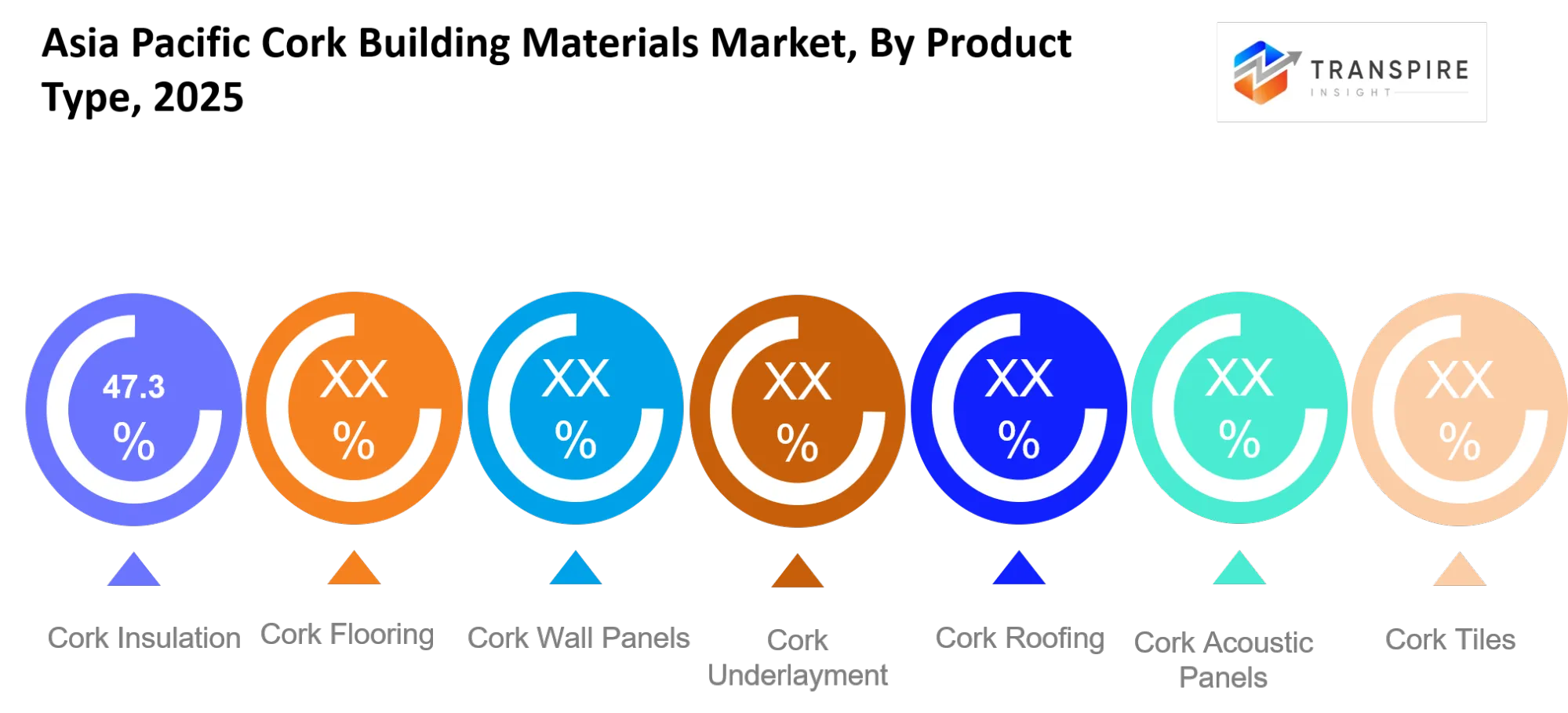
By Application:
Use in the residential area continues to lead due to expanding residential construction in urban areas. In the commercial sector buildings are quick to use cork for offices and shops due to the importance of comfort and noise control. Industrial buildings mainly use cork for shock control, while renovations are more frequently using cork due to age and the requirement for safe and lasting building materials.
Buildings that use sustainable methods (green buildings) and hospitality establishments were among the first to respond to strict new building guidelines. Institutions use a greater percentage of cork for comfort and security in schools and medical buildings. Other usage of cork remains at a lower level but has increased steadily due to the growing demand for durable and energy efficient materials in building.
By Distribution Channel:
Direct sales will continue to be a significant trend since bulk cork materials require supplier contracts due to their volume to larger construction companies. Distributors will see their market reach extend to medium-sized cities where the proportion of project based buying grows. Online retailers see slow development for small quantity orders while specialists cater to interior decoration demands. Construction materials merchants and wholesale dealers satisfy the moderate project supplies.
The retail chains have witnessed rise due to the need of home decoration and reconstruction consumers seeking immediate availability. Direct purchase shall continue to be dominant in huge infrastructural projects to ensure cost-saving and high quality needs. Distributors and wholesale dealers will develop to cater to scattered region building demands while online retail and specialists will grow incrementally according to the increasing demand in small-scale remodeling.
By End User:
Construction companies are at the forefront of usage since cork is now incorporated in insulation and finishes planning for new constructions. Architects promote the application of cork for its thermal and acoustic benefits. Homeowners adopt cork predominantly for flooring and interiors, and interior designers focus on the adoption of comfort-related materials for modern buildings.
Real estate developers have increased their use of cork in order to satisfy green building criteria and for an attractive market approach with the incorporation of sustainable design. Contractors take responsibility for installations for all commercial and residential constructions to assure appropriate material applications. Facility managers apply cork for ease of maintenance for existing buildings. Other users have remained somewhat limited for the time being, but their consumption rates are expected to grow as consumers increasingly recognize their cost and comfort-enhancing potential in the long run.
What are the Key Use Cases Driving the Asia Pacific Cork Building Materials Market?
The major application is within the building insulation segment in residential & commercial building construction. The high-density urban construction where there is a growing need for energy efficiency and thermal insulation due to increase in costs to achieve the mandated comfort standards due to new green building codes has witnessed a rise in demand of cork usage for both thermal and acoustic insulation.
Secondary application of flooring and acoustic wall panels in office spaces, hospitality spaces & institutional buildings are finding increased traction in various market segments. It's use in high-end fit-outs & renovations where architectural and property developers use cork to enhance noise control & get sustainable certification standards in place.
Emerging applications are being tested in vibration damping systems for industrial building construction & marine construction as a core component in lightweight composite panels. Furthermore, it is also used for retrofitting aged infrastructure by contractors and facility managers as its efficiency in enhancing building durability and in lowering long-term maintenance costs will gain further momentum in the Asian Pacific under rising environmental compliance needs.
|
Report Metrics |
Details |
|
Market size value in 2025 |
USD 486.5 Million |
|
Market size value in 2026 |
USD 510.2 Million |
|
Revenue forecast in 2033 |
USD 687.4 Million |
|
Growth rate |
CAGR of 4.35% from 2026 to 2033 |
|
Base year |
2025 |
|
Historical data |
2021 - 2024 |
|
Forecast period |
2026 - 2033 |
|
Report coverage |
Revenue forecast, competitive landscape, growth factors, and trends |
|
Regional scope |
Asia Pacific (India, China, Japan, Australia, South Korea, Rest of Asia Pacific) |
|
Key company profiled |
Amorim, Corksribas, Granorte, MJO Cork, USFloors, Wicanders, Jelinek Cork, Capri Cork, Expanko, Zandur, WE Cork, AcoustiCORK, Cork House, Corkart, Sedacor |
|
Customization scope |
Free report customization (country, regional & segment scope). Avail customized purchase options to meet your exact research needs. |
|
Report Segmentation |
By Product Type (Cork Insulation, Cork Flooring, Cork Wall Panels, Cork Underlayment, Cork Roofing, Cork Acoustic Panels, Cork Tiles, Others); By Application (Residential Buildings, Commercial Buildings, Industrial Buildings, Renovation Projects, Green Buildings, Hospitality Projects, Institutional Buildings, Others); By Distribution Channel (Direct Sales, Distributors, Online Retail, Specialty Stores, Builders Merchants, Wholesale Suppliers, Retail Chains, Others); By End User (Construction Companies, Architects, Homeowners, Interior Designers, Real Estate Developers, Contractors, Facility Managers, Others) |
Which Regions are Driving the Asia Pacific Cork Building Materials Market Growth?
China maintains its top position owing to huge urbanization projects and stringent compliance to green building standards. Energy efficient promotion campaigns by the Chinese government compelled builders to include cork-based insulation in the public and commercial structures such as offices, buildings complexes etc. Moreover, abundant domestic supply of construction leads to increased usage in tier 1 and tier 2 cities with faster implementation. The combination of the aforementioned factors provide China a stable demand that continues to place it as a regional leader.
The steady second position has been claimed by India owing to strong demands for continued development of infrastructures and the consistent housing development programs that drive demand for sustainable building materials in the country. However, policy implementation and the cost efficient properties of the material is what drive its growth unlike China. Use of cork in the development of residential and institutional buildings increased due to growing comfort requirements. With constant economic stability and development of infrastructure the consumption in tier 1 and tier 2 cities such as Mumbai and Delhi is predictable to remain stable.
The fastest growing region is Southeast Asia owing to robust investment in development of hospitality and tourism sectors, commercial properties, and coastal regions. Development of tourism facilities, public spaces etc has increased in the regions such as Indonesia and Vietnam post 2022 with rise in FDI inflows. Port and airport constructions led by strong government support and investments to the regions have created an indirect demand in acoustic and insulating properties used for hotels, restaurants etc. The regions offer significant growth opportunities between 2026 and 2033 focusing on mid-range development and refurbishment sectors.
Who are the Key Players in the Asia Pacific Cork Building Materials Market and How Do They Compete?
The structure of the Asia Pacific Cork Building Materials Market is somewhat fragmented, with global insulation producers competing alongside specialty cork material suppliers. Key areas of competition among market players include product performance, certification of sustainability with Green Building standards, and application potential for hybrid systems. Existing manufacturers are emphasizing supply consistency and expanding the catalog of certified low carbon building materials in an attempt to secure long-term supply agreements with builders and developers. Competition based solely on price is secondary in most larger projects due to the criteria of certification and technical performance.
Corticeira Amorim is emphasizing new composite development for increased durability, application beyond mere insulation, and structural components. Kingspan Group emphasizes integrated systems and well-established partnerships with commercial developers, especially within high density markets. Sika leverages cork composites within integrated sealing and adhesive solutions to improve installation time. Owens Corning and Rockwool are leveraging existing distribution channels, certified thermal performance options, and partnerships with local developers. These global brands have established or increased presence in Asia Pacific by adapting their products to fit tropical climate conditions or coastal environments, building local partnerships, and employing local manufacturing methods.
Company List
- Amorim
- Corksribas
- Granorte
- MJO Cork
- USFloors
- Wicanders
- Jelinek Cork
- Capri Cork
- Expanko
- Zandur
- WE Cork
- AcoustiCORK
- Cork House
- Corkart
- Sedacor
Recent Development News
In March 2025, Kingspan Group announced the acquisition of HPS North America, expanding its building finishing portfolio in Asia-linked supply chains. The move strengthens Kingspan’s integration strategy and improves regional production alignment for insulation and envelope systems. Sourcehttps://www.kingspan.com/
In February 2025, Saint-Gobain completed the acquisition of FOSROC, strengthening its construction chemicals presence across Asia-Pacific and emerging markets. The acquisition expands its product reach in waterproofing and infrastructure materials used in large-scale construction projects. Sourcehttps://www.saint-gobain.com/
What Strategic Insights Define the Future of the Asia Pacific Cork Building Materials Market?
The Asia Pacific Cork Building Materials Market is moving towards increased inclusion in regulated building systems, where selection decisions will increasingly focus on carbon reporting and life cycle compliance and energy performance. Within 5-7 years, market development will be shifted from a preference for discretionary usage in interiors towards specifications for insulation and vibration dampening, spurred by developing stringent green building codes across China, India and Southeast Asia.
A less prominent risk could be the dependency on narrowly localized supply chain processes for cork which place this market at risk of pricing volatility or project delays if European harvesting schedules are contracted or transit problems reoccur. On the flipside, the pressure of replacement will increase if more sophisticated bio-foams can match this performance at reduced price levels.
A development opportunity arises from the potential for cork-polymer hybrid composites to be integrated with the dense building infrastructure of the regions that need a high number of retrofit projects. Especially in coastal megacities, such urban infrastructure may require refurbishment of existing commercial buildings for energy code compliance. For this, firms should leverage local processing partnerships in the Asia region and invest in certified hybrid product categories and specifications for public purchasing that would grant a secure place in longer term contracts and contribute to stable profit margins.
Asia Pacific Cork Building Materials Market Report Segmentation
By Product Type
- Cork Insulation
- Cork Flooring
- Cork Wall Panels
- Cork Underlayment
- Cork Roofing
- Cork Acoustic Panels
- Cork Tiles
By Application
- Residential Buildings
- Commercial Buildings
- Industrial Buildings
- Renovation Projects
- Green Buildings
- Hospitality Projects
- Institutional Buildings
By Distribution Channel
- Direct Sales
- Distributors
- Online Retail
- Specialty Stores
- Builders Merchants
- Wholesale Suppliers
- Retail Chains
By End User
- Construction Companies
- Architects
- Homeowners
- Interior Designers
- Real Estate Developers
- Contractors
- Facility Managers
Frequently Asked Questions
Find quick answers to common questions.
The Asia Pacific Cork Building Materials Market size is USD 687.4 Million in 2033.
Key Segments for the Asia Pacific Cork Building Materials Market are By Product Type (Cork Insulation, Cork Flooring, Cork Wall Panels, Cork Underlayment, Cork Roofing, Cork Acoustic Panels, Cork Tiles, Others); By Application (Residential Buildings, Commercial Buildings, Industrial Buildings, Renovation Projects, Green Buildings, Hospitality Projects, Institutional Buildings, Others); By Distribution Channel (Direct Sales, Distributors, Online Retail, Specialty Stores, Builders Merchants, Wholesale Suppliers, Retail Chains, Others); By End User (Construction Companies, Architects, Homeowners, Interior Designers, Real Estate Developers, Contractors, Facility Managers, Others).
Major Asia Pacific Cork Building Materials Market Players are Amorim, Corksribas, Granorte, MJO Cork, USFloors, Wicanders, Jelinek Cork, Capri Cork, Expanko, Zandur, WE Cork, AcoustiCORK, Cork House, Corkart, Sedacor.
The Current Asia Pacific Cork Building Materials Market size is USD 486.5 Million in 2025.
The Asia Pacific Cork Building Materials Market CAGR is 4.35% from 2026 to 2033.
- Amorim
- Corksribas
- Granorte
- MJO Cork
- USFloors
- Wicanders
- Jelinek Cork
- Capri Cork
- Expanko
- Zandur
- WE Cork
- AcoustiCORK
- Cork House
- Corkart
- Sedacor
About the Authors

Kartik bhong
I am Kartik Bhong, a Senior Research Analyst at Transpire Insight, specializing in the Packaging, Manufacturing, and Construction industry. My work focuses on analyzing market trends, emerging technologies, industry regulations, and competitive landscapes to deliver accurate, data-driven insights. I am passionate about transforming complex industry information into clear, practical content that helps businesses, professionals, and decision-makers stay informed and make confident strategic decisions. Through continuous research and a strong commitment to accuracy, I strive to create reliable, well-researched content that reflects the latest developments across these dynamic industries and supports the vision of Transpire Insight in delivering valuable market intelligence.

Chakradhar Khansole
Chakradhar serves as the Research Director at Transpire Insight, bringing over 8 years of experience in technology, innovation, and strategic market intelligence. He specializes in transforming complex market data into actionable business insights that enable organizations to make informed, growth-oriented decisions. Recognized for his strategic vision and analytical expertise, Chakradhar leads high-impact research initiatives, delivering comprehensive market assessments, competitive intelligence, and forward-looking industry analysis.
Recently Published Reports
-
Apr 2026
Handling and Lifting Equipment Market
Handling and Lifting Equipment Market Size, Share & Analysis Report By Product (Cranes and Hoists, Forklifts, Conveyor Systems, Aerial Work Platforms, Others), By Application (E-Commerce, Automotive and Railway, Food and Beverages, Aviation, Others), and Geography (North America, Europe, Asia-Pacific, Middle East and Africa, South and Central America), 2021 - 2031
-
Apr 2026
HVAC Equipment Market
HVAC Equipment Market Size, Share & Analysis Report By Heating Equipment Type (Boilers and Furnaces, Heat Pumps, and Unitary Heaters), By Ventilation Equipment (Air Handling Units, Humidifiers and Dehumidifiers, Air Filters, and Fan Coiling Units), By Air Conditioning Equipment (Unitary Air Conditioners, Room Air Conditioners, Packaged Terminal Air Conditioners, and Chillers), By End User (Commercial, Residential, Industrial, and others), and Geography (North America, Europe, Asia-Pacific, Middle East and Africa, South and Central America), 2021 – 2031
-
Apr 2026
Refrigeration Valves Market
Refrigeration Valves Market Size, Share & Analysis Report By Type (Solenoid Valves, Expansion Valves, Check Valves, Service Valves, Others), By Application (Commercial Refrigeration, Industrial Refrigeration, Transport Refrigeration, Residential Refrigeration, Air Conditioning Systems), By End User (Food and Beverage Industry, Pharmaceutical Industry, HVAC Industry, Chemical Industry, Others), and Geography (North America, Europe, Asia-Pacific, Middle East and Africa, South and Central America), 2021 – 2031
-
Apr 2026
E-Commerce Packaging Materials Market
E-Commerce Packaging Materials Market By Material Type (Corrugated Boxes, Paper & Paperboard, Foam & Cushioning Materials, Plastic Packaging, Flexible Packaging, Protective Packaging, Others), By Product(Primary Packaging, Secondary Packaging, Tertiary Packaging), By Packaging Function (Protective Packaging, Branding & Presentation Packaging, Transit & Logistic Packaging, Sustainable Packaging, Tamper Evidence Packaging), By End-User (Retail & Consumer Goods, Electronic Appliances, Food & Beverages, Healthcare & Pharmaceutical, Fashion & Apparel, Home & Furnishing, Others); By Industry Analysis, Size, Share, Growth, Trends, and Forecasts 2021-2033