

Asia Pacific Cashew Nut Kernel Market Size & Forecast:
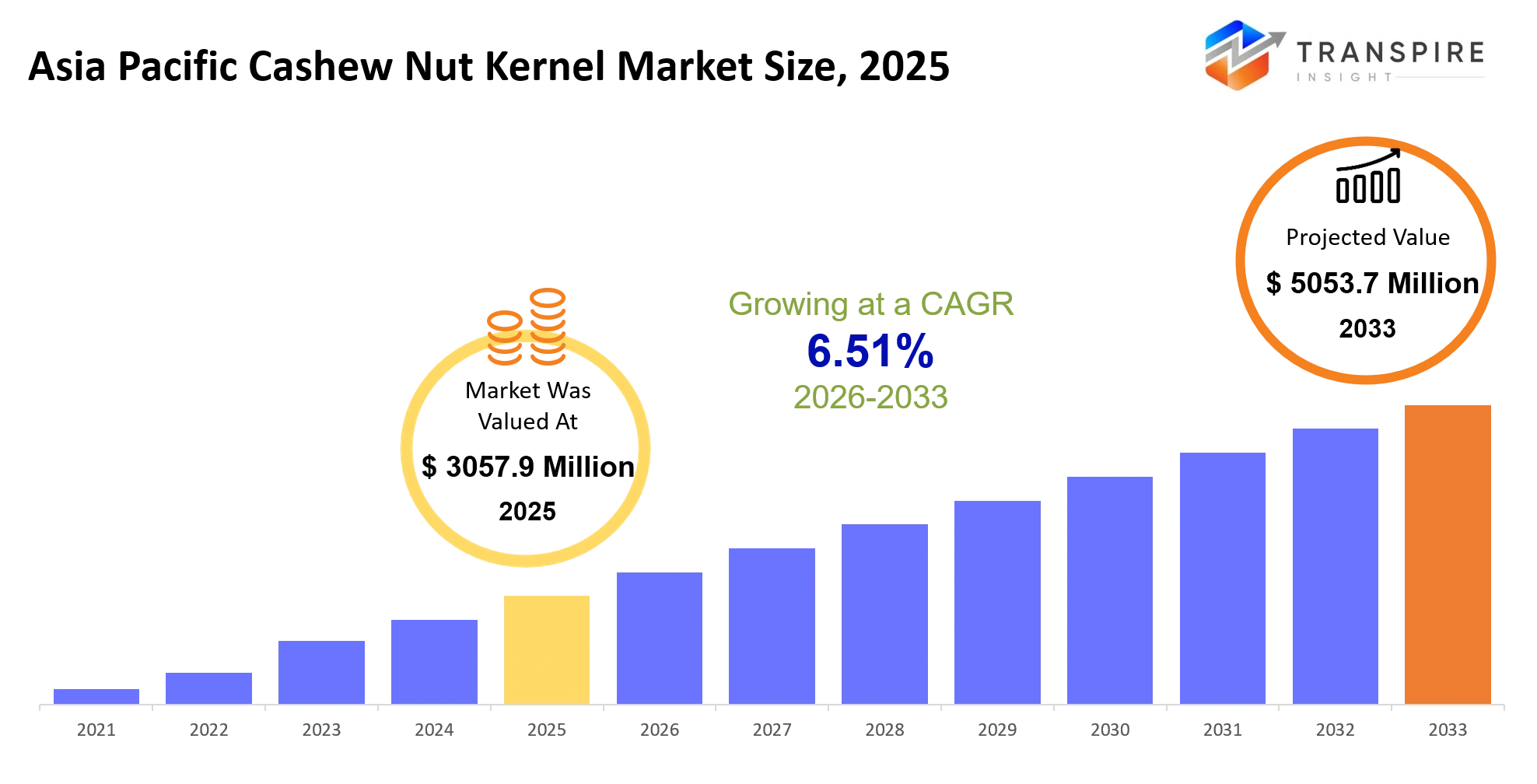
- Asia Pacific Cashew Nut Kernel Market Size 2025: USD 3057.9 Million
- Asia Pacific Cashew Nut Kernel Market Size 2033: USD 5053.7 Million
- Asia Pacific Cashew Nut Kernel Market CAGR: 6.51%
- Asia Pacific Cashew Nut Kernel Market Segments: By Product Type (Whole Kernels, Broken Kernels, Roasted Kernels, Flavored Kernels, Organic Kernels, Others); By Grade (W180, W210, W240, W320, W450, Others); By Distribution Channel (Retail, Wholesale, Online, Others); By End User (Food Processing, Households, Foodservice, Others).
Asia Pacific Cashew Nut Kernel Market Summary
The Asia Pacific Cashew Nut Kernel Market was valued at USD 3057.9 Million in 2025. It is forecast to reach USD 5053.7 Million by 2033. That is a CAGR of 6.51% over the period.
In the Asia Pacific cashew nut kernel market, it sort of plays a critical part in supplying food manufacturers, snack brands, bakeries and also foodservice operators with a versatile ingredient that delivers nutrition, texture, and premium product positioning. Cashew kernels are used broadly in packaged snacks, confectionery, dairy alternatives, ready-to-eat meals, and plant based formulations, which means producers can better align with what consumers are asking for, healthier options and more value-added food products, basically.
Over the last five years the market has been shifting in a more structural way toward processed, branded, and even application-specific kernels, rather than doing the whole bulk commodity trade. Food manufacturers now increasingly want consistent quality, traceability, and customized grades to support product innovation. And the COVID-19 pandemic, well that thing became a major trigger. It disrupted labor availability, logistics routes and export flows, so processors and buyers started diversifying sourcing approaches and also tried to strengthen supply chain resilience, more or less.
Right now, expansion is being supported by the rising integration of cashew kernels into premium snacks and plant based food categories. When manufacturers add cashews into higher-margin items, value realization improves across the supply chain, which in turn supports stronger revenues, plus more investment into processing capacity across the region.
Key Market Insights
- Dominant share and strong processing and exporting infrastructure in India make it the leader in Asia Pacific Cashew Nut Kernel Market with an estimated market share of 40%+.
- The value-added flavored and processed kernels will grow at the fastest rate in the forecast period.
- The organic and traceable kernel products segment will gain market share throughout the export-driven supply chains.
- The demand from the snack food manufacturers will be maximum as the application will account for more than 35% of the total consumption of cashew kernels.
- The application segment of the dairy alternative products will grow at the fastest rate up to 2030.
- The demand for processed cashew kernels will be high from the manufacturers of the bakery and confectionery industries.
- Food formulations based on plants are a dominant source of revenue in many of the regional markets.
- Food & Beverage manufacturers hold the leading market share in the market, greater than 45% of market demand.
- Plant-based food manufacturers will grow at the fastest end-user rate through the forecast period.
- Food service providers are increasing procurement volumes to service premium menuing strategies.
What are the Key Drivers, Restraints, and Opportunities in the Asia Pacific Cashew Nut Kernel Market?
The major driver of growth in Asia Pacific Cashew Nut Kernel Market has been the fast growing premium snack foods and plant-based food production. Food processors are incorporating cashew kernels as functional ingredients as they offer benefits like proteins, healthy fats, texture, and formula flexibility among various product categories. Market acceptance of dairy alternatives, protein snacks, nut based spreads and ready to eat foods has driven processors to increase their consumption of cashew kernels and thus create high demand and revenue at all stages from processing, packaging and distribution. With food manufacturers offering products of a premium nature with enhanced profit margins, volumes of sourced high-quality, uniform kernels also increase over time.
The major market restraint is the structure dependency on the production cycle and weather-sensitive raw cashew supply. Climate conditions like changing rainfall, unpredictable weather, pests and farm yield fluctuations impact availability of raw cashews, prices also follow similar trends. Unlike short-term supply or operational issues, these factors require many years for development of farms and enhancement of agricultural productivity, this increases the cost of sourcing of raw material and reduces profit margins and future stability of supply contracts. In addition to this some food manufacturers defer their product development plans or switch to other ingredients.
A major opportunity lies in the value addition and traceable premium products of cashew kernel. Global brands increasingly demand certified, traceable, and sustainable sourced raw materials that satisfy the needs of retailers and consumers. Investments in traceable digital systems, automated grading machines and high quality premium packaging facilities are helping processors to shift away from commodity exports towards value-added segments. Nations such as Vietnam and India are stepping up their investments into premium product processing technology creating opportunities for export of such premium kernels.
What Has the Impact of Artificial Intelligence Been on the Asia Pacific Cashew Nut Kernel Market?
The implementation of AI and advanced digital technologies are helping the Asia Pacific cashew nut kernel industry to progress in processing, quality control and supply chain management. Many new processing plants are now adopting AI enabled vision systems for grading of kernels based on defects, color and size, thus reducing the reliance on manual visual inspection, improving consistency and speed of the process. They are also using machine learning to help predict availability of raw cashew nuts, optimizing procurement decisions and forecasting trends of price movements based on climatic and harvest conditions and trading history.
Predictive analytics can help boost operational efficiencies with proactive maintenance planning for plant equipment to avoid machine failure and reduce idle time and enhance asset performance using data from sensor based monitoring systems. By optimizing inventories with AI based inventory management systems to balance the supply and export demand for raw materials and final products, the storage costs and wastage can be reduced, thereby achieving improved yield and quality compliance to global standards.
The lack of digital infrastructure for implementation of AI solutions for small and medium sized processors, fragmented value chain and difficulty in sourcing quality information and standards from the farm level to the processing plant due to non-standardized and variable quality data, however limits the use of AI in processing operations.
Key Market Trends
- Since 2020 food manufacturers have increased use of cashew kernels in dairy alternatives by increasing procurement contracts for consistent kernel grades suited for application.
- Processing plants in India and Vietnam expedited investments in automated sorting and grading, cutting down reliance on manual processes and enabling consistency in exports.
- Buyers favored traced sourcing programs between 2021 and 2025, with retailers increasing scrutiny on suppliers' audit capabilities and ingredient provenance.
- Supply chain vulnerabilities were revealed through COVID-19 disruptions, leading to significant processors diversifying their supply channels with sourcing across several producing regions.
- Premium branded and packaged products rose in prominence post 2022, driving manufacturers away from purely export based activities and towards branding.
- Digitized quality monitoring systems were adopted by many export-centric processors post 2021, helping reduce export shipment delays by enabling better batch monitoring and increasing compliance.
- Large food companies increased their long term contracts from 2021 with their kernel suppliers to guarantee kernel availability against fluctuating raw cashew prices.
- Sustainability certifications began to have a greater impact on decisions post 2020, as international buyers integrated social and environmental compliance parameters into purchasing.
- Activity between firms began to center on expanding processing capacity, with many major companies investing in further facilities for value capture from kernels.
- Plant-based food companies increased their cashew kernel purchases significantly between 2021 and 2025, thereby opening up new demand segments outside of confectionaries and snacks.
Asia Pacific Cashew Nut Kernel Market Segmentation
By Product Type :
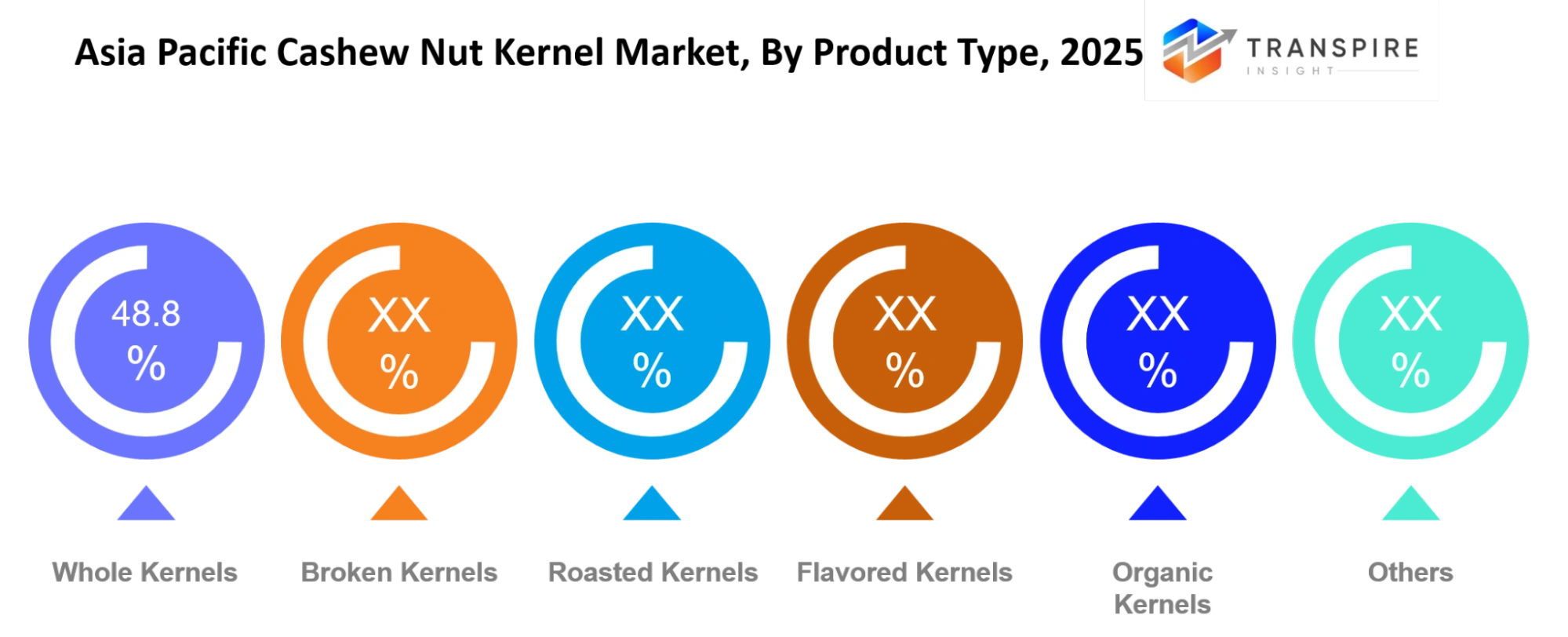
Whole kernels command a high premium due to consistent size, appearance and suitability for premium retail packaging. Food manufacturers and exporters use whole kernels for food for direct consumption, gift packages and premium snacks. The demand for whole kernels from both the retail and food service sector ensure consistent trade across markets regionally.
Broken kernels are cost-effective raw materials for bakery, confectionery, non-dairy products, sauces, processed foods etc.. Roasted kernels further provide convenience and flavor. Flavored kernels have become increasingly sought after due to changing snack consumer preferences. Organic kernels are sought after due to their certified origins, other consists of specialty forms required for various food and industrial applications.
By Grade :
W180 grade kernels are one of the largest and most premium cashew kernels, their higher size and good appearance translate to a higher price and are sought after by premium food retailers and for export. W210 and W240 kernels continue to remain important from a commercial point of view due to good all-round quality and wider usage in food products.
W320 is among the most commonly traded grades due to a balance between cost and quality. W450 kernels are smaller in size and can be used in processed food applications where appearance is less important. Other includes special types of cashew kernels meant for various specific applications across the Asia Pacific Cashew Nut Kernel market.
By Distribution Channel :
Retail distribution channels include supermarkets, convenience stores, specialty food stores, and chain stores to ensure that cashew kernels are easily accessible to customers. The availability of products in the supermarkets, specialty outlets and chain stores depends on factors such as the product visibility, packaging, quality of the product and marketing strategies that are formulated to make an appeal for the consumers in this channel. It caters to both premium and mass market segments in both urban and growing markets.
Wholesale distribution involves connecting to processors, traders, food processors, institutional buyers through sales volume. The Internet is considered a key growing distribution channel and is driven by easy product accessibility and expanding customer reach. The category other involves alternative sales networks, direct business, and specialized distribution agreements for market coverage across the regions.
By End User :
The end user category includes food processing where cashew kernels are used extensively in the food and beverage industry for making food products such as snacks, chocolates and confectionery products, bakery items, vegetarian and plant-based foods, ready-to-eat food products etc. Cashew kernels are an ideal ingredient for manufacturers to use in their value-added food products and also because of its consistent quality and dependable supply.
Households utilize the cashew kernels for eating, cooking, baking and for various purposes of health and nutrition. The category includes food service channels such as restaurants which utilize cashew kernels in their desserts, main courses, snack options and also for specialized dishes that offer a unique touch to the food.
What are the Key Use Cases Driving the Asia Pacific Cashew Nut Kernel Market?
The food processing sector creates the biggest demand for cashews kernels used in pre-packaged snacks, confectionery, bakery items and ready-to-eat meals. Manufacturers opt for consistent flavour, nutritive values and flexibility for premium food product development. The increasing production volumes demand and require continuous purchasing in regional markets.
Apart from that, there is growing demand coming from the plant-based food manufacturing and foodservice sector. Producers of alternatives to dairy products are using cashews kernels in their milk beverages, spreads, yogurts and cheese substitute as a creamy texture and versatile element of the formulation. Restaurants, caf's and catering services are also using cashews kernels as a key ingredient in desserts, salads, sauces, and upscale menu development.
There are growing opportunities arising from the functional nutrition segment and dedicated health product categories. Sport nutrition producers are searching for cashew based ingredient sources for their protein-packed snacks and nutritional blend. There is also rising concern regarding the clean label and traceable ingredient formulation, which will favor certified cashew kernels over the forecast period for premium product positioning.
|
Report Metrics |
Details |
|
Market size value in 2025 |
USD 3057.9 Million |
|
Market size value in 2026 |
USD 3250.4 Million |
|
Revenue forecast in 2033 |
USD 5053.7 Million |
|
Growth rate |
CAGR of 6.51% from 2026 to 2033 |
|
Base year |
2025 |
|
Historical data |
2021 - 2024 |
|
Forecast period |
2026 - 2033 |
|
Report coverage |
Revenue forecast, competitive landscape, growth factors, and trends |
|
Regional scope |
Asia Pacific (India, China, Japan, Australia, South Korea, Rest of Asia Pacific) |
|
Key company profiled |
Olam, Vietnam Cashew Corp, Jain Farm Fresh, Nutraj, Kalbavi Cashews, Achal Cashew, Bismi Cashew, King Cashew, Vietdelta, CBL Natural Foods, Haldiram, PepsiCo, ITC, Parle, Kellogg. |
|
Customization scope |
Free report customization (country, regional & segment scope). Avail customized purchase options to meet your exact research needs. |
|
Report Segmentation |
By Product Type (Whole Kernels, Broken Kernels, Roasted Kernels, Flavored Kernels, Organic Kernels, Others); By Grade (W180, W210, W240, W320, W450, Others); By Distribution Channel (Retail, Wholesale, Online, Others); By End User (Food Processing, Households, Foodservice, Others). |
Which Regions are Driving the Asia Pacific Cashew Nut Kernel Market Growth?
Dominant Asia Pacific Cashew Nut Kernel Market Region: India's leadership is rooted in its massive processing capabilities, well-established export network, and integration with the global food supply chain. Its vast processing clusters and skilled labor pools combine with its deeply entrenched network of buyers throughout the world to facilitate high volumes of production and steady exports. The country has world-class port infrastructure, which can rapidly ship raw and shelled cashew nuts through crucial trade routes.
A complex network of processors, traders, packagers, and food companies solidify the country’s dominance. Second most influential:Vietnam's competitiveness has developed around export oriented processing, through investing in advanced automation technologies, rather than large domestic markets, similar to India. Advanced sorting and grading technology alongside high-quality control methods allows for precise handling for high international market quality at competitive costs of operations. Strong ties to governments and stable trade relations allow for continued market supply.
Fastest growing regional market: Indonesia and Cambodia and other Southeast Asian countries, will represent the fastest growing region, through increased investment in agricultural infrastructure and development as well as a reduced reliance on international markets for processing. Local supply chains and agricultural sectors have received added growth due to investment, increased crop fields, and private sector involvement. Between 2026-2033, this region will provide many investment opportunities and access for new entrants into the supply sector.
Who are the Key Players in the Asia Pacific Cashew Nut Kernel Market and How Do They Compete?
Competition in the Asia Pacific Cashew Nut Kernel Market remains moderately fragmented, with large exporters, integrated processors and niche regional players vying for position within different value segments. Cost efficiency still matters, but the primary battlegrounds now include processing quality, traceability, quality standards (certifications) and the supply of tailor-made kernel grades. The incumbent players remain protected in their current market share by significant investment into automation and vertical integration along the supply chain; new players will seek to acquire share by competing primarily in the premium and value-added segments. The players with robust raw material supply chains and consistent delivery on international quality standards will continue to thrive.
Olam Food Ingredients' competitiveness lies within the company's vast global networks of integrated sourcing partners and extensive supplier relations within all the major global food manufacturers. The company competes through rigorous traceability systems, sustainability initiatives and offering of value-added ingredients targeted at global multinational food corporations. Ongoing investment into developing stronger sourcing partnerships and expanding processing capabilities will enhance supply reliability, support volume increases, and pave the way for wider inclusion into higher-value food segments.
Vietnam Cashew Corporation is highly competitive on the basis of its efficiency in export-oriented processing and strategic geographic location in one of the most significant cashew producing nations in the world. High automation for grading and consistent quality management ensures a high level of output for bulk export markets; Bismi Cashew Company competes on quality and tailored offerings to various customer demands. Further diversification through processing investments and expanded involvement in the broader agricultural supply chain (e.g. To Halim Group) enhance competitiveness by gaining better control over the raw material acquisition process and improving operational efficiencies.
Company List
- Olam
- Vietnam Cashew Corp
- Jain Farm Fresh
- Nutraj
- Kalbavi Cashews
- Achal Cashew
- Bismi Cashew
- King Cashew
- Vietdelta
- CBL Natural Foods
- Haldiram
- PepsiCo
- ITC
- Parle
- Kellogg
Recent Development News
In October 2025, the Government of Mozambique announced an investment commitment of USD 374 million to expand the country’s cashew sector. The program aims to increase annual cashew production from 158,000 tonnes to 689,000 tonnes by 2034, strengthening raw cashew supply and processing capacity for regional and global kernel markets.
Source: https://www.imarcgroup.com/
In September 2025, the Government of Tamil Nadu established the Tamil Nadu Cashew Board as a dedicated industry development body. Backed by an allocation of ₹10 crore, the board will support cultivation, processing infrastructure, storage, exports, and technology adoption, with the objective of strengthening the state’s position in India’s cashew value chain.
Source: https://timesofindia.indiatimes.com/
What Strategic Insights Define the Future of the Asia Pacific Cashew Nut Kernel Market?
The Asia Pacific Cashew Nut Kernel Market is in the process of a structurally integrated and value-adding supply chain, spurred by increased domestic and export demand for plant-based nutrition, premium snacking and traceable food ingredients. Within 5-7 years, sources of competitive advantage are expected to move from pure economies of scale to management of source relationships, operational efficiency and product development and differentiation. An underestimated risk will be that an increasing concentration of raw cashew supply among very few growing regions could exacerbate vulnerability to climate variability, crop disease, export policies, etc., generating volatility in the growth assumptions that are likely underestimated.
An important opportunity that presents will be the application of digital traceability and certification tools and platforms, especially in Southeast Asia where food safety and ESG requirements will continue to tighten. Players in the space will want to lock-in growers into long-term supply contracts, but will also want to invest in traceability-enabled processing to develop supply security, competitive advantage with export markets, and an opportunity to charge a premium for traceable, safe food.
Asia Pacific Cashew Nut Kernel Market Report Segmentation
By Product Type
- Whole Kernels
- Broken Kernels
- Roasted Kernels
- Flavored Kernels
- Organic Kernels
By Grade
- W180
- W210
- W240
- W320
- W450
By Distribution Channel
- Retail
- Wholesale
- Online
By End User
- Food Processing
- Households
- Foodservice
Frequently Asked Questions
Find quick answers to common questions.
The Asia Pacific Cashew Nut Kernel Market size is USD 5053.7 Million in 2033.
Key segments for the Asia Pacific Cashew Nut Kernel Market are By Product Type (Whole Kernels, Broken Kernels, Roasted Kernels, Flavored Kernels, Organic Kernels, Others); By Grade (W180, W210, W240, W320, W450, Others); By Distribution Channel (Retail, Wholesale, Online, Others); By End User (Food Processing, Households, Foodservice, Others).
Major Asia Pacific Cashew Nut Kernel Market players are Olam, Vietnam Cashew Corp, Jain Farm Fresh, Nutraj, Kalbavi Cashews, Achal Cashew, Bismi Cashew, King Cashew, Vietdelta, CBL Natural Foods, Haldiram, PepsiCo, ITC, Parle, Kellogg.
The Asia Pacific Cashew Nut Kernel Market size is USD 3057.9 Million in 2025.
The Asia Pacific Cashew Nut Kernel Market CAGR is 6.51% from 2026 to 2033.
- Olam
- Vietnam Cashew Corp
- Jain Farm Fresh
- Nutraj
- Kalbavi Cashews
- Achal Cashew
- Bismi Cashew
- King Cashew
- Vietdelta
- CBL Natural Foods
- Haldiram
- PepsiCo
- ITC
- Parle
- Kellogg
About the Authors

Chetan Dhatrak
I’m Chetan Dhatrak, a Senior Research Analyst at Transpire Insight, specializing in the Consumer Goods, Foods and Beverages industry. I focus on analyzing market trends, consumer behavior, competitive landscapes, and industry developments to deliver accurate, data-driven insights. My research at Transpire Insight is built on credible sources and in-depth analysis, helping businesses and readers better understand market dynamics, emerging opportunities, and evolving consumer preferences. I’m committed to creating reliable, well-researched content that supports informed decision-making and reflects the latest developments in the consumer goods and food & beverage sectors.

Chakradhar Khansole
Chakradhar serves as the Research Director at Transpire Insight, bringing over 8 years of experience in technology, innovation, and strategic market intelligence. He specializes in transforming complex market data into actionable business insights that enable organizations to make informed, growth-oriented decisions. Recognized for his strategic vision and analytical expertise, Chakradhar leads high-impact research initiatives, delivering comprehensive market assessments, competitive intelligence, and forward-looking industry analysis.
Recently Published Reports
-
Apr 2026
Baby Infant Formula Market
Baby Infant Formula Market Size, Share & Analysis Report By ype (Infant Milk, Follow On Milk, Specialty Baby Milk, Growing-Up Milk), By Ingredient (Carbohydrate, Fat, Protein, Minerals, Vitamins, and Others), By Product Form (Powder, Liquid, and Ready-to-feed), By Distribution Channels (Supermarket/Hypermarket, Specialty Store, Pharmacies, Online Retail, and Others), and Geography (North America, Europe, Asia-Pacific, Middle East and Africa, South and Central America), 2021 - 2031
-
Apr 2026
Edible Insects for Animal Feed Market
Edible Insects for Animal Feed Market Size, Share & Analysis Report By Type (Insect Powder, Insect Meal, Insect Bar, Insect Paste, Insect Oil, and Others), By Insect Type (Beetles, Cricket, Caterpillar, Hymenoptera, Orthoptera, Tree Bugs, and Others), By Application (Livestock, Pet Food, and Aquaculture), By Livestock Type (Poultry, Swine, and Others), and Geography (North America, Europe, Asia-Pacific, Middle East and Africa, South and Central America), 2021 - 2031
-
Apr 2026
Food Industry Disinfection and Bacterial Control Market
Food Industry Disinfection and Bacterial Control Market Size, Share & Analysis Report By Type (Chemical Disinfectants, Physical Disinfectants, and Biocides and Antimicrobials), By Application (Food Processing Equipment Surface Disinfection, Food Preparation Areas Surface Disinfection, Storage Areas Surface Disinfection, Anti-microbial Coatings Food Preservation, and Preservative Solutions Food Preservation), By End User (Meat and Poultry Processing, Dairy Processing, Seafood Processing, Bakery and Confectionery, Restaurants and Commercial Kitchens, and Food Service Providers), By Sales Channel (Online, Offline), and Geography (North America, Europe, Asia-Pacific, Middle East and Africa, South and Central America), 2021 - 2031
-
May 2026
Freeze Dried Food Market
Freeze Dried Food Market Size, Share & Analysis Report By Product Type (Fruits, Vegetables, Freeze-Dried Dairy Products, Freeze-Dried Meat and Seafood, Freeze-Dried Pet Food, and Prepared Meal), By Nature (Organic, and Conventional), By Form (Powdered, Granules, and Diced), By End Use (Breakfast Cereals, Dairy Products, Bakery & Confectionery, Nutritional Bars & Supplements, Powdered Beverages, Snacks, and Retail (Household)), and Geography (North America, Europe, Asia-Pacific, Middle East and Africa, South and Central America), 2021 - 2031