

Asia Pacific Artificial Intelligence In Agriculture Market Size & Forecast:
- Asia Pacific Artificial Intelligence In Agriculture Market Size 2025: USD 407.5 Billion
- Asia Pacific Artificial Intelligence In Agriculture Market Size 2033: USD 2238.4 Billion
- Asia Pacific Artificial Intelligence In Agriculture Market CAGR: 23.78%
- Asia Pacific Artificial Intelligence In Agriculture Market Segments: By Technology (Machine Learning, Computer Vision, Predictive Analytics, Robotics, Drones, NLP, Others); By Application (Precision Farming, Crop Monitoring, Livestock Monitoring, Smart Irrigation, Yield Prediction, Others); By Deployment (Cloud, On-Premise, Hybrid, Others); By End User (Farmers, Agribusinesses, Cooperatives, Government Agencies, Others)
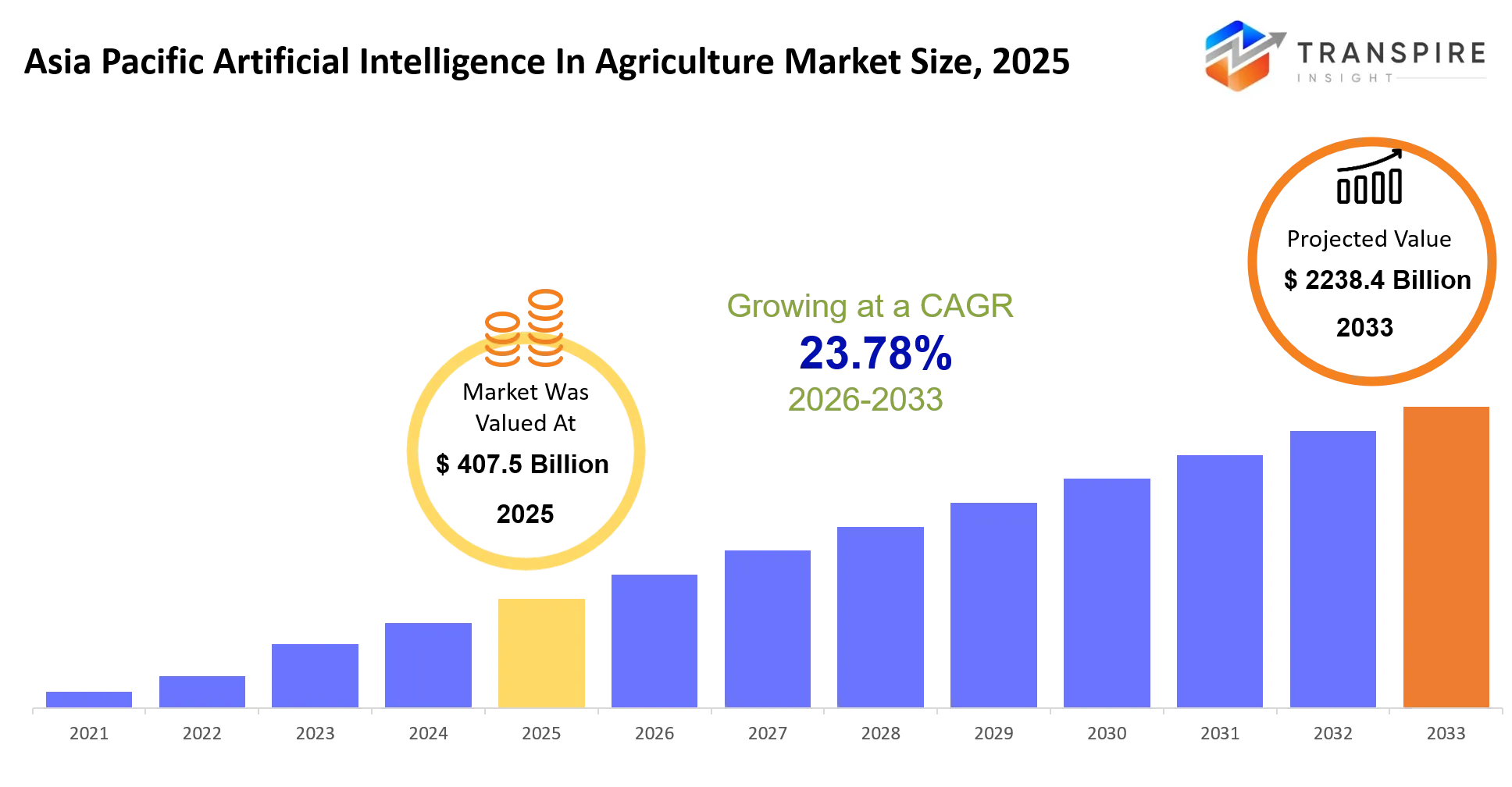
Asia Pacific Artificial Intelligence In Agriculture Market Summary
The Asia Pacific Artificial Intelligence In Agriculture Market was valued at USD 407.5 billion in 2025. It is forecast to reach USD 2238.4 billion by 2033. That is a CAGR of 23.78% over the period.
The Asia Pacific Artificial Intelligence in Agriculture Market basically helps farmers make better decisions across planting, irrigation, crop protection, and harvesting, by turning field data into actionable insights and well.. more practical outcomes. Like in real life, AI systems look at weather conditions, soil health, crop images, plus equipment performance, so they can cut down on input waste, push yields upward, and also manage operational risks, especially when farms are large, but also kind of fragmented, and hard to coordinate.
Over the last five years the market has moved away from those isolated precision farming pilots and into more integrated digital agriculture platforms. These new platforms tend to blend machine learning, computer vision, drones, and connected farm equipment in one place. A big trigger was supply chain disruption and labor shortages during and after the COVID-19 period, it sort of showed how fragile traditional farm operations can be. That experience then accelerated investment in automation and remote monitoring tools, because everyone needed continuity and faster visibility, not just theoretical planning.
Right now, growth is being pulled forward by the need to produce more food using limited land, water, and labor resources. And as AI keeps improving prediction accuracy, and overall operational efficiency, farmers and agribusinesses are seeing a clearer economic case for adoption. Basically, they can translate those technology investments into measurable productivity improvements, plus stronger revenue opportunities for the solution providers too.
Key Market Insights
- China is a player in the Artificial Intelligence In Agriculture Market in Asia Pacific. It has around 35% to 40% of the market share in 2025. This is because China is investing a lot in farming.
- India is growing fast in this market. It will keep growing until 2032. This is because India has programs for agriculture many startups working on agri-tech and more machines are being used on farms.
- Japan and Australia are also important in this market. They use precision agriculture and have good technology for farming.
- Machine Learning is the leading technology in this market. It has than 30% share in 2025. Machine Learning helps farmers forecast yields, detect diseases and optimize farms.
- Computer Vision is the biggest technology. It is used more and more for drone imaging and monitoring crops.
- Robotics and Autonomous Farming Systems will grow the fastest from 2025 to 2032. This is because there is a shortage of labor and a need for automation.
- Precision Farming is the application. It has 28% to 32% market share in 2025. Farmers use it to produce more while spending less.
- Crop Monitoring and Disease Detection're growing fast. They use AI to take images and analyze data in time.
- There is demand for smart irrigation solutions. This is because managing water is becoming very important.
- Large commercial farms have the share. They have, than 45% of the market revenue in 2025. This is because they can invest more and are more ready to use technology.
What are the Key Drivers, Restraints, and Opportunities in the Asia Pacific Artificial Intelligence In Agriculture Market?
The most powerful force moving the Asia Pacific Artificial Intelligence In Agriculture Market forward is basically the push to boost farm productivity while labor is getting less , and also input costs keep going up. This momentum really picked up when governments across China, India, Japan, and Australia rolled out more digital agriculture plans , and they backed precision farming systems. Meanwhile, improvements in cloud computing, computer vision, and sensor networks helped lower the install expenses so the AI solutions feel more commercially workable. When producers can access near real time crop observation, yield prediction, and automated choices supports, they tend to tune fertilizer , pesticide and even water usage. These clear efficiency improvements are helping companies see better return on investment and it speeds up technology uptake. So that’s all tied pretty directly to market revenue growth.
The biggest holdback still seems to be how agriculture is split up , not one unified structure, across many Asia Pacific locations. A lot of farms run on small plots with weak digital infrastructure, and their technology budgets are pretty tight. The issue is kind of structural too, because it connects to land ownership habits, connectivity shortfalls, and uneven access to financing. Even if an AI tool shows obvious economic merit, the rollout can get delayed by implementation costs , extra data gathering requirements, and the need for technical training. Then adoption ends up being mostly on larger commercial setups, which means the market never reaches its full revenue promise.
A big upcoming chance shows up in AI-driven autonomous farming setups, the whole idea of farming sorta running on its own, with less hands on. Funding for agricultural robots, drone fleets, and machine vision tools is ramping up, especially in places like China, Japan and Australia. And as these technologies become more budget-friendly and able to play nicely with farm management platforms, they can open the door to large-scale automation, essentially setting up the next wave of market expansion.
What Has the Impact of Artificial Intelligence Been on the Asia Pacific Artificial Intelligence In Agriculture Market?
Artificial intelligence along with more advanced digital technologies is quietly changing how farming gets done all across the Asia Pacific, like from “react when something goes wrong” toward data-driven optimization, instead. In practice, AI platforms help shift farm management into a more analytical mode where decisions don’t just happen after the fact. These AI-empowered systems can automate crop monitoring , irrigation scheduling, pest detection, and fertilizer application, by pulling together information from drones, satellite pictures, in-field sensors, and connected farm equipment.
What that really does is lower the amount of hands-on work, and it also helps farmers distribute resources more accurately , not just in a rough way. And machine learning is being used more and more for forecasting tasks , for example yield prediction, identifying disease outbreaks, evaluating weather risk, and planning maintenance for machinery. When the models study prior field records together with live environmental signals, they can flag likely crop stress, or machinery failures before they start disrupting day to day work. That gives growers the chance to respond sooner, so corrective steps happen earlier and production losses can be reduced.
The operational impact is becoming increasingly measurable. Precision irrigation systems can reduce water consumption while maintaining crop productivity, and AI-guided input management helps lower fertilizer and pesticide usage. Automated monitoring also improves field coverage, enhances labor efficiency, and supports more consistent production outcomes across large farming operations. In several commercial farming environments, these technologies have contributed to lower operating costs and improved resource utilization.
However, there is still a big limitation, the whole high cost of blending AI into current farm infrastructure. A lot of small to medium farms do not have the needed connectivity, and the sensor networks too, plus enough historical records that you kind of need in order to really get the full benefits from advanced agricultural intelligence systems. So basically this ends up slowing the wider market adoption, because it is not just a plug and play kind of scenario.
Key Market Trends
- Since 2020 farmers have changed the way they work by using intelligence platforms that combine satellite pictures, sensors and predictive analytics instead of using separate precision agriculture tools.
- Labor shortages in Japan, Australia and South Korea made farmers use tractors, robotic harvesting systems and artificial intelligence to help with field work.
- The government started agriculture programs in a big way after 2021 which encouraged the use of smart farming technologies in China and India.
- Farmers used to check on crops from time to time but now they use artificial intelligence and drones to keep an eye on them all the time.
- Big farming companies are using intelligence to predict when crops might get sick which helps them stop the problem before it starts.
- After 2022 many farmers started using cloud-based platforms that made it easier for them to use technologies without spending a lot of money upfront.
- Companies like John Deere, Bayer, Trimble and CropX are working with distributors to help more farmers use new technologies.
- Because water is scarce farmers are using intelligence to control how much water they use and they are automating the scheduling of irrigation.
- People who buy these platforms want to be able to see all the information they need in one place, including data from machines weather forecasts and field analytics.
- Now companies are focusing on selling services that help farmers analyze data of just selling equipment, which creates a steady stream of income and helps build long-term relationships with customers.
Asia Pacific Artificial Intelligence In Agriculture Market Segmentation
By Technology:
Machine Learning kind of holds a leading position in agriculture lately, since operational teams are increasingly leaning on data driven decision making, which is pretty natural. With advanced algorithms in the picture, they can sift through weather patterns, soil conditions, crop health, and even estimate yield potential, so planning gets smoother and resources don’t get wasted. Also, there’s wider availability of agricultural datasets, plus cloud based processing tools that make it easier for farms of different sizes to get started. Over time, continuous tuning of model accuracy has increased trust in AI assisted recommendations, even if people still double-check outputs sometimes.
Then Computer Vision keeps getting more traction, mostly through drone imaging, satellite monitoring, and automated crop inspection systems that flag issues without waiting for manual walks. Predictive Analytics is doing its part too, especially for yield forecasting and risk assessment, which helps ag businesses respond to shifting field conditions in a more controlled way. Robotics and Drones are also pushing field automation farther, cutting down labor dependency, while improving day to day operational efficiency. And Natural Language Processing, along with a few emerging technologies, is showing up in farm management platforms, so in the end you end up with a bigger technology ecosystem around modern agriculture.
By Application:
Precision Farming is still a big thing, mainly because people really need to use water fertilizers pesticides and other inputs in a more efficient way. AI based systems give field specific guidance, so production can be optimized, without wasting resources—at least that’s the idea. There’s also more focus on day to day operational efficiency, so precision agriculture solutions are spreading across lots of commercial farms. And with better visibility into how each field is performing, growers are seeing stronger results in productivity.
Crop Monitoring has been growing in importance, since growers want real time insights on crop status, and also on possible hazards before they get out of hand. In parallel, Livestock Monitoring is assisting animal health management, using continuous data collection and analysis to keep things on track and improve output. Smart Irrigation is helping with water management practices, especially in areas where water is limited or hard to secure. On top of that, Yield Prediction tools are getting more advanced, which lets agricultural stakeholders improve planning schedules and inventory control, with less guesswork overall.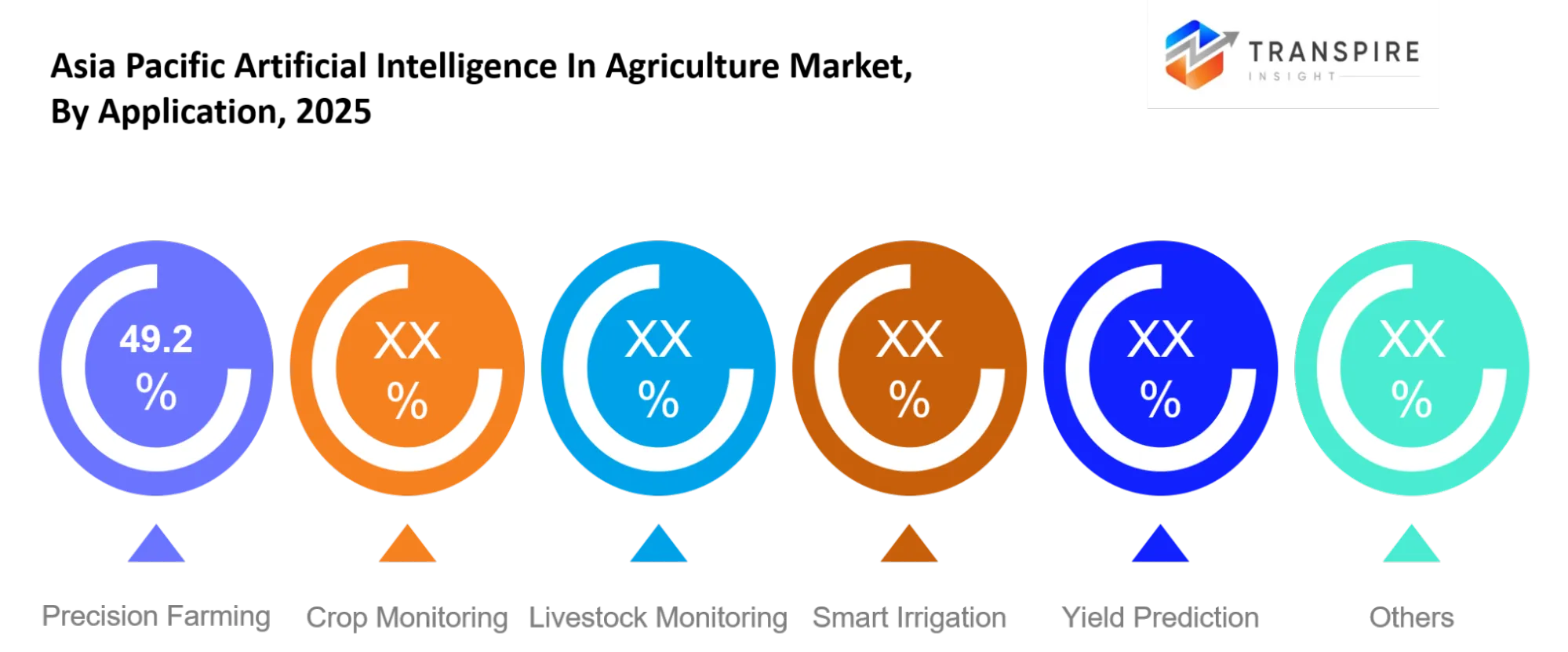
By Deployment:
Cloud deployment is becoming the go to approach, mainly because it scales well, it cuts down on upfront cost, and it makes advanced analytics much more reachable. With cloud based platforms, agri businesses can gather, sort, and evaluate huge amounts of farm information, without needing to keep up with heavy on site infrastructure. Routine software upgrades and the fact that you can reach everything remotely , also add to daily ease. Meanwhile, the ongoing improvement of internet access in rural zones keeps pushing people toward cloud adoption, almost naturally.
That said, on premise deployment is still a solid option for groups that need stronger oversight over sensitive operational data, plus more room for system tailoring. Hybrid deployment is getting more attention lately , because it blends the flexibility of the cloud environment with the safety benefits of local infrastructure. This kind of middle route supports organizations that want strong performance while keeping tighter data governance. And beyond those, there are other deployment methods, still used when certain agricultural settings call for specific operational needs.
By End User:
Large commercial farms, they really do stand out as a major user group since they typically have bigger tech budgets and more room to bring in advanced digital solutions. Putting money into automation, predictive analytics, and precision farming technologies tends to make day to day operations more efficient, especially when you’re dealing with large swaths of cultivated land. There’s a strong push toward productivity and cost control, and that keeps adoption moving among big scale farming enterprises. On top of that, long term technology plans often nudge continued funding toward AI powered agricultural systems.
Smaller and medium sized farms are starting to join digital agriculture too, mostly via subscription based platforms and cloud services that are more affordable. In a similar way, agribusiness companies are leaning on AI to tighten supply chain visibility, support production planning, and manage resources more steadily. Meanwhile agricultural cooperatives and related organizations are also looking at smarter, “intelligent farming” approaches in order to boost collective operational performance. As access to digital infrastructure expands, it’s opening up new possibilities for a wider set of end users, not just the usual few.
What are the Key Use Cases Driving the Asia Pacific Artificial Intelligence In Agriculture Market?
The main use case pushing adoption is precision farming, you know, where artificial intelligence helps tighten up planting, irrigation, fertilization, and crop protection decisions. In practice this kind of thing ends up attracting the most demand because it boosts productivity, while at the same time lowering input costs. Farmers rely on machine learning models, plus field data, to make quicker decisions that are also more accurate, and that sort of thing really improves operational efficiency.
Crop monitoring, and smart irrigation , are getting more momentum across commercial farming operations and agribusiness organizations. Computer vision systems look at drone and satellite imagery to spot crop stress, pest activity , and disease outbreaks early on. Then smart irrigation platforms use weather information along with soil data, to improve water allocation especially in places where resources are tight.
On top of that the newer applications are things like autonomous farming equipment and AI assisted livestock management systems. Agricultural robotics can back up harvesting and other field tasks with very little human involvement, while intelligent livestock monitoring tools help follow animal health, plus productivity. As sensor networks get cheaper and data availability keeps increasing, these applications are expected to roll out more widely during the forecast period.
|
Report Metrics |
Details |
|
Market size value in 2025 |
USD 407.5 Billion |
|
Market size value in 2026 |
USD 502.8 Billion |
|
Revenue forecast in 2033 |
USD 2238.4 Billion |
|
Growth rate |
CAGR of 23.78% from 2026 to 2033 |
|
Base year |
2025 |
|
Historical data |
2021 - 2024 |
|
Forecast period |
2026 - 2033 |
|
Report coverage |
Revenue forecast, competitive landscape, growth factors, and trends |
|
Regional scope |
Asia Pacific (India, China, Japan, Australia, South Korea, Rest of Asia Pacific) |
|
Key company profiled |
John Deere, Trimble, Bayer, Syngenta, AGCO, IBM, Microsoft, Oracle, SAP, Bosch, CropX, Taranis, DeLaval, Topcon, DJI |
|
Customization scope |
Free report customization (country, regional & segment scope). Avail customized purchase options to meet your exact research needs. |
|
Report Segmentation |
By Technology (Machine Learning, Computer Vision, Predictive Analytics, Robotics, Drones, NLP, Others); By Application (Precision Farming, Crop Monitoring, Livestock Monitoring, Smart Irrigation, Yield Prediction, Others); By Deployment (Cloud, On-Premise, Hybrid, Others); By End User (Farmers, Agribusinesses, Cooperatives, Government Agencies, Others) |
Which Regions are Driving the Asia Pacific Artificial Intelligence In Agriculture Market Growth?
China still takes the lead in the Asia Pacific Artificial Intelligence for Agriculture Market, mostly because of strong government support for agricultural modernization and big, very steady investments into digital farming infrastructure. In practice, national programs for smart agriculture have been kinda speeding up the rollout of AI based analytics, drones , and automated farming gear across many of the main agricultural provinces. Since the agriculture sector is so large it produces huge streams of data, so it basically opens the door for machine learning use cases and precision farming frameworks. Plus, tech firms, research institutions and agribusiness orgs keep showing up in force, which really helps lock in regional leadership.
Japan comes in as the second-largest contributor, but the market doesn’t exactly move the same way as China. Growth there is less about raw scale and more about tackling the aging agricultural workforce, along with the fact that farm labor is limited and sometimes just hard to keep. Japan keeps investing, consistently in robotics, autonomous machinery, and improved sensing technologies, and that has made a pretty solid base for long-term expansion. And because the technology ecosystems are already well established, and policy support is more predictable than in some places, Japan ends up acting like a dependable source of market revenue.
India is kinda emerging as the fastest growing market, as digital agriculture initiatives keep expanding in both public and private sectors. In the last while, growth has been helped by more money flowing into agri tech startups , better rural connectivity and just broader access to cloud based agricultural platforms. Also, affordable AI solutions are becoming easier to reach for small and medium sized farms, so there are new adoption opportunities outside the big commercial operations only. This overall momentum is expected to create some really attractive chances for technology providers and investors looking to expand across the 2026–2033 period.
Who are the Key Players in the Asia Pacific Artificial Intelligence In Agriculture Market and How Do They Compete?
Competition in the Asia Pacific Artificial Intelligence In Agriculture Market is still kind of moderately fragmented, with major global technology providers, agricultural equipment manufacturers, and specialized agri tech firms all chasing market share, it’s not exactly one clean race. In practice, “technology capability” has become the main reason buyers choose one provider over another, because buyers are increasingly asking for a platform, that can blend predictive analytics, automation, computer vision, plus real time farm intelligence. Meanwhile, older agricultural machinery companies are defending themselves by wiring AI into their equipment ecosystems, whereas newer software focused players are nudging the traditional approach aside with cloud based, and subscription driven offerings.
It’s also a bit more collaborative lately, with technology developers partnering more often with agricultural stakeholders, aimed at speeding up adoption and improving real life field results, not just demos.
John Deere stands out via its integration of artificial intelligence into connected agricultural machinery, which then allows automated guidance, field analysis, and precision farming workflows inside one unified ecosystem. Trimble tends to lean toward data driven farm management and positioning technologies, helping raise operational accuracy across large scale farming groups. Both firms keep pushing forward through technology partnerships and ongoing upgrades, that improve interoperability between machinery, software platforms, and the field data systems themselves.
CropX kind of built a competitive spot around soil intelligence and farm analytics, giving in practice actionable recommendations via sensor based monitoring and AI powered insights. Taranis on the other hand focuses on high resolution aerial imaging and computer vision, helping growers spot crop threats early, with more precision than the usual scouting methods, or whatever you want to call them. Bayer is also ramping up its digital agriculture efforts by rolling out integrated agronomic platforms that merge crop science know how with advanced analytics, so farmers get stronger decision support tools across several Asia Pacific markets.
Company List
- AGCO
- IBM
- Microsoft
- Oracle
- SAP
- Bosch
- CropX
- Taranis
- DeLaval
- Topcon
- DJI
Recent Development News
In April 2026, Bayer announced that its FarmRise digital agriculture platform surpassed 5 Billion registered farmers in India. The expansion strengthens AI-powered advisory services, weather intelligence, market access, and digital farm management capabilities, supporting broader adoption of smart agriculture technologies across the region. Source:https://www.bayer.in/en-in/media
In December 2025, DCM Shriram and Bayer CropScience expanded cooperation through joint initiatives focused on soil health, carbon sequestration, integrated crop management, and digital advisory services. The collaboration enhances access to technology-driven agricultural solutions and supports the modernization of farming operations across India. Source:https://www.esgnews.earth/latest-news
What Strategic Insights Define the Future of the Asia Pacific Artificial Intelligence In Agriculture Market?
Over the next five to seven years, the Asia Pacific Artificial Intelligence In Agriculture Market is expected to move beyond those precision farming tools, toward more connected agricultural intelligence ecosystems, kind of like everything talks to everything. The thing really pushing this shift is the growing need to boost food production efficiency, while also handling labor shortages, climate variability, and tight resource constraints, not easy stuff. In the future, value creation will depend more and more on whether farm equipment, sensor networks, satellite data, and predictive analytics can be brought together into one decision-making platform, instead of only selling standalone technologies that do one job, then stop.
There’s also a less visible risk, data concentration and platform dependency. As just a few technology providers gain control over agricultural datasets and the digital infrastructure, farms might end up with higher switching costs, and less interoperability, too. That situation could slow down innovation, and put up adoption barriers for smaller technology vendors, who already have fewer resources and less leverage.
At the same time, there’s an emerging opportunity. Generative AI, plus autonomous decision-support systems, could be really helpful for small and medium-sized farms especially in India and Southeast Asia, where digital agriculture adoption is speeding up. Market participants should focus on open and interoperable platforms, ones that can integrate with existing farm operations. Because, flexibility and ecosystem compatibility may end up being stronger competitive advantages than any single technology feature, taken by itself.
Asia Pacific Artificial Intelligence In Agriculture Market Report Segmentation
By Technology
- Machine Learning
- Computer Vision
- Predictive Analytics
- Robotics
- Drones
- Natural Language Processing (NLP)
- Others
By Application
- Precision Farming
- Crop Monitoring
- Livestock Monitoring
- Smart Irrigation
- Yield Prediction
- Others
By Deployment
- Cloud
- On-Premise
- Hybrid
- Others
By End User
- Farmers
- Agribusinesses
- Cooperatives
- Government Agencies
- Others
Frequently Asked Questions
Find quick answers to common questions.
The Expected Asia Pacific Artificial Intelligence In Agriculture Market size for the Market will be USD 2238.4 Billion in 2033.
Key Segments for the Asia Pacific Artificial Intelligence In Agriculture Market are By Technology (Machine Learning, Computer Vision, Predictive Analytics, Robotics, Drones, NLP, Others); By Application (Precision Farming, Crop Monitoring, Livestock Monitoring, Smart Irrigation, Yield Prediction, Others); By Deployment (Cloud, On-Premise, Hybrid, Others); By End User (Farmers, Agribusinesses, Cooperatives, Government Agencies, Others).
Major Asia Pacific Artificial Intelligence In Agriculture Market Players areJohn Deere, Trimble, Bayer, Syngenta, AGCO, IBM, Microsoft, Oracle, SAP, Bosch, CropX, Taranis, DeLaval, Topcon, DJI.
The Current Asia Pacific Artificial Intelligence In Agriculture Market size is USD 407.5 Billion in 2025.
The Asia Pacific Artificial Intelligence In Agriculture Market CAGR is 23.78% from 2026 to 2033.
- John Deere
- Trimble
- Bayer
- Syngenta
- AGCO
- IBM
- Microsoft
- Oracle
- SAP
- Bosch
- CropX
- Taranis
- DeLaval
- Topcon
- DJI
About the Authors

Mayur Shinde
I am Mayur Shinde, a Senior Research Analyst at Transpire Insight, specializing in the Automotive & Transportation and Information & Communication Technology (ICT) Industry. My work focuses on analyzing emerging market trends, technological advancements, competitive landscapes, and industry developments to deliver accurate, data-driven insights. I am passionate about transforming complex market information into clear, actionable content that helps businesses, professionals, and decision-makers stay informed and make confident strategic decisions.

Chakradhar Khansole
Chakradhar serves as the Research Director at Transpire Insight, bringing over 8 years of experience in technology, innovation, and strategic market intelligence. He specializes in transforming complex market data into actionable business insights that enable organizations to make informed, growth-oriented decisions. Recognized for his strategic vision and analytical expertise, Chakradhar leads high-impact research initiatives, delivering comprehensive market assessments, competitive intelligence, and forward-looking industry analysis.
Recently Published Reports
-
Apr 2026
3D Optical Profiler Market
3D Optical Profiler Market Size, Share & Analysis Report By Type (Desktop 3D Optical Profiler, and Portable 3D Optical Profiler), By Technology (Confocal Technology, and White Light Interference), By End-Use Industry (Manufacturing, Research Institutions, Automotive, Aerospace and Defense, Medical Devices, and Other), and Geography (North America, Europe, Asia-Pacific, Middle East and Africa, South and Central America), 2021 - 2031
-
Apr 2026
Depth Sensor Market
Depth Sensor Market Size, Share & Analysis Report By Type (Infrared Depth Sensors, Time-of-Flight (ToF) Sensors, Stereo Vision Sensors, Structured Light Sensors, Ultrasonic Depth Sensors), By Application (Automotive, Robotics, Gaming, Consumer Electronics, Industrial Automation, Healthcare, Security & Surveillance, Others), By End Users (Automotive Manufacturers, Consumer Electronics Companies, Healthcare Providers, Industrial Companies, Security Agencies, Gaming Companies, Robotics Companies, Others), and Geography (North America, Europe, Asia-Pacific, Middle East and Africa, South and Central America), 2021 – 2031
-
Apr 2026
Digital Manufacturing Market
Digital Manufacturing Market Size, Share & Analysis Report By Component (Hardware, Software, and Services), By Technology (Robotics, 3D Printing, Internet of Things (IoT), and Others), By Application (Automotive and Transportation, Aerospace and Defense, Consumer Electronics, Industrial Machinery, and Others), By Process Type (Computer-Based Designing, Computer-Based Simulation, Computer 3D Visualization, Analytics, and Others), and Geography (North America, Europe, Asia-Pacific, Middle East and Africa, South and Central America), 2021 – 2031
-
Apr 2026
Digital Visa Services Market
Digital Visa Services Market Size, Share & Analysis Report By Type (Individual Travelers, Group Travelers), By Application (Tourism, Business Travel, Others), and Geography (North America, Europe, Asia-Pacific, Middle East and Africa, South and Central America), 2021 – 2031