
Asia Pacific Air Freight Market Size & Forecast:
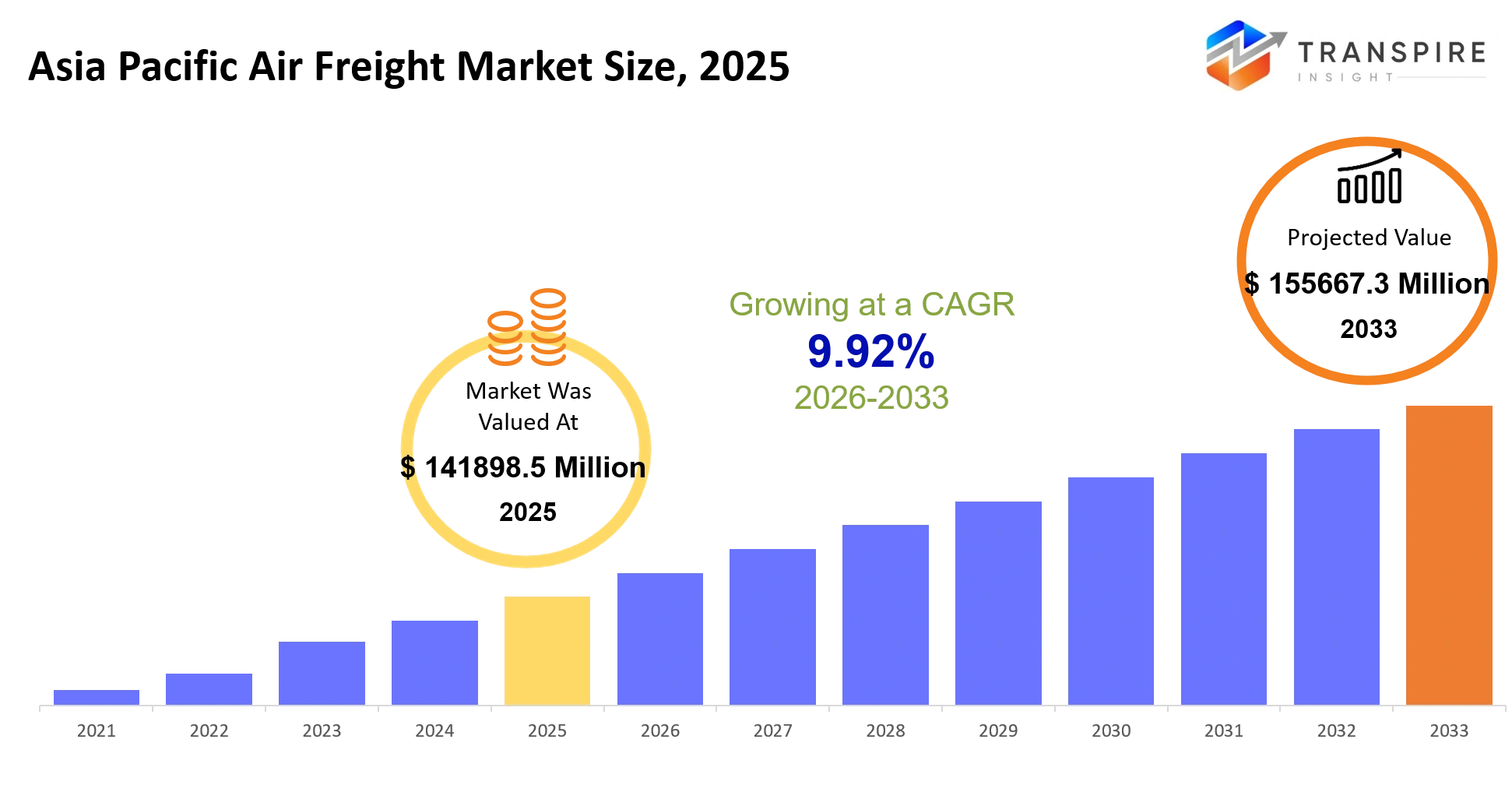
- Asia Pacific Air Freight Market Size 2025: USD 141898.5 Million
- Asia Pacific Air Freight Market Size 2033: USD 301865.9 Million
- Asia Pacific Air Freight Market CAGR: 9.92%
- Asia Pacific Air Freight Market Segments: By Service Type (Express Freight, Standard Freight, Charter Freight, Temperature-Controlled Freight, Dangerous Goods Freight, Others); By Destination (Domestic, International, Cross-Border, Others); By End User (E-commerce, Healthcare, Automotive, Electronics, Retail, Others); By Cargo Type (General Cargo, Perishables, Pharmaceuticals, High Value Goods, Others).
To learn more about this report,  Download Free Sample Report
Asia Pacific Air Freight Market Summary
The Asia Pacific Air Freight Market was valued at USD 141898.5 Million in 2025. It is forecast to reach USD 301865.9 Million by 2033. That is a CAGR of 9.92% over the period.
The Asia Pacific Air Freight Market is really important for getting goods and things that need to be delivered quickly from one place to another. It helps businesses like manufacturers and retailers get their products to people fast even if it costs a bit more. This is especially true for things like computer chips, online shopping, medicine and getting parts to factories on time.
In the last few years the Asia Pacific Air Freight Market has changed a lot. Now the Asia Pacific Air Freight Market uses computers and the internet to track shipments and make paperwork easier. This also helps businesses predict what might happen with their supplies. The pandemic and some problems between countries showed that the old way of doing things was not working well for the Asia Pacific Air Freight Market. So companies started looking for ways to get their goods from one place to another using the Asia Pacific Air Freight Market.
Now the market is growing because more people are buying things online from other countries. There is also a demand for computer chips and companies want to make sure they can get the things they need quickly. As a result more companies are using air cargo to get their goods delivered fast. This means that airlines and logistics companies can make money by offering special services to help companies get their products to people quickly.
Key Market Insights
- The Asia Pacific Air Freight Market was led by East Asia in 2025. This was because East Asia had a lot of manufacturing and export activity. East Asia had over 45 percent of the market.
- South Asia is expected to grow fast until 2030. This is because South Asia is investing in its airports and has industries that export goods.
- Most of the air cargo was cargo. This type of cargo made up more than 40 percent of all the cargo being moved around the region.
- The Asia Pacific Air Freight Market also had a lot of freight. This is because businesses wanted their goods to be delivered quickly. They also wanted to manage their inventory
- The pharmaceutical and healthcare industries had the growth between 2024 and 2030. This was because these industries need temperature-controlled transportation.
- The Asia Pacific Air Freight Market also had a lot of electronics and semiconductor shipments. These shipments were 35 percent of all the premium cargo. This is because these industries use in-time manufacturing practices.
- E-commerce retailers were the growing users of the Asia Pacific Air Freight Market. This is because more people are buying things online from countries after 2022.
- DHL, FedEx and UPS made their digital freight management better. This helped them to track their shipments easily.
- Kuehne+Nagel and DSV worked with partners in the region and invested in warehouses. This helped them to provide logistics services.
- The Asia Pacific Air Freight Market is very competitive. Companies are using intelligence to optimize their routes. They are also using automated customs processing and real-time cargo tracking. These things have been very important since 2023.
What are the Key Drivers, Restraints, and Opportunities in the Asia Pacific Air Freight Market?
Driver
The Asia Pacific Air Freight Market is growing fast. More people are buying things online from countries. Many new factories are making things like semiconductors and medicine. These factories need to get their products to people on time. They use airplanes to transport them.
During the pandemic there were problems with getting things from one place to another. Now factories want to make sure they can get their products to people quickly and reliably. The Asia Pacific Air Freight Market is getting business. It is making money from transporting important and time-sensitive things like semiconductors and medicine.
Companies are using tools to track their shipments. This makes sure everything runs smoothly. People can see where their packages are and when they will arrive. This makes them more confident in using air transportation. Exporters and logistics companies are using the Asia Pacific Air Freight Market more and more.
Restraint
The biggest problem for the Asia Pacific Air Freight Market is that airports and logistics hubs are too full. They do not have space to handle all the cargo. Cargo terminals and warehouses get too full. It takes time to get things in and out.
Building facilities costs a lot of money and takes a long time. This creates a problem. We cannot solve it quickly. When facilities are too full it causes delays. It increases the cost of transportation. This makes it harder for the Asia Pacific Air Freight Market to compete. The market may not grow as quickly as it could.
Opportunity
There is an opportunity for the Asia Pacific Air Freight Market to make more money by creating special logistics networks for things like medicine and semiconductors. These things need to be handled carefully and require special equipment so companies can charge more money to transport them. If companies invest in the equipment and technology they can make a lot of money transporting these kinds of things.
The Asia Pacific Air Freight Market is also getting business because there are new factories and manufacturing hubs in South and Southeast Asia. As these places grow and invest in airports and logistics facilities there will be more opportunities for the Asia Pacific Air Freight Market to transport things. Companies that can provide cargo services and have strong networks in the region will be able to take advantage of this growth and make more money.
What Has the Impact of Artificial Intelligence Been on the Asia Pacific Air Freight Market?
The Asia Pacific Air Freight Market is really changing because of intelligence and advanced digital technologies. These things are making operations more efficient, cargo handling accurate and fleet management better. Airlines, freight operators and airport logistics providers are using intelligence to automate cargo sorting, warehouse operations, shipment tracking and making sure they follow the rules.These automated control platforms can look at a lot of shipment data at the time which means people do not have to do as much work and cargo can move faster across the region.
Artificial intelligence is also helping airlines guess what will happen in the future. They use systems to look at data from airplane parts, which helps them find problems before they happen and reduces the time airplanes are not working. Artificial intelligence is also helping with predicting how much cargo they will have, finding the best routes using less fuel and planning how much cargo they can carry.
All these things help airplanes be used more, reduce costs and use fuel, which means cargo gets delivered on time. Airlines can also use platforms to make sure they have the right amount of cargo on each flight and plan their routes better.
Using these technologies has made operations more reliable, costs are under control and the service is better. But there is still a problem. It is very expensive to use artificial intelligence with old aviation and logistics systems. Many operators are also having trouble because they do not have the kind of data to train their systems to make good predictions.
Key Market Trends
- Since 2020 online shopping shipments across borders have jumped and airlines and freight companies are growing their cargo space and fast delivery networks.
- Big airlines turned passenger planes into cargo planes from 2021 to 2025, which helped with cargo space during supply chain problems.
- Airlines are now using AI for planning routes. Maintaining planes, which helps reduce delays and use their fleet better.
- Airports in the region are investing in automated cargo areas, which helps handle cargo more efficiently.
- After 2020 shipments of medicines and temperature-sensitive goods increased a lot so there's a need for advanced cold storage and monitoring.
- Airlines are now using trade routes, which helps them not rely on just one manufacturing hub and makes their supply chains stronger.
- Airlines are working on being more sustainable by using fuel- programs, digital systems for paperwork and platforms to monitor emissions.
- Most top logistics companies now offer real-time tracking of cargo which helps with accuracy and customer service.
- Airlines, online shopping companies and logistics providers are teaming up more which creates freight systems in the region.
- Customs authorities have been expanding clearance programs since 2022, which helps move cargo faster across borders.
Asia Pacific Air Freight Market Segmentation
By Service Type
Express Freight is still in demand because people want fast delivery. Online shopping and shipments that need to be delivered quickly have increased. There is a need for faster transportation. Logistics providers are making their express networks better by improving schedules and adding air cargo capacity. They are also using tracking systems to help people see where their shipments are and when they will arrive.Standard Freight is a choice for people who are on a budget and ship regular cargo. Many businesses in manufacturing, retail and industry use it because it is reliable.
Charter Freight is used when people need to ship a lot of cargo and need a plane.
Temperature-Controlled Freight is important for shipping things like medicine, healthcare products and food that can spoil.Dangerous Goods Freight is used for shipping things that are regulated and need to be handledThere are also types of freight services that help with special cargo needs.
By Destination
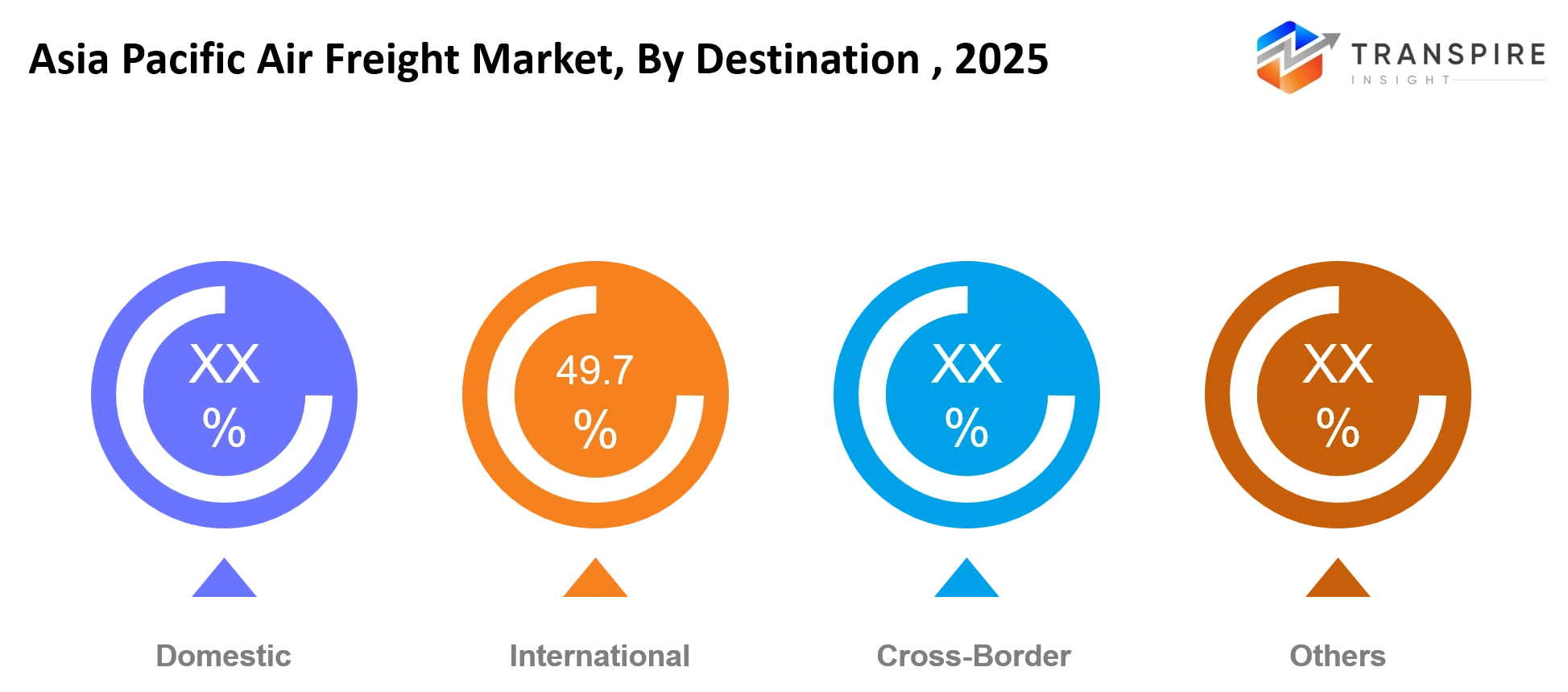
Domestic air freight plays a role in connecting cities where products are made, sold and bought. As businesses expand they need to move goods. Domestic cargo movement is on the rise. Airports and logistics facilities are improving, making it simpler to transport cargo.Companies want to know when their shipments will arrive so they can manage their stock.International freight is a part of cargo transport because of global trade. Cross-border shipments are growing as more businesses trade with each other and people shop online.Customs and digital documentation systems are streamlining cargo processing. Cutting down on delays.
To learn more about this report, Download Free Sample Report
By End User
People buy things on the internet. That is why we need cargo. They want to get their things fast. They want to know that the things will get to them.When more people shop online the companies that help get the things to them have to do work.They have to get the things to the stores so the stores have what people want to buy and the people are happy.The people who make medicine use airplanes to get the medicine to where it's needed. They also use airplanes to get devices and other important things to where they are needed.The companies that make cars use cargo to help them make cars.
The companies that make electronics use trucks and airplanes to get their things to the stores.
The stores use airplanes to get the things they sell to them so they have what people want to buy.Online shopping is a reason for cargo demand. Online shopping makes logistics providers work harder to get things to people faster.
By Cargo Type
General Cargo is a part of freight activity because many businesses use it. A wide range of products are shipped through established cargo networks.Consistent shipment volumes contribute to demand for transportation services.Perishables need to be shipped and handled carefully.Pharmaceuticals are a growing cargo category because of increasing healthcare demand.High Value Goods, such, as electronics and luxury products require transportation and advanced tracking systems.Other cargo categories support a range of commercial activities.
What are the Key Use Cases Driving the Asia Pacific Air Freight Market?
The main thing that is making the Asia Pacific Air Freight Market grow is that people need to transport things that're time-sensitive for online shopping and stores. A lot of people are shopping online now so stores need to get things to people and they need to restock their shelves fast. Air freight is a way to do this because it is fast and reliable and it can help get things to people in big cities.
There are areas where air freight is being used more and more like in healthcare and electronics. Companies that make medicine need air transportation to get vaccines and other medicines to people because these medicines are sensitive and need to be handled in a way. Electronics companies also use air freight to get parts and finished products to people so they can keep making things and not have any problems with their supply chain.
There are some areas where air freight is being used like helping companies that make semiconductors and advanced healthcare products like cell and gene therapies. More and more companies are building high-tech factories. They need a safe and fast way to move their products around. Because there are rules now about how to handle special products companies will be more likely to use premium air cargo services in the future. The Asia Pacific Air Freight Market is important for these things and the Asia Pacific Air Freight Market will keep growing because of this.
|
Report Metrics |
Details |
|
Market size value in 2025 |
USD 141898.5 Million |
|
Market size value in 2026 |
USD 155667.3 Million |
|
Revenue forecast in 2033 |
USD 301865.9 Million |
|
Growth rate |
CAGR of 9.92% from 2026 to 2033 |
|
Base year |
2025 |
|
Historical data |
2021 - 2024 |
|
Forecast period |
2026 - 2033 |
|
Report coverage |
Revenue forecast, competitive landscape, growth factors, and trends |
|
Regional scope |
Asia Pacific |
|
Key company profiled |
DHL, FedEx, UPS, Kuehne+Nagel, DB Schenker, DSV, Nippon Express, Expeditors, CEVA Logistics, Bollore, Cathay Cargo, Emirates SkyCargo, Singapore Airlines Cargo, ANA Cargo, C.H. Robinson. |
|
Customization scope |
Free report customization (country, regional & segment scope). Avail customized purchase options to meet your exact research needs. |
|
Report Segmentation |
By Service Type (Express Freight, Standard Freight, Charter Freight, Temperature-Controlled Freight, Dangerous Goods Freight, Others); By Destination (Domestic, International, Cross-Border, Others); By End User (E-commerce, Healthcare, Automotive, Electronics, Retail, Others); By Cargo Type (General Cargo, Perishables, Pharmaceuticals, High Value Goods, Others). |
Which Regions are Driving the Asia Pacific Air Freight Market Growth?
The Asia Pacific Air Freight Market is led by East Asia. This is because East Asia has a manufacturing base and a lot of airports with good infrastructure. The Asia Pacific Air Freight Market in East Asia also has a capacity to handle cargo. Big cargo hubs in East Asia support the movement of electronics and industrial equipment and consumer goods across the world. The government in East Asia helps make logistics and customs processing better and faster. This makes it easier to move things. The Asia Pacific Air Freight Market in East Asia has a lot of airlines and freight forwarders and e-commerce companies and airport operators working together. This helps East Asia stay ahead in the Asia Pacific Air Freight Market.
Oceania is not as big as East Asia in the Asia Pacific Air Freight Market.. Oceania is doing well because it is stable and people are investing in logistics. The Asia Pacific Air Freight Market in Oceania needs air transportation for things like food and medicine and other valuable things. The rules in Oceania are clear. This helps airlines and cargo operators plan for the future. They are also making airports and cargo handling facilities better in Oceania. This helps make money for the Asia Pacific Air Freight Market in Oceania.
Southeast Asia is growing fast in the Asia Pacific Air Freight Market. This is because governments are spending a lot of money on airports and trade and logistics. There is a lot of e-commerce activity in Southeast Asia and manufacturing is getting more diverse. This creates demand for air cargo services in the Asia Pacific Air Freight Market. Southeast Asia has been working on infrastructure projects and supply chain relocation strategies. This helps Southeast Asia in the Asia Pacific Air Freight Market and in trade. The Asia Pacific Air Freight Market in Southeast Asia will keep growing from 2026 to 2033. This will create opportunities for airlines and logistics providers and investors who want to be part of the growing cargo volumes in the Asia Pacific Air Freight Market.
Who are the Key Players in the Asia Pacific Air Freight Market and How Do They Compete?
The Asia Pacific Air Freight Market is pretty busy with a lot of companies competing. These companies are not just fighting about who can charge the price. They are trying to be better at things like getting cargo to its destination, handling cargo well and making it easy for people to track their shipments.Big companies are trying to stay by buying more planes and investing in new technology. Some smaller companies are focusing on areas that are growing fast like shipping medicine, things people buy online and food that needs to stay cold. Being able to use airports and important logistics hubs is also a big advantage.
Singapore Airlines Cargo is really good at handling cargo and it helps that they are based in one of the busiest airports in the region. They have systems for handling cargo and special services for things like medicine and food. Cathay Cargo is about connecting factories in Asia with the rest of the world. They have platforms that make it easy to book shipments and track them in real time. They are always updating their cargo terminals to make things run smoothly.DHL Aviation is different because they can do everything from picking up cargo to delivering it to someone's door. They are really good at handling shopping shipments because they can get things to people quickly. FedEx Express is great at getting things to people and they have advanced systems that let people track their shipments from start to finish. They are always investing in facilities, technologies and partnerships to make their network bigger and more reliable.
These companies are all trying to be the best in the Asia Pacific Air Freight Market. They are doing this by being good at things, like shipping cargo and making it easy for people to track their shipments. The Asia Pacific Air Freight Market is a place to compete but these companies are doing well.
Company List
- DB Schenker
- DSV
- Nippon Express
- Expeditors
- CEVA Logistics
- Bollore
- Cathay Cargo
- Emirates SkyCargo
- Singapore Airlines Cargo
- ANA Cargo
- C.H. Robinson
Recent Development News
"In April 2026, MASkargo entered a strategic partnership with Teleport to integrate freighter capacity and strengthen intra-Southeast Asia air cargo connectivity. The collaboration combines MASkargo’s global cargo network with Teleport’s regional logistics reach, supporting growing trade flows and e-commerce shipments across Southeast Asia.
Source: https://www.maskargo.com
"In March 2026, DHL Global Forwarding launched new dedicated air freight services between Asia and Europe by leveraging DHL Aviation assets. The expansion added controlled-capacity routes connecting key logistics hubs, improving reliability and cargo capacity on one of the industry's most important trade corridors.
Source: https://group.dhl.com
"In March 2026, Japan Airlines and Cargolux strengthened their partnership through new cargo cooperation covering the Narita–Luxembourg and Narita–Chicago routes. The agreement expands network connectivity between Asia, Europe, and North America, providing customers with broader cargo service options and improved access to major freight hubs.
Source: https://press.jal.co.jp
"In March 2026, ANA Group announced a cargo business reorganization integrating ANA Cargo, Nippon Cargo Airlines, and NCA Japan into a unified structure. The move is designed to strengthen global air freight operations through consolidated sales, warehouse operations, and network management capabilities.
Source: https://www.anahd.co.jp
What Strategic Insights Define the Future of the Asia Pacific Air Freight Market?
The Asia Pacific Air Freight Market is moving toward a more integrated, technology-driven logistics model over the next five to seven years. The strongest force behind this shift will be the combination of cross-border e-commerce growth, supply chain diversification, and increasing demand for time-sensitive transportation. Cargo operators that can combine digital visibility, flexible capacity management, and specialized handling services will capture a larger share of future demand as customers prioritize reliability over simple cost considerations.
A less visible risk lies in market concentration around a limited number of major cargo hubs and trade corridors. Disruptions caused by geopolitical tensions, infrastructure bottlenecks, or regulatory changes could quickly affect cargo flows and create capacity imbalances across the region.
An emerging opportunity is developing around advanced healthcare logistics, particularly the transportation of biologics, cell therapies, and precision medicines that require strict temperature control and traceability. Market participants should invest early in cold-chain infrastructure, digital cargo monitoring platforms, and strategic partnerships with healthcare and technology providers to build long-term competitive advantages.
Asia Pacific Air Freight Market Report Segmentation
By Service Type
- Express Freight
- Standard Freight
- Charter Freight
- Temperature-Controlled Freight
- Dangerous Goods Freight
- Others
By Destination
- Domestic
- International
- Cross-Border
- Others
By End User
- E-commerce
- Healthcare
- Automotive
- Electronics
- Retail
- Others
By Cargo Type
- General Cargo
- Perishables
- Pharmaceuticals
- High Value Goods
- Others
Frequently Asked Questions
Find quick answers to common questions.
The expected Asia Pacific Air Freight Market size for the market will be USD 301865.9 Million in 2033.
Key segments for the Asia Pacific Air Freight Market are By Service Type (Express Freight, Standard Freight, Charter Freight, Temperature-Controlled Freight, Dangerous Goods Freight, Others); By Destination (Domestic, International, Cross-Border, Others); By End User (E-commerce, Healthcare, Automotive, Electronics, Retail, Others); By Cargo Type (General Cargo, Perishables, Pharmaceuticals, High Value Goods, Others).
Major Asia Pacific Air Freight Market players are DHL, FedEx, UPS, Kuehne+Nagel, DB Schenker, DSV, Nippon Express, Expeditors, CEVA Logistics, Bollore, Cathay Cargo, Emirates SkyCargo, Singapore Airlines Cargo, ANA Cargo, C.H. Robinson.
The Asia Pacific Air Freight Market size is USD 141898.5 Million in 2025.
The Asia Pacific Air Freight Market CAGR is 9.92% from 2026 to 2033.
- DHL
- FedEx
- UPS
- Kuehne+Nagel
- DB Schenker
- DSV
- Nippon Express
- Expeditors
- CEVA Logistics
- Bollore
- Cathay Cargo
- Emirates SkyCargo
- Singapore Airlines Cargo
- ANA Cargo
- C.H. Robinson
About the Authors

Mayur Shinde
I am Mayur Shinde, a Senior Research Analyst at Transpire Insight, specializing in the Automotive & Transportation and Information & Communication Technology (ICT) Industry. My work focuses on analyzing emerging market trends, technological advancements, competitive landscapes, and industry developments to deliver accurate, data-driven insights. I am passionate about transforming complex market information into clear, actionable content that helps businesses, professionals, and decision-makers stay informed and make confident strategic decisions.

Chakradhar Khansole
Chakradhar serves as the Research Director at Transpire Insight, bringing over 8 years of experience in technology, innovation, and strategic market intelligence. He specializes in transforming complex market data into actionable business insights that enable organizations to make informed, growth-oriented decisions. Recognized for his strategic vision and analytical expertise, Chakradhar leads high-impact research initiatives, delivering comprehensive market assessments, competitive intelligence, and forward-looking industry analysis.
Recently Published Reports
-
Apr 2026
ATV & UTV Market
ATV & UTV Market Size, Share & Analysis Report By Type (ATV, and UTV), By Variants (Less Than 400 CC, 400 CC To 800 CC, and More Than 800 CC), and Geography (North America, Europe, Asia-Pacific, Middle East and Africa, South and Central America), 2021 - 2031
-
Apr 2026
Automotive Central Gateway Module Market
Automotive Central Gateway Module Market Size, Share & Analysis Report By Type (Ethernet Central Gateway Module, CAN Central Gateway Module, LIN Central Gateway Module, and FlexRay), By Application (Powertrain Control, Body Control, Infotainment System, Advanced Driver Assistance Systems (ADAS), and Others), By End User (Passenger Vehicles, and Commercial Vehicles), and Geography (North America, Europe, Asia-Pacific, Middle East and Africa, South and Central America), 2021 - 2031
-
Apr 2026
Automotive Engine Oil Filter Market
Automotive Engine Oil Filter Market Size, Share & Analysis Report By Filter Type (Fuel Filter, Engine Oil Filter, Hydraulic Oil Filter, and Others), By Filter Media (Cellulose, Synthetic, and Micro), By Sales Channel (OEMs, and Aftermarket), By Vehicle Type (Passenger Cars, Light Commercial Vehicles, Heavy Duty Trucks, Buses and Coaches, and Off-road Vehicles), and Geography (North America, Europe, Asia-Pacific, Middle East and Africa, South and Central America), 2021 - 2031
-
Apr 2026
Automotive Parts Aluminium Die Casting Market
Automotive Parts Aluminium Die Casting Market Size, Share & Analysis Report By Production Process (Pressure Die Casting, Vacuum Die Casting, Squeeze Die Casting, Gravity Die Casting), By Application (Body Parts, Engine Parts, Transmission Parts, Battery And Related Components, Other Application Types), and Geography (North America, Europe, Asia-Pacific, Middle East and Africa, South and Central America), 2021 - 2031
Our Clients



