

Asia Pacific Acute Inflammatory Demyelinating Polyneuropathy (AIDP) - Guillain-barre syndrome Market Summary
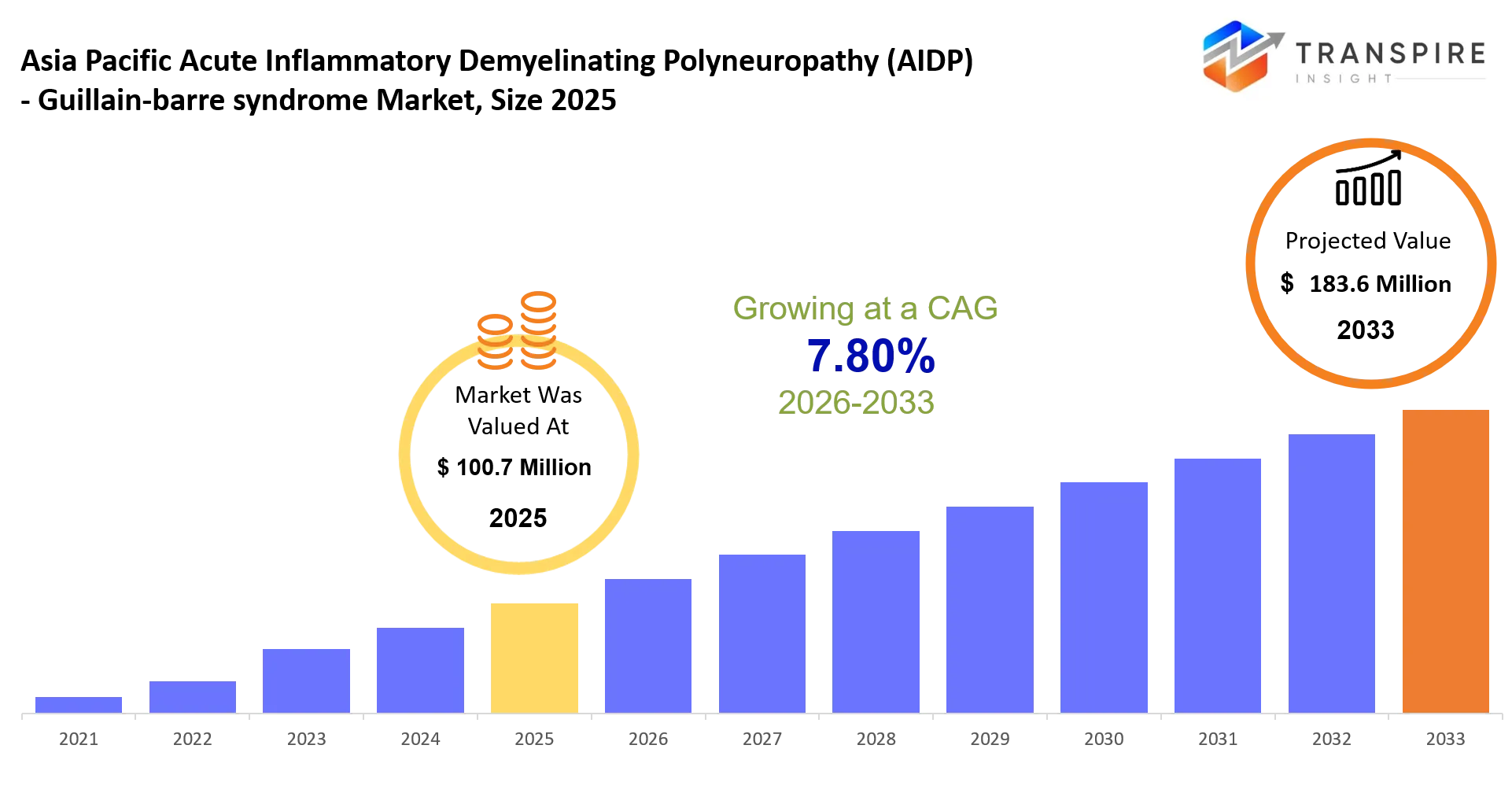
As per Transpire Insight Analysis the Asia Pacific Acute Inflammatory Demyelinating Polyneuropathy (AIDP) - Guillain-barre syndrome Market size is estimated at USD 100.7 Million in 2025 and is anticipated to reach USD 183.6 Million by 2033, growing at a CAGR of 7.80% from 2026 to 2033.
The Asia Pacific Acute Inflammatory Demyelinating Polyneuropathy AIDP and Guillain- Barre syndrome market kind of supports healthcare systems in figuring out, managing and follow up care for patients who suddenly run into nerve damage. This can lead to muscle weakness , or even paralysis and, sometimes, it also drags the situation into more intensive care needs, you know.It also helps patients reach therapies like intravenous immunoglobulin, plasma exchange, diagnostic testing, plus rehabilitation approaches across general hospitals and more specialized care centers. In the last 3–5 years, things have slowly leaned toward faster diagnosis, and more coordinated neurological care, since many hospitals are using advanced testing options and beefing up their critical care capacity. One big moment was the COVID-19 pandemic , it pushed more attention toward immune related nervous system complications, and it brought additional investment for neurological disease monitoring , even when resources were tight. Market growth is mostly pulled by the expanded hospital infrastructure, plus easier reach to expert treatments , and also government programs that target rare disease care , which then sort of nudges earlier action and wider adoption of therapies throughout Asia Pacific.
Asia Pacific Acute Inflammatory Demyelinating Polyneuropathy (AIDP) - Guillain-barre syndrome Market Size & Forecast:
- Asia Pacific Acute Inflammatory Demyelinating Polyneuropathy (AIDP) - Guillain-barre syndrome Market Size 2025: USD 100.7 Million
- Expected Market Value 2033: USD 183.6 Million
- Forecast CAGR: 7.80%
- Leading region in 2025: East Asia
- Fastest Growing region: South Asia
- Key Profile: CSL Behring, Grifols, Takeda, Kedrion Biopharma, Octapharma, Pfizer, Roche, Sanofi, Baxter International, Biotest, China Biologic Products, GC Biopharma, Intas Pharmaceuticals, Bharat Serums and Vaccines, SK Plasma
Key Market Insights
- East Asia is basically out in front, at around 52% market share in 2025, backed up by pretty advanced neurological care setups and easier treatment access, which makes a difference in practice.
- South Asia seems to be the fastest growing region in the 2025–2033 window , mostly because of bigger healthcare investments , more diagnostic reach, and more specialists being available.
- The Immunoglobulin therapy area actually leads , with roughly 65% share, since clinical adoption is already well established and many physicians lean toward acute management.
- Plasma exchange stays in the second-largest spot, supported by hospital-based protocols, in several more developed Asian markets.
- For segment momentum, emerging diagnostic technologies are the fastest-growing through 2033, helping with earlier AIDP identification and also making patient monitoring more precise.
- On the application side, hospital treatment dominates with about 70% share in 2025, because inpatient neurological care is still really essential for serious cases.
- Home-based rehabilitation services are the fastest growing application, and a lot of that is tied to remote monitoring adoption after the initial acute phase is done.
- For end users, specialty hospitals and neurological centers lead the demand, sitting at nearly 55% share due to stronger treatment capabilities.
- Rehabilitation clinics are the fastest-growing end-user category too, as post-treatment recovery programs keep expanding across Asia Pacific healthcare networks.
- CSL Limited also expanded its immunoglobulin production capacities, to shore up plasma-derived therapy supply and to keep up with neurological treatment demand.
What are the Key Drivers, Restraints, and Opportunities in the Asia Pacific Acute Inflammatory Demyelinating Polyneuropathy (AIDP) - Guillain-barre syndrome Market?
The main growth driver behind the Asia Pacific Acute Inflammatory Demyelinating Polyneuropathy (AIDP) - Guillain-Barre syndrome Market seems to be the move toward earlier neurological diagnosis and the broader acceptance of advanced immunotherapy. In practice, regulatory greenlights for intravenous immunoglobulin products, plus more favorable hospital reimbursement frameworks, have eased access obstacles for many patients. Also, the growing availability of nerve conduction testing, together with expanded specialist neurology services, has boosted the number of confirmed diagnoses. So it basically sets up a kind of direct revenue flow, where quicker identification allows earlier treatment, more consistent therapy use , and then stronger demand for plasma-derived options.
On the other hand, the key restraint is still the limited presence of specialized neurological care facilities outside the biggest metropolitan areas. Rolling out the advanced diagnostic groundwork needs major capital spending, trained neurologists, and dependable therapy supply routes. Unfortunately these issues don’t get fixed quickly, since workforce development and hospital modernization plans usually take several years. From what Transpire Insight observes through regional procurement updates and product launch timetables, supply chain concentration is staying as the most important operational risk. If plasma collection processes get disrupted, or manufacturing capacity faces bottlenecks, therapy availability can slip, and market revenue will likely soften.
The key opportunity is sort of in widening the digital neurology platforms and using AI supported diagnosis across the emerging Asia Pacific economies, where health systems are still catching up. Machine learning techniques for analyzing nerve signal patterns, remote check-ins and connected rehabilitation tools can help with access in areas that are underserved in practice. If people invest more in telemedicine infrastructure in places like India and parts of Southeast Asia, that also opens doors for earlier detection and more decentralized patient management, which can in turn boost how readily treatments get adopted.
What Has the Impact of Artificial Intelligence Been on the Asia Pacific Acute Inflammatory Demyelinating Polyneuropathy (AIDP) - Guillain-barre syndrome Market?
Artificial intelligence and digital technologies are slowly, kind of, reshaping the Asia Pacific neurological disorder treatment landscape, mostly by improving diagnosis , monitoring, and care coordination. With AI driven clinical decision tools, clinicians can look through a patient’s symptoms, nerve conduction records, and even recovery trajectories to help spot AIDP cases earlier, sometimes much faster. At the same time, digital platforms are getting pulled into hospital routines, so patient tracking and treatment documentation, plus compliance oversight for neurological care protocols, can run with less manual effort, kind of smoother.
Machine learning models can also nudge healthcare providers by estimating how recovery might unfold, then fine tuning therapy schedules, and flagging people who might need closer observation. In practice this could lift operational efficiency, because it helps cut diagnostic delays, and supports a more sensible distribution of resources.
There are also remote monitoring technologies that let rehabilitation teams follow mobility gains after discharge, which then builds a more continuous care pathway.
Still, AI uptake is not really everywhere, because adoption is restricted by costly implementation, uneven medical data availability, and integration barriers across healthcare systems that have different levels of digital maturity. On top of that, gaps in data quality can quietly lower algorithm accuracy once you move into real clinical settings.
Key Market Trends
- In 2025, hospitals sort of boosted uptake of digital neurological assessment tools, which actually helped with earlier identification of Guillain-Barre syndrome cases a bit sooner than before, or at least that’s what people were saying.
- Between 2024 and 2026, AI enabled diagnostic platforms started showing up across lots of Asian healthcare systems, and they were used to assist with faster neuro evaluation workflows, in a more smooth way.
- From 2025 onward, plasma therapy manufacturers kept pushing production investments, aiming to ease immunoglobulin supply constraints across the Asia Pacific region , pretty consistently too.
- In 2026, telemedicine adoption really accelerated across rural healthcare networks, and it improved specialist access for the more complex neurological disorders.
- During 2025–2033, there’s an expected rise in rehabilitation technology integration, as recovery oriented care models become more central, sort of.
- Since 2024, healthcare providers have been prioritizing automated patient monitoring systems, to improve follow up outcome tracking after treatment.
- In 2025, regional hospitals increased investments in neurological specialty centers because diagnostic requirements were climbing.
- Sometime between 2025 and 2030, it’s expected that machine learning applications will help in clinical forecasting, as in, not just predicting outcomes but also tuning treatment optimization.
- Then in 2026 there was more focus on supply chain diversification strategies, especially when plasma-derived therapy availability became this big, very visible market concern.
Asia Pacific Acute Inflammatory Demyelinating Polyneuropathy (AIDP) - Guillain-barre syndrome Market Segmentation
By Treatment Type :
Intravenous Immunoglobulin (IVIG) still ends up being the go-to treatment, mostly because it can act faster and it’s more broadly accepted by many neurologists. Plasma exchange, meanwhile, keeps getting used for the toughest presentations, when a rapid kind of removal of the harmful antibodies really becomes a priority. Corticosteroids don’t look especially strong for AIDP management on their own, but they keep showing up in wider conversations around neurological care, sort of alongside other decisions.
More focus is expected on supportive care plus immunotherapy options, especially as rehabilitation practices improve and patient recovery programs get better organized. Hospitals are also tightening treatment protocols so that acute therapies are paired with ongoing or continuous monitoring, even during the early phases. And as advances in plasma-derived therapies continue, better availability for advanced options across Asia Pacific health systems should follow, or at least expand.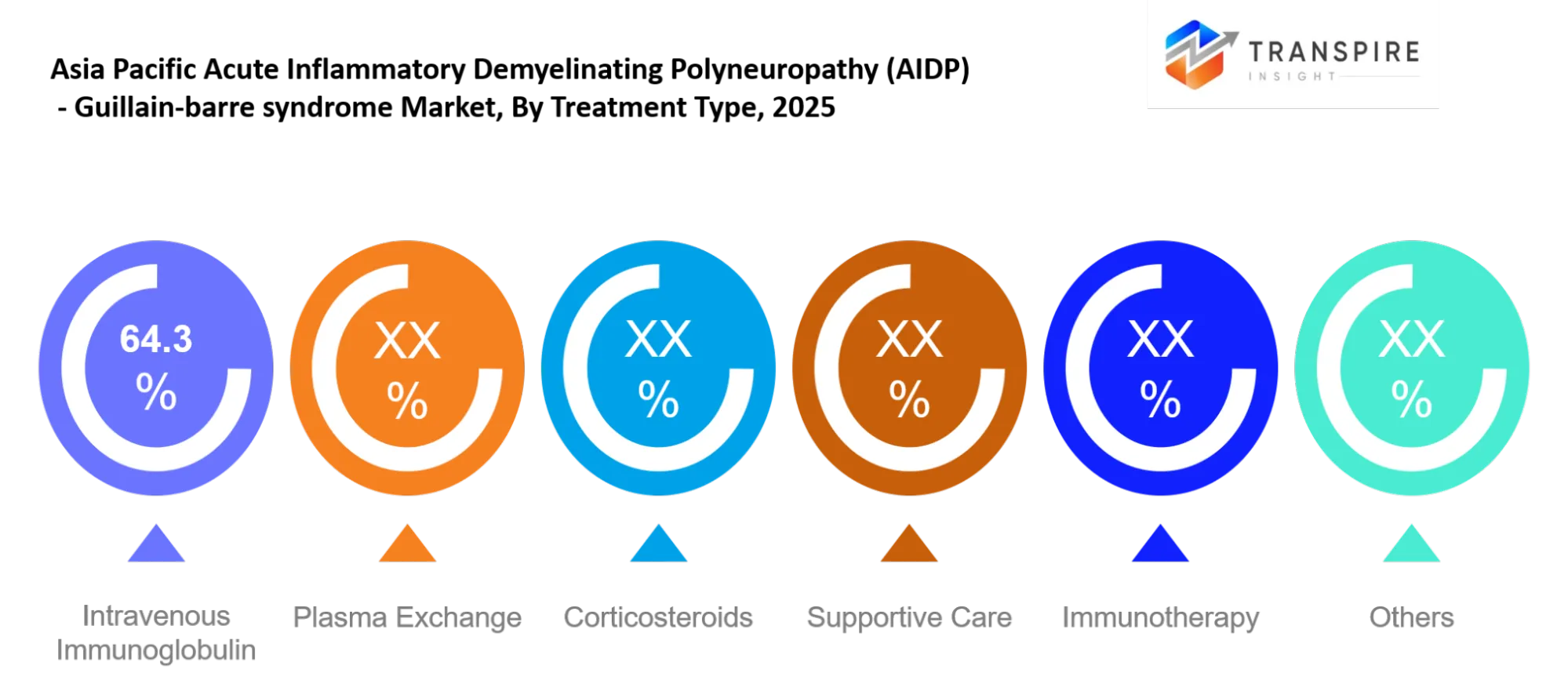
By Diagnosis :
Neurological exam remains the first diagnostic step, because clinical assessment can point out muscle weakness, changes in reflexes, and sensory issues. Nerve conduction studies matter a lot too, since they provide detailed data about nerve damage patterns, and they also hint at disease severity. Lumbar puncture helps support the diagnosis through cerebrospinal fluid analysis, particularly when it’s suspected based on the overall picture.
MRI and blood tests are gradually becoming more important as supplementary diagnostic tools for a more accurate evaluation of the disease. Healthcare facilities are working on improved testing technologies too, with the goal of shrinking diagnosis delays. Finally, growth in specialized neurological centers should help increase access to advanced diagnostic procedures across regional healthcare networks.
By End User :
Hospitals still look like the top end user group , mainly because they have those advanced emergency care facilities and real access to specialized neurological services. Specialty neurology clinics are also growing, they expand offerings with more pinpoint expertise in rare neurological conditions, rather than being general. Rehabilitation centers are becoming more crucial for long period recovery handling after the acute treatment phase, kinda like the “second stage” in practice.
Academic medical centers add a lot too, via clinical research, physician education, and the improvement of treatment pathways. As the neurological care base gets wider , service availability should rise especially in developing countries. The money put into healthcare facilities should help with better patient management and overall treatment results across the wider region.
By Distribution Channel :
Hospital pharmacies stay the main distribution route , because the most critical therapies need controlled storage plus professional supervision. Specialty pharmacies help people reach advanced neurological medicines using careful handling and distribution services. Retail pharmacies only cover a small part of the picture, mainly for supportive medications that are used while recovery is ongoing.
Online pharmacies are getting more attention as digital healthcare expands, and as medicine delivery systems get smoother. If supply chain management improves , treatment access should become easier in remote places. Distribution networks should keep evolving, since healthcare providers want dependable access to neurological therapies.
By Patient Group :
Adults are currently the biggest patient group, mostly because diagnosis happens more often, and acquired neurological conditions seem to show up more frequently. Pediatric patients really need specialized monitoring , since how treatment is planned can swing depending on age related clinical factors. For geriatric patients the management has to be extra careful, because they often have more comorbid health conditions that can slow recovery processes or complicate them.
If diagnosis improves across the various age groups, then broader treatment adoption will become a lot more realistic. Healthcare providers are also working on care strategies that are tailored to the patient, in order to improve recovery outcomes. And if rehabilitation services are expanded , that should build stronger support systems for pediatric patients as well as elderly patient populations.
What are the Key Use Cases Driving the Asia Pacific Acute Inflammatory Demyelinating Polyneuropathy (AIDP) - Guillain-barre syndrome Market?
Hospitals still sit at the center of the Asia Pacific Acute Inflammatory Demyelinating Polyneuropathy (AIDP) - Guillain-barre syndrome Market, kinda like the main reason this market keeps moving, with IVIG-based treatment helping in emergency neurological care. In practice, hospitals and specialty neurology clinics keep buying advanced therapies because fast action helps manage patients better, and also lowers the risk of very severe complications.
On the other side, rehabilitation centers and academic medical centers are pushing the scope outward, using recovery programs, plus some clinical research activities. Meanwhile, specialty clinics are rolling out more structured monitoring services, to raise diagnosis precision and maintain better long-term neurological support.
Looking ahead, AI-assisted diagnosis platforms and remote rehabilitation tools are becoming more noticeable use cases during the forecast period. Telemedicine providers and healthcare networks are also testing digital approaches, so specialists can reach underserved regions more consistently, even if they are far away.
|
Report Metrics |
Details |
|
Market size value in 2025 |
USD 100.7 Million |
|
Market size value in 2026 |
USD 108.5 Million |
|
Revenue forecast in 2033 |
USD 183.6 Million |
|
Growth rate |
CAGR of 7.80% from 2026 to 2033 |
|
Base year |
2025 |
|
Historical data |
2021 - 2024 |
|
Forecast period |
2026 - 2033 |
|
Report coverage |
Revenue forecast, competitive landscape, growth factors, and trends |
|
Regional scope |
Asia Pacific (India, China, Japan, Australia, South Korea, Rest of Asia Pacific) |
|
Key company profiled |
CSL Behring, Grifols, Takeda, Kedrion Biopharma, Octapharma, Pfizer, Roche, Sanofi, Baxter International, Biotest, China Biologic Products, GC Biopharma, Intas Pharmaceuticals, Bharat Serums and Vaccines, SK Plasma . |
|
Customization scope |
Free report customization (country, regional & segment scope). Avail customized purchase options to meet your exact research needs. |
|
Report Segmentation |
By Treatment Type (Intravenous Immunoglobulin (IVIG), Plasma Exchange, Corticosteroids, Supportive Care, Immunotherapy, Others); By Diagnosis (Neurological Examination, Nerve Conduction Studies, Lumbar Puncture, MRI, Blood Tests, Others); By End User (Hospitals, Specialty Neurology Clinics, Rehabilitation Centers, Academic Medical Centers, Others); By Distribution Channel (Hospital Pharmacies, Retail Pharmacies, Specialty Pharmacies, Online Pharmacies, Others); By Patient Group (Adults, Pediatric Patients, Geriatric Patients, Others) |
Which Regions are Driving the Asia Pacific Acute Inflammatory Demyelinating Polyneuropathy (AIDP) - Guillain-barre syndrome Market Growth?
East Asia seems to hold the strongest position in the Asia Pacific Acute Inflammatory Demyelinating Polyneuropathy (AIDP) – Guillain-barre syndrome market, with a rough estimated 52% share in 2025. There is a lot going on here. A strong neurological healthcare foundation, plus advanced reimbursement systems, and real government backing for rare disease handling, all together, help explain why the region keeps dominating. China, Japan, and South Korea keep pushing the ecosystem forward via specialized hospitals, pharmaceutical funding, and pretty advanced diagnostic networks, it’s almost like a loop that keeps reinforcing itself. With ongoing healthcare modernization, more specialist availability, and better access to immunoglobulin therapies, East Asia’s position is likely to stay pretty steady through 2033, even if demand patterns shift over time.
Meanwhile Australia and Southeast Asia bring in stable market revenue, mostly because their healthcare systems are more structured and medical investment trends stay fairly consistent. Australia leans on regulated treatment pathways, and it also has a solid hospital network. Singapore, on the other hand, supports advanced neurological care largely because healthcare spending is high, and the services tend to be well organized. In the end, regulatory steadiness and dependable healthcare financing help keep adoption of diagnostic services, plus treatment options, moving without too much disruption. So yes the expansion pace can be a little slower versus emerging markets, but the region remains a consistent, kind of reliable contributor overall.
South Asia will likely be the fastest-growing region over 2026–2033, because there is this ongoing expansion of healthcare infrastructure and better access to neurological services. In India, plus the surrounding markets, governments and operators are putting money into specialty hospitals, telemedicine linkages, and diagnostic facilities, which helps in more accurate disease recognition. At the same time, more advanced therapies are becoming available, and private healthcare involvement is rising, so you get fresh growth momentum. This whole push should open doors for therapy makers, tech providers, and healthcare investors who are trying to enter the regional market.
Who are the Key Players in the Asia Pacific Acute Inflammatory Demyelinating Polyneuropathy (AIDP) - Guillain-barre syndrome Market and How Do They Compete?
The competitive landscape of the Asia Pacific Acute Inflammatory Demyelinating Polyneuropathy (AIDP) - Guillain-barre syndrome Market stays somewhat consolidated, and the rivalry is mostly around therapy availability, how much they can manufacture, clinical reliability , and regional supply routing. A number of players with serious plasma based therapy know-how and wide distribution channels keep their positions. At the same time, smaller biotechnology companies keep showing up with more precise innovations and better treatment access, even if the overall structure isn’t that fragmented.
CSL Limited plays it strong with advanced plasma collection setups and immunoglobulin production capacity, so therapy availability tends to remain steady across neurological treatment environments. Takeda Pharmaceutical Company leans into plasma derived medicine development and global supply coordination, and the benefit is basically manufacturing scale along with therapy know-how.
Grifols boosts competition via plasma collection technology and ongoing investments in production networks, which helps stabilize supply consistency. Octapharma, meanwhile, differentiates with specialized plasma derived treatments and regional distribution strengths that line up with hospital demand. Kedrion Biopharma is working on wider reach through partnerships and targeted plasma therapy solutions that fit neurological use cases.
Company List
- CSL Behring
- Grifols
- Takeda
- Kedrion Biopharma
- Octapharma
- Pfizer
- Roche
- Sanofi
- Baxter International
- Biotest
- China Biologic Products
- GC Biopharma
- Intas Pharmaceuticals
- Bharat Serums and Vaccines
- SK Plasma
Recent Development News
In July 2026, Takeda Pharmaceutical Company announced a collaboration with the Indonesian Government to strengthen plasma-derived medicinal product access. The initiative includes an investment of up to USD 30 million to establish a plasma ecosystem, improving future immunoglobulin supply for neurological treatments including AIDP-related care.
Source https://www.takeda.com/
In February 2026, CSL Limited highlighted expansion of its immunoglobulin portfolio and hospital reach in China through strategic commercial partnerships. The initiative supports broader access to immunoglobulin therapies and strengthens CSL’s position in Asia Pacific plasma-derived treatment markets. Source https://investors.csl.com/
What Strategic Insights Define the Future of the Asia Pacific Acute Inflammatory Demyelinating Polyneuropathy (AIDP) - Guillain-barre syndrome Market?
The Asia Pacific Acute Inflammatory Demyelinating Polyneuropathy (AIDP) - Guillain-barre syndrome Market is slowly moving toward a more integrated neurological care model, pushed by earlier diagnosis , better specialist networks and wider access to advanced immunotherapies. In the next 5–7 years , most treatment providers will likely try to blend hospital based therapies with digital check ups and rehabilitation pathways that are easier to follow.
There’s also a more quiet risk, like supply concentration in plasma derived therapies where something like a manufacturing disruption or regulatory shift could suddenly change treatment availability even while the growth outlook still looks strong.
At the same time there’s a new opening, AI supported neurological diagnosis together with remote recovery monitoring , particularly across South Asia, where healthcare access is still growing. Market participants should put more emphasis on diversified supply chains, regional collaborations and digital healthcare platforms—so they can absorb shocks better and win on the future demand.
Asia Pacific Acute Inflammatory Demyelinating Polyneuropathy (AIDP) - Guillain-barre syndrome Market Report Segmentation
By Treatment Type
- Intravenous Immunoglobulin (IVIG)
- Plasma Exchange
- Corticosteroids
- Supportive Care
- Immunotherapy
By Diagnosis
- Neurological Examination
- Nerve Conduction Studies
- Lumbar Puncture
- MRI
- Blood Tests
By End User
- Hospitals
- Specialty Neurology Clinics
- Rehabilitation Centers
- Academic Medical Centers
By Distribution Channel
- Hospital Pharmacies
- Retail Pharmacies
- Specialty Pharmacies
- Online Pharmacies
By Patient Group
- Adults
- Pediatric Patients
- Geriatric Patients
Frequently Asked Questions
Find quick answers to common questions.
The Expected Asia Pacific Acute Inflammatory Demyelinating Polyneuropathy (AIDP) - Guillain-barre syndrome Market size for the market will be USD 183.6 Million in 2033.
Key Segments for the Asia Pacific Acute Inflammatory Demyelinating Polyneuropathy (AIDP) - Guillain-barre syndrome Market are By Treatment Type (Intravenous Immunoglobulin (IVIG), Plasma Exchange, Corticosteroids, Supportive Care, Immunotherapy, Others); By Diagnosis (Neurological Examination, Nerve Conduction Studies, Lumbar Puncture, MRI, Blood Tests, Others); By End User (Hospitals, Specialty Neurology Clinics, Rehabilitation Centers, Academic Medical Centers, Others); By Distribution Channel (Hospital Pharmacies, Retail Pharmacies, Specialty Pharmacies, Online Pharmacies, Others); By Patient Group (Adults, Pediatric Patients, Geriatric Patients, Others).
Major Asia Pacific Acute Inflammatory Demyelinating Polyneuropathy (AIDP) - Guillain-barre syndrome Market players are CSL Behring, Grifols, Takeda, Kedrion Biopharma, Octapharma, Pfizer, Roche, Sanofi, Baxter International, Biotest, China Biologic Products, GC Biopharma, Intas Pharmaceuticals, Bharat Serums and Vaccines, SK Plasma.
The Current Asia Pacific Acute Inflammatory Demyelinating Polyneuropathy (AIDP) - Guillain-barre Syndrome Market size is USD 100.7 Million in 2025.
The Asia Pacific Acute Inflammatory Demyelinating Polyneuropathy (AIDP) - Guillain-barre syndrome Market CAGR is 7.80% from 2026 to 2033.
- CSL Behring
- Grifols
- Takeda
- Kedrion Biopharma
- Octapharma
- Pfizer
- Roche
- Sanofi
- Baxter International
- Biotest
- China Biologic Products
- GC Biopharma
- Intas Pharmaceuticals
- Bharat Serums and Vaccines
- SK Plasma
About the Authors

Pankaj Ghogare Patil
I am Pankaj Ghogare Patil, a Senior Research Analyst at Transpire Insight, specializing in the Pharmaceutical, Chemicals & Materials, Healthcare IT, and Biotechnology industry. My expertise lies in conducting comprehensive market research, analyzing industry trends, evaluating competitive landscapes, and translating complex data into actionable insights. At Transpire Insight, I closely follow emerging technologies, regulatory developments, and market innovations to create accurate, well-researched, and informative content that helps businesses and professionals make informed decisions. I am committed to producing credible, evidence-based articles that reflect industry best practices while making technical topics accessible and valuable for a broad audience.

Chakradhar Khansole
Chakradhar serves as the Research Director at Transpire Insight, bringing over 8 years of experience in technology, innovation, and strategic market intelligence. He specializes in transforming complex market data into actionable business insights that enable organizations to make informed, growth-oriented decisions. Recognized for his strategic vision and analytical expertise, Chakradhar leads high-impact research initiatives, delivering comprehensive market assessments, competitive intelligence, and forward-looking industry analysis.
Recently Published Reports
-
Jul 2026
Alopecia Treatment Market
Alopecia Treatment Market Size, Share & Analysis Report By Disease Type (Alopecia Areata, Cicatricial Alopecia, Traction Alopecia, Alopecia Totalis, Androgenetic Alopecia, Alopecia Universalis, and Other Disease Types), By Treatment Type (Topical Treatments, Oral Medications, Injectable Therapies, and Hair Transplantation), By Gender (Male, and Female), By Distribution Channel (Hospitals and Clinics, Retail Pharmacies, and Online Retailers), and Geography (North America, Europe, Asia-Pacific, Middle East and Africa, South and Central America), 2021 - 2031
-
Jul 2026
Medical Ultrasound Probe Market
Medical Ultrasound Probe Market Size, Share & Analysis Report By Type (Linear Type, Convex Type, Endocavitary Probe, Phased Array/Cardiac Probe, Transesophageal (TEE) Probe, and Others), By Application (Ophthalmology, Cardiology, Musculoskeletal, Oncology, Obstetrics & Gynecology, General Imaging, and Others), By End User (Hospitals & Clinics, Diagnostic Centers, Ambulatory Surgical Centers, and Others), and Geography (North America, Europe, Asia-Pacific, Middle East and Africa, South and Central America), 2021 – 2031
-
May 2026
Biosimilars Market
Biosimilars Market By Product Type (Monoclonal Antibodies, Recombinant Hormones, Erythropoietin, G-CSF, Others), By Indication (Oncology, Autoimmune Diseases, Blood Disorders, Diabetes, Others), By Manufacturing Type (In-House Manufacturing, Contract Manufacturing), By Distribution Channel (Hospital Pharmacies, Retail Pharmacies, Online Pharmacies), By Industry Analysis, Size, Share, Growth, Trends, and Forecasts 2021-2033
-
Apr 2026
Gastrointestinal Endoscopy Market
Gastrointestinal Endoscopy Market By Type (Rigid Gastrointestinal Endoscope, Flexible Gastrointestinal Endoscopes, Disposable Gastrointestinal Endoscope), By Procedure Type (Colonoscopy, Gastroscopy, Duodenoscopy, Enteroscopy, Flexible Sigmoidoscopy, Others), By Application (Diagnosis, Treatment), By End-Users (Hospitals, Ambulatory Surgical Centers, Specialty Clinics, Laboratories, Others), By Industry Analysis, Size, Share, Growth, Trends, and Forecasts 2021-2033