Europe Intravenous Infusion Pump Market Size & Forecast:
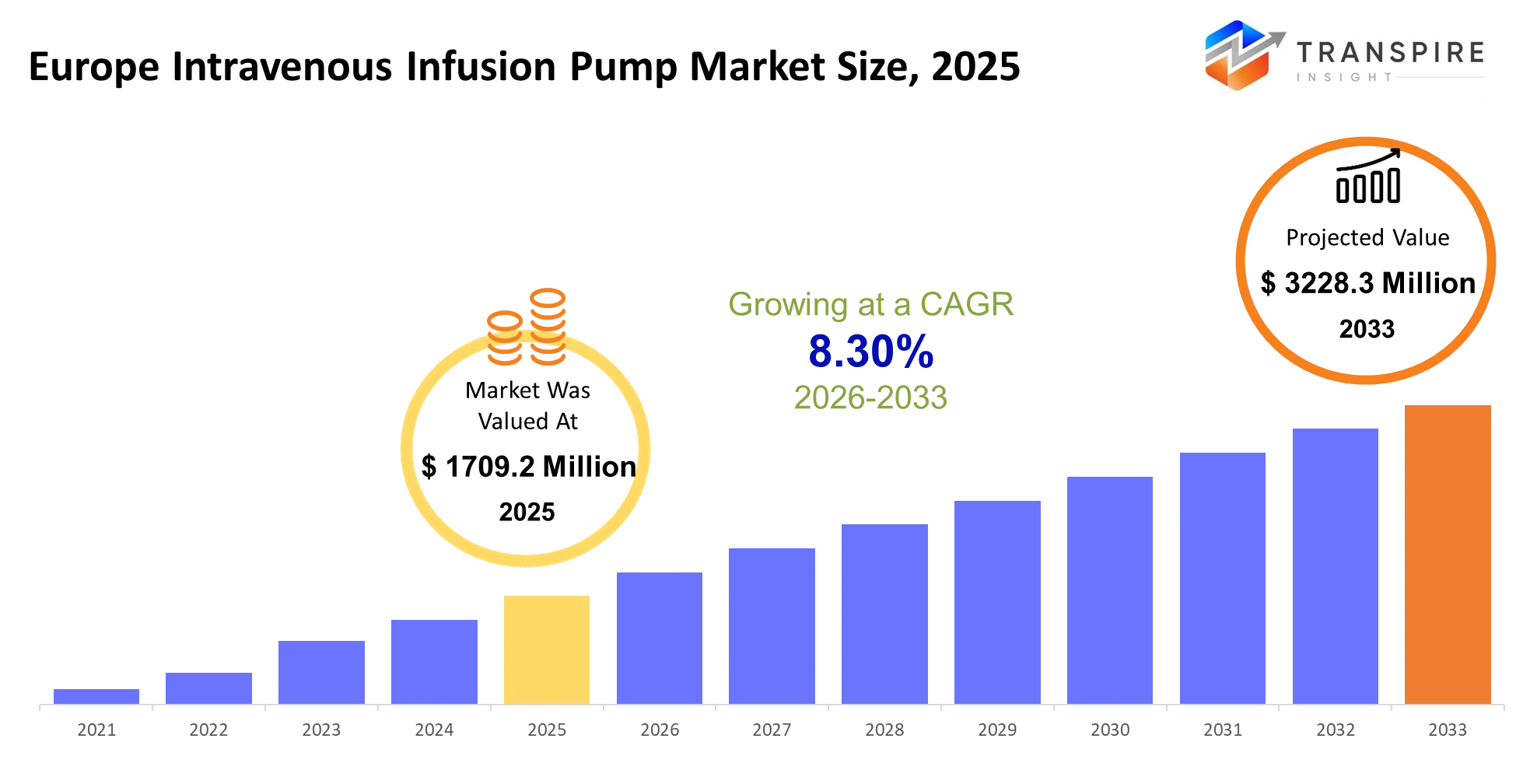
- Europe Intravenous Infusion Pump Market Size 2025: USD 1709.2 Million
- Europe Intravenous Infusion Pump Market Size 2033: USD 3228.3 Million
- Europe Intravenous Infusion Pump Market CAGR: 8.30%
- Europe Intravenous Infusion Pump Market Segments: By Type (Volumetric Pumps, Syringe Pumps, Ambulatory Pumps, PCA Pumps, Others), By Application (Chemotherapy, Pain Management, Nutrition, Pediatrics, Others), By End-User (Hospitals, Clinics, Homecare, Ambulatory Centers, Others), By Technology (Smart Pumps, Conventional Pumps, Wireless Pumps, Others).
To learn more about this report,  Download Free Sample Report
Europe Intravenous Infusion Pump Market Summary:
The Europe Intravenous Infusion Pump Market size is estimated at USD 1709.2 Million in 2025 and is anticipated to reach USD 3228.3 Million by 2033, growing at a CAGR of 8.30% from 2026 to 2033. The intravenous infusion pump market in Europe enables hospitals and ambulatory centers and home care facilities to provide continuous drug delivery because their systems guarantee accurate dosage and dependable operational performance which determines patient results. The systems deliver chemotherapy and insulin and pain medication and nutritional supplements and critical care medicines while they decrease manual medication delivery mistakes and enable doctors to track delivery speeds in high-demand medical locations.
The market has moved toward smart infusion platforms which enable wireless connectivity and system interoperability and centralized system monitoring during the past five years. The European Union medical device compliance regulations combined with cybersecurity requirements drove hospitals to replace their older infusion pumps because the COVID-19 pandemic caused ICUs to expand which revealed problems with hospital equipment availability and maintenance systems and medical device standardization between hospitals.
The current market momentum shows how healthcare organizations face both financial and operational demands. Hospitals are implementing connected infusion systems in order to decrease medication errors and decrease nurse workload and enhance asset usage throughout their various departments. Healthcare providers are showing a preference for portable and programmable pumps because their use enables decentralized care systems to function properly. The transition process is increasing demand for infusion infrastructure that can scale up its services because it extends service contracts and software upgrade periods and fleet management profits in hospitals and home care environments.
Key Market Insights
- Germany controls 2025 European IV infusion pump market because its hospitals have cutting-edge infrastructure and its intensive care units operate at maximum capacity.
- The United Kingdom shows the fastest regional market growth which will continue until 2032 because of digital healthcare updates and the development of outpatient infusion centers.
- The French pharmaceutical market maintains its large size because of effective reimbursement systems and the increasing need for accurate drug delivery systems.
- The healthcare sector in Italy and Spain is expanding through the development of home healthcare infusion systems and the growth of ambulatory care services.
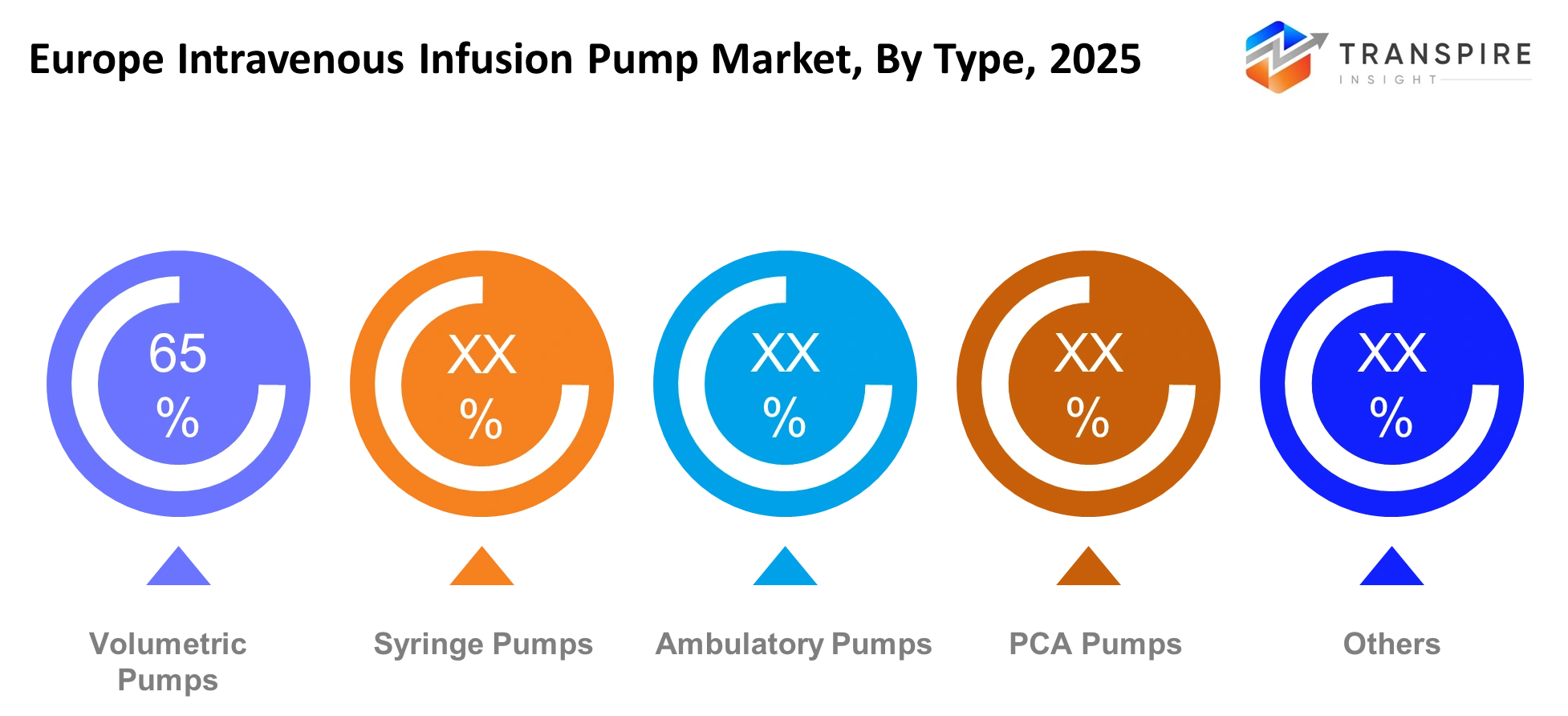
- In 2025 hospitals will use volumetric infusion pumps which hold more than 38 percent of the market because critical care units need precise delivery of medications.
- European healthcare institutions use syringe infusion pumps as their second biggest segment because these devices support neonatal care and oncology treatment and anesthesia procedures.
- The 2025,2032 forecast period will see ambulatory infusion pumps become the fastest-growing market segment because of rising home infusion therapy requirements.
- Wireless smart infusion systems are expanding their market presence because they enable centralized system monitoring while connecting with electronic health record systems.
- The European IV infusion pump market generates approximately 30 percent of its revenue from oncology applications which handle rising chemotherapy treatment and extended infusion therapies.
- Hospitals need constant multi-drug infusion treatment for their critical care and intensive care patients which leads to a growth in these medical applications.
- The fastest-growing application segment for home-based chronic disease treatment will continue until 2032 because of decentralized healthcare delivery methods.
What are the Key Drivers, Restraints, and Opportunities in the Europe Intravenous Infusion Pump Market?
The European Intravenous Infusion Pump Market experiences its most significant growth because hospitals and outpatient care networks are implementing smart infusion systems. The transition gained momentum after the European Union established stricter Medical Device Regulation standards and launched investigations into medication errors that occurred in intensive care units. Healthcare providers demonstrate their commitment to modern technology by replacing outdated infusion devices with smart pumps that provide interoperability through their electronic health record and centralized monitoring system capabilities. The equipment sales increase due to the upgrade cycle which generates additional software licensing revenue and long-term service contracts that enhance patient safety metrics and clinical workflow efficiency.
The market faces its primary structural challenge through high costs associated with replacing systems and integrating new technologies. Hospitals need to establish complete IT infrastructure compatibility and obtain cybersecurity authentication while training clinicians and achieving regulatory approval before they can use advanced infusion systems. Many mid-sized healthcare facilities across Southern and Eastern Europe still operate fragmented digital infrastructure, which creates financial and operational barriers to complete smart pump integration. The limitation prevents hospitals from upgrading their infusion equipment while it also hinders public healthcare systems from using advanced infusion technologies that require long procurement processes.
Home-based infusion therapy represents the clearest long-term growth opportunity. European healthcare systems invest in decentralized care models to decrease hospital treatment expenses and alleviate pressure on hospital beds. Portable ambulatory infusion pumps with wireless monitoring capabilities enable patients to receive chemotherapy and antibiotic therapy and manage chronic pain outside of acute care facilities.
What Has the Impact of Artificial Intelligence Been on the Europe Intravenous Infusion Pump Market?
The European intravenous infusion pump market undergoes transformation through artificial intelligence and advanced digital technologies which enable better medication delivery and automated patient monitoring and predictive clinical systems management. The deployment of AI-powered infusion systems in hospitals enables automatic dosage verification and programming error detection and health record system data integration. The system functions enable medical staff to handle critical care processes without manual work while delivering precise medication distribution in oncology and intensive care units.
The machine learning models now enable predictive maintenance for connected infusion systems through their analysis of battery health and calibration drift and alarm frequency and component wear patterns. Healthcare providers utilize these analytics to decrease unplanned device breakdowns while increasing equipment longevity and maximizing departmental usage. European hospitals demonstrate decreased pump downtime and service interruptions due to maintenance work after they implemented cloud-based monitoring solutions. The digital fleet management systems enhance asset tracking capabilities which enable healthcare providers to minimize equipment replacement expenses while decreasing asset loss throughout their hospital networks.
Advanced analytics improve clinical decision-making processes by discovering infusion patterns which result in adverse drug reactions and operational performance challenges. The process of AI adoption encounters fundamental structural obstacles which prevent its advancement. The majority of hospitals use disjointed information technology systems which create difficulties for infusion equipment and monitoring systems and patient information networks to work together.
Key Market Trends
- European hospitals have accelerated their replacement of standalone infusion pumps with interoperable smart systems which work with their electronic health record systems since 2021.
- The EU Medical Device Regulation enforcement of 2021 required manufacturers to develop new designs for infusion software and cybersecurity systems and device traceability solutions.
- The period from 2022 to 2025 saw greater adoption of portable ambulatory infusion pumps because outpatient chemotherapy and antibiotic therapy volumes increased throughout Europe.
- Baxter International and Becton Dickinson and Company expanded their financial commitment to cloud-based infusion management systems in order to enhance their extended hospital agreements.
- The pandemic period demonstrated to hospitals that centralized equipment purchasing processes should be shortened because limited access to infusion devices created operational hazards during ICU demand spikes.
- Healthcare providers began using AI-based predictive maintenance systems after 2023 which enabled them to decrease infusion pump downtime while optimizing equipment usage across their multiple hospital locations.
- Home healthcare providers expanded their infusion therapy services by 20% since 2020 because governments began to support decentralized patient care which costs less than traditional methods.
- European healthcare systems now prefer software-upgradable infusion systems because they allow hospitals to use equipment for longer periods without incurring high replacement costs.
- Manufacturers changed their competitive approach by moving to software and maintenance and analytics sales after 2022 instead of depending on hardware sales for their business.
- The period from 2021 to 2025 saw significant growth in wireless infusion monitoring usage within oncology departments because nursing staff needed to handle medication safety and their workload challenges.
Europe Intravenous Infusion Pump Market Segmentation
By Type
The type segment market remains dominated by volumetric pumps because hospitals require constant operation of high-volume fluid delivery systems for their critical care and oncology and surgical departments. The combination of precise dosage delivery and multiple drug therapy compatibility and digital monitoring system integration enables hospitals to use volumetric systems through their entire medical operations.
Syringe pumps maintain a substantial share due to precision drug delivery requirements in neonatal care, anesthesia, and intensive care applications where controlled low-volume infusion remains essential. Healthcare providers increasingly adopt ambulatory pumps because they move chronic treatment programs from hospitals to outpatient and home-based treatment environments.
PCA pumps also show stable utilization in post-operative pain management, although procurement growth remains slower in cost-sensitive public healthcare systems. The type segment will develop future products that companies will design as portable devices with software capabilities and battery-powered functionality. Manufacturing companies will develop products that combine compact structures with remote monitoring systems and easy maintenance to create increased replacement demand and extended service revenue.
To learn more about this report, Download Free Sample Report
By Application
The application segment of chemotherapy shows its highest use because cancer treatment needs extended medication support that must happen under strict control in both hospital and clinic settings. The total number of oncology treatments which European countries provide leads to the increasing demand for programmable infusion systems that have precise dosing capabilities and safety monitoring features. The surgical procedure increase together with the growth of palliative care services has created a major application field for pain management.
The field of nutrition-based infusion therapy continues to show strong growth especially in intensive care units and facilities that provide long-term care for elderly patients. Pediatric applications create new market opportunities because neonatal and pediatric care needs precise control over drug delivery systems which must deliver exact amounts with high accuracy. The future growth of the application segment will serve to establish better support for decentralized healthcare delivery systems.
The upcoming launch of portable infusion platforms will meet the increasing need for home-based chemotherapy, antibiotic treatment, and chronic illness management. The market will attract investor and manufacturer interest toward advanced software components, systems for patient observation, and specialized devices which offer therapy-based solutions.
By End-User
The primary end-user market segment consists of hospitals because emergency departments, oncology units, surgical theaters, and intensive care units at large healthcare facilities administer the most infusion therapy treatments. The centralization of procurement and hospitals' substantial purchasing capabilities and their investment in digital systems enable hospitals to implement modern smart infusion systems more rapidly than smaller medical facilities.
The number of outpatient treatments continues to grow, which enables clinics to maintain their current business level, especially in their oncology and dialysis departments. Homecare environments have become the fastest-growing end-user market because healthcare organizations seek to decrease their inpatient treatment expenses, which results in lower hospital bed occupancy rates. Ambulatory surgical centers are increasing their use of infusion equipment through their implementation of same-day treatment systems and their use of minimally invasive surgical techniques.
The future market development for the end-user segment will support medical facilities that need to operate connected infusion systems which can be managed from remote locations. The equipment manufacturers will enhance their service contracts and predictive maintenance solutions and software support capabilities, because decentralized infusion therapy is becoming vital for commercial operations.
By Technology
Healthcare providers now prioritize medication safety and centralized monitoring and electronic health record system interoperability which makes smart pumps the leading technology solution for medication delivery systems. European healthcare networks procure smart infusion technologies because Drug error reduction software and wireless communication and automated alert systems provide essential features. Conventional pumps maintain essential function in smaller hospitals together with budget-constrained healthcare systems which face infrastructure restrictions that prevent digital system implementation.
The increasing need for home-based infusion management and remote supervision drives the rapid adoption of wireless pumps throughout the industry. Healthcare providers can use connectivity improvements to increase their fleet efficiency while decreasing the need for manual equipment monitoring. The upcoming competition between technologies will focus on three key areas which include cybersecurity protection and cloud-based analytics and artificial intelligence systems that perform predictive maintenance and dosage optimization.
Manufacturers who develop interoperable software ecosystems together with scalable digital infrastructure solutions will achieve better contract outcomes than their competitors who lack such capabilities while buyers will assess infusion platforms through their entire lifecycle costs instead of focusing on initial purchase expenses.
What are the Key Use Cases Driving the Europe Intravenous Infusion Pump Market?
The main reason European hospitals use infusion pumps. The programmable infusion systems in oncology departments enable precise chemotherapy drug delivery through controlled dosing during extended treatment periods. The highest equipment requirements arise from large hospitals and specialized cancer centers which need to monitor multiple drugs through continuous safety alerts and precise flow control.
The use of home-based antibiotic therapy and chronic pain management is growing quickly in both ambulatory care and homecare environments. The healthcare industry is adopting portable infusion pumps to decrease hospital expenses while enabling remote treatment for patients. Nutritional infusion therapy is becoming popular in both elderly care facilities and post-surgical recovery programs.
The development of new applications has created two systems which combine remote pediatric infusion monitoring with artificial intelligence-powered infusion control used in intensive care operations. Several European healthcare systems are testing connected infusion platforms that integrate with electronic health records to improve medication tracking and reduce manual programming errors during critical care treatment.
|
Report Metrics |
Details |
|
Market size value in 2025 |
USD 1709.2 Million |
|
Market size value in 2026 |
USD 1847.7 Million |
|
Revenue forecast in 2033 |
USD 3228.3 Million |
|
Growth rate |
CAGR of 8.30% from 2026 to 2033 |
|
Base year |
2025 |
|
Historical data |
2021 - 2024 |
|
Forecast period |
2026 - 2033 |
|
Report coverage |
Revenue forecast, competitive landscape, growth factors, and trends |
|
Regional scope |
Europe (Germany, United Kingdom, France, Italy, Spain and Rest of Europe) |
|
Key company profiled |
BD, Baxter, B Braun, Fresenius Kabi, ICU Medical, Smiths Medical, Medtronic, Terumo, Moog, Nipro, Mindray, Zyno Medical, Insulet, Roche, Johnson & Johnson. |
|
Customization scope |
Free report customization (country, regional & segment scope). Avail customized purchase options to meet your exact research needs. |
|
Report Segmentation |
By Type (Volumetric Pumps, Syringe Pumps, Ambulatory Pumps, PCA Pumps, Others), By Application (Chemotherapy, Pain Management, Nutrition, Pediatrics, Others), By End-User (Hospitals, Clinics, Homecare, Ambulatory Centers, Others), By Technology (Smart Pumps, Conventional Pumps, Wireless Pumps, Others). |
Which Regions are Driving the Europe Intravenous Infusion Pump Market Growth?
The European market for intravenous infusion pumps is dominated by Western Europe because this region has superior medical facilities and operational digitization at hospitals and its healthcare system enforces strict drug safety requirements. Countries such as Germany, France, and the Netherlands continue to invest heavily in connected infusion systems that work with electronic health record platforms. The combination of strong reimbursement frameworks together with centralized procurement programs enables hospitals to completely replace their traditional infusion systems with advanced smart pump systems. The region has a well-developed medical device ecosystem which includes manufacturers, software developers, clinical training organizations, and hospital information technology service providers to support ongoing technology implementation.
Northern Europe functions as a dependable revenue source for the market because medical facilities in the region establish efficient business operations while managing equipment throughout its entire lifespan. The hospital networks in Sweden, Denmark, and Finland experience economic growth because their existing infrastructure undergoes continuous modernization instead of needing new development projects. The public healthcare sector implements wireless infusion management systems through gradual procurement processes which help decrease operational interruptions while enhancing cybersecurity measures. Government funding stability combined with ongoing financial backing for home healthcare initiatives creates stable demand for portable infusion devices that enable remote patient monitoring.
The strongest growth momentum in Eastern Europe exists because healthcare modernization programs progress through the three countries of Poland, Romania, and the Czech Republic. The European Union healthcare funding initiatives supported recent investments which created favorable conditions for hospitals to implement advanced infusion technologies after the year 2022. The private hospital expansion and the growing need for critical care capacity both drove businesses to increase their procurement of programmable and ambulatory infusion systems. The period from 2026 to 2033 will present manufacturers and investors with valuable opportunities which specifically include mid-tier smart pumps and cloud-based monitoring platforms and localized technical service operations.
Who are the Key Players in the Europe Intravenous Infusion Pump Market and How Do They Compete?
The market for intravenous infusion pumps in Europe exhibits moderate consolidation because companies compete through their software capabilities and system interoperability and their ability to deliver ongoing technical assistance instead of focusing exclusively on hardware costs. Multinational companies sustain their market presence through integrated infusion systems which merge intelligent pumping systems with centralized monitoring tools and electronic health record systems. New companies who wish to enter the market encounter significant obstacles because European Union medical device regulations and cybersecurity testing and hospital integration standards require extensive technical investments.
The competition between companies now focuses on their ability to maintain product operational efficiency and their ability to perform predictive equipment maintenance and their ability to provide medical services in both hospital and home care environments. Becton Dickinson and Company creates a market advantage through its linked medication management system which connects infusion pumps to hospital operational software and dose error prevention systems. The company maintains its European hospital network expansion through enhanced interoperability capabilities and its cloud-based system for managing fleet operations. Baxter International concentrates its efforts on developing intelligent infusion systems which use remote monitoring technology to ensure safe medication administration in essential care environments. Baxter establishes ongoing software and maintenance income through its strategic investments in digital health systems and its development of permanent partnerships with hospitals.
The competitive position of B. Braun remains strong because the company provides extensive clinical support services which support its complete range of infusion therapy products that serve both hospitals and outpatient care providers. The company uses its extensive distribution networks throughout Germany and Central Europe to speed up the distribution process of its wireless infusion systems. Fresenius Kabi strengthens differentiation by combining infusion devices with pharmaceutical and nutrition therapy solutions which enable healthcare providers to streamline their procurement and treatment management processes. The company ICU Medical expands its business operations by developing specialized infusion safety technologies while acquiring new companies to improve its critical care product integration across European healthcare facilities.
Company List
- BD
- Baxter
- B Braun
- Fresenius Kabi
- ICU Medical
- Smiths Medical
- Medtronic
- Terumo
- Moog
- Nipro
- Mindray
- Zyno Medical
- Insulet
- Roche
- Johnson & Johnson
Recent Development News
In February 2026, Baxter lowers 2026 outlook amid infusion pump disruptions and regulatory issues: Baxter International reported weaker 2026 earnings guidance, citing continued disruptions in its infusion pump segment, including regulatory holds on key devices in international markets such as Europe. The company highlighted ongoing recovery challenges across hospital supply chains.
Source: https://www.reuters.com
In February 2026, Baxter announces board changes as infusion pump recall pressures continue: Baxter confirmed leadership and board-level changes as it manages fallout from infusion pump recalls affecting hospital deployments. European hospital procurement cycles remain cautious due to device availability uncertainty.
Source: https://www.reuters.com
What Strategic Insights Define the Future of the Europe Intravenous Infusion Pump Market?
The Europe Intravenous Infusion Pump Market is transitioning its fundamental structure towards complete infusion networks which will provide enhanced strategic benefits through software interoperability and predictive analytics and remote patient management systems compared to existing hardware solutions. The healthcare delivery model which uses decentralized networks and the urgent need for hospitals to optimize their workforce capabilities are driving this evolution. Organizations which want to maintain their market dominance during the next five to seven years must develop complete digital care systems which include infusion technology links instead of focusing only on their product distribution network.
The healthcare sector markets face unrecognized dangers because connected infusion networks create cybersecurity threats. Hospitals face security weaknesses in their older IT systems while their public healthcare systems lack consistent cybersecurity funding which creates challenges for manufacturers to obtain procurement approvals and manage compliance expenses when they expand their wireless infusion systems.
The AI-enabled home infusion therapy platforms which companies develop in Eastern and Northern Europe present a new business opportunity for their business operations which provide home healthcare services. Companies that establish themselves early in the market through development of interoperable software which supports local technical assistance and permanent digital service agreements will acquire competitive advantages which enable them to maintain their market presence against competing companies that offer cheaper devices.
Europe Intravenous Infusion Pump Market Report Segmentation
By Type
- Volumetric Pumps
- Syringe Pumps
- Ambulatory Pumps
- PCA Pumps
- Others
By Application
- Chemotherapy
- Pain Management
- Nutrition
- Pediatrics
- Others
By End-User
- Hospitals
- Clinics
- Homecare
- Ambulatory Centers
- Others
By Technology
- Smart Pumps
- Conventional Pumps
- Wireless Pumps
- Others
Frequently Asked Questions
Find quick answers to common questions.
The approximate Europe Intravenous Infusion Pump Market size for the market will be USD 3228.3 Million in 2033.
The key segments of the Europe Intravenous Infusion Pump Market are By Type (Volumetric Pumps, Syringe Pumps, Ambulatory Pumps, PCA Pumps, Others), By Application (Chemotherapy, Pain Management, Nutrition, Pediatrics, Others), By End-User (Hospitals, Clinics, Homecare, Ambulatory Centers, Others), By Technology (Smart Pumps, Conventional Pumps, Wireless Pumps, Others).
Major players in the Europe Intravenous Infusion Pump Market are BD, Baxter, B Braun, Fresenius Kabi, ICU Medical, Smiths Medical, Medtronic, Terumo, Moog, Nipro, Mindray, Zyno Medical, Insulet, Roche, Johnson & Johnson.
The current market size of the Europe Intravenous Infusion Pump Market is USD 1709.2 Million in 2025.
The Europe Intravenous Infusion Pump Market CAGR is 8.30%.
- BD
- Baxter
- B Braun
- Fresenius Kabi
- ICU Medical
- Smiths Medical
- Medtronic
- Terumo
- Moog
- Nipro
- Mindray
- Zyno Medical
- Insulet
- Roche
- Johnson & Johnson
Recently Published Reports
-
Apr 2026
AI in Diabetic Retinopathy Market
AI in Diabetic Retinopathy Market Size, Share & Analysis Report By Type (Screening AI Systems, Diagnostic AI Systems, and Predictive AI Models), By Application Segment (Hospitals, Ophthalmology Clinics, Diagnostic Centers, and Research and Development), and Geography (North America, Europe, Asia-Pacific, Middle East and Africa, South and Central America), 2021 - 2031
-
Apr 2026
Psychometric Tests Market
Psychometric Tests Market Size, Share & Analysis Report By Type (Personality Tests, Ability/Aptitude Tests, Skill/Knowledge Tests, and Others), By Application (Talent Acquisition and Talent Management), and Geography (North America, Europe, Asia-Pacific, Middle East and Africa, South and Central America), 2021 – 2031
-
Apr 2026
Rare Biological Sample Collection Market
Rare Biological Sample Collection Market Size, Share & Analysis Report By Type (Isolation Kits & Reagent, Blood Collection Tubes, and Others), By Application (Oncology, Transcriptomics, Pharmacogenomics, and Others), and Geography (North America, Europe, Asia-Pacific, Middle East and Africa, South and Central America), 2021 – 2031
-
Apr 2026
Patient Lift Pendant Market
Patient Lift Pendant Market By Product Type (Wired Pendants, Wireless, Programmable), By Operation Type(Manual, Electric), By End-Users (Healthcare Professionals, Patients), By Application (Hospitals, Homecare, Rehabilitation Centers, Others), By Industry Analysis, Size, Share, Growth, Trends, and Forecasts 2021-2033
Our Clients
.jpg)