
Market Summary
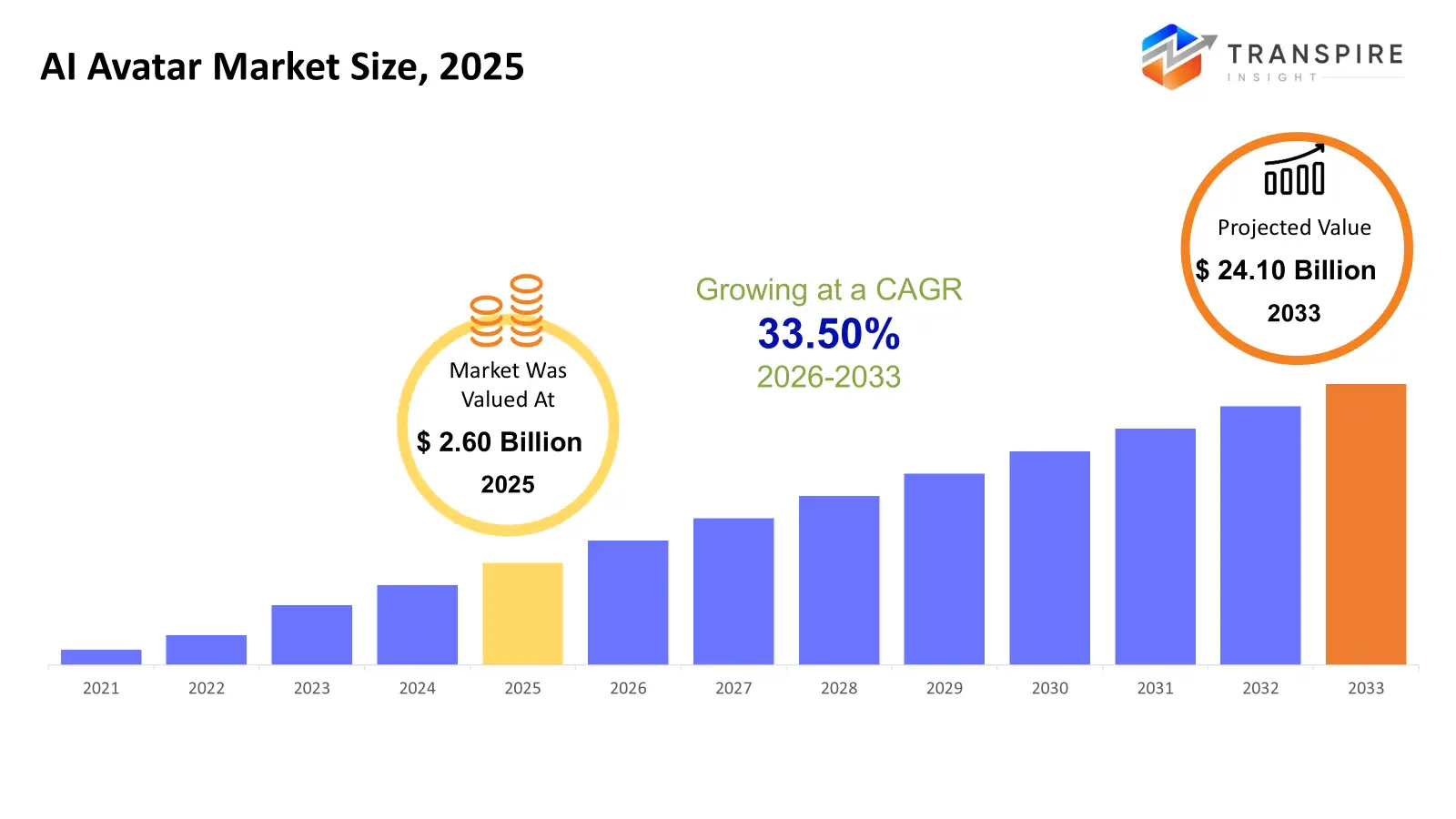
The global AI Avatar market size was valued at USD 2.60 billion in 2025 and is projected to reach USD 24.10 billion by 2033, growing at a CAGR of 33.50% from 2026 to 2033. The market for AI avatars is growing gradually because of the increasing use of AI-driven customer engagement tools by businesses, the quick development of generative AI and NLP, and the growing need for scalable digital interactions in sectors including media, healthcare, education, and BFSI.
Market Size & Forecast
- 2025 Market Size: USD 2.60 Billion
- 2033 Projected Market Size: USD 24.10 Billion
- CAGR (2026-2033): 33.50%
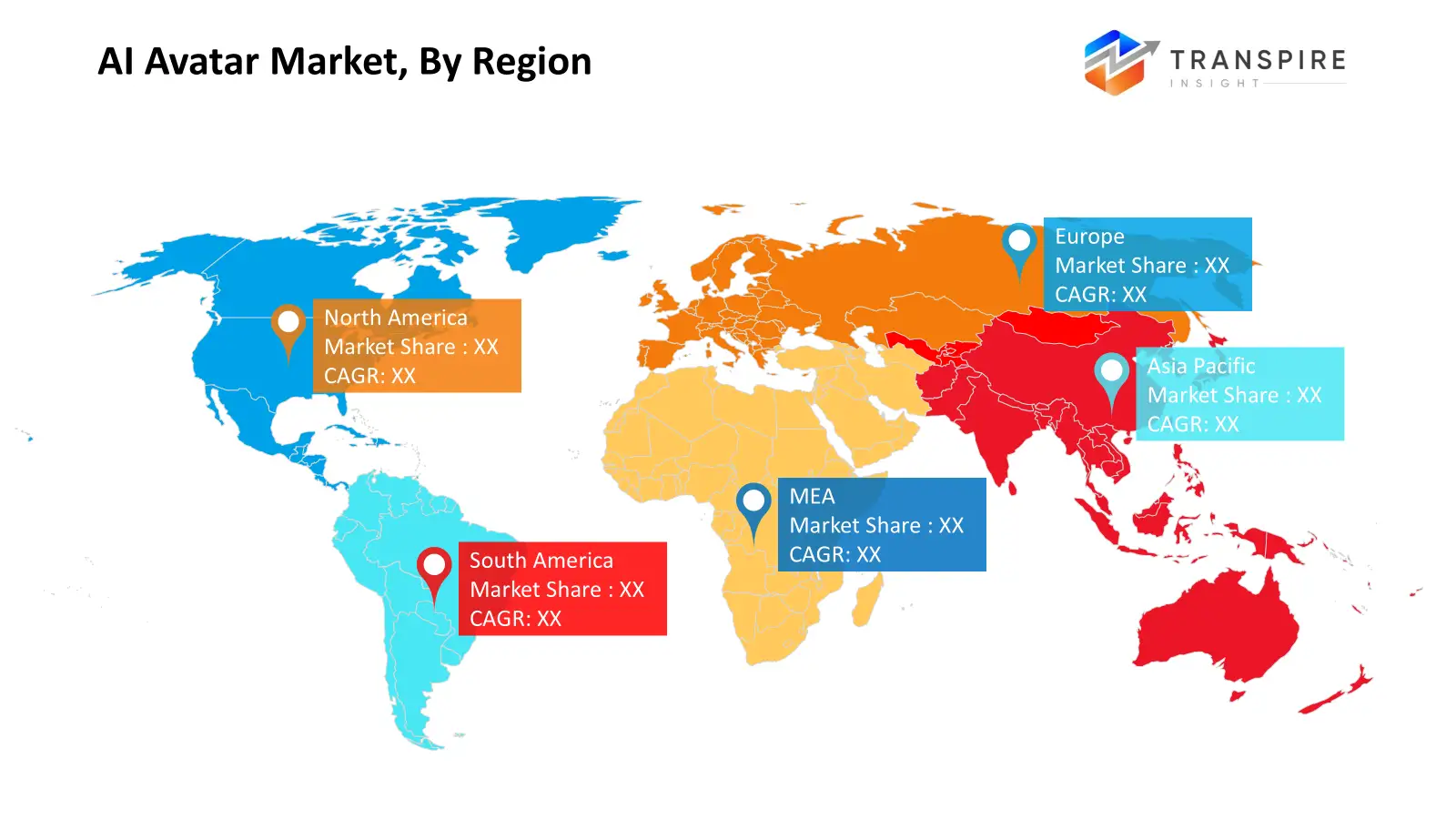
- North America: Largest Market in 2026
- Asia Pacific: Fastest Growing Market
To learn more about this report,  Download Free Sample Report
Key Market Trends Analysis
- Strong adoption of AI avatars in North America is bolstered by the region's developed digital infrastructure, high enterprise AI spending and extensive use of virtual assistants and digital humans in media, BFSI and customer service all of which support the region's ongoing market leadership and innovation momentum.
- Due to the existence of significant AI developers, the early commercialization of generative AI avatars and the robust demand from big businesses concentrating on automation, personalization and brand-led digital engagement strategies, the United States serves as the primary growth engine in North America.
- Quick digitalization, growing gaming and e-commerce ecosystems, and significant investments in AI technology across China, Japan, South Korea and India are driving the quick adoption of AI avatars in Asia Pacific, making the area a major long-term growth contributor.
- Digital humans are becoming more and more popular as businesses prioritize realistic, emotionally responsive avatars capable of complex interactions, especially for customer support, healthcare engagement, and brand representation, where human-like communication greatly enhances user trust and experience.
- Generative AI is emerging as the most influential technology trend, enabling real-time speech, expression, and content generation, reducing development timelines while enhancing personalization, scalability, and realism of AI avatars across multiple commercial applications.
- Customer service and virtual assistant applications dominate adoption trends as businesses look for affordable, always-available solutions to handle high interaction volumes, improve service consistency, and integrate AI avatars with CRM and enterprise communication platforms.
- Due to their emphasis on immersive, interactive digital experiences and their usage of AI avatars for virtual influencers, brand engagement, and tailored customer interactions that directly drive revenue generation, the media, entertainment, and retail sectors are at the forefront of end-use adoption.
So, The creation and application of intelligent digital characters that can communicate with users through text, speech and visual expressions is referred to as the AI avatar market. These avatars mimic human like interactions across digital platforms by combining technologies like generative AI, machine learning and natural language processing. From simple animated avatars to sophisticated digital beings with contextual awareness and emotional intelligence the industry is changing. AI avatars are being used more and more to provide personalized experiences at scale, automate customer interactions and improve consumer engagement. Businesses in the BFSI, healthcare, retail, education and media sectors are implementing these technologies to increase operational effectiveness and decrease reliance on human resources. Adoption is further accelerated by integration with enterprise software ecosystems and cloud-based deployment. Avatar performance and realism are still being enhanced by ongoing developments in AI models, real-time rendering and speech synthesis. AI avatars are evolving from experimental tools to strategic assets as businesses embrace digital transformation and omnichannel interaction
AI Avatar Market Segmentation
By Avatar Type
- 3D Avatars
3D avatars are digitally created characters that are utilized on platforms for customer interaction, education and entertainment. Developments in motion capture, game engines and real-time rendering are driving their acceptance. Businesses are using 3D avatars more frequently to improve virtual environments' visual realism and user interaction. Gaming, virtual events and immersive marketing are areas where demand is especially high. Their commercial acceptance is further supported by their cost effectiveness and scalability.
- Digital Humans (AI-powered Virtual Humans)
Digital humans are sophisticated AI avatars with human-like communication, emotional expression and contextual awareness. To provide individualized and conversational experiences, they use computer vision, generative AI and natural language processing. Because they can run continuously and lessen human workload, use is increasing in customer service, healthcare and BFSI. Businesses see digital humans as important assets for automation and brand image. They are positioned as a high-value market niche due to their complexity and realism.
By Technology
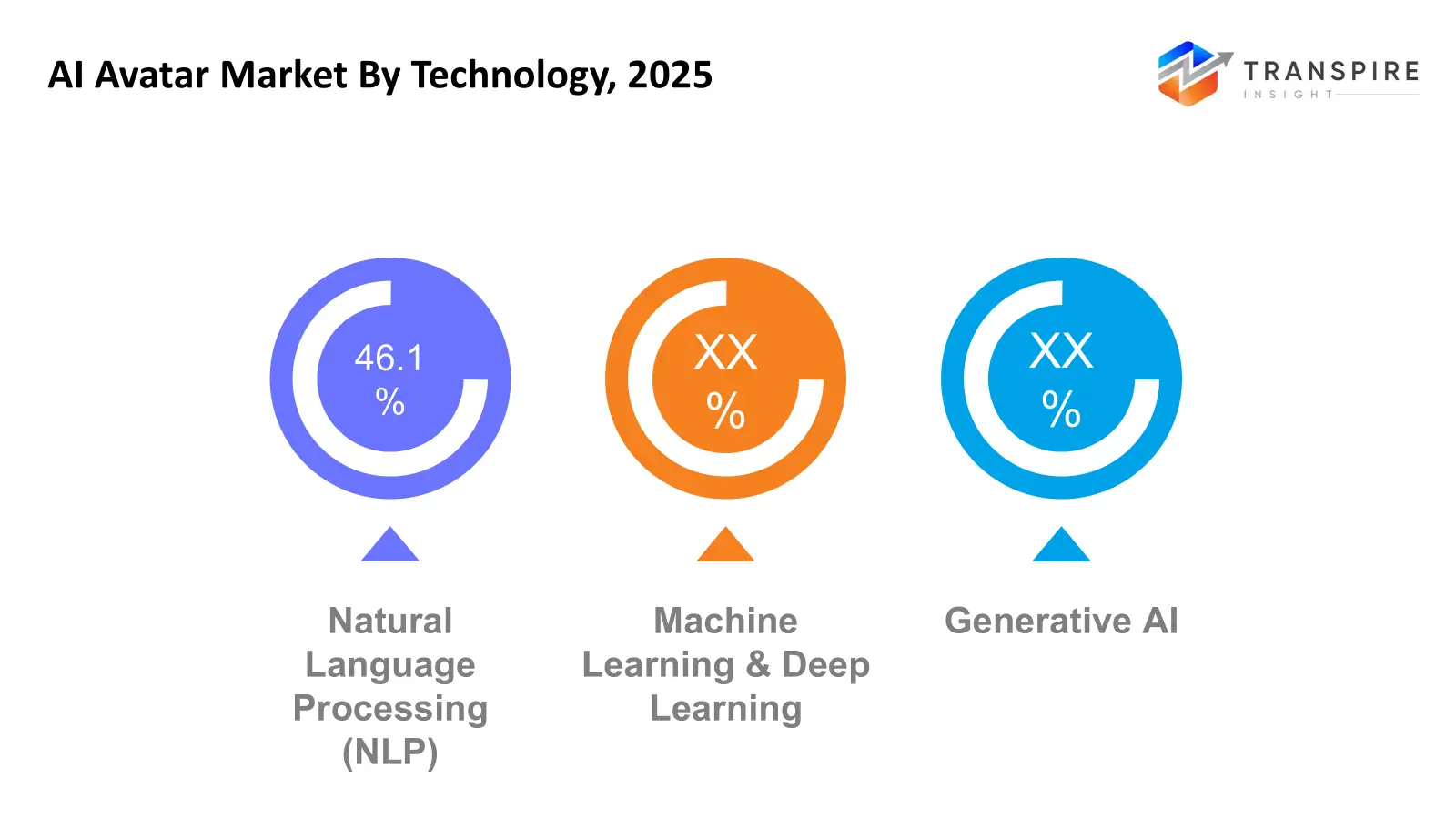
- Natural Language Processing (NLP)
AI avatars can comprehend, interpret, and react to human language in real time due to NLP. Conversational avatars used in virtual assistance and customer service are based on this technology. Constant advancements in language models improve contextual awareness and response accuracy. Global adoption is further increased by multilingual capabilities. NLP is still essential for raising the caliber of user interactions and engagement.
- Machine Learning & Deep Learning
AI avatars may learn from human interactions and get better over time thanks to machine learning and deep learning techniques. These technologies facilitate adaptive responses, behavior modeling, and facial recognition. Their use improves personalization in a variety of sectors, including retail, healthcare and education. Model performance is being accelerated by increased processing power and data availability. The intelligence and flexibility of AI avatars are supported by this section.
- Generative AI
Real-time production of speech, gestures, facial expressions, and customized information for avatars is made possible via generative AI. It greatly enhances avatar deployment's scalability, emotional intelligence and realism. Businesses use generative AI to automate customer interactions and content creation. Improved engagement results and shorter development times are the main drivers of rapid enterprise adoption. In the AI avatar ecosystem, this technology is a major growth engine.
To learn more about this report, Download Free Sample Report
By Application
- Customer Service & Virtual Assistants
AI avatars are frequently employed in digital channels to automate consumer interactions. They lower operating expenses while improving reaction time, availability and consistency. Adoption is strong in BFSI, retail and telecom sectors. Service customization is enhanced through integration with CRM systems. One important revenue generating category is represented by this application.
- Marketing & Brand Engagement
AI avatars are used by brands to provide customized and interactive marketing experiences. Avatars operate as virtual brand advocates across websites, apps and virtual events. Their capacity to interact with users in real time increases conversion rates and customer retention. Growing desire for immersive marketing drives segment expansion. Businesses are using avatars more and more to distinguish their brand identities.
- Training & Education
AI avatars are employed as training aids, tutors, and virtual instructors. They back corporate training initiatives, skill development and interactive learning. The trend toward digital and remote learning environments is what propels adoption. Avatars make it possible to give instruction in a scalable and customized manner. Growing investments in edtech solutions are advantageous to this market.
- Medical care
AI avatars in healthcare help with patient involvement, mental health support, and health education. By providing ongoing communication and direction they increase accessibility to care. Telehealth and wellness applications are becoming more and more popular. Avatars also help administrative efficiency and patient adherence. Data security and regulatory compliance continue to be important factors.
- Gaming & Entertainment
Due to the strong need for realism and immersion, gaming and entertainment continue to be early adopters of AI avatars. Avatars promote player engagement, storytelling, and virtual performances. Growth is aided by integration with metaverse platforms and gaming engines. Adoption is driven by consumer demand for engaging digital experiences. This sector makes a substantial contribution to technological advancement and innovation.
By End-Use Industry
- Media & Entertainment
AI avatars are used by media and entertainment organizations for digital personalities, influencers and virtual hosts. Demand for interactive content and audience participation are what propel adoption. Avatars allow for scalable content creation and lower production costs. Growth is supported by digital storytelling and virtual concerts. This sector continues to be a significant center for innovation.
- Retail & E-commerce
AI avatars are used by retailers as virtual product guides and shopping helpers. Through real-time communication and tailored advice, they improve the client experience. Adoption lowers cart abandonment and increases conversion rates. Integration with e-commerce systems allows scalability. Growing digital retail penetration is advantageous to this market.
- Healthcare
AI avatars are used by healthcare providers for patient assistance, education, and communication. Avatars increase operational effectiveness and patient involvement. Initiatives in digital health and telemedicine are driving adoption. They lessen staff workload by facilitating non-clinical encounters. Accuracy and data privacy are important adoption criteria.
- BFSI
BFSI institutions utilize AI avatars for customer onboarding, support, and advisory services. Avatars guarantee consistent communication while increasing service availability. Customer satisfaction and cost optimization are supported by adoption. Integration with secure systems is vital. Demand at the enterprise level is robust in this category.
- Learning
AI avatars are used by educational institutions for administrative assistance, virtual instruction and tutoring. They improve accessibility and learner engagement. Adoption is fueled by remote learning trends and digital transformation projects. Personalized learning experiences at scale are made possible by avatars. With edtech investments, this market is still growing.
Regional Insights
Due to widespread use in the US and Canada, North America continues to be the largest geographic market for AI avatars, with Mexico progressively catching up through enterprise digitization initiatives. Regional supremacy is supported by significant AI investment, cutting-edge infrastructure and early commercialization especially in customer service, BFSI and media applications. Europe, which is dominated by Germany, the UK, France, Spain and Italy, is a mature but continuously expanding market. Enterprises throughout these countries focus on regulated, enterprise grade AI avatar deployments, especially in BFSI, retail and education. Through tactics of digital engagement and gradual acceptance, the rest of Europe participates. Asia Pacific is the fastest-growing market, with demand being driven by the gaming, e-commerce and education sectors in China, Japan, South Korea, India, Australia and New Zealand. South America, particularly by Brazil and Argentina, displays rising adoption centered on customer service automation. Smart city initiatives, digital government projects and increasing enterprise AI investments are gaining pace across the Middle East and Africa, especially in Saudi Arabia, the United Arab Emirates and South Africa.
To learn more about this report, Download Free Sample Report
Recent Development News
- September 2025, New automated advertising features for its AI Studio platform were revealed by DeepBrain AI, a top generative AI firm with a focus on synthetic media. using merely a product image or URL, these allow marketers to rapidly create product-use movies using AI avatars, doing away with the need for conventional filming and editing processes.
- In April 2024, In order to scale sales and marketing communications and assist teams in creating individualized video outreach at enterprise scale, Vidyard announced the release of hyper-realistic AI avatars on its Vidyard Messages platform. These avatars replicate a user's voice and appearance. The company recently raised $15M in capital to boost innovation and adoption.
|
Report Metrics |
Details |
|
Market size value in 2025 |
USD 2.60 Billion |
|
Market size value in 2026 |
USD 3.20 Billion |
|
Revenue forecast in 2033 |
USD 24.10 Billion |
|
Growth rate |
CAGR of 33.50% from 2026 to 2033 |
|
Base year |
2025 |
|
Historical data |
2021 – 2024 |
|
Forecast period |
2026 – 2033 |
|
Report coverage |
Revenue forecast, competitive landscape, growth factors, and trends |
|
Regional scope |
North America; Europe; Asia Pacific; Latin America; Middle East & Africa |
|
Country scope |
United States; Canada; Mexico; United Kingdom; Germany; France; Italy; Spain; Denmark; Sweden; Norway; China; Japan; India; Australia; South Korea; Thailand; Brazil; Argentina; South Africa; Saudi Arabia; United Arab Emirates |
|
Key company profiled |
Synthesia Ltd., HeyGen,D-ID Ltd., Veed.io, Vyond, Microsoft Corporation, NVIDIA Corporation, Meta Platforms, Inc., Google LLC, Soul Machines Limited, UneeQ, Hour One AI, ObEN Inc., Genies, Inc., Akool Inc. |
|
Customization scope |
Free report customization (country, regional & segment scope). Avail customized purchase options to meet your exact research needs. |
|
Report Segmentation |
By Avatar Type (3D Avatars, Digital Humans (AI-powered Virtual Humans)), By Technology (Natural Language Processing (NLP), Machine Learning & Deep Learning, Generative AI), By Application (Customer Service & Virtual Assistants, Marketing & Brand Engagement, Education & Training, Healthcare, Gaming & Entertainment) and By End-Use Industry (Media & Entertainment, Retail & E-commerce, Healthcare, BFSI, Education) |
Key AI Avatar Company Insights
Offering enterprise-grade systems for producing lifelike, multilingual digital avatars without the costs associated with traditional video production, Synthesia Ltd. is a major player in the AI avatar and synthetic video sector. With their technology, businesses can create professional training, marketing and customer engagement movies with customisable avatars while drastically cutting expenses and time. Synthesia is positioned for worldwide adoption in industries including corporate training, e-learning and HR communication due to its extensive language support and scalability. Strong funding and strategic alliances support the company's ongoing efforts to improve avatar realism and conversational skills, strengthening its competitive advantage through steady innovation.
Key AI Avatar Companies:
- Synthesia Ltd
- HeyGen
- D-ID Ltd.
- io
- Vyond
- Microsoft Corporation
- NVIDIA Corporation
- Meta Platforms, Inc.
- Google LLC
- Soul Machines Limited
- UneeQ
- Hour One AI
- ObEN Inc.
- Genies, Inc.
- Akool Inc.
Global AI Avatar Market Report Segmentation
By Avatar Type
- 3D Avatars
- Digital Humans (AI-powered Virtual Humans)
By Technology
- Natural Language Processing (NLP)
- Machine Learning & Deep Learning
- Generative AI
By Application
- Customer Service & Virtual Assistants
- Marketing & Brand Engagement
- Education & Training
- Healthcare
- Gaming & Entertainment
By End-Use Industry
- Media & Entertainment
- Retail & E-commerce
- Healthcare
- BFSI
- Education
Regional Outlook
- North America
- United States
- Canada
- Mexico
- Europe
- Germany
- United Kingdom
- France
- Spain
- Italy
- Rest of Europe
- Asia Pacific
- Japan
- China
- Australia & New Zealand
- South Korea
- India
- Rest of Asia Pacific
- South America
- Brazil
- Argentina
- Rest of South America
- Middle East & Africa
- Saudi Arabia
- United Arab Emirates
- South Africa
- Rest of the Middle East & Africa
Frequently Asked Questions
Find quick answers to common questions.
The approximate AI Avatar Market size for the market will be USD 24.10 billion in 2033.
Key segments for the AI Avatar Market are By Avatar Type (3D Avatars, Digital Humans (AI-powered Virtual Humans)), By Technology (Natural Language Processing (NLP), Machine Learning & Deep Learning, Generative AI), By Application (Customer Service & Virtual Assistants, Marketing & Brand Engagement, Education & Training, Healthcare, Gaming & Entertainment) and By End-Use Industry (Media & Entertainment, Retail & E-commerce, Healthcare, BFSI, Education).
Major AI Avatar Market players are Synthesia Ltd., Microsoft Corporation, NVIDIA Corporation, Meta Platforms, Inc., HeyGen
The North America region is leading the AI Avatar Market.
The CAGR of the AI Avatar Market is 33.50%.
- Synthesia Ltd.
- HeyGen
- D-ID Ltd.
- io
- Vyond
- Microsoft Corporation
- NVIDIA Corporation
- Meta Platforms, Inc.
- Google LLC
- Soul Machines Limited
- UneeQ
- Hour One AI
- ObEN Inc.
- Genies, Inc.
- Akool Inc.
Recently Published Reports
-
Apr 2026
3D Optical Profiler Market
3D Optical Profiler Market Size, Share & Analysis Report By Type (Desktop 3D Optical Profiler, and Portable 3D Optical Profiler), By Technology (Confocal Technology, and White Light Interference), By End-Use Industry (Manufacturing, Research Institutions, Automotive, Aerospace and Defense, Medical Devices, and Other), and Geography (North America, Europe, Asia-Pacific, Middle East and Africa, South and Central America), 2021 - 2031
-
Apr 2026
Depth Sensor Market
Depth Sensor Market Size, Share & Analysis Report By Type (Infrared Depth Sensors, Time-of-Flight (ToF) Sensors, Stereo Vision Sensors, Structured Light Sensors, Ultrasonic Depth Sensors), By Application (Automotive, Robotics, Gaming, Consumer Electronics, Industrial Automation, Healthcare, Security & Surveillance, Others), By End Users (Automotive Manufacturers, Consumer Electronics Companies, Healthcare Providers, Industrial Companies, Security Agencies, Gaming Companies, Robotics Companies, Others), and Geography (North America, Europe, Asia-Pacific, Middle East and Africa, South and Central America), 2021 – 2031
-
Apr 2026
Digital Manufacturing Market
Digital Manufacturing Market Size, Share & Analysis Report By Component (Hardware, Software, and Services), By Technology (Robotics, 3D Printing, Internet of Things (IoT), and Others), By Application (Automotive and Transportation, Aerospace and Defense, Consumer Electronics, Industrial Machinery, and Others), By Process Type (Computer-Based Designing, Computer-Based Simulation, Computer 3D Visualization, Analytics, and Others), and Geography (North America, Europe, Asia-Pacific, Middle East and Africa, South and Central America), 2021 – 2031
-
Apr 2026
Digital Visa Services Market
Digital Visa Services Market Size, Share & Analysis Report By Type (Individual Travelers, Group Travelers), By Application (Tourism, Business Travel, Others), and Geography (North America, Europe, Asia-Pacific, Middle East and Africa, South and Central America), 2021 – 2031