
Feb 24, 2026
The report “Liquid Desiccant HVAC Systems Market By Product Type (Packed Tower Systems, Spray Tower Systems, Internally Cooled Dehumidifiers, Hybrid Liquid Desiccant–Vapor Compression Systems, Modular / Integrated Units), By Desiccant Type (Lithium Chloride, Lithium Bromide, Calcium Chloride, Triethylene Glycol, Other Salt Solutions), By Application (Commercial Buildings, Industrial Facilities, Healthcare Facilities, Educational Institutions, Data Centers, Residential Buildings) and By End User (Hospitals & Laboratories, Pharmaceuticals, Food Processing, Hospitality, Manufacturing, IT & Telecom)” is expected to reach USD 3.40 billion by 2033, registering a CAGR of 14.70% from 2026 to 2033, according to a new report by Transpire Insight.
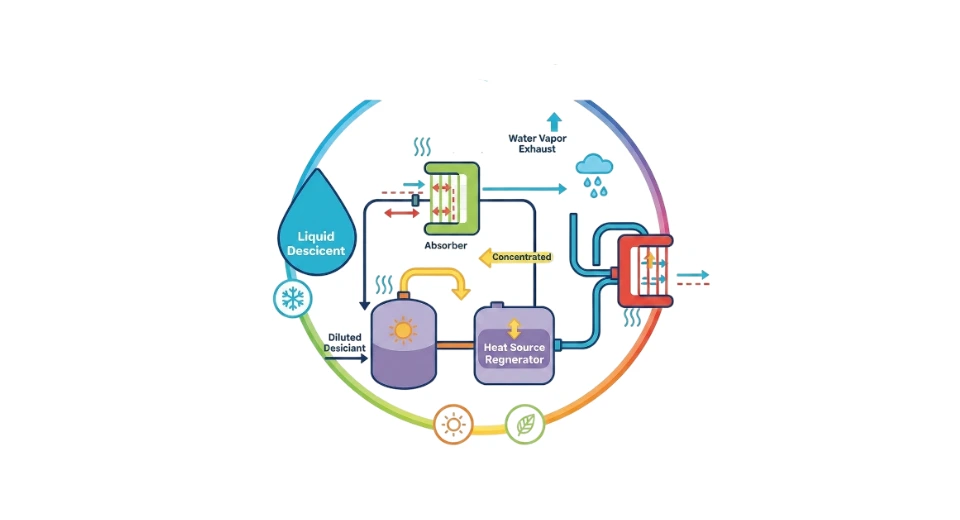
The liquid desiccant HVAC systems market is a cutting-edge area of the overall HVAC market, emphasizing self-reliant humidity management by using liquid hygroscopic systems. In contrast to traditional systems, which handle sensible and latent loads concurrently, the liquid desiccant systems separate the dehumidification process from the temperature control process, thus improving the efficiency of the overall system. This makes the system more energy-efficient by reducing the energy consumption of the compressor and improving the ventilation process, especially in high-humidity and high-occupancy areas. The market is fueled by the increasing concern for indoor air quality in commercial buildings, healthcare facilities, data centers, and industrial settings. The increasing ventilation requirements and infection control measures are driving the adoption of systems that can provide reliable humidity management without significant energy costs. The technology is also finding acceptance in green buildings due to its compatibility with heat recovery systems and renewable thermal energy sources.
Demand is driven by areas that are undergoing rapid infrastructure development and urbanization. Commercial property development, industrial upgrading, and healthcare infrastructure upgrades are driving procurement. Hybrid solutions that integrate liquid desiccant dehumidification with vapor compression systems continue to enhance life cycle performance metrics, further enhancing the market’s value proposition. Innovation, modularization, and an increasing focus on mold prevention and moisture management are influencing the competitive landscape. With the tightening of energy efficiency regulations worldwide, there is a growing focus on advanced HVAC solutions that can manage latent loads effectively and reduce carbon emissions, ensuring steady market growth.
The Packed Tower Systems segment is projected to witness the highest CAGR in the Liquid Desiccant HVAC Systems during the forecast period.
According to Transpire Insight, Packed tower systems are currently the most prominent product type because of their high mass transfer efficiency. These systems have large contact areas between air and desiccants, which makes it possible to remove moisture effectively in large commercial and industrial buildings. They are designed to work continuously even at high latent loads, which makes them suitable for use in applications where stable environmental conditions are required.
From a technical standpoint, packed tower systems are reliable, flexible to meet varying capacity demands, and compatible with centralized HVAC systems. Their capability to handle large airflow rates with consistent dehumidification performance further cements their dominance in large-scale infrastructure projects. Continuous improvements in corrosion-resistant materials and automated controls further improve their efficiency and performance.
The Lithium Chloride segment is projected to witness the highest CAGR in the Liquid Desiccant HVAC Systems during the forecast period.
Lithium chloride tops the list of desiccant type due to its high hygroscopic nature and moisture absorption capacity. Its thermal stability and performance under varying humidity conditions make it ideal for high-efficiency commercial and institutional applications. The compatibility of the compound with hybrid systems improves its use in advanced HVAC applications.
Market-wise, lithium chloride is suitable for reliable long-term operation with manageable crystallization challenges if carefully controlled. Its established supply chain and performance in the field give confidence to system integrators and facility managers. Further improvement in solution management and corrosion control technologies strengthens its market position..
The Commercial Buildings segment is projected to witness the highest CAGR in the Liquid Desiccant HVAC Systems during the forecast period.
According to Transpire Insight, Commercial buildings are the largest market segment due to the growing need for ventilation. Office buildings, airports, shopping malls, and institutional buildings are increasingly demanding advanced humidity control systems. Liquid desiccant systems have improved air quality and reduced energy consumption related to latent load management.
From an analytical perspective, the commercial market has the advantage of being retrofitted and integrated with building management systems. The increasing trend of green building certifications is further fueling the demand for systems that optimize energy performance. Developers are favoring HVAC systems that can deliver operational savings and meet environmental standard.
The Hospitals & Laboratories segment is projected to witness the highest CAGR in the Liquid Desiccant HVAC Systems during the forecast period.
Hospitals and laboratories are the most prominent end-use market because of the need for tight humidity control. Healthcare environments require a stable environment to ensure patient safety. Liquid desiccant systems can provide precise humidity control and higher ventilation rates.
From an analytical perspective, the demand for healthcare is more stable and less affected by economic cycles. Health and safety regulations force healthcare providers to invest in advanced HVAC systems. The use of liquid desiccant systems to mitigate microbial risks and improve indoor air quality enhances their strategic role in healthcare.
The North America region is projected to witness the highest CAGR in the Liquid Desiccant HVAC Systems during the forecast period.
North America is the most prominent regional market due to the presence of stringent energy efficiency regulations, well-developed commercial infrastructure, and an increasing number of retrofitting projects. The United States is the key revenue-generating country due to the expansion of the healthcare sector, data centers, and sustainable construction projects.
From a research perspective, the North America market has well-established technical knowledge, well-developed distribution channels, and active innovation in HVAC design. The integration of the system with renewable energy solutions and smart building solutions is an added advantage.
Key Players
The top 15 players in the Liquid Desiccant HVAC Systems market include Mojave Energy Systems, Alfa Laval, Copeland LP, Blue Frontier, 5AC Technologies, Inc., AirGreen, Inc., Ventilex, Aolan, Thermair, Munters AB, Advantix Systems, Kathabar Dehumidification Systems, Bry-Air Inc., DuCool Ltd., and Desiccant Rotors International Pvt. Ltd.
Drop us an email at:
Call us on:
+91 7666513636

 inquiry@transpireinsight.com
 APAC:+91 7666513636
 Address





