
Oct 30, 2026
Market Forecast
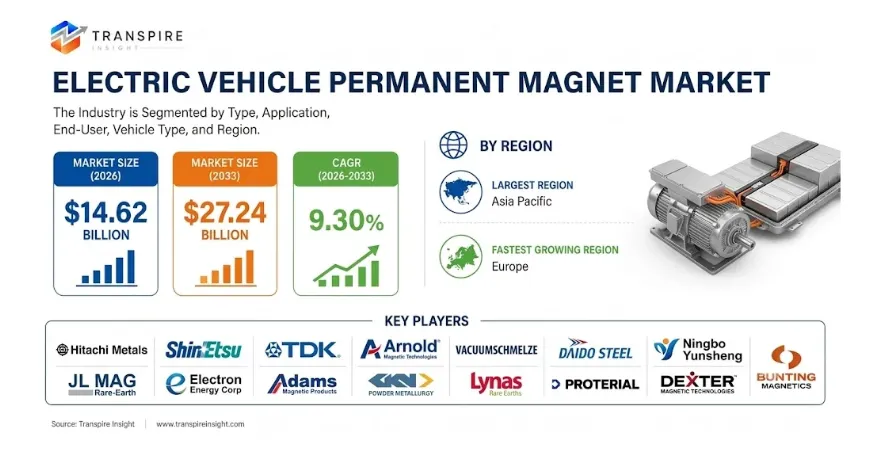
The global electric vehicle permanent magnet market was valued at USD 13.39 billion in 2025 and is projected to grow from USD 14.62 billion in 2026 to USD 27.24 billion by 2033, at a CAGR of 9.30% through the forecast period, according to a new report by Transpire Insights.
Global adoption of electric mobility really drives the demand for EV permanent magnets - with neodymium-iron-boron magnets right at the center of almost every traction motor in battery electric vehicles today. As EV production numbers build across passenger cars, commercial vehicles, two-wheelers, and electric buses, both the amount of magnet content per vehicle and overall demand for high-performance rare-earth magnets are increasing together - producing quite possibly the most strategically crucial material demand shifts within the entire automotive supply chain.
EV Permanent Magnet Market Growth & Trends
Permanent magnet synchronous motors really dominate EV traction applications since they have better power density, efficiency over a very wide operating range, and a smaller size compared to induction and switched reluctance options for many passenger vehicle needs. The NdFeB magnets at the core of these motors need rare-earth elements - mainly neodymium and dysprosium - whose production is very concentrated in China, raising some serious supply chain security issues that are pushing investments in rare-earth mining, magnet manufacturing, and even alternative motor designs all over Western markets and related countries.
Changes in motor design are affecting both the volume and type of magnet demanded as well as the quantity. Axial flux motor architectures - gaining more commercial acceptance through deployments in Renault and Ferrari EVs - make use of somewhat different magnet shapes and are able to achieve a much higher power density than traditional radial flux designs, thus creating demand for magnets with unique size and magnetic performance requirements. Companies such as Hitachi Metals, Shin-Etsu Chemical, and TDK Corporation are actually developing axial flux-optimised magnet products to cater to this changing design trend.
Emerging Economies & Technology
Europe is really taking off when it comes to EV permanent magnets - particularly because of the very rapid growth of European EV production and the quite strategic focus that EU governments and automotive OEMs have placed on having domestic rare-earth magnet supply chains. European Critical Raw Materials Act and EU Battery Regulation are actually setting policy priorities and offering financial incentives for investing in European magnet manufacturing. Companies like VAC (VACUUMSCHMELZE), Proterial, and even some newcomers backed by European automotive OEM partnerships are building out European magnet production capacity so we don't rely so much on Chinese supplies anymore.
High-temperature magnets – NdFeB formulations with a bit more dysprosium or terbium content that keep their magnetic properties at the extremely high operating temperatures found in high-performance traction motors - are growing very fast indeed. As our expectations for EV performance go up and thermal management challenges in motor designs force us to push operating temperatures even higher, high-temperature magnet specifications are being adopted across many different types of vehicle programs far beyond just the high-performance cars where they were initially used most often.
Electric Motors Segment
Applications related to electric motors account for 58% of the entire global EV permanent magnet market - by far the biggest segment. Virtually every battery electric vehicle requires at least one permanent magnet traction motor - and many premium EV platforms now use two or even three motors - in the front, rear, or all-wheel drive configurations - each holding a lot of NdFeB magnet material. The amount of magnet mass per vehicle varies depending on motor power and design specifics, but a typical BEV traction motor usually holds around 1-3 kilograms of NdFeB magnets - resulting in a very significant demand per vehicle that really grows right along with global EV production levels.
Recycling magnets from end-of-life EV motors is another emerging secondary supply path getting a lot of investment interest lately. Recovering and processing NdFeB magnets from disassembled motors might help us rely less on primary rare-earth mining over time, and there are already several European and North American recycling initiatives backed by automotive OEMs and government funding working on developing commercially viable magnet recovery methods. The sheer size of the EV fleet will eventually make motor magnet recycling a quite important supply source by the mid-2030s - especially when the first batch of mass-market BEVs reaches its end of life.
High-Temperature Magnets - Fastest-Growing Section
High-temperature NdFeB magnets are expanding at a CAGR of 12. 1 percent - the fastest pace within the EV permanent magnet market. The increasing performance demands of EV traction motors - higher power outputs, even more severe thermal cycles, and greater continuous duty needs in commercial vehicles and high-performance cars - are pushing the specification of high-temperature magnet grades that keep their full magnetic properties at continuous operating temperatures over 150°C. Such grades command quite high price premiums compared to regular NdFeB and really change the product mix towards more valuable magnet formulations.
The availability and security of heavy rare earth elements - especially dysprosium and terbium, added to NdFeB magnets to improve high-temperature coercivity - is an extremely important commercial and geopolitical goal for EV supply chains. Lynas Rare Earths in Australia and MP Materials in the US are creating heavy rare-earth separation capabilities that may give a non-Chinese source of the crucial elements needed for high-temperature magnet manufacturing apart from China itself.
Asia-Pacific Region - Biggest Regional Market
Asia-Pacific region holds 46% of the entire global EV permanent magnet market - the biggest regional share. China is at once the world's biggest EV production market and the dominant magnet manufacturing location, with companies like Ningbo Yunsheng, JL MAG Rare-Earth, and Zhongke San Huan making up a very big part of worldwide NdFeB magnet output. Japan's TDK and Shin-Etsu Chemical, along with South Korea's magnet producers, meet both local and international automotive OEM requirements with high-end magnet products all over the globe.
China's control over rare-earth mining and processing - producing roughly 85 percent of the planet's rare-earth magnets - gives Chinese magnet makers a significant structural supply chain benefit that their Western competitors are trying hard to reproduce by investing in domestic mining, separation, and magnet manufacturing themselves. Export controls on heavy rare-earth processing technology set by China in 2023-24 have greatly increased the sense of urgency for Western supply chain growth.
Europe - Fastest-Growing Region
Europe really advances itself at a CAGR of 11. 4% - the very highest regional rate in this market. It's because of the fast-paced EV production scaling at European automotive manufacturers, EU strategic autonomy policies pushing domestic magnet supply investments, and new magnet manufacturing plant announcements from both long-time producers and newcomers alike - all contributing to above-average market growth indeed. The European EV production pipeline - with Volkswagen, Stellantis, BMW, Mercedes-Benz, and Renault all significantly increasing their BEV output - demands a reliable magnet supply which European lawmakers are actively trying to provide via our domestic industrial policy efforts.
UK government investment in rare-earth magnet manufacturing capabilities - via Innovate UK funding and the Automotive Transformation Fund - really supports the development of domestic magnet production. Vacuumschmelze's UK manufacturing expansion and several other new magnet production projects supported by partnerships between European automotive OEMs are building up the European magnet supply infrastructure itself - thus reducing our reliance on Asian imports for those key strategic EV components.
What Are the Recent Developments in the EV Permanent Magnet Market?
Q4 2024 – Shin-Etsu Chemical: Announced a EUR 500 million investment in a new NdFeB magnet manufacturing facility in Europe, targeting automotive OEM supply with locally produced magnets to reduce Japanese and European EV manufacturers' supply chain dependence on Chinese magnet production.
Q4 2024 – Lynas Rare Earths: Commenced separated heavy rare-earth production at its Kalgoorlie facility in Western Australia, providing the first significant non-Chinese source of dysprosium and terbium for high-temperature NdFeB magnet manufacturing outside Asia.
Q1 2025 – TDK Corporation: Launched a new high-temperature NdFeB magnet product line achieving stable magnetic performance at continuous operating temperatures up to 200°C, targeting the commercial EV truck and high-performance passenger EV segments where motor thermal loads exceed standard magnet specifications.
Q2 2025 – Ningbo Yunsheng: Received OEM qualification for its new grain boundary diffusion NdFeB magnet technology at two European automotive OEMs, enabling heavy rare-earth element savings of up to 30% versus conventional high-temperature magnet production while maintaining equivalent magnetic performance.
Q2 2025 – VACUUMSCHMELZE: Secured a long-term magnet supply agreement with a major German automotive OEM covering permanent magnet supply for electric traction motors across its BEV platform portfolio, one of the largest individual European magnet supply contracts announced in the period.
Q3 2025 – Proterial: Opened a new NdFeB magnet production line at its Japanese facility specifically configured for axial flux motor magnet geometries, targeting the growing commercial adoption of axial flux traction motors in passenger EV and light commercial vehicle platforms.
About Transpire Insight
Turning Complex Data into Clear, Actionable Market Intelligence
In today’s hyper-competitive and fast-moving economy, guessing isn’t a business strategy. To lead your industry, launch game-changing products, or scale into new geographies, you need precise, reliable market intelligence, not just high-level noise.
At Transpire Insight, we are a full-service market research, data analytics, and strategic consulting firm. We help corporate leaders, innovators, and investors navigate complex market shifts with absolute confidence.
By combining rigorous primary research, deep statistical modeling, and hands-on domain expertise, we convert raw data into high-impact strategic roadmaps that drive measurable growth.
What Drives Us
Markets don’t stand still, and neither do we. Our core mission is simple: to empower organizations with verified, technology-enabled insights that remove guesswork from strategic planning.
Whether you are evaluating a niche technological shift, assessing supply chain dynamics, or looking for high-growth target segments, our intelligence gives you a decisive competitive edge.
Why Leading Enterprises Trust Transpire Insight
We don't offer one-size-fits-all research. Our analysts specialize in dedicated verticals—from Biotechnology and Semiconductors to Advanced Automotive, Clean Energy, and Industrial Manufacturing. We speak your industry's language and understand the specific nuances, regulatory shifts, and economic drivers shaping your market.
Syndicated Market Reports: In-depth, turn-key research studies covering market size, share, competitive benchmarking, and multi-year forecasts.
Customized Market Intelligence: Tailored research engagements built around your exact business questions, specific product lines, or targeted regional dynamics.
Strategic Consulting: On-demand analytical support, entry-strategy planning, and direct consultation to help you act on data with speed and accuracy.
Reliable forecasts demand ground-truth data. Our research process combines comprehensive desk research with extensive primary interviews across key industry stakeholders including C-suite executives, supply chain leaders, procurement heads, and subject matter experts. Every report undergoes strict validation to ensure maximum precision and relevance.
Our Core Sectors
We provide continuous tracking and deep-dive analytical coverage across high-impact industries:
Manufacturing and Construction
Let’s Shape Your Growth Strategy Together
Whether you are preparing for your next fiscal cycle, analyzing market entry barriers, or looking for deep-dive quantitative data, Transpire Insight is your trusted intelligence partner.
Ready to gain a clearer view of your market?
Email Us: inquiry@transpireinsight.com
Speak to Our Analyst: +91 7666513636
Want to dive deeper? Head over to www.transpireinsight.com or join our community on Twitter, LinkedIn, and Facebook for the latest updates

 inquiry@transpireinsight.com
 APAC:+91 7666513636
 Address


