
Global Electric Vehicle Permanent Magnet Market Size & Forecast:
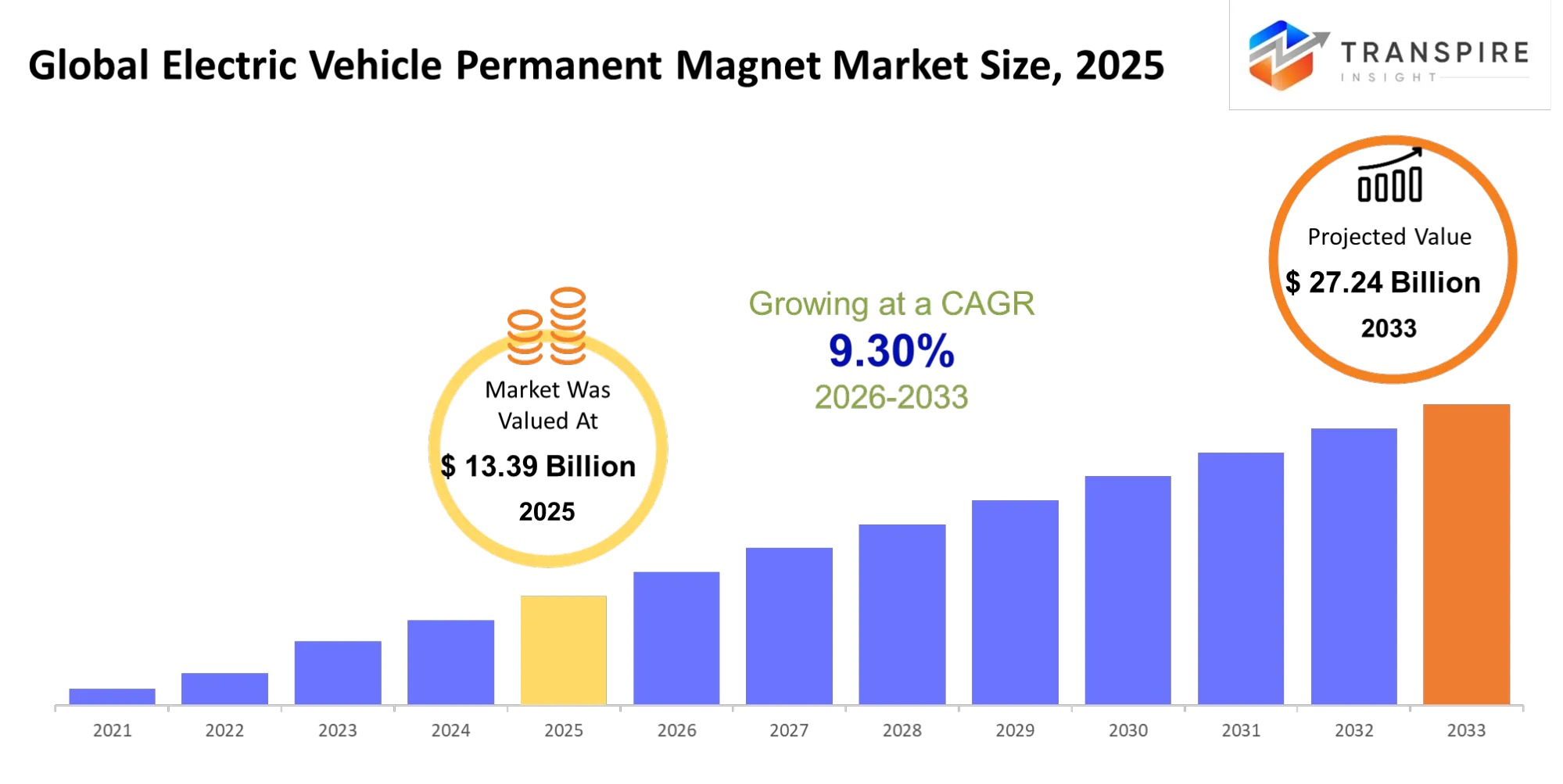
- Global Electric Vehicle Permanent Magnet Market Size 2025: USD 13.39 Billion
- Global Electric Vehicle Permanent Magnet Market Size 2033: USD 27.24 Billion
- Global Electric Vehicle Permanent Magnet Market CAGR: 9.30%
- Global Electric Vehicle Permanent Magnet Market Segments: By Type (Neodymium-Iron-Boron Magnets, Ferrite Magnets, Samarium Cobalt Magnets, Bonded Magnets, Rare-earth Magnets, High-temperature Magnets, Others); By Application (Electric Motors, Battery Systems, Charging Infrastructure, Power Steering Systems, Regenerative Braking Systems, Others); By End-User (Electric Vehicle OEMs, Component Manufacturers, Battery Producers, Others); By Vehicle Type (Passenger EVs, Commercial EVs, Two-wheelers, Electric Buses, Others)
Global Electric Vehicle Permanent Magnet Market Summary:
The Global Electric Vehicle Permanent Magnet Market size is estimated at USD 13.39 billion in 2025 and is anticipated to reach USD 27.24 billion by 2033, growing at a CAGR of 9.30% from 2026 to 2033.
The electric vehicle (EV) permanent magnet market is all about the super-strong magnets that go inside an EV's motor. Think of these magnets as the muscle of the car; they take electricity from the battery and instantly turn it into the physical force that spins the wheels and makes the car move.
Over the last 3 to 5 years, this industry hit a massive turning point. Historically, these magnets relied on rare metals that are mostly controlled by a single country, leading to extreme price spikes and supply shortages. To fix this, carmakers forced a major structural shift: they started designing new motors that use little to no rare metals, completely changing how these magnets are made.
The market is booming because of a simple chain reaction. Governments passed strict rules to cut down carbon emissions, forcing car companies to build way more EVs. Because magnets are the most efficient way to get a longer driving range out of a single battery charge, automakers are choosing them over any other motor type, directly skyrocketing the demand for these magnets.
Key Market Insights:
- Europe has 25% market share.
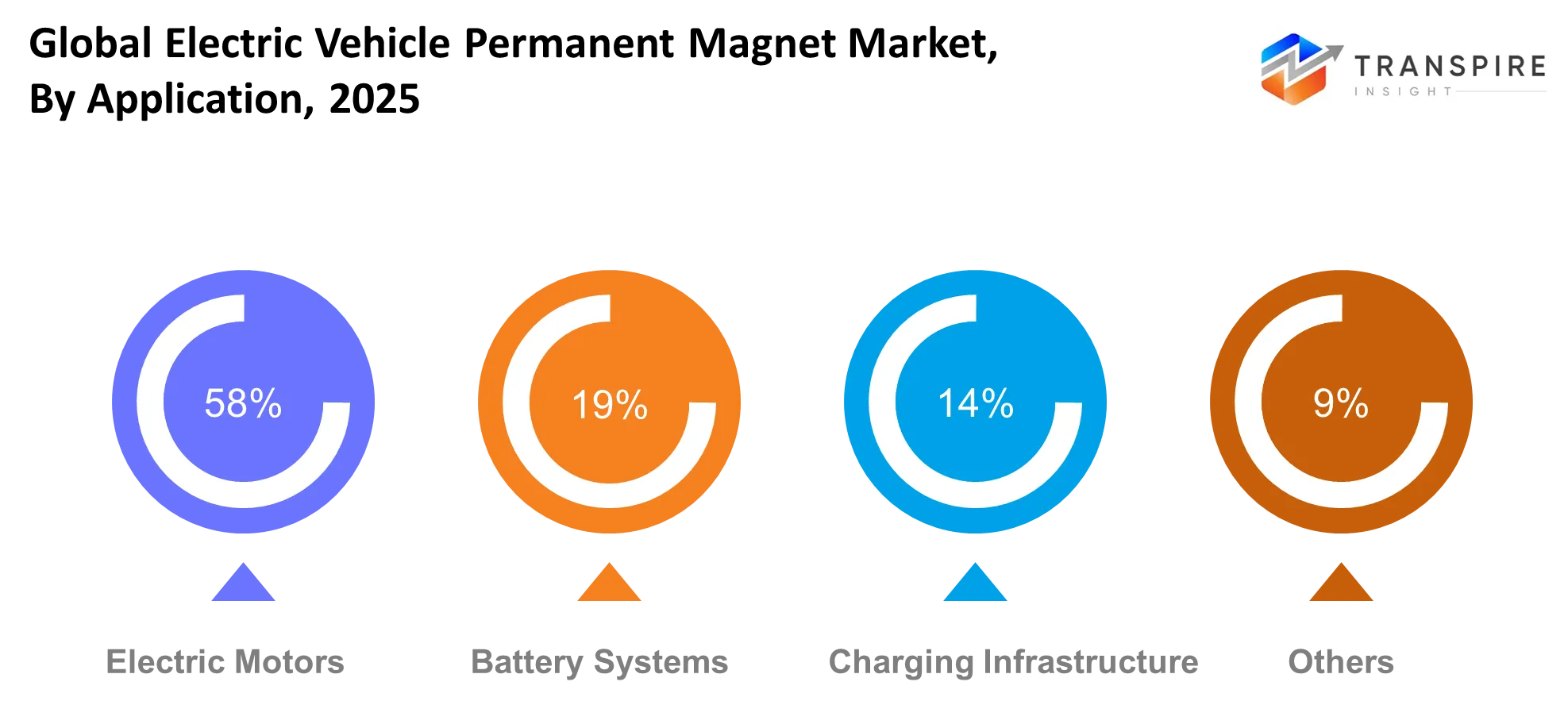
- Electric Motors is the dominant subsegment with a market share of 58%.
- High-temperature magnets are the fastest–growing sub–segment with a CAGR of 12.1%
- Asia Pacific is the dominant region with 46% market share.
- ROW holds 8% of the electric vehicle permanent magnet market.
- Battery systems holds 19% of the market share.
- Charging infrastructure holds 14% of the market share.
What are the Key Drivers, Restraints, and Opportunities in the Electric Vehicle Permanent Magnet Market?
Driver
With global net-zero targets, an entire engine revolution to electric platforms had to happen. However, because permanent magnet motors are very energy efficient, automakers have overwhelmingly opted for them over other, less expensive options to maximize range per charge. This technical requirement results in an immediate increase in demand for each car in the vehicle's volume, directly increasing the market revenue when the volume of cars is increased. Recently, JSW MG Motor India has announced that it will invest Rs. 4,000 crore and will produce four new energy vehicles (NEVs) consisting of electric and plug-in hybrid models. This investment will help to increase the production capacity, improve the localization rate, and drive the demand for electric vehicle permanent magnet motors and rare earth materials. In February 2026, JSW MG Motor India announced plans to invest₹4,000 crore and launch four new energy vehicles (NEVs), including electric and plug-in hybrid models.
Restraint
The uncontrollable situation of the rare earth element supply chain, where more than 70% of the elements are extracted and 90% of the magnets are manufactured in a single region, severely restricts growth. The problem continues because the new mines and processing plants are extremely expensive to open, subject to rigid environmental laws, and can take as long as 10 years to get up and running, which means automakers are extremely sensitive to price increases.
Opportunity
The future is in advanced recycling technologies and “heavy rare-earth-free” magnet chemistry: For instance, significant investments are being made in the United States and Europe to directly recover high-grade neodymium from old electronics and from scrap metal. This closed-loop recycling will be optimized to bring growth, with a localized, stable flow of materials, without any limit on mining.
What Has the Impact of Artificial Intelligence Been on the Electric Vehicle Permanent Magnet Market?
By enhancing material development, production efficiency, and supply chain management, artificial intelligence (AI) is becoming more and more significant in the electric vehicle permanent magnet industry. By evaluating material characteristics and performance requirements, AI-powered systems assist manufacturers in optimizing magnet design, allowing the creation of high-efficiency permanent magnets with reduced rare-earth content.
AI-driven automation improves quality control in manufacturing by instantly identifying flaws in magnet production processes. Additionally, by optimizing manufacturing settings, machine learning algorithms lower energy usage, material waste, and operating expenses. These enhancements enable producers to satisfy the increasing demand from the electric vehicle industry while achieving higher consistency and scalability. A few months ago, Matter demonstrated a rare-earth-free electric motor and introduced India's first AI-Defined Vehicle (AIDV) platform. The invention supports developments in the electric vehicle permanent magnet ecosystem by utilizing AI to maximize vehicle performance, efficiency, and next-generation EV technology.
Key Market Trends:
- Conventional motors began to be replaced by high-efficiency permanent magnet motor systems, especially by automakers.
- As manufacturers started to rely less on a single country to source rare earths, the number of sources increased.
- The Magnet recycling take-up grew, contributing to the circular economy and material security.
- Motor designs advanced towards increased power density and range for the vehicle.
- Rare-earth-free and low-rare-earth motor technologies were more highly developed by manufacturers.
- Some localized manufacturing of magnets continued as geopolitical and supply-chain worries increased.
- AI optimization of motors became more popular, enhancing efficiency and thermal performance.
- The requirements for next-generation EV platforms started shifting to lighter magnet materials.
- Automaker-miner-magnet collaborations grew.
- The need for sustainable procurement and selection of permanent magnet materials became more notable.
Global Electric Vehicle Permanent Magnet Market Segmentation
By Type
The undisputed Heavyweight is neodymium-Iron-boron magnets. Ferrite Magnet is inexpensive and highly corrosion-resistant, but has low strength. Though Samarium Cobalt (SmCo) Magnets are very resistant to high temperatures without losing magnetism, they are expensive and brittle. Bonded Magnets are created by blending the magnetic powder with plastic. High-temperature magnets are the most rapidly expanding sub-segment and are projected to increase at a rate of 12.1% CAGR during the forecast period. A type of specially formulated NdFeB or SmCo magnet that does not demagnetise during the intense heat created by hard driving.
By Application
Electric Motors is the dominating subsegment with a market share of 58%. This is where the big, high-grade permanent magnets reside to convert electricity into action. The power steering system and the regenerative braking system are important safety and efficiency components. Here, small, exact magnets are required for automated steering, which is needed to run smoothly and to prepare for the catching of energy if the car decelerates. The global market share of battery systems is 19%. Internal switches, safety relays, and sensors primarily use battery systems & charging infrastructure to control high voltage currents safely.
By Vehicle-Type
The quantity driver is the Passenger EVs. The heavy-duty haulers are Commercial EVs & Electric Buses. They need large, powerful motors and magnets that can withstand high temperatures to transport heavy loads for extended periods of time without getting too hot. Electric scooters and bikes are two-wheelers. The smaller, lighter, and often lower-cost magnets (which are sometimes bonded or ferrite) are used in this segment as they have a much smaller range and power requirement.
By End-User
The main buyers are the Component Manufacturers (Tier 1 Suppliers). These are the companies, such as Bosch or Denso, that purchase raw magnets, manufacture the electric motors, and then sell the electric motors to the car companies. Electric vehicle OEMs (car manufacturers) that decide to make their own electric motors. They purchase magnets straight from the manufacturer to have their own supply chain.
What are the Key Use Cases Driving the Electric Vehicle Permanent Magnet Market?
The absolute anchor of this market is the EV traction motor drivetrain, specifically within the fast-growing passenger EV and commercial electric bus segments. High-intensity neodymium magnets are embedded directly into the rotor cores of these main propulsion systems. This specific placement is non-negotiable for automakers because it yields the extreme torque density and energy-conversion efficiency required to hit competitive driving ranges on a single charge.
Beyond the main drivetrain, automakers are aggressively expanding magnet use into precision vehicle sub-systems. Component manufacturers rely on smaller permanent magnets to power automated features like electric power steering (EPS), active safety sensors, and regenerative braking assemblies, ensuring rapid response times and minimal power draw from the central battery.
Concurrently, a major wave of emerging use-cases is developing around advanced micro-mobility architectures and alternative drivetrains. This includes specialized, lightweight magnets tailored for urban two-wheelers, alongside high-temperature resistant variants engineered specifically for heavy-duty commercial truck motors to prevent demagnetization under relentless thermal stress.
Report Metrics
|
Report Metrics |
Details |
|
Market size value in 2025 |
USD 13.39 Billion |
|
Market size value in 2026 |
USD 14.62 Billion |
|
Revenue forecast in 2033 |
USD 27.24 Billion |
|
Growth rate |
CAGR of 9.30% from 2026 to 2033 |
|
Base year |
2025 |
|
Historical data |
2021 - 2024 |
|
Forecast period |
2026 - 2033 |
|
Report coverage |
Revenue forecast, competitive landscape, growth factors, and trends |
|
Regional scope |
United States; Canada; Mexico; United Kingdom; Germany; France; Italy; Spain; Denmark; Sweden; Norway; China; Japan; India; Australia; South Korea; Thailand; Brazil; Argentina; South Africa; Saudi Arabia; United Arab Emirates |
|
Key company profiled |
Hitachi Metals, Shin-Etsu Chemical, TDK Corporation, Arnold Magnetic Technologies, VACUUMSCHMELZE, Daido Steel, Ningbo Yunsheng, JL MAG Rare-Earth, Electron Energy Corporation, Adams Magnetic Products, GKN Powder Metallurgy, Lynas Rare Earths, Proterial, Dexter Magnetic Technologies, Bunting Magnetics. |
|
Customization scope |
Free report customization (country, regional & segment scope). Avail customized purchase options to meet your exact research needs. |
|
Report Segmentation |
By Type (Neodymium-Iron-Boron Magnets, Ferrite Magnets, Samarium Cobalt Magnets, Bonded Magnets, Rare-earth Magnets, High-temperature Magnets, Others); By Application (Electric Motors, Battery Systems, Charging Infrastructure, Power Steering Systems, Regenerative Braking Systems, Others); By End-User (Electric Vehicle OEMs, Component Manufacturers, Battery Producers, Others); By Vehicle Type (Passenger EVs, Commercial EVs, Two-wheelers, Electric Buses, Others). |
Which Regions are Driving the Global Electric Vehicle Permanent Magnet Market Growth?
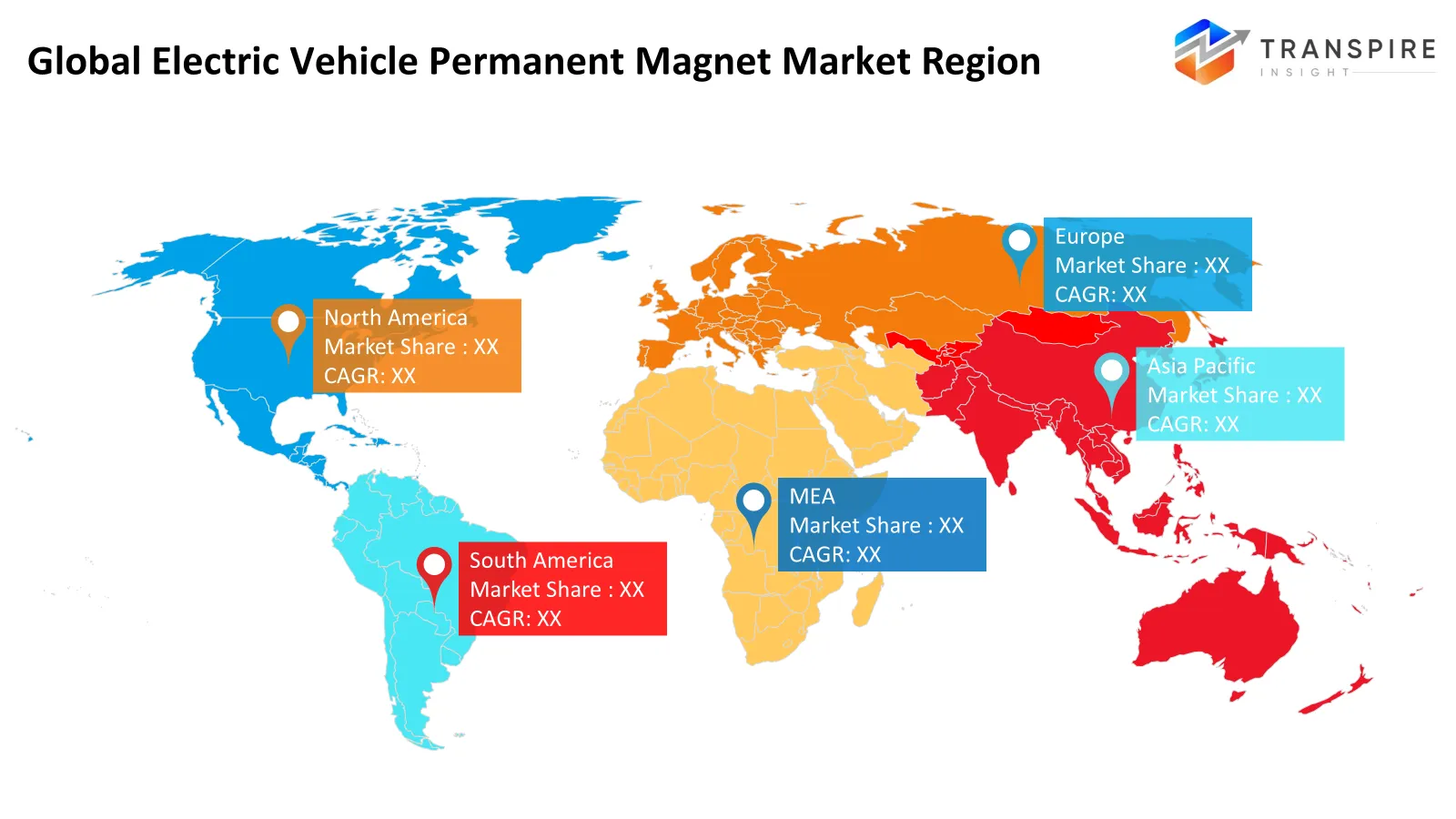
The Asia Pacific region heavily dominates the market, commanding a 46% revenue share. This massive lead is driven by the region's absolute control over raw materials, as it owns the vast majority of global rare-earth mining and processing infrastructure. A few of the prominent companies of this region are Ningbo Yunsheng & Zhejiang Innuovo, Proterial, Ltd., and JL MAG Rare Earth. A highly mature domestic supply chain, backed by aggressive production subsidies in manufacturing hubs like China, allows suppliers to build high-performance magnets at a fraction of Western costs. Recently, the Government of India announced plans to begin domestic production of rare-earth permanent magnets by the end of 2026 under a public-private partnership model. The initiative is expected to strengthen the regional EV supply chain, reduce dependence on imports, and support growing demand for permanent magnet motors used in electric vehicles.
Europe stands firmly as the second-largest market, securing roughly 25% of the global value. Unlike Asia's mining-centric ecosystem, Europe's market stability relies on a long-standing network of premium Tier-1 automotive component suppliers and advanced automation industries. Strict regional corporate fleet electrification mandates and well-established quality standards force European automakers to maintain high engineering benchmarks. This strong focus on vehicle reliability and performance creates a steady, highly predictable demand for high-tier permanent magnets, shielding the local market from sudden consumer retail fluctuations. Recently, Stellantis unveiled a €60 billion strategy that includes launching 60 new vehicle models by 2030, spanning electric, hybrid, and combustion platforms, while expanding partnerships across manufacturing and technology. The initiative is expected to strengthen Europe's EV ecosystem and increase demand for permanent magnet motors and critical rare-earth materials used in electric drivetrains.
Simultaneously, Europe has emerged as the fastest-growing region, posting an impressive CAGR of 11.4%. This sudden acceleration was triggered by recent, strict regulatory updates like the EU Critical Raw Materials Act, which penalizes heavy reliance on single-country supply chains. To safeguard local automakers, governments are pouring massive investments into building regional processing facilities and closed-loop magnet recycling hubs. This political push creates an entirely new future opportunity centered on localized, independent magnet production that does not rely on foreign mining, rapidly unlocking regional market growth. Recently, BMW Group began pre-series production of its fully electric Neue Klasse BMW i3 at its Munich plant, with full-scale production scheduled for the second half of 2026. The launch strengthens Europe's EV manufacturing capacity and is expected to drive demand for advanced electric drivetrain components, including permanent magnet materials and motor technologies across the regional EV supply chain. In February 2026, BMW Group began pre-series production of its fully electric Neue Klasse BMW i3 at its Munich plant, with full-scale production scheduled for the second half of 2026.
Who are the Key Players in the Global Electric Vehicle Permanent Magnet Market and how do they Compete?
The global EV permanent magnet market is highly competitive and split between Asian vertically integrated giants and Western specialized producers. Competition centers on securing stable raw material supply chains, reducing geopolitical risks, and engineering magnets that can withstand extreme motor temperatures without relying on scarce, volatilely priced heavy rare earth elements.
Asian players leverage massive scale and innovation to dominate high-volume supply chains. JL MAG Rare-Earth and Ningbo Yunsheng pursue an aggressive low-cost, high-volume strategy backed by direct domestic access to processed materials. Conversely, Japanese innovators like Shin-Etsu Chemical, TDK Corporation, Daido Steel, and Proterial (formerly Hitachi Metals) lead in technological innovation; they focus on proprietary grain boundary diffusion techniques to drastically reduce or eliminate heavy rare earths while maintaining high magnetic performance. Upstream, Lynas Rare Earths competes via supply-chain independence, expanding non-Chinese extraction and refining to provide geographic security.
Western manufacturers survive by targeting high-value, specialized niches. VACUUMSCHMELZE focuses on high-end innovation, engineering premium magnets for European luxury performance EVs. Arnold Magnetic Technologies, Electron Energy Corporation, Dexter Magnetic Technologies, Adams Magnetic Products, and Bunting Magnetics capture aerospace and military-grade EV niches by providing custom-molded designs. Meanwhile, GKN Powder Metallurgy utilizes an innovation-focused automotive strategy, using advanced powder metal forming to optimize magnet integration into motor components.
Global Electric Vehicle Permanent Magnet Market Companies
- Hitachi Metals
- Shin-Etsu Chemical
- TDK Corporation
- Arnold Magnetic Technologies
- VACUUMSCHMELZE
- Daido Steel
- Ningbo Yunsheng
- JL MAG Rare-Earth
- Electron Energy Corporation
- Adams Magnetic Products
- GKN Powder Metallurgy
- Lynas Rare Earths
- Proterial
- Dexter Magnetic Technologies
- Bunting Magnetics
Recent Development News
In May 2026, Mahindra announced plans to launch six new passenger EVs and increase production capacity by 50%. The expansion is expected to accelerate demand for permanent magnet motors and advanced electric drivetrain components across India’s EV market.
(Source: https://www.electrive.com)
What Strategic Insights Define the Future of the Electric Vehicle Permanent Magnet Market?
The market is shifting decisively toward geopolitical insulation and absolute material efficiency. As automakers demand shorter supply chains, the industry is moving away from centralized mining hubs toward localized processing networks.
Conversely, an emerging opportunity lies in automated direct-to-rotor recycling systems. Instead of breaking down magnets into chemical components, capturing and reshaping solid scrap metal from retired EV fleets bypasses traditional refining limits completely.
OEMs must structurally decouple from raw mining dependencies by investing in localized, long-term joint ventures with closed-loop recyclers, while simultaneously redesigning motor cooling jackets to safely accommodate lower-coercivity, rare-earth-less magnets.
Global Electric Vehicle Permanent Magnet Market Segmentation
By Type
- Neodymium-Iron-Boron Magnets
- Ferrite Magnets
- Samarium Cobalt Magnets
- Bonded Magnets
- Rare-earth Magnets
- High-temperature Magnets
- Others
By Application
- Electric Motors
- Battery Systems
- Charging Infrastructure
- Power Steering Systems
- Regenerative Braking Systems
- Others
By End-User
- Electric Vehicle OEMs
- Component Manufacturers
- Battery Producers
- Others
By Vehicle Type
- Passenger EVs
- Commercial EVs
- Two-wheelers
- Electric Buses
- Others
Regional Outlook
North America
- United States
- Canada
- Mexico
Europe
- Germany
- United Kingdom
- France
- Spain
- Italy
- Rest of Europe
Asia Pacific
- Japan
- China
- Australia & New Zealand
- South Korea
- India
- Rest of Asia Pacific
South America
- Brazil
- Argentina
- Rest of South America
Middle East & Africa
- Saudi Arabia
- United Arab Emirates
- South Africa
- Rest of the Middle East & Africa
Frequently Asked Questions
Find quick answers to common questions.
The Global Electric Vehicle Permanent Magnet Market size was valued at USD 13.39 billion in 2025 and is poised to reach USD 27.24 billion by 2033, expanding at a 9.30% CAGR.
Key segments for the Global Electric Vehicle Permanent Magnet Market are By Type (Neodymium-Iron-Boron Magnets, Ferrite Magnets, Samarium Cobalt Magnets, Bonded Magnets, Rare-earth Magnets, High-temperature Magnets, Others); By Application (Electric Motors, Battery Systems, Charging Infrastructure, Power Steering Systems, Regenerative Braking Systems, Others); By End-User (Electric Vehicle OEMs, Component Manufacturers, Battery Producers, Others); By Vehicle Type (Passenger EVs, Commercial EVs, Two-wheelers, Electric Buses, Others).
The Global Electric Vehicle Permanent Magnet Market is driven by rising EV adoption, government net-zero initiatives, and the high energy efficiency of permanent magnet motors, which help maximize vehicle range and performance. Growing investments in EV manufacturing and production expansion further boost demand for permanent magnet motors and rare earth materials.
The Global Electric Vehicle Permanent Magnet Market is led by major manufacturers, such as Hitachi Metals, Shin-Etsu Chemical, TDK Corporation, Arnold Magnetic Technologies, VACUUMSCHMELZE, Daido Steel, Ningbo Yunsheng, JL MAG Rare-Earth, Electron Energy Corporation, Adams Magnetic Products, GKN Powder Metallurgy, Lynas Rare Earths, Proterial, Dexter Magnetic Technologies, and Bunting Magnetics.
Asia Pacific holds 46% of the global electric vehicle permanent magnet market, making it the leading regional market. Its dominance is driven by strong EV production in countries such as China, Japan, and South Korea, extensive rare earth material processing capabilities, supportive government policies, and growing investments in electric mobility and battery manufacturing.
Commercial opportunities in the Global Electric Vehicle Permanent Magnet Market lie in advanced rare-earth recycling technologies and the development of heavy rare-earth-free magnet materials. Growing investments in recycling infrastructure across the United States and Europe can create a stable, localized supply of neodymium and other critical materials, reducing mining dependence and supporting long-term market growth.
- Hitachi Metals
- Shin-Etsu Chemical
- TDK Corporation
- Arnold Magnetic Technologies
- VACUUMSCHMELZE
- Daido Steel
- Ningbo Yunsheng
- JL MAG Rare-Earth
- Electron Energy Corporation
- Adams Magnetic Products
- GKN Powder Metallurgy
- Lynas Rare Earths
- Proterial
- Dexter Magnetic Technologies
- Bunting Magnetics
About the Authors

Mayur Shinde
I am Mayur Shinde, a Senior Research Analyst at Transpire Insight, specializing in the Automotive & Transportation and Information & Communication Technology (ICT) Industry. My work focuses on analyzing emerging market trends, technological advancements, competitive landscapes, and industry developments to deliver accurate, data-driven insights. I am passionate about transforming complex market information into clear, actionable content that helps businesses, professionals, and decision-makers stay informed and make confident strategic decisions.

Chakradhar Khansole
Chakradhar serves as the Research Director at Transpire Insight, bringing over 8 years of experience in technology, innovation, and strategic market intelligence. He specializes in transforming complex market data into actionable business insights that enable organizations to make informed, growth-oriented decisions. Recognized for his strategic vision and analytical expertise, Chakradhar leads high-impact research initiatives, delivering comprehensive market assessments, competitive intelligence, and forward-looking industry analysis.
Recently Published Reports
-
Apr 2026
ATV & UTV Market
ATV & UTV Market Size, Share & Analysis Report By Type (ATV, and UTV), By Variants (Less Than 400 CC, 400 CC To 800 CC, and More Than 800 CC), and Geography (North America, Europe, Asia-Pacific, Middle East and Africa, South and Central America), 2021 - 2031
-
Apr 2026
Automotive Central Gateway Module Market
Automotive Central Gateway Module Market Size, Share & Analysis Report By Type (Ethernet Central Gateway Module, CAN Central Gateway Module, LIN Central Gateway Module, and FlexRay), By Application (Powertrain Control, Body Control, Infotainment System, Advanced Driver Assistance Systems (ADAS), and Others), By End User (Passenger Vehicles, and Commercial Vehicles), and Geography (North America, Europe, Asia-Pacific, Middle East and Africa, South and Central America), 2021 - 2031
-
Apr 2026
Automotive Engine Oil Filter Market
Automotive Engine Oil Filter Market Size, Share & Analysis Report By Filter Type (Fuel Filter, Engine Oil Filter, Hydraulic Oil Filter, and Others), By Filter Media (Cellulose, Synthetic, and Micro), By Sales Channel (OEMs, and Aftermarket), By Vehicle Type (Passenger Cars, Light Commercial Vehicles, Heavy Duty Trucks, Buses and Coaches, and Off-road Vehicles), and Geography (North America, Europe, Asia-Pacific, Middle East and Africa, South and Central America), 2021 - 2031
-
Apr 2026
Automotive Parts Aluminium Die Casting Market
Automotive Parts Aluminium Die Casting Market Size, Share & Analysis Report By Production Process (Pressure Die Casting, Vacuum Die Casting, Squeeze Die Casting, Gravity Die Casting), By Application (Body Parts, Engine Parts, Transmission Parts, Battery And Related Components, Other Application Types), and Geography (North America, Europe, Asia-Pacific, Middle East and Africa, South and Central America), 2021 - 2031
Our Clients



