United Kingdom EV Magnet Market Size & Forecast:
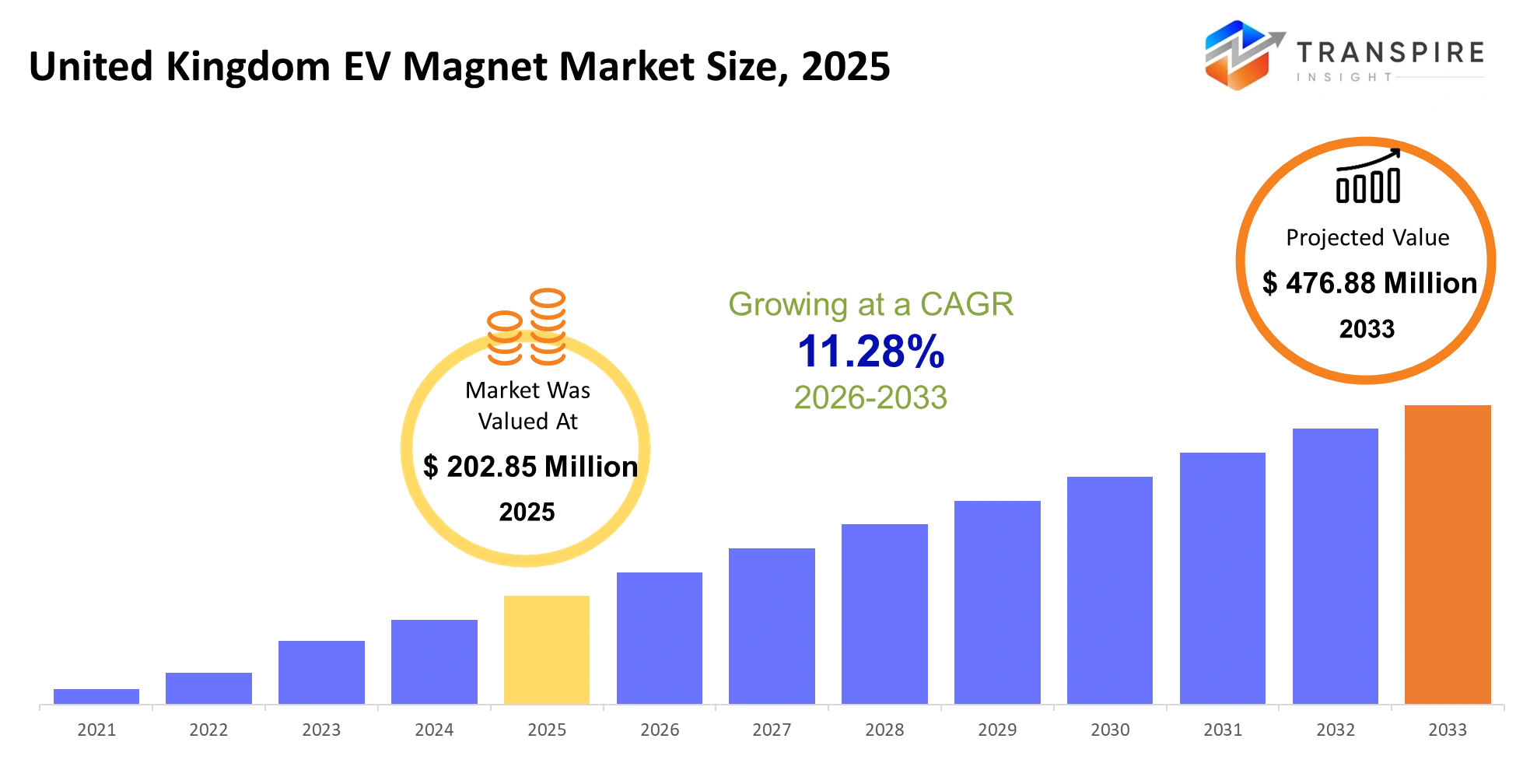
- United Kingdom EV Magnet Market Size 2025: USD 202.85 Million
- United Kingdom EV Magnet Market Size 2033: USD 476.88 Million
- United Kingdom EV Magnet Market CAGR: 11.28%
- United Kingdom EV Magnet Market Segments: By Magnet Type (Neodymium Iron Boron Magnets, Ferrite Magnets, Samarium Cobalt Magnets, Alnico Magnets, Others); By Vehicle Type (Passenger EVs, Commercial EVs, Hybrid Vehicles, Electric Buses, Others); By Application (Traction Motors, Charging Systems, Power Steering Systems, Battery Systems, Others); By End User (Automotive OEMs, EV Component Manufacturers, Aftermarket Suppliers, Others).
To learn more about this report,  Download Free Sample Report
United Kingdom EV Magnet Market Summary
The United Kingdom EV Magnet Market was valued at USD 202.85 Million in 2025. It is forecast to reach USD 476.88 Million by 2033. That is a CAGR of 11.28% over the period.
The United Kingdom EV Magnet Market basically supports electric vehicle propulsion systems, by supplying high-performance permanent magnets that are used in traction motors, regenerative braking setups, and a few auxiliary electric components too. In real life, these magnet units help with smaller motor designs, with stronger torque density and better energy efficiency, which then has a direct effect on vehicle range, acceleration, and how well the battery utilization actually performs. Over the last 3–5 years, the market feel like it’s moved away from the older ferrite based motor pieces , and toward rare earth permanent magnets, especially neodymium iron boron blends that are tuned for high efficiency EV platforms.
One big trigger was the supply chain disruptions and the geopolitical tension around rare earth sourcing, in particular after major global automotive manufacturers ran into production bottlenecks tied to China dominated refining capacity. So UK and European automakers had to adjust, meaning they diversified their sourcing strategies and also started investing in more localized magnet supply chains. Right now, market expansion seems tied to the EV production targets ramping up, plus tighter vehicle emission regulations, both of which push OEMs toward more efficient motor architectures. As manufacturers scale up their electrified vehicle platforms, magnet suppliers that can lock in rare earth access and also handle advanced processing capacity are getting more high-value contracts and longer term procurement agreements.
Key Market Insights
- In 2025 England kind of dominates the United Kingdom EV Magnet Market, sitting at almost 69% share because EV manufacturing stays really concentrated and the battery supply chain keeps getting big, investment in the right places.
- It’s also why the Midlands automotive clusters still pull in magnet processing activity and EV drivetrain component suppliers, especially those tied to the Jaguar Land Rover and Nissan production networks, which feels like a big deal in practice.
- Then Scotland looks like the fastest mover regionally during 2026–2030, aided by clean energy funding plus research efforts around more advanced materials, less fuss more focus.
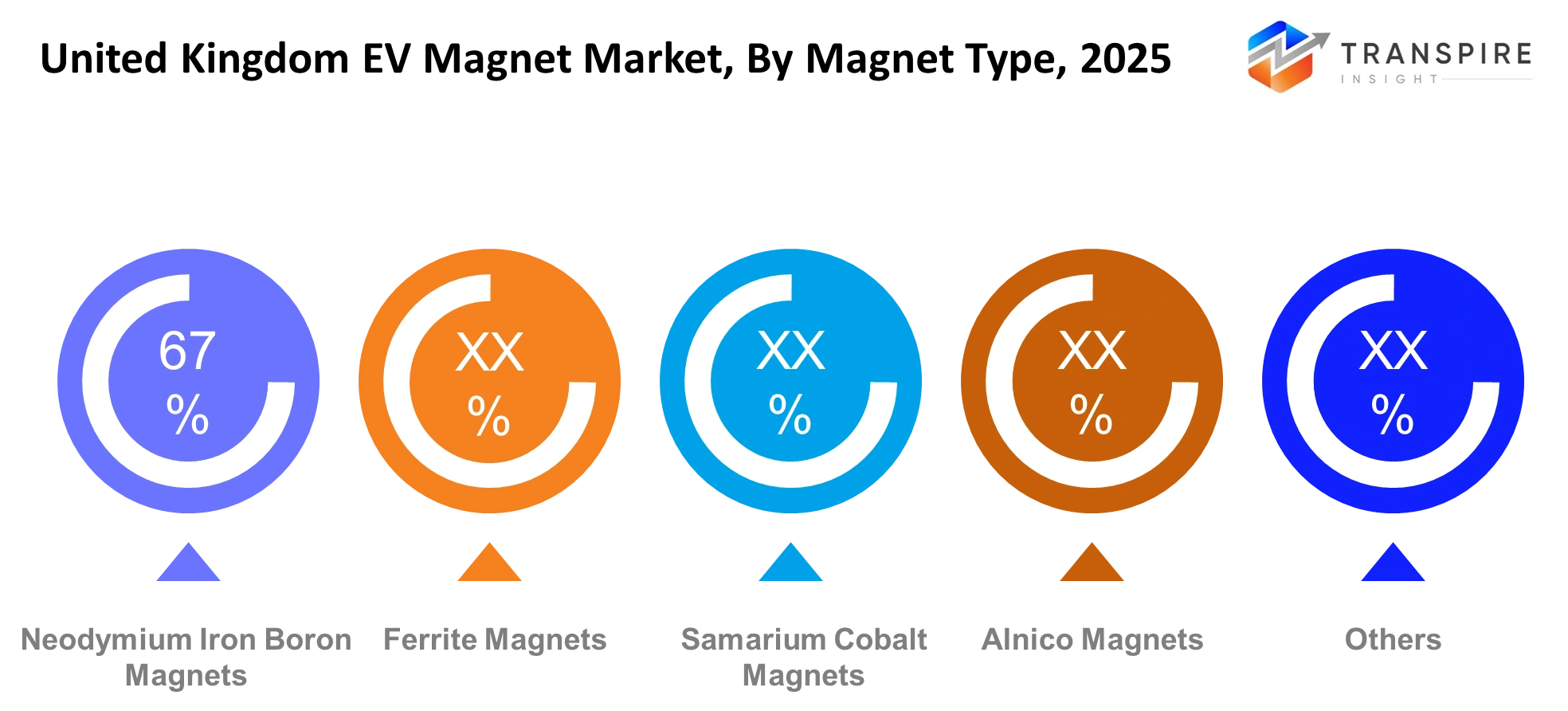
- Neodymium-iron-boron magnets basically take the lead with around 64% share in 2025, since high-performance EV motors need stronger magnetic pull, and they also need better overall efficiency.
- After that, ferrite magnets hold the second largest portion, mostly in lower-cost auxiliary motor uses, and also across entry level electric mobility setups.
- What’s more interesting is recycled rare earth magnets, they show the quickest segment growth through 2030, because automakers are trying to protect the supply chain, and reduce raw material dependence, when possible not just on paper.
- On the application side, traction motors dominate the United Kingdom EV Magnet Market with close to 72% share, mainly because battery electric vehicle production keeps rising.
- Regenerative braking systems are the fastest grower though, with OEMs pushing improved energy recovery and stricter driving efficiency requirements.
- Meanwhile electric commercial vehicles are increasingly leaning toward high-temperature permanent magnets, mainly for heavy-duty torque performance, and to help with battery optimization that actually matters in day to day operations.
- Passenger vehicle manufacturers still account for the biggest market slice, driven by expanding EV output targets and those zero emission fleet strategies, which are getting talked about everywhere lately.
What are the Key Drivers, Restraints, and Opportunities in the United Kingdom EV Magnet Market?
The main thing that seems to be driving the United Kingdom EV Magnet Market is this fast move toward high-efficiency electric drivetrains after tighter vehicle emission rules, and also because there is a planned phaseout for selling new internal combustion vehicles. Car makers are leaning more and more on neodymium based permanent magnets, mostly because these materials provide higher torque density and also lower energy loss, compared to older motor technologies. That change, it basically boosts magnet consumption per vehicle quite directly , especially on premium battery electric models where the longer driving range, plus the compact motor design, really steers buying choices. As UK and European automakers push into more local EV production, longer term sourcing arrangements for rare earth magnets are getting stronger. And that, in turn, raises supplier revenues while also speeding up investments in domestic parts.
The biggest restraint is still the heavy reliance on imported rare earth processing capacity, and a lot of that concentration sits in China. This is not something that can be fixed quickly, because things like refining infrastructure, alloy handling know-how, and even the raw material logistics, all take years of capital work and technical ramp up. Because of that, supply uncertainty and price swings keep showing up, and they are pushing manufacturing costs higher for EV motor producers. Sometimes this also slows down procurement plans, and it makes it harder for smaller companies to lock in dependable magnet supply agreements.
A noticeable opportunity is starting to show up in recycled rare earth magnet recovery, plus secondary processing technologies. If investment keeps going into urban mining and closed loop recycling setups across the Midlands and Northern England, it is creating other supply routes for neodymium and dysprosium materials, so the whole value chain becomes a bit less rigid.Companies capable of integrating recycled magnet feedstock into automotive-grade motor production could gain strategic advantages as automakers prioritize supply chain resilience and localized sourcing between 2026 and 2033.
What Has the Impact of Artificial Intelligence Been on the United Kingdom EV Magnet Market?
Artificial intelligence along with more advanced digital technologies are starting to re-shape EV magnet manufacturing and even electric drivetrain development throughout the automotive supply chain here in the United Kingdom. In many factories, AI-enabled production systems are now used to auto magnet alignment, keep alloy composition on track, and monitor thermal treatment more closely during neodymium magnet manufacturing. What people call “smart factory” platforms, when they get wired into industrial sensors, can help manufacturers cut down on material scrap and also hold tighter tolerances in those high-performance traction motor parts, it’s kinda the point. Digital twins are also being rolled out in EV motor development , so teams can mimic magnetic flux behavior, refine motor efficiency, and generally shrink the number of prototype rounds before actual commercial production begins.
Then there are machine learning models that back predictive maintenance across automated magnet processing lines, by spotting equipment vibration oddities, temperature shifts, and coating defects before operational failures pop up. On the automotive maker side, they’re also leaning on AI-driven performance analytics to improve motor energy efficiency and stretch battery range depending on what drivers are doing, changing conditions and all that. Together these approaches tend to reduce downtime, lift production yield, and push down operating costs, mostly because raw materials get used better and processes stay more consistent, less guesswork.
Still, AI adoption isn’t fully spreading everywhere, partly because there’s limited access to high-quality rare earth processing data. Also, the integration cost for retrofitting older manufacturing sites with newer automation infrastructure can be pretty high. Smaller suppliers keep running into trouble too, because putting real-time analytics in place isn’t simple. Many regional production setups still rely on fragmented industrial software architectures, so deployment becomes slower, messy, and sometimes unrealistic.
Key Market Trends
- UK automakers started buying more neodymium-iron-boron magnets after 2021 , mostly because it boosted torque density and kinda helped extend the electric vehicle driving range.
- After 2022, the whole supply chain problem—especially the rare earth processing being tied up in China , meant manufacturers leaned more toward localized sourcing options plus they started investing in recycled magnet supply strategies, like it was a more stable plan.
- GKN Automotive then kept pushing electrified drivetrain development programs, so that higher efficiency motor architectures could be supported across the European EV manufacturing network, you know, the usual cluster of plants.
- Between 2023 and 2025, recycled rare earth magnet technologies really got more traction because OEMs were trying to reduce material dependency and at the same time improve supply resilience, less awkward risk later on.
- In the Midlands, automotive suppliers increasingly used AI enabled manufacturing systems, to get better magnet alignment precision but also to cut down on production waste.
- Electric commercial vehicle makers also shifted toward high temperature permanent magnets , since those hold up better for heavy duty transport and logistics applications where everything is harder.
- Then there’s regulatory pressure tied to UK zero emission vehicle targets , which ended up speeding up long term procurement agreements between automakers and magnet processing companies.
- Ferrite magnet usage gradually backed off in premium EV platforms, as manufacturers prioritized higher energy efficiency along with more compact motor designs.
- VACUUMSCHMELZE and Arnold Magnetic Technologies also strengthened advanced alloy engineering capabilities, so they could cover next generation traction motor requirements, basically more demanding specs.
- After 2024, battery electric vehicle platforms more often integrated lightweight magnet assemblies, to improve thermal efficiency and reduce drivetrain energy losses, small gains add up.
United Kingdom EV Magnet Market Segmentation
By Magnet Type
Neodymium iron boron magnets still take the dominant spot in the market, mainly because EV makers care a lot about high magnetic strength, a compact motor design, and better energy efficiency. In practice, these magnets help deliver higher torque density in traction motors, so they show up a lot in long range battery electric vehicles, plus those premium EV builds. Ferrite magnets sit with the second-largest share, mostly because their production costs are cheaper, and the supply tends to be steady ,especially for auxiliary motor systems and lower cost mobility uses. Meanwhile samarium cobalt magnets stay rather niche, usually only for specialized high temperature uses, where thermal stability matters more than the overall cost question.
The increase in neodymium magnets is closely tied to the shift toward high performance electric drivetrains and tighter vehicle efficiency targets being pushed across the UK auto sector. Ferrite magnets are under growing substitution pressure in advanced passenger EVs, since weaker magnetic performance can lower motor efficiency and limit battery optimization options. Going forward, investment will more and more gravitate toward recycled rare earth magnet technologies and improved alloy engineering, aimed at reducing how much the supply chain depends on imported raw materials. Magnet producers that can raise thermal resistance and reduce rare earth intensity should be in a better place to lock in longer term agreements with automotive OEMs.
To learn more about this report, Download Free Sample Report
By Vehicle Type
Passenger EVs represent the biggest portion of magnet use, because battery electric cars rely on high efficiency traction motors and regenerative braking setups. Demand is getting more support from the strong adoption of premium EV models, and also from government backed electrification goals, which keeps reinforcing ordering patterns across domestic auto production networks.
Commercial EVs and electric buses are a comparatively smaller slice but it keeps growing fast, largely because fleet electrification mandates are showing up more and more , plus cities are pushing urban emission reduction policies. Hybrid vehicles keep a pretty steady demand too, since a lot of automakers are still leaning on hybrid platforms while they slowly transition to full electric vehicle portfolios.
Passenger EV growth is basically driven by rivalry among manufacturers to boost driving range, sharpen acceleration response, and improve battery efficiency without making the vehicle heavier than before. For commercial vehicle electrification, the demand picture gets more specific: high-temperature permanent magnets are required to handle tougher load scenarios and those long, continuous duty cycles. Going forward, growth will increasingly lean toward commercial fleets and electric buses as logistics operators move faster on zero emission transport adoption. Companies that are building durable, high efficiency motor magnets for heavy duty use are expected to see stronger purchasing activity between 2026 and 2033.
By Application
Traction motors lead the application segmentation because permanent magnets are still core to electric drivetrain efficiency and torque production. These high-performance traction systems soak up the most volume of neodymium based magnets across both passenger and commercial electric vehicles. Charging systems, plus power steering roles, sit in secondary positions, helped along by the wider electrification of vehicle subsystems and the added presence of auxiliary motor integration. Battery systems are currently a smaller application area, since magnet use there remains more limited when you compare it with drivetrain technology, overall.
Traction motor demand keep on growing as automotive makers try to squeeze more compact motor packages and squeeze better thermal efficiency out of the next EV platform builds. Power steering setups are also moving toward lighter magnet assemblies, mostly to get better energy efficiency and also to cut down on mechanical complication across electric drivetrains. The outlook for new application growth will increasingly lean toward integrated drivetrain systems, where you can stack higher power density while also lowering the overall need for rare earth content. In practice, product teams are expected to push lightweight magnetic components , and make sure they’re compatible with more advanced cooling arrangements so the newer EV motor designs can actually work as intended.
By End User
Automotive OEMs show up as the main end-user category, since vehicle manufacturers basically control buying decisions for traction motors, drivetrain systems, and electrified powertrain architectures. Big OEM orders create fairly steady high-volume demand for advanced permanent magnet tech and they often lock in long term supply agreements too. EV component manufacturers follow as the second-largest share, partly because more motor assembly and electrics integration is getting outsourced along with thermal management systems. The aftermarket side stays smaller because EV drivetrain replacement cycles are still relatively short, or I should say limited, compared with conventional automotive parts markets.
Automotive OEM demand is getting pushed by pretty aggressive electrification goals, and there’s also this growing pressure to localize the really critical supply chain parts across Europe , and the UK too. EV component manufacturers keep moving forward, often by forming partnerships with automakers that want more flexibility in sourcing and also those specialized motor engineering skills. In the near future, the market power is likely to drift more toward vertically integrated suppliers, basically players who can tie together magnet processing, motor fabrication, and digital performance tuning inside one more controlled supply ecosystem. Investors, meanwhile, are expected to lean toward companies that have dependable rare earth sourcing strategies and advanced manufacturing that can scale , without too many bottlenecks.
What are the Key Use Cases Driving the United Kingdom EV Magnet Market?
Traction motors are still mostly the big reason EV magnet adoption keeps moving, kind of, because battery electric vehicles need compact and very efficient motor setups that can crank out solid torque and keep a long driving range going. In the passenger space, the demand is the biggest, since vehicle makers are scaling long range electric platforms in line with UK rules on zero emission vehicles, so yeah that’s pushing a lot of production.
Then you have electric buses and commercial delivery fleets as more of a second wave. This shows up especially in urban logistics and public transportation, where operators are increasingly going for high temperature permanent magnet systems to squeeze better drivetrain durability, stronger regenerative braking efficiency and overall energy performance even in demanding heavy duty routes.
More new stuff is popping up too, like integrated e-axle systems, and also lighter electric aviation propulsion platforms that need advanced magnetic materials with lower thermal losses. Recycled rare earth magnets are getting a lot of attention as well, because automakers want more local sourcing and less reliance on imported raw material processing networks, even if the supply chain conversation is pretty complicated, right now.
|
Report Metrics |
Details |
|
Market size value in 2025 |
USD 202.85 Million |
|
Market size value in 2026 |
USD 225.74 Million |
|
Revenue forecast in 2033 |
USD 476.88 Million |
|
Growth rate |
CAGR of 11.28% from 2026 to 2033 |
|
Base year |
2025 |
|
Historical data |
2021 - 2024 |
|
Forecast period |
2026 - 2033 |
|
Report coverage |
Revenue forecast, competitive landscape, growth factors, and trends |
|
Regional scope |
United Kingdom |
|
Key company profiled |
Hitachi Metals, VACUUMSCHMELZE, Arnold Magnetic Technologies, TDK Corporation, Shin-Etsu Chemical, Proterial, Ningbo Yunsheng, Bunting Magnetics, GKN Automotive, BorgWarner, Nidec Corporation, Siemens, Toshiba Materials, Daido Steel, Electron Energy Corporation. |
|
Customization scope |
Free report customization (country, regional & segment scope). Avail customized purchase options to meet your exact research needs. |
|
Report Segmentation |
By Magnet Type (Neodymium Iron Boron Magnets, Ferrite Magnets, Samarium Cobalt Magnets, Alnico Magnets, Others); By Vehicle Type (Passenger EVs, Commercial EVs, Hybrid Vehicles, Electric Buses, Others); By Application (Traction Motors, Charging Systems, Power Steering Systems, Battery Systems, Others); By End User (Automotive OEMs, EV Component Manufacturers, Aftermarket Suppliers, Others). |
Which Regions are Driving the United Kingdom EV Magnet Market Growth?
England kind of leads the EV magnet market, mostly because it has this dense concentration of automotive manufacturing sites , plus a bundle of advanced engineering clusters and a steady stream of electric vehicle supply chain investments. The Midlands in particular, backed by production networks that are connected to Jaguar Land Rover, Nissan, and Tier-1 drivetrain suppliers, ends up creating the highest magnet demand across passenger EV plans. There’s also strong regulatory enforcement that’s tied to zero-emission vehicle targets , and with government-backed battery manufacturing initiatives, local sourcing rules for traction motor parts keep getting tightened. Overall, you can see how a mature ecosystem of motor developers, rare earth processing partnerships and automotive research institutions keeps the region dominant long term.
Wales ends up as the second-largest contributor, but the way the market behaves there feels a bit different than England because the growth is more dependent on industrial stability and manufacturing continuity , not just large scale EV assembly growth. You get established automotive component suppliers and electronics manufacturers keeping a fairly consistent appetite for magnet assemblies used in electric drivetrains and auxiliary systems. Plus, public sector support for industrial decarbonization and long-term workforce retention has helped Wales keep steady production capacity even when other parts of the supply chain look volatile. So yeah, it becomes a useful support area for automotive OEMs that want diversified component sourcing inside the UK.
Scotland, meanwhile, shows the fastest growth momentum after 2023, mainly due to more investment into renewable energy integration, rare earth recycling research, and advanced materials development. The push behind clean energy manufacturing incentives and circular economy funding has opened up new opportunities for recycled magnet processing, and for more sustainable material recovery systems.Research collaborations between universities and automotive technology firms are accelerating development of low-rare-earth magnet alternatives and secondary refining technologies. Between 2026 and 2033, this regional acceleration is expected to attract investors focused on recycled rare earth supply chains, advanced alloy innovation, and localized EV component manufacturing infrastructure.
Who are the Key Players in the United Kingdom EV Magnet Market and How Do They Compete?
The competitive landscape in the United Kingdom for EV magnet market is kinda moderately consolidated, with competition being influenced by rare earth sourcing access, magnet engineering know how, and how well firms integrate into automotive drivetrain supply chains. Established global magnet manufacturers keep defending their share via their own alloy technologies and longer term contracts with automotive OEMs, yet there are also emerging recyclers and advanced materials companies moving in using localized supply tactics. At this point, technology performance, plus supply security matters more than plain pricing benefits, because EV manufacturers are really focused on thermal efficiency, torque density, and dependable procurement for next generation electric drivetrains.
VACUUMSCHMELZE is centered on high performance permanent magnet systems meant for advanced traction motor uses, especially where thermal stability has to be strong and the motor architecture stays compact. What really separates them is specialized alloy engineering, and the long standing, kind of tight relationships with European automotive manufacturers that are building premium EV platform roadmaps. GKN Automotive also pushes forward with integrated e-drive systems, where motor technology, power electronics, and drivetrain optimization are treated together inside one engineering platform, so the whole setup stays more synchronized. Their growth plans are increasingly aimed at localized electrified drivetrain production networks across the UK and Europe, not only at brand new plant locations.
Arnold Magnetic Technologies competes with customized magnet assemblies tuned for high efficiency EV applications, and they run advanced motor prototyping programs in parallel. Proterial differentiates through advanced neodymium magnet processing technologies, which boost magnetic strength while reducing reliance on heavy rare earths, or at least that’s the intent they emphasize in their materials approach.Ningbo Yunsheng maintains cost competitiveness through large-scale rare earth processing capacity and expanding partnerships with global automotive suppliers seeking stable long-term magnet procurement arrangements.
Company List
- Hitachi Metals
- VACUUMSCHMELZE
- Arnold Magnetic Technologies
- TDK Corporation
- Shin-Etsu Chemical
- Proterial
- Ningbo Yunsheng
- Bunting Magnetics
- GKN Automotive
- BorgWarner
- Nidec Corporation
- Siemens
- Toshiba Materials
- Daido Steel
- Electron Energy Corporation
Recent Development News
In July 2025, VACUUMSCHMELZE joined the UK government-backed CirculaREEconomy project, which focuses on developing a sovereign rare-earth permanent magnet supply chain. The initiative supports EV manufacturers including Ford, Bentley, and Wrightbus by advancing sustainable magnet production and recycling capabilities across the UK automotive sector.
Source: https://www.vac-magnetics.com
In February 2026, GKN Automotive cancelled plans for a European permanent rare earth magnet factory following strategic restructuring after acquisition activity. The decision highlighted ongoing profitability concerns and supply chain pressure facing Western EV magnet manufacturing expansion outside China.
Source: https://www.reuters.com
What Strategic Insights Define the Future of the United Kingdom EV Magnet Market?
The United Kingdom EV Magnet Market, seems to be drifting in a more localized and vertically integrated direction over time, with supply chains built around advanced permanent magnet processing, and also recycled rare earth recovery . On top of that, high efficiency electric drivetrain manufacturing is getting more attention. Over the next 5–7 years, people will likely care even more about supply security, and not only motor performance, as automakers work to cut exposure to China dominated rare earth refining networks. At the same time demand for compact, lightweight traction motors is still pushing investment into neodymium based magnet innovation, and the kind of advanced alloy engineering that makes those components more reliable.
There’s also a risk that is a bit less obvious, because it doesn’t show up in sales charts right away. The chance of technology substitution is growing, via rare-earth-free motor architectures. A number of automotive manufacturers are moving faster on induction systems and switched reluctance motor setups, basically to reduce dependence on costly rare earth materials , which could in the long run slow magnet demand growth in some EV segments.
Meanwhile an opportunity is starting to form around recycled magnet ecosystems, especially in Scotland and the Midlands. Clean energy funding plus circular economy policies are helping fund secondary rare earth processing infrastructure. Companies should lock in long term partnerships across recycling, refining, and motor manufacturing, so they can strengthen domestic supply chains before procurement competition heats up later in the decade.
United Kingdom EV Magnet Market Report Segmentation
By Magnet Type
- Neodymium Iron Boron Magnets
- Ferrite Magnets
- Samarium Cobalt Magnets
- Alnico Magnets
- Others
By Vehicle Type
- Passenger EVs
- Commercial EVs
- Hybrid Vehicles
- Electric Buses
- Others
By Application
- Traction Motors
- Charging Systems
- Power Steering Systems
- Battery Systems
- Others
By End User
- Automotive OEMs
- EV Component Manufacturers
- Aftermarket Suppliers
- Others
Frequently Asked Questions
Find quick answers to common questions.
The expected United Kingdom EV Magnet Market size is USD 476.88 Million in 2033.
Key segments for the United Kingdom EV Magnet Market are By Magnet Type (Neodymium Iron Boron Magnets, Ferrite Magnets, Samarium Cobalt Magnets, Alnico Magnets, Others); By Vehicle Type (Passenger EVs, Commercial EVs, Hybrid Vehicles, Electric Buses, Others); By Application (Traction Motors, Charging Systems, Power Steering Systems, Battery Systems, Others); By End User (Automotive OEMs, EV Component Manufacturers, Aftermarket Suppliers, Others).
Major United Kingdom EV Magnet Market players are Hitachi Metals, VACUUMSCHMELZE, Arnold Magnetic Technologies, TDK Corporation, Shin-Etsu Chemical, Proterial, Ningbo Yunsheng, Bunting Magnetics, GKN Automotive, BorgWarner, Nidec Corporation, Siemens, Toshiba Materials, Daido Steel, Electron Energy Corporation.
The United Kingdom EV Magnet Market size is USD 202.85 Million in 2025.
The United Kingdom EV Magnet Market CAGR is 11.28% from 2026 to 2033.
- Hitachi Metals
- VACUUMSCHMELZE
- Arnold Magnetic Technologies
- TDK Corporation
- Shin-Etsu Chemical
- Proterial
- Ningbo Yunsheng
- Bunting Magnetics
- GKN Automotive
- BorgWarner
- Nidec Corporation
- Siemens
- Toshiba Materials
- Daido Steel
- Electron Energy Corporation
Recently Published Reports
-
Apr 2026
ATV & UTV Market
ATV & UTV Market Size, Share & Analysis Report By Type (ATV, and UTV), By Variants (Less Than 400 CC, 400 CC To 800 CC, and More Than 800 CC), and Geography (North America, Europe, Asia-Pacific, Middle East and Africa, South and Central America), 2021 - 2031
-
Apr 2026
Automotive Central Gateway Module Market
Automotive Central Gateway Module Market Size, Share & Analysis Report By Type (Ethernet Central Gateway Module, CAN Central Gateway Module, LIN Central Gateway Module, and FlexRay), By Application (Powertrain Control, Body Control, Infotainment System, Advanced Driver Assistance Systems (ADAS), and Others), By End User (Passenger Vehicles, and Commercial Vehicles), and Geography (North America, Europe, Asia-Pacific, Middle East and Africa, South and Central America), 2021 - 2031
-
Apr 2026
Automotive Engine Oil Filter Market
Automotive Engine Oil Filter Market Size, Share & Analysis Report By Filter Type (Fuel Filter, Engine Oil Filter, Hydraulic Oil Filter, and Others), By Filter Media (Cellulose, Synthetic, and Micro), By Sales Channel (OEMs, and Aftermarket), By Vehicle Type (Passenger Cars, Light Commercial Vehicles, Heavy Duty Trucks, Buses and Coaches, and Off-road Vehicles), and Geography (North America, Europe, Asia-Pacific, Middle East and Africa, South and Central America), 2021 - 2031
-
Apr 2026
Automotive Parts Aluminium Die Casting Market
Automotive Parts Aluminium Die Casting Market Size, Share & Analysis Report By Production Process (Pressure Die Casting, Vacuum Die Casting, Squeeze Die Casting, Gravity Die Casting), By Application (Body Parts, Engine Parts, Transmission Parts, Battery And Related Components, Other Application Types), and Geography (North America, Europe, Asia-Pacific, Middle East and Africa, South and Central America), 2021 - 2031
Our Clients