
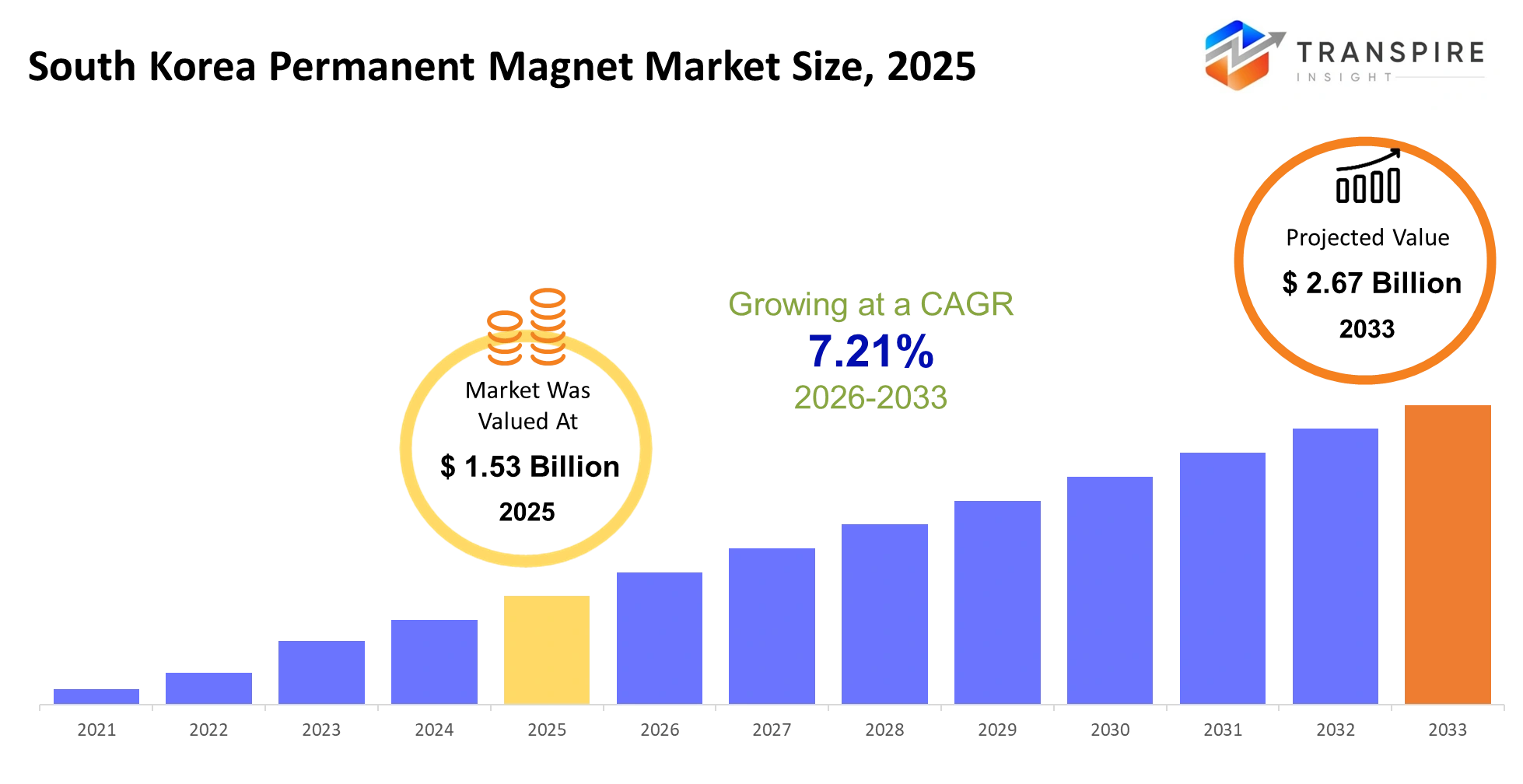
South Korea Permanent Magnet Market Size & Forecast:
- South Korea Permanent Magnet Market Size 2025: USD 1.53 Billion
- South Korea Permanent Magnet Market Size 2033: USD 2.67 Billion
- South Korea Permanent Magnet Market CAGR: 7.21%
- South Korea Permanent Magnet Market Segments: By Type (Neodymium-Iron-Boron, Ferrite, Samarium Cobalt, Alnico), By Application (Automotive, Electronics, Energy, Industrial Machinery), By End-User (Automotive Industry, Electronics Industry, Renewable Energy).
To learn more about this report,  Download Free Sample Report
South Korea Permanent Magnet Market Summary:
South Korea Permanent Magnet Market size was estimated at USD 1.53 Billion in 2025 and is anticipated to reach USD 2.67 Billion by 2033, growing at a CAGR of 7.21% from 2026 to 2033.
The South Korean permanent magnet market operates as part of the advanced materials and electronics manufacturing industry which will grow through its dedication to precision engineering and its export-oriented production practices. The industry will maintain its connections to electric mobility and consumer electronics and renewable energy systems, which require devices to deliver dependable magnetic performance while using compact and energy-efficient designs. In South Korea, major industrial corporations and component producers will advance toward using rare earth materials with higher purity levels, particularly neodymium-iron-boron materials, which are necessary for developing smaller yet more powerful devices. Domestic buyers will increasingly choose magnets that enable them to create products with lighter motors, reduced noise levels, and extended operational life. People will drive demand for products through their daily technology interactions which range from using quiet home appliances to operating advanced electric vehicles. The country's semiconductor and display industry will affect how magnet products are used because manufacturers need to achieve perfect compatibility between their electronic parts and their equipment that moves mechanically.
The market will be affected by supply chain visibility and the implementation of government policies which South Korea uses to decrease its need for foreign rare earth materials. The government-supported programs will promote recycling of magnetic materials while funding research into new materials that provide both performance and stable supply advantages. Producers will implement cleaner processing methods and better waste management techniques because environmental regulations will become more stringent over time. Manufacturing automation will enable better production results through precise magnet control which provides essential support for robotic systems and upcoming industrial machinery. The evolution of consumer expectations will result in companies across various sectors developing products that meet environmental sustainability standards while delivering reliable performance. Manufacturers will use both magnetic strength and their sustainable production methods to compete in the market. The market will develop its future direction through industrial discipline together with changing demand patterns and continuous technological progress.
Key Market Trends & Insights:
- The manufacturing sectors of automotive and electronics and heavy machinery will create sustained demand for permanent magnets in the South Korean market. The production of electric vehicles and smart devices will maintain ongoing demand for high-performance magnets which manufacturers need to meet the efficiency requirements of modern industrial applications.
- The South Korean Permanent Magnet Market will experience growth because domestic automotive companies increase their electric vehicle production. Permanent magnets will be essential components in motors and battery systems because they improve energy efficiency. Rising investments in clean mobility will create stronger demand because manufacturers aim to achieve better performance and greater durability while decreasing energy waste.
- The South Korean permanent magnet market will begin to implement methods which decrease its reliance on imported rare earth elements. Companies will invest in recycling and alternative material research to maintain supply stability. The approach will control costs for industries which need continuous magnet strength because it ensures long-term supply.
- The South Korean Permanent Magnet Market will expand as new technologies emerge in consumer electronics and semiconductor manufacturing. The development of smaller and more efficient components will need magnets which offer both higher strength and exact precision. The ongoing advancements in product design will enable all applications that use smartphones and wearables and advanced computing systems.
- National policies that promote clean energy and advanced manufacturing will provide backing for the South Korean permanent magnet market. Domestic production and research activities will receive support through financial incentives and research funding. The support system will enhance supply chain efficiency while decreasing dependence on outside resources through sustainable industrial development.
South Korea Permanent Magnet Market Segmentation
By Type :
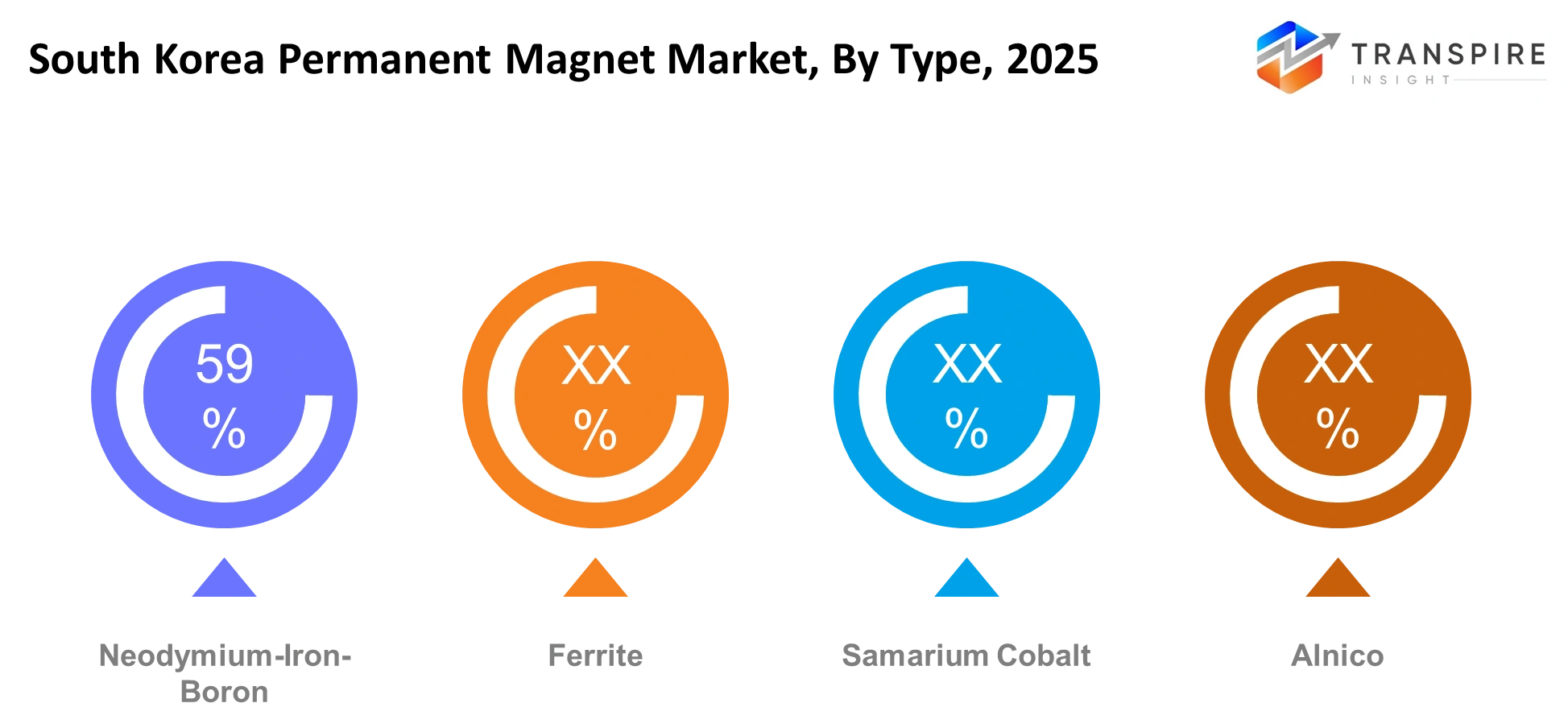
- Neodymium-Iron-Boron: The South Korean Permanent Magnet Market shows remarkable demand for neodymium-iron-boron magnets due to their excellent magnetic properties and small size.The market will continue to grow because advanced electronics and electric vehicles and precision equipment require this technology. The manufacturing industry will drive growth through its current research efforts to create smaller products with enhanced performance capabilities.
- Ferrite: The Permanent Magnet Market in South Korea maintains its constant demand for ferrite magnets because of their affordable price and reliable operation in basic applications. Ferrite magnets will continue to be used in common household devices and standard electric motors. The market will maintain steady demand because businesses choose to produce affordable products through mass production instead of developing products with advanced magnetic capabilities.
- Samarium Cobalt: The South Korean Permanent Magnet Market uses samarium cobalt magnets for applications that need protection against high temperatures and corrosion. The aerospace and defense sectors and specialized electronic systems will increase their use of this technology. This type of material will develop into a critical element for foundations which must provide both reliability and extended operational duration under extreme situations.
- Alnico: The South Korean Permanent Magnet Market uses alnico magnets for specialized industrial applications which need precise temperature control. The magnets will still be used in sensors and instruments because they offer particular benefits in specific controlled environments. The market will maintain steady demand because of specific benefits which exist in particular controlled environments.
To learn more about this report, Download Free Sample Report
By Application :
- Automotive: The South Korea Permanent Magnet Market will experience growth in its automotive sector through electric vehicle development and advanced motor technology. The use of magnets will enable organizations to enhance their operational productivity while minimizing energy consumption. The rising demand for sustainable transportation solutions will lead to increased adoption among automotive manufacturers and their associated component production activities.
- Electronics: The South Korea Permanent Magnet Market for electronics will experience substantial growth because consumers demand smaller electronics that provide high energy efficiency.Speakers and smartphones and storage devices will make use of magnets. The need for continuous product development will require manufacturers to adopt advanced magnetic materials which improve performance and product lifespan.
- Energy: The South Korea Permanent Magnet Market will experience growth because the energy sector develops especially through wind power and other renewable energy sources. The generators and turbines will require magnets. The demand for renewable projects will increase as energy systems strive to achieve optimal performance and extended operational periods.
- Industrial Machinery: The South Korea Permanent Magnet Market will expand because industrial machinery requires magnets to enhance motor performance and automated systems. The demand for robotics will grow in both industrial and manufacturing sectors. Industries will implement advanced magnetic technologies because they want to increase productivity while reducing energy expenses.
By End-User :
- Automotive Industry: The South Korean Permanent Magnet Market will experience growth because the automotive sector will drive electric vehicle development forward. The manufacturers will require magnets to build motor systems and sensor devices and control system components. The demand for electric vehicles and hybrid vehicles will grow because manufacturers will increase their production rates for both domestic and international markets.
- Electronics Industry: The Permanent Magnet Market in South Korea will experience strong connections to the electronics sector because South Korean electronics manufacturers develop new consumer and industrial devices. The magnets will enable devices to achieve better performance while maintaining smaller sizes. The companies will maintain steady demand for their products because they will produce high volumes while working to enhance their product quality and operational efficiency.
- Renewable Energy: The South Korean Permanent Magnet Market will experience growth from the renewable energy sector because wind and other renewable energy systems continue to expand in operation. The magnets will function as essential components that enable power plants to operate at their maximum efficiency. The government will enable this segment to grow because it supports recycling and sustainability goals which will create ongoing demand in this market.
Country Insights
- The Permanent Magnet Market in South Korea shows continuous development because industrial activities and advanced manufacturing systems provide essential support. The demand from electronics and automotive production and renewable energy equipment leads to increased market needs. Domestic companies focus on improving material efficiency and reducing import reliance, which helps them establish an environment that promotes their long-term growth and their supply chain development between different time periods.
- The Permanent Magnet Market in South Korea gains advantages from its established technological base and its highly trained workers. Research institutions and manufacturers develop new materials, which they use to create alternatives to rare earth materials and to produce advanced high-performance magnets. Government-backed programs support sustainable sourcing and recycling practices, which help domestic capabilities while decreasing vulnerability to international raw material price changes.
- The Permanent Magnet Market in South Korea shows increased connections with electric vehicle technology and wind energy initiatives. The growing clean energy objectives of the organization lead to increased magnet usage in motors and generators. The market grows because of strong export demand, while supplier-manufacturer partnerships help optimize production processes and maintain consistent product delivery to global markets.
Recent Development News
February 2026 – South Korea strengthens rare-earth supply chain policy
South Korea’s Ministry of Trade, Industry and Energy announced new national-level measures to stabilize rare-earth supply chains, which directly impacts permanent magnet production. The plan includes public–private cooperation and strategic stockpiling to reduce external risks.
February 2026 – Global magnet supply risks highlight Korea’s strategic role (Reuters)
A Reuters report noted that global magnet supply chains remain fragile, with projects outside China struggling. This situation indirectly strengthens South Korea’s importance as countries diversify supply chains away from China dominance.
|
Report Metrics |
Details |
|
Market size value in 2025 |
USD 1.53 Billion |
|
Market size value in 2026 |
USD 1.64 Billion |
|
Revenue forecast in 2033 |
USD 2.67 Billion |
|
Growth rate |
CAGR of 7.21% from 2026 to 2033 |
|
Base year |
2025 |
|
Historical data |
2021 - 2024 |
|
Forecast period |
2026 - 2033 |
|
Report coverage |
Revenue forecast, competitive landscape, growth factors, and trends |
|
Country scope |
South Korea |
|
Key company profiled |
Hitachi Metals Ltd., Shin-Etsu Chemical Co. Ltd., TDK Corporation, Arnold Magnetic Technologies, VACUUMSCHMELZE GmbH & Co. KG, Daido Steel Co. Ltd., Ningbo Yunsheng Co. Ltd., JL MAG Rare-Earth Co. Ltd., Beijing Zhong Ke San Huan Hi-Tech Co. Ltd., Electron Energy Corporation, Adams Magnetic Products Co., Dexter Magnetic Technologies Inc., Bunting Magnetics Co., Lynas Rare Earths Ltd., Neo Performance Materials Inc. |
|
Customization scope |
Free report customization (country, regional & segment scope). Avail customized purchase options to meet your exact research needs. |
|
Report Segmentation |
By Type (Neodymium-Iron-Boron, Ferrite, Samarium Cobalt, Alnico), By Application (Automotive, Electronics, Energy, Industrial Machinery), By End-User (Automotive Industry, Electronics Industry, Renewable Energy). |
Key South Korea Permanent Magnet Company Insights
- The South Korea Permanent Magnet Market includes established manufacturers together with technology-driven companies which work to create materials with improved efficiency and establish reliable supply networks. Companies will invest in research to improve magnet performance while managing cost pressure, which will create continuous demand from electronics and automotive and renewable energy sectors.
- The South Korea Permanent Magnet Market demonstrates increasing domestic producer collaboration with international partners to obtain rare earth materials while decreasing their need for imported resources. The business strategies of the company will include capacity expansion together with process upgrades to satisfy growing industrial demands while preserving product excellence and export market competitiveness.
South Korea Permanent Magnet Market Companies:
- Hitachi Metals Ltd.
- Shin-Etsu Chemical Co. Ltd.
- TDK Corporation
- Arnold Magnetic Technologies
- VACUUMSCHMELZE GmbH & Co. KG
- Daido Steel Co. Ltd.
- Ningbo Yunsheng Co. Ltd.
- JL MAG Rare-Earth Co. Ltd.
- Beijing Zhong Ke San Huan Hi-Tech Co. Ltd.
- Electron Energy Corporation
- Adams Magnetic Products Co.
- Dexter Magnetic Technologies Inc.
- Bunting Magnetics Co.
- Lynas Rare Earths Ltd.
- Neo Performance Materials Inc
South Korea Permanent Magnet Market Segmentation
By Type
- Neodymium-Iron-Boron
- Ferrite
- Samarium Cobalt
- Alnico
By Application
- Automotive
- Electronics
- Energy
- Industrial Machinery
By End-User
- Automotive Industry
- Electronics Industry
- Renewable Energy
Frequently Asked Questions
Find quick answers to common questions.
The approximate South Korea Permanent Magnet Market size for the market will be USD 2.67 Billion in 2033.
Key segments for the South Korea Permanent Magnet Market are By Type (Neodymium-Iron-Boron, Ferrite, Samarium Cobalt, Alnico), By Application (Automotive, Electronics, Energy, Industrial Machinery), By End-User (Automotive Industry, Electronics Industry, Renewable Energy).
Major South Korea Permanent Magnet Market players are Hitachi Metals Ltd., Shin-Etsu Chemical Co. Ltd., TDK Corporation, Arnold Magnetic Technologies, VACUUMSCHMELZE GmbH & Co. KG, Daido Steel Co. Ltd., Ningbo Yunsheng Co. Ltd., JL MAG Rare-Earth Co. Ltd., Beijing Zhong Ke San Huan Hi-Tech Co. Ltd., Electron Energy Corporation, Adams Magnetic Products Co., Dexter Magnetic Technologies Inc., Bunting Magnetics Co., Lynas Rare Earths Ltd., Neo Performance Materials Inc.
The South Korea Permanent Magnet Market size is USD 1.53 Billion in 2025.
The South Korea Permanent Magnet Market CAGR is 7.21%.
- Hitachi Metals Ltd.
- Shin-Etsu Chemical Co. Ltd.
- TDK Corporation
- Arnold Magnetic Technologies
- VACUUMSCHMELZE GmbH & Co. KG
- Daido Steel Co. Ltd.
- Ningbo Yunsheng Co. Ltd.
- JL MAG Rare-Earth Co. Ltd.
- Beijing Zhong Ke San Huan Hi-Tech Co. Ltd.
- Electron Energy Corporation
- Adams Magnetic Products Co.
- Dexter Magnetic Technologies Inc.
- Bunting Magnetics Co.
- Lynas Rare Earths Ltd.
- Neo Performance Materials Inc
Recently Published Reports
-
May 2026
Healthcare Polymer Packaging Market
Healthcare Polymer Packaging Market Size, Share & Analysis Report By Packaging Type (Syringes, IV Bottles and Pouches, Clamshells, Blisters, Bottles & Jars, Containers, Tubes, IV Parental Packaging, Others), By Type (Regulated, Non-regulated), By Polymer Type (LDPE (Low-Density Polyethylene), HDPE (High-Density Polyethylene), Homo-polymer (Homo), Random Copolymer (Random), Block Copolymer (Block), PET, Polystyrene, Polyvinyl Chloride, Polyamide/EVOH, Others), and Geography (North America, Europe, Asia-Pacific, Middle East and Africa, South and Central America), 2021 - 2031
-
Apr 2026
Hydrophilic Tape (Waterstop) Market
Hydrophilic Tape (Waterstop) Market Size, Share & Analysis Report By Type (Bentonite-Based Hydrophilic Tape, Rubber-Based Hydrophilic Tape), By Application (Residential Buildings, Commercial Buildings, Infrastructure Projects), and Geography (North America, Europe, Asia-Pacific, Middle East and Africa, South and Central America), 2021 - 2031
-
Apr 2026
Metalens Market
Metalens Market Size, Share & Analysis Report By Type (Visible Light Metalens, and Infrared Metalens), By Application (Consumer Electronics, Automotive Electronics, Industrial, Medical, and Others), and Geography (North America, Europe, Asia-Pacific, Middle East and Africa, South and Central America), 2021 - 2031
-
Apr 2026
PBT Resin Market
PBT Resin Market Size, Share & Analysis Report By Type (Reinforced PBT Resin, Unreinforced PBT Resin), By Processing Method (Injection Molding, Extrusion, Blow Molding, Others), By End-User (Automotive, Electrical & Electronics, Consumer Appliances, Industrial Machinery, Medical Devices, Packaging, Others), and Geography (North America, Europe, Asia-Pacific, Middle East and Africa, South and Central America), 2021 - 2031