
Oct 31, 2026
Market Forecast
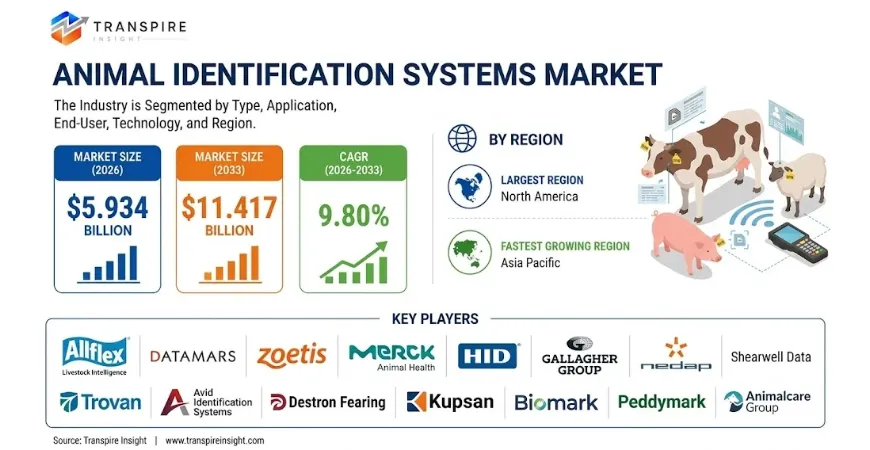
The global animal identification systems market was valued at USD 5.414 billion in 2025 and is projected to grow from USD 5.934 billion in 2026 to USD 11.417 billion by 2033, at a CAGR of 9.80% through the forecast period, according to a new report by Transpire Insights.
Livestock traceability mandates, disease outbreak response infrastructure, the growth of precision livestock farming, and expanding pet identification programs really drive this market. The combination of RFID, GPS, biometric sensing, and IoT platform technology is changing animal identification from a static administrative task into a dynamic, real-time monitoring capability - delivering both operational and biosecurity value far beyond just meeting regulatory requirements.
Animal Identification Systems Market Growth & Trends
Regulatory livestock traceability requirements form the core demand driver for animal identification systems worldwide. The EU Farm-to-Fork Strategy, Australia's National Livestock Identification System, Brazil's cattle traceability program, and USDA animal disease traceability rules in the US all require individual animal identification for cattle, sheep, and pigs - thus creating obligatory demand for certified identification devices throughout the entire global livestock industry. These regulatory frameworks keep expanding in scope and geographical reach, incorporating more species and increasing traceability demands even in markets that once only had optional identification schemes.
Disease outbreak response presents an attractive business opportunity for very robust animal identification infrastructure beyond simply meeting regulations. The COVID-19 pandemic greatly accelerated investments in zoonotic disease surveillance, coupled with ongoing breakouts of foot-and-mouth disease, African swine fever, and avian influenza on numerous continents, really highlights the epidemiological value of quickly tracing animal movements during outbreaks. Countries with effectively established national identification databases have shown much quicker outbreak containment times - creating both political and commercial motivations to invest in identification systems in markets that didn't already have them.
Emerging Economies & Technology
The Asia-Pacific area is the fastest-growing region for animal identification systems, mainly driven by the huge and continually expanding livestock industries across China, India, Southeast Asia, and Australia. China's livestock traceability investments - sparked by food safety policies after past contamination crises - will generate massive purchases of electronic ear tags, RFID readers, and integrated livestock management platforms. India's National Animal Disease Control Program features animal identification as a key element of its disease management structure, leading to centrally funded procurements across its enormous cattle and buffalo population.
Smart livestock monitoring systems - using RFID or GPS animal identification combined with wearable sensors that continually monitor body temperature, rumination activity, movement patterns, and signs of the reproductive cycle - are really the technology area seeing the fastest growth. These systems do much more than just identify animals; they offer real-time health and productivity information that makes it possible to detect diseases early on, automatically find oestrus for improved breeding, and accurately manage animal diets. The economic payoff from improving both health and productivity is quite evident - and it's driving adoption even further among commercial livestock producers regardless of any regulatory requirements.
Livestock Tracking Segment
Livestock tracking represents 57% of the global animal identification systems market - the largest application by far. Cattle ear tags, sheep EID (electronic identification) tags, and pig RFID tags are the biggest sellers in this category, with driven demand from regulated markets giving us our revenue base and precision agriculture adoption adding a growth factor. Allflex Livestock Intelligence and Datamars are really the established leaders in the electronic livestock tag sector, with very wide product lines offering many different tag types and RFID frequencies across various regulatory needs in different countries.
Genomic identification - linking an animal's RFID or EID identifier to its actual genomic profile - is a highly advanced application that's starting to gain commercial acceptance in the dairy and beef genetics industry, where genetic worth data combined with each animal's individual production and health history lets us make much more accurate breeding choices and commercially evaluate each animal itself. Integrating genomic and electronic identification gives you a complete individual animal data file that offers value all throughout their entire life cycle of production.
Smart Livestock Monitoring: Fastest-Growing Segment
Smart livestock monitoring systems are expanding at a CAGR of 12. 7% - the highest rate within the animal identification marketplace. Connected collar, ear tag, and bolus sensors that continually monitor an individual animal's health and behavior indicators are showing returns on investment in commercial dairy and beef farms through decreased disease treatment costs, enhanced reproduction efficiency, and earlier detection of high-cost health incidents like lameness and mastitis. Nedap, Allflex, and Gallagher Group have all created commercial intelligent monitoring platforms for dairy and beef farms.
AI-driven behavior analysis - utilizing machine learning to recognize unusual individual animal behavior patterns that precede clinical disease symptoms by 12-48 hours - is a commercially differentiated ability that is driving higher prices for the most sophisticated smart livestock monitoring systems. Early disease detection that makes it possible for veterinary intervention even before clinical symptoms appear significantly decreases treatment costs, enhances recovery rates, and minimizes production losses in ways that operators can really measure against the system cost.
North America - Biggest Regional Market
North America has 38% of the global animal identification systems market - the biggest regional share. The United States has the world's biggest commercial cattle industry by value, with the USDA's National Animal Identification System and state-level traceability demands consistently creating a need for electronic ear tags and livestock management software. The North American pet microchip market - driven by companion animal registration mandates and the cultural norm of responsible pet ownership - creates a very large volume part of the region's identification systems market.
Canada's Canadian Cattle Identification Agency demands approved electronic identification for all cattle passing through provincial lines, preserving consistent procurement demand from Canadian cattle breeders and feedlots. The Canadian pet identification market is equally well-established, with municipal pet licensing programs ever more requiring or encouraging microchip registration.
Asia Pacific – Fastest-Growing Region
Asia Pacific is advancing at a CAGR of 13.5% — the highest regional rate in this market. The sheer scale of livestock populations across China, India, and Southeast Asia creates enormous potential market volume that regulatory and commercial adoption is progressively converting into procurement. China's accelerating livestock traceability investment — driven by food safety policy and the agricultural modernisation agenda of the Chinese government — is creating one of the largest single national market growth opportunities in the global animal identification industry.
Australia's NLIS (National Livestock Identification System) is one of the world's most comprehensive and well-functioning national livestock identification programmes, requiring electronic identification for all cattle and sheep in the country and providing a model for other nations developing their own traceability infrastructure. Australian livestock identification technology and programme management expertise is being exported to developing livestock industry markets in Southeast Asia and Africa through advisory and technology transfer arrangements.
What Are the Recent Developments in the Animal Identification Systems Market?
Q4 2024 – Allflex Livestock Intelligence: Launched a new multi-sensor cattle ear tag combining RFID identification with body temperature monitoring and activity tracking, enabling continuous individual animal health surveillance through a single approved identification device without additional collar or bolus sensors.
Q4 2024 – Zoetis: Expanded its SenseHub livestock monitoring platform with a new AI-powered health alert system that identifies individual animals showing early signs of bovine respiratory disease 24-48 hours before clinical symptoms are visible, demonstrating reduced treatment costs and mortality rates in commercial feedlot trials.
Q1 2025 – Datamars: Received regulatory approval for a new ultra-high frequency RFID sheep tag meeting the EU sheep and goat identification regulation requirements, providing European sheep producers with a compliant electronic identification solution for the transition to UHF-based national identification systems.
Q2 2025 – Nedap: Secured a supply contract with a major Dutch dairy cooperative to deploy its CowControl precision livestock monitoring system across member farms, covering individual cow health, reproduction, and milking performance monitoring for a combined herd of over 150,000 animals.
Q2 2025 – HID Global: Launched a new pet microchip registry integration platform connecting veterinary clinic microchip implantation records with national and international pet identification databases in real time, reducing the registration gaps that reduce the recovery rate for lost microchipped pets.
Q3 2025 – Merck Animal Health: Introduced a GPS tracking collar for beef cattle with integrated body condition scoring capability using computer vision, enabling range cattle producers to monitor individual animal location, movement, and body condition across large grazing areas without physical mustering.
About Transpire Insight
Turning Complex Data into Clear, Actionable Market Intelligence
In today’s hyper-competitive and fast-moving economy, guessing isn’t a business strategy. To lead your industry, launch game-changing products, or scale into new geographies, you need precise, reliable market intelligence, not just high-level noise.
At Transpire Insight, we are a full-service market research, data analytics, and strategic consulting firm. We help corporate leaders, innovators, and investors navigate complex market shifts with absolute confidence.
By combining rigorous primary research, deep statistical modeling, and hands-on domain expertise, we convert raw data into high-impact strategic roadmaps that drive measurable growth.
What Drives Us
Markets don’t stand still, and neither do we. Our core mission is simple: to empower organizations with verified, technology-enabled insights that remove guesswork from strategic planning.
Whether you are evaluating a niche technological shift, assessing supply chain dynamics, or looking for high-growth target segments, our intelligence gives you a decisive competitive edge.
Why Leading Enterprises Trust Transpire Insight
We don't offer one-size-fits-all research. Our analysts specialize in dedicated verticals—from Biotechnology and Semiconductors to Advanced Automotive, Clean Energy, and Industrial Manufacturing. We speak your industry's language and understand the specific nuances, regulatory shifts, and economic drivers shaping your market.
Syndicated Market Reports: In-depth, turn-key research studies covering market size, share, competitive benchmarking, and multi-year forecasts.
Customized Market Intelligence: Tailored research engagements built around your exact business questions, specific product lines, or targeted regional dynamics.
Strategic Consulting: On-demand analytical support, entry-strategy planning, and direct consultation to help you act on data with speed and accuracy.
Reliable forecasts demand ground-truth data. Our research process combines comprehensive desk research with extensive primary interviews across key industry stakeholders including C-suite executives, supply chain leaders, procurement heads, and subject matter experts. Every report undergoes strict validation to ensure maximum precision and relevance.
Our Core Sectors
We provide continuous tracking and deep-dive analytical coverage across high-impact industries:
Manufacturing and Construction
Let’s Shape Your Growth Strategy Together
Whether you are preparing for your next fiscal cycle, analyzing market entry barriers, or looking for deep-dive quantitative data, Transpire Insight is your trusted intelligence partner.
Ready to gain a clearer view of your market?
Email Us: inquiry@transpireinsight.com
Speak to Our Analyst: +91 7666513636
Want to dive deeper? Head over to www.transpireinsight.com or join our community on Twitter, LinkedIn, and Facebook for the latest updates

 inquiry@transpireinsight.com
 APAC:+91 7666513636
 Address


