
Global Animal Identification Systems Market Size & Forecast:
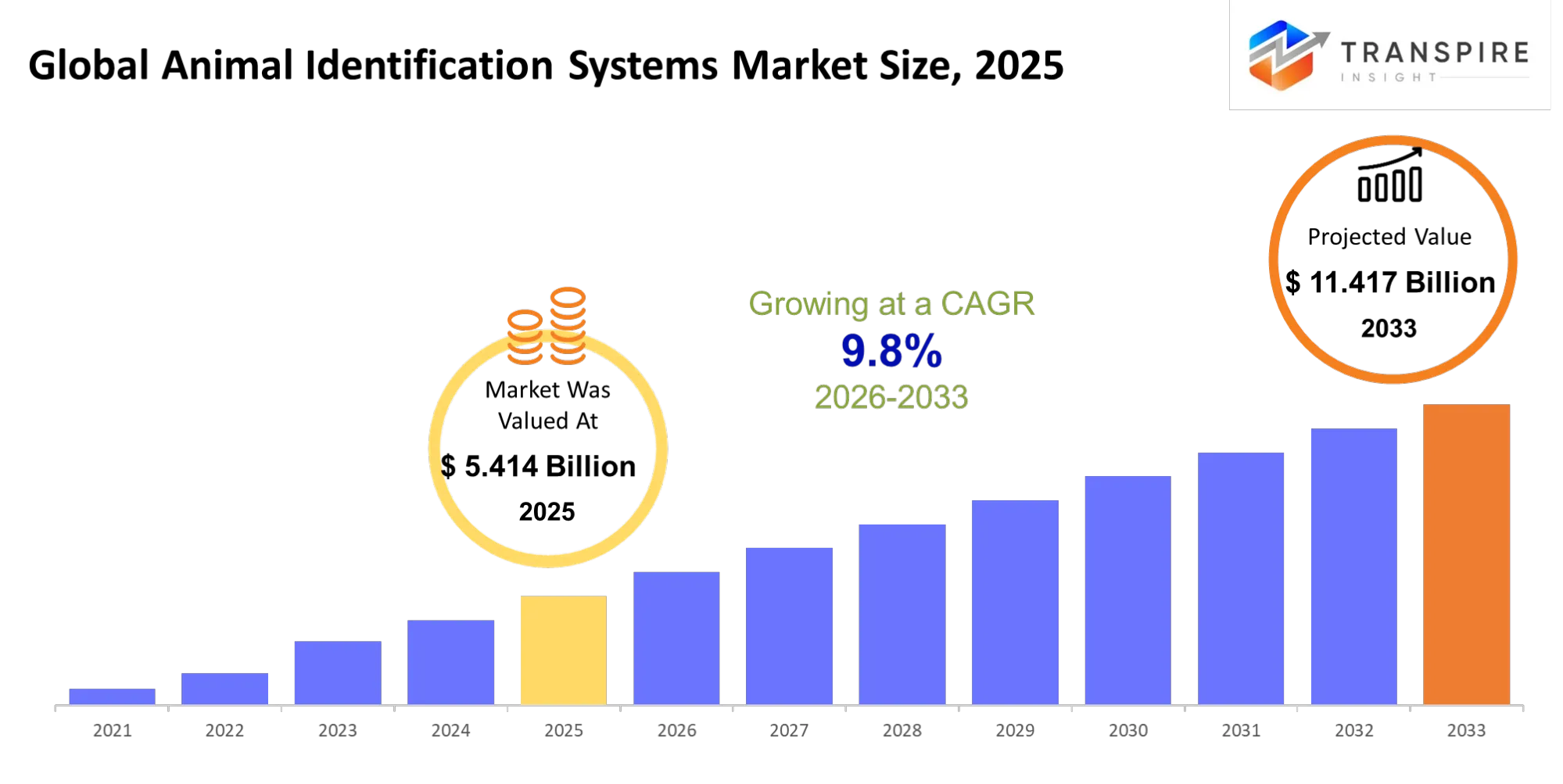
- Global Animal Identification Systems Market Size 2025: USD 5.414 Billion
- Global Animal Identification Systems Market Size 2033: USD 11.417 Billion
- Global Animal Identification Systems Market CAGR: 9.8%
- Global Animal Identification Systems Market Segments: By Type (RFID Tags, Ear Tags, Microchips, GPS Tracking Collars, Biometric Identification Systems, Smart Livestock Monitoring Systems, Others); By Application (Livestock Tracking, Pet Identification, Wildlife Monitoring, Veterinary Management, Dairy Farm Monitoring, Others); By End-User (Farmers, Veterinary Clinics, Government Agencies, Pet Owners, Others); By Technology (RFID-based Systems, GPS-enabled Systems, IoT-integrated Monitoring Platforms, AI-assisted Tracking Systems, Others)
Global Animal Identification Systems Market Summary
The Global Animal Identification Systems Market size is estimated at USD 5.414 Billion in 2025 and is anticipated to reach USD 11.417 Billion by 2033, growing at a CAGR of 9.8% from 2026 to 2033.
This industry isn't just about punching plastic numbers into a cow's ear; it deploys rugged electronic tags, injectable microchips, and smart collars to track animals instantly. Recently, things changed fast as basic plastic tags gave way to connected digital setups. A massive surge in global livestock disease outbreaks served as a harsh wake-up call, forcing governments to enforce strict food tracking laws.
The market is taking off because modern supply chains demand digital proof of an animal’s health history before production. Grocery lines are putting heavy pressure on ranchers to prove origin, triggering immediate upgrades to automated scanning setups on commercial farms to keep food lines moving.
Key Market Insights:
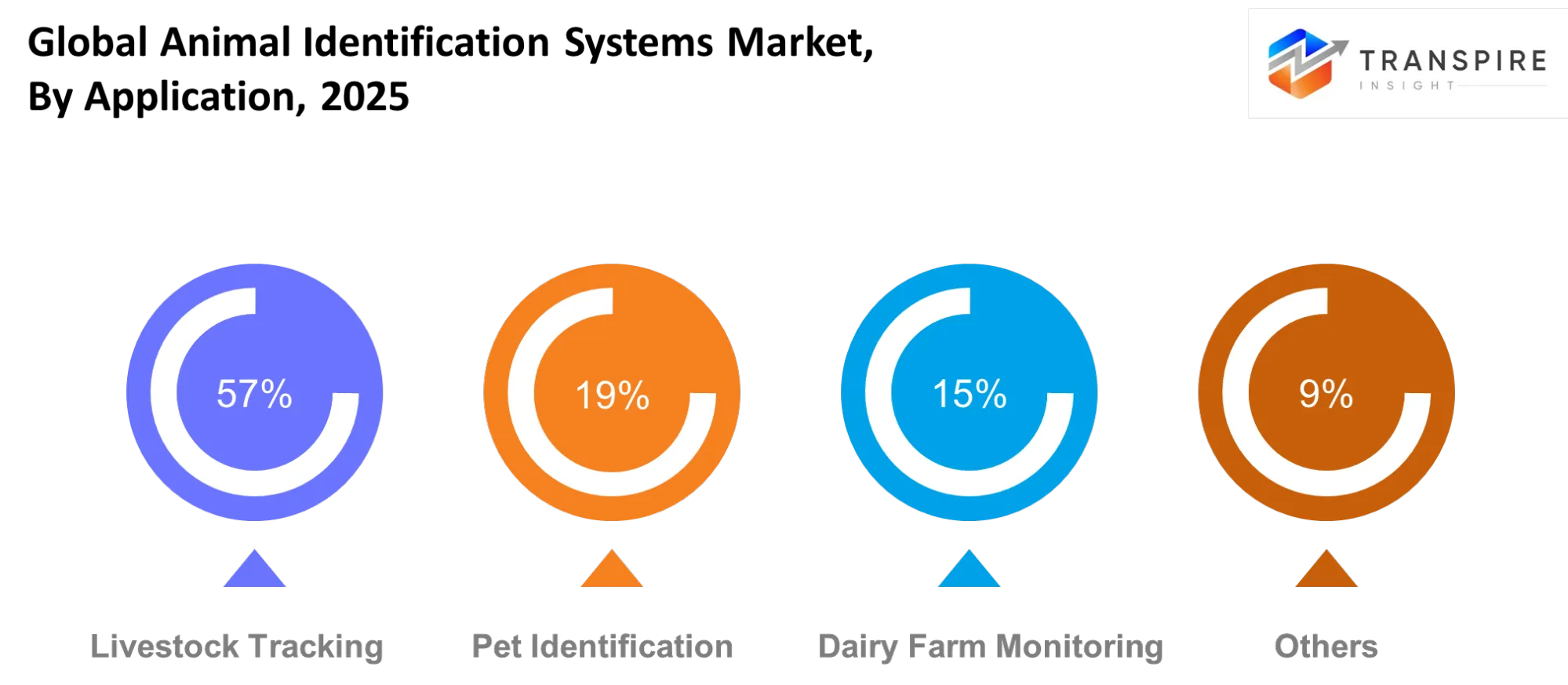
- Livestock Tracking dominates with a 57% share, driven by players like Merck Animal Health's Allflex embedding continuous health algorithms into smart collars to instantly separate routine livestock resting from genuine illness.
- Smart Livestock Monitoring Systems grow fastest at a 12.7% CAGR as tech innovators like Nedap deploy IoT-integrated platforms to execute complex herd management routines from automated cloud dashboards.
- Pet Identification holds a solid 19% share, supported by pioneers like Avid Identification Systems and Destron Fearing rolling out tiny, biocompatible injectable microchips that autonomously sync local veterinary scans with global pet registries.
- Dairy Farm Monitoring secures a 15% footprint with engineering firms like Gallagher Group launching connected ear tags that evaluate daily cattle feeding habits against automated weight scales to cut feed waste.
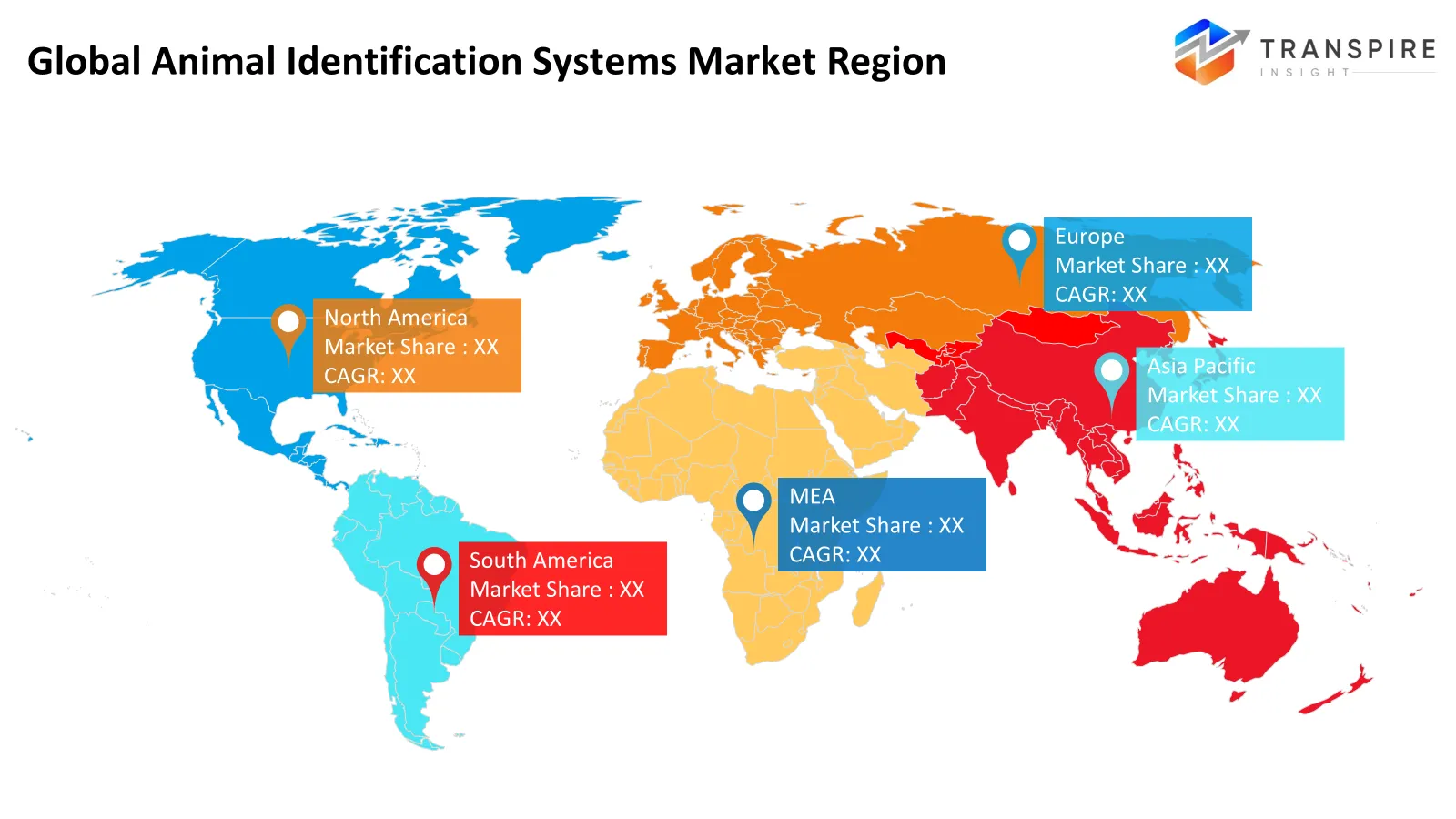
- North America controls 38% of global volume as commercial ranchers integrate platforms from Datamars directly into large-scale scanning chutes to meet the local appetite for rapid, multi-animal tracking in harsh weather.
- Europe maintains a 29% market stake, with regional brands like Shearwell Data manufacturing tamper-proof electronic identity systems to satisfy strict regional livestock tracking mandates and consumer safety laws.
- Asia Pacific is surging at a 13.5% CAGR as animal health heavyweights like Zoetis ramp up digital infrastructure to supply automated scanning networks for rapidly expanding livestock farms.
- Other Applications capture the remaining 9% share, with elite providers like HID Global focusing exclusively on custom, high-security RFID frameworks for premium food tracking lines and sensitive wildlife conservation zones.
What are the Key Drivers, Restraints, and Opportunities in the Global Animal Identification Systems Market?
Driver
Strict government rules on tracking disease are what's really driving this market forward. Because catching a livestock outbreak early is so critical, regulators are forcing farms to dump old-school visual tags for digital tracking networks. This policy shift means massive upfront hardware sales and steady tracking software revenue.
In July 2025, the USDA handed Merck Animal Health a contract to supply up to $20 million in free RFID ear tags to swine producers over five years. This financial backing completely wipes out the setup cost barrier for farmers, kicking the deployment of connected livestock setups into overdrive.
Restraint
High setup costs are keeping smaller farms from buying into this tech. While individual electronic tags don't break the bank, the peripheral gear does. Small and mid-sized cattle ranches simply can't swing the cash for expensive panel readers, overhead antennas, and the monthly software subscriptions needed to make sense of the data. Since independent farming runs on razor-thin margins, this massive price barrier isn't going away anytime soon, locking out a huge chunk of the market.
Opportunity
Moving toward Ultra-High-Frequency (UHF) scanning is going to open up a massive new avenue for growth. Right now, standard low-frequency scanning forces ranchers to squeeze animals through slow, single-file chutes to get a reading. By switching to rugged UHF readers, large feedlots in North America can scan hundreds of moving cattle all at once, even in a heavy downpour or blizzard. This fixes a painful labor bottleneck and sets up a highly profitable hardware market built specifically for large-scale operations.
What Has the Impact of Artificial Intelligence Been on the Global Animal Identification Systems Market?
Artificial intelligence is completely rewriting how animal tracking works by transforming basic, passive tags into smart, real-time health monitors. Instead of just logging an animal's location, tech teams are putting machine learning algorithms straight into livestock wearables. These systems constantly study massive amounts of live data—like shifting movement patterns, eating habits, and resting times—to handle daily herd management without needing hands-on visual checks.
This tech shift brings major practical upgrades. Instead of waiting for obvious signs of sickness, predictive AI catches tiny drops in a cow’s daily activity to spot a developing disease up to three days before any physical symptoms show up. This lets ranchers treat sick animals early and head off massive outbreaks. However, bad rural internet remains a huge roadblock. High-end cloud AI requires strong, continuous data connections, which are incredibly tough and expensive to set up across massive, remote pastures.
In April 2026, AppSwarm rolled out its AI app, AniPet Nature, to a much wider audience on the Google Play Store. Instead of forcing users to dig through reference manuals, the app uses machine learning to instantly ID animal species from a simple photo upload, serving up fast facts on behavior and habitats for casual animal lovers and field researchers alike.
Key Market Trends:
- Livestock operators are abandoning legacy plastic ear tags. Tightening disease containment laws mean commercial ranches must switch to electronic RFID setups if they want to keep shipping meat across borders.
- Passive physical markers are losing ground. System designers are gradually shifting to active, sensor-heavy monitoring collars that track rumination and body temperature continuously without requiring manual chute scans.
- Companion animal owners and veterinarians are completely purging old paper registries. They are adopting modern, cloud-connected injectable microchips to guarantee instant, cross-border pet identification and security.
- Dairy farm managers are no longer relying on routine visual herd inspections. Instead, they are linking electronic ear tags straight to automated feed weigh scales to track precise cattle feeding habits on the move.
- Industrial feedlots are actively replacing slow low-frequency scanning systems. Ultra-high-frequency (UHF) reader networks are now preferred to scan hundreds of fast-moving cattle simultaneously, even in freezing winter blizzards.
- Slow, manual health monitoring on large farms is disappearing. Farm operators are deploying predictive machine learning models to catch tiny behavioral drops and flag illnesses up to three days before physical symptoms show up.
- Wildlife conservation teams are phasing out thick, short-lived tracking collars. They now opt for ultra-light, kinetic and solar energy-harvesting modules that monitor animal migrations for years without requiring battery swaps.
- Supply chain logistics managers are rejecting private internal tracking spreadsheets. They are demanding immutable blockchain ledgers to give grocery buyers verifiable proof of an animal’s health history from birth to market.
Global Animal Identification Systems Market Segmentation
By Type
RFID Tags, Ear Tags, and Microchips hold the foundational market position by type, commanding the highest sales volume because they provide the low-cost, mandatory baseline required for basic herd logging. Right behind them, Smart Livestock Monitoring Systems are expanding the fastest, clocking an industry-leading 12.7% CAGR. The growth logic here is split: classic ear tags and injectable microchips generate steady, recurring revenue through sheer regulatory volume, while smart monitoring setups are surging because commercial operators need to spot sick animals early to beat severe labor shortages. Looking forward, the lines between these physical tools will blur completely. Dumb plastic markers will be heavily phased out, forcing manufacturers to build multi-sensor tags and integrated monitoring systems that act as real-time biosecurity hubs on every farm.
By Application
Livestock Tracking completely anchors this segment, processing the vast majority of volume and holding a dominant 57% market share. The unique growth logic is tied straight to strict government food safety rules and meat export mandates; global supply chains require rock-solid proof of an animal's health from birth to grocery store. On the flip side, Pet Identification (19%) and Dairy Farm Monitoring (15%) represent fast-growing, high-margin niches where individual health tracking matters far more than bulk volume. Ultimately, the application landscape will split. Heavy beef and swine operations will continue demanding massive shipments of rugged, low-cost tracking tags, while the dairy and pet sectors will force tech teams to roll out advanced biometric arrays and continuous telemetry systems.
By End-User
Farmers and large-scale agricultural enterprises are the heavyweight buyers here, essentially dictating the tracking hardware supply chain terms for everyone else. Government Agencies and Pet Owners pull steady, reliable numbers, but massive commercial livestock operations drive the actual market structure. Their unique growth logic comes straight from the need to shield slim profit margins; a single unchecked disease outbreak can wipe out an entire herd, making automated tracking systems an absolute economic necessity. The biggest future implication is how these tracking ecosystems are sold. Rather than buying standard tags from a mix of different suppliers, massive agricultural operators will require unified, custom data platforms built to work flawlessly with their specific automated feeding and sorting chutes.
By Technology
RFID-based Systems easily command the top market position by technology, capturing the dominant share because they provide the baseline electronic tracking required by international regulatory bodies. Meanwhile, IoT-integrated Monitoring Platforms and AI-assisted Tracking Systems are growing at a rapid clip. The growth logic is centered squarely on data speed; standard low-frequency RFID generates stable revenue through basic compliance checks, but IoT and AI tech are surging because large feedlots need to process real-time animal telemetry without manual bottlenecking. Moving forward, the technology mix will undergo a major overhaul. Slow, single-animal scanning setups will fade away, making cloud-connected IoT systems and long-range ultra-high-frequency (UHF) networks the absolute industry standard for multi-animal tracking.
What are the Key Use Cases Driving the Global Animal Identification Systems Market?
Livestock tracking anchors the market around one critical need: stopping diseases from wiping out entire herds. Large beef and swine ranches deploy electronic RFID tags to log an animal's life history, letting managers enforce instant quarantines the second an outbreak hits.
The tech is fast expanding into dairy operations and pet care. Dairy outfits link smart tags to automated milking stations to monitor daily yields and feeding habits. Meanwhile, pet owners rely on tiny injectable microchips tied to cloud databases to recover lost pets and simplify vet records.
Newer uses are popping up in wildlife tracking and high-end logistics. Teams use solar GPS collars to track migrations, while premium food brands use secure RFID to build unchangeable blockchain logs that prove organic origins to grocery shoppers.
|
Report Metrics |
Details |
|
Market size value in 2025 |
USD 5.414 Billion |
|
Market size value in 2026 |
USD 5.945 Billion |
|
Revenue forecast in 2033 |
USD 11.417 Billion |
|
Growth rate |
CAGR of 9.8% from 2026 to 2033 |
|
Base year |
2025 |
|
Historical data |
2021 - 2024 |
|
Forecast period |
2026 - 2033 |
|
Report coverage |
Revenue forecast, competitive landscape, growth factors, and trends |
|
Regional scope |
United States; Canada; Mexico; United Kingdom; Germany; France; Italy; Spain; Denmark; Sweden; Norway; China; Japan; India; Australia; South Korea; Thailand; Brazil; Argentina; South Africa; Saudi Arabia; United Arab Emirates |
|
Key companies profiled |
Allflex Livestock Intelligence, Datamars, Zoetis, Merck Animal Health, HID Global, Gallagher Group, Nedap, Shearwell Data, Trovan, Avid Identification Systems, Destron Fearing, Kupsan, Biomark, Peddymark, Animalcare Group |
|
Customization scope |
Free report customization (country, regional & segment scope). Avail customized purchase options to meet your exact research needs. |
|
Report Segmentation |
By Type (RFID Tags, Ear Tags, Microchips, GPS Tracking Collars, Biometric Identification Systems, Smart Livestock Monitoring Systems, Others); By Application (Livestock Tracking, Pet Identification, Wildlife Monitoring, Veterinary Management, Dairy Farm Monitoring, Others); By End-User (Farmers, Veterinary Clinics, Government Agencies, Pet Owners, Others); By Technology (RFID-based Systems, GPS-enabled Systems, IoT-integrated Monitoring Platforms, AI-assisted Tracking Systems, Others) |
Which Regions are Driving the Global Animal Identification Systems Market Growth?
North America dominates the global market, holding the largest share of overall revenue. This massive market footprint comes down to its huge commercial ranches and strict federal disease control policies. Government agencies are actively pushing livestock operators to ditch old-school metal tags for electronic RFID networks that can isolate unexpected disease outbreaks in minutes. Because protecting multi-billion-dollar beef and pork exports from sudden shipping bans is a top priority, tracking hardware makers have a highly reliable, high-volume market here.
In November 2024, the USDA fully implemented its updated Animal Disease Traceability rule, strictly requiring all official identification applied to sexually intact adult cattle and bison moving interstate to be both visually and electronically readable via RFID technology.
Europe secures a highly stable footprint as the second-largest market by putting animal welfare and clear supply chains ahead of raw production numbers. While the US focuses mostly on catching disease outbreaks, Europe's growth is driven by shoppers and regulators demanding proof of ethical breeding and farm-to-table traceability. Strict cross-border laws force both commercial livestock handlers and pet breeders to log every animal into unified, continent-wide digital databases. This heavy regulatory backing guarantees steady, long-term demand for high-end microchips and electronic tracking tools that can breeze through tough government audits.
In November 2025, the European Parliament and Council reached a provisional agreement on new welfare and traceability rules for companion animals, establishing strict, mandatory continent-wide digital registration requirements to closely monitor breeding establishments and combat the illegal pet trade.
Asia Pacific is the fastest-growing market right now as it rushes to digitize its massive, highly fragmented farming sector. This rapid growth is driven by a mix of new city mandates targeting urban stray animal populations and heavy state funding to modernize local dairy farms. Swapping out messy paper logs for localized digital setups opens up an enormous window for tech companies selling cheap, scalable tracking gear. As small independent farms merge into larger, automated smart-farms, the region is going to see a massive boom in bulk hardware sales over the coming years.
In December 2025, the Indian Ministry of Fisheries, Animal Husbandry & Dairying reported that nearly 360 million animals had been issued a "Pashu Aadhar" under the National Digital Livestock Mission. The program mandates a 12-digit barcoded ear tag for all registered livestock, directly utilizing the Bharat Pashudhan mobile application to digitally record vaccinations, breeding activities, and disease surveillance on a massive national scale.
Who are the Key Players in the Global Animal Identification Systems Market and how do they Compete?
The animal identification market rejects simple price wars in favor of aggressive technological integration. Hardware producers compete by bundling RFID tags with cloud ecosystems, trapping agricultural users inside proprietary data networks. Consolidation is intense, as legacy manufacturers constantly acquire machine-learning startups to expand their predictive health analytics.
Merck Animal Health relies on a heavy innovation play, moving past basic plastic tags to roll out full biometric monitoring networks. They stand out by connecting livestock wearables straight to cloud algorithms that spot sick cattle days before physical symptoms show up. To grow its footprint, Merck focuses on buying up tech startups, absorbing analytics firms like Quantified Ag to transform simple ear tags into smart biosecurity hubs.
Datamars executes a targeted niche strategy, dominating companion animal reunification and specialized regional livestock tracking. It stands out by operating a globally integrated pet platform that instantly connects implanted microchips to shelter databases. The company expands through aggressive regional partnerships, actively collaborating with groups like the Argentinian Roundtable for Sustainable Beef to secure massive national traceability mandates.
Company List
- Allflex Livestock Intelligence
- Datamars
- Zoetis
- Merck Animal Health
- HID Global
- Gallagher Group
- Nedap
- Shearwell Data
- Trovan
- Avid Identification Systems
- Destron Fearing
- Kupsan
- Biomark
- Peddymark
- Animalcare Group
Recent Development News
In May 2026, Merck Animal Health teamed up with Salesforce to roll out the Agentforce Life Sciences platform across its entire global operation. This move creates a single digital hub that links tracking hardware directly to vets and farmers, drastically speeding up data sharing and proactive customer support. [https://www.salesforce.com]
In May 2026, Datamars took its advanced RFID tagging tech beyond the farm to actively monitor and protect New Zealand’s vulnerable penguin populations. Repurposing its heavy-duty livestock hardware for wildlife gives the manufacturer a serious new foothold in the high-value conservation space. [https://datamars.com/news/]
What Strategic Insights Define the Future of the Global Animal Identification Systems Market?
The future of animal identification lies in moving from passive compliance to predictive ecosystem management. The market is rapidly shifting from simple, reactive logging tags to continuous biosecurity networks that embed real-time health data directly into global supply chains.
However, a major hidden risk rests in data siloing and platform lock-in. As manufacturers build closed, proprietary cloud ecosystems, farm operators risk getting trapped in single-vendor setups, exposing them to sudden software price hikes and single-point-of-failure vulnerabilities if a network crashes.
Conversely, a massive opportunity sits in insurance-linked underwriting. Actuaries are beginning to tie lower premium rates directly to farms utilizing verified, real-time biometric telemetry, turning a standard regulatory expense into an active cost-saving asset.
To win, hardware vendors must pivot toward open API architectures. Building cross-compatible platforms that play nice with third-party software will prevent user pushback and secure long-term enterprise contracts.
Global Animal Identification Systems Market Segmentation:
By Type
- RFID Tags
- Ear Tags
- Microchips
- GPS Tracking Collars
- Biometric Identification Systems
- Smart Livestock Monitoring Systems
- Others
By Application
- Livestock Tracking
- Pet Identification
- Wildlife Monitoring
- Veterinary Management
- Dairy Farm Monitoring
- Others
By End-User
- Farmers
- Veterinary Clinics
- Government Agencies
- Pet Owners
- Others
By Technology
- RFID-based Systems
- GPS-enabled Systems
- IoT-integrated Monitoring Platforms
- AI-assisted Tracking Systems
- Others
Regional Outlook
North America
- United States
- Canada
- Mexico
Europe
- Germany
- United Kingdom
- France
- Spain
- Italy
- Rest of Europe
Asia Pacific
- Japan
- China
- Australia & New Zealand
- South Korea
- India
- Rest of Asia Pacific
South America
- Brazil
- Argentina
- Rest of South America
Middle East & Africa
- Saudi Arabia
- United Arab Emirates
- South Africa
- Rest of the Middle East & Africa
Frequently Asked Questions
Find quick answers to common questions.
The Global Animal Identification Systems Market size was valued at USD 5.414 Billion in 2025 and is poised to reach USD 11.417 Billion by 2033, expanding at a 9.8% CAGR.
Key segments for the Global Animal Identification Systems Market are Type (RFID Tags, Ear Tags, Microchips, GPS Tracking Collars, Biometric Identification Systems, Smart Livestock Monitoring Systems), Application (Livestock Tracking, Pet Identification, Wildlife Monitoring, Veterinary Management, Dairy Farm Monitoring), End-User (Farmers, Veterinary Clinics, Government Agencies, Pet Owners), and Technology (RFID-based Systems, GPS-enabled Systems, IoT-integrated Monitoring Platforms, AI-assisted Tracking Systems).
Growth is primarily driven by the rising need for automated biosecurity and immediate disease containment in large-scale livestock operations, expanding government regulations mandating electronic tracking, and the increasing adoption of smart ear tags and microchips in precision dairy farming and pet identification.
The global market is led by major manufacturers including Allflex Livestock Intelligence, Datamars, Zoetis, Merck Animal Health, HID Global, Gallagher Group, Nedap, Shearwell Data, Trovan, Avid Identification Systems, Destron Fearing, Kupsan, Biomark, Peddymark, Animalcare Group.
North America holds the largest revenue share of the global market, heavily influencing dynamics through its highly centralized, large-scale commercial livestock operations and strict federal mandates—such as the USDA electronic RFID rule—that compel operators to adopt digital traceability frameworks to protect multi-billion-dollar meat exports.
Opportunities exist in insurance-linked underwriting, where insurance providers offer lower premium rates to farms utilizing verified, real-time biometric animal telemetry, as well as the commercial development of open API architectures that let tracking hardware smoothly link up with third-party farm management software.
- Allflex Livestock Intelligence
- Datamars
- Zoetis
- Merck Animal Health
- HID Global
- Gallagher Group
- Nedap
- Shearwell Data
- Trovan
- Avid Identification Systems
- Destron Fearing
- Kupsan
- Biomark
- Peddymark
- Animalcare Group
About the Authors

Chetan Dhatrak
I’m Chetan Dhatrak, a Senior Research Analyst at Transpire Insight, specializing in the Consumer Goods, Foods and Beverages industry. I focus on analyzing market trends, consumer behavior, competitive landscapes, and industry developments to deliver accurate, data-driven insights. My research at Transpire Insight is built on credible sources and in-depth analysis, helping businesses and readers better understand market dynamics, emerging opportunities, and evolving consumer preferences. I’m committed to creating reliable, well-researched content that supports informed decision-making and reflects the latest developments in the consumer goods and food & beverage sectors.

Chakradhar Khansole
Chakradhar serves as the Research Director at Transpire Insight, bringing over 8 years of experience in technology, innovation, and strategic market intelligence. He specializes in transforming complex market data into actionable business insights that enable organizations to make informed, growth-oriented decisions. Recognized for his strategic vision and analytical expertise, Chakradhar leads high-impact research initiatives, delivering comprehensive market assessments, competitive intelligence, and forward-looking industry analysis.
Recently Published Reports
-
Apr 2026
Baby Infant Formula Market
Baby Infant Formula Market Size, Share & Analysis Report By ype (Infant Milk, Follow On Milk, Specialty Baby Milk, Growing-Up Milk), By Ingredient (Carbohydrate, Fat, Protein, Minerals, Vitamins, and Others), By Product Form (Powder, Liquid, and Ready-to-feed), By Distribution Channels (Supermarket/Hypermarket, Specialty Store, Pharmacies, Online Retail, and Others), and Geography (North America, Europe, Asia-Pacific, Middle East and Africa, South and Central America), 2021 - 2031
-
Apr 2026
Edible Insects for Animal Feed Market
Edible Insects for Animal Feed Market Size, Share & Analysis Report By Type (Insect Powder, Insect Meal, Insect Bar, Insect Paste, Insect Oil, and Others), By Insect Type (Beetles, Cricket, Caterpillar, Hymenoptera, Orthoptera, Tree Bugs, and Others), By Application (Livestock, Pet Food, and Aquaculture), By Livestock Type (Poultry, Swine, and Others), and Geography (North America, Europe, Asia-Pacific, Middle East and Africa, South and Central America), 2021 - 2031
-
Apr 2026
Food Industry Disinfection and Bacterial Control Market
Food Industry Disinfection and Bacterial Control Market Size, Share & Analysis Report By Type (Chemical Disinfectants, Physical Disinfectants, and Biocides and Antimicrobials), By Application (Food Processing Equipment Surface Disinfection, Food Preparation Areas Surface Disinfection, Storage Areas Surface Disinfection, Anti-microbial Coatings Food Preservation, and Preservative Solutions Food Preservation), By End User (Meat and Poultry Processing, Dairy Processing, Seafood Processing, Bakery and Confectionery, Restaurants and Commercial Kitchens, and Food Service Providers), By Sales Channel (Online, Offline), and Geography (North America, Europe, Asia-Pacific, Middle East and Africa, South and Central America), 2021 - 2031
-
May 2026
Freeze Dried Food Market
Freeze Dried Food Market Size, Share & Analysis Report By Product Type (Fruits, Vegetables, Freeze-Dried Dairy Products, Freeze-Dried Meat and Seafood, Freeze-Dried Pet Food, and Prepared Meal), By Nature (Organic, and Conventional), By Form (Powdered, Granules, and Diced), By End Use (Breakfast Cereals, Dairy Products, Bakery & Confectionery, Nutritional Bars & Supplements, Powdered Beverages, Snacks, and Retail (Household)), and Geography (North America, Europe, Asia-Pacific, Middle East and Africa, South and Central America), 2021 - 2031