

Market Summary
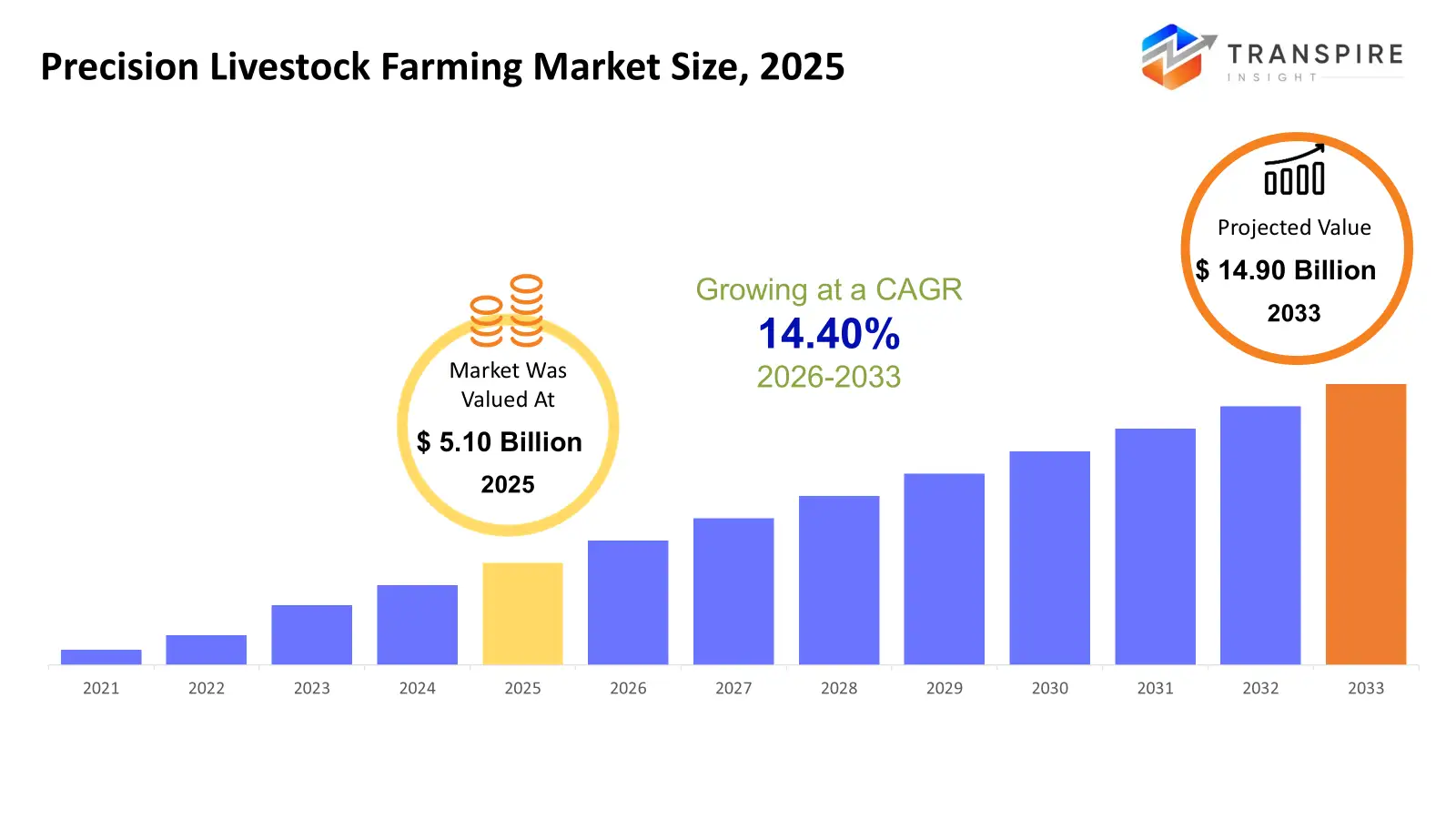
The global Precision Livestock Farming market size was valued at USD 5.10 billion in 2025 and is projected to reach USD 14.90 billion by 2033, growing at a CAGR of 14.40% from 2026 to 2033. The growing need for data-driven livestock productivity, developing labor shortages, and the expanding use of automation technology on commercial farms are the main factors driving the market's compound annual growth rate. Global adoption of technology is further accelerated by a strong emphasis on animal care, cost optimization, and real-time monitoring.
Market Size & Forecast
- 2025 Market Size: USD 5.10 Billion
- 2033 Projected Market Size: USD 14.90 Billion
- CAGR (2026-2033): 14.40%
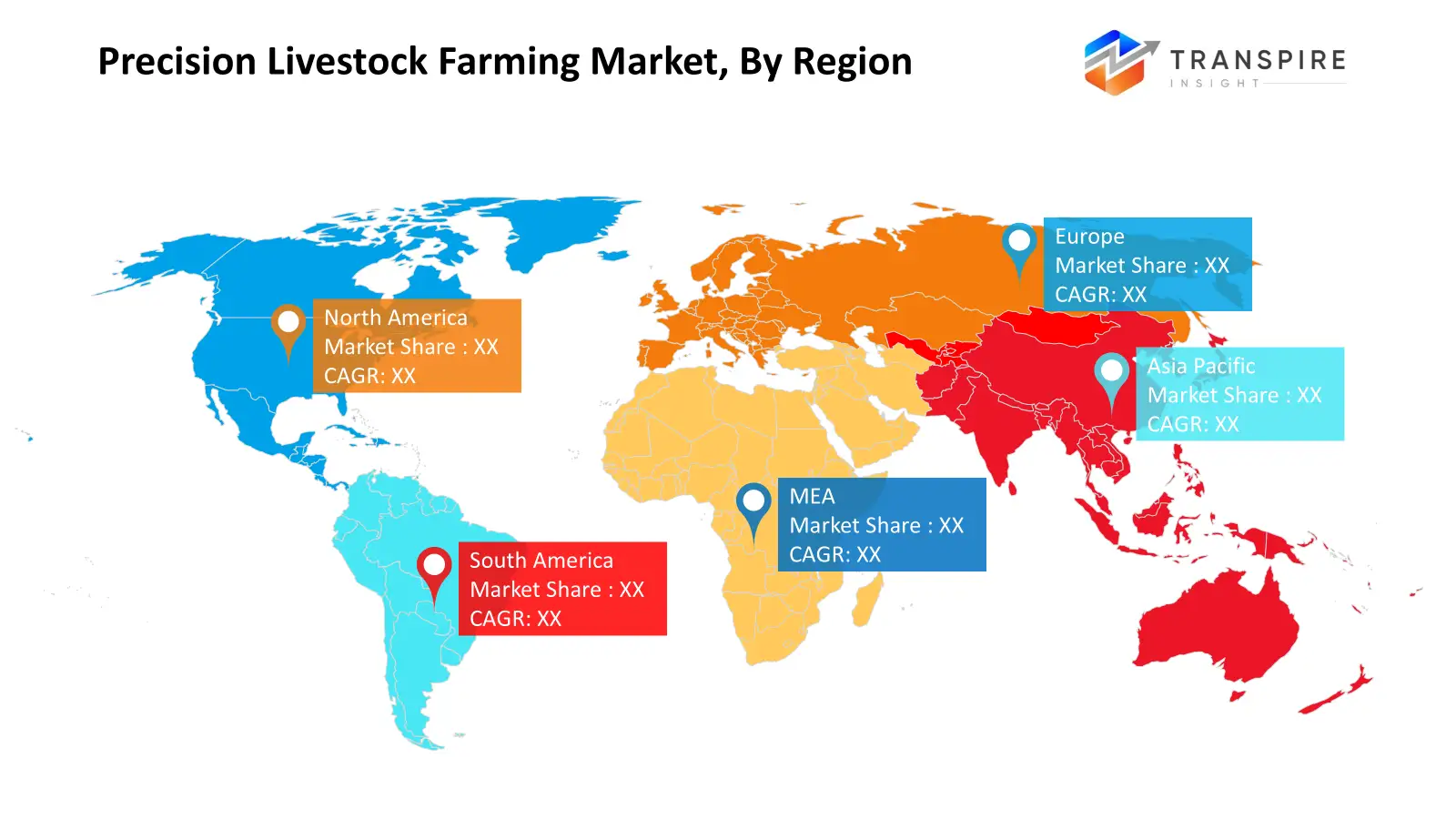
- North America: Largest Market in 2026
- Asia Pacific: Fastest Growing Market
To learn more about this report,  Download Free Sample Report
Key Market Trends Analysis
- Due to favorable digital infrastructure, compliance-driven farming practices, high farm mechanization levels, robust investment capacity, and extensive integration of automation and analytics platforms across large-scale dairy, swine, and poultry operations, North America continues to lead adoption.
- As commercial farms increasingly use software platforms, health monitoring, and milking automation to improve produce consistency, handle labor shortages, and adhere to traceability and animal welfare regulations, the United States continues to be the primary growth engine in North America.
- Rapid livestock population growth, modern farming methods, and growing government initiatives promoting smart agriculture particularly in China, India, Australia, and New Zealand, where efficiency and disease control are top priorities are all contributing to Asia Pacific's accelerated growth.
- As farms place a higher priority on real-time visibility, traceability, and disease containment, identification and tracking systems are the most widely adopted technologies. This allows for better herd management, regulatory compliance, and performance optimization across ever-larger and more complicated livestock operations.
- As early illness diagnosis, lower mortality, and better animal welfare become essential to farm profitability and sustainability, particularly in high-density livestock production contexts, animal health and behavior monitoring continues to be the top application trend.
- Because of their rigorous management needs, better return on technology investment, and heavy reliance on automated milking, feeding, and health monitoring systems to maintain constant output and quality standards, dairy cattle are the most popular animal type group.
- As integrated precision animal farming systems are being adopted in both developed and emerging agricultural economies due to manpower reliance, continuous production cycles, and quality compliance, dairy farms represent the most advanced end-use segment.
So, the precision livestock farming market refers to the use of cutting-edge technology that allow for automation, data-driven decision-making, and real-time monitoring in livestock production. In dairy, swine, poultry, and other livestock farms, these solutions combine hardware, software, and analytics to improve productivity, animal welfare, and operational efficiency. The market is intimately related to the larger digital transformation of agriculture, as traditional farming patterns are being reshaped by economic pressures, decreasing labor availability, and growing food demand. With the use of precision livestock farming systems, farmers may more accurately and with less manual involvement keep an eye on the health, feeding habits, reproductive cycles, and environmental conditions of their animals. Market expansion is also supported by the growing emphasis on sustainability, traceability, and regulatory compliance. Precision technologies are increasingly seen as necessary expenditures rather than discretionary upgrades, supporting long-term market development prospects as livestock producers work to decrease feed waste, manage disease outbreaks, and increase output predictability.
Precision Livestock Farming Market Segmentation
By Technology
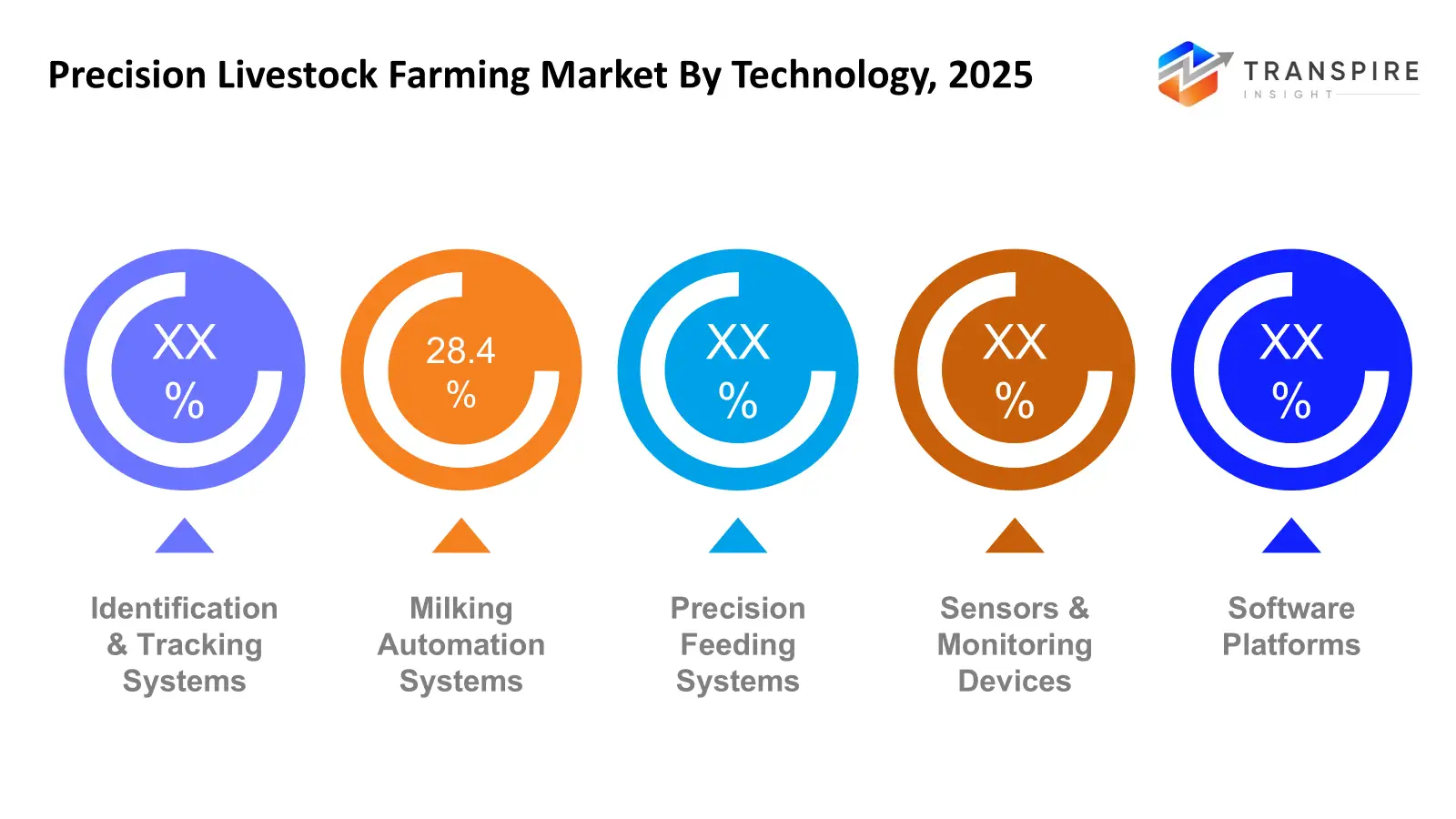
- Identification & Tracking Systems
Using RFID, GPS, and biometric technologies, this section facilitates real-time animal identification, location monitoring, and movement analysis. Regulatory compliance, herd optimization, and traceability requirements are what motivate adoption. In large-scale farms, it enhances lifecycle monitoring, productivity, and disease control.
- Milking Automation Systems
Robotic and semi-robotic milking with little human interaction is made possible by milking automation systems. The need for continuous milk quality, growing herd sizes, and manpower shortages all contribute to growth. These technologies increase operational efficiency, maximize milking frequency, and improve animal welfare.
- Precision Feeding Systems
Precision feeding systems adjust feed intake according on productivity, weight, and animal health. They cut operational expenses, increase feed conversion ratios, and lessen feed waste. Adoption in commercial farms is highly supported by the growing emphasis on sustainable livestock production.
- Sensors & Monitoring Devices
Wearable and ambient sensors that monitor temperature, activity, health, and barn conditions are included in this section. Early disease identification and productivity optimization are the main drivers of demand. Constant observation lowers mortality and veterinary expenses while also improving animal welfare.
- Software Platforms
Software platforms combine information from several hardware systems to produce insights that may be put to use. Cloud adoption, AI analytics, and decision-support requirements are what drive growth. These solutions improve long-term performance optimization, predictive management, and farm-level insight.
To learn more about this report, Download Free Sample Report
By Application
- Feeding Management
Applications for feeding management maximize feeding schedules and nutrition planning. The demand for increased yield efficiency and growing feed prices are the main drivers of adoption. By increasing animal growth rates and decreasing waste, these methods have a direct effect on profitability.
- Milking / Milk Harvesting
The automation and monitoring of milk production operations are the main objectives of this application. In dairy-intensive areas, there is a high demand for consistent quality and labor efficiency. It facilitates real-time performance tracking, hygienic compliance, and yield optimization.
- Animal Health & Behavior Monitoring
Early identification of disease, stress, and abnormal behavior is made possible by health and behavior monitoring. Welfare requirements and rising disease management costs are the main drivers of growth. These methods increase overall herd lifetime, decrease downtime, and improve recovery outcomes.
- Reproduction / Breeding Management
This section facilitates heat detection, breeding optimization, and fertility tracking. The demand for increased reproductive efficiency is driving up adoption. Reducing calving intervals and optimizing genetic and production potential are two benefits of accurate data.
- Environmental Monitoring
In livestock facilities, environmental monitoring monitors temperature, humidity, ventilation, and air quality. Climate fluctuations and animal welfare requirements are the main drivers of demand. Productivity, health, and death rates are all directly impacted by optimized settings.
- Other Support Functions
Production analytics, waste management, and weight monitoring are further uses. By improving operational control, these functions support fundamental systems. Adoption promotes adherence to sustainability guidelines and comprehensive agricultural optimization.
By Animal Type
- Dairy Cattle
Because of their high management needs, dairy cattle make up the greatest adoption base. The need for health monitoring and milking automation is driven by high milk output reliance. Investments in technology are justified by quantifiable increases in productivity and quality.
- Beef Cattle
The main goals of precision solutions for beef cattle are feed optimization and growth monitoring. Large ranch operations that strive for efficiency are seeing an increase in adoption. These technologies lessen production unpredictability and increase weight growth consistency.
- Swine
Precision feeding, health monitoring, and environmental control are all beneficial to swine farming. Adoption is promoted by density-driven operations and high disease sensitivity. Utilizing technology enhances feed efficiency and mortality management.
- Poultry
Applications for poultry place a strong emphasis on flock behavior analysis and environmental monitoring. Automation is encouraged by high production volumes and narrow profit margins. Regulatory compliance, feed efficiency, and survival rates are all enhanced by precision tools.
- Others
Sheep, goats, and new livestock categories are included in this section. Adoption is still low but is increasing as a result of specialized commercial farming. As more affordable options become available, technology penetration rises.
By End-Use
- Dairy Farms
Due to their high level of automation readiness, dairy farms dominate end-use adoption. Investment in robots and monitoring is driven by ongoing demands for milk production. The reduction of labor and increases in productivity are particularly advantageous to these farms.
- Swine Farms
PLF systems are used by swine farms to effectively manage big herds. The main motivators are feed cost optimization and disease control. Scalability and operational consistency are supported by precision systems.
- Poultry Farms
PLF is used by poultry farms to monitor behavior and regulate the climate. Demand is driven by biosecurity concerns and high stocking density. Automation improves welfare standard compliance and yield stability.
- Other Farm Types
Small-scale and mixed farms fall under this category. Cost sensitivity causes adoption to happen gradually. Scalable and modular technologies, however, are reaching a wider audience.
Regional Insights
North America stands for an established market that features high technology adoption across the United States, Canada, and Mexico. Large commercial farms in the US drive Tier 1 adoption, whereas Canada and Mexico make up Tier 2 markets with gradually rising automation and monitoring expenditures. Strong penetration is seen in Europe as a result of animal welfare laws and regulatory compliance. While the remainder of Europe exhibits moderate but growing adoption backed by environmental measures, Germany, the UK, France, Italy, and Spain function as Tier 1 markets with advanced automation. The fastest-growing regional market is Asia Pacific, which is dominated by Tier 1 nations including China, Japan, Australia, New Zealand, South Korea, and India. While the rest of Asia Pacific offers high-growth Tier 2 potential, these markets profit from livestock expansion, modernization initiatives, and government-backed smart farming projects. As Tier 1 cattle producers, Brazil and Argentina dominate South America, with adoption concentrated on export-oriented farms. Food security and climate-driven monitoring requirements encourage progressive adoption across Tier 2 countries in the Middle East and Africa, which is still a growing market dominated by Saudi Arabia, the United Arab Emirates, and South Africa.
To learn more about this report, Download Free Sample Report
Recent Development News
- September 2025, With improved Flow-ResponsiveTM milking technology for increased milking efficiency, increased cow comfort, and sophisticated sensor integration, DeLaval announced the release of the new VMSTM V300 2025 model, which elevates robotic milking performance. This press release describes cutting-edge features intended to increase dairy farm output, include sophisticated analytics, and promote sustainable management techniques for contemporary livestock operations.
- In April 2025, The Milk Sustainability Center was enlarged by DeLaval and John Deere, who also welcomed dsm-firmenich as a strategic partner and added new regional availability. In order to support the adoption of precision livestock farming with cutting-edge digital tools, this initiative offers dairy and livestock producers an integrated data environment to monitor herd performance, nutrient usage efficiency, and sustainability parameters.
(Source:https://corporate.delaval.com/2025/04/delaval-unveils-faster-smarter-bigger-milking-robot-model)
|
Report Metrics |
Details |
|
Market size value in 2025 |
USD 5.10 Billion |
|
Market size value in 2026 |
USD 5.80 Billion |
|
Revenue forecast in 2033 |
USD 14.90 Billion |
|
Growth rate |
CAGR of 14.40% from 2026 to 2033 |
|
Base year |
2025 |
|
Historical data |
2021 – 2024 |
|
Forecast period |
2026 – 2033 |
|
Report coverage |
Revenue forecast, competitive landscape, growth factors, and trends |
|
Regional scope |
North America; Europe; Asia Pacific; Latin America; Middle East & Africa |
|
Country scope |
United States; Canada; Mexico; United Kingdom; Germany; France; Italy; Spain; Denmark; Sweden; Norway; China; Japan; India; Australia; South Korea; Thailand; Brazil; Argentina; South Africa; Saudi Arabia; United Arab Emirates |
|
Key company profiled |
DeLaval, GEA Group, Allflex Livestock Intelligence, Afimilk Ltd., BouMatic, Lely International, Dairymaster, Fancom BV, Fullwood Packo, Connecterra, Cainthus, Zoetis Inc., Merck & Co., Inc., HerdDogg, CowManager |
|
Customization scope |
Free report customization (country, regional & segment scope). Avail customized purchase options to meet your exact research needs. |
|
Report Segmentation |
By Technology (Identification & Tracking Systems, Milking Automation Systems, Precision Feeding Systems, Sensors & Monitoring Devices, Software Platforms), By Animal Type (Feeding Management, Milking / Milk Harvesting, Animal Health & Behavior Monitoring, Reproduction / Breeding Management, Environmental Monitoring, Other Support Functions), By Animal Type (Dairy Cattle, Beef Cattle, Swine, Poultry, Others) and By End-Use (Dairy Farms, Swine Farms, Poultry Farms, Other Farm Types) |
Key Precision Livestock Farming Company Insights
DeLaval stands as an internationally recognized manufacturer of precision livestock farming solutions, with a strong emphasis on dairy automation, herd management, and integrated data analytics platforms. The company's wide range of products, which together improve farm productivity and animal welfare, includes robotic milking systems, precision feeding units, sensor-based health monitoring, and cloud-enabled management software. With a strong worldwide distribution and service network, DeLaval's products are extensively used by commercial dairy businesses in more than 60 countries. DeLaval is able to meet changing producer needs and keep a dominant market position in the PLF landscape by constant innovation, smart alliances, and investments in AI and IoT capabilities.
Key Precision Livestock Farming Companies:
- DeLaval
- GEA Group
- Allflex Livestock Intelligence
- Afimilk Ltd.
- BouMatic
- Lely International
- Dairymaster
- Fancom BV
- Fullwood Packo
- Connecterra
- Cainthus
- Zoetis Inc.
- Merck & Co., Inc.
- HerdDogg
- CowManager
Global Precision Livestock Farming Market Report Segmentation
By Technology
- Identification & Tracking Systems
- Milking Automation Systems
- Precision Feeding Systems
- Sensors & Monitoring Devices
- Software Platforms
By Application
- Feeding Management
- Milking / Milk Harvesting
- Animal Health & Behavior Monitoring
- Reproduction / Breeding Management
- Environmental Monitoring
- Other Support Functions
By Animal Type
- Dairy Cattle
- Beef Cattle
- Swine
- Poultry
- Others
By End-Use
- Dairy Farms
- Swine Farms
- Poultry Farms
- Other Farm Types
Regional Outlook
- North America
- United States
- Canada
- Mexico
- Europe
- Germany
- United Kingdom
- France
- Spain
- Italy
- Rest of Europe
- Asia Pacific
- Japan
- China
- Australia & New Zealand
- South Korea
- India
- Rest of Asia Pacific
- South America
- Brazil
- Argentina
- Rest of South America
- Middle East & Africa
- Saudi Arabia
- United Arab Emirates
- South Africa
- Rest of the Middle East & Africa
Frequently Asked Questions
Find quick answers to common questions.
The approximate Precision Livestock Farming Market size for the market will be USD 14.90 billion in 2033.
Key segments for the Precision Livestock Farming Market are By Technology (Identification & Tracking Systems, Milking Automation Systems, Precision Feeding Systems, Sensors & Monitoring Devices, Software Platforms), By Animal Type (Feeding Management, Milking / Milk Harvesting, Animal Health & Behavior Monitoring, Reproduction / Breeding Management, Environmental Monitoring, Other Support Functions), By Animal Type (Dairy Cattle, Beef Cattle, Swine, Poultry, Others) and By End-Use (Dairy Farms, Swine Farms, Poultry Farms, Other Farm Types).
Major Precision Livestock Farming Market players are DeLaval, GEA Group, Allflex Livestock Intelligence, Afimilk Ltd., Lely International.
The North America region is leading the Precision Livestock Farming Market.
The CAGR of the Precision Livestock Farming Market is 14.40%.
- DeLaval
- GEA Group
- Allflex Livestock Intelligence
- Afimilk Ltd.
- BouMatic
- Lely International
- Dairymaster
- Fancom BV
- Fullwood Packo
- Connecterra
- Cainthus
- Zoetis Inc.
- Merck & Co., Inc.
- HerdDogg
- CowManager
Recently Published Reports
-
Apr 2026
Baby Infant Formula Market
Baby Infant Formula Market Size, Share & Analysis Report By ype (Infant Milk, Follow On Milk, Specialty Baby Milk, Growing-Up Milk), By Ingredient (Carbohydrate, Fat, Protein, Minerals, Vitamins, and Others), By Product Form (Powder, Liquid, and Ready-to-feed), By Distribution Channels (Supermarket/Hypermarket, Specialty Store, Pharmacies, Online Retail, and Others), and Geography (North America, Europe, Asia-Pacific, Middle East and Africa, South and Central America), 2021 - 2031
-
Apr 2026
Edible Insects for Animal Feed Market
Edible Insects for Animal Feed Market Size, Share & Analysis Report By Type (Insect Powder, Insect Meal, Insect Bar, Insect Paste, Insect Oil, and Others), By Insect Type (Beetles, Cricket, Caterpillar, Hymenoptera, Orthoptera, Tree Bugs, and Others), By Application (Livestock, Pet Food, and Aquaculture), By Livestock Type (Poultry, Swine, and Others), and Geography (North America, Europe, Asia-Pacific, Middle East and Africa, South and Central America), 2021 - 2031
-
Apr 2026
Food Industry Disinfection and Bacterial Control Market
Food Industry Disinfection and Bacterial Control Market Size, Share & Analysis Report By Type (Chemical Disinfectants, Physical Disinfectants, and Biocides and Antimicrobials), By Application (Food Processing Equipment Surface Disinfection, Food Preparation Areas Surface Disinfection, Storage Areas Surface Disinfection, Anti-microbial Coatings Food Preservation, and Preservative Solutions Food Preservation), By End User (Meat and Poultry Processing, Dairy Processing, Seafood Processing, Bakery and Confectionery, Restaurants and Commercial Kitchens, and Food Service Providers), By Sales Channel (Online, Offline), and Geography (North America, Europe, Asia-Pacific, Middle East and Africa, South and Central America), 2021 - 2031
-
Apr 2026
Freeze Dried Food Market
Freeze Dried Food Market Size, Share & Analysis Report By Product Type (Fruits, Vegetables, Freeze-Dried Dairy Products, Freeze-Dried Meat and Seafood, Freeze-Dried Pet Food, and Prepared Meal), By Nature (Organic, and Conventional), By Form (Powdered, Granules, and Diced), By End Use (Breakfast Cereals, Dairy Products, Bakery & Confectionery, Nutritional Bars & Supplements, Powdered Beverages, Snacks, and Retail (Household)), and Geography (North America, Europe, Asia-Pacific, Middle East and Africa, South and Central America), 2021 - 2031