
Sep 28, 2026
By Transpire Insight
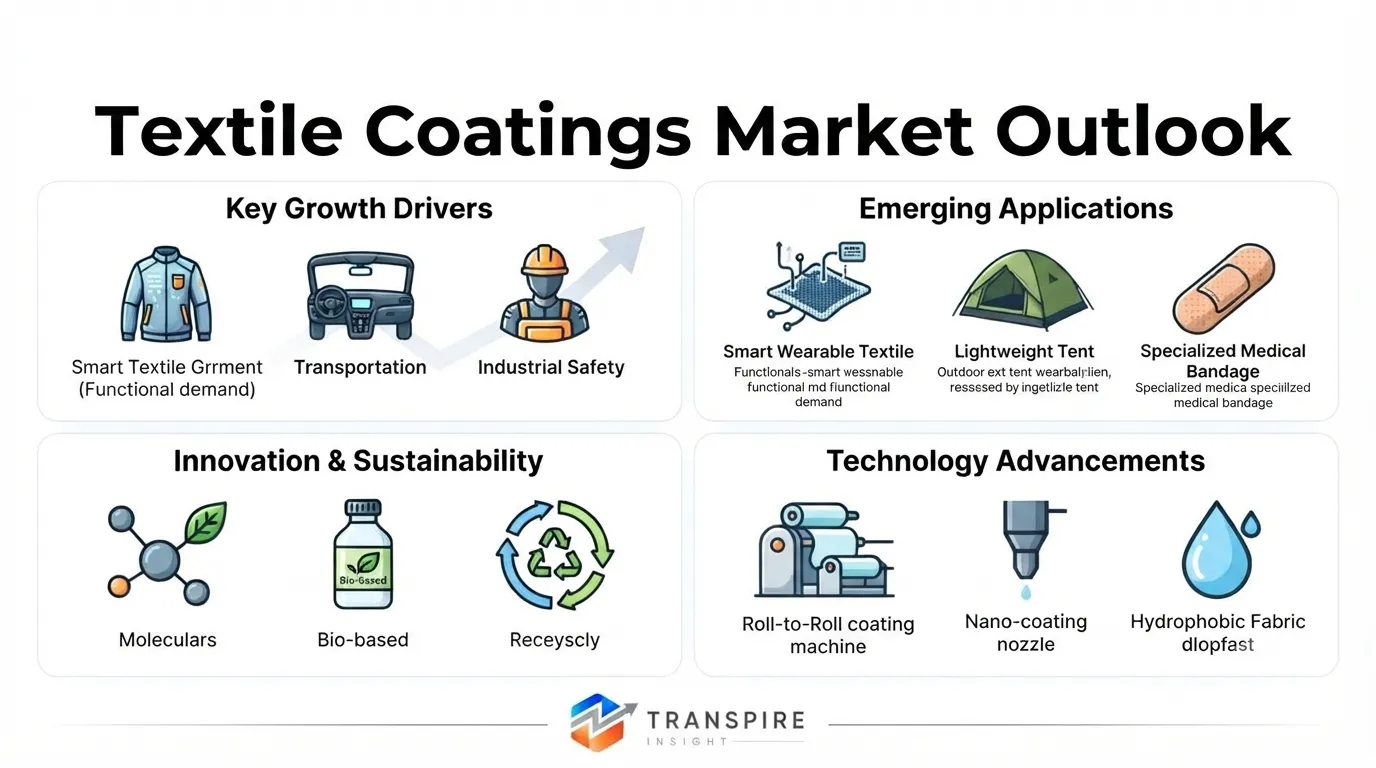
Description
According to a research report published by Transpire Insight, the textile coatings market size is projected to grow from USD 4.758 billion in 2026 to USD 6.478 billion by 2035, at a CAGR of 4.8% during the forecast period 2027-2035. Rapid expansion in automotive interiors, rising demand for protective industrial apparel, strict regulatory shifts toward eco-friendly waterborne polymers, and continuous innovations in multi-functional smart technical textiles are driving growth.
Introduction
The textile coatings market is expanding rapidly, driven by high demand across automotive, protective clothing, industrial manufacturing, and sports apparel sectors. Textile coatings apply specialized polymer layers to woven, nonwoven, or knitted substrates to deliver water resistance, flame retardancy, antimicrobial properties, and durability. As regulations tighten around solvent emissions and hazardous chemicals, the industry is accelerating its transition toward bio-based, waterborne, and recyclable polyurethane and silicone coating formulations.
Recent Development News
April 2026: Covestro unveiled next-generation partially bio-based waterborne INSQIN polyurethane textile coatings and recyclable TPU technologies for automotive and protective apparel applications at Techtextil Frankfurt.
July 2026: The Lubrizol Corporation expanded its advanced specialty chemical platform by launching high-performance Solsperse hyperdispersants optimized for water-based industrial coatings and textile digital inks.
Stay Ahead of Emerging Opportunities with Expert Market Insights by Transpire Insight
Transpire Insight provides comprehensive, data-driven market intelligence to support smarter business decisions. Our research is rooted in comprehensive analysis, authoritative predictions, and industry expertise, enabling organizations to make informed decisions in rapidly evolving markets. We provide in-depth analysis of market segmentation, competitive positioning, regional trends, and emerging investment opportunities in high-growth areas. We blend accuracy with actionable intelligence, helping companies uncover new growth avenues, strengthen strategic decision-making, and stay ahead in a dynamic market.
Textile Coatings Market Size & Statistics
The Market Size for Textile Coatings Was Estimated to be Worth USD 4.758 Billion in 2026.
The Market Size is Going to Expand at a CAGR of 4.8% between 2026 and 2035.
The Textile Coatings Market Size is anticipated to reach USD 6.478 Billion by 2035.
Asia-Pacific is projected to drive the highest demand during the forecast period, accounting for 48% of the textile coatings market.
Asia-Pacific is projected to grow the fastest during the forecast period at a CAGR of 12.34% in the textile coatings market.
Regional Growth and Demand Analysis by Transpire Insight
Asia-Pacific continues to anchor textile coatings demand, commanding just over half the world's market share on the back of large-scale manufacturing hubs across China, India, and Southeast Asia. India's textile industry, backed by government export incentives and rising domestic apparel consumption, is pulling in fresh investment from coating suppliers keen to serve both technical textile and fashion segments. Regional data credits this lead to concentrated export capacity and cost-competitive production, with thermoplastic-based systems seeing particularly strong uptake in automotive upholstery and protective workwear applications across the region.
Beyond its current lead, Asia-Pacific is also expected to register the fastest expansion among all regions, propelled by continued manufacturing capacity additions and rising demand for technical and medical textiles. Meanwhile, North America and Europe are shaping the innovation trajectory through stricter VOC and PFAS regulations, prompting suppliers such as Milliken to introduce non-PFAS flame-retardant chemistries and prompting facilities like Solvay's Alve-One unit in Rosignano to produce eco-designed blowing agents for coated textile applications. This regulatory pressure, combined with Asia-Pacific's scale advantages, is reshaping sourcing strategies as buyers balance cost efficiency against compliance-driven product innovation.
Top 15 Trends in the Textile Coatings Market
Shift toward waterborne and solvent-free coating systems
Manufacturers are replacing solvent-based formulations with waterborne and solvent-free polyurethane systems to cut VOC emissions, meet tightening regulations, and satisfy sustainability-conscious apparel and automotive buyers.
PFAS-free flame-retardant and water-repellent formulations
Brands like Milliken are launching non-PFAS flame-retardant and water-repellent chemistries as regulators phase out persistent perfluorinated compounds, pushing suppliers toward safer, compliant alternative coating technologies.
Bio-based and plant-derived polymer coatings
European suppliers are developing bio-based, plant-derived polymer chemistries aligned with Green Deal sustainability ambitions, reducing reliance on petroleum-based resins while maintaining durability, flexibility, and performance.
Smart textiles with conductive, sensing coatings
Coating developers are integrating conductive and sensor-embedded chemistries into fabrics, enabling temperature regulation, biometric monitoring, and connectivity features across fashion, healthcare, and advanced sportswear applications.
Antimicrobial and antiviral coatings for medical textiles
Hospitals and healthcare brands are prioritizing antimicrobial and antiviral coating technologies for medical textiles, driving this segment toward the fastest projected growth rate among coating categories.
Lightweight coatings for electric-vehicle interiors
Automakers are adopting lightweight, high-performance coated fabrics for electric-vehicle interiors and upholstery, balancing weight reduction, durability, and aesthetic requirements as EV production volumes continue expanding.
List of Top 25 Companies Leading the Textile Coatings Market
Conclusion
The textile coatings market is experiencing significant transformation, driven by sustainable waterborne polymers, bio-based chemistries, and high-performance technical applications. Leading chemical and textile manufacturers are accelerating investment in fluorine-free, low-emission formulations to meet strict environmental regulations. As smart textiles, automotive interiors, and protective apparel demand greater functional durability, advanced textile coating technologies will remain vital components of the industrial materials supply chain.


Send us a brief description of your challenge and we'll get back to you within 24 hours.

 [email protected]
 APAC:+91 7666513636
 Address


