
Nov 17, 2026
By Transpire Insight
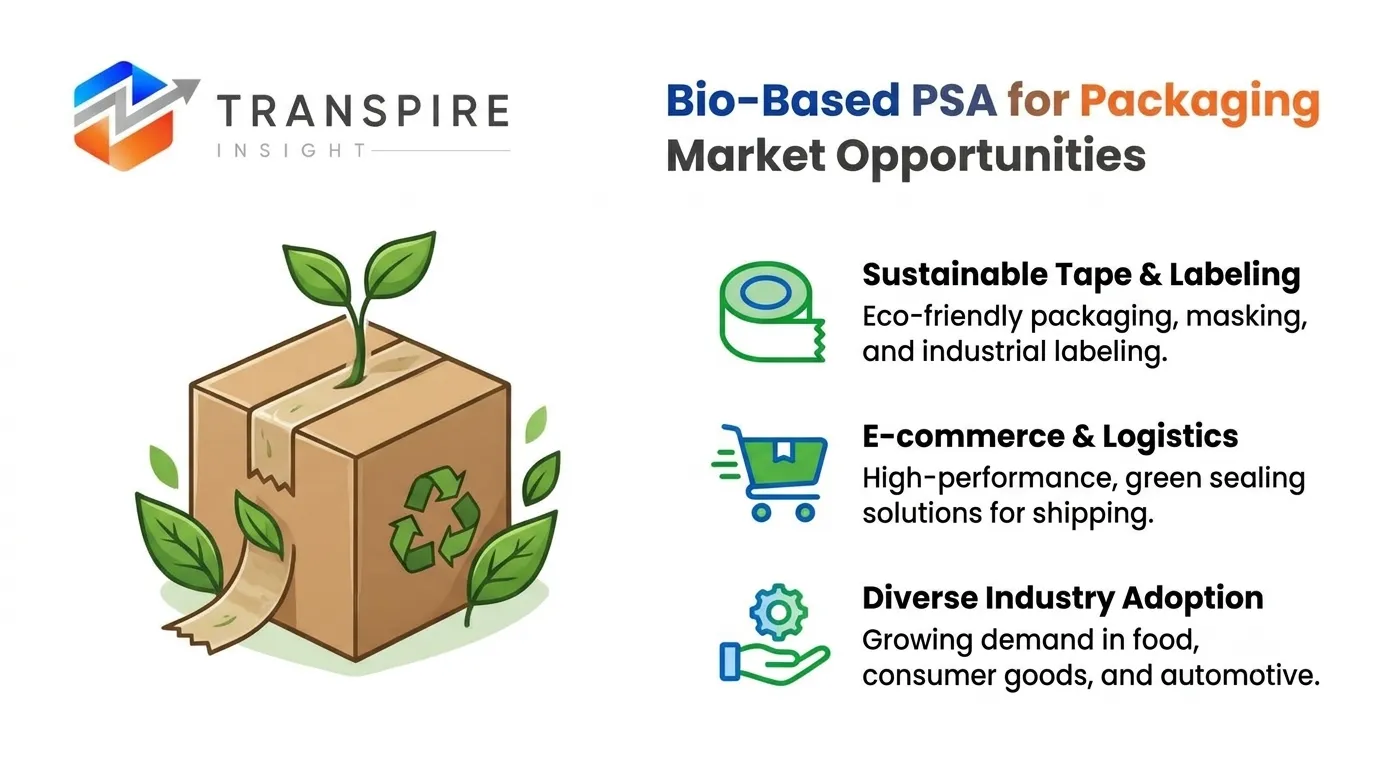
Description
According to a research report published by Transpire Insight, the global Bio-Based PSA for Packaging Market size was valued at USD 105.87 million in 2026 and is projected to grow at a CAGR of 10.19% during the 2027–2035 forecast period. Based on this growth rate, the market is expected to reach approximately USD 116.66 million in 2027 and USD 253.54 million by 2035. Increasing demand for sustainable packaging materials, growing adoption of renewable raw materials, stricter packaging waste requirements, and rising interest in recyclable and compostable labeling solutions are supporting industry expansion. Manufacturers are focusing on plant-derived polymers, bio-based acrylic adhesives, compostable pressure-sensitive adhesives, improved bonding performance, and formulations compatible with existing packaging production equipment.
Introduction
Packaging adhesives are facing a material change. Brands that have already reduced conventional plastic packaging are examining the smaller components that remain in their products, including labels, stickers, tapes, seals, and adhesive layers.
Bio-based pressure-sensitive adhesives (PSAs) address this requirement by incorporating renewable biological raw materials into adhesive formulations. Unlike conventional petroleum-derived adhesives, these products use feedstocks such as plant-based oils, biomass-derived polymers, and other renewable chemical ingredients.
The distinction matters: bio-based does not automatically mean biodegradable or compostable. A PSA manufactured using renewable raw materials can still require conventional waste treatment. Compostability, recyclability, and bio-based content must therefore be assessed separately.
Packaging applications include food and beverage labels, pharmaceutical labels, consumer product stickers, e-commerce packaging tapes, paper-based packaging, flexible packaging components, and specialty identification labels.
The competitive environment includes specialist developers such as Toyochem, ICAP-SIRA, Shenzhen JF Bio Products, and Sealock, alongside major adhesive manufacturers including Henkel, Arkema's Bostik, H.B. Fuller, and Avery Dennison. Their capabilities differ, particularly in renewable chemistry, pressure-sensitive formulations, packaging applications, and commercial manufacturing.
Recent Development News
January 2026: Toyochem, a member of the artience Group, announced the development of pressure-sensitive adhesives with significantly increased biomass content. Its Cyabine polyurethane adhesive series achieved biomass content of up to 80%, while the Oribain acrylic adhesive series reached up to 75%. The development also included removable PSA formulations containing 10% biomass content, extending renewable material applications into packaging, labels, and tapes.
March 2026: Shenzhen JF Bio Products announced that its BALK™ bio-based compostable pressure-sensitive adhesive received the Biodegradable Products Institute's Commercial and Home Certification. The certification represents an important development for compostable labels, stickers, and adhesive tape applications, where adhesive residues can interfere with end-of-life packaging treatment.
August 2026: Archroma Packaging Technologies announced Cartacol® APS75 Ultra, an ultra-high-solids water-based pressure-sensitive adhesive for paper labels. The formulation is designed to reduce the amount of water requiring evaporation during coating, supporting lower drying-energy requirements for label converters. The product is a process-efficiency development rather than a confirmed bio-based PSA launch.
October 2026: CJ Biomaterials and Dongsung Chemical introduced ECOVIVA® PHA-based hot-melt adhesive for consumer packaging applications. The formulation uses CJ Biomaterials' PHA biopolymer and is intended for cosmetics packaging, household goods, and electronics. Its ability to bond challenging substrates, including paper to aluminum, expands the use of renewable polymer chemistry in packaging adhesives. This is a hot-melt adhesive development, not evidence that every ECOVIVA application is pressure-sensitive.
November 2026: Bostik introduced Thermogrip® HM 7430 and Thermogrip® HM 6134 at LOUPE India 2026. HM 7430 is a mineral-oil-free label adhesive with 30% bio-based content, developed for food, pharmaceutical, and e-commerce labeling applications. The products also address converting requirements such as die-cutting performance and substrate wettability.
Stay Ahead of Emerging Opportunities with Expert Market Insights by Transpire Insight
Transpire Insight provides market intelligence covering industry size, competitive positioning, regional demand, product innovation, and long-term growth opportunities. Our research evaluates developments across sustainable packaging materials, renewable adhesive chemistry, labeling technologies, and industrial applications.
We provide detailed assessments of company portfolios, market segmentation, competitive developments, technology adoption, and regional opportunities. Our research supports manufacturers, investors, suppliers, packaging converters, and procurement professionals evaluating the commercial potential of bio-based adhesive technologies.
Bio-Based PSA for Packaging Market Size & Statistics
Regional Growth and Demand Analysis by Transpire Insight
Europe
Europe was the leading regional market for bio-based PSA for packaging in 2025. The region has an established packaging materials industry, a strong specialty chemicals manufacturing base, and increasing attention to packaging recyclability and renewable feedstocks.
Germany, France, Italy, the Netherlands, and the United Kingdom are important markets for adhesive development and sustainable packaging applications. Manufacturers are evaluating bio-based adhesives for paper labels, product identification, food packaging, and specialty tapes.
Companies such as Henkel, Arkema, tesa, UPM Adhesive Materials, and ICAP-SIRA contribute to the region's adhesive and labeling ecosystem. Their established technical capabilities and relationships with packaging converters support the development of alternative adhesive formulations.
The European market also presents a technical challenge. Renewable content must be balanced with adhesion, temperature resistance, removability, and compatibility with recycling processes. Packaging manufacturers increasingly require documented material composition rather than broad environmental claims.
Asia Pacific
Asia Pacific is projected to be the fastest-growing regional market. China, Japan, South Korea, and India have extensive packaging manufacturing industries, growing label consumption, and established chemical and adhesive production capabilities.
Japan has a strong position in specialty adhesive development. Toyochem's biomass-based pressure-sensitive adhesive technologies demonstrate how renewable feedstocks are being incorporated into established acrylic and polyurethane adhesive platforms.
China is also developing its position through bio-based materials research and compostable adhesive products. Shenzhen JF Bio Products' BALK™ technology represents a notable example of development in bio-based and compostable PSA applications.
In India, demand for food packaging, pharmaceutical labels, consumer goods packaging, and e-commerce shipping materials creates opportunities for sustainable adhesive suppliers. Bostik's 2026 introduction of a 30% bio-based label adhesive for Indian converters reflects the growing commercial attention to renewable adhesive formulations.
North America
North America represents an important market for sustainable packaging materials, specialty labels, and pressure-sensitive adhesive technologies. The United States has an established adhesive manufacturing industry and a large customer base across food, beverages, healthcare, consumer goods, and e-commerce.
Manufacturers are examining adhesive formulations that combine renewable content with packaging performance. Compostability certifications and compatibility with recycling systems are also becoming relevant purchasing considerations for packaging developers.
Companies such as H.B. Fuller, 3M, Avery Dennison, Henkel, and Arkema participate in the broader regional adhesive and labeling market. Specialist developers are also introducing new bio-based formulations targeting applications that have traditionally depended on petroleum-derived adhesive chemistry.
Top 15 Trends in the Bio-Based PSA for Packaging Market
Increasing Adoption of Plant-Derived Pressure-Sensitive Adhesives
Manufacturers are examining renewable raw materials as alternatives to conventional petrochemical feedstocks. Plant oils, biomass-derived chemical intermediates, and renewable polymer components are being incorporated into pressure-sensitive adhesive development.
Toyochem's biomass-based Cyabine and Oribain technologies demonstrate the technical direction. The company has reported biomass content of up to 80% in selected polyurethane PSA formulations and up to 75% in its acrylic series.
For packaging converters, the main purchasing question is straightforward: does the renewable formulation maintain the tack, peel strength, adhesion, and processing consistency required for commercial production?
Rising Demand for Sustainable Food and Beverage Labels
Food and beverage packaging uses pressure-sensitive labels for branding, ingredient information, traceability, and product identification. These applications create opportunities for bio-based adhesives, particularly where packaging producers are trying to reduce fossil-based material inputs.
Adhesive performance remains demanding. Labels must stay attached during storage, transportation, refrigeration, and handling. In selected applications, wash-off characteristics are equally important because adhesive residues can affect container recycling.
Growing Development of Compostable PSA Formulations
Compostable packaging materials require attention to every component, including adhesive layers. Conventional pressure-sensitive adhesives can remain in waste streams even when the primary packaging material is designed to decompose.
Shenzhen JF Bio Products' BALK™ technology addresses this issue through a compostable bio-based PSA formulation. Its 2026 BPI certification demonstrates the growing importance of independently assessed end-of-life performance.
However, compostability certification for an adhesive should not automatically be interpreted as certification for the complete packaging structure. The finished product must meet the relevant requirements.
Expansion of Bio-Based Adhesive Applications in E-Commerce Packaging
E-commerce operations consume large quantities of packaging labels, sealing tapes, identification stickers, and shipping materials. This creates opportunities for adhesive suppliers to introduce renewable-content products into high-volume applications.
Packaging converters require adhesives that perform consistently on automated equipment. Bonding speed, substrate compatibility, temperature resistance, and storage stability remain purchasing considerations.
Increasing Use of Biomass-Derived Acrylic Polymers
Acrylic PSAs are widely used in label and tape applications because of their adhesion characteristics and formulation flexibility. Replacing part of their conventional fossil-derived feedstock with renewable alternatives is therefore an important development area.
Toyochem's Oribain series demonstrates the use of biomass-derived components in acrylic PSA chemistry. The commercial opportunity lies in increasing renewable content without sacrificing the product characteristics expected by label manufacturers.
Development of Water-Based Bio-Based Adhesives
Water-based adhesive formulations are attracting interest as packaging manufacturers review solvent use, emissions, and production efficiency.
The next stage involves combining water-based processing with renewable polymer chemistry. Adhesive producers must maintain coating stability, drying performance, tack, and bonding strength while improving the material's environmental profile.
Increasing Interest in Removable and Wash-Off Label Adhesives
Removable and wash-off PSAs are relevant to reusable packaging, returnable containers, and recycling applications. These formulations are designed to release from selected substrates under specified conditions.
Renewable raw materials add another development dimension. Manufacturers must ensure that bio-based content does not interfere with removal behavior, label integrity, or recycling performance.
Greater Focus on Adhesive Compatibility With Packaging Recycling
A sustainable label is not necessarily a recycling-compatible label. The face material, adhesive, liner, container substrate, and recycling process all affect the final outcome.
Packaging producers are therefore examining adhesive residues, wash-off behavior, contaminant levels, and compatibility with paper and plastic recycling systems.
Suppliers that provide application-specific technical data will have an advantage when converters evaluate new materials.
Growing Development of Bio-Based Hot-Melt Adhesives
Hot-melt adhesives are used across packaging assembly, sealing, labeling, and product attachment. Renewable polymer chemistry is creating opportunities to reduce fossil-based raw material use in these applications.
The ECOVIVA® collaboration between CJ Biomaterials and Dongsung Chemical in 2026 illustrates this development. Its PHA-based adhesive is designed for consumer packaging and challenging substrate combinations.
Although hot-melt adhesives are not automatically pressure-sensitive, innovations in this category contribute to the wider sustainable packaging adhesive industry.
Rising Demand for Renewable Material Certification
Packaging manufacturers increasingly need measurable information about the renewable content of their materials. Certifications, biomass calculations, and independently assessed product claims help buyers compare suppliers.
For bio-based PSAs, this is particularly relevant because renewable content and biodegradability are separate material properties. Clear documentation makes it easier for packaging companies to select appropriate adhesive formulations.
List of Top 30 Companies Leading the Bio-Based PSA for Packaging Market
The following companies were selected based on their activity in bio-based adhesive development, pressure-sensitive adhesive technology, packaging adhesives, label materials, renewable polymer chemistry, and related commercial applications as of 2026.
The list is a competitive-industry shortlist, not a verified ranking by market revenue or bio-based PSA market share. Some companies are direct bio-based PSA developers, while others compete through broader packaging adhesive, label-stock, and sustainable materials portfolios.
Toyochem is a Japanese specialty chemicals manufacturer with adhesive technologies covering pressure-sensitive adhesives, packaging materials, and industrial applications. Its biomass-based PSA developments make it a particularly relevant participant in the bio-based adhesive segment.
Headquarters: Tokyo, Japan.
Why It Ranks: Demonstrated development of high-biomass-content acrylic and polyurethane pressure-sensitive adhesive formulations.
Product Line: Biomass-based acrylic PSAs, polyurethane PSAs, packaging adhesives, label adhesives, and industrial adhesive materials.
ICAP-SIRA is an Italian specialty polymer and adhesive manufacturer. Its ACRILEM ECO series represents its participation in renewable acrylic polymer and pressure-sensitive adhesive development.
Headquarters: Italy.
Why It Ranks: Specialist acrylic polymer capabilities and bio-renewable PSA development for labels, tapes, and industrial applications.
Product Line: Bio-based acrylic PSA polymers, adhesive polymers, specialty resins, and industrial adhesive materials.
Shenzhen JF Bio Products focuses on bio-based adhesive and sustainable materials development. Its BALK™ product family includes compostable pressure-sensitive adhesives, tapes, and stickers.
Headquarters: Shenzhen, China.
Why It Ranks: Direct participation in bio-based compostable PSA development and the 2026 BPI Commercial and Home Certification achievement for BALK™.
Product Line: BALK™ bio-based PSAs, compostable adhesive tapes, biodegradable stickers, and water-soluble pressure-sensitive adhesive products.
Sealock is a UK-based adhesive manufacturer with a portfolio of bio-based hot-melt and aqueous adhesive products. Its renewable adhesive range serves packaging, paper products, and industrial applications.
Headquarters: United Kingdom.
Why It Ranks: Established bio-based adhesive development, including high-renewable-content packaging adhesives and selected pressure-sensitive formulations.
Product Line: Bio-based hot-melt adhesives, aqueous adhesives, packaging adhesives, and specialty PSA products.
BioBond Adhesives develops plant-based adhesive technologies for industrial, consumer, packaging, label, and tape applications. Its BioMelt product family includes plant-based hot-melt and pressure-sensitive adhesive offerings.
Headquarters: United States.
Why It Ranks: Direct product development in plant-based hot-melt pressure-sensitive adhesives and sustainable packaging adhesive technologies.
Product Line: BioMelt hot-melt adhesives, plant-based PSAs, label adhesives, and specialty packaging adhesives.
Bostik is the adhesive solutions business of Arkema and supplies technologies across packaging, converting, construction, and industrial applications. Its pressure-sensitive adhesive portfolio includes hot-melt, water-based, solvent-based, and UV-curable formulations.
Headquarters: Colombes, France.
Why It Ranks: Extensive PSA expertise, packaging industry relationships, and the development of renewable-content adhesive formulations.
Product Line: Label PSAs, hot-melt adhesives, packaging adhesives, specialty bonding solutions, and bio-based adhesive formulations.
Henkel is a major global adhesive manufacturer with a substantial presence in packaging, labeling, and industrial bonding. Its Adhesive Technologies business develops solutions for consumer goods packaging, flexible packaging, and self-adhesive applications.
Headquarters: Düsseldorf, Germany.
Why It Ranks: Global adhesive manufacturing capabilities, established packaging customers, and renewable chemical initiatives relevant to sustainable PSA development.
Product Line: Pressure-sensitive adhesives, packaging laminating adhesives, hot-melt adhesives, label adhesives, and specialty bonding systems.
H.B. Fuller supplies adhesive technologies for packaging, hygiene, construction, electronics, and industrial manufacturing. Its packaging adhesive business includes products used in carton sealing, labels, and converting.
Headquarters: St. Paul, Minnesota, USA.
Why It Ranks: Established global packaging adhesive operations and investment in lower-impact adhesive technologies.
Product Line: Pressure-sensitive adhesives, hot-melt adhesives, packaging adhesives, labeling solutions, and specialty industrial adhesives.
Avery Dennison is a major supplier of pressure-sensitive materials and labeling solutions. Its product portfolio serves food, beverage, healthcare, logistics, retail, and consumer packaging markets.
Headquarters: Mentor, Ohio, USA.
Why It Ranks: Strong global presence in pressure-sensitive label materials and continuing development of sustainable labeling solutions.
Product Line: Pressure-sensitive label materials, packaging labels, specialty films, adhesive materials, and sustainable labeling solutions.
UPM Adhesive Materials supplies self-adhesive label materials through its UPM Raflatac and UPM Intercoat businesses. Its products serve food, beverage, pharmaceutical, logistics, and consumer packaging applications.
Headquarters: Helsinki, Finland.
Why It Ranks: Established international label-material manufacturing capabilities and investment in renewable and recyclable labeling materials.
Product Line: Pressure-sensitive label stock, paper labels, film labels, packaging label materials, and sustainable label solutions.
tesa is an international adhesive tape and self-adhesive product manufacturer. Its products are used in packaging, automotive, electronics, consumer goods, and industrial applications.
Headquarters: Norderstedt, Germany.
Why It Ranks: Extensive pressure-sensitive adhesive expertise, international manufacturing operations, and sustainability-oriented adhesive development.
Product Line: Packaging tapes, pressure-sensitive adhesive products, industrial tapes, specialty labels, and bonding solutions.
3M is a diversified technology and materials manufacturer with established adhesive and tape operations. Its pressure-sensitive technologies serve packaging, industrial, transportation, healthcare, and consumer applications.
Headquarters: St. Paul, Minnesota, USA.
Why It Ranks: Broad adhesive technology capabilities, extensive product development resources, and established customer relationships across industrial packaging markets.
Product Line: Pressure-sensitive tapes, packaging tapes, specialty adhesive materials, industrial bonding products, and labeling solutions.
Nitto Denko is a Japanese materials manufacturer specializing in adhesive technologies, functional films, and specialty materials. Its pressure-sensitive products serve electronics, automotive, industrial, and packaging-related applications.
Headquarters: Osaka, Japan.
Why It Ranks: Strong polymer and adhesive technology expertise and established international operations.
Product Line: Pressure-sensitive adhesive tapes, specialty adhesive films, industrial bonding materials, and functional polymer products.
Conclusion
The Bio-Based PSA for Packaging Market is moving beyond experimental renewable formulations toward commercially relevant adhesive technologies. Growth will depend on whether manufacturers can deliver measurable bio-based content without compromising adhesion, coating performance, shelf stability, and packaging compatibility.
Toyochem, ICAP-SIRA, Shenzhen JF Bio Products, Sealock, and BioBond have identifiable activities in bio-based adhesive development. Larger suppliers such as Bostik, Henkel, H.B. Fuller, Avery Dennison, and UPM Adhesive Materials bring established manufacturing, customer relationships, and pressure-sensitive materials expertise to the competitive environment.
The next commercial opportunity lies in application-specific formulations. Food labels, pharmaceutical packaging, e-commerce tapes, and recyclable paper packaging should be evaluated separately because each application has different bonding and end-of-life requirements.
For manufacturers entering this industry, the recommended next step is to benchmark renewable-content levels, certification requirements, adhesive performance, and converter compatibility before committing to large-scale production. A bio-based formulation that works on an existing packaging line has a clearer route to commercial adoption than one requiring a complete manufacturing change.


Send us a brief description of your challenge and we'll get back to you within 24 hours.

 [email protected]
 APAC:+91 7666513636
 Address


