
Jul 11, 2026
By Transpire Insight
Description
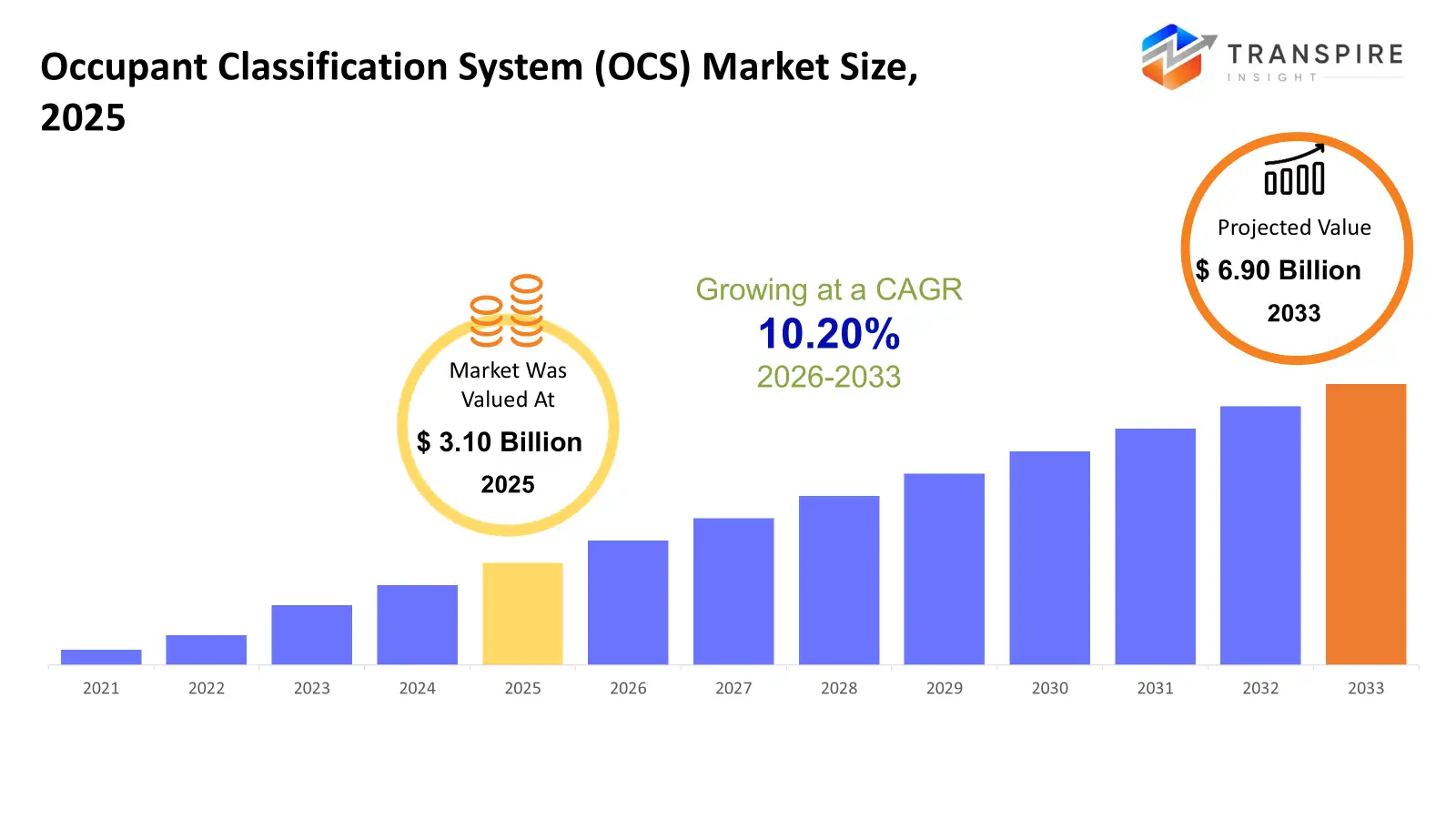
According to a research report published by Transpire Insight, the global Occupant Classification System (OCS) market size is projected to grow from USD 5.50 billion in 2026 to USD 8.90 billion by 2035, at a CAGR of 12.20% during the forecast period 2026-2035. The main drivers are strict global safety regulations (including those specified in the US FMVSS 208 and Euro NCAP standards). Further, the increasing demand from consumers for the enhanced safety features of advanced passenger vehicles, the quick adoption of electric vehicles (EVs), and the integration of AI-driven Advanced Driver-Assistance Systems (ADAS) are key drivers of market growth.
Introduction
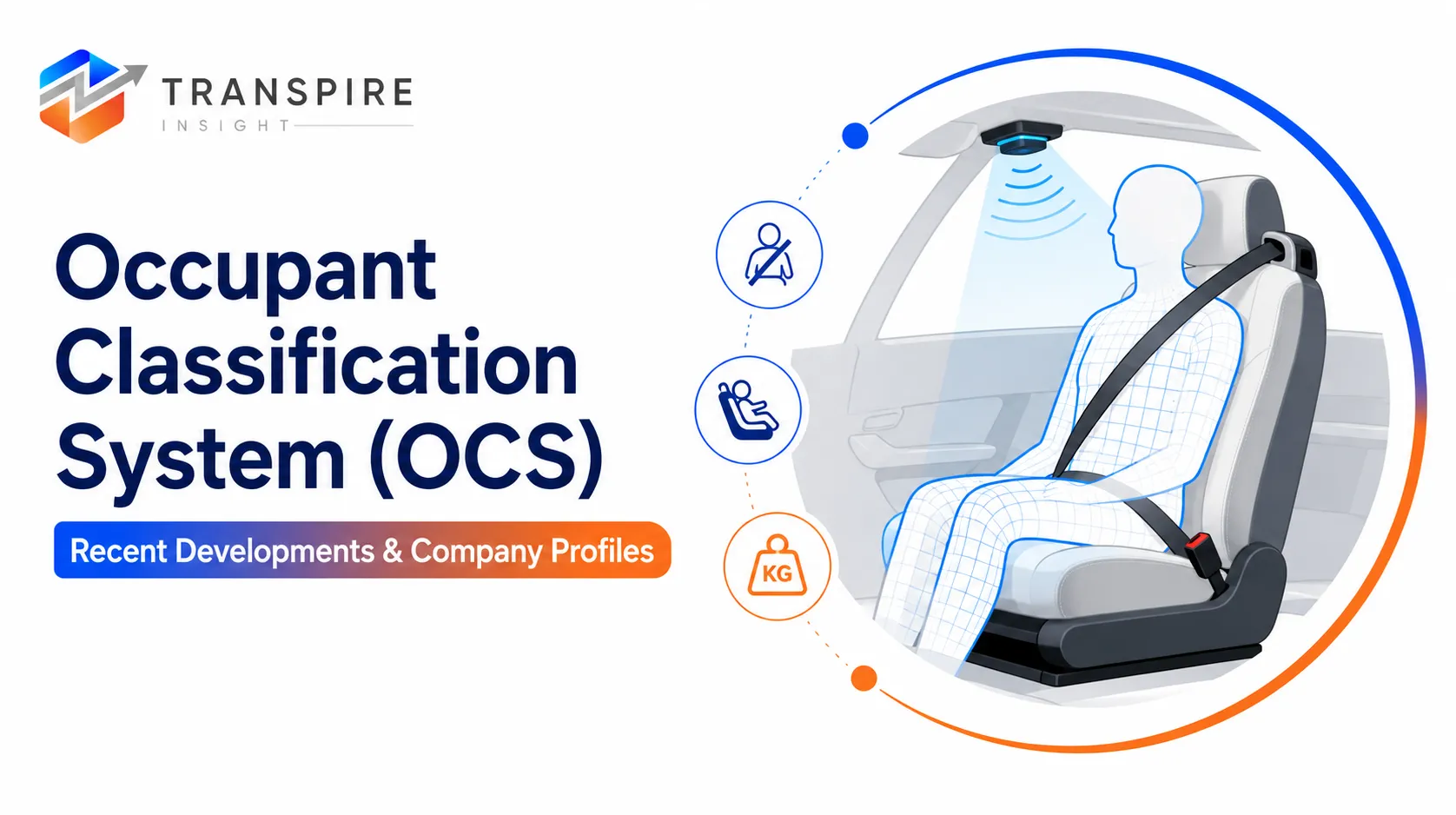
An Occupant Classification System (OCS) is an important in-cabin safety technology that identifies and classifies the weight, posture, and height of the front seat occupant. The system identifies empty seats, children, and adults and communicates directly with the Airbag Control Unit (ACU). This smart classification guarantees that airbags are activated at different strengths in the event of a crash, or not inflated at all for baby seats and empty seats, significantly reducing the risk of injuries caused by the airbag and improving passive vehicle safety.
Recent Development News
Stay Ahead of Emerging Opportunities with Expert Market Insights by Transpire Insight
Transpire Insight provides comprehensive, data-driven market intelligence to support smarter business decisions. Our research is rooted in comprehensive analysis, authoritative predictions, and industry expertise, enabling organizations to make informed decisions in rapidly evolving markets. In-depth analysis of market segmentation, competitive positioning, regional trends, and emerging investment opportunities in high-growth areas. We blend accuracy with actionable intelligence, empowering companies to uncover new avenues for growth, bolster strategic decision-making, and stay ahead in a dynamic global market.
Download the exclusive Occupant Classification System (OCS) Market sample report today to uncover expert insights, emerging trends, and the opportunities defining the future of the industry.
Occupant Classification System (OCS) Market Size & Statistics
Regional Growth and Demand Analysis by Transpire Insight
North America is expected to generate significant, sustained demand during the forecast period in the Occupant Classification System (OCS) market. The dominant position of North America is due to strict automotive safety mandates, particularly the early implementation of Federal Motor Vehicle Safety Standards (FMVSS 208) in the United States, which require smart airbag systems. The United States is currently a major innovation hub in the OCS market, considering factors such as high consumer demand for premium sports utility vehicles (SUVs) and rapid technological integration with Advanced Driver-Assistance Systems (ADAS). Automotive engineering teams have undertaken advanced design activities aimed at manufacturing smart sensing architectures that minimize airbag-induced deployment injuries for child occupants.
Asia-Pacific is anticipated to grow the fastest during the forecast period in the Occupant Classification System (OCS) market. The region will witness the highest compound growth rate due to increasing vehicle production, surging middle-class disposable income, and expanding regulatory frameworks for passenger safety. China, India, Japan, and South Korea are the rapidly expanding nations regarding automotive manufacturing activities that drive the massive volume demand for built-in safety electronics. There is a prominent increase in fleet modernization and localized standard compliance programs by vehicle manufacturers across China and India. This is being done with the aim of ensuring affordable, scalable, and highly accurate pressure- and radar-based occupant detection systems in economy and mid-size passenger cars.
Top 15 Trends in theOccupant Classification System (OCS) Market
Proceed to Checkout to purchase the exclusive Occupant Classification System (OCS) Market report and gain instant access to in-depth market intelligence, strategic analysis, and future growth opportunities.
Top 25 Companies Leading theOccupant Classification System (OCS) Market
Customize the exclusive Occupant Classification System (OCS) Market report today to receive tailored insights, country-specific analysis, and business-focused market intelligence.
Top 25 Companies Leading the Occupant Classification System (OCS) Market
1. Robert Bosch GmbH
German engineering powerhouse is heavily scaling smart passive vehicle safety sensor production globally.
Founded: 1886 | HQ: Gerlingen, Germany.
Why It Ranks: Industry pioneer delivering top-tier sensor reliability and deep automotive software integration.
Regional Dominance: Europe and North America through vast luxury OEM supplier contracts.
Product Line: MEMS pressure sensors, intelligent airbag control units, and passenger classification systems.
2. Denso Corporation
A leading Japanese tier-one automotive supplier is expanding connected mobility in-cabin sensing networks.
Founded: 1949 | HQ: Kariya, Aichi, Japan.
Why It Ranks: Key Toyota group supplier leveraging massive manufacturing scale and precision electronics.
Regional Dominance: The Asia-Pacific region holds dominant shares across major Japanese vehicle lines.
Product Line: Advanced occupant sensing units, seat weight sensors, and radar-based interiors.
3. ZF Friedrichshafen AG
Global mobility technology leader redefining safety via integrated active and passive solutions.
Founded: 1915 | HQ: Friedrichshafen, Germany.
Why It Ranks: Market stronghold established by acquiring TRW Automotive's safety product portfolios.
Regional Dominance: Strong dual presence across both European and North American commercial markets.
Product Line: Seat belt tension sensors, smart restraint modules, and multi-zone OCS systems.
4. Continental AG
Major international tier-one developer accelerating software-defined vehicle safety and cabin telemetry.
Founded: 1871 | HQ: Hanover, Germany.
Why It Ranks: Renowned for high-fidelity electronic safety architectures and radar-based occupancy detection.
Regional Dominance: Highly influential across European luxury brands and domestic Chinese manufacturing plants.
Product Line: Digital pressure mapping matrices, capacitive sensing mats, and occupant tracking modules.
5. IEE Smart Sensing Solutions
Specialized innovative sensing manufacturer focused purely on advanced in-cabin safety technologies.
Founded: 1989 | HQ: Contern, Luxembourg.
Why It Ranks: Niche expertise in sophisticated seat matrix sensors and complex human-machine interfaces.
Regional Dominance: Global reach with massive premium brand penetration in Europe and America.
Product Line: Fail-safe passenger classification mats, capacitive hands-on detection, and out-of-position systems.
6. Aptiv PLC
Global tech enterprise designing green, connected brain-and-spine architectures for modern electric vehicles.
Founded: 1994 | HQ: Dublin, Ireland.
Why It Ranks: Leader in sensor fusion and AI-enabled software processing for cabin interiors.
Regional Dominance: Expanding footprint across North American and major Chinese electric vehicle ecosystems.
Product Line: Multi-sensor fusion modules, interior occupant detection cameras, and smart electronic nodes.
7. AISIN Corporation
Massive Japanese manufacturing group optimizing vehicle comfort and body safety components.
Founded: 1965 | HQ: Kariya, Aichi, Japan.
Why It Ranks: Exceptional mechanical integration capabilities blending OCS structures directly into seat assemblies.
Regional Dominance: Commands an extensive market share throughout Eastern Asian passenger vehicle lines.
Product Line: Weight-sensing seat track structures, electronic control ECUs, and smart seating.
8. TE Connectivity Ltd.
Global industrial connector giant provisioning highly ruggedized electrical hardware for transportation.
Founded: 2007 | HQ: Schaffhausen, Switzerland.
Why It Ranks: Unmatched connectivity components ensure zero-latency data transmission for safety-critical hardware.
Regional Dominance: Broad worldwide distribution network with heavy industrial supply across North America.
Product Line: Highly accurate custom force sensors, wiring harnesses, and component couplers.
9. NIDEC Corporation
Electric motor specialist rapidly diversifying into automotive electronic sensor control components.
Founded: 1973 | HQ: Kyoto, Japan.
Why It Ranks: Aggressive automotive acquisition strategies are driving tech expansion inside automated vehicle lines.
Regional Dominance: Rapidly expanding manufacturing and assembly footprints throughout competitive Asian automotive hubs.
Product Line: Precision sensory motor modules, electronic sensor units, and tactile response equipment.
10. CTS Corporation
Custom designer of sensors and actuators serving aerospace, defense, and automotive.
Founded: 1896 | HQ: Lisle, Illinois, USA.
Why It Ranks: Decades of expertise in engineering stable, high-reliability position and load cell sensors.
Regional Dominance: Rooted in North America with extensive production operations spanning global markets.
Product Line: Under-seat weight-sensing load cells, passenger detection components, and seat-track position sensors.
Schedule a meeting with our market experts to discuss the exclusive Occupant Classification System (OCS) Market report and identify the best research solution for your organization.
Conclusion
The global Occupant Classification System (OCS) market is rapidly evolving in response to the changing regional vehicle safety laws and advanced cabin electronics. North America has a high demand with strict regulatory safety measures, while Asia-Pacific continues to grab unparalleled growth momentum with rising automobile production in China and India. The market is making the transition to sensor fusion and artificial intelligence, with strong brands such as Bosch and Denso driving the market toward unparalleled protection and smart airbag optimization of all vehicle occupants worldwide.


Send us a brief description of your challenge and we'll get back to you within 24 hours.

 [email protected]
 APAC:+91 7666513636
 Address


