
Aug 08, 2026
By Transpire Insight
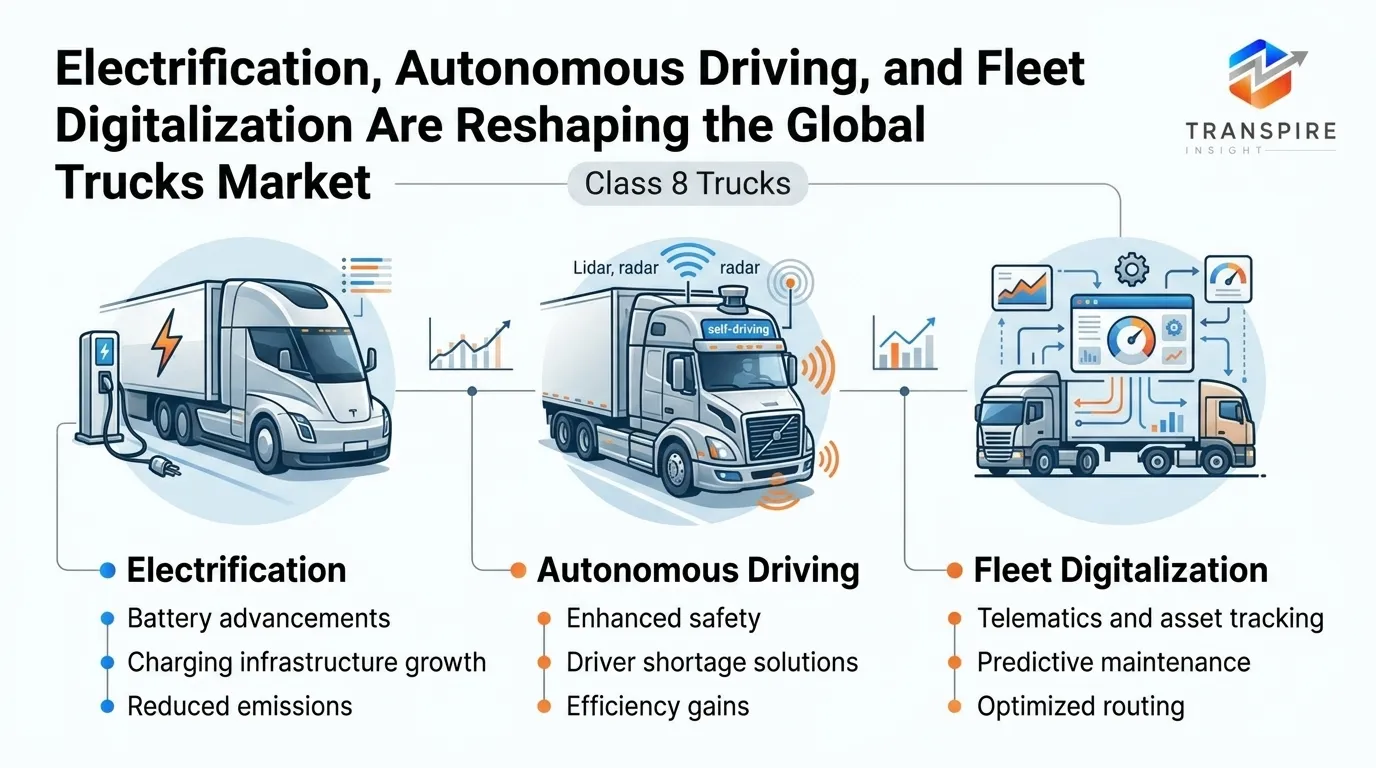
The global Class 8 trucks industry is entering one of the most transformative periods in its history as manufacturers, logistics providers, and fleet operators accelerate investments in zero-emission technologies, autonomous driving, digital fleet management, and connected transportation ecosystems. During 2025–2026, the market has witnessed strong momentum in truck orders, expanding production pipelines, and significant investments in battery-electric and hydrogen-powered heavy-duty trucks. Leading manufacturers such as Daimler Truck, Volvo Group, PACCAR, TRATON Group, Hyundai Motor, Tata Motors, Ashok Leyland, and FAW Jiefang are increasingly shifting their product strategies toward sustainable freight solutions while simultaneously integrating artificial intelligence, predictive maintenance, and software-defined vehicle platforms into next-generation Class 8 trucks. Recent industry developments also show fleets accelerating purchases to secure production slots ahead of regulatory changes and emissions requirements, highlighting continued confidence in the long-term heavy-duty trucking market.
According to Transpire Insights, the Global Class 8 Trucks Market was valued at approximately USD 302.7 billion in 2026 and is projected to reach nearly USD 476.2 billion by 2034, expanding at a CAGR of approximately 5.16% during the forecast period. Asia-Pacific remains the dominant regional market, supported by extensive freight transportation networks, rapid industrialization, expanding infrastructure projects, and growing commercial vehicle production.
Class 8 trucks, defined as commercial vehicles with a Gross Vehicle Weight Rating (GVWR) exceeding 33,000 pounds (approximately 14,968 kilograms), form the backbone of global freight transportation. These heavy-duty vehicles move raw materials, industrial machinery, agricultural products, construction equipment, petroleum products, consumer goods, and containerized cargo across national and international logistics networks. As globalization, e-commerce, and industrial manufacturing continue expanding, the importance of efficient long-haul freight transportation has become even more pronounced. Today, millions of Class 8 trucks operate across highways worldwide, supporting industries that collectively contribute trillions of dollars to the global economy.
Electrification has emerged as one of the defining trends influencing the Class 8 truck market. Governments across North America, Europe, China, and several Asia-Pacific economies continue implementing stricter emission standards while offering financial incentives for zero-emission commercial vehicles. Manufacturers have responded by significantly expanding battery-electric truck portfolios capable of serving regional haulage, port logistics, and urban freight operations. Daimler Truck reported that its battery-electric truck and bus sales increased by 66% in 2025, demonstrating accelerating market acceptance of electric heavy-duty vehicles. At the same time, Volvo Trucks has announced major investments in next-generation electric drivelines and renewable-fuel powertrains to support its long-term decarburization strategy.
Hydrogen fuel-cell technology is also gaining commercial traction, particularly for long-distance freight transportation where extended driving range and shorter refueling times are essential. In early 2026, Hyundai announced that its XCIENT Fuel Cell Class 8 fleet had collectively surpassed 22 million kilometers of operation across Europe, demonstrating the growing commercial viability of hydrogen-powered heavy-duty logistics. This milestone reflects increasing confidence among fleet operators seeking low-emission alternatives for demanding long-haul applications.
Another major transformation involves the rapid digitalization of commercial trucking. Modern Class 8 trucks increasingly function as connected intelligent platforms equipped with advanced telematics, over-the-air software updates, predictive maintenance systems, artificial intelligence-based route optimization, driver assistance technologies, and real-time fleet analytics. Fleet operators are utilizing these capabilities to improve vehicle utilization, reduce maintenance costs, optimize fuel consumption, and enhance driver safety. Industry studies estimate that predictive maintenance technologies can reduce unplanned vehicle downtime by 21–32%, while advanced route optimization systems can improve fleet fuel efficiency by 6–16%, creating substantial operational savings across large transportation fleets.
Download the exclusive Class 8 Trucks Market sample report today to uncover expert insights, emerging trends, and the opportunities defining the future of the industry.
Autonomous driving is expected to become another major growth driver throughout the coming decade. Although fully autonomous freight transportation remains in the early stages of commercialization, leading manufacturers continue investing heavily in Level 4 autonomous trucking systems capable of operating within designated freight corridors. Daimler Truck has indicated plans for limited autonomous truck deployments in the United States, with broader commercialization expected in the coming years as regulatory frameworks mature and autonomous technologies advance. Simultaneously, military logistics and defense transportation programs are accelerating innovation in remote driving, truck platooning, and autonomous convoy operations, technologies that are increasingly influencing commercial freight transportation.
Rising Freight Demand, Infrastructure Investments, and Fleet Modernization Continue to Strengthen the Global Class 8 Trucks Market
The Class 8 trucks market has become one of the most strategically important segments of the global commercial vehicle industry because it directly supports manufacturing, construction, mining, agriculture, energy, retail distribution, and international trade. While consumer vehicle markets are largely influenced by household purchasing behavior, demand for Class 8 trucks is closely linked to industrial production, freight volumes, infrastructure development, logistics efficiency, and business investment. As economies continue recovering from supply chain disruptions and governments increase investments in transportation infrastructure, fleet operators are renewing aging truck fleets while expanding capacity to meet growing freight demand.
According to Transpire Insights, one of the most influential factors driving the Class 8 trucks market is the continuous expansion of the global logistics industry. Worldwide freight transportation has experienced significant structural changes over the past decade as e-commerce, cross-border trade, cold-chain logistics, and industrial manufacturing continue expanding. Industry estimates indicate that the global logistics sector now exceeds USD 9.9 trillion in annual economic activity, while road transportation accounts for nearly 61–65% of total inland freight movement worldwide. Every increase in freight demand ultimately translates into higher utilization of heavy-duty trucks, encouraging fleet replacement and investment in modern Class 8 vehicles capable of improving operational efficiency.
The rapid growth of e-commerce has further transformed freight transportation requirements. Online retail continues generating millions of additional freight movements every day, increasing demand for regional distribution centers, intercity transportation, and long-haul trucking operations. Global e-commerce sales are projected to exceed USD 8.3 trillion before the end of the decade, creating sustained demand for heavy-duty transportation capable of supporting faster and more reliable delivery networks. Large logistics providers are increasingly investing in digitally connected truck fleets that improve shipment visibility, optimize routing decisions, and reduce delivery times across expanding distribution networks.
Another major growth driver is the modernization of transportation infrastructure. Governments worldwide continue allocating substantial budgets toward highways, industrial corridors, logistics parks, smart ports, and cross-border transportation projects. According to international infrastructure estimates, annual global infrastructure investment exceeds USD 3 trillion, with transportation remaining one of the largest investment categories. New expressways, dedicated freight corridors, inland ports, and multimodal logistics hubs enable Class 8 trucks to operate more efficiently while reducing travel time, vehicle wear, and fuel consumption. Emerging economies across Asia-Pacific, the Middle East, and Latin America are particularly increasing investments in highway expansion to support industrialization and international trade.
The construction and mining industries continue generating strong demand for heavy-duty trucks. Large infrastructure projects require continuous transportation of cement, steel, aggregates, heavy machinery, and construction materials over long distances. Similarly,mining operations depend on Class 8 trucks to transport minerals, fuel, and industrial equipment between extraction sites and processing facilities. As governments expand renewable energy projects, manufacturing facilities, airports, railways, and urban development initiatives, freight demand associated with these sectors is expected to remain resilient throughout the forecast period.
Market Analysis
Asia-Pacific continues to dominate the global Class 8 trucks market, accounting for approximately 42–46% of total industry demand. China remains the world's largest commercial vehicle manufacturing hub, supported by its extensive industrial base, infrastructure development, and rapidly expanding logistics sector. India is also witnessing sustained demand as government investments in highways, industrial corridors, and freight connectivity continue improving long-distance transportation efficiency. Japan and South Korea contribute through advanced truck manufacturing, technology innovation, and exports of heavy-duty commercial vehicles to international markets.
North America represents the second-largest regional market, benefiting from one of the world's most developed freight transportation networks. Industry estimates indicate that trucks move more than 72% of all domestic freight by weight in the United States, while the country operates over 4 million Class 8 trucks across commercial transportation fleets. The region is also leading the commercialization of battery-electric heavy-duty trucks, hydrogen fuel-cell technologies, autonomous trucking systems, and advanced fleet management software. Fleet replacement cycles remain relatively short compared to many global markets, sustaining steady demand for technologically advanced Class 8 vehicles.
Europe continues strengthening its position through stringent emissions regulations, rapid electrification, and increasing adoption of renewable fuels. Countries including Germany, France, Sweden, the Netherlands, and the United Kingdom are investing heavily in charging infrastructure, hydrogen corridors, and intelligent transportation systems supporting low-emission freight mobility. European manufacturers such as Daimler Truck, Volvo Group, Scania, and MAN are introducing increasingly efficient battery-electric and hydrogen-powered Class 8 trucks designed to meet ambitious carbon reduction targets established by the European Union.
From a propulsion perspective, diesel-powered Class 8 trucks continue holding the largest market share because of their proven reliability, extensive refueling infrastructure, high payload capability, and suitability for long-haul transportation. Despite the growing adoption of alternative fuels, diesel remains the preferred solution for many fleet operators requiring maximum operational flexibility across long-distance freight routes.
However, battery-electric Class 8 trucks are projected to register the fastest growth during the forecast period. Advances in battery technology, improvements in charging infrastructure, declining battery costs, and supportive government incentives are encouraging logistics companies to deploy electric trucks for regional distribution, port operations, and urban freight transportation. Industry forecasts suggest that global sales of heavy-duty electric trucks could grow at a double-digit annual rate throughout the coming decade as manufacturers continue improving driving range and payload performance.
Hydrogen fuel-cell trucks are also gaining momentum, particularly in applications requiring longer driving distances and rapid refueling. Several pilot projects across Europe, North America, and Asia are demonstrating hydrogen's potential to complement battery-electric vehicles in demanding long-haul freight operations where charging downtime remains a significant operational consideration.
Proceed to Checkout to purchase the exclusive Class 8 Trucks Market report and gain instant access to in-depth market intelligence, strategic analysis, and future growth opportunities.
Competitive Landscape
Competition within the Class 8 Trucks market has shifted beyond horsepower, payload capacity, and fuel economy. Manufacturers now compete across digital technologies, electrification, autonomous driving, software integration, sustainability, lifecycle services, and fleet connectivity. Heavy-duty trucks are increasingly becoming intelligent mobility platforms capable of generating real-time operational data that improves fleet productivity while reducing operating costs.
Strategic partnerships are becoming increasingly important. Truck manufacturers are collaborating with battery manufacturers, hydrogen technology companies, charging infrastructure providers, autonomous driving software developers, semiconductor companies, and logistics operators to accelerate commercialization of next-generation heavy-duty transportation solutions. These collaborations are reducing development costs while improving vehicle performance, energy efficiency, and digital integration.
Financial Impact
Global investment in freight transportation continues to create substantial opportunities throughout the Class 8 truck value chain. Beyond vehicle manufacturers, sustained market growth benefits engine suppliers, transmission manufacturers, battery producers, hydrogen infrastructure developers, tire manufacturers, fleet management software providers, component suppliers, maintenance service providers, leasing companies, and logistics technology firms.
Industry estimates indicate that connected fleet management systems can reduce fuel consumption by 7–15%, lower maintenance expenses by 15–25%, and improve vehicle utilization by nearly 11% through predictive maintenance, AI-assisted route optimization, and real-time operational monitoring. These measurable cost savings are encouraging fleet operators to accelerate adoption of digitally connected Class 8 trucks despite higher initial acquisition costs.
Electrification, Artificial Intelligence, and Autonomous Freight Are Transforming the Future of the Class 8 Trucks Market
The Class 8 Trucks market is undergoing the most significant technological transformation since the commercialization of diesel-powered heavy-duty vehicles. For decades, the industry primarily competed on engine performance, payload capacity, durability, and fuel economy. Fleet operators evaluated trucks largely based on purchase price, maintenance costs, engine reliability, and resale value. While these factors remain important, the competitive landscape is now shifting toward intelligent mobility, software-defined vehicles, alternative powertrains, autonomous driving, predictive maintenance, and connected fleet ecosystems. Heavy-duty trucks are evolving into data-driven transportation platforms capable of continuously optimizing operational efficiency throughout their service life.
One of the most influential developments is the increasing integration of artificial intelligence into fleet operations. Modern Class 8 trucks generate enormous volumes of operational data through hundreds of onboard sensors monitoring engine performance, tire pressure, braking systems, fuel consumption, transmission health, driver behavior, and cargo conditions. Industry studies estimate that a connected heavy-duty truck can generate more than 25 GB of operational data every day, enabling fleet operators to make real-time decisions regarding maintenance scheduling, route optimization, fuel efficiency, and driver safety.
Artificial intelligence is transforming this data into measurable business value. AI-powered fleet management systems continuously analyze vehicle health, weather conditions, road congestion, delivery schedules, and fuel prices to recommend optimal operational strategies. According to logistics technology assessments, predictive maintenance supported by artificial intelligence can reduce unexpected vehicle breakdowns by 24–37%, lower maintenance costs by approximately 22%, and improve fleet availability by nearly 16%. These improvements are particularly valuable for long-haul freight operators where every hour of vehicle downtime directly affects delivery schedules and operating profitability.
Several pilot programs across North America have already demonstrated autonomous heavy-duty trucks transporting commercial freight over hundreds of kilometers under supervised operational conditions. These systems integrate radar, LiDAR, cameras, artificial intelligence, GPS, and high-performance computing to continuously monitor surrounding traffic while making real-time driving decisions. Industry analysts estimate that autonomous trucking could reduce long-haul operating costs by 20–30% through lower fuel consumption, optimized driving behavior, and increased vehicle utilization. Although widespread deployment remains dependent on regulatory approval and infrastructure readiness, autonomous freight transportation is expected to become one of the industry's most disruptive innovations during the next decade.
Why Global Manufacturers Are Investing Aggressively in Next-Generation Commercial Vehicles
Competition within the Class 8 Trucks market is no longer determined solely by engine technology or manufacturing scale. Manufacturers are increasingly competing through electrification, software capabilities, digital services, sustainability, and integrated transportation ecosystems. As governments introduce stricter emissions regulations and fleet operators prioritize total cost of ownership, truck manufacturers are significantly expanding investments in research, product development, and strategic partnerships.
Leading companies including Daimler Truck Holding AG, Volvo Group, PACCAR Inc., TRATON Group, Hyundai Motor Company, Tata Motors, Ashok Leyland, FAW Jiefang, Dongfeng Motor, and Isuzu Motors collectively invest well above USD 16 billion annually in research and development across commercial vehicles, electrification, hydrogen propulsion, digital mobility, autonomous systems, and connected transportation technologies. These investments are enabling manufacturers to introduce increasingly sophisticated heavy-duty trucks capable of meeting evolving customer expectations while complying with future environmental regulations.
Battery-electric trucks have become one of the industry's highest investment priorities. Improvements in lithium-ion battery technology have significantly increased driving range while reducing battery costs compared with previous generations. Several newly introduced electric Class 8 trucks now offer operational ranges exceeding 500 kilometers on a single charge, making them increasingly suitable for regional freight distribution, port logistics, municipal transportation, and dedicated commercial routes. Simultaneously, rapid expansion of commercial charging infrastructure is improving operational feasibility for fleet operators transitioning toward electric transportation.
Hydrogen fuel-cell technology continues attracting substantial investment as an alternative solution for long-haul freight. Unlike battery-electric trucks that require extended charging periods, hydrogen-powered vehicles can generally be refueled within 10–20 minutes, making them attractive for logistics operations where minimizing downtime is essential. Governments across Europe, Japan, South Korea, China, and North America continue funding hydrogen production, transportation, and refueling infrastructure, creating favorable conditions for commercial adoption of fuel-cell Class 8 trucks over the coming decade.
Strategic Partnerships Are Accelerating the Future of Heavy-Duty Transportation
Collaboration has become one of the defining characteristics of today's commercial vehicle industry. Developing next-generation Class 8 trucks requires expertise spanning batteries, hydrogen systems, semiconductors, artificial intelligence, autonomous driving, cloud computing, cybersecurity, charging infrastructure, and fleet management software. Consequently, manufacturers increasingly rely on strategic partnerships rather than developing every technology independently.
Battery manufacturers remain among the industry's most important partners. Global demand for heavy-duty electric vehicles has encouraged truck manufacturers to establish long-term agreements with leading battery suppliers to ensure stable access to high-capacity lithium-ion cells while accelerating development of next-generation battery technologies offering greater energy density, faster charging, and longer service life.
Hydrogen collaborations are expanding equally rapidly. Truck manufacturers are partnering with energy companies, industrial gas suppliers, infrastructure developers, and government agencies to establish hydrogen production facilities and refueling networks supporting commercial freight transportation. These partnerships are expected to reduce infrastructure barriers that currently limit broader adoption of hydrogen-powered Class 8 trucks.
Technology companies are playing an increasingly influential role in commercial vehicle development. Semiconductor manufacturers, artificial intelligence specialists, cloud service providers, and autonomous driving software developers continue collaborating with truck manufacturers to develop intelligent transportation platforms capable of supporting highly automated logistics operations. Modern heavy-duty trucks increasingly incorporate more than 100 electronic control units (ECUs) managing everything from powertrain performance to advanced driver assistance systems and cybersecurity.
Commercial Vehicle Manufacturers Continue Expanding Global Production Capacity
Growing global freight demand has encouraged major manufacturers to expand production capacity while modernizing manufacturing operations through automation, robotics, artificial intelligence, and digital quality control systems. Heavy-duty truck production increasingly utilizes Industry 4.0 technologies capable of improving manufacturing precision while reducing production costs and lead times.
Industry estimates indicate that global commercial vehicle production exceeds 4 million heavy-duty trucks annually, with Asia-Pacific accounting for the largest share of worldwide manufacturing output. China remains the dominant production hub, while Europe and North America continue specializing in technologically advanced premium Class 8 vehicles designed for international freight transportation.
Manufacturers are also investing heavily in sustainable manufacturing practices. Modern truck assembly facilities increasingly utilize renewable electricity, automated energy management systems, water recycling technologies, and low-carbon production processes to reduce environmental impact. These sustainability initiatives align with broader corporate commitments to achieving carbon neutrality while improving operational efficiency throughout global manufacturing networks.
Market Impact: Intelligent Freight Transportation Is Becoming the New Industry Standard
The evolution of the Class 8 Trucks market extends well beyond improvements in vehicle performance. Heavy-duty trucks are increasingly becoming intelligent transportation platforms that combine artificial intelligence, electrification, hydrogen propulsion, predictive analytics, cloud connectivity, autonomous driving, and digital fleet management into highly integrated mobility ecosystems.
This transformation is creating opportunities throughout the commercial vehicle value chain. Battery manufacturers, hydrogen infrastructure providers, semiconductor companies, charging network operators, logistics software developers, cybersecurity firms, telematics providers, maintenance service companies, component suppliers, and cloud computing providers all stand to benefit from sustained investment in next-generation heavy-duty transportation technologies.
Customize the exclusive Class 8 Trucks Market report today to receive tailored insights, country-specific analysis, and business-focused market intelligence.
The Key Players Shaping the Global Class 8 Trucks Market
The global Class 8 Trucks market is highly consolidated, with a handful of multinational manufacturers accounting for the majority of heavy-duty truck production worldwide. Unlike the passenger vehicle industry, competition in the Class 8 segment extends far beyond vehicle sales. Manufacturers compete through engine efficiency, fleet operating costs, digital connectivity, electrification, autonomous driving capabilities, after-sales services, financing solutions, and lifecycle management. According to Transpire Insights, the leading global manufacturers collectively account for approximately 72–79% of worldwide Class 8 truck production, while regional manufacturers continue strengthening their positions through localized manufacturing, expanding dealer networks, and customized commercial vehicle solutions.
The industry is currently experiencing one of its largest investment cycles as truck manufacturers accelerate the transition toward battery-electric trucks, hydrogen fuel-cell vehicles, connected fleet management, artificial intelligence, and autonomous freight transportation. Collectively, the world's largest commercial vehicle manufacturers generate well over USD 500 billion in annual revenue, allowing sustained investment in research, digital technologies, sustainable manufacturing, and next-generation commercial mobility solutions.
Daimler Truck is widely recognized as the world's largest commercial vehicle manufacturer and one of the global leaders in the Class 8 truck industry. Through brands including Freightliner, Mercedes-Benz Trucks, Western Star, BharatBenz, and FUSO, the company maintains manufacturing operations across North America, Europe, Asia, and Latin America. In 2025, Daimler Truck generated approximately €54 billion in annual revenue while delivering over 460,000 commercial vehicles globally. The company continues investing heavily in battery-electric trucks under its eActros platform and hydrogen-powered commercial vehicles through its cellcentric joint venture. Daimler is also among the industry leaders developing Level 4 autonomous freight transportation, focusing on long-haul logistics across North America.
Volvo Group has established itself as one of the world's leading heavy-duty truck manufacturers through brands including Volvo Trucks, Renault Trucks, Mack Trucks, and UD Trucks. The company has been one of the earliest adopters of sustainable transportation technologies and currently operates one of the industry's largest portfolios of battery-electric heavy-duty trucks. During 2025, Volvo Group reported approximately SEK 570 billion (around USD 53 billion) in annual revenue while delivering commercial vehicles across more than 190 countries. Volvo has already supplied thousands of battery-electric trucks worldwide and continues expanding investments in hydrogen fuel-cell technology, autonomous transport systems, and connected fleet solutions aimed at improving operational efficiency and reducing carbon emissions.
PACCAR is one of North America's most influential manufacturers of premium heavy-duty trucks through its globally recognized Kenworth, Peterbilt, and DAF brands. The company has built a strong reputation for fuel-efficient long-haul tractors, advanced powertrain technologies, and premium fleet services. PACCAR generated approximately USD 36 billion in revenue during 2025, supported by robust demand across North America and Europe. The company continues investing in connected vehicle technologies, battery-electric trucks, autonomous driving partnerships, and digital fleet management systems while expanding manufacturing capacity to meet rising global freight demand.
TRATON Group, a subsidiary of the Volkswagen Group, operates globally through well-established brands including Scania, MAN Truck & Bus, International Motors (formerly Navistar), and Volkswagen Truck & Bus. The company maintains a strong presence across Europe, North America, South America, and emerging international markets. During 2025, TRATON generated approximately €47 billion in annual revenue while delivering more than 330,000 commercial vehicles worldwide. The company is accelerating investments in electric heavy-duty trucks, software-defined commercial vehicles, and autonomous freight technologies while expanding digital service offerings for fleet operators.
Hyundai has rapidly strengthened its global position within the heavy-duty truck industry through continuous investment in battery-electric and hydrogen-powered commercial vehicles. The company's XCIENT Fuel Cell truck has become one of the world's first commercially deployed hydrogen-powered Class 8 truck platforms operating across multiple international markets. Hyundai generated over KRW 175 trillion (approximately USD 125 billion) in annual revenue during 2025, enabling significant investment in sustainable mobility, hydrogen ecosystems, autonomous commercial vehicles, and advanced manufacturing technologies. The company continues collaborating with governments and logistics providers to expand hydrogen freight transportation infrastructure.
Transpire Insights Expert View
According to Transpire Insights, the global Class 8 Trucks market is entering a new era where heavy-duty commercial vehicles are evolving from conventional freight carriers into intelligent, software-driven transportation platforms. The market is no longer influenced solely by freight demand or vehicle replacement cycles. Instead, it is increasingly shaped by digital transformation, decarbonization, artificial intelligence, autonomous driving, connected logistics, and government-led investments in transportation infrastructure. As global supply chains become more integrated and freight volumes continue rising, Class 8 trucks will remain the backbone of international commerce, supporting industries ranging from manufacturing and construction to retail, mining, agriculture, energy, and healthcare logistics.
E-commerce continues to reshape commercial transportation requirements. Worldwide online retail sales are projected to exceed USD 8 trillion before the end of the decade, creating unprecedented demand for regional distribution centers, fulfillment facilities, and long-haul freight transportation. Every additional fulfillment center requires a reliable heavy-duty transportation network connecting manufacturers, ports, warehouses, and retail distribution hubs. Fleet operators are therefore investing in advanced Class 8 trucks equipped with intelligent route optimization, predictive maintenance, cargo tracking, and real-time fleet management technologies capable of improving delivery efficiency while reducing operating costs.
Hydrogen fuel-cell technology represents another major opportunity for long-haul freight transportation. Unlike battery-electric trucks, hydrogen-powered vehicles can generally achieve significantly faster refueling while maintaining longer operational ranges under demanding freight conditions. Governments worldwide continue investing billions of dollars in hydrogen production, storage, transportation, and refueling infrastructure. Industry forecasts indicate that global hydrogen demand could exceed 150 million metric tons annually by 2035, creating favorable conditions for broader commercialization of hydrogen-powered heavy-duty trucks across international freight corridors.
Artificial intelligence is expected to fundamentally redefine fleet operations over the coming decade. Modern commercial vehicles already utilize AI to optimize fuel consumption, monitor driver behavior, predict component failures, schedule maintenance, improve route planning, and enhance overall fleet utilization. Industry studies indicate that AI-assisted fleet management can reduce fuel consumption by 8–15%, decrease maintenance expenses by 20–30%, improve asset utilization by approximately 15%, and lower accident frequency through advanced driver monitoring systems. As machine learning algorithms become increasingly sophisticated, commercial vehicles will operate more efficiently while significantly reducing operating costs for logistics providers.
Government investment continues strengthening long-term market fundamentals. Countries worldwide are allocating substantial budgets toward highway expansion, smart transportation systems, logistics parks, dedicated freight corridors, bridges, ports, and multimodal transportation infrastructure. According to international infrastructure assessments, global transportation infrastructure investment is expected to exceed USD 40 trillion cumulatively by 2040, with a substantial proportion supporting road freight modernization. These investments will improve freight efficiency while increasing demand for technologically advanced Class 8 trucks capable of supporting modern logistics ecosystems.
Sustainability has become a defining competitive factor across the commercial vehicle industry. Large logistics providers are increasingly committing to carbon neutrality while pursuing ambitious environmental, social, and governance (ESG) objectives. Modern Class 8 trucks equipped with aerodynamic improvements, lightweight materials, intelligent power management, low-rolling-resistance tires, predictive maintenance, and alternative powertrains enable fleet operators to reduce greenhouse gas emissions while improving fuel economy. Industry assessments suggest that advanced aerodynamic designs alone can improve heavy-duty truck fuel efficiency by 5–10%, while integrated digital fleet management systems further enhance operational sustainability.
Schedule a meeting with our market experts to discuss the exclusive Class 8 Trucks Market report and identify the best research solution for your organization.
Conclusion
The global Class 8 Trucks market is undergoing one of the most significant transformations in the history of commercial transportation. While heavy-duty trucks will continue serving as the foundation of global freight movement, future market growth will increasingly depend on technological innovation rather than mechanical performance alone. Electrification, hydrogen propulsion, artificial intelligence, autonomous driving, connected fleet ecosystems, predictive maintenance, and software-defined vehicle platforms are collectively redefining how freight is transported across international supply chains.
Continuous advances in battery technology, hydrogen infrastructure, digital logistics, intelligent transportation systems, and smart manufacturing are enabling commercial vehicles to become more productive, sustainable, and operationally efficient than ever before. Simultaneously, governments, logistics providers, infrastructure developers, and vehicle manufacturers are investing billions of dollars to modernize freight transportation while reducing environmental impact and strengthening supply chain resilience.


Send us a brief description of your challenge and we'll get back to you within 24 hours.

 inquiry@transpireinsight.com
 APAC:+91 7666513636
 Address


