

Video as a Service (VaaS) Market Summary:
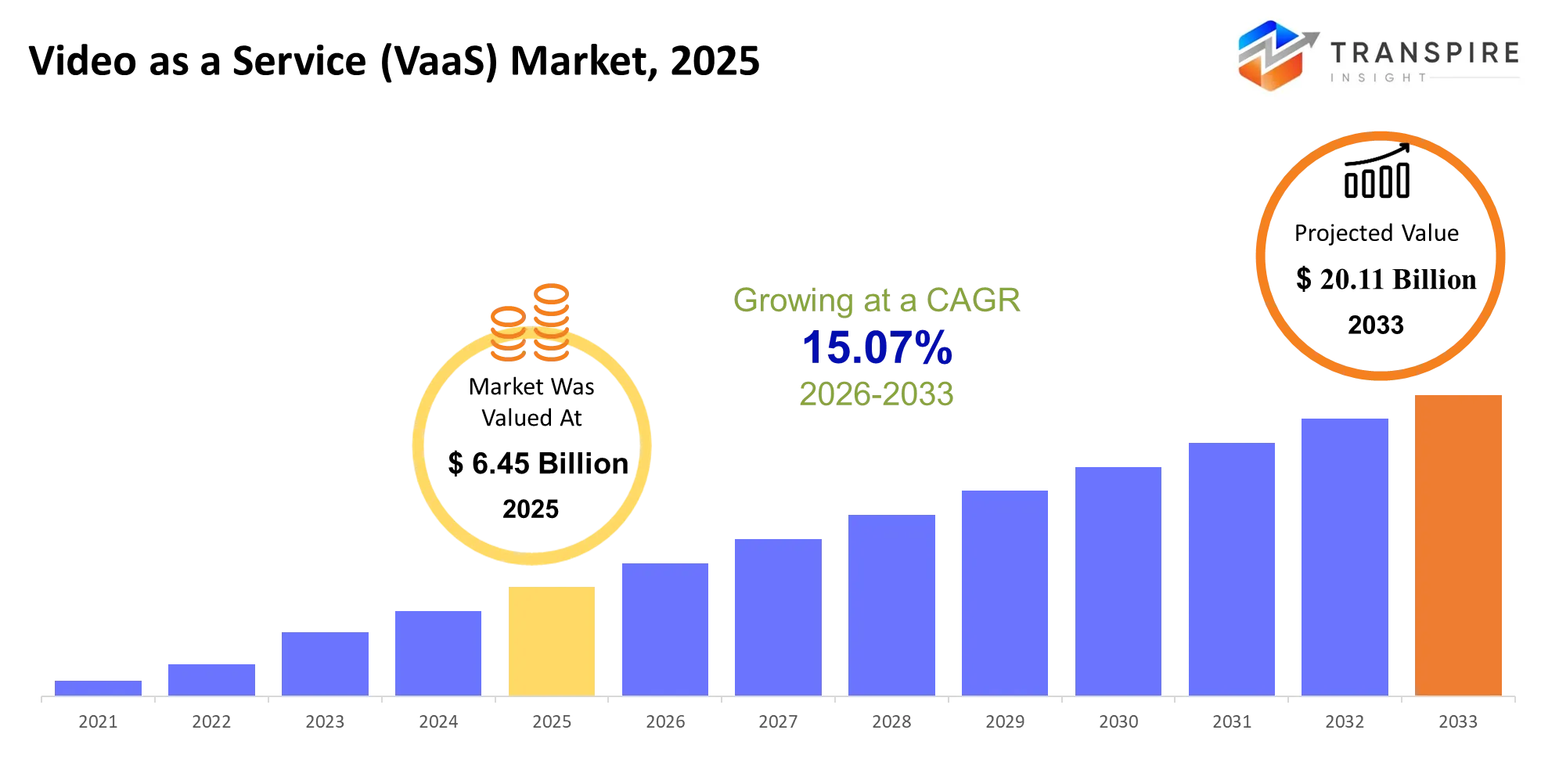
As per Transpire Insight Analysis, the Video as a Service (VaaS) Market size is estimated at USD 6.45 billion in 2025 and is anticipated to reach USD 20.11 billion by 2033, growing at a CAGR of 15.07% from 2026 to 2033.
The Video as a Service (VaaS) Market is changing how businesses deliver meetings, training, customer support and digital communication through cloud-based video platforms. Over the last three to five years, there has been a shift in the market from basic video conferencing to a more integrated solution including live collaboration, cloud-based recording, and intelligent functionalities. The rising trend of hybrid working models has been one of the major factors influencing this shift, as companies begin spending in order to develop communication platforms that will help bridge the gap between their remote and office-going workers. On top of that, there have been developments within the cloud infrastructure and internet access space, providing more options for video services for companies.
Video as a Service (VaaS) Market Size & Forecast:
- Market Size 2025: USD 6.45 Billion
- Expected Market Value (2033): USD 20.11 Billion
- Forecast CAGR (2026–2033): 15.07%
- Leading Region in 2025: North America
- Fastest Growing Region: Asia Pacific
- Key Company Profiles: Microsoft Teams, Zoom, Cisco Webex, Google Meet, RingCentral, GoTo, 8x8, Vonage, Adobe, Amazon Web Services, Kaltura, Panopto, Vimeo, Brightcove, Avaya
Key Market Insights:
Markets are moving towards those that provide a combination of reliable and strong video communications along with productivity solutions, cloud, and AI.
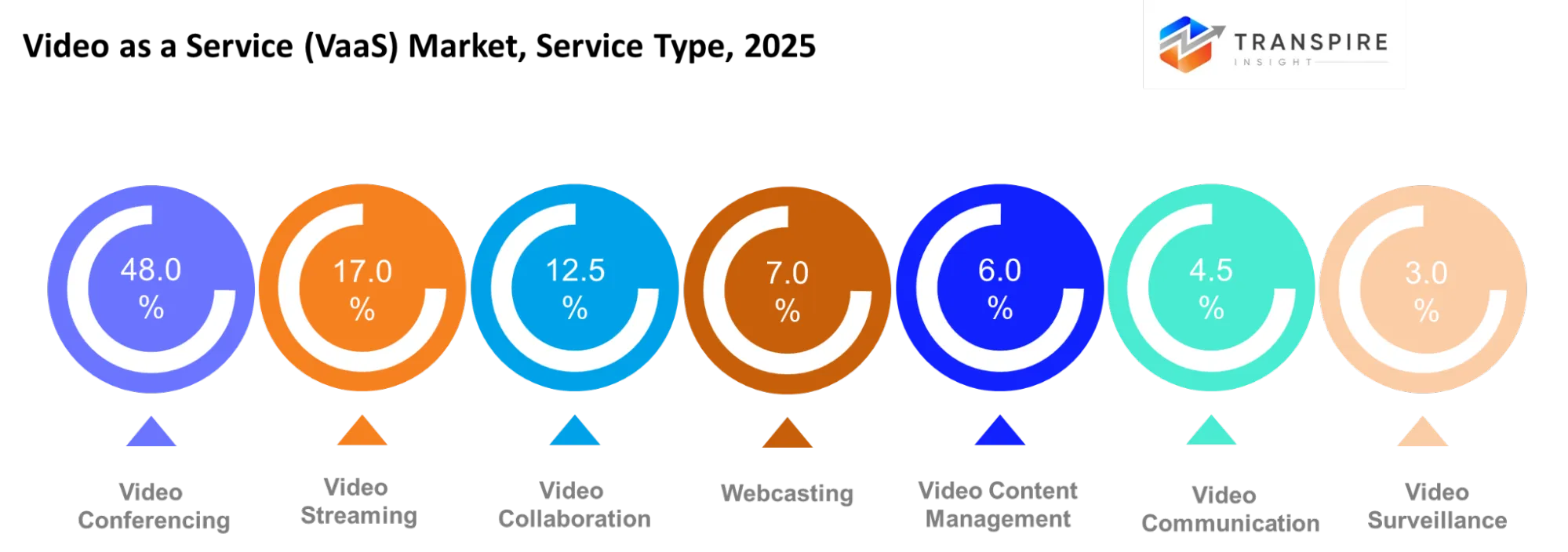
- Video conferencing holds 48.0% of the market, as the value of video conferencing cannot be ignored when it comes to business meetings, consultations, and communication of distributed teams.
- Video streaming is 17.0% of the market as organisations make use of hosted video solutions to exhibit their products, hold virtual events, and communicate online.
- Video collaboration constitutes 12.5% of the market as video solutions like shared workspace, screen sharing, and collaborative documents become popular among organisations.
- Webcasting makes up 7.0% of the market as businesses use digital broadcasting to communicate with their employees, clients, and other professionals.
- Video content management has a 6.0% share of the market since the recording needs to be managed through storage, retrieval, and distribution of the recordings.
- Video communication has a 4.5% market share because companies incorporate video capabilities into their communication workflows, including customer service and business applications.
- Video surveillance has a 3.0% share of the market through cloud video access and centralised monitoring capabilities.
What are the Key Drivers, Restraints, and Opportunities in the Video as a Service (VaaS) Market?
Drivers
The emergence of cloud technology is creating video solutions that can easily be used by many companies. The increase in hybrid work, remote work, and online customer interactions makes cloud-based video more attractive. Most companies were using cloud-based video before the pandemic, but it has been reinforced because of the pandemic for video conferencing and customer interactions. Subscription platforms allow companies to scale up.
Restraints
The issues of data privacy, cybersecurity, and connectivity. Video conferencing is prone to leaking sensitive corporate discussions, recordings, and documents when there is no proper security measure in place on the part of the participants. Businesses operating in a regulated industry will need to meet other conditions concerning storage and management of video content. Issues such as connectivity, latency, and inadequate hardware may affect the quality of video meetings in areas with poorly developed broadband networks. Integration of legacy communication software solutions can lead to higher costs and difficulty in switching.
Opportunities
Integration with AI, cloud-based infrastructure, and vertical-specific video solutions offers huge growth opportunities. Other growth drivers include vendor differentiation based on solutions such as automatic transcription, multilingual communication, recording and summarisation of meetings, and workflow integrations. Asia Pacific offers good opportunities as companies, educational organisations, and healthcare facilities start implementing digital services. Service providers that offer affordable solutions that ensure high security and performance will attract both small and large organisations.
|
Driver |
Relative Impact on Growth (%) |
Geographic Relevance |
Impact Timeline |
Demand Strength |
Growth Mechanism (5–10 words) |
Key Beneficiaries (5–10 words) |
Major Constraint (5–10 words) |
|
Cloud-based video infrastructure adoption |
28% |
North America, Europe, Asia-Pacific |
Medium-term (2–4 years) |
High |
Reduces infrastructure costs and enables scalable video delivery |
Cloud platforms, VaaS providers, enterprise customers |
Data sovereignty concerns and unpredictable cloud operating costs |
|
Rising demand for remote work and video collaboration |
24% |
North America, Europe, Asia-Pacific |
Short-term (≤2 years) |
High |
Expands subscriptions through distributed workforce collaboration requirements |
Video conferencing vendors, enterprises, unified communications providers |
Subscription fatigue and inconsistent user engagement |
|
Growth in video streaming and digital content consumption |
20% |
Asia-Pacific, North America, Europe |
Medium-term (2–4 years) |
High |
Increases demand for scalable streaming and content delivery |
Streaming platforms, content owners, CDN providers |
Bandwidth expenses and intense platform competition |
|
Integration of artificial intelligence and video automation |
16% |
North America, Europe, Asia-Pacific |
Long-term (≥4 years) |
High |
Automates transcription, translation, analytics, and content management |
AI vendors, VaaS platforms, corporate content teams |
Privacy risks, integration complexity, and implementation costs |
|
Expansion of high-speed connectivity and secure enterprise video services |
12% |
Asia-Pacific, North America, Middle East |
Long-term (≥4 years) |
Medium |
Improves video quality, reliability, and secure access |
Telecom operators, cybersecurity vendors, VaaS providers |
Uneven connectivity, cybersecurity threats, and compliance costs |
|
Total |
100% |
— |
— |
— |
— |
— |
— |
What Has the Impact of Artificial Intelligence Been on the Video as a Service (VaaS) Market?
The use of artificial intelligence turns video service platforms into tools used to manage information flow and streamline organisational activities. Artificial intelligence-powered transcription makes video discussions easily searchable in the form of text, and automated summaries enable participants to find out what was decided during the meeting, what the key topics are, and what needs to be done next. These features save a lot of time spent by workers on viewing long videos and writing notes. There are also AI-assisted tools such as noise suppression, automatic speaker recognition, virtual backgrounds, and language translation during live meetings. Predictive and analytical abilities create additional possibilities. Video quality analytics allows identifying regular network issues, and the usage of analytics gives administrators an insight into how the platform is used and make better resource allocation. In addition, AI assistants may link discussion to enterprise software, which means that teams may organise their work and find needed information without switching tools again and again. There are limitations to using AI in such services. Advanced tools require higher subscription and computing fees, and inaccuracies in transcripts, language recognition, privacy, and complex integration may undermine the benefits.
Instance
In September 2025, Zoom Communications rolled out AI Companion 3.0, which includes AI-driven meeting notes, discussion summaries, and workflow automation. Such functionalities enable organisations to enhance collaboration and productivity, thus making the need for AI-integrated video communication services even stronger. https://news.zoom.com/zoomtopia2025/
Key Market Trends:
Video solutions are increasingly shifting towards integrated digital workspaces, rather than just standalone meeting applications. Service providers concentrate on the following innovations in order to increase the value of video communication beyond live calls.
- Traditionally, video services provided real-time interaction features only; now, however, there is a tendency to opt for services that provide automatic summarising, transcription, and creation of follow-up tasks.
- Companies incorporate meeting solutions into calendar applications, messengers, documentation, and project management services to avoid fragmented processes.
- Corporations prefer video services that are interoperable with different platforms and collaboration tools to avoid dependence on one service provider.
- Firms move beyond real-time meetings and start adopting solutions that will help them create searchable repositories of recorded meetings that will be used for training, information exchange, and learning.
- Popularisation of smartphones and remote work imposes needs to make mobile meetings and screen sharing better.
- Increasing role of video services in normal business processes imposes a need to pay more attention to security controls, meeting privacy, and recording administration and security.
Video as a Service (VaaS) Market Segmentation
By service types
video conferencing leads with 48.0% share due to wide adoption in corporate meetings, remote collaboration, customer conversations, and consultations. The market includes video streaming at 17.0%, providing services to businesses that need to disseminate live or pre-recorded content to broader audiences. Video collaboration shares 12.5% owing to demand for interactive services which provide not only video calls but also screen sharing and co-working space. The share of webcasting is 7.0%, while video content management is at 6.0%. Video communication makes up 4.5% of the total market, and video surveillance – 3.0%, while others make up 2.0%. Cloud video collaboration is considered to be the fastest-growing segment in the provided brief, with a CAGR of 13.7%.
By deployment type
The market includes cloud, on-premises, hybrid, SaaS, private cloud, public cloud, multicloud, and others. Cloud video services can be attractive for businesses that seek scalability and do not want to invest much in building physical infrastructure. On-premises and private cloud services can be relevant for businesses that want more control over their sensitive data and configurations, and even storage. Hybrid and multicloud services provide businesses more flexibility in case of varying security and legacy issues.
By organisation size
There are large companies, SMEs and startups, governmental bodies, educational institutions, media organisations, and other organisations making up the market. Large companies have needs in the fields of consolidation of management, security at a high level, integration with current corporate processes, and collaboration with distributed teams. SMEs and startups pay more attention to low-cost subscription plans, fast deployment, and ease of use. Governmental and special organisations require compliance, restricted access, and reliable communication.
By application
Video remains one of the main application categories. Video applications are used for meetings, collaboration, presentations, and internal communication. Educational institutions use video applications for remote learning, including tele-learning and hybrid learning and recording classes. Healthcare providers use video applications for virtual office visits and remote management of patients where it is possible. Media and entertainment organisations use video platforms for content delivery and hosting virtual/hybrid events. Marketers use video solutions for product demonstrations and customer support, consultations, and troubleshooting.
By platform
Platforms used in the market encompass web-based, mobile, desktop, embedded, API, browser, hybrid and other formats. Browser- and web-based platforms enable easy access that doesn't require users to install much locally. Desktop platforms can offer more extensive integration with existing workplace tools. The mobility of the mobile offering is ideal for communicating on-the-go, whereas the embedded video functionality enables companies to add communication to their own apps. API-based platforms are ideal for enterprise clients and software developers who want a bespoke platform. Finally, hybrid platforms combine access approaches to meet the demands of multiple types of users, devices and workplaces.
By end user
the target industries that use video include banking, financial services and insurance, IT and telecom, healthcare, education, media and entertainment, retail, government, and more. BFSI businesses use videos for customer consultation, internal meetings, and remote advisory services in some instances. The IT and telecom industry uses video for virtual collaboration to handle dispersed teams and help customers and other interested parties. The healthcare and education industry use video to increase their reach and provide consultations and education, while media and entertainment businesses use videos to help with consumer outreach and engagement.
What are the Key Use Cases Driving the Video as a Service (VaaS) Market?
Video conferencing is a use case of the VaaS market that belongs to the service-type segment. It is employed by companies for internal meetings, client pitches, recruitment interviews, and collaboration of teams located far from each other. The cloud-based solution makes the process easier without the need to have much hardware in the office. The emerging use cases include distance learning, telemedicine consultations, virtual product demos, digital marketing, and customer care. These use cases are related to video services and segments like education, healthcare, retail, and corporate communications. The new use cases include AI-assisted training, automatic recordation of meetings, interactive virtual events, and video integration into business applications.
|
Report Metrics |
Details |
|
Market size value in 2025 |
USD 6.45 Billion |
|
Market size value in 2026 |
USD 7.53 Billion |
|
Revenue forecast in 2033 |
USD 20.11 Billion |
|
Growth rate |
CAGR of 15.07% from 2026 to 2033 |
|
Base year |
2025 |
|
Historical data |
2021 - 2024 |
|
Forecast period |
2026 - 2033 |
|
Report coverage |
Revenue forecast, competitive landscape, growth factors, and trends |
|
Regional scope |
United States; Canada; Mexico; United Kingdom; Germany; France; Italy; Spain; Denmark; Sweden; Norway; China; Japan; India; Australia; South Korea; Thailand; Brazil; Argentina; South Africa; Saudi Arabia; United Arab Emirates |
|
Key company profiled |
Microsoft Teams, Zoom, Cisco Webex, Google Meet, RingCentral, GoTo, 8x8, Vonage, Adobe, Amazon Web Services, Kaltura, Panopto, Vimeo, Brightcove, Avaya |
|
Customization scope |
Free report customization (country, regional & segment scope). Avail customized purchase options to meet your exact research needs. |
|
Report Segmentation |
Service Type (Video Conferencing, Video Streaming, Video Collaboration, Webcasting, Video Content Management, Video Communication, Video Surveillance, Others)Deployment (Cloud, On-Premise, Hybrid, SaaS, Private Cloud, Public Cloud, Multi-Cloud, Others)Organization Size (Large Enterprises, SMEs, Startups, Government, Educational Institutions, Healthcare Organizations, Media Companies, Others)Application (Corporate Communication, Education, Healthcare, Entertainment, Marketing, Customer Service, Training, Others)Platform (Web-Based, Mobile, Desktop, Embedded, API-Based, Browser-Based, Hybrid Platform, Others)End User (BFSI, IT & Telecom, Healthcare, Education, Media & Entertainment, Retail, Government, Others) |
Which Regions are Driving the Video as a Service (VaaS) Market Growth?
North America
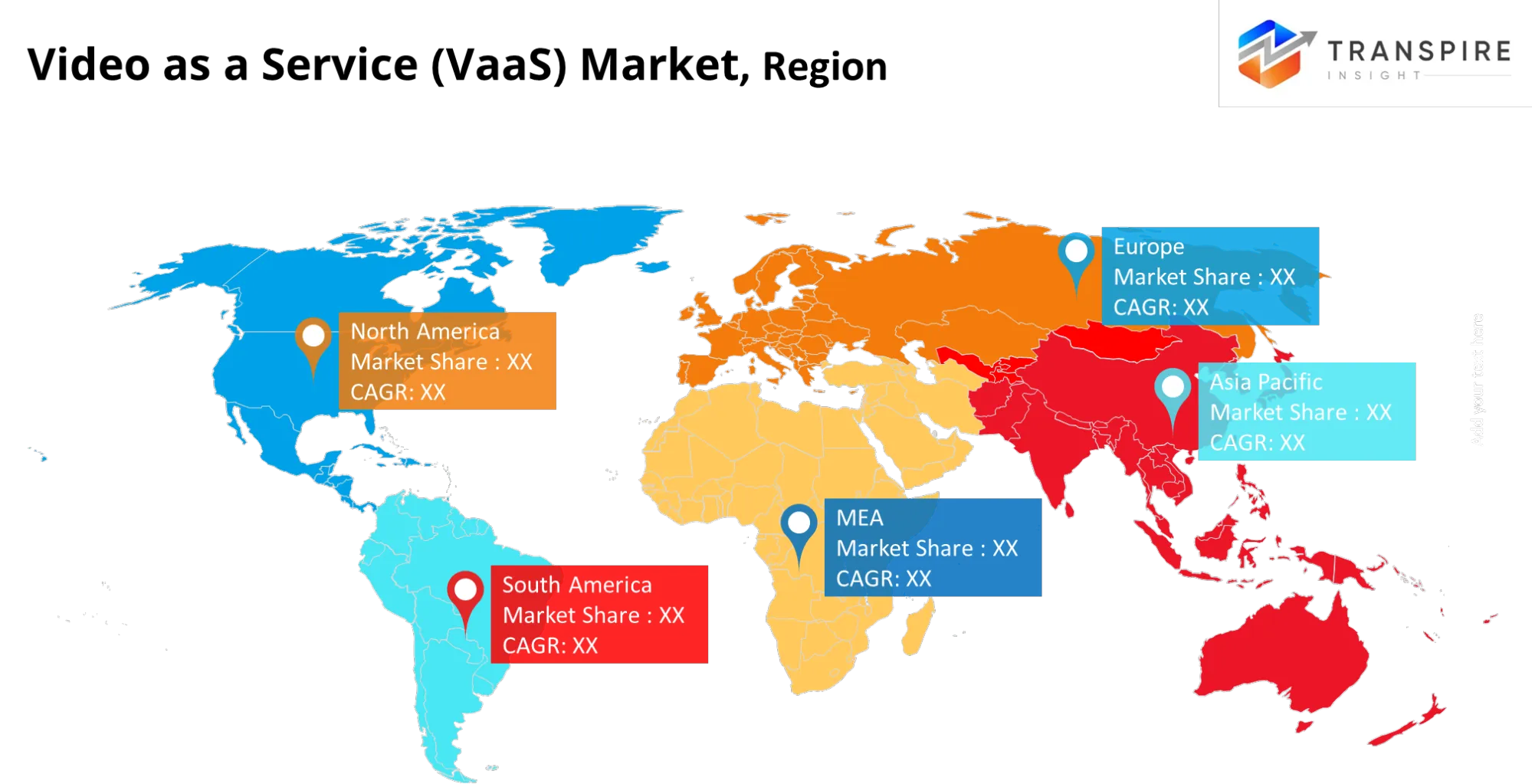
The market share of North America in the Video as a Service Market is the largest, at 39.5%. This is mainly attributed to the availability of enterprise software services, cloud infrastructure, and the use of digital workplaces. The video-based services are used by companies for hybrid workplaces and customer engagements, as well as training and collaborations among international offices. Large investments in AI technology and cybersecurity drive the need for video services.
In September 2025, Zoom rolled out AI Companion 3.0 to enhance collaboration at work and automate tasks, meeting the demand for AI-based video communication services. https://news.zoom.com/zoomtopia2025/
Europe
Europe constitutes 27.0%. It is driven by the adoption of digital collaboration solutions in organisations, governmental institutions, and educational establishments. Enterprises invest in communication platforms that comply with data security requirements and cross-border communication needs. The developed telecommunications infrastructure and technology foundation in the region facilitate the adoption process. In contrast to North America, there are some regulatory aspects to be taken into account in Europe.
In October 2025, OpenTalk added the ability to record and live stream its cloud-based video conferencing system, meeting the need for secure digital meetings and events. https://opentalk.eu/en/news/opentalk-2530-now-streaming-and-recording-functionality
Asia Pacific
Asia Pacific accounts for 24.0% of the market share and has the highest growth rate of all the regions with a forecasted CAGR of 15.2%. Increased digital capabilities, cloud software, mobile internet connections, and technology-based businesses are providing opportunities within the region. Businesses are using video services for work from home, e-learning, customer engagement and communication within the geographical boundaries of their operations. Further investments in improving connectivity as well as cost-effective cloud service options, can allow providers to reach out to SMEs, educational and health establishments, as well as emerging enterprises.
In June 2026,Ricoh acquired Vision Multimedia Group to enhance its regional workplace and AV collaboration services. https://www.ricoh.com/release/2026/0602_1
Who are the Key Players in the Video as a Service (VaaS) Market and how do they compete?
Competition in the Video as a Service Market are service reliability, user-friendliness, security measures, pricing, connectivity, and capacity to provide large-scale communication solutions. These include Zoom, Microsoft, Cisco, Google, RingCentral, GoTo, 8x8, and Vonage. Strategies of these competitors vary depending on their customer base and product lines. Zoom's competitive edge is the meeting solution that is easy to use, incorporates AI productivity functions, and allows integrations with other business applications. This can be seen in Zoom Mate, which was introduced in June 2026. Microsoft is competitive due to the integration of Teams with Microsoft 365 productivity tools. Google makes it easy to integrate video meetings into its larger productivity framework. Cisco is a market player because of Webex, Enterprise communications services, collaboration products and security-based integrations. In October 2026, Cisco introduced more capabilities to AI Agent of Webex as well as enhanced collaboration devices' interoperability. Other market players are competitive via cloud telephony services, contact centre integration, developer API, flexible pricing, and business communication services.
Video as a Service (VaaS) Market companies
- Microsoft Teams
- Zoom
- Cisco Webex
- Google Meet
- RingCentral
- GoTo
- 8x8
- Vonage
- Adobe
- Amazon Web Services
- Kaltura
- Panopto
- Vimeo
- Brightcove
- Avaya
|
Company |
Est. Revenue Share Range |
Key Offerings |
Strategic Positioning |
Geographic Strength |
Technology Focus |
|
Microsoft |
Estimated 12–20% |
Microsoft Teams, Teams Premium, Teams Town Hall, Microsoft eCDN |
Productivity ecosystem integration and enterprise-scale adoption |
North America, Europe, Asia Pacific |
Generative AI, intelligent meetings, cloud integration |
|
Zoom Communications |
Estimated 10–18% |
Zoom Meetings, Zoom Webinars, Zoom Events, Zoom Rooms |
Video-first platform with broad enterprise and SMB appeal |
North America, Asia Pacific, Europe |
AI Companion, real-time collaboration, cloud video |
|
Cisco Systems |
Estimated 8–15% |
Webex Suite, Webex Meetings, Webex Events, Webex Calling |
Enterprise-grade collaboration and hybrid deployment flexibility |
North America, Europe, Asia Pacific |
AI meeting agents, secure cloud, hybrid interoperability |
|
Alphabet (Google) |
Estimated 6–12% |
Google Meet, Google Workspace, Google Meet hardware, Google Vids |
Workspace ecosystem integration and accessible cloud collaboration |
North America, Asia Pacific, Europe |
Gemini AI, live translation, intelligent audio and video |
|
RingCentral |
Estimated 3–7% |
RingCentral Video, RingEX, RingCentral Events, RingCentral Rooms |
Unified communications with integrated video and telephony |
North America, Europe, Asia Pacific |
Cloud communications, AI-assisted meetings, API integrations |
|
GoTo |
Estimated 2–5% |
GoTo Meeting, GoTo Webinar, GoTo Connect, GoTo Training |
Simplified business meetings and cost-conscious deployment |
North America, Europe, Asia Pacific |
Cloud conferencing, transcription, secure screen sharing |
|
Adobe |
Estimated 2–5% |
Adobe Connect, virtual classrooms, webinar platforms, interactive meeting rooms |
Specialized virtual learning and high-engagement online events |
North America, Europe, Asia Pacific |
Persistent virtual rooms, interactive learning, content sharing |
|
Amazon Web Services (AWS) |
Estimated 2–6% |
Amazon IVS, Amazon Chime SDK, Amazon Kinesis Video Streams, AWS Elemental Media Services |
Developer-led video infrastructure and scalable cloud delivery |
North America, Asia Pacific, Europe |
Low-latency streaming, APIs, cloud media processing |
|
Kaltura |
Estimated 1–4% |
Kaltura Video Platform, Kaltura Events, video portals, virtual classroom solutions |
Enterprise video management and specialized digital experiences |
North America, Europe, Asia Pacific |
API-first architecture, AI video creation, interactive media |
|
Zoho Corporation |
Estimated 1–3% |
Zoho Meeting, Zoho Webinar, meeting recording, webinar management |
Affordable collaboration integrated with business applications |
Asia Pacific, North America, Europe |
SaaS integration, cloud meetings, |
Recent Development News
In June 2026, Zoom launched ZoomMate as an AI workspace linking up the conversational context to enterprise search, AI-based deliverables, and workflow execution. This move is part of a general trend of video platforms that help people perform actions after their discussions. https://news.zoom.com/
In September 2025, Cisco launched new agentic abilities for Webex, such as its ability to integrate with enterprise apps and collaboration device software updates. This move was indicative of Cisco’s approach to connecting human teams with AI tools while still preserving enterprise security and workflow integration. https://investor.cisco.com/news/news-details/2025/Cisco-Introduces-Agentic-Capabilities-for-Next-Generation-Collaboration/default.aspx
What Strategic Insights Define the Future of the Video as a Service (VaaS) Market?
The future of the Video as a Service market would rely more on the success of connecting video communication to the workflow process rather than the fundamental features of meetings. AI-enabled documentation, automation of tasks, and multilingual cooperation would be some of the distinguishing factors that would help organizations realize productivity gains. However, there is an underlying danger of vendors focusing too much on the development of advanced AI-powered features without providing enough value to support higher subscription prices. In addition to data privacy issues, integration problems, and poor performance under various network conditions, these issues might hinder the adoption rate. There is a growing trend for vertical applications targeting specific industries such as healthcare, education, customer service, and small businesses needing robust video features without complicated infrastructure. The priorities of the vendors in the future include building secure cloud architecture, ensuring interoperability, providing control over AI algorithms, and offering flexible pricing plans.
Service Type
- Video Conferencing
- Video Streaming
- Video Collaboration
- Webcasting
- Video Content Management
- Video Communication
- Video Surveillance
- Others
Deployment
- Cloud
- On-Premise
- Hybrid
- SaaS
- Private Cloud
- Public Cloud
- Multi-Cloud
- Others
Organization Size
- Large Enterprises
- SMEs
- Startups
- Government
- Educational Institutions
- Healthcare Organizations
- Media Companies
- Others
Application
- Corporate Communication
- Education
- Healthcare
- Entertainment
- Marketing
- Customer Service
- Training
- Others
Platform
- Web-Based
- Mobile
- Desktop
- Embedded
- API-Based
- Browser-Based
- Hybrid Platform
- Others
End User
- BFSI
- IT & Telecom
- Healthcare
- Education
- Media & Entertainment
- Retail
- Government
- Others
By Regional Analysis
North America
- US
- Canada
- Mexico
Europe
- Germany
- UK
- France
- Italy
- Spain
- Russia
- Rest of Europe
Asia Pacific
- China
- Japan
- India
- South Korea
- Australia
- Rest of Asia Pacific
South America
- Brazil
- Argentina
- Rest of South America
Middle East & Africa
- UAE
- Saudi Arabia
- Qatar
- South Africa
- Rest of the Middle East & Africa
Frequently Asked Questions
Find quick answers to common questions.
The video as a service (VaaS) market size was valued at USD 6.45 billion in 2025 and is poised to reach USD 20.11 billion by 2033, expanding at a 15.07% CAGR.
Key segments for the video as a service (VaaS) market are Service Type (Video Conferencing, Video Streaming, Video Collaboration, Webcasting, Video Content Management, Video Communication, Video Surveillance, Others)Deployment (Cloud, On-Premise, Hybrid, SaaS, Private Cloud, Public Cloud, Multi-Cloud, Others)Organization Size (Large Enterprises, SMEs, Startups, Government, Educational Institutions, Healthcare Organizations, Media Companies, Others)Application (Corporate Communication, Education, Healthcare, Entertainment, Marketing, Customer Service, Training, Others)Platform (Web-Based, Mobile, Desktop, Embedded, API-Based, Browser-Based, Hybrid Platform, Others)End User (BFSI, IT & Telecom, Healthcare, Education, Media & Entertainment, Retail, Government, Others)
Growth is primarily driven by increasing adoption of cloud-based video communication, rising demand for remote work and virtual meetings, growing use of video streaming services, and advancements in AI-powered video technologies. Increasing digitalization across education, healthcare, and corporate sectors also supports market expansion.
The market is led by major manufacturers including Microsoft Teams, Zoom, Cisco Webex, Google Meet, RingCentral, GoTo, 8x8, Vonage, Adobe, Amazon Web Services, Kaltura, Panopto, Vimeo, Brightcove, Avaya
North America constitutes 39.5% of the world Video as a Service (VaaS) market owing to its superior digital infrastructure, adoption of cloud-based video services, need for remote collaboration, and presence of leading technology firms. The growing spending on AI-based video solutions and enterprise communication software is aiding in the growth of the market in this region.
Opportunities in the worldwide market for Video as a Service (VaaS) include the increasing need for cloud-based video conferencing, video analytics with AI, and virtual collaboration services. The increased use of video technology in fields such as education, healthcare, and corporate communication, as well as the increased adoption of hybrid working models, offers more opportunities
- Microsoft Teams
- Zoom
- Cisco Webex
- Google Meet
- RingCentral
- GoTo
- 8x8
- Vonage
- Adobe
- Amazon Web Services
- Kaltura
- Panopto
- Vimeo
- Brightcove
- Avaya
About the Authors

Mayur Shinde
I am Mayur Shinde, a Senior Research Analyst at Transpire Insight, specializing in the Automotive & Transportation and Information & Communication Technology (ICT) Industry. My work focuses on analyzing emerging market trends, technological advancements, competitive landscapes, and industry developments to deliver accurate, data-driven insights. I am passionate about transforming complex market information into clear, actionable content that helps businesses, professionals, and decision-makers stay informed and make confident strategic decisions.

Chakradhar Khansole
Chakradhar serves as the Research Director at Transpire Insight, bringing over 8 years of experience in technology, innovation, and strategic market intelligence. He specializes in transforming complex market data into actionable business insights that enable organizations to make informed, growth-oriented decisions. Recognized for his strategic vision and analytical expertise, Chakradhar leads high-impact research initiatives, delivering comprehensive market assessments, competitive intelligence, and forward-looking industry analysis.
Recently Published Reports
-
Apr 2026
3D Optical Profiler Market
3D Optical Profiler Market Size, Share & Analysis Report By Type (Desktop 3D Optical Profiler, and Portable 3D Optical Profiler), By Technology (Confocal Technology, and White Light Interference), By End-Use Industry (Manufacturing, Research Institutions, Automotive, Aerospace and Defense, Medical Devices, and Other), and Geography (North America, Europe, Asia-Pacific, Middle East and Africa, South and Central America), 2021 - 2031
-
Apr 2026
Depth Sensor Market
Depth Sensor Market Size, Share & Analysis Report By Type (Infrared Depth Sensors, Time-of-Flight (ToF) Sensors, Stereo Vision Sensors, Structured Light Sensors, Ultrasonic Depth Sensors), By Application (Automotive, Robotics, Gaming, Consumer Electronics, Industrial Automation, Healthcare, Security & Surveillance, Others), By End Users (Automotive Manufacturers, Consumer Electronics Companies, Healthcare Providers, Industrial Companies, Security Agencies, Gaming Companies, Robotics Companies, Others), and Geography (North America, Europe, Asia-Pacific, Middle East and Africa, South and Central America), 2021 – 2031
-
Apr 2026
Digital Manufacturing Market
Digital Manufacturing Market Size, Share & Analysis Report By Component (Hardware, Software, and Services), By Technology (Robotics, 3D Printing, Internet of Things (IoT), and Others), By Application (Automotive and Transportation, Aerospace and Defense, Consumer Electronics, Industrial Machinery, and Others), By Process Type (Computer-Based Designing, Computer-Based Simulation, Computer 3D Visualization, Analytics, and Others), and Geography (North America, Europe, Asia-Pacific, Middle East and Africa, South and Central America), 2021 – 2031
-
Apr 2026
Digital Visa Services Market
Digital Visa Services Market Size, Share & Analysis Report By Type (Individual Travelers, Group Travelers), By Application (Tourism, Business Travel, Others), and Geography (North America, Europe, Asia-Pacific, Middle East and Africa, South and Central America), 2021 – 2031