

Payroll Services Market Summary:
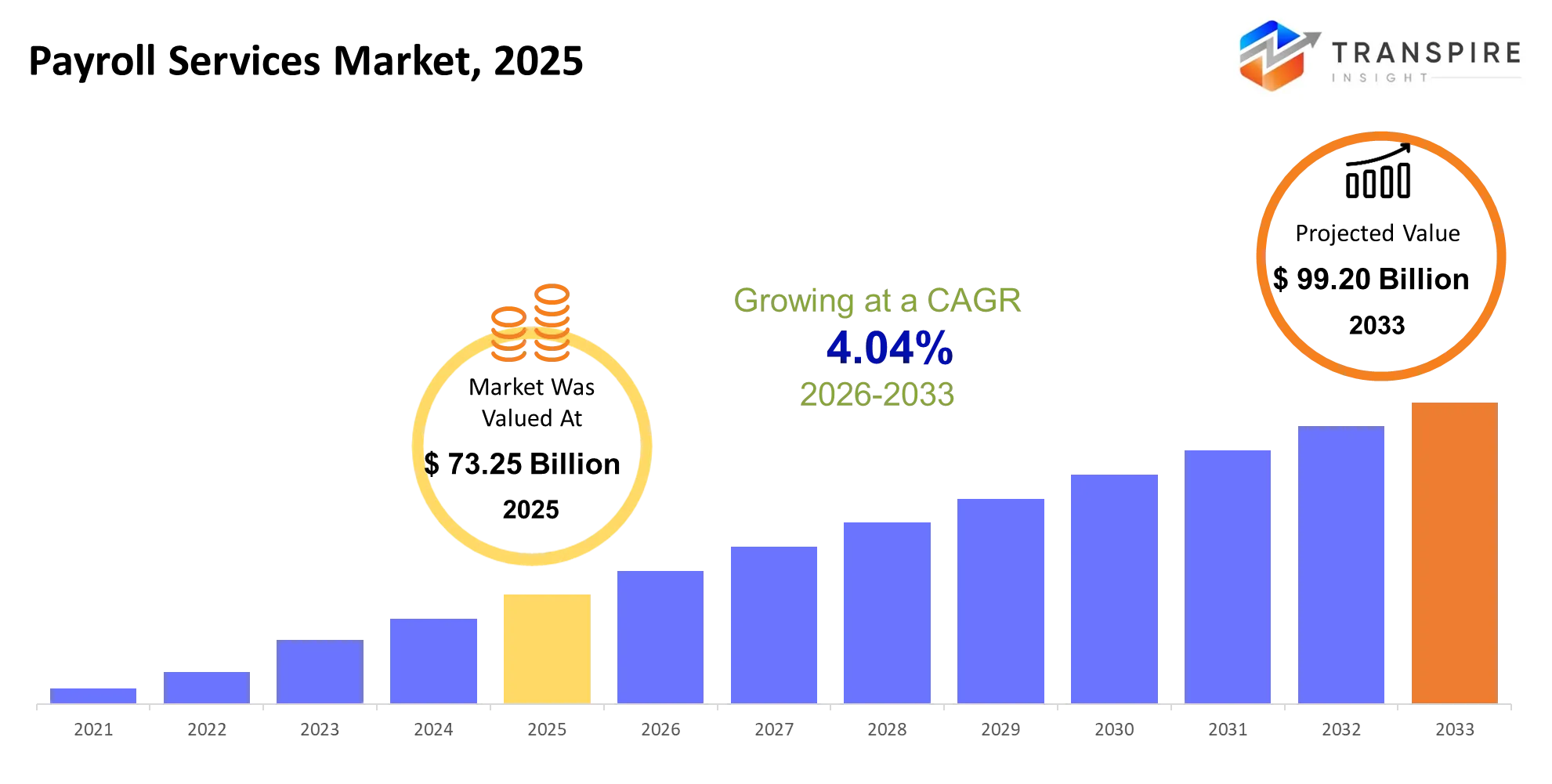
As per the Transpire Insight, The Payroll Services Market size is estimated at USD 73.25 billion in 2025 and is anticipated to reach USD 99.20 billion by 2033, growing at a CAGR of 4.04% from 2026 to 2033.
The payroll services industry is evolving as companies seek safe, accurate, and cost-effective ways to administer employee pay, tax withholdings, benefits, and reporting as workforces get more complex. Payroll processing has shifted in the last five years from a semi-autonomous local function to a fully cloud-based operation that combines human resources, finance, and payroll data. The rise of remote work and recruiting has accelerated this transition, as employers are exposed to a range of tax rules, pay cycles and reporting requirements. Regulatory changes such as the European Union's Pay Transparency Directive have also been driving organizations to update payroll reporting accuracy and reporting as well. Many payroll vendors are offering automation and real-time payroll analytics, as well as providing integrated payment services to take over more repetitive calculations and give organizations more control over compliance and pay. This evolution is repositioning payroll to be a strategic enabler of workforce agility and business growth.
Payroll Services Market Size & Forecast:
- Market Size 2025: USD 73.25 Billion
- Expected Market Value (2033): USD 99.20 Billion
- Forecast CAGR (2026–2033): 4.04%
- Leading Region in 2025: North America
- Fastest Growing Region: Asia Pacific
- Key Company Profiles: ADP, Paychex, UKG, Workday, Ceridian, Paycom, Paylocity, Intuit, SAP, Oracle, Rippling, Gusto, TriNet, Deel, Remote.
Key Payroll Services Market Insights:
Payroll services are becoming more of a multi-faceted financial and workforce management tool, and compliance automation and cross-border payment features are shaping enterprise purchasing decisions. Providers aren't just offering accuracy and localization of regulatory expertise, but also employee self-service powered by AI, differentiating themselves from simple salary processing.
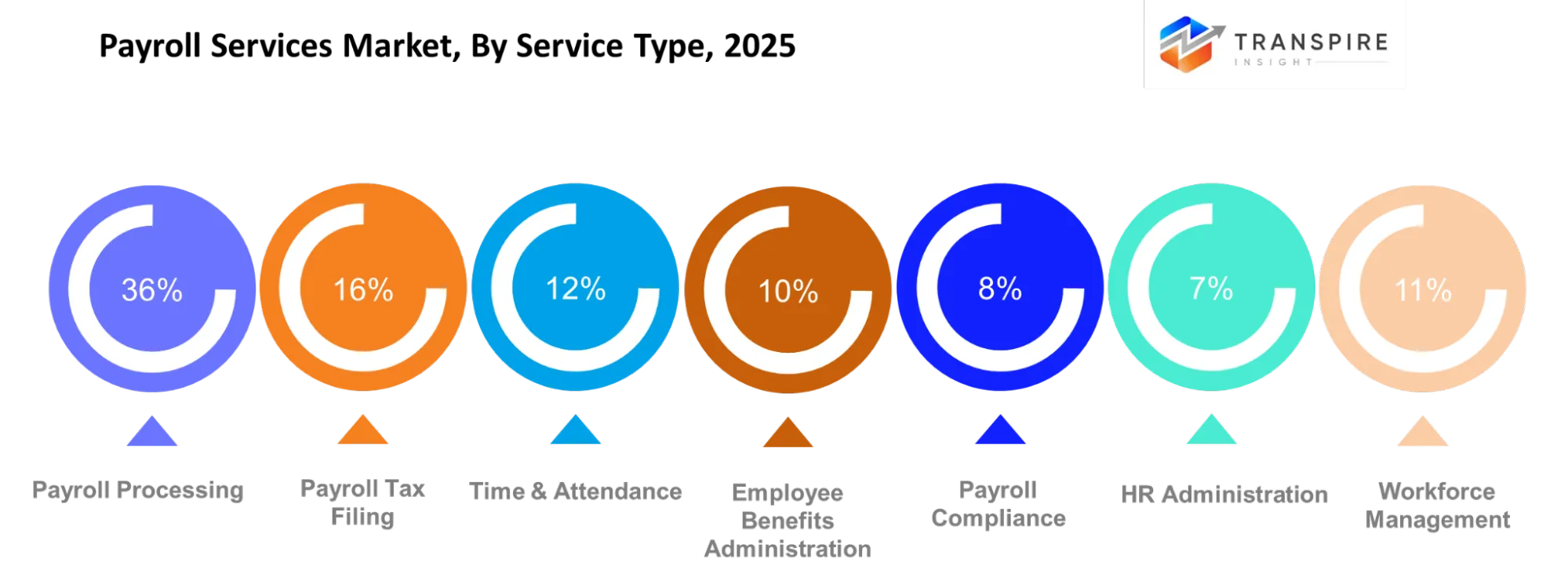
- Payroll processing is the top performer with a 36.5% market share, and ADP is expanding its automation capabilities throughout its footprint in GlobalView and Celergo in 140 countries.
- Payroll tax filing takes the lead with 16.0% as providers incorporate jurisdiction-specific statutory changes and automated remittance controls.
- The cloud payroll market is growing at a rate of 10.8% CAGR, driven by API-based integration between HCM, ERP, time, and finance systems.
- Time and attendance is 12.5%, and Paylocity integrates time tracking, earned-wage access, and garnishment into payroll.
- Employee benefits administration takes up 10.0% as Gusto aims to reach 150,000 new SMB customers with integrated payroll-benefits workflows.
- Payroll compliance is 8.5%, and 57% of payroll professionals say local compliance is their biggest challenge.
- HR administration accounts for 7.0%, and Rippling brings HR, IT, and finance data together to automate onboarding-to-offboarding payroll events.
- Workforce management accounts for 6.0%, with Paycom employing one-database architecture for payroll, labour, and talent.
- Deel achieved a USD 1 billion ARR run rate, driven by the need for contractor, EOR, and multi-country payroll consolidation.
What are the Key Drivers, Restraints, and Opportunities in the Payroll Services Market?
Driver:
Cross-border employment, frequent tax updates, and the expansion of flexible working arrangements are accelerating payroll outsourcing. The shift toward distributed teams has exposed employers to multiple withholding requirements, statutory contributions, and payment regulations. Manual processing creates reconciliation delays and compliance risks, encouraging companies to adopt managed payroll platforms. Integration with HR and accounting systems improves processing accuracy, reduces administrative expenditure, and generates recurring subscription revenue for service providers. Mandatory digital tax reporting and electronic payslip requirements further reinforce adoption among regulated industries and multinational employers.
Restraint:
Legacy HR and ERP systems still restrict automation. Many enterprises operate fragmented payroll data across countries, making integration costly and slowing real-time visibility. The issue persists because older systems contain customised calculations, historical employee data, and local statutory logic that cannot be replaced quickly. In a payroll survey, automating inbound and outbound data ranked among the leading operational challenges after local compliance.
Opportunity:
AI-assisted payroll validation, embedded financial services, and cloud-based international payroll infrastructure present strong expansion opportunities. Automated compliance monitoring can flag incorrect deductions before payments are executed, while API-enabled banking connections give employers clearer visibility into settlement status. Investment in localized payroll platforms across Southeast Asia, Latin America, and Africa could unlock growth among underserved businesses moving from spreadsheets to digital workforce administration. As these markets formalize employment and tax reporting, providers that combine local compliance expertise with scalable cloud technology will be better positioned to capture long-term demand.
Payroll Services Market – Driver Impact Analysis (2026)
|
Driver |
Relative Impact on Growth (%) |
Geographic Relevance |
Impact Timeline |
Demand Strength |
Growth Mechanism |
Key Beneficiaries |
Major Constraint |
|
Rising Adoption of Cloud-Based Payroll and SaaS Platforms |
28% |
North America, Europe, Asia Pacific |
Short-term (≤2 years) |
High |
Subscription platforms reduce processing costs and enable scalability. |
ADP, Paychex, Workday, SAP, cloud payroll providers |
Legacy system integration challenges and data migration costs. |
|
Increasing Payroll Compliance Complexity and Regulatory Digitalization |
24% |
Europe, North America, Asia Pacific |
Short-term (≤2 years) |
High |
Evolving tax regulations accelerate automated compliance service adoption. |
Payroll outsourcing firms, compliance specialists, multinational enterprises |
Frequent regulatory changes and jurisdiction-specific compliance requirements. |
|
Expansion of Multinational Workforces and Cross-Border Payroll Outsourcing |
20% |
Asia Pacific, North America, Europe |
Medium-term (2–4 years) |
High |
workforce expansion increases demand for centralized payroll. |
Deel, Remote, ADP, multinational employers, outsourcing providers |
Cross-border taxation complexities and fragmented employment regulations. |
|
AI-Driven Payroll Automation and Advanced Analytics Integration |
16% |
North America, Europe, Asia Pacific |
Medium-term (2–4 years) |
High |
AI automates payroll validation, anomaly detection, and reconciliation. |
Workday, UKG, Oracle, payroll technology vendors |
Data privacy concerns and limited AI integration capabilities. |
|
Growing SME Outsourcing and Integrated HR-Payroll Service Adoption |
12% |
Asia Pacific, Latin America, Middle East & Africa |
Long-term (≥4 years) |
Medium |
SMEs outsource payroll to reduce administrative overhead costs. |
Gusto, Paylocity, Intuit, regional payroll service providers |
Budget limitations and low digital adoption among SMEs. |
|
Total |
100% |
— |
— |
— |
— |
— |
— |
What Has the Impact of Artificial Intelligence Been on the Payroll Services Market?
Artificial intelligence transforms payroll processes through automation of rule-based, repetitive, and exception-based tasks. Machine-learning algorithms analyse attendance, overtime, pay rate adjustments, and historic payroll data for discrepancies prior to payroll authorization. Natural language processing extracts relevant payroll questions, categorises employee records, and aids compliance teams with the ever-changing tax codes. Using predictive analytics, employers can forecast salary costs, seasonal labour expenses, estimated and actual overtime, and anticipatory cash flow constraints. Anomaly detection algorithms minimize duplicate payments, unfamiliar deduction irregularities, and unforeseen changes to employee bank account details. From a process perspective, intelligent automation reduces reconciliation efforts, shortens pay cycle times, and allows industry specialists to address intricate employee issues and interpret new regulations. Cloud-based human capital management platforms consolidate personal and payroll data and reduce information decoupling between HR, payroll, and benefits teams. AI-driven payroll processes are constrained by outdated, multi-system legacy environments, exorbitant implementation costs, and inconsistent data quality and volumes. Human interpretations of new tax ordinances and local regulations are necessary to mitigate potential compliance violations and augment trustworthy payroll data through discernable, auditable calculations.
In October 2026, fintech companyMercurylaunched an AI-native payroll solution integrated directly into its core business accounts. Powered by the platform's proprietary AI agent, Mercury Command, the new feature allows founders to manage employee and contractor compensation using natural-language prompts.
Key Payroll Services Market Trends:
Payroll services are shifting away from transactional administration to integrated workforce intelligence, with payment accuracy, compliance visibility, and employee experience impacting purchasing decisions. The key evolution is towards integrated payroll ecosystems, integrating automation, predictive analytics, compliance, and flexible payment channels.
- Cloud is the new norm, replacing on-premises systems that often struggle with statutory changes.
- Payroll is evolving from a monthly cycle to on-demand wage visibility as real-time and earned-wage access become the norm.
- AI-powered anomaly detection is changing the way payroll is managed from correcting after the run to preventing errors before the run.
- Governments are increasingly imposing new tax withholding and labour and reporting obligations, driving compliance automation.
- Manual data transfers between HCM, ERP, time tracking, and finance applications are being replaced by API-based integration.
- Multi-country payroll platforms are centralizing disjointed local vendors into a single, system.
- The rise of gig, contractor, and cross-border workers is driving the need for flexible payment and tax structures. Flexible payment and tax handling structures are needed as gig, contractor, and cross-border worker numbers grow.
- Self-service and mobile access are easing HR workload and enhancing pay transparency.
- Payroll providers are tying them together with analytics, benefits, and workforce-management tools to boost account value.
Payroll Services Market Segmentation
Service Type:
Payroll processing leads the service-type segment with 36.5% share because all employers require accurate wage calculation, deductions, and payment procedures. Payroll processing volume increases through automation of duplicate calculations and linking with time, human resources, and finance data. Payroll tax filing holds a 16.0% share with demand for increased complexity of law and accurate taxpayer remittance. Time and attendance has a 12.5% share as hybrid work and hourly work tracking becomes a business norm. Employee benefits administration accounts fora 10.0% share, payroll compliance has 8.5% with monitoring and audit trail requirements, human resources administration is at 7.0%, workforce management is at 6.0%, and other services are at 3.5%.
Deployment:
Cloud-Based payroll is expanding rapidly, with Cloud Payroll projected to grow at a 10.8% CAGR, supported by automated updates, remote accessibility, and scalable processing infrastructure. On-Premise solutions remain relevant among organizations requiring direct control over sensitive employee information. Hybrid deployment combines local security with cloud flexibility, while SaaS models offer subscription-based affordability. Managed Service, Hosted, and Outsourced payroll solutions reduce administrative responsibilities and support regulatory compliance. Other deployment approaches address specialized integration requirements, allowing businesses to modernize payroll operations without replacing existing systems.
Enterprise Size:
Large Enterprises and Multinational Corporations represent significant payroll service users because they manage complex compensation structures, international employees, and multiple regulatory frameworks. SMEs, Micro Businesses, and Startups increasingly adopt subscription-based payroll platforms to reduce administrative costs and improve payment accuracy. Mid-Sized Companies prioritize scalable systems that integrate payroll with accounting and workforce management applications. Government Organizations emphasize transparency, standardized reporting, and statutory compliance. Other enterprises require customized payroll configurations, creating opportunities for providers offering flexible pricing, automation, and specialized implementation support.
End User:
BFSI organizations prioritize secure payroll processing, audit trails, and regulatory compliance because of strict financial governance requirements. IT & Telecom companies increasingly adopt cloud payroll solutions to manage distributed employees and international compensation. Healthcare providers require automated shift allowances, overtime calculations, and workforce scheduling integration. Retail businesses depend on flexible payroll systems for seasonal employment, while Manufacturing emphasizes attendance accuracy and labour cost management. Education, Government, and Professional Services increasingly utilise integrated platforms to improve reporting, payment transparency, and administrative efficiency.
Payroll Type:
Domestic Payroll remains a major service category, supported by recurring salary processing, statutory deductions, and local tax compliance requirements. International Payroll and Multi-Country Payroll are expanding as multinational organizations consolidate workforce payments across different jurisdictions. Contractor Payroll supports project-based employment, while Expatriate Payroll addresses complex taxation and international compensation arrangements. Temporary Worker Payroll and Gig Worker Payroll benefit from flexible employment models and digital payment integration. Other specialized payroll services create opportunities for automated compliance monitoring and customized workforce payment solutions.
Service Provider:
Payroll BPOs maintain a strong position by managing salary processing, statutory reporting, and administrative responsibilities for businesses seeking operational efficiency. HR Technology Companies and HCM Providers increasingly differentiate through cloud platforms, workforce analytics, and integrated employee management solutions. Accounting Firms offer tax expertise and financial reconciliation, while Professional Employer Organizations combine payroll with broader employment services. FinTech Companies introduce digital payments and embedded financial capabilities, whereas Consulting Firms provide regulatory advisory and implementation support. Other providers address specialized industry requirements and compliance challenges.
What are the Key Use Cases Driving the Payroll Services Market?
The core use case is high-volume payroll processing for large enterprises, where providers calculate salaries, statutory deductions, benefits, and final payments across multiple entities. This links directly to the 36.5% payroll-processing share and is especially critical in BFSI, IT, manufacturing, and retail, where workforce size and pay rules vary widely.
Expanding applications include payroll tax filing, time-and-attendance integration, benefits administration, and compliance monitoring. Healthcare and manufacturing use time-linked payroll for shifts and overtime, while multinational firms use cloud platforms to manage cross-border tax rules and centralized reporting.
Emerging use cases include real-time wage access, contractor and gig-worker payments, AI-based exception management, and predictive payroll-cost planning. These applications are strongest in technology, professional services, and platform-based businesses with flexible workforces.
|
Report Metrics |
Details |
|
Market size value in 2025 |
USD 73.25 Billion |
|
Market size value in 2026 |
USD 75.18 Billion |
|
Revenue forecast in 2033 |
USD 99.20 Billion |
|
Growth rate |
CAGR of 4.04% from 2026 to 2033 |
|
Base year |
2025 |
|
Historical data |
2021 - 2024 |
|
Forecast period |
2026 - 2033 |
|
Report coverage |
Revenue forecast, competitive landscape, growth factors, and trends |
|
Regional scope |
United States; Canada; Mexico; United Kingdom; Germany; France; Italy; Spain; Denmark; Sweden; Norway; China; Japan; India; Australia; South Korea; Thailand; Brazil; Argentina; South Africa; Saudi Arabia; United Arab Emirates |
|
Key companies profiled |
ADP, Paychex, UKG, Workday, Ceridian, Paycom, Paylocity, Intuit, SAP, Oracle, Rippling, Gusto, TriNet, Deel, Remote. |
|
Customization scope |
Free report customization (country, regional & segment scope). Available customized purchase options to meet your exact research needs. |
|
Report Segmentation |
Service Type (Payroll Processing, Payroll Tax Filing, Time & Attendance, Employee Benefits Administration, Payroll Compliance, HR Administration, Workforce Management, Others)Deployment (Cloud-Based, On-Premise, Hybrid, SaaS, Managed Service, Hosted, Outsourced, Others)Enterprise Size (Large Enterprises, SMEs, Micro Businesses, Startups, Mid-Sized Companies, Multinational Corporations, Government Organizations, Others)End User (BFSI, IT & Telecom, Healthcare, Retail, Manufacturing, Education, Government, Professional Services)Payroll Type (Domestic Payroll, International Payroll, Multi-Country Payroll, Contractor Payroll, Expatriate Payroll, Temporary Worker Payroll, Gig Worker Payroll, Others)Service Provider (Payroll BPOs, HR Technology Companies, Accounting Firms, Professional Employer Organizations, HCM Providers, FinTech Companies, Consulting Firms, Others). |
Which Regions are Driving the Payroll Services Market Growth?
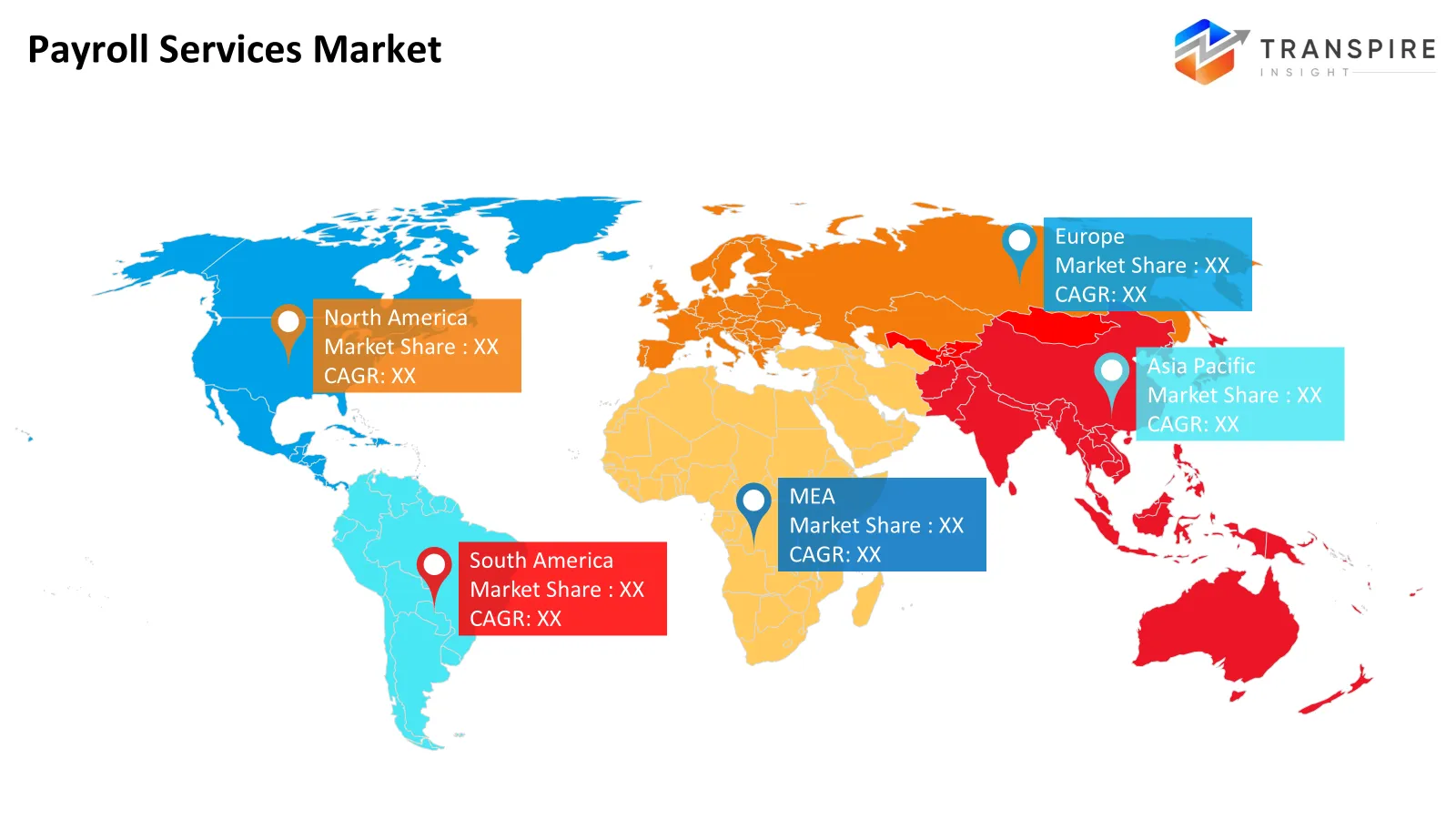
North America dominates the payroll services market with 40.5% market share, supported by mature outsourcing pipelines, sophisticated HR technology, and complex payroll taxation regimes. Adoption is led by the US, where employers value automated withholding, employee benefit integrations, and multi-state rules. ADP, Paychex, and Workday are enabled by cloud, AI-related processing, and integrated workforce management. The need for payroll precision, security, and GPFS is further boosting regional leadership.
In May 2026, Paychex introduced its new agentic AI technology, WISE, which includes an Intelligent Pay Cycle feature. This launch enables organizations to proactively monitor workflows for anomalies, automatically flagging missing data or scheduling conflicts before they impact final processing.
https://www.paychex.com/newsroom/news-releases/paychex-wise-top-hr-product-2026
Europe has a 28.5% market share and is the second-largest region after North America. Europe has a leading position because of a better focus on compliance standardization and protecting employee data. Alongside the General Data Protection Regulation (GDPR), the rising responsibility of pay transparency requirements forces organisations to upgrade their compensation files and payroll reporting. Germany, the UK and France have sound payroll outsourcing ecosystems for big network corporations. Demand for new compliance-oriented technology and multi-year service contracts support the region.
In May 2026, payroll technology provider Payslip secured a new round of growth financing from Salica Investments to scale its AI-powered infrastructure across more than 125 countries.
https://www.fintechlaunches.com/announcements/payslip-secures-growth-financing-expand-ai-global-payroll-platform-enterprise-payroll-operations/
Asia Pacific accounts for 22.0% of the market and is the fastest-growing region at an 11.4% compound annual growth rate driven by workforce formalisation and the proliferation of digital payroll. Countries such as India, China, and Southeast Asia have started replacing manual salary administration with cloud-connected payment instruments. As digital payment infrastructure expands, the markets offer an avenue for low-cost payroll subscriptions and localized automation for compliance. Latin America holds 5.5% of the market, while the Middle East and Africa make up 3.5% of the market, with potential in the area of wage reporting through e-payrolling and workforce digitization.
In September 2026, Workday announced a strategic payroll partnership with HR tech provider Neeyamo to deliver native, unified payroll capability for customers managing operations in India.
https://www.workday.com/en-in/homepage.html
Who are the Key Players in the Payroll Services Market, and how do they compete?
The Payroll Services market experiences competition from well-established outsourcing vendors, enterprise applications vendors, and specialist firms with a cloud-centric approach. Players can differentiate themselves on regulation coverage, processing accuracy, integration, and service pricing. In addition, international growth is continuing to be supported by a network of local compliance infrastructure.
ADP focuses on outsized outsourcing and automation at scale and broadens geographically via multinational service providers. Paychex targets small businesses with combined payroll & advisory services, and UKG centres around workforce scheduling. Workday leverages enterprise data connectivity and broadens payroll access via acquisitions. Dayforce (formerly Ceridian) champions a unified human resources & non-stop payroll model, and Paycom combines employee-centric processing. Paylocity combines payroll with human capital management platform solutions, and Intuit offers budget-friendly integrations via QuickBooks. SAP & Oracle support multinational businesses by providing integrated ERP platforms and working with local implementers. Rippling provides automated HR, IT, and payroll workflows, and Gusto simplifies administration for small organisations. TriNet integrates a PEO with modern payroll, and Deel & Remote build international payroll, contractor management, and employer-of-record frameworks, expanding through localised integrations & compliance.
Key Players are:
- ADP
- Paychex
- UKG
- Workday
- Ceridian
- Paycom
- Paylocity
- Intuit
- SAP
- Oracle
- Rippling
- Gusto
- TriNet
- Deel
- Remote
Payroll Services Market — Enhanced Competitive Benchmarking
|
Company |
Est. Revenue Share Range |
Key Offerings |
Strategic Positioning |
Geographic Strength |
Technology Focus |
|
ADP |
Estimated 12–16% |
RUN Powered by ADP, ADP Workforce Now, ADP Payroll, ADP Celergo |
payroll leader leveraging scale and compliance expertise |
North America, Europe, Asia Pacific |
AI automation, cloud payroll, predictive analytics, tax compliance |
|
Paychex |
Estimated 5–8% |
Paychex Flex, SurePayroll, Payroll Outsourcing, HR Solutions |
SMB payroll specialist emphasizing service and integrated HR |
North America |
Cloud payroll, automated tax filing, employee self-service |
|
UKG |
Estimated 4–7% |
UKG Pro Payroll, UKG Ready, UKG One View |
Enterprise workforce platform integrating payroll and time management |
North America, Europe |
AI workforce intelligence, cloud payroll, real-time analytics |
|
Workday |
Estimated 3–5% |
Workday Payroll, Payroll Connect, Payroll Partner Integrations |
Premium enterprise platform connecting finance, HR and payroll |
North America, Europe, Asia Pacific |
Unified cloud architecture, AI agents, payroll data integration |
|
Dayforce |
Estimated 3–5% |
Dayforce Payroll, Dayforce Managed Payroll, Payroll |
Unified payroll specialist differentiating through continuous calculation capabilities |
North America, Europe, Asia Pacific |
Continuous payroll calculation, AI automation, compliance engines |
|
SAP |
Estimated 2–4% |
SAP SuccessFactors Employee Central Payroll, SAP Payroll Control Centre |
Enterprise ecosystem provider serving complex multinational payroll environments |
Europe, Asia Pacific, North America |
Cloud ERP integration, payroll automation, localized compliance |
|
Oracle |
Estimated 2–4% |
Oracle Fusion Cloud Payroll, Oracle Cloud HCM, Payroll Interface |
Enterprise cloud challenger emphasizing integrated financial operations |
North America, Europe, Asia Pacific |
Embedded AI, cloud payroll, automated statutory processing |
|
Deel |
Estimated 1–3% |
Deel Payroll, Payroll, Employer of Record |
expansion specialist simplifying distributed workforce payroll management |
North America, Europe, Asia Pacific |
Payroll orchestration, automated compliance, cross-border payment integration |
|
Rippling |
Estimated 1–3% |
Rippling Payroll, Payroll, HR and IT Platform |
Automation challenger unifying employee data across business systems |
North America, Europe |
Workflow automation, unified employee records, payroll integrations |
|
Remote |
Estimated 0.5–2% |
Remote Payroll, Employer of Record, Contractor Management |
Cross-border payroll specialist targeting international workforce expansion |
Europe, North America, Asia Pacific |
payroll automation, localized compliance, payment infrastructure |
Recent Development News
- In September 2026, Thoma Bravo announced a strategic growth investment in Tanda, a workforce management, payroll, and HR platform serving approximately 8,000 businesses globally. The investment supports AI-driven payroll innovation, product development, and international expansion, helping shift-based employers improve wage accuracy, workforce compliance, and payroll efficiency. https://www.thomabravo.com/press-releases/thoma-bravo-announces-strategic-growth-investment-in-tanda
- In October 2026, HR Path acquired Payroll Experts Australia, a specialist in payroll compliance, processing, remediation, and workforce management consulting. The acquisition strengthens HR Path’s payroll service capabilities across Australia and New Zealand, enabling businesses to access integrated payroll compliance, HR technology implementation, and operational support. https://www.prnewswire.com/news-releases/hr-path-strengthens-its-australian-presence-with-strategic-acquisition-of-payroll-experts-australia-302915161.html
- In October 2026, EY announced a strategic alliance with Strada to deliver integrated payroll and workforce management solutions for multinational enterprises. The partnership combines Strada’s payroll technology and payment capabilities with EY’s tax, compliance, and workforce advisory expertise, helping organizations simplify multi-country payroll operations, reduce vendor fragmentation, and strengthen regulatory compliance. https://www.ey.com/en_tw/newsroom/2026/10/ey-announces-strategic-alliance-with-strada-to-help-set-a-new-standard-in-integrated-global-payroll-solutions
What Strategic Insights Define the Future of thePayroll Services Market?
The world is moving towards intelligent, compliance-based payroll services that combine salary management, workforce intelligence, and international payments execution. The key to winning in the market will be accuracy, compliance flexibility, and integration with corporate financial systems, rather than transaction volume. A lesser-known risk relates to the evolving AI tools that may someday determine a person's salary using some logic that fails to consider jurisdiction-specific tax rules and resulting penalties. At the same time, formalisation of the working class in developing Asian nations implies a market for affordable, mobile-enabled payroll services targeted at non-formalized business customers. Embedded payments and workforce cost analytics embedded into payroll services may foster customer stickiness and future revenue streams. Contenders should focus on auditable AI, local regulatory partnerships, secure APIs, and the ability to set up a range of modular services for small and mid-sized enterprises. This would reinforce resilience, ease of entry for developers, and facilitate sustainable international growth.
Key Segmentations are:
Service Type
- Payroll Processing
- Payroll Tax Filing
- Time & Attendance
- Employee Benefits Administration
- Payroll Compliance
- HR Administration
- Workforce Management
- Others
Deployment
- Cloud-Based
- On-Premise
- Hybrid
- SaaS
- Managed Service
- Hosted
- Outsourced
- Others
Enterprise Size
- Large Enterprise
- SMEs
- Micro Businesses
- Startups
- Mid-Sized Companies
- Multinational Corporations
- Government Organisations
- Others
End User
- BFSI
- IT & Telecom
- Healthcare
- Retail
- Manufacturing
- Education
- Government
- Professional Services
Payroll Type
- Domestic Payroll
- International Payroll
- Multi-Country Payroll
- Contractor Payroll
- Expatriate Payroll
- Temporary Worker Payroll
- Gig Worker Payroll
- Others
Service Provider
- Payroll BPOs
- HR Technology Companies
- Accounting Firms
- Professional Employer Organizations
- HCM Providers
- FinTech Companies
- Consulting Firms
- Others
By Regional Analysis
North America
- US
- Canada
- Mexico
Europe
- Germany
- UK
- France
- Italy
- Spain
- Russia
- Rest of Europe
Asia Pacific
- China
- Japan
- India
- South Korea
- Australia
- Rest of Asia Pacific
South America
- Brazil
- Argentina
- Rest of South America
Middle East & Africa
- UAE
- Saudi Arabia
- Qatar
- South Africa
- Rest of the Middle East & Africa
Frequently Asked Questions
Find quick answers to common questions.
The payroll services market size was valued at USD 73.25 billion in 2025 and is poised to reach USD 99.20 billion by 2033, expanding at a 4.04% CAGR.
Key segments for the payroll services market are Service Type (Payroll Processing, Payroll Tax Filing, Time & Attendance, Employee Benefits Administration, Payroll Compliance, HR Administration, Workforce Management, Others)Deployment (Cloud-Based, On-Premise, Hybrid, SaaS, Managed Service, Hosted, Outsourced, Others)Enterprise Size (Large Enterprises, SMEs, Micro Businesses, Startups, Mid-Sized Companies, Multinational Corporations, Government Organizations, Others)End User (BFSI, IT & Telecom, Healthcare, Retail, Manufacturing, Education, Government, Professional Services)Payroll Type (Domestic Payroll, International Payroll, Multi-Country Payroll, Contractor Payroll, Expatriate Payroll, Temporary Worker Payroll, Gig Worker Payroll, Others)Service Provider (Payroll BPOs, HR Technology Companies, Accounting Firms, Professional Employer Organizations, HCM Providers, FinTech Companies, Consulting Firms, Others).
Growth is primarily driven by increasing payroll automation, cloud-based HR adoption, complex tax regulations, cross-border employment, workforce digitization, and demand for AI-enabled payroll compliance solutions.
The payroll services market is led by major manufacturers, including ADP, Paychex, UKG, Workday, Ceridian, Paycom, Paylocity, Intuit, SAP, Oracle, Rippling, Gusto, TriNet, Deel, and Remote.
North America dominates the payroll services market with a 40.5% share, supported by advanced payroll infrastructure, widespread cloud adoption, complex tax regulations, established service providers, and increasing investment in AI-powered workforce management.
Key opportunities include AI-driven payroll automation, cloud-based payroll platforms, cross-border payment solutions, embedded financial services, compliance outsourcing, and expansion into emerging economies.
- ADP
- Paychex
- UKG
- Workday
- Ceridian
- Paycom
- Paylocity
- Intuit
- SAP
- Oracle
- Rippling
- Gusto
- TriNet
- Deel
- Remote
About the Authors

Mayur Shinde
I am Mayur Shinde, a Senior Research Analyst at Transpire Insight, specializing in the Automotive & Transportation and Information & Communication Technology (ICT) Industry. My work focuses on analyzing emerging market trends, technological advancements, competitive landscapes, and industry developments to deliver accurate, data-driven insights. I am passionate about transforming complex market information into clear, actionable content that helps businesses, professionals, and decision-makers stay informed and make confident strategic decisions.

Chakradhar Khansole
Chakradhar serves as the Research Director at Transpire Insight, bringing over 8 years of experience in technology, innovation, and strategic market intelligence. He specializes in transforming complex market data into actionable business insights that enable organizations to make informed, growth-oriented decisions. Recognized for his strategic vision and analytical expertise, Chakradhar leads high-impact research initiatives, delivering comprehensive market assessments, competitive intelligence, and forward-looking industry analysis.
Recently Published Reports
-
Apr 2026
3D Optical Profiler Market
3D Optical Profiler Market Size, Share & Analysis Report By Type (Desktop 3D Optical Profiler, and Portable 3D Optical Profiler), By Technology (Confocal Technology, and White Light Interference), By End-Use Industry (Manufacturing, Research Institutions, Automotive, Aerospace and Defense, Medical Devices, and Other), and Geography (North America, Europe, Asia-Pacific, Middle East and Africa, South and Central America), 2021 - 2031
-
Apr 2026
Depth Sensor Market
Depth Sensor Market Size, Share & Analysis Report By Type (Infrared Depth Sensors, Time-of-Flight (ToF) Sensors, Stereo Vision Sensors, Structured Light Sensors, Ultrasonic Depth Sensors), By Application (Automotive, Robotics, Gaming, Consumer Electronics, Industrial Automation, Healthcare, Security & Surveillance, Others), By End Users (Automotive Manufacturers, Consumer Electronics Companies, Healthcare Providers, Industrial Companies, Security Agencies, Gaming Companies, Robotics Companies, Others), and Geography (North America, Europe, Asia-Pacific, Middle East and Africa, South and Central America), 2021 – 2031
-
Apr 2026
Digital Manufacturing Market
Digital Manufacturing Market Size, Share & Analysis Report By Component (Hardware, Software, and Services), By Technology (Robotics, 3D Printing, Internet of Things (IoT), and Others), By Application (Automotive and Transportation, Aerospace and Defense, Consumer Electronics, Industrial Machinery, and Others), By Process Type (Computer-Based Designing, Computer-Based Simulation, Computer 3D Visualization, Analytics, and Others), and Geography (North America, Europe, Asia-Pacific, Middle East and Africa, South and Central America), 2021 – 2031
-
Apr 2026
Digital Visa Services Market
Digital Visa Services Market Size, Share & Analysis Report By Type (Individual Travelers, Group Travelers), By Application (Tourism, Business Travel, Others), and Geography (North America, Europe, Asia-Pacific, Middle East and Africa, South and Central America), 2021 – 2031