

Video Surveillance Systems Market Summary:
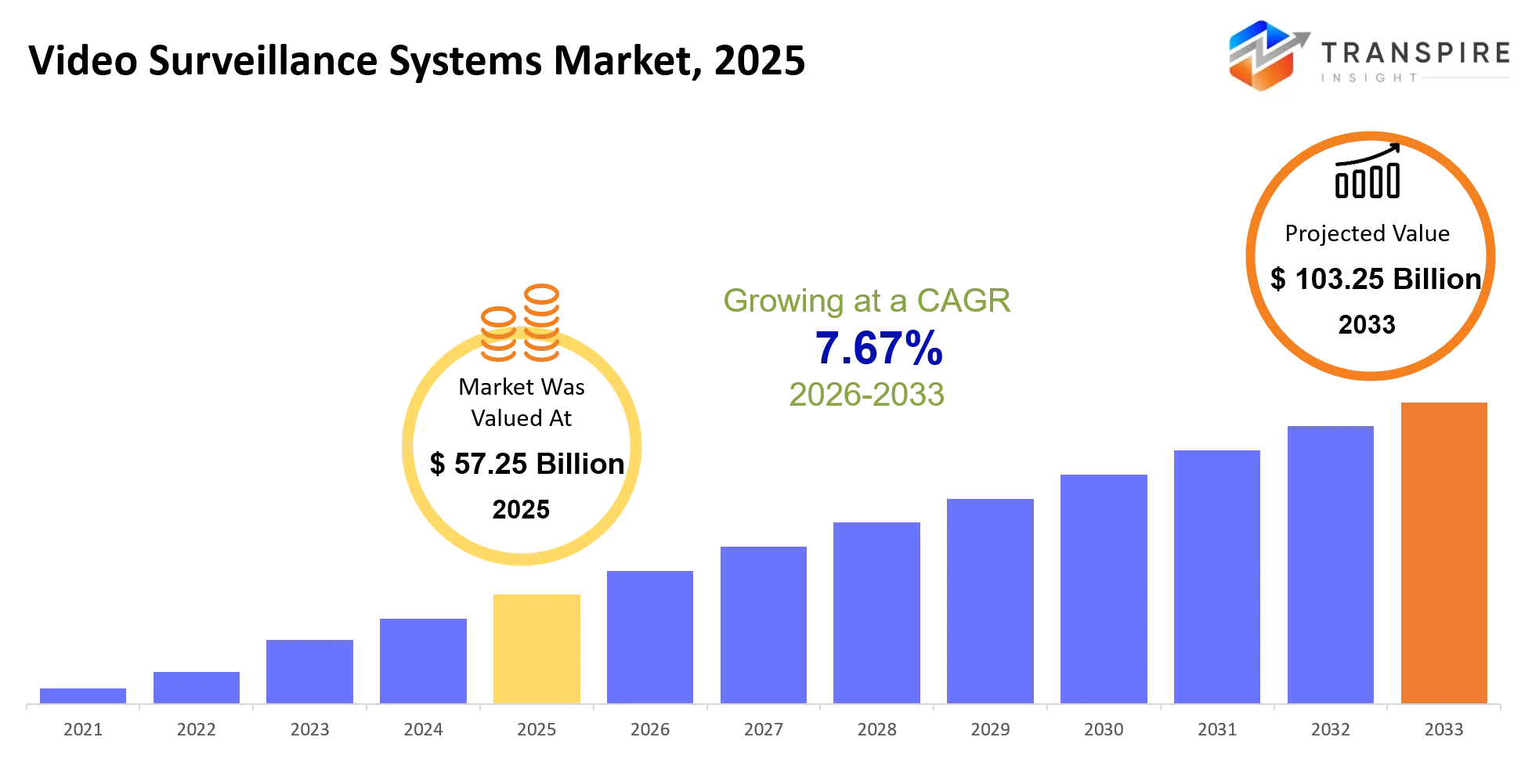
As per Transpire Insight Analysis, the Video Surveillance Systems Market size is estimated at USD 57.25 billion in 2025 and is anticipated to reach USD 103.25 billion by 2033, growing at a CAGR of 7.67% from 2026 to 2033.
The video surveillance systems market around the world is changing. It is moving away from just recording to new connected smart monitoring. These new systems can help with security and also with activities. In the past three to five years, companies have started to use cameras together with cloud platforms, edge computing, analytics and AI. This helps them handle large amounts of video data more quickly. A big change is that more companies are using IP-based and hybrid surveillance setups. This lets them control cameras and analytics in place. At the time, more worries about security in commercial buildings, transport systems, public areas and factories have made companies want to update old surveillance equipment. Powered analytics are also changing how video is used. Systems are no longer for recording. They are now able to find people, cars, strange actions and other events. As companies want answers and to use their camera networks better, money is being spent on systems that mix surveillance with analytics, remote control and smart operations.
Video Surveillance Systems Market Size & Forecast:
- Market Size 2025: USD 57.25 Billion
- Expected Market Value (2033): USD 103.25 Billion
- Forecast CAGR (2026–2033): 7.67%
- Leading Region in 2025: North America
- Fastest Growing Region: Asia Pacific
- Key Company Profiles: Hikvision, Dahua Technology, Axis Communications, Bosch Security, Hanwha Vision, Honeywell, Johnson Controls, Avigilon, Motorola Solutions, Panasonic, Sony, FLIR, Vivotek, Uniview, Verkada
Key Market Insights:
This market is shifting towards automation and information technology for surveillance. The market still heavily depends on physical surveillance infrastructure, but the growth is slowly moving towards software intelligence and AI-driven analytics.
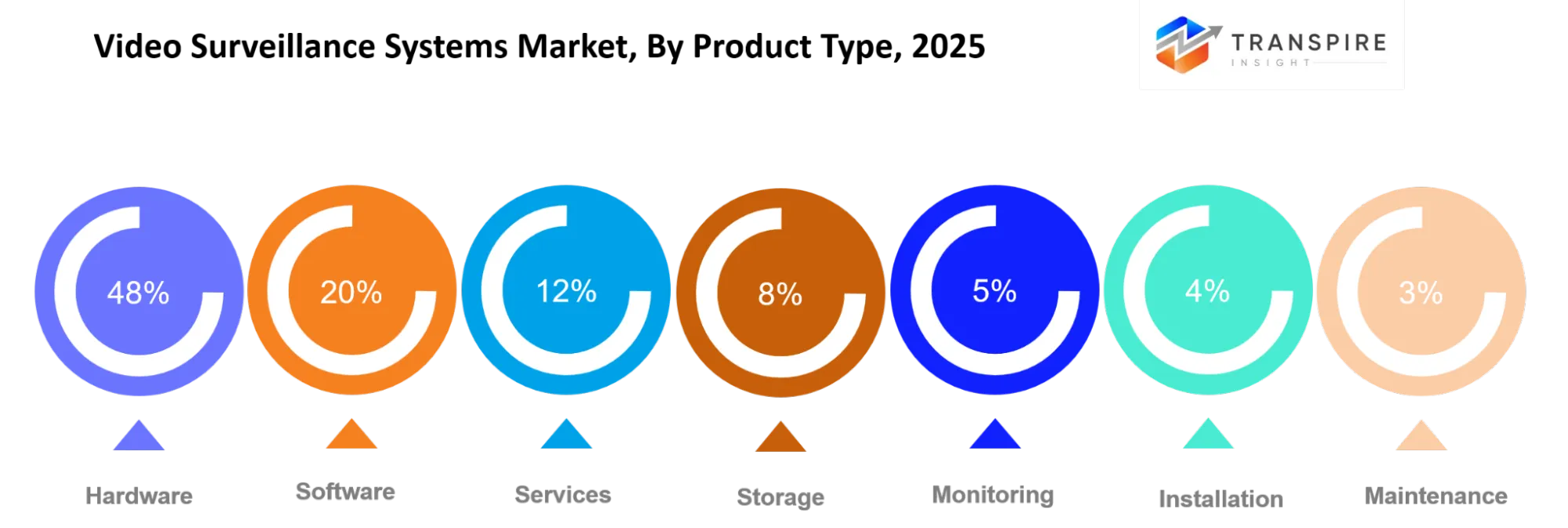
- Hardware constitutes 48% of the market and continues to be the largest share because companies keep replacing their old cameras and recorders with a network.
- Software comprises 20% of the market, driven by increasing usage of video management software solutions that enable users to centralise their videos, manage their cameras and integrate surveillance systems with other security systems.
- Storage makes up 8%, while the use of higher-resolution cameras and an increase in retention time are leading companies to use local storage in combination with cloud and edge-based storage solutions.
- Monitoring makes up 5% of the market and continues to grow due to companies' needs for remote monitoring and centralising security operations in commercial, industrial and public sectors.
- Installation comprises 4% and reflects the increasing need of companies to install additional cameras or update their surveillance systems.
- Maintenance makes up 2% of the market, while companies put more emphasis on keeping large camera systems operating.
What are the Key Drivers, Restraints, and Opportunities in the Video Surveillance Systems Market?
Drivers
Market growth is the move from passive video capture to intelligent video analysis. Companies are now searching for solutions that can identify relevant events autonomously rather than rely on security professionals monitoring video streams all the time. Progress made in edge-based AI allows cameras to analyse data on site, decreasing the need for central computation and providing real-time alerts. To illustrate, the company Axis recently released cameras equipped with built-in AI-powered analytics that detect and classify people and cars at the edge.
Restraints
Deployment and integration costs pose another problem, especially for those organisations looking to upgrade their extensive legacy surveillance networks, as replacing just the camera component may not be enough since an organisation may require a new network setup, storage capabilities, software for analytics, cybersecurity measures, and integration with existing security systems. The need for data protection increases the complexity of the implementation process as video footage may include sensitive data.
Opportunities
The development of edge AI and cloud-based surveillance presents a good opportunity for vendors to produce a system that can be easily deployed and managed on a large scale due to a hybrid approach allowing an organisation to keep sensitive data local while using the cloud platform for centralisation purposes. Vendors are collaborating with each other to explore new application fields. For instance, Qualcomm and CP PLUS have partnered to integrate edge AI capabilities and the video security ecosystem of CP PLUS for real-time video intelligence in India.
What Has the Impact of artificial intelligence on the Video Surveillance Systems Market?
AI is transforming video surveillance into an automatic process of recognising and prioritising events rather than mere recording. With AI, video cameras can identify people, cars, objects, movement types, and other predefined events without the need to watch all the streams recorded at every moment by security operators. That way, security operators are able to concentrate only on incidents that demand some action. AI enables more advanced search and investigation of videos. It allows operators to find necessary people, cars or objects faster than doing it manually while watching hours of recorded material. Axis has implemented AI-optimized surveillance infrastructure with free-text search functionality to speed up video investigations using many cameras. The deployment of AI technology requires some computer capacity, proper cameras, integration processes, and experienced personnel. The accuracy of AI systems depends on lighting, camera position, environment, and training data.
Instance
In March 2026, BLAZE VMS was introduced by Hanwha Vision. This is a video management system which utilizes the artificial intelligence analytics technology. This is an increased incorporation of artificial intelligence analytics in video management systems.
https://www.hanwhavision.com/uk/news-events/news-hub?tab=press-releas
Key Market Trends:
The trends in the surveillance industry are shifting from being centred around cameras to becoming more about integration. Edge and cloud computing, whereas companies require surveillance technologies to give them data and not just record video footage.
- Recording technology is being replaced by intelligent analysis, with camera technology now analysing events and not just recording footage.
- Edge computing is gaining popularity, enabling analytics to be conducted near cameras while reducing any lag that may occur due to the transfer of all video streams to centralised systems.
- Hybrid cloud-based surveillance is also gaining momentum, especially among companies that use cameras in several locations.
- Video technology is becoming increasingly integrated with other security systems such as access control, alarms, intercom, sensors, and communications technology.
- Video searching with the help of AI is helping in conducting investigations since the operator can find relevant events or objects without having to review large amounts of video footage.
Video Surveillance Systems MarketSegmentation
By Component
hardware accounts for the largest share at 48% of the market. Physical components like cameras, recorders, networking devices, and associated hardware will continue to be essential in building surveillance systems. Software makes up 20% of the market, driven by the need for video management and analysis and centralised management. Services make up 12%, storage 8%, monitoring 5%, installation 4%, maintenance 2%, and other hardware 1%. The replacement of traditional hardware with networked hardware and intelligent hardware will continue to make hardware significant, as well as services and software.
By System
The importance of IP video surveillance systems is growing with companies adopting networked infrastructures that can enable remote management and analytics capabilities. Whereas analogue systems still cater to places where the current infrastructure exists, hybrid systems act as the bridge from legacy systems to IP systems. Systems based on network cameras, NVR systems, DVR systems, PTZ systems, among others, cater to varying requirements. Long-term trends point towards systems that integrate networks, better images, analytics, and remote management capabilities.
By Deployment
On-premises systems are still useful for companies that need to have full control over the infrastructure and the video data, especially in sensitive locations. Cloud deployment systems are growing due to the increasing need for remote access and remote management. Hybrid systems offer a middle path with a combination of local processing and cloud connection capabilities, while edge-based systems enable analytics to be done at the level of the camera.
By Application
Indoor and outdoor surveillance remain the primary applications in demand, although remote surveillance is growing as companies work out of multiple sites. Mobile surveillance caters to needs that are temporary or mobile-based, whereas access control and intrusion detection become increasingly integrated into video surveillance solutions. Vehicle traffic monitoring also remains an important application as cameras are used for traffic observation. All these applications are slowly making the transition to automated event detection.
By End User
businesses and industrial firms make up important end-user categories because of the need to ensure the security of the business premises, employees, stock, and other business assets. Surveillance applications for government and transport purposes are extensive in terms of public infrastructure surveillance and surveillance of busy locations. Hospitals use surveillance applications for security reasons and controlled access purposes, while retailers use surveillance for security and operational purposes.
By Camera Type
Fixed cameras continue to be prevalent for surveillance of specified areas, and PTZ cameras offer flexibility for surveillance over larger areas. Dome cameras and bullet cameras have their own installation and environmental needs, but thermal cameras are used when visibility is poor. Panoramic cameras allow surveillance of wider areas, and body-worn cameras are finding increasing use in mobile and public safety operations. The rise of AI-based camera hardware is making the camera an intelligent processor itself.
By Technology
AI-based Surveillance and Video Analytics are becoming crucial technologies for industry growth. Technologies such as facial recognition, object detection, cloud analytics, edge analytics and thermal imaging are all increasingly being integrated into advanced surveillance systems. AI-based Video Analytics are the fastest-growing segment, according to the provided market data, at a 15.4% CAGR. Processors are being embedded within cameras so that detection and classification can be done locally.
What are the Key Use Cases Driving the Video Surveillance Systems Market?
Video surveillance is used to monitor commercial, industrial, governmental, and residential settings by ensuring that there is constant visibility in indoor and outdoor settings. A new hardware component demonstrates further investment in cameras and physical surveillance technologies. Applications of video surveillance are moving beyond just security. Video can be used in stores for monitoring purposes, in transport for traffic monitoring, and at industrial plants for surveillance combined with access control and monitoring. Remote monitoring is becoming more helpful for companies with many locations. New applications for surveillance are more and more technology-based. Object detection, automatic alerts, license plate recognition, intelligent video search, and edge analytics can help businesses make use of the data collected by their cameras. Such innovations make it possible to integrate surveillance systems into business processes.
|
Report Metrics |
Details |
|
Market size value in 2025 |
USD 57.25 Billion |
|
Market size value in 2026 |
USD 61.55 Billion |
|
Revenue forecast in 2033 |
USD 103.25 Billion |
|
Growth rate |
CAGR of 7.67% from 2026 to 2033 |
|
Base year |
2025 |
|
Historical data |
2021 - 2024 |
|
Forecast period |
2026 - 2033 |
|
Report coverage |
Revenue forecast, competitive landscape, growth factors, and trends |
|
Regional scope |
United States; Canada; Mexico; United Kingdom; Germany; France; Italy; Spain; Denmark; Sweden; Norway; China; Japan; India; Australia; South Korea; Thailand; Brazil; Argentina; South Africa; Saudi Arabia; United Arab Emirates |
|
Key company profiled |
Hikvision, Dahua Technology, Axis Communications, Bosch Security, Hanwha Vision, Honeywell, Johnson Controls, Avigilon, Motorola Solutions, Panasonic, Sony, FLIR, Vivotek, Uniview, Verkada |
|
Customization scope |
Free report customization (country, regional & segment scope). Avail customized purchase options to meet your exact research needs. |
|
Report Segmentation |
By Component (Hardware, Software, Services, Storage, Monitoring, Installation, Maintenance, Others); By System (IP Video Surveillance, Analog Video Surveillance, Hybrid Systems, Network Cameras, DVR Systems, NVR Systems, PTZ Systems, Others); By Deployment (On-premises, Cloud-based, Hybrid, Edge-based, Remote, Mobile, Centralized, Others); By Application (Indoor Surveillance, Outdoor Surveillance, Remote Monitoring, Mobile Surveillance, Access Control, Traffic Monitoring, Intrusion Detection, Others); By End User (Commercial, Industrial, Residential, Government, Transportation, Healthcare, Retail, Others); By Camera Type (Fixed, PTZ, Dome, Bullet, Thermal, Panoramic, Body-worn, Others); By Technology (AI-based, Facial Recognition, Object Detection, Video Analytics, Cloud Analytics, Edge Analytics, Thermal Imaging, Others) |
Which Regions are Driving the Video Surveillance Systems MarketGrowth?
North America
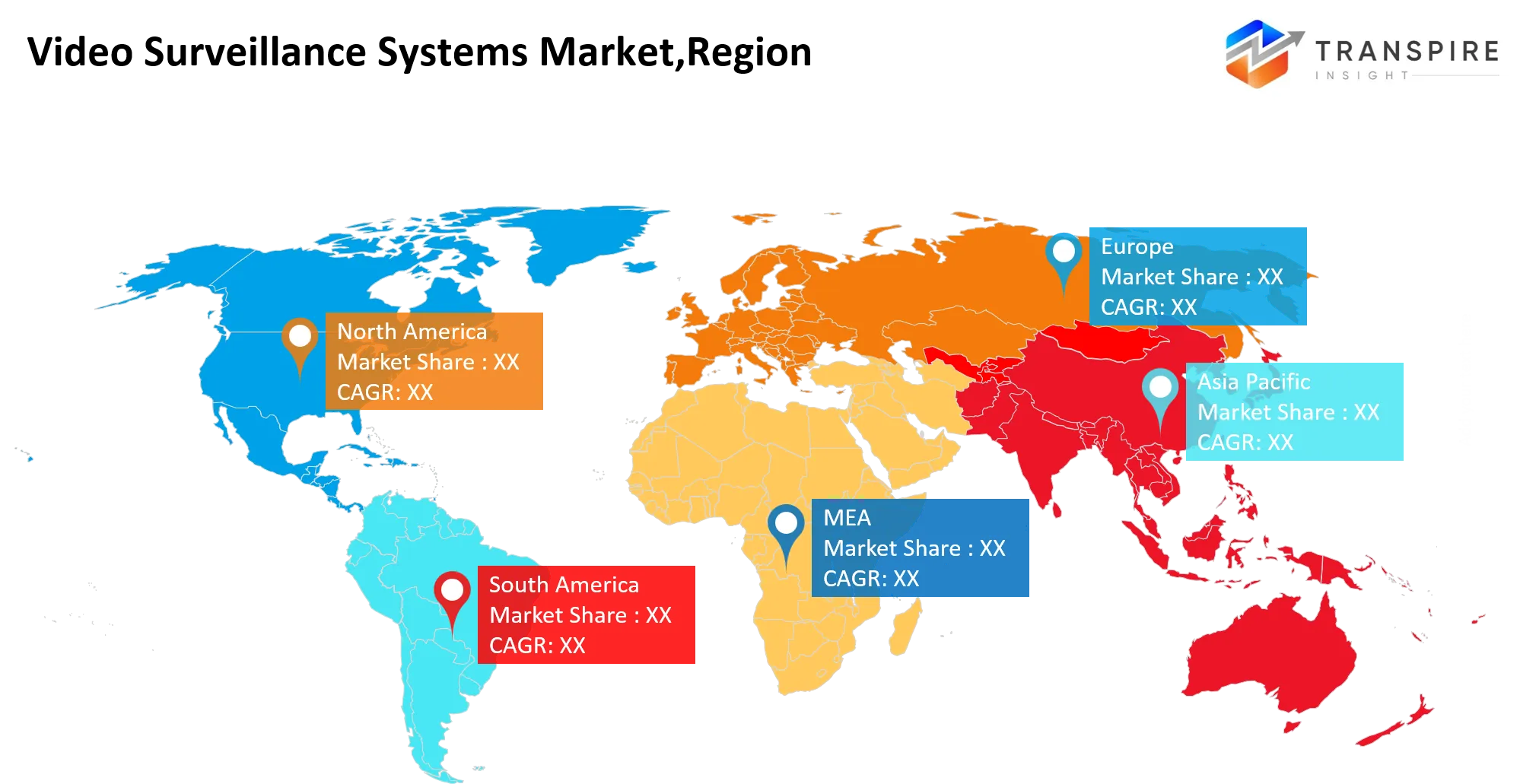
North America is the leading regional market, accounting for 31%. The leading position of North America is justified by existing security technology suppliers, developed enterprise infrastructure, and high adoption of network surveillance solutions. Companies in commercial, government, transportation, and critical infrastructure segments remain committed to installing innovative monitoring systems. Also, there is a developed environment for AI analytics, cloud technologies, and security solutions in the region. This enables companies to shift from traditional surveillance solutions to combined video and access control solutions with automated responses.
In September 2026, Axis Communications made a joint announcement regarding the deployment of a combined video surveillance and access control system for Rutherford Police Department in New Jersey, reflecting an increasing use of integrated surveillance technology in public safety applications.
https://newsroom.axis.com/en-us/press-release/rutherford-police
Europe
Europe constitutes 24% of the market share. The region is characterised by existing infrastructure for security purposes and modernisation of security surveillance systems in various business, transport, industry, and public sectors. Companies are more and more interested in integrating security features with secure data management and cybersecurity solutions. The existence of companies providing security technologies and systems also contributes to market stability due to replacement and upgrades of old surveillance systems.
In June 2026, Thames Valley Police, Genetec, CDS Systems and Hanwha Vision deployed an integrated CCTV solution that included AI-enabled cameras to enhance the performance of surveillance operations and video evidence examination.
https://www.genetec.com/customer-stories/thames-valley-police
Asia-Pacific
The Asia-Pacific region holds a 29% share in the market and is regarded as the fastest-growing region. Rapid growth in infrastructure development, urbanisation, industry development, and implementation of interconnected surveillance technologies is helping fuel demand in this region. Growth in the development of smart cities and commercial and industrial establishments is generating further need for advanced surveillance systems.
In August 2026, Axis Communications obtained its first QCVN certifications in Vietnam, allowing the company to deploy its network video surveillance technology in the Southeast Asian market.
https://newsroom.axis.com/en-sg/press-release/vietnam-qcvn-certification
Who are the Key Players in the video surveillance systems marketand how do they compete?
Competitiveness in the video surveillance systems industry is now defined by the use of AI, image resolution, edge computing, connectivity to the cloud, cybersecurity, and integration into larger security systems. Businesses compete using not only the camera hardware itself but also the analytics, management platforms, sensors, and other ecosystems. The emphasis of Axis Communications' competitiveness is technology innovation, networked surveillance, edge computing, and open integration. Axis released several models of AI-enabled cameras and multisensory products, including cameras for edge-based object detection and classification. The company aims to integrate high-resolution imaging with analytics and cybersecurity technologies, as well as third-party integration. Motorola Solutions, through its subsidiary Avigilon, is moving toward enterprise security platforms that include video surveillance. This company's strategy is based on the combination of video security, access control, visitor management, monitoring, and public safety workflows
Video Surveillance Systems Market companies
- Hikvision
- Dahua Technology
- Axis Communications
- Bosch Security
- Hanwha Vision
- Honeywell
- Johnson Controls
- Avigilon
- Motorola Solutions
- Panasonic
- Sony
- FLIR
- Vivotek
- Uniview
- Verkada
Recent Development News
In March 2026, Honeywell and Rhombus made an announcement about their cooperation that will unite cloud video management, access control, and AI-based security technology. According to the representatives of these companies, this integrated system should make security management easier and provide the expansion of cloud-connected building security systems.
In September 2025, Axis Communications introduced its new multisensory surveillance technologies such as AI-enabled bullet cameras, a bispectral PTZ camera, and radar technologies. These systems incorporate video surveillance, thermal imaging, radar, and edge analytics into one surveillance system
https://newsroom.axis.com/en-us/press-release/gsx-2025
What Strategic Insights Define the Future of the Video Surveillance Systems Market?
The future of the video surveillance systems market will be more intelligent and interconnected, with increasingly autonomous security infrastructure. Camera hardware will remain significant, yet differentiation in the industry will happen through analytics, edge computing, cloud-based management, cybersecurity, and connectivity to other operational systems. The key vulnerability of the technology will be its increasing connectivity and increasing attack surface of surveillance infrastructure, making cybersecurity a vital part of the system design, not just another feature to implement. Also, vendors will need to ensure that their analytics based on artificial intelligence work reliably under all possible conditions. An opportunity will be found in the convergence of surveillance, access control, environmental and traffic sensors, operational software, and similar elements. The product innovations by Axis Communications and Motorola Solutions already demonstrate this trend. As such, the vendors need to change their strategy from selling cameras to offering complete surveillance ecosystems comprised of reliable hardware, edge computing, secure connectivity, analytics, and management solutions.
By Component
- Hardware
- Software
- Services
- Storage
- Monitoring
- Installation
- Maintenance
- Others
By System
- IP Video Surveillance
- Analog Video Surveillance
- Hybrid Systems
- Network Cameras
- DVR Systems
- NVR Systems
- PTZ Systems
- Others
By Deployment
- On-premises
- Cloud-based
- Hybrid
- Edge-based
- Remote
- Mobile
- Centralized
- Others
By Application
- Indoor Surveillance
- Outdoor Surveillance
- Remote Monitoring
- Mobile Surveillance
- Access Control
- Traffic Monitoring
- Intrusion Detection
- Others
By End User
- Commercial
- Industrial
- Residential
- Government
- Transportation
- Healthcare
- Retail
- Others
By Camera Type
- Fixed
- PTZ
- Dome
- Bullet
- Thermal
- Panoramic
- Body-worn
- Others
By Technology
- AI-based
- Facial Recognition
- Object Detection
- Video Analytics
- Cloud Analytics
- Edge Analytics
- Thermal Imaging
- Others
Frequently Asked Questions
Find quick answers to common questions.
The video surveillance systems market size was valued at USD 57.25 billion in 2025 and is poised to reach USD 103.25 billion by 2033, expanding at a 7.67% CAGR.
Key segments for the video surveillance systems market are By Component (Hardware, Software, Services, Storage, Monitoring, Installation, Maintenance, Others); By System (IP Video Surveillance, Analog Video Surveillance, Hybrid Systems, Network Cameras, DVR Systems, NVR Systems, PTZ Systems, Others); By Deployment (On-premises, Cloud-based, Hybrid, Edge-based, Remote, Mobile, Centralized, Others); By Application (Indoor Surveillance, Outdoor Surveillance, Remote Monitoring, Mobile Surveillance, Access Control, Traffic Monitoring, Intrusion Detection, Others); By End User (Commercial, Industrial, Residential, Government, Transportation, Healthcare, Retail, Others); By Camera Type (Fixed, PTZ, Dome, Bullet, Thermal, Panoramic, Body-worn, Others); By Technology (AI-based, Facial Recognition, Object Detection, Video Analytics, Cloud Analytics, Edge Analytics, Thermal Imaging, Others)
Growth is primarily driven by increasing safety concerns, greater usage of AI-based surveillance technology, more smart city initiatives, rising real-time monitoring needs, and increased adoption of cloud video surveillance solutions.
The market is led by major manufacturers including Hikvision, Dahua Technology, Axis Communications, Bosch Security, Hanwha Vision, Honeywell, Johnson Controls, Avigilon, Motorola Solutions, Panasonic, Sony, FLIR, Vivotek, Uniview, and Verkada
North America holds 31% of the market for video surveillance systems, which is driven by adoption of high-end security technologies, deployment of AI-enabled cameras, increased remote monitoring requirements, and investments made in public and infrastructure security.
Opportunities in the international market of video surveillance systems encompass applications of artificial intelligence to video analytics, cloud-based surveillance systems, smart cities initiatives, remote surveillance, and the requirement for sophisticated cameras that have facial recognition and real-time threat detection capabilities.
- Hikvision
- Dahua Technology
- Axis Communications
- Bosch Security
- Hanwha Vision
- Honeywell
- Johnson Controls
- Avigilon
- Motorola Solutions
- Panasonic
- Sony
- FLIR
- Vivotek
- Uniview
- Verkada
About the Authors

Mayur Shinde
I am Mayur Shinde, a Senior Research Analyst at Transpire Insight, specializing in the Automotive & Transportation and Information & Communication Technology (ICT) Industry. My work focuses on analyzing emerging market trends, technological advancements, competitive landscapes, and industry developments to deliver accurate, data-driven insights. I am passionate about transforming complex market information into clear, actionable content that helps businesses, professionals, and decision-makers stay informed and make confident strategic decisions.

Chakradhar Khansole
Chakradhar serves as the Research Director at Transpire Insight, bringing over 8 years of experience in technology, innovation, and strategic market intelligence. He specializes in transforming complex market data into actionable business insights that enable organizations to make informed, growth-oriented decisions. Recognized for his strategic vision and analytical expertise, Chakradhar leads high-impact research initiatives, delivering comprehensive market assessments, competitive intelligence, and forward-looking industry analysis.
Recently Published Reports
-
Apr 2026
3D Optical Profiler Market
3D Optical Profiler Market Size, Share & Analysis Report By Type (Desktop 3D Optical Profiler, and Portable 3D Optical Profiler), By Technology (Confocal Technology, and White Light Interference), By End-Use Industry (Manufacturing, Research Institutions, Automotive, Aerospace and Defense, Medical Devices, and Other), and Geography (North America, Europe, Asia-Pacific, Middle East and Africa, South and Central America), 2021 - 2031
-
Apr 2026
Depth Sensor Market
Depth Sensor Market Size, Share & Analysis Report By Type (Infrared Depth Sensors, Time-of-Flight (ToF) Sensors, Stereo Vision Sensors, Structured Light Sensors, Ultrasonic Depth Sensors), By Application (Automotive, Robotics, Gaming, Consumer Electronics, Industrial Automation, Healthcare, Security & Surveillance, Others), By End Users (Automotive Manufacturers, Consumer Electronics Companies, Healthcare Providers, Industrial Companies, Security Agencies, Gaming Companies, Robotics Companies, Others), and Geography (North America, Europe, Asia-Pacific, Middle East and Africa, South and Central America), 2021 – 2031
-
Apr 2026
Digital Manufacturing Market
Digital Manufacturing Market Size, Share & Analysis Report By Component (Hardware, Software, and Services), By Technology (Robotics, 3D Printing, Internet of Things (IoT), and Others), By Application (Automotive and Transportation, Aerospace and Defense, Consumer Electronics, Industrial Machinery, and Others), By Process Type (Computer-Based Designing, Computer-Based Simulation, Computer 3D Visualization, Analytics, and Others), and Geography (North America, Europe, Asia-Pacific, Middle East and Africa, South and Central America), 2021 – 2031
-
Apr 2026
Digital Visa Services Market
Digital Visa Services Market Size, Share & Analysis Report By Type (Individual Travelers, Group Travelers), By Application (Tourism, Business Travel, Others), and Geography (North America, Europe, Asia-Pacific, Middle East and Africa, South and Central America), 2021 – 2031