
Global Perimeter Intrusion Detection and Prevention Market Size & Forecast:
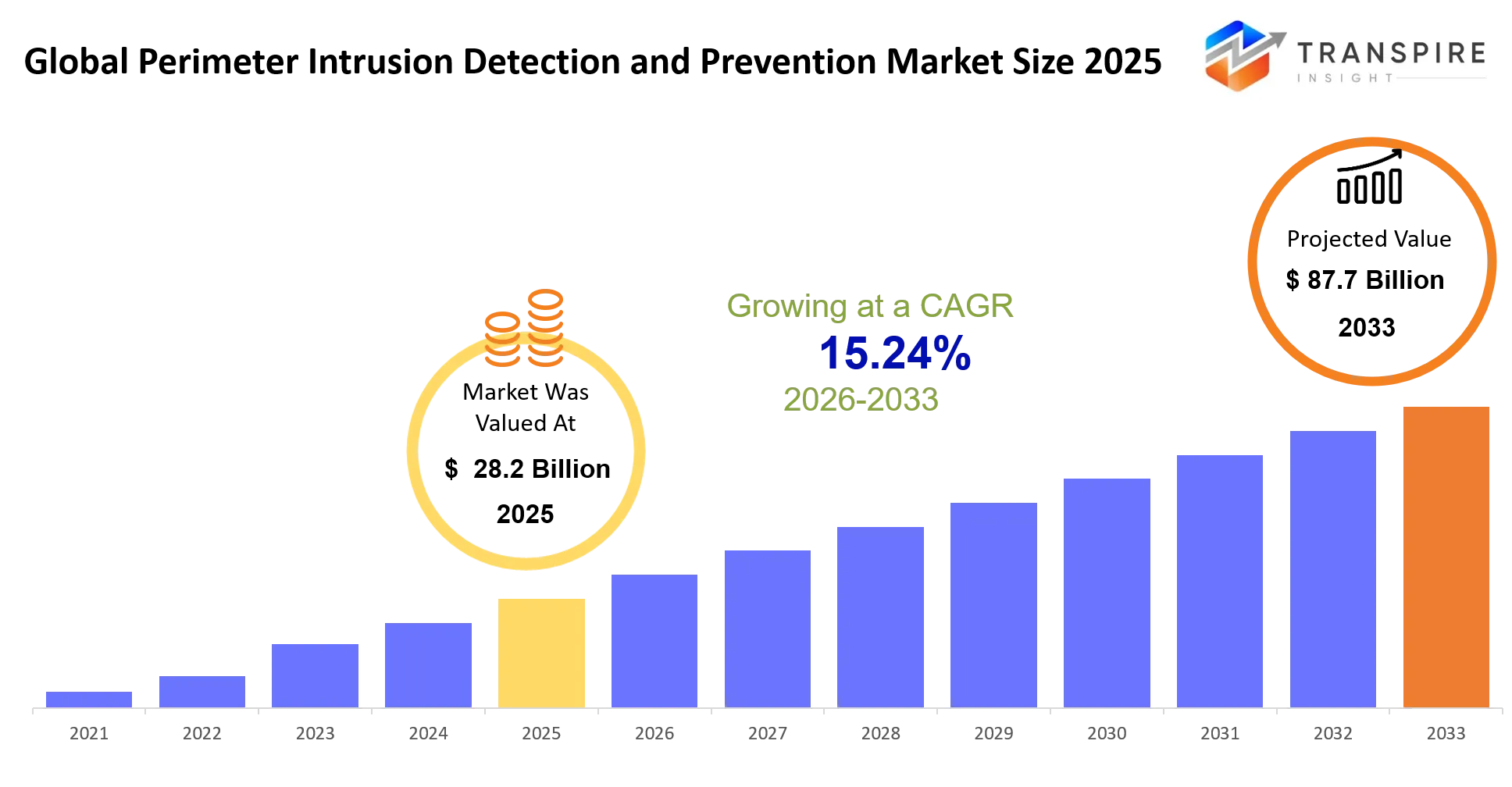
- Global Perimeter Intrusion Detection and Prevention Market Size 2025: USD 28.2 Billion
- Global Perimeter Intrusion Detection and Prevention Market Size 2033: USD 87.7 Billion
- Global Perimeter Intrusion Detection and Prevention Market CAGR: 15.24%
- Global Perimeter Intrusion Detection and Prevention Market Segments: By Type (Fence-mounted Sensors, Microwave Sensors, Infrared Barriers, Radar Systems, Fiber Optic Sensors, Video Surveillance Systems, Others); By Application (Military & Defense, Critical Infrastructure, Commercial Facilities, Industrial Sites, Airports, Others); By End-User (Government Agencies, Enterprises, Industrial Facilities, Others); By Technology (AI Video Analytics, Smart Sensors, Cloud Monitoring, Others)
Global Perimeter Intrusion Detection and Prevention Market Summary:
As per Transpire Insight Analysis, the Global Perimeter Intrusion Detection and Prevention Market size is estimated at USD 28.2 Billion in 2025 and is anticipated to reach USD 87.7 Billion by 2033, growing at a CAGR of 15.24% from 2026 to 2033.
This dynamic industry develops physical hardware and intelligent tracking layers designed to secure physical boundaries by stopping unauthorized trespassers before they access high-value zones. Over the past few years, the market has completely discarded simple standalone fences to undergo a structural technological shift toward integrated, multi-layered digital defenses. A major real-world trigger behind this growth is the severe escalation of unauthorized physical breaches, cross-border threats, and organized vandalism targeting isolated asset grids. Consequently - critical site operators are forced to replace slow, manual perimeter monitoring with intelligent, self-learning networks that combine radar systems, fiber-optic sensors, and real-time alerts to instantly process boundary threats without triggering costly nuisance alarms.
Key Market Insights:
The Global Perimeter Intrusion Detection and Prevention Market is fundamentally transitioning from static, reactive boundary fencing into intelligent, proactive decision-making ecosystems. By heavily fusing deep learning video analytics, multi-spectrum edge sensors, and cloud infrastructure, modern facilities are eliminating costly false alarms while compressing multi-point threat verification into instant, actionable real-time alerts.
- Locking down a staggering 59% global revenue share, the military and defense segment is moving past simple boundary wires to implement intelligent smart barriers, deploying advanced fiber-optic and ground-based radar configurations to secure vast, remote cross-border zones.
- The AI video analytics technology sector represents the undisputed market accelerator, charging ahead at a blistering 15.2% CAGR as facility security managers aggressively swap old analog CCTV networks for intelligent edge cameras that classify loitering, climbing, and cutting.
- Commanding an authoritative 38% market slice, North America continues its revenue dominance by pushing heavy federal and military infrastructure spending into multi-ring, AI-powered perimeter defense frameworks across highly restricted capital complexes.
- Capturing a highly stable 28% of worldwide revenue, the European theater relies heavily on strict national security regulations and critical infrastructure protection acts, driving regional utility networks to mandate automated, double-knock intrusion verification pipelines.
- Accelerating as the fastest-growing geographical market with an explosive 14.1% CAGR, the Middle East and Africa region is rapidly expanding its high-end security tech spend to protect massive smart cities, dense oil and gas arrays, and localized sovereign assets.
- Securing 14% of the global market footprint, critical infrastructure facilities are rapidly phasing out isolated security nodes, partnering with developers like Axis Communications to integrate 60 GHz radar-video fusion cameras that track target speed, angle, and path in dense fog or pitch darkness.
- Representing 10% of total industry demand, the commercial facilities segment is pivoting toward cloud-connected monitoring setups, integrating Honeywell's intelligent building platforms to manage multi-site retail and enterprise boundaries from a single unified security operations center.
- Claiming an 8% market share, heavy industrial sites are aggressively deploying ruggedized fiber-optic sensors, utilizing Senstar’s next-generation embedded fiber architectures and advanced Sensor Fusion Engines to instantly filter out wind-driven fence vibrations from actual intrusion attempts.
- Accounting for 4% of total procurement volume, global airports are building continuous, long-range buffer zones beyond the perimeter fence line, combining Southwest Microwave's digital microwave barriers with automated PTZ tracking cameras to shut down unauthorized airfield entry before a breach occurs.
What are the Key Drivers, Restraints, and Opportunities in the Global Perimeter Intrusion Detection and Prevention Market?
Driver
The market is expanding rapidly due to the commercial transition toward sensor-fused, multi-layered boundary intelligence that replaces legacy hardware-defined fences. Traditional video motion grids are highly susceptible to environmental noise, producing overwhelming false-alarm rates that paralyze security operators. This shift was triggered by the sudden necessity to safeguard isolated critical infrastructure nodes, such as energy pipelines and grid substations, against coordinated sabotage and physical cross-border incursions. This operational urgency drives massive software and smart-hardware adoption as global industrial operators aggressively scale up automated edge analytics to capture incoming real-time threats before a physical breach occurs.
In June 2026, security technology developer SaverOne signed a formal Pilot Cooperation Agreement with electronic perimeter protection provider RBtec to integrate its proprietary radio-frequency sensing technology into fence alarm infrastructures. This targeted technological deployment allows security systems to detect, locate, and analyze unauthorized mobile cell footprints under severe weather conditions where standard optical cameras and line-of-sight sensors face complete visual failure.
Restraint
High upfront capital installation costs combined with a widening field integration skills gap persistently restrain profit margins for commercial facilities. Deploying a resilient perimeter network requires heavy initial outlays for ground radar, thermal arrays, and buried microphonic cables, alongside extensive trenching and structural wiring. This bottleneck persists because local systems integrators often lack the specialized engineering expertise required to properly tune complex sensor-fusion algorithms across vast, irregular topographies, leading to long project delays and recurring operational error rates.
Opportunity
The most lucrative growth window lies in the operational convergence of autonomous commercial drone infrastructure with existing ground-based border sensor stacks. Fusing beyond visual line-of-sight (BVLOS) drone patrols with fence-mounted microphonic sensors empowers critical facilities to automatically launch airborne first-responder units to verify alerts. This paradigm shift unlocks massive procurement streams from hyperscale data center clusters and remote mining arrays seeking to replace slow human guard patrols with closed-loop, automated aerial verification systems.
What Has the Impact of Artificial Intelligence Been on the Global Perimeter Intrusion Detection and Prevention Market?
Artificial intelligence is fundamentally rewiring how security operations teams secure physical boundaries. Rather than relying on simple, blind tripwires or staring at rows of video monitors, defense forces and facility managers now deploy machine learning algorithms to process raw boundary data at the edge. AI deeply optimizes detection by providing reliable classification and predictive capability. Neural networks can ingest live feeds from thermal cameras, ground radar, and fence-mounted fiber-optic sensors to instantly distinguish a human intruder, climbing action, or moving vehicle from harmless environmental noise like blowing debris, heavy wind, or roaming wildlife. By fusing multiple sensor signals together, AI automates the threat verification process—instantly commanding motorized pan-tilt-zoom (PTZ) cameras to lock onto and track a specific suspect's speed and direction while filtering out 95% of the nuisance alarms that cause severe operator fatigue.
However, a major limitation remains the multi-sensor integration and accuracy gap in unpredictable, highly complex environments. In dense, cluttered industrial zones containing heavy moving machinery or sudden steam releases, AI tracking systems can still suffer from momentary target confusion, necessitating continuous software tuning.
In July 2025, AI security analytics developer Scylla announced a strategic technology partnership with Hanwha Vision to integrate its advanced AI threat detection directly into Hanwha's multi-sensor cameras powered by the NVIDIA Jetson edge computing platform. This specialized software deployment enables high-performance perimeter intrusion detection and real-time behavior analytics right at the camera level, allowing remote physical infrastructures to run advanced visual models locally without needing large backend server farms.
Key Market Trends:
Instead of treating physical perimeters as dumb structural boundaries, organizations are converting fencing lines into active data nodes through multi-sensor algorithmic fusion. This operational shift successfully eliminates isolated security alerts—replacing standalone camera grids with intelligent, multi-layered decision frameworks that automatically validate potential breaches.
- Security operational commands are systematically abandoning legacy single-technology alerts to deploy double-knock verification routines that require both radar tracking lines and visual cameras to confirm a target simultaneously.
- The widespread industry transition toward 60 GHz radar-video fusion devices allows site operators to track target coordinates, speed, and approach angle continuously through thick smoke, heavy rain, or complete darkness.
- Critical site infrastructure teams are replacing standard fence tripwires with optical time-domain reflectometry via distributed acoustic sensors (DAS) to pinpoint precise cut or climb locations along vast property perimeters.
- Boutique and commercial facilities are dropping expensive localized security server layouts to adopt edge-intelligent IP cameras that handle complex pattern recognition and behavior logging right at the camera level.
- Instead of deploying permanent human guards to manually investigate boundary sensor disturbances, enterprises are setting up automated triggers that immediately launch autonomous security drones to verify remote alerts.
- Traditional perimeter layout strategies are actively shifting to combat low-radar-cross-section threats by layering radio frequency spectrum monitoring with micro-radar units to stop unauthorized aerial drone intrusions.
- Global facility operators are heavily transitioning toward unified command interfaces, using open platform common operating software to aggregate low-level sensor analytics and video feeds onto a single pane of glass.
Global Perimeter Intrusion Detection and Prevention Market Segmentation
By Type
Fence-mounted sensors and video surveillance systems hold the commanding revenue shares, functioning as the primary structural pillars of boundary security worldwide. Concurrently, radar systems and fiber optic sensors are emerging as the most disruptive and rapidly expanding technology types. The unique growth logic driving this segment is the absolute operational necessity to eliminate the blind spots and high false-alarm rates inherent to standalone legacy fences. Fiber optic sensors excel by transforming entire boundary perimeters into continuous microphonic listening arrays, while radar systems provide wide-area, long-range volumetric tracking that detects intruders long before they reach a physical barrier. Moving forward, the boundary between physical sensors and visual verification will dissolve completely. System designers will be forced to natively integrate multi-sensor edge processing directly into standard sensor nodes, enabling perimeter hardware to instantly confirm a threat and direct thermal tracking cameras to the exact coordinate of a disturbance without human intervention.
By Application
Military & defense represents the undisputed heavyweight application pocket, locking down an authoritative 59% share of all global revenue. Critical infrastructure follows at 14%, while commercial facilities secure 10%, industrial sites claim 8%, and airports account for 4%. This heavy financial concentration remains ironclad because sovereign borders, military staging grounds, and high-security defense installations require continuous, zero-fail boundary enforcement against state-level and asymmetrical threats. However, the true technological accelerator is the critical infrastructure segment, where utility providers are rapidly upgrading physical perimeters to counter rising tactical sabotage. Looking ahead, perimeter protection platforms must execute a dual-product fulfillment architecture. They must engineer ruggedized, military-grade long-range systems capable of tracking fast-moving, low-profile threats across harsh cross-border environments, while simultaneously distributing highly optimized, low-nuisance systems tailored for commercial and urban facilities that require discrete, zero-footprint boundary protection.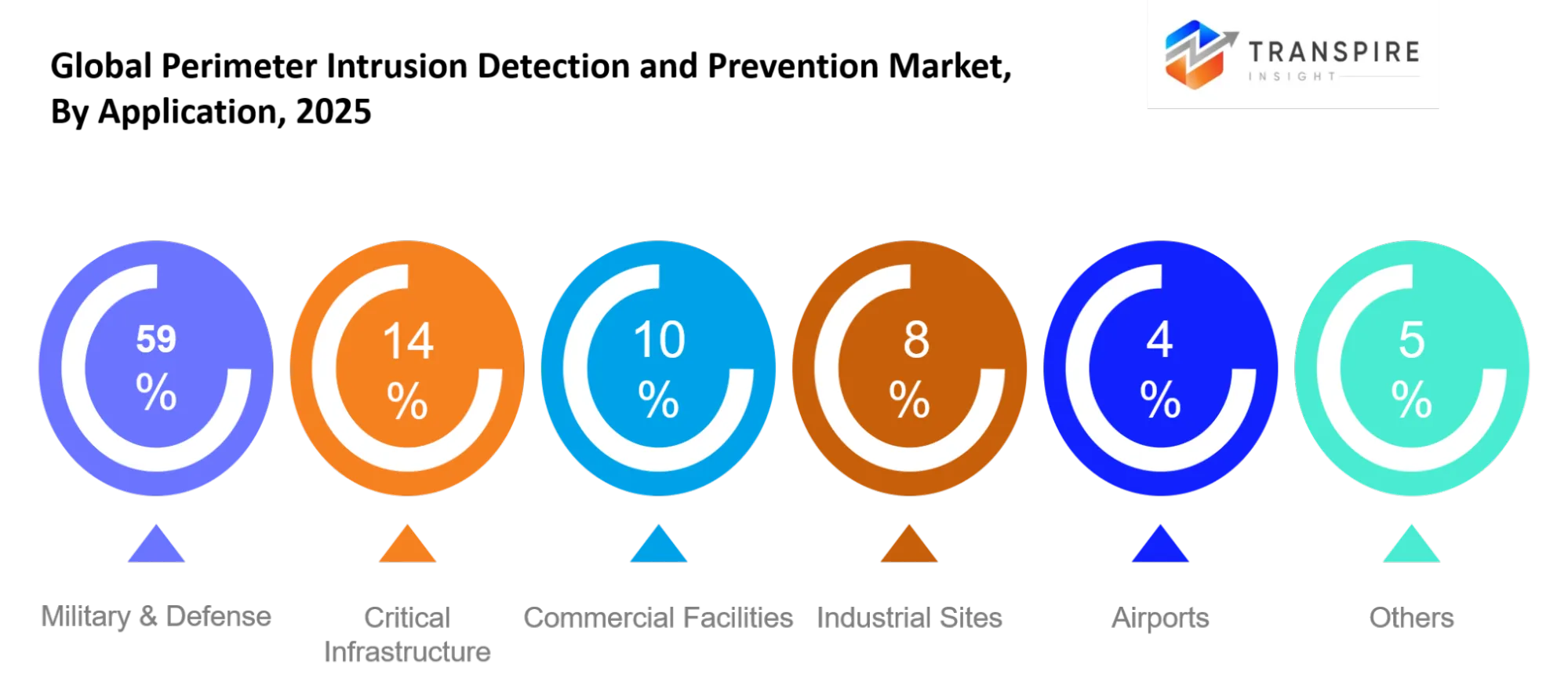
By End-User
Government agencies act as the foundational financial anchors of day-to-day market procurement because their entire operational mandate relies on securing national borders, military bases, and civic capital assets. Concurrently, large commercial enterprises and industrial facilities are escalating their purchasing volumes as critical high-growth consumers. This market distribution is shifting rapidly as private enterprises—specifically operators of hyperscale data centers, logistics hubs, and hazardous material industrial sites—realize that a single perimeter breach can result in catastrophic operational downtime and intellectual property loss. Moving forward, perimeter hardware providers will find it impossible to capture long-term market share by merely selling standalone physical barriers or separate cameras. Sustainable commercial success will require providing fully bundled, unified subscription-ready platforms, wrapping the core sensing hardware together with automated edge AI, automated aerial drone dispatch protocols, and cloud-hosted common operating software.
By Technology
Smart sensors and cloud monitoring hold a major portion of the operational footprint, but AI video analytics represents the undisputed market accelerator, charging ahead at a blistering 15.2% CAGR. The growth logic here is entirely driven by the transition from passive recorded evidence to active real-time threat prevention. Legacy perimeter setups fail because security personnel cannot reliably monitor dozens of raw video feeds simultaneously, leading to human fatigue and missed breaches. AI video analytics resolves this structural vulnerability by operating as an unblinking digital guard that continuously runs object classification models directly at the edge. Looking ahead, software providers will be forced to move past simple motion and line-crossing rules. Future market dominance will belong to platforms that utilize predictive agentic AI models capable of assessing behavioral intent—such as recognizing pre-incident loitering patterns and casing behaviors—to automatically harden security layers before an actual breach attempt begins.
What are the Key Use Cases Driving the Global Perimeter Intrusion Detection and Prevention Market?
The dominant deployment of boundary security infrastructure centers heavily on the fortification of remote military installations and international border defense lines. In these highly strategic environments, operators utilize multi-layered configurations of buried fiber-optic distributed acoustic sensors (DAS) and long-range ground radars to establish continuous, unblinking tactical surveillance loops that can automatically detect, pinpoint, and track hostile cross-border movements or stealthy manual cutting attempts across thousands of miles of rough, unlit terrain.
Beyond traditional military deployment, applications are rapidly expanding across high-value critical infrastructure sectors, specifically targeting hyperscale data centers, major electrical substations, and regional airport airfields. Facility managers are actively integrating 60 GHz radar-video fusion systems and digital microwave barriers to protect expansive open grounds from coordinated vandalism, copper theft, and physical sabotage, using these overlapping sensor layers to instantly auto-zoom PTZ cameras onto targets.
Emerging use cases are gaining significant traction in dense urban and high-security industrial processing sites through the deployment of agentic AI video analytics and autonomous aerial drone networks. Instead of relying on slow, reactive human guard patrols to check vast physical boundaries, modern industrial facilities use smart sensors to automatically launch beyond visual line-of-sight (BVLOS) drones to rapidly investigate and verify perimeter alarms, shifting the facility's security posture into a fully automated, closed-loop threat confirmation cycle.
|
Report Metrics |
Details |
|
Market size value in 2025 |
USD 28.2 Billion |
|
Market size value in 2026 |
USD 32.5 Billion |
|
Revenue forecast in 2033 |
USD 87.7 Billion |
|
Growth rate |
CAGR of 15.24% from 2026 to 2033 |
|
Base year |
2025 |
|
Historical data |
2021 - 2024 |
|
Forecast period |
2026 - 2033 |
|
Report coverage |
Revenue forecast, competitive landscape, growth factors, and trends |
|
Regional scope |
United States; Canada; Mexico; United Kingdom; Germany; France; Italy; Spain; Denmark; Sweden; Norway; China; Japan; India; Australia; South Korea; Thailand; Brazil; Argentina; South Africa; Saudi Arabia; United Arab Emirates |
|
Key company profiled |
Honeywell, Bosch Security, Axis Communications, Senstar, Southwest Microwave, OPTEX, RBtec, FLIR Systems, Johnson Controls, Fiber SenSys, CIAS Elettronica, Raytheon, Magal Security Systems, Hikvision, Dahua Technology |
|
Customization scope |
Free report customization (country, regional & segment scope). Avail customized purchase options to meet your exact research needs. |
|
Report Segmentation |
By Type (Fence-mounted Sensors, Microwave Sensors, Infrared Barriers, Radar Systems, Fiber Optic Sensors, Video Surveillance Systems, Others); By Application (Military & Defense, Critical Infrastructure, Commercial Facilities, Industrial Sites, Airports, Others); By End-User (Government Agencies, Enterprises, Industrial Facilities, Others); By Technology (AI Video Analytics, Smart Sensors, Cloud Monitoring, Others) |
Which Regions Are Driving the Global Perimeter Intrusion Detection and Prevention Market Growth?
The North American region maintains a commanding grip on the Global Perimeter Intrusion Detection and Prevention Market, capturing a dominant 38% of all worldwide industry revenue. This geographic hegemony is heavily driven by a massive concentration of high-security federal facilities, aerospace defense hubs, and extensive critical asset infrastructure operating across the United States and Canada. The regional ecosystem is structurally supported by aggressive regulatory updates from bodies like the North American Electric Reliability Corporation (NERC), which mandate strict physical boundary protections for utility grids. Consequently, integrating multi-layered, sensor-fused defense barriers has become an absolute operational mandate for North American site managers seeking to eliminate unauthorized access vulnerabilities before breaches manifest.
Europe serves as a highly stable, predictable secondary pillar for the global market, locking down an essential 28% share of total industry demand. While the North American market concentrates heavily on federal spending and strict electrical grid protection mandates, European system adoption is driven entirely by its massive commercial enterprise networks and extensive regional transportation logistics clusters. This regional market stability is structurally insulated by rigid cross-border monitoring guidelines and strict national infrastructure security policies that force private logistics hubs and storage operators to deploy continuous, perimeter-wide tracking frameworks. To maintain strict corporate liability compliance and streamline localized alarm verification, European firms steadily contract for integrated, multi-tier perimeter networks equipped with edge-intelligent IP cameras. In January 2026, network video pioneer Axis Communications elevated mission-critical surveillance at Intersec Dubai by introducing its unified AXIS D2123-VE 60 GHz radar device fused directly with long-range PTZ camera configurations. This targeted technological launch specifically addresses European commercial and transport infrastructure requirements, utilizing automated double-knock verification routines that require both radar tracking streams and visual cameras to confirm a target concurrently, thereby slashing false alert overheads across complex regional perimeters.
The Middle East and Africa region has emerged as the fastest-growing territory globally, accelerating at a market-leading 14.1% CAGR while securing a critical 12% of the overall market revenue footprint. This sudden structural shift is driven by explosive megacity infrastructure investments, large-scale oil and gas pipeline developments, and an intense regional push to secure sprawling sovereign boundaries across extreme desert climates. Historically, this region relied on traditional physical masonry walls and standard human guard patrols, but it has now rapidly pivoted into an aggressive consumer of high-end, automated electronic boundary tech. Looking ahead, future procurement in this booming corridor relies entirely on deploying massively scalable, ruggedized distributed acoustic sensing arrays and micro-radar networks capable of running real-time behavior analytics under brutal heat and sandstorm conditions.
In June 2026, perimeter protection provider OPTEX officially launched its TXI Series outdoor intrusion detection sensors, incorporating a patent-pending Triple AND Logic processing engine designed to resist intense thermal shifts. This specialized hardware deployment explicitly targets the rapidly expanding Middle Eastern urban asset protection sector, allowing site operators to establish high-mount, narrow curtain barriers along complex structural facades that accurately classify human movement while completely filtering out the blinding glare, sand drift, and wildlife anomalies common to the region.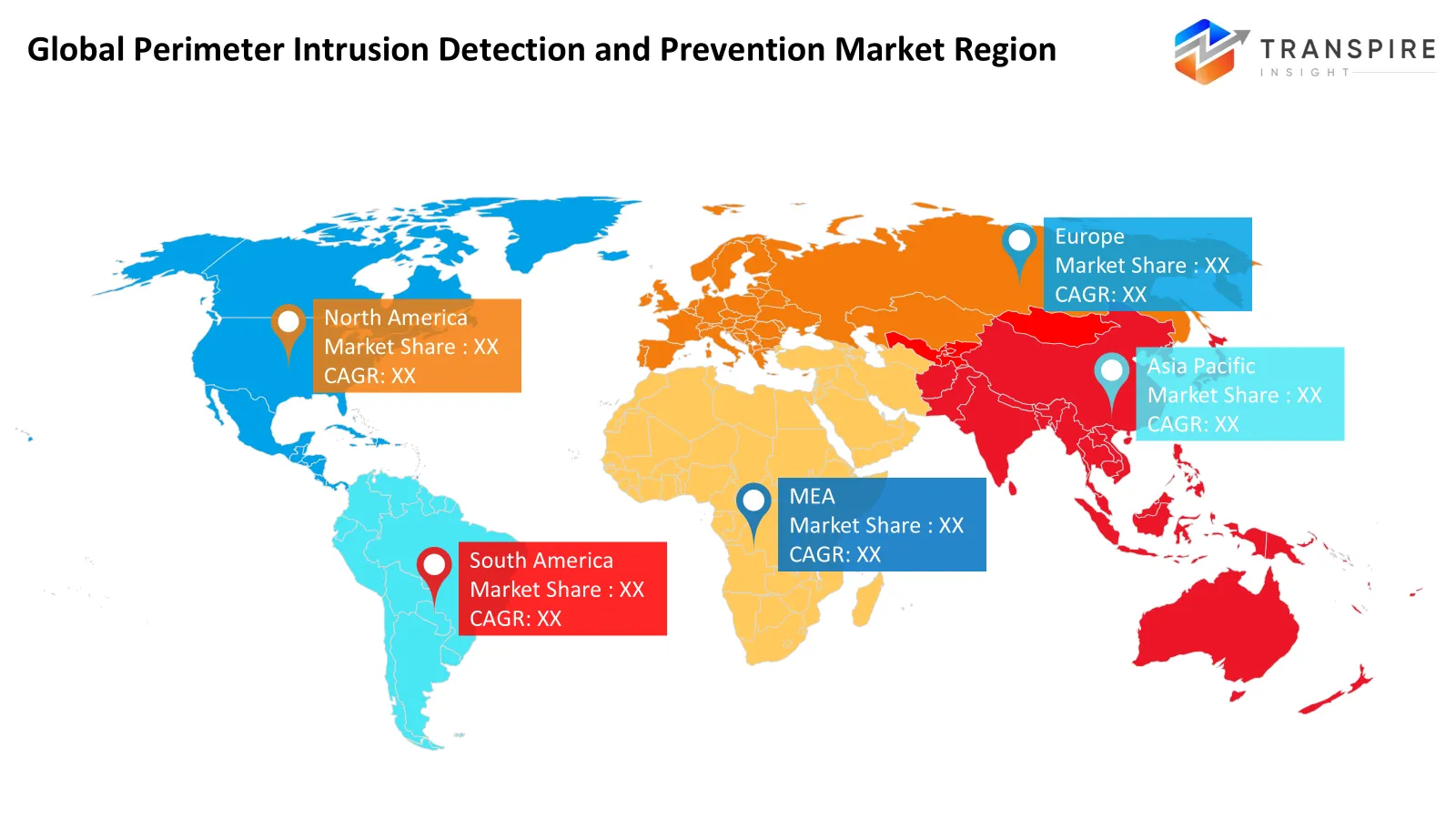
Who are the Key Players in the Perimeter Intrusion Detection and Prevention Market and how do they Compete?
The Global Perimeter Intrusion Detection and Prevention Market features intense competition driven by the urgent need to minimize false alarms while maximizing threat capture rates. Industry participants compete primarily on open-platform software flexibility, multi-sensor hardware fusion capabilities, and edge-intelligence depth rather than basic hardware pricing structures.
Axis Communications utilizes a relentless technological innovation strategy, differentiating itself through the deployment of edge-based AI micro-radar devices fused with thermal imaging cameras. Their unique differentiation lies in executing high-accuracy object classification directly on the camera node via its advanced processors, eliminating expensive centralized server processing fees. Axis pursues aggressive expansion by embedding its proprietary AXIS Perimeter Defender suite into distributed logistics networks and commercial smart city frameworks globally.
Senstar Technologies executes a specialized niche differentiation strategy - anchoring its portfolio around premium distributed fiber-optic acoustic sensing (DAS) networks. Senstar differentiates its market position by leveraging an advanced Sensor Fusion Engine that correlates microphonic fence data with video tracking parameters to deliver zero-fail protection. The company expands its global operational footprint through high-security government tenders - targeting long-term maintenance contracts across remote electrical grids, correction facilities, and strategic energy pipelines.
Company List
- Honeywell
- Bosch Security
- Axis Communications
- Senstar
- Southwest Microwave
- OPTEX
- RBtec
- FLIR Systems
- Johnson Controls
- Fiber SenSys
- CIAS Elettronica
- Raytheon
- Magal Security Systems
- Hikvision
- Dahua Technology
Recent Development News
In September 2025, Optex Co., Ltd. globally launched its REDSCAN Lite indoor laser scan and LiDAR sensor infrastructure. This high-performance product launch allows system integrators to establish highly accurate, customizable volumetric boundary lines across critical commercial and indoor logistic facilities, enabling instantaneous threat profiling without requiring extensive manual software configuration. [https://www.optexpinnacle.com
In January 2026, security innovation leader Axis Communications officially introduced the AXIS X1100 Explosion-Protected PTZ Camera alongside its integrated 60 GHz radar-video fusion arrays at Intersec Dubai. This specialized hardware deployment provides critical energy, oil, and gas processing sites with a ruggedized, marine-grade surveillance platform certified for Zone 1 hazardous environments, allowing automated tracking and early smoke or threat detection in extreme industrial settings. [https://www.cxoinsightme.com
What Strategic Insights Define the Future of the Perimeter Intrusion Detection and Prevention Market?
The market is rapidly heading toward a decentralized architecture where sensor-fused edge intelligence, rather than localized command software, acts as the primary decision-maker. One massive hidden risk facing this transition is the emergence of AI-adversarial physical bypass vectors, where intruders utilize specialized low-radar-cross-section materials or generative heat-masking textiles to easily blend into environmental background noise and completely deceive edge classification networks. Concurrently, an outstanding emerging opportunity lies in integrating localized radio frequency (RF) spectrum monitoring arrays to intercept unauthorized drone telemetry lines before an airborne breach occurs. Strategically, manufacturers and systems integrators must immediately pivot away from selling standalone physical sensors. To capture long-term high-margin procurement contracts, companies must shift to delivering subscription-ready common operating platforms that natively combine ground-based acoustic data, optical classification, and automated counter-UAS (unmanned aerial systems) protocols on a single, unified plane of glass.
Key Segmentations are:
By Type
- Fence-mounted Sensors
- Microwave Sensors
- Infrared Barriers
- Radar Systems
- Fiber Optic Sensors
- Video Surveillance Systems
- Others
By Application
- Military & Defense
- Critical Infrastructure
- Commercial Facilities
- Industrial Sites
- Airports
- Others
By End-User
- Government Agencies
- Enterprises
- Industrial Facilities
- Others
By Technology
- AI Video Analytics
- Smart Sensors
- Cloud Monitoring
- Others
Regional Outlook
North America
- United States
- Canada
- Mexico
Europe
- Germany
- United Kingdom
- France
- Spain
- Italy
- Rest of Europe
Asia Pacific
- Japan
- China
- Australia & New Zealand
- South Korea
- India
- Rest of Asia Pacific
South America
- Brazil
- Argentina
- Rest of South America
Middle East & Africa
- Saudi Arabia
- United Arab Emirates
- South Africa
- Rest of the Middle East & Africa
Frequently Asked Questions
Find quick answers to common questions.
The Global Perimeter Intrusion Detection and Prevention Market size was valued at USD 28.2 Billion in 2025 and is poised to reach USD 87.7 Billion by 2033, expanding at a 15.24% CAGR.
Key segments for the Global Perimeter Intrusion Detection and Prevention Market are Type (Fence-mounted Sensors, Microwave Sensors, Infrared Barriers, Radar Systems, Fiber Optic Sensors, Video Surveillance Systems, Others), Application (Military & Defense, Critical Infrastructure, Commercial Facilities, Industrial Sites, Airports, Others), End-User (Government Agencies, Enterprises, Industrial Facilities, Others), and Technology (AI Video Analytics, Smart Sensors, Cloud Monitoring, Others).
Growth is primarily driven by the commercial transition toward sensor-fused, multi-layered boundary intelligence that replaces legacy hardware-defined fences, the operational urgency to secure isolated critical infrastructure nodes against coordinated sabotage or physical cross-border incursions, and the rapid deployment of high-accuracy edge AI analytics that drastically minimize the false-alarm rates paralyzing security operators.
The global market is led by major manufacturers including Honeywell, Bosch Security, Axis Communications, Senstar, Southwest Microwave, OPTEX, RBtec, FLIR Systems, Johnson Controls, Fiber SenSys, CIAS Elettronica, Raytheon, Magal Security Systems, Hikvision, and Dahua Technology.
North America holds a dominant 38% revenue share of the global market. This dominance is driven by an intense concentration of high-security federal complexes, aerospace defense hubs, and extensive critical asset infrastructure alongside aggressive regulatory update mandates from bodies like NERC that require automated, zero-fail boundary enforcement layers.
High-margin commercial opportunities lie in the global operational convergence of autonomous security drone infrastructure with existing ground-based border sensor stacks, allowing beyond visual line-of-sight (BVLOS) drones to execute automated alert verification. Additionally, substantial revenue pathways exist in integrating localized radio frequency (RF) spectrum monitoring arrays to detect and intercept unauthorized aerial drone telemetry lines before a perimeter breach occurs.
- Honeywell
- Bosch Security
- Axis Communications
- Senstar
- Southwest Microwave
- OPTEX
- RBtec
- FLIR Systems
- Johnson Controls
- Fiber SenSys
- CIAS Elettronica
- Raytheon
- Magal Security Systems
- Hikvision
- Dahua Technology
About the Authors

Tejashri Dhatrak
I am Tejashri Dhatrak, a Senior Research Analyst at Transpire Insight, specializing in the Aerospace and Defence sector. My work focuses on analyzing industry trends, defence technologies, market developments, and emerging innovations that shape the global aerospace and security landscape. At Transpire Insight, I research complex topics, evaluate credible sources, and transform technical insights into accurate, well-structured, and easy-to-understand content for industry professionals and decision-makers. My goal is to provide reliable, research-backed information that helps readers stay informed about defence capabilities, aerospace advancements, strategic developments, and the evolving dynamics of the global defence ecosystem.

Chakradhar Khansole
Chakradhar serves as the Research Director at Transpire Insight, bringing over 8 years of experience in technology, innovation, and strategic market intelligence. He specializes in transforming complex market data into actionable business insights that enable organizations to make informed, growth-oriented decisions. Recognized for his strategic vision and analytical expertise, Chakradhar leads high-impact research initiatives, delivering comprehensive market assessments, competitive intelligence, and forward-looking industry analysis.
Recently Published Reports
-
Apr 2026
Aerospace Fluoropolymers Market
Aerospace Fluoropolymers Market Size, Share & Analysis Report By Type (PTFE, FEP, PFA, ETFE, and Others), By Application (Electrical Insulation, Seals & Gaskets, Coatings, and Others), By End User (Commercial Aviation, Military Aviation, General Aviation, and Others), and Geography (North America, Europe, Asia-Pacific, Middle East and Africa, South and Central America), 2021 - 2031
-
Apr 2026
Airborne SATCOM System Market
Airborne SATCOM System Market Size, Share & Analysis Report By Type (SATCOM Terminals, Transceivers, Airborne Radio, Modems and Routers, SATCOM Radomes, and Other), By Application (Government and Defense and Commercial), and Geography (North America, Europe, Asia-Pacific, Middle East and Africa, South and Central America), 2021 – 2031
-
Apr 2026
Ship Leasing Market
Ship Leasing Market Size, Share & Analysis Report By Vessel Type (Container Ships, Bulk Carriers, Tankers, and Specialized Vessels), By Lease Duration (Short-Term Lease (Less than 1 year), Medium-Term Lease (1-5 years), and Long-Term Lease (More than 5 years)), By Lease Type (Bareboat Charter, Time Charter, Financial Lease, and Others), By End-User Industry (Oil and Gas, Manufacturing and Industrial, Automotive, Agriculture and Food, Retail and Consumer Goods, and Others), and Geography (North America, Europe, Asia-Pacific, Middle East and Africa, South and Central America), 2021 – 2031
-
Apr 2026
Thread Rolling Dies Market
Thread Rolling Dies Market Size, Share & Analysis Report By Type (Flat Thread Rolling Dies, Circular (Cylindrical) Dies, Tangential Thread Rolling Dies, Planetary Thread Rolling Dies, and Other Types), By Material Type (High-Speed Steel (HSS), Carbide, Tool Steel, Alloy Steel, and Other Specialized Alloys), By Distribution Channel (Direct Sales, Distributors and Dealers, and Online Platforms), By Application (Automotive Industry, Aerospace and Defense, Construction and Infrastructure, Industrial Machinery, Electronics and Electrical Components, Medical Devices, and Fastener Production), and Geography (North America, Europe, Asia-Pacific, Middle East and Africa, South and Central America), 2021 – 2031
Our Clients