
United Kingdom Physical Security Market Size & Forecast:
- United Kingdom Physical Security Market Size 2025: USD 7.29 Billion
- United Kingdom Physical Security Market Size 2033: USD 12.81 Billion
- United Kingdom Physical Security Market CAGR: 7.31%
- United Kingdom Physical Security Market Segments: By Component (Video Surveillance Systems, Access Control Systems, Intrusion Detection Systems, Perimeter Security Systems, Security Alarms, Biometrics Systems, Visitor Management Systems, Others); By Deployment (On-premise Security Systems, Cloud-based Security Systems, Hybrid Security Systems, Edge-based Security Systems, Mobile-integrated Security, Others); By Application (Commercial Buildings, Government Facilities, Industrial Sites, Residential Properties, Transportation Hubs, Educational Institutions, Healthcare Facilities, Others); By Technology (AI-enabled Surveillance, Biometric Access Control, IoT-integrated Security, Facial Recognition Systems, Smart Sensors, Video Analytics, Others); By End User (Government Sector, BFSI, Healthcare, Retail, Transportation, Manufacturing, Hospitality, Others)
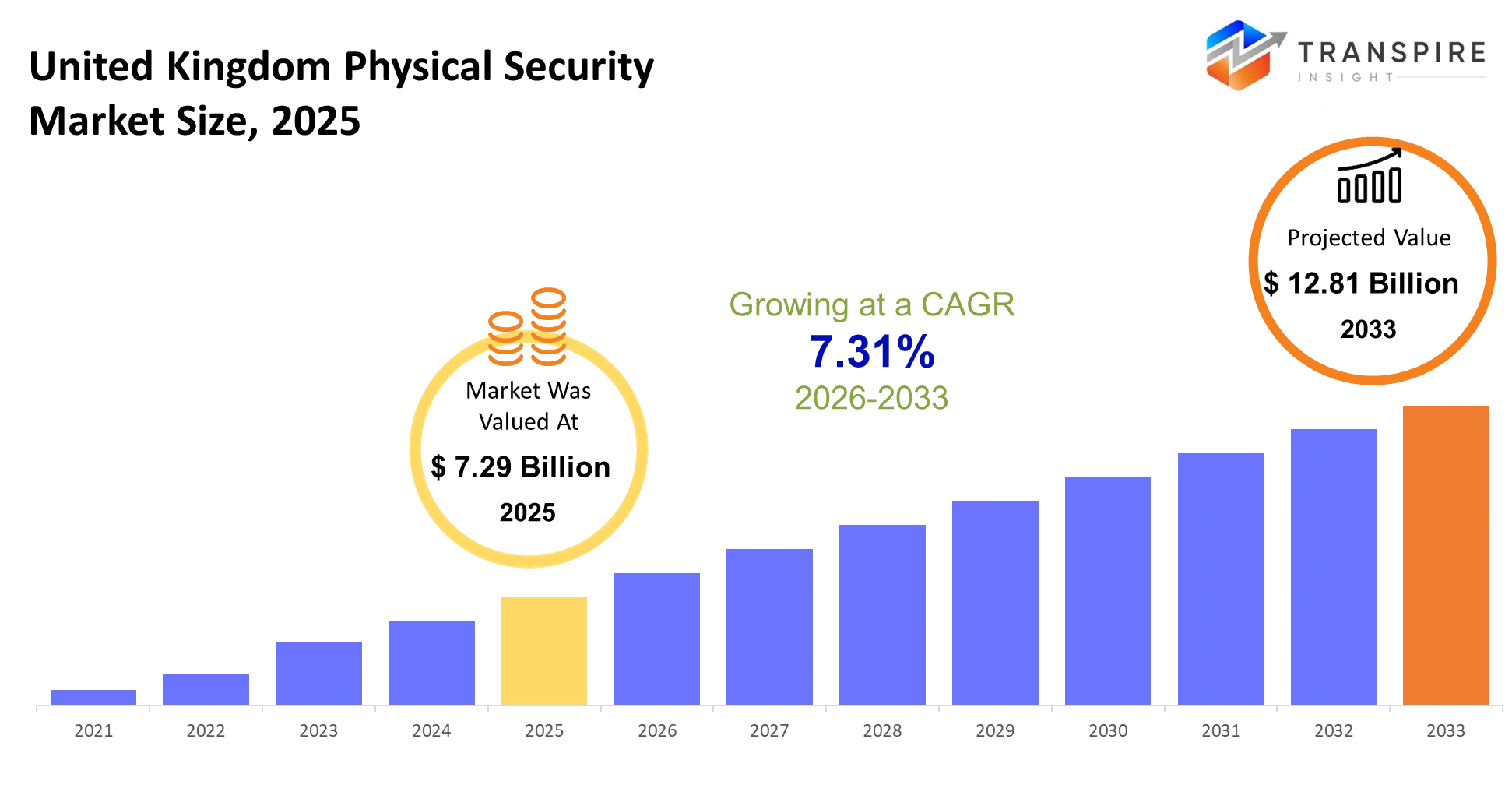
United Kingdom Physical Security Market Summary
The United Kingdom Physical Security Market was valued at USD 7.29 Billion in 2025. It is forecast to reach USD 12.81 Billion by 2033. That is a CAGR of 7.31% over the period.
Bosch Security Systems, Honeywell, Johnson Controls, ADT, Siemens, Genetec, NEC Corporation, Hanwha Vision, Cisco Systems, Motorola Solutions, Avigilon, Gallagher Security over the period.
In the United Kingdom, the physical security market really is all about safeguarding transport hubs, ports, utilities, and industrial sites from intrusion, stolen goods, and operational disruption and it does this by blending surveillance, gate access control, perimeter detection and monitoring routines, so safety keeps running and assets stay protected. Over the last five years, the whole sector has leaned away from analogue CCTV and those kinds of siloed systems, toward IP based surveillance, AI video analytics, and cloud-managed platforms , that connect many security roles into one command-style environment.
Also, after 2022 and around the geopolitical tensions, risk levels to critical infrastructure went up, especially for energy assets and maritime lanes, so investments accelerated for more advanced monitoring and automated response systems across UK locations. This kind of change shows a departure from buying standalone hardware only, toward integrated software driven security ecosystems, which means there is more demand for remote operations, centralized control rooms, and extended service agreements across both enterprise clients and public sector users.
Key Market Insights
- London pretty much dominates the United Kingdom Physical Security Market , with something like 35–40% share, mainly because there’s dense commercial infrastructure and a heavy concentration of critical assets.
- Southeast England is also the fastest-growing region through 2030, and it is pushed by logistics hubs, smart city initiatives , and the ongoing expansion of industrial corridors.
- When it comes to tech types, video surveillance systems are currently leading the United Kingdom Physical Security Market, holding the biggest slice thanks to broad CCTV modernization efforts across both public and private sectors.
- Access control systems take the second-largest position, and they’re backed by biometric integration plus enterprise level authentication upgrades, especially in high security facilities.
- Integrated security platforms are the fastest-moving segment, growing quickly as organizations move toward unified monitoring, and yes also AI enabled analytics solutions.
- For applications, critical infrastructure protection stands out with nearly 40% of application share, driven by energy, transport, and maritime security needs.
- Smart city surveillance is the fastest-growing application, fueled by urban digitization programs and AI powered traffic plus safety monitoring deployments.
- And then there’s the top share, tied to national security and infrastructure protection mandates , that overall requirement really shapes the market.
- On the end-user side commercial enterprises are the fastest-growing category, ramping up spending on advanced intrusion detection and cloud based security management systems.
What are the Key Drivers, Restraints, and Opportunities in the United Kingdom Physical Security Market?
The strongest driver is sort of the fast integration of AI enabled surveillance together with centralized security management across critical infrastructure. That change really started to pick up after 2022, when extra geopolitical uncertainty and energy supply vulnerabilities made operators want to upgrade older CCTV setups. Then, basically enterprises begin moving away from scattered, piece-meal systems toward unified platforms that bundle video analytics, access control and real-time threat detection. And in turn, this kind of shift boosts recurring software and managed service revenues, because buyers now often care more about long term system integration than they do about one time hardware purchases.
One major constraint is the heavy upfront cost and the overall complexity involved with retrofitting current infrastructure, especially when you add advanced IP based and cloud connected security tools. A lot of UK facilities still run hybrid legacy environments, which can be very awkward to merge with newer platforms. This structural issue tends to stretch procurement cycles, and it also slows down full scale digital adoption, most noticeably in the public sector and in mid sized commercial sites where budget approvals are slow, and capital spending is kept on a tight leash.
There is a noticeable growth chance around edge based video analytics and 5G enabled surveillance networks, in particular tied to smart city programs in London, plus parts of Southeast England. Pilot deployments along transport corridors and within urban monitoring zones show how low latency distributed processing can cut response times, and it can improve situational awareness too. That, in practice, opens new scalable revenue streams for solution providers, and it makes the whole rollout feel more gradual but also more repeatable.
What Has the Impact of Artificial Intelligence Been on the United Kingdom Physical Security Market?
Artificial intelligence and advanced digital technologies are doing a lot, sort of reshaping the United Kingdom Physical Security Market , by moving security work from reactive monitoring toward automated intelligence-led decision systems . In real-world deployments, AI-based video analytics can automatically spot unauthorized access, loitering, perimeter breaches , and even strange crowd behavior. That means less need for constant manual CCTV watching in transport hubs, industrial sites , and places tied to critical infrastructure. At the same time, integrated control platforms handle alarm validation and incident triaging with more consistency, so security teams coordinate responses better, and the whole false alert fatigue gets reduced , which is honestly a big deal.
Machine learning is also getting used for predictive maintenance of surveillance cameras, access control devices, and connected network sensors. These models look at how performance drifts over time, and they help operators plan maintenance before a failure happens. In other words, they improve uptime and cut down on those unplanned outages that show up in big security networks. In high-security environments, AI-driven risk scoring tools further refine how staff are assigned on the ground , and they can support compliance with regulatory surveillance requirements.
All of this has led to some measurable operational wins: quicker incident response, better monitoring efficiency, and less downtime caused by maintenance issues. Together, those outcomes tend to lower long-term operational costs for end users, even when the initial setup takes effort.
Still, there is a major limitation that keeps adoption from being smooth everywhere: the integration complexity with older analogue infrastructure. Lots of UK sites run hybrid arrangements, and the data isn’t standardized in a consistent way. Because of that, AI accuracy can get capped and full-scale deployment can slow down, even with strong demand for automation and more advanced analytics.
Key Market Trends
- Since 2022 the UK operators have moved , from analogue CCTV over to IP based AI surveillance and it did improve real time threat detection accuracy across transport and energy sites.
- After 2022 you could see procurement behavior shift too, like more platform contracts instead of only hardware buying, so vendors such as Axis Communications and Bosch Security Systems got more long term service revenues, not just sales.
- Then post 2022 geopolitical disruptions sort of piled up, which meant critical infrastructure security upgrades became more intense, especially across UK energy terminals and maritime logistics corridors around the country.
- After 2023 cloud based security management was adopted faster than expected, giving centralized monitoring and lowering the need for on site control rooms in many enterprise facilities.
- At the same time smart city deployments in London and Southeast England pushed the AI surveillance rollout ahead, so traffic monitoring got better and public safety analytics could be more integrated.
- From 2023 onward cybersecurity needs got stricter , so physical security systems had to handle encrypted data transmission and add secure device authentication layers.
- Later, edge computing along with 5G pilot projects expanded after 2024, and that reduced latency in surveillance processing for higher risk infrastructure and transport environments.
- Finally workforce monitoring automation increased efficiency too, which reduced the amount of manual CCTV operator workload, while incident response stayed more consistent across large scale security networks.
United Kingdom Physical Security Market Segmentation
By Component :
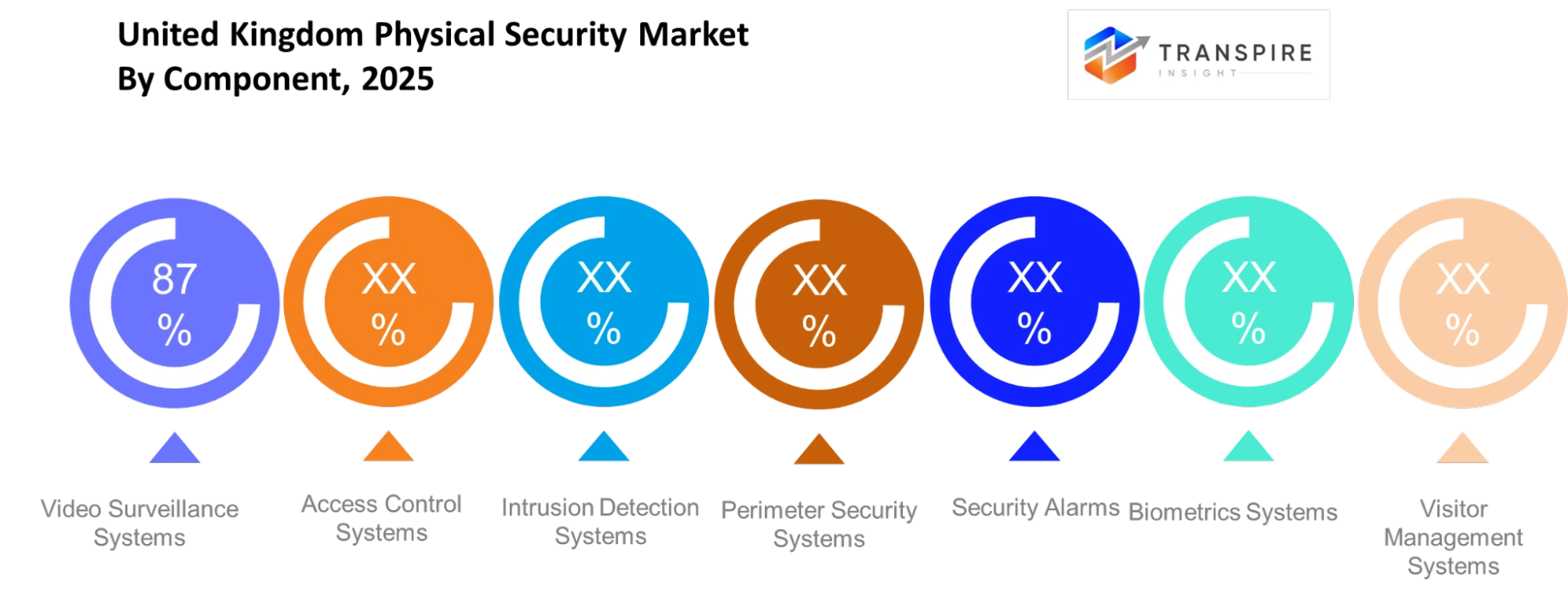
Video surveillance systems are still the most widely deployed part, even as organizations move away from traditional analog CCTV into connected, IP-based monitoring. kind of makes sense, because this change gives near real-time visibility across multiple facilities and it helps incident response, especially in transport hubs and industrial zones .
Access control and biometric systems are getting used more and more, mainly in high security environments like government buildings ,and corporate offices. These setups strengthen identity verification, they also lower the chances of unauthorized entry . At the same time, intrusion detection and perimeter protection are growing, because infrastructure safeguarding is becoming more automated and sensor driven. Security alarms plus visitor management tools still play a role in layered protection across many commercial sites.
By Deployment :
On-premise systems still matter a lot for very sensitive locations, where people need direct control of the security infrastructure. You often see them in government and defense related facilities, where data isolation is taken really seriously.
Meanwhile cloud-based security systems are expanding, largely because remote monitoring requirements keep rising and centralized control is easier to manage. Hybrid deployments are also on the increase, since organizations try to blend older systems with newer cloud platforms. Edge-based and mobile integrated security solutions can respond quicker and they allow more adaptable monitoring across distributed assets.
By Application :
Government facilities are a major application area because there are strict security needs, and also for protecting national infrastructure which is pretty sensitive stuff. Transportation hubs too , depend a lot on advanced monitoring systems, since they need to manage passenger flow and reduce safety risks at the same time.
Commercial buildings and industrial sites are starting to adopt integrated security solutions, with the idea to cut down theft and also the operational disruptions. Healthcare facilities, and educational institutions are also leaning more and more on surveillance together with access control tools, to raise safety levels. Even residential usage is going up, especially with smart home security integration in the background.
By Technology :
AI enabled surveillance is getting more and more central in modern security systems, it helps with automated threat detection, and it also reduces how much manual monitoring people have to do. Video analytics tools help a lot with accuracy, especially when you need to spot unusual behavior across big surveillance networks.
Biometric tools, including facial recognition technologies, are expanding in secure access environments. Then there are IoT integrated systems that connect multiple devices for real time data sharing, while smart sensors help improve detection of movement, intrusion, and environmental changes. Altogether these technologies improve operational responsiveness, and they also boost system efficiency in a practical way.
By End User :
The government sector is still the main end user, mainly because of big infrastructure protection needs and regulatory security requirements. BFSI institutions too lean on more advanced platforms, meant to safeguard financial assets and protect sensitive data, you know.
Transportation and manufacturing are going for integrated security setups more and more, so they can secure day to day operations and their supply chains as well. Healthcare facilities put monitoring systems in place to keep patient as well as staff safety under control, mostly. Retail and hospitality are also widening adoption, aiming to curb theft, boost customer safety , and maintain tighter operational oversight.
What are the Key Use Cases Driving the United Kingdom Physical Security Market?
In the United Kingdom Physical Security Market, the main use case kind of boils down to real time surveillance plus threat detection, across important critical infrastructure like transport hubs, energy facilities and government buildings. In these sorts of setups you need constant watchfulness so incidents don’t happen, unauthorized access doesn’t slip through, theft gets reduced and operations don’t get derailed, and that is what makes organizations lean hard on combined video surveillance with access control systems.
On top of that, expanded applications show up in workforce safety monitoring at manufacturing plants, and also in passenger security management across transportation networks. Meanwhile, BFSI institutions are stepping up the use of advanced authentication systems, to secure branches and ATM networks. This shift points to a sharper emphasis on fraud prevention and carefully controlled access environments, more or less.
Looking ahead, emerging use cases are being shaped around AI enabled predictive risk detection plus automated incident response, especially inside smart city initiatives. In the public sector, pilots in urban surveillance and traffic corridors are also testing edge based analytics, aiming for quicker decision making and better emergency response coordination, throughout the forecast period.
|
Report Metrics |
Details |
|
Market size value in 2025 |
USD 7.29 Billion |
|
Market size value in 2026 |
USD 7.82 Billion |
|
Revenue forecast in 2033 |
USD 12.81 Billion |
|
Growth rate |
CAGR of 7.31% from 2026 to 2033 |
|
Base year |
2025 |
|
Historical data |
2021 - 2024 |
|
Forecast period |
2026 - 2033 |
|
Report coverage |
Revenue forecast, competitive landscape, growth factors, and trends |
|
Regional scope |
Middle East and Africa (Saudi Arabia, United Arab Emirates, South Africa, Rest of Middle East and Africa) |
|
Key company profiled |
Hikvision, Dahua Technology, Axis Communications, Bosch Security Systems, Honeywell, Johnson Controls, ADT, Siemens, Genetec, NEC Corporation, Hanwha Vision, Cisco Systems, Motorola Solutions, Avigilon, Gallagher Security |
|
Customization scope |
Free report customization (country, regional & segment scope). Avail customized purchase options to meet your exact research needs. |
|
Report Segmentation |
By Component (Video Surveillance Systems, Access Control Systems, Intrusion Detection Systems, Perimeter Security Systems, Security Alarms, Biometrics Systems, Visitor Management Systems, Others); By Deployment (On-premise Security Systems, Cloud-based Security Systems, Hybrid Security Systems, Edge-based Security Systems, Mobile-integrated Security, Others); By Application (Commercial Buildings, Government Facilities, Industrial Sites, Residential Properties, Transportation Hubs, Educational Institutions, Healthcare Facilities, Others); By Technology (AI-enabled Surveillance, Biometric Access Control, IoT-integrated Security, Facial Recognition Systems, Smart Sensors, Video Analytics, Others); By End User (Government Sector, BFSI, Healthcare, Retail, Transportation, Manufacturing, Hospitality, Others) |
Which Regions are Driving the United Kingdom Physical Security Market Growth?
London and Southeast England are basically the leading area in the United Kingdom Physical Security Market, mostly because there is such a dense cluster of government institutions, financial hubs, and international transport routes. Also, regulatory enforcement for critical infrastructure protection has been pretty strong, so airports, seaports, and metro systems keep moving toward more advanced surveillance plus access control tools. With major ports like Felixstowe and Heathrow Airport still running at full speed, the need for continuous monitoring and integrated command platforms keeps getting reinforced. On top of that, there’s a mature ecosystem made up of security integrators, technology suppliers and managed service firms that kinda helps sustain deployments and later upgrades in high-risk locations.
The Midlands plays the part of a stable secondary contributor, supported by its manufacturing backbone and logistics corridors, rather than super concentrated urban infrastructure. Here, automotive plants, warehouses, and industrial estates are what drive the steady uptake of intrusion detection along with perimeter protection systems. Compared to London, where upgrades are more or less pushed by regulatory pressure, this region’s demand is shaped more by day to day operational continuity and asset protection priorities. Long term investments from industrial operators also keep security modernization cycles moving, without any big, sudden spikes.
Scotland and Northern England show the fastest growth momentum, like it’s being quietly pushed by the recent investments into renewable energy infrastructure and offshore wind developments. There’s also this new regulatory focus on protecting energy assets and coastal installations. It’s made a jump in deployment of remote surveillance and sensor based monitoring systems, you know, the kind that can keep watching without too much fuss. Meanwhile port modernization projects across several coastal cities have, kind of, strengthened the demand for integrated security solutions in maritime linked facilities. So over the 2026–2033 period, this whole growth wave will likely create solid entry opportunities for technology vendors aiming at edge analytics, remote monitoring, and ruggedized security infrastructure.
Who are the Key Players in the United Kingdom Physical Security Market and How Do They Compete?
Competition in the United Kingdom physical security market is still, sort of moderately fragmented , where global technology providers end up rubbing shoulders with niche security integrators as well as newer, fast-growing AI driven entrants. Older companies keep trying to defend their share by moving away from hardware only offers, and toward a more connected software led security ecosystem, kind of end to end. In practice, the main battle line is less about standalone equipment price and more about platform strength, the way systems actually interoperate, and lifecycle service contracts that keep going after installation. For buyers, especially in critical infrastructure and commercial settings, it has become more important that a vendor can unify video surveillance, access control, and analytics into one operational framework. That shift, in turn puts quite a bit of pressure on legacy vendors to modernize their portfolios, rather than just refresh models.
Firms like Honeywell International Inc. tend to push end-to-end building security platforms, tying together fire safety, access control, and predictive monitoring so they can land longer enterprise agreements. Axis Communications differentiates with network based video systems and open architecture designs, which makes it easier to bring in third party analytics tools , and that strengthens their standing in transport and smart city deployments. Siemens AG uses industrial automation to embed security inside broader operational control systems across energy and manufacturing locations. Johnson Controls meanwhile leans into building management integration, linking HVAC, access control, and surveillance into one consolidated platform. On the other hand, Hikvision often competes very aggressively on scale and pricing, while also expanding AI enabled camera capabilities for high volume urban surveillance projects.
Company List
- Hikvision
- Dahua Technology
- Axis Communications
- Bosch Security Systems
- Honeywell
- Johnson Controls
- ADT
- Siemens
- Genetec
- NEC Corporation
- Hanwha Vision
- Cisco Systems
- Motorola Solutions
- Avigilon
- Gallagher Security
Recent Development News
In December 2025, Limerston Capital announced acquisition of Aristi. The transaction consolidated Aristi into its Xypher platform, expanding managed security operations capabilities across SOC, MDR, and penetration testing services in the UK cybersecurity and physical-digital security convergence space.Source https://www.gov.uk/
In December 2025, Aspire Technology Solutions secured £200 million in new investment led by LDC. The funding is being used to accelerate expansion and support an acquisition-driven growth strategy, reinforcing demand for integrated security and managed service infrastructure across UK enterprise security environments.Source https://www.gov.uk/
What Strategic Insights Define the Future of the United Kingdom Physical Security Market?
The United Kingdom Physical Security Market is kind of structurally moving toward more fully integrated, software defined security ecosystems where the hardware becomes, you know, basically a data input layer rather than the main value driver. Over the next 5–7 years, this shift will be pushed by stricter security expectations for critical infrastructure and the ongoing convergence of physical security with cybersecurity frameworks. In practice, organizations will keep looking for platforms that sort of unify surveillance, analytics and automated response inside centralized control environments , and they’ll be less willing to rely on manual monitoring.
One less obvious risk that’s starting to show up during this transition is vendor concentration, meaning a small set of platform providers could end up dominating the integrated security architectures. That might lower procurement flexibility, and it can also lift long term switching costs for enterprises and public agencies alike. Meanwhile, dependence on cloud connectivity creates another kind of operational exposure, especially for hybrid legacy environments that still show up in many UK facilities.
At the same time, there’s an emerging opportunity too, particularly with edge native AI security systems deployed along transport corridors and across distributed energy assets. This feels especially relevant in coastal and industrial regions that are undergoing modernization. Market participants should concentrate on building interoperable, modular platforms that can plug into legacy infrastructure while still scaling into AI driven ecosystems , because this kind of adaptability will end up shaping competitive positioning over the next investment cycle.
United Kingdom Physical Security Market Report Segmentation
By Component
- Video Surveillance Systems
- Access Control Systems
- Intrusion Detection Systems
- Perimeter Security Systems
- Security Alarms
- Biometrics Systems
- Visitor Management Systems
By Deployment
- On-premise Security Systems
- Cloud-based Security Systems
- Hybrid Security Systems
- Edge-based Security Systems
- Mobile-integrated Security
By Application
- Commercial Buildings
- Government Facilities
- Industrial Sites
- Residential Properties
- Transportation Hubs
- Educational Institutions
- Healthcare Facilities
By Technology
- AI-enabled Surveillance
- Biometric Access Control
- IoT-integrated Security
- Facial Recognition Systems
- Smart Sensors
- Video Analytics
By End User
- Government Sector
- BFSI
- Healthcare
- Retail
- Transportation
- Manufacturing
- Hospitality
Frequently Asked Questions
Find quick answers to common questions.
The United Kingdom Physical Security Market size is USD 12.81 Billion in 2033.
Key segments for the United Kingdom Physical Security Market are By Component (Video Surveillance Systems, Access Control Systems, Intrusion Detection Systems, Perimeter Security Systems, Security Alarms, Biometrics Systems, Visitor Management Systems, Others); By Deployment (On-premise Security Systems, Cloud-based Security Systems, Hybrid Security Systems, Edge-based Security Systems, Mobile-integrated Security, Others); By Application (Commercial Buildings, Government Facilities, Industrial Sites, Residential Properties, Transportation Hubs, Educational Institutions, Healthcare Facilities, Others); By Technology (AI-enabled Surveillance, Biometric Access Control, IoT-integrated Security, Facial Recognition Systems, Smart Sensors, Video Analytics, Others); By End User (Government Sector, BFSI, Healthcare, Retail, Transportation, Manufacturing, Hospitality, Others).
Major United Kingdom Physical Security Market players are Hikvision, Dahua Technology, Axis Communications, Bosch Security Systems, Honeywell, Johnson Controls, ADT, Siemens, Genetec, NEC Corporation, Hanwha Vision, Cisco Systems, Motorola Solutions, Avigilon, Gallagher Security.
The United Kingdom Physical Security Market size is USD 7.29 Billion in 2025.
The United Kingdom Physical Security Market CAGR is 7.31% from 2026 to 2033.
- Hikvision
- Dahua Technology
- Axis Communications
- Bosch Security Systems
- Honeywell
- Johnson Controls
- ADT
- Siemens
- Genetec
- NEC Corporation
- Hanwha Vision
- Cisco Systems
- Motorola Solutions
- Avigilon
- Gallagher Security
About the Authors

Kartik bhong
I am Kartik Bhong, a Senior Research Analyst at Transpire Insight, specializing in the Packaging, Manufacturing, and Construction industry. My work focuses on analyzing market trends, emerging technologies, industry regulations, and competitive landscapes to deliver accurate, data-driven insights. I am passionate about transforming complex industry information into clear, practical content that helps businesses, professionals, and decision-makers stay informed and make confident strategic decisions. Through continuous research and a strong commitment to accuracy, I strive to create reliable, well-researched content that reflects the latest developments across these dynamic industries and supports the vision of Transpire Insight in delivering valuable market intelligence.

Chakradhar Khansole
Chakradhar serves as the Research Director at Transpire Insight, bringing over 8 years of experience in technology, innovation, and strategic market intelligence. He specializes in transforming complex market data into actionable business insights that enable organizations to make informed, growth-oriented decisions. Recognized for his strategic vision and analytical expertise, Chakradhar leads high-impact research initiatives, delivering comprehensive market assessments, competitive intelligence, and forward-looking industry analysis.
Recently Published Reports
-
Apr 2026
Handling and Lifting Equipment Market
Handling and Lifting Equipment Market Size, Share & Analysis Report By Product (Cranes and Hoists, Forklifts, Conveyor Systems, Aerial Work Platforms, Others), By Application (E-Commerce, Automotive and Railway, Food and Beverages, Aviation, Others), and Geography (North America, Europe, Asia-Pacific, Middle East and Africa, South and Central America), 2021 - 2031
-
Apr 2026
HVAC Equipment Market
HVAC Equipment Market Size, Share & Analysis Report By Heating Equipment Type (Boilers and Furnaces, Heat Pumps, and Unitary Heaters), By Ventilation Equipment (Air Handling Units, Humidifiers and Dehumidifiers, Air Filters, and Fan Coiling Units), By Air Conditioning Equipment (Unitary Air Conditioners, Room Air Conditioners, Packaged Terminal Air Conditioners, and Chillers), By End User (Commercial, Residential, Industrial, and others), and Geography (North America, Europe, Asia-Pacific, Middle East and Africa, South and Central America), 2021 – 2031
-
Apr 2026
Refrigeration Valves Market
Refrigeration Valves Market Size, Share & Analysis Report By Type (Solenoid Valves, Expansion Valves, Check Valves, Service Valves, Others), By Application (Commercial Refrigeration, Industrial Refrigeration, Transport Refrigeration, Residential Refrigeration, Air Conditioning Systems), By End User (Food and Beverage Industry, Pharmaceutical Industry, HVAC Industry, Chemical Industry, Others), and Geography (North America, Europe, Asia-Pacific, Middle East and Africa, South and Central America), 2021 – 2031
-
Apr 2026
E-Commerce Packaging Materials Market
E-Commerce Packaging Materials Market By Material Type (Corrugated Boxes, Paper & Paperboard, Foam & Cushioning Materials, Plastic Packaging, Flexible Packaging, Protective Packaging, Others), By Product(Primary Packaging, Secondary Packaging, Tertiary Packaging), By Packaging Function (Protective Packaging, Branding & Presentation Packaging, Transit & Logistic Packaging, Sustainable Packaging, Tamper Evidence Packaging), By End-User (Retail & Consumer Goods, Electronic Appliances, Food & Beverages, Healthcare & Pharmaceutical, Fashion & Apparel, Home & Furnishing, Others); By Industry Analysis, Size, Share, Growth, Trends, and Forecasts 2021-2033