
Asia Pacific Biometric Technology Market Size & Forecast:
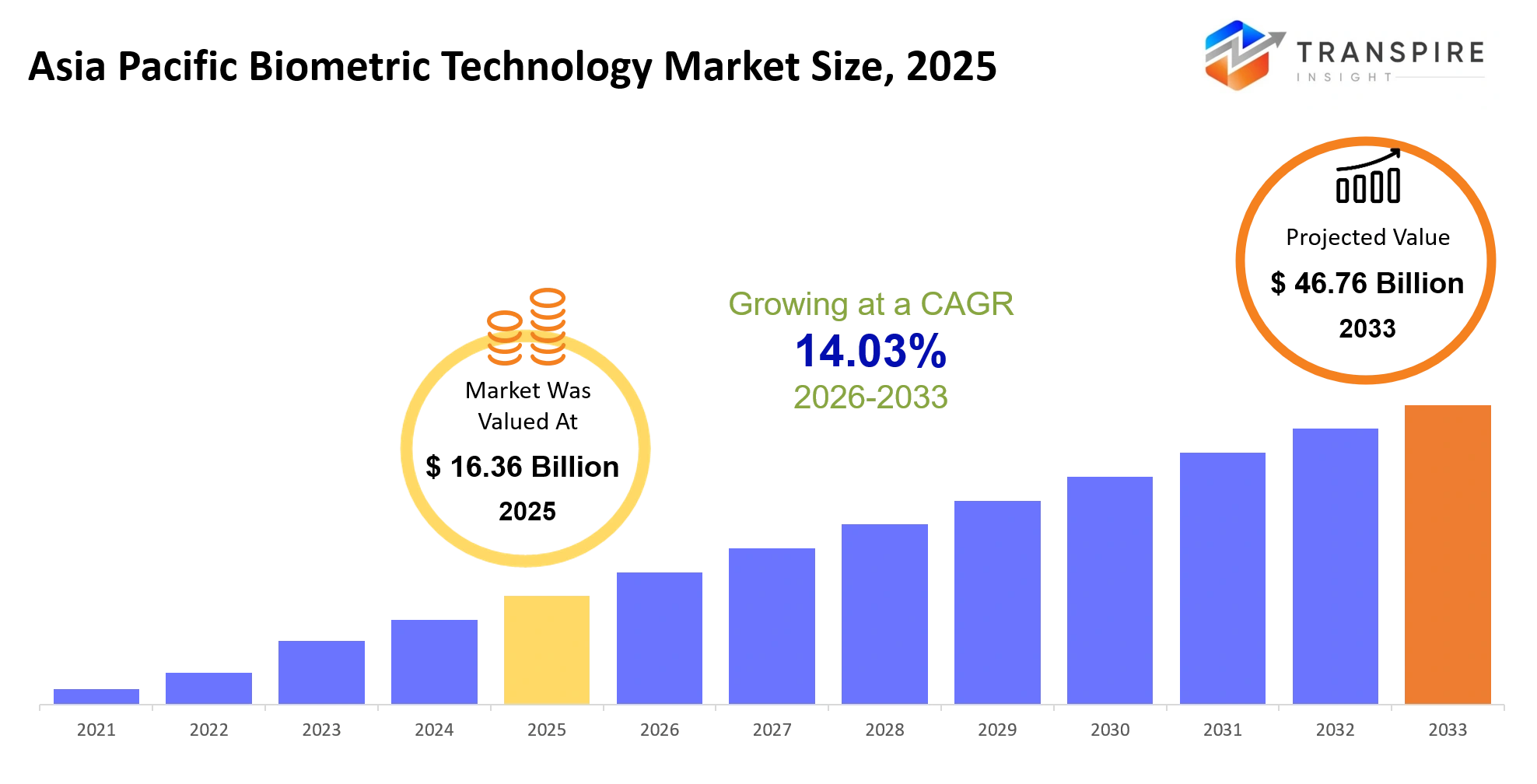
- Asia Pacific Biometric Technology Market Size 2025: USD 16.36 Billion
- Asia Pacific Biometric Technology Market Size 2033: USD 46.76 Billion
- Asia Pacific Biometric Technology Market CAGR: 14.03%
- Asia Pacific Biometric Technology Market Segments: By Technology (Fingerprint Recognition, Facial Recognition, Iris Recognition, Voice Recognition, Palm Recognition, Vein Recognition, Others); By Component (Hardware, Software, Services, Sensors, Analytics Platforms, Others); By Application (Access Control, Identity Verification, Payments, Border Control, Workforce Management, Others); By End User (Government, BFSI, Healthcare, Retail, IT & Telecom, Others).
Asia Pacific Biometric Technology Market Summary
The Asia Pacific Biometric Technology Market was valued at USD 16.36 Billion in 2025. It is forecast to reach USD 46.76 Billion by 2033. That is a CAGR of 14.03% over the period.
Biometric technology within the Asia Pacific (APAC) market is applied across airports, seaports, factories, financial institutions, and critical public infrastructure in identification verification and access control by substituting manual identification and password logins with biometric recognition technologies. The market has evolved over the last 3-5 years to move structurally away from simple finger print devices to multimodal (face, iris and voice) biometric combinations delivered through cloud identity infrastructure and edge devices.
These trends were driven further by the need for touchless verification as mandated and exacerbated by the Covid-19 pandemic across large populations and transit centers, and border reopenings requiring more stringent identity checks across both travel and critical infrastructure networks. Consequently, organizations want higher throughput for passengers and workforce, and also decreased security identity fraud and compliance risks; these organizations now see biometrics as critical to improving both outcomes in both operational ways.
Key Market Insights
- China holds the largest share in the Asia Pacific Biometric Technology Market in 2025 with almost 40% revenue share in Asia Pacific because of large scale public security projects.
- India is the fastest growing market during the forecast period ending 2032 driven by its various digital identity programs, banking infrastructure modernization and large-scale deployment of e-governance initiatives.
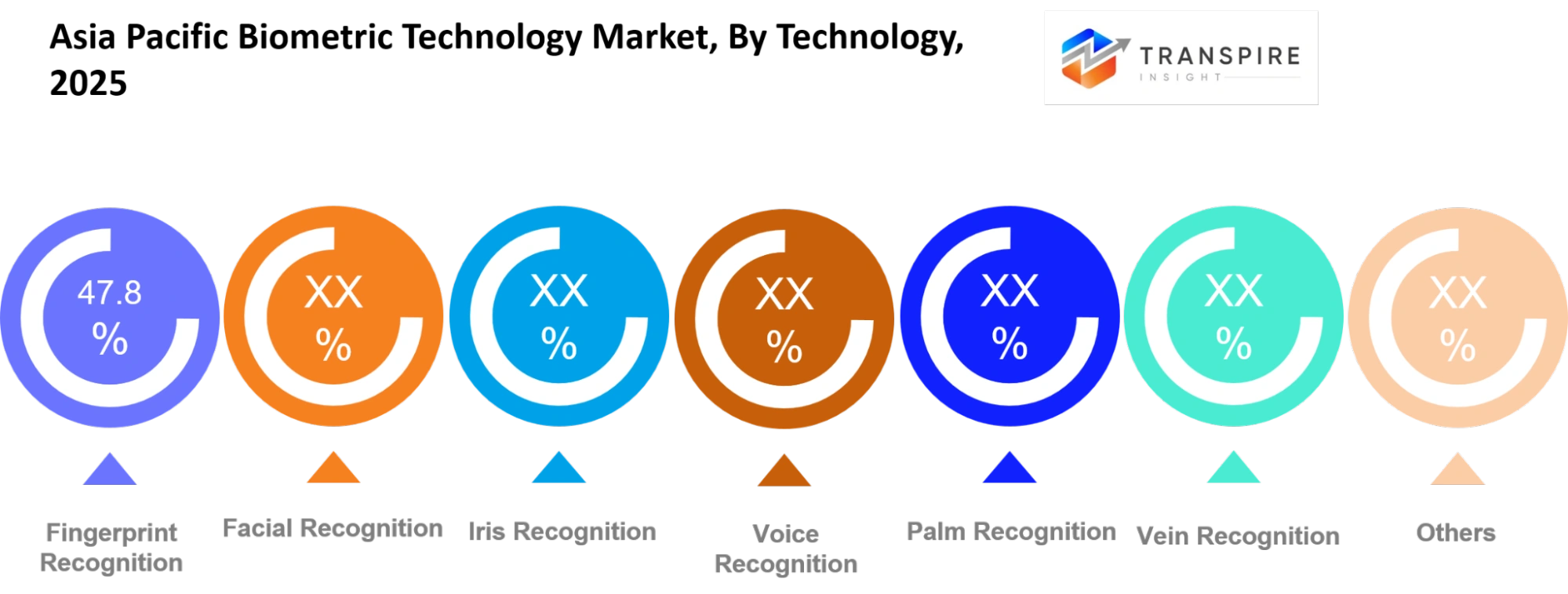
- Facial Recognition holds a market share of over 35% in the Asia Pacific Biometric Technology Market and is expected to grow with large scale deployment for contactless authentication and smart surveillance applications.
- Fingerprint Recognition is the second largest segment of the market owing to the affordable technology and widespread application in banking and workforce management sectors.
- Multimodal Biometrics will witness the highest CAGR during the forecast period as enterprises increasingly focus on better accuracy and security along with reduction in fraud.
- Government and public security applications command over 30% share of the market driven by several national ID programs, border control measures, etc.
- The financial services segment is expected to grow at the highest pace owing to the increasing adoption of biometric authentication by banks for digital on-boarding and payment validation.
- The healthcare segment is increasingly adopting biometrics for access control to enhance patient data protection and improve identity management framework.
- The government sector will emerge as the leading end-user segment with a majority share owing to investments made in national ID and surveillance systems.
- Banking and financial institutions are expected to witness rapid growth owing to fraud reduction and ease of authentication offered by biometrics.
What are the Key Drivers, Restraints, and Opportunities in the Asia Pacific Biometric Technology Market?
Growing government-supported digital identity initiatives and enterprise digitalization are key drivers for the Asia Pacific Biometric Technology Market. Government departments in countries such as China, India, Singapore, and Australia are using biometrics as an authentication layer to manage national IDs, national borders, and the delivery of government services. Meanwhile, banks and fintech companies are deploying face and fingerprint authentication in lieu of traditional password protection in an attempt to cut fraud and speed up customer onboarding. These trends are leading to direct revenue gains for vendors of biometric hardware, software and services, since biometric authentication has now moved beyond an optional layer of security to a mandatory business function.
Data privacy concerns and the varying standards on data protection across the regions are major structural restraints facing the Asia Pacific Biometric Technology Market. The existence of a variety of privacy and data protection standards related to the storage and cross-border transfer of biometric data causes significant increases in implementation costs and lead times, hindering large-scale rollouts, especially in sectors like banking and healthcare, with a slow realization of near-term revenue.
The opportunity to develop an AI-powered multimodal biometrics framework combining face, iris, voice, and behavioral recognition and then integrate this into an integrated identity solution is the biggest growth opportunity in this market. Financial companies based in Southeast Asia are already investing in such systems and Indian digital service providers also plan to build systems using the technology, the core benefit is to improve accuracy and resist spoofing. Such systems can only become truly prevalent once cloud infrastructure has developed further, and at a lower cost for the processing and management of information from different biometrics.
What Has the Impact of Artificial Intelligence Been on the Asia Pacific Biometric Technology Market?
The region has seen changes to biometrics due to AI. It is more accurate, the steps are fully automated and decisions can be made immediately. Banks are also deploying AI models to automate customer onboarding procedures by comparing faces to submitted ID documents, and identifying fraudulent inputs automatically, without manual intervention. Airlines, at airports and border control agencies are using computer vision solutions to automatically authenticate travelers, hence reducing queues.
AI-based machine learning also has predictive abilities, through constant analysis of authentication events and identification of unusual activity before fraud happens. Some behavioral biometrics platforms are able to monitor keyboard typing and touch screen interactions to reveal unauthorized access to an account or to identify synthetic identities. These can assist businesses to minimize fraud losses, enhance success rate and reduce cost of operations.
AI-powered liveness detection has become another important advancement because it can distinguish real users from photographs, masks, or deepfake videos with greater precision. However, adoption still faces limitations. High integration costs, concerns about algorithmic bias, and inconsistent performance across diverse lighting conditions and demographic groups remain significant challenges, particularly for organizations operating large-scale public authentication systems across multiple countries.
Key Market Trends
- Facial recognition now exceeds fingerprint in terms of adoption since 2020, with contactless authentication and enhanced verification accuracy taking prominence in both public and private sector projects.
- Governments across AP continue to build upon digital identity schemes, where India alone records over 1.4bn biometric enrollments and is accelerating development of downstream authentication applications.
- The use of multimodal biometrics has seen a surge with many buyers preferring face/ iris/ voice to be integrated to reduce risks of spoofing by >30% over single factor systems.
- Between 2021-2025, Banks have redirected investment to the development of AI-based liveness detection capabilities following an upsurge in sophistication and cost of deepfake attacks and identity fraud.
- Since 2022 cloud based deployment models have accelerated, offering rapid software updates, unified identity management and reduced IT infrastructure costs for enterprises.
- As a result, China, Australia and Singapore continue to tighten regulations across biometrics which has seen vendors rethink the structure of their data storage facilities and improve privacy-by-design offerings.
- Competition has shifted away from hardware performance towards AI algorithms, and companies like NEC, Thales, IDEMIA, Fujitsu continue to invest in algorithm improvement.
- Biometric corridors are increasingly seen at airports and border control points replacing manned document verification, cutting transit time at major transit points by up to 40%.
- Since 2023, behavioral biometrics has been marked out as the fastest growing opportunity in biometrics with the use of user behaviors in real-time detection of fraud increasingly becoming the standard for financial institutions.
Asia Pacific Biometric Technology Market Segmentation
By Technology :
Fingerprint, face, iris, voice, palm, and vein recognition form the primary technology groups within Asia Pacific biometric systems. Security, speed and accuracy will remain important focus areas for both the enterprise and the public sector as digital identity programs grow.
Advances in sensors, artificial intelligence, and image processing will support expansion in banking, health care, transportation and enterprise applications. Technology vendors will focus on non-contact verification, increased matching performance to meet updated security and performance requirements.
By Component :
Hardware, software, services, sensors, and analytics platforms will comprise all aspects of biometric solutions for the region. Hardware would involve readers and cameras. Software would support authentication and data bases. Services such as installation and technical support will allow operations to continue efficiently over extended periods.
Digital identity programs will increase investment in all elements with a particular emphasis on analytics. Organizations will be able to gain increased insight from the use of their identity data and will focus on improving security across disparate and distributed systems.
By Application :
Access control, identity verification, payment, border control, and workforce management are the major application segments for biometrics. The customers want an alternative to manual processes where authentication is secure, operation is quick, and identity fraud and access to the system is protected from external threats.
Digitalization and growth of smart infrastructures is likely to bring more application areas for biometrics systems. Payment and workforce management are segments that will receive major investments as businesses will opt for a more convenient, secure, and user-friendly operation over multiple locations.
By End User :
The key end user sectors in the Asia Pacific Biometric Technology Market are government, BFSI, healthcare, retail and IT & Telecom industries. The government sector uses biometric technology for national identification programs and in government services whereas the BFSI sector will continue to use it for customer authentication and prevention of frauds.
Healthcare sectors use biometrics for patient identification, secure access of records. Retail and IT and Telecom industry is also expected to witness significant growth with adoption of biometrics technology in various use-cases for enhance customer service, increase cybersecurity framework and provide effective delivery of digital services throughout the region.
What are the Key Use Cases Driving the Asia Pacific Biometric Technology Market?
By far the most important use case remains authentication of identity and control of access through both governments and financial sectors as well as transportation and border crossings. The digital ID projects that various governments have implemented across the Asia Pacific region; border security efforts in nations and payment and transactional verifications within financial services all use fingerprint and facial authentication methods to prevent fraud, verify accounts and deliver a faster and better service to consumers. The combination of security with ease of use leads to highest deployment figures in the region.
Close secondary uses that are gaining traction are in the sectors of health care and retail. Health care facilities will use biometric security systems to ensure that medical records remain safe and that they are accessing the correct patient. The retail sector has implemented fingerprint and payment authentication alongside facial recognition technology for the purposes of streamlined purchases and elimination of transaction fraud. The IT and telecom sectors continue to implement biometric technologies into mobile applications and other digital applications and services.
Applications that are currently more nascent include behavior based biometrics and artificial intelligence powered liveness detection techniques. By monitoring patterns of human behavior or identifying genuine and non-generated identities, this technology will enable new avenues such as mobile banking, digital retail transactions, and real-time access to secure government online services within the next few years.
|
Report Metrics |
Details |
|
Market size value in 2025 |
USD 16.36 Billion |
|
Market size value in 2026 |
USD 18.65 Billion |
|
Revenue forecast in 2033 |
USD 46.76 Billion |
|
Growth rate |
CAGR of 14.03% from 2026 to 2033 |
|
Base year |
2025 |
|
Historical data |
2021 - 2024 |
|
Forecast period |
2026 - 2033 |
|
Report coverage |
Revenue forecast, competitive landscape, growth factors, and trends |
|
Regional scope |
Asia Pacific (India, China, Japan, Australia, South Korea, Rest of Asia Pacific) |
|
Key company profiled |
NEC, Thales, IDEMIA, Fujitsu, HID Global, Suprema, Cognitec, FacePhi, Aware Inc., BIO-key, Samsung SDS, Microsoft, Cisco, ZKTeco, Hitachi. |
|
Customization scope |
Free report customization (country, regional & segment scope). Avail customized purchase options to meet your exact research needs. |
|
Report Segmentation |
By Technology (Fingerprint Recognition, Facial Recognition, Iris Recognition, Voice Recognition, Palm Recognition, Vein Recognition, Others); By Component (Hardware, Software, Services, Sensors, Analytics Platforms, Others); By Application (Access Control, Identity Verification, Payments, Border Control, Workforce Management, Others); By End User (Government, BFSI, Healthcare, Retail, IT & Telecom, Others). |
Which Regions are Driving the Asia Pacific Biometric Technology Market Growth?
China holds the most significant share in the Asia Pacific biometric technology market primarily due to increasing governmental support and focus on digitalization projects like identity verification, public security, smart city schemes and much more. Domestic policies further stimulate widespread use of facial recognition and fingerprint authentication and AI-based surveillance systems in travel, banking, government services, among others. This, coupled with hefty investments in semiconductor manufacturing, artificial intelligence and cloud computing, foster a thriving ecosystem to drive innovation and commercialization. With these policy advantages, technology expertise and massive domestic demand, China continues to remain the largest regional player.
While Japan is ranked as the second most influential market, its growth has taken a different trajectory. Unlike China, it does not heavily depend on vast government surveillance projects but more on secured authentication in banking, healthcare and enterprise scenarios, which are characterized by privacy and security needs. Strong macroeconomic stability and slow-motion regulatory deployment combined with long-term strategic investments in the digital infrastructure support a steady rise of biometrics in the country. Investments by enterprises and institutions on contactless biometrics and identification solutions ensure a stable supply of regional revenue for many years to come.
India, the fastest growing market in this region, relies heavily on its ongoing digital revolution and the ever-expanding digital identity infrastructure. Increase in public service use of biometrics and rapid growth of mobile banking, along with rising investments in cloud technology have considerably escalated the adoption of biometrics both in the rural and urban areas. Moreover, various schemes focusing on bolstering digital governance and financial inclusion present lucrative opportunities for biometric service and technology providers and partners to participate in and benefit from the market. This significant growth momentum should create appealing opportunities for new and existing players in the 2026-2033 time frame.
Who are the Key Players in the Asia Pacific Biometric Technology Market and How Do They Compete?
The Asia-Pacific biometric technology market is moderately concentrated, with the world's leading technology vendors facing off against regional specialists. The main ground of competition has shifted towards technological innovation. Customers' preference for AI-enhanced facial recognition, multimodal authentication and cloud-based identity management solutions are driving this trend. Existing companies are attempting to maintain their positions in the market by making further R&D investments. However, smaller vendors are entering the market with specialized software solutions and less expensive deployment methods.
NEC Corporation distinguishes itself through sophisticated facial recognition solutions that have highly accurate outcomes for public security and transportation sectors. The company collaborates with government and airport authorities in Asia to expand its market coverage and is investing significantly in artificial intelligence. IDEMIA focuses on solutions combining biometric authentication and digital credentials encrypted in an ID system, offering much stronger protection against identity theft to financial companies and government organizations.
Thales attempts to distinguish its offerings by combining biometric authentication features to its existing cyber security products to provide clients a total security solution. Fujitsu is differentiating its solutions by utilizing palm vein biometrics that provides non-contact authentication, higher levels of accuracy, and privacy security. Both companies are continually developing new capabilities with local partners, new software, and artificial intelligence to keep pace with the growing needs of banking, health and enterprise.
Company List
- NEC
- Thales
- IDEMIA
- Fujitsu
- HID Global
- Suprema
- Cognitec
- FacePhi
- Aware Inc.
- BIO-key
- Samsung SDS
- Microsoft
- Cisco
- ZKTeco
- Hitachi
Recent Development News
In April 2026, Amadeus announced acquisition of IDEMIA Public Security for €1.2 billion in an all-cash deal. The transaction will expand Amadeus' capabilities in airport biometrics, border management, and secure identity solutions while increasing its addressable market across regulated industries.
Source: https://www.reuters.com/
In January 2026, NEC launched a fused face and iris biometrics system for on-the-move authentication. The new multimodal technology enables hands-free identity verification with high accuracy in airports, public security environments, and other high-throughput applications, supporting broader adoption of contactless biometric systems.
Source: https://www.biometricupdate.com/
What Strategic Insights Define the Future of the Asia Pacific Biometric Technology Market?
The Asia Pacific Biometric Technology Market is evolving toward integrated digital identity systems, where biometric authentication, artificial intelligence, and cloud infrastructure function as a single platform instead of isolated security instruments. These systemic changes are being fueled by the implementation of government e-government initiatives, increased prevalence of digital banking, and demand for seamless identity verification across physical and digital spheres. Over the next 5 to 7 years, value will shift toward software, identity orchestration, and AI driven fraud mitigation rather than purely from the sale of hardware.
A more hidden risk arises from regulatory fragmentation. Different countries in the region are instituting different regulations concerning biometric data storage, consent and cross border data movement. This means the increased compliance cost associated with managing divergent regulations may slow multi-country implementations and give an advantage to existing incumbents with robust legal and technical teams.
A newly appearing opportunity is Behavioral Biometrics in Southeast Asia in relation to digital banking and e-commerce. Players who invest now in privacy-preserving AI and interoperable identity systems may see a competitive advantage in flexibility and regulatory readiness in the near future.
Asia Pacific Biometric Technology Market Report Segmentation
By Technology
- Fingerprint Recognition
- Facial Recognition
- Iris Recognition
- Voice Recognition
- Palm Recognition
- Vein Recognition
By Component
- Hardware
- Software
- Services
- Sensors
- Analytics Platforms
By Application
- Access Control
- Identity Verification
- Payments
- Border Control
- Workforce Management
By End User
- Government
- BFSI
- Healthcare
- Retail
- IT & Telecom
Frequently Asked Questions
Find quick answers to common questions.
The Asia Pacific Biometric Technology Market size is USD 46.76 Billion in 2033.
Key segments for the Asia Pacific Biometric Technology Market are By Technology (Fingerprint Recognition, Facial Recognition, Iris Recognition, Voice Recognition, Palm Recognition, Vein Recognition, Others); By Component (Hardware, Software, Services, Sensors, Analytics Platforms, Others); By Application (Access Control, Identity Verification, Payments, Border Control, Workforce Management, Others); By End User (Government, BFSI, Healthcare, Retail, IT & Telecom, Others).
Major Asia Pacific Biometric Technology Market players are NEC, Thales, IDEMIA, Fujitsu, HID Global, Suprema, Cognitec, FacePhi, Aware Inc., BIO-key, Samsung SDS, Microsoft, Cisco, ZKTeco, Hitachi.
The Asia Pacific Biometric Technology Market size is USD 16.36 Billion in 2025.
The Asia Pacific Biometric Technology Market CAGR is 14.03% from 2026 to 2033.
- NEC
- Thales
- IDEMIA
- Fujitsu
- HID Global
- Suprema
- Cognitec
- FacePhi
- Aware Inc.
- BIO-key
- Samsung SDS
- Microsoft
- Cisco
- ZKTeco
- Hitachi
About the Authors

Avinash Kumar
I’m Avinash Kumar, a Senior Research Analyst at Transpire Insight, with expertise in the Electronics and Semiconductor and Energy & Power industry. My work focuses on analyzing emerging technologies, market trends, industry developments, and innovation across these sectors. I specialize in transforming complex technical and market insights into clear, research-backed content that helps professionals, businesses, and decision-makers stay informed. Through continuous industry research and data-driven analysis, I strive to deliver accurate, reliable, and practical perspectives on the latest advancements shaping the semiconductor and energy landscape.

Chakradhar Khansole
Chakradhar serves as the Research Director at Transpire Insight, bringing over 8 years of experience in technology, innovation, and strategic market intelligence. He specializes in transforming complex market data into actionable business insights that enable organizations to make informed, growth-oriented decisions. Recognized for his strategic vision and analytical expertise, Chakradhar leads high-impact research initiatives, delivering comprehensive market assessments, competitive intelligence, and forward-looking industry analysis.
Recently Published Reports
-
Apr 2026
Fiber Optic Faceplates Market
Fiber Optic Faceplates Market Size, Share & Analysis Report By Type (< 300 mm2, 300-350 mm2, and > 350 mm2, By Application (Night Vision, Holographic Imaging, Medical, and Others), and Geography (North America, Europe, Asia-Pacific, Middle East and Africa, South and Central America), 2021 - 2031
-
Apr 2026
High Temperature Superconductors Market
High Temperature Superconductors Market Size, Share & Analysis Report By Type (1G HTS, and 2G HTS), By Application (Power Cable, Fault Current Limiter, and Transformer), and Geography (North America, Europe, Asia-Pacific, Middle East and Africa, South and Central America), 2021 - 2031
-
Apr 2026
Industrial Plugs and Socket Market
Industrial Plugs and Socket Market Size, Share & Analysis Report By Type (Industrial Plugs, Industrial Sockets), By Current (Up to 32 A, 32 to 125 A, Above 125 A), By Protection (Dustproof and Splash Proof, Waterproof, Explosion Proof), By End User (Heavy Industries, Oil and Gas, Chemicals and Pharmaceuticals, Power Generation, Others), and Geography (North America, Europe, Asia-Pacific, Middle East and Africa, South and Central America), 2021 - 2031
-
Apr 2026
InGaAs Avalanche Photodiodes Market
InGaAs Avalanche Photodiodes Market Size, Share & Analysis Report By Type (1100 - 1700 nm, and 1000 - 1600 nm), By Application (Missile Warning System, Muzzle Flash Detection, Wafer Defect Inspection, Laser Rangefinders, and Others), and Geography (North America, Europe, Asia-Pacific, Middle East and Africa, South and Central America), 2021 - 2031