
Asia Pacific Internet Of Things In Healthcare Market Size & Forecast:
- Asia Pacific Internet Of Things In Healthcare Market Size 2025: USD 30.76 Billion
- Asia Pacific Internet Of Things In Healthcare Market Size 2033: USD 124.66 Billion
- Asia Pacific Internet Of Things In Healthcare Market CAGR: 19.12%
- Asia Pacific Internet Of Things In Healthcare Market Segments: By Component (Medical Devices, Software, Services, Connectivity Solutions, Sensors, Platforms, Others); By Application (Remote Patient Monitoring, Telemedicine, Asset Tracking, Medication Management, Clinical Operations, Others); By Deployment (Cloud, On-Premise, Hybrid, Others); By End User (Hospitals, Clinics, Homecare, Diagnostic Centers, Others).
To learn more about this report,  Download Free Sample Report
Asia Pacific Internet Of Things In Healthcare Market Summary
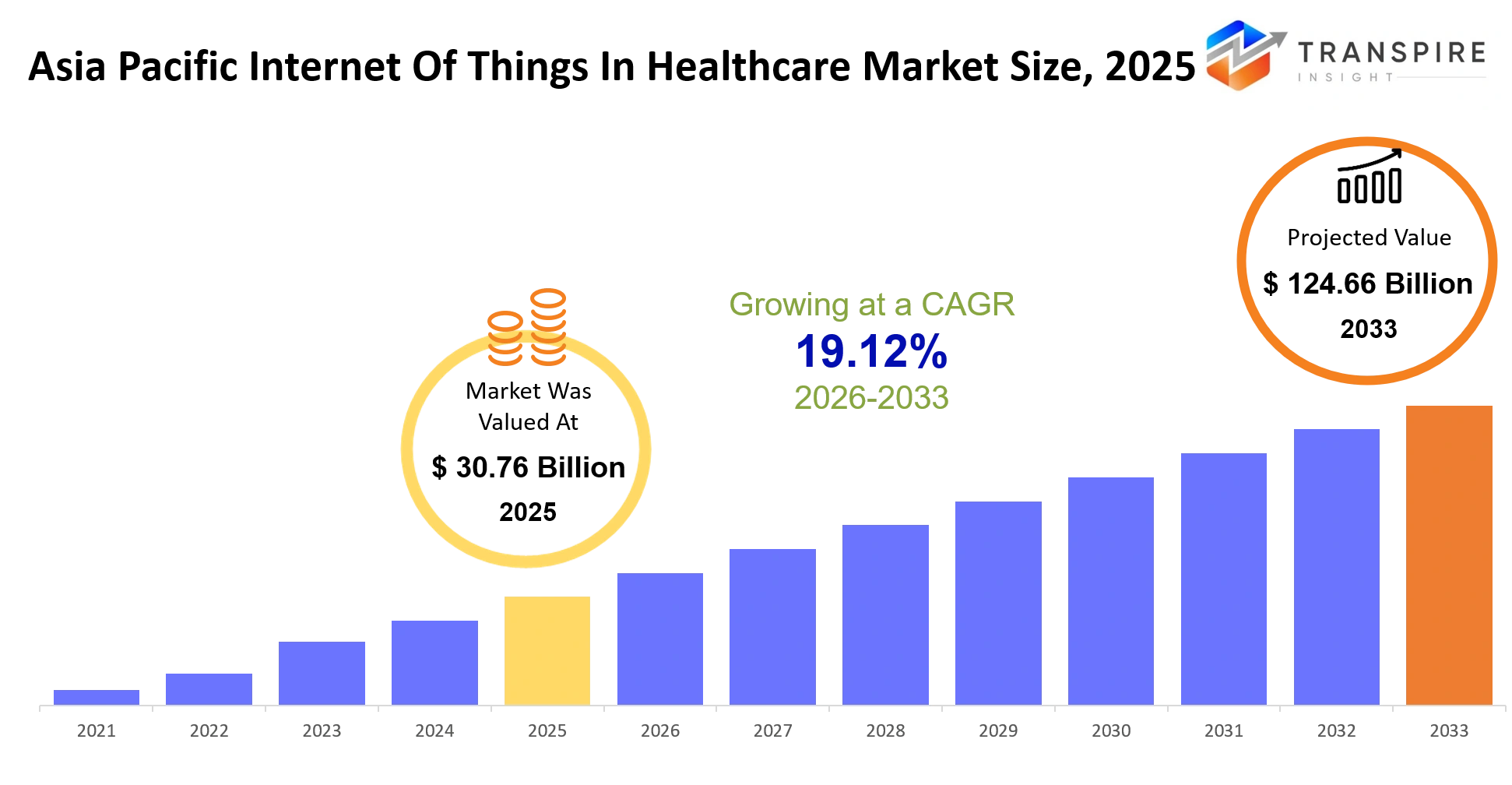
The Asia Pacific Internet Of Things In Healthcare Market was valued at USD 30.76 Billion in 2025. It is forecast to reach USD 124.66 Billion by 2033. That is a CAGR of 19.12% over the period.
The Asia Pacific Internet of Things (IoT) in Healthcare market kinda allows hospitals, clinics, and care providers to observe patients, medical assets, and even clinical workflows in real time using linked devices. In practice it supports healthcare organizations to cut down on treatment wait times, boost patient results, and keep better tabs on critical equipment, while also pushing care beyond hospital walls via remote monitoring setups and connected health platforms.
Over the last three to five years, the market has actually changed in a more structural fashion, moving away from standalone medical devices toward a kind of integrated digital care ecosystem that merges sensors, cloud platforms, data insights, and electronic health records. One major catalyst was the COVID-19 pandemic, it really showed the weaknesses in hospital capacity, and at the same time sped up the spending on remote patient monitoring and telehealth infrastructure across the region. That pivot basically opened a clear path for more widespread IoT usage, since providers wanted ongoing patient visibility while trying to limit face to face visits. And because healthcare systems are dealing with aging populations, along with a rise in chronic illnesses, connected care approaches are turning into operational realities… not just nice experiments. This, in turn, helps translate technology rollouts into tangible efficiency improvements and longer term revenue options.
Key Market Insights
- China kind of dominates the Asia Pacific Internet Of Things Healthcare Market, and in 2025 it sits at about 35–40% market share, mainly because large-scale healthcare digitization is moving fast.
- In that mix, medical devices and patient monitoring systems basically run the show, making up close to 40% of the industry size, since they're deployed pretty widely in hospitals.
- Then, connectivity platforms and healthcare software solutions grab the second biggest chunk, and they’re more or less what helps with real time data integration, for sure.
- If you look at growth, remote patient monitoring solutions are the fastest growing segment through 2030, and that's backed by chronic disease management programs.
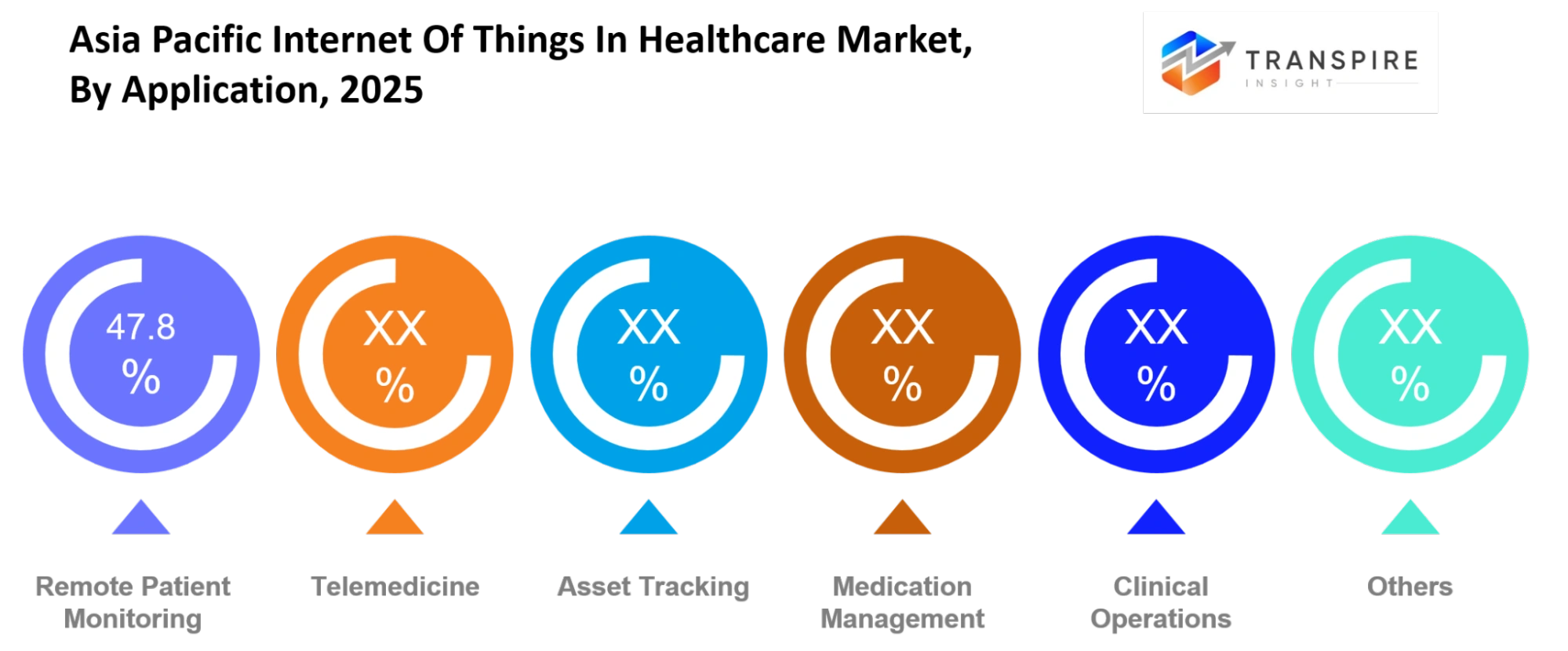
- Overall, remote patient monitoring also leads the market with roughly 30–35% share, which points to healthcare providers putting more emphasis on continuous care ,all the time.
- Clinical workflow optimization is starting to feel like one of those high-growth applications across bigger healthcare networks, you know the kind.
- Connected asset tracking options are also getting more attention lately, mainly to cut down on lost equipment and to push utilization rates higher.
- Hospitals and healthcare systems are still leading the charge, and in 2025 they’re contributing more than 50% of the market revenue, more or less.
- Meanwhile home healthcare providers are the fastest-growing end user group during the forecast period.
- And specialty clinics are increasingly turning to connected healthcare technologies so they can gain operational efficiency, as well as better patient outcomes.
What are the Key Drivers, Restraints, and Opportunities in the Asia Pacific Internet Of Things In Healthcare Market?
The big push driving the Asia Pacific Internet Of Things in Healthcare Market is kinda the move toward connected, decentralized healthcare delivery, not really the one thing but that overall trend. It picked up speed after the pandemic, when healthcare systems started spending a lot on telehealth platforms, remote monitoring setup, and digital health records. Hospitals , insurers are now more and more sure that connected devices can cut down avoidable admissions, help people manage chronic conditions better, and also keep collecting steady patient information even when someone is not physically in a clinic or ward. So, as a consequence, many healthcare players are giving bigger technology budgets to IoT-enabled monitoring solutions, which opens up real money pathways for device manufacturers, platform operators, and other healthcare technology sellers.
Even so, data security and interoperability are still the biggest structural hurdles. A lot of healthcare organizations run older legacy systems that basically were not built to talk smoothly with today’s connected devices. When you try to bring together multiple vendors, different data standards and cybersecurity protocols, it takes serious capital and long, slow implementation cycles. Because of that, the rollout gets delayed across big healthcare networks, and organizations struggle to expand these connected health ecosystems at the pace they want. In the end you see delayed adoption, plus slower monetization of more advanced IoT solutions, which kinda holds everything back.
A really strong long term opportunity lies in AI enabled remote patient monitoring and sort of predictive healthcare management, a bit like watching health trend lines before anything serious happens. Places like India, China, and Indonesia are ramping up digital health infrastructure , while at the same time they deal with an increasing load of chronic disease plus a shortage in healthcare personnel, which makes the whole situation more difficult. If you pair advanced analytics platforms with wearable sensor data, cloud computing and predictive algorithms, you can spot health deterioration earlier , so acute intervention doesn’t have to wait until it becomes unavoidable. Funding and build outs around smart hospitals, 5G connected healthcare networks, and home based care models are also shaping the ground for the next stage of market expansion, especially in underserved zones and in areas that are rapidly urbanizing, where access is still kind of thin.
What Has the Impact of Artificial Intelligence Been on the Asia Pacific Internet Of Things In Healthcare Market?
Artificial intelligence has kind of expanded the value proposition of connected healthcare systems across the Asia Pacific region, by turning big volumes of IoT generated data into sort of actionable clinical insights. In practice, healthcare providers are more and more using AI algorithms to automate patient monitoring routines, rank the high-risk cases faster , and cut down the manual checking of continuous sensor information. Connected medical devices now can flag abnormal vital signs, push alerts forward, and also back up clinical decision making with very little human intervention.
Then there is machine learning, which is strengthening predictive capabilities across healthcare networks too. When these models sift through earlier patient records, wearable gadget measurements, and live physiological signals, they can try to see what’s coming—like an anticipated health drop, upcoming hospital readmissions, or other complications, before it becomes truly critical. This kind of forecasting approach supports clinicians with more mindful resource planning, better day to day operations efficiency, and less needless spending on treatment.
On top of that, more advanced digital technologies like edge computing, cloud analytics, and 5G connectivity improve real-time data processing and remote care delivery. With these, device uptime tends to get better, clinical response can happen faster, and patient engagement outcomes often improve as well. Healthcare organizations also see benefits in asset management, and better utilization of medical equipment, which is kind of a practical win.
Still, there is a limitation that shows up a lot with adoption. Many healthcare providers run into fragmented data environments, inconsistent data quality, and complicated integration requirements. High implementation costs, plus interoperability struggles, can lower model accuracy and also slow down broad deployment especially across diverse healthcare systems in emerging Asia Pacific markets.
Key Market Trends
- Since 2020, hospitals across China , Japan, and Australia have kind of moved from pilot IoT rollouts toward enterprise wide connected health platforms which is more or less a whole shift in how care is managed.
- Remote patient monitoring that used to feel like a niche offering turned into a mainstream care approach, especially once providers started expanding virtual care programs after the pandemic, you know.
- At the same time, healthcare organizations have been mixing IoT sensors with AI analytics , which helps teams spot patient deterioration earlier and jump into clinical interventions faster than before.
- Between 2021 and 2025, the money focus changed too, from buying devices to cloud based healthcare data integration, plus interoperability solutions that actually let systems talk.
- Regulators in several Asia Pacific countries also tightened up their digital health frameworks. That has made it easier to justify broader adoption of connected medical devices and more secure data sharing across networks.
- Bigger names like Philips , Medtronic, GE HealthCare, and Siemens Healthineers then started leaning harder into partnerships with telecom carriers and cloud providers, basically to push deployment forward at a quicker pace.
- Buyers are now leaning toward end to end healthcare ecosystems instead of standalone devices. So vendors are developing integrated software, analytics, and monitoring capabilities, rather than treating everything as separate parts.
- Providers have also expanded their wearable technology programs since 2022, using continuous data capture to back chronic disease management strategies in a more steady way.
- And yeah , cybersecurity spending climbed a lot as hospitals connected more clinical assets. It’s tied to higher worry around patient data protection and compliance requirements , which is not surprising.
- Since commercial 5G networks rolled out, healthcare institutions have further accelerated real time monitoring applications, and those rely on low latency connectivity, almost like it’s become the baseline expectation.
Asia Pacific Internet Of Things In Healthcare Market Segmentation
By Component :
Medical devices kind of form the basis of connected healthcare systems , where patient health information is gathered using monitors, wearables, infusion pumps, and a bunch of other connected equipment. Sensors help with real time data capture , and connectivity options make it possible to push that information securely between the devices and the healthcare networks.
Then the Software , platforms, and services come in, they turn the collected data into clinical meaning. Platforms bring together data from several places, software then supports analysis and decision making , and services cover implementation , maintenance, plus technical help. All those pieces together tend to help healthcare orgs boost operational efficiency and also improve how patient care gets delivered.
By Application :
Remote patient monitoring supports continuous observation of health conditions outside the usual healthcare spaces. Telemedicine in turn enables virtual appointments and more digital back and forth between clinicians and patients , so medical services are easier to reach in both city and rural areas.
Asset tracking helps facilities keep tabs on equipment utilization and where things are located, which lowers losses and makes availability better. Medication management supports accurate drug administration along with adherence tracking, and clinical operations applications help coordinate workflows, patient handling, and resource distribution across healthcare facilities.
To learn more about this report, Download Free Sample Report
By Deployment :
Cloud deployment gives scalable storage, data processing, and remote access , which is why many healthcare orgs pick it as a more flexible digital backbone. With cloud based systems there’s real time data exchange too, and it’s generally simpler to tie together workflows across different healthcare sites, even when they are geographically spread out.
On-premise deployment on the other hand gives stronger control , especially for data handling and security, because the infrastructure is hosted locally. Hybrid deployment mixes both, meaning cloud and on-premise setups run together, so providers can juggle flexibility with compliance obligations and day to day operational control. It also helps support a wider variety of connected health applications, without forcing everything into a single environment.
By End User :
Hospitals are a major end user group since they rely heavily on connected medical devices, continuous patient monitoring, and digital healthcare platforms. Clinics likewise use connected tech to make patient management smoother, coordinate appointments , and track treatment progress in outpatient settings.
In homecare, connected healthcare solutions are showing up more often , mainly for remote monitoring and sustained disease management over time. Diagnostic centers use connected systems to improve testing routines, speed up data exchange, and keep reporting accuracy higher, and other healthcare facilities tend to adopt similar capabilities to raise service quality and operational effectiveness.
What are the Key Use Cases Driving the Asia Pacific Internet Of Things In Healthcare Market?
Remote patient monitoring is still, kind of the main thing that pushes adoption across the Asia Pacific Internet Of Things In Healthcare market. In practice healthcare providers rely on connected wearable devices, vital-sign monitors , and smart medical equipment, to watch what’s happening with patients in real time. This use case seems to get the most traction, because it helps cut down on hospital trips, it also supports long-term illness control, and it gives a more steady style of care for aging populations.
Telemedicine and asset tracing are starting to show up more often among hospitals, clinics, and diagnostic centers. Connected platforms back virtual visits, while asset tracking offerings let healthcare facilities find the essential tools faster, boost equipment usage, and lower day to day operational waste across big medical networks.
Newer ideas are also forming like AI-enabled predictive care and connected medication oversight systems. Healthcare orgs are trying out platforms that process real time patient info to flag possible health risks before things turn into major complications . There are also smart medication adherence tools, plus connected homecare ecosystems, which look promising as healthcare systems stretch beyond traditional clinical settings over the forecast window.
|
Report Metrics |
Details |
|
Market size value in 2025 |
USD 30.76 Billion |
|
Market size value in 2026 |
USD 36.64 Billion |
|
Revenue forecast in 2033 |
USD 124.66 Billion |
|
Growth rate |
CAGR of 19.12% from 2026 to 2033 |
|
Base year |
2025 |
|
Historical data |
2021 - 2024 |
|
Forecast period |
2026 - 2033 |
|
Report coverage |
Revenue forecast, competitive landscape, growth factors, and trends |
|
Regional scope |
Asia Pacific (India, China, Japan, Australia, South Korea, Rest of Asia Pacific) |
|
Key company profiled |
Philips, Medtronic, GE HealthCare, Siemens Healthineers, IBM, Microsoft, Cisco, Oracle, Honeywell, SAP, Abbott, Baxter, Qualcomm, Telit, Bosch. |
|
Customization scope |
Free report customization (country, regional & segment scope). Avail customized purchase options to meet your exact research needs. |
|
Report Segmentation |
By Component (Medical Devices, Software, Services, Connectivity Solutions, Sensors, Platforms, Others); By Application (Remote Patient Monitoring, Telemedicine, Asset Tracking, Medication Management, Clinical Operations, Others); By Deployment (Cloud, On-Premise, Hybrid, Others); By End User (Hospitals, Clinics, Homecare, Diagnostic Centers, Others). |
Which Regions are Driving the Asia Pacific Internet Of Things In Healthcare Market Growth?
China is still basically the biggest regional market in Asia Pacific, and it keeps leading, largely because of big scale healthcare digitization programs, steady government backing for smart healthcare infrastructure and, also extensive roll out of connected medical technologies. In practice, many major hospitals are starting to mesh IoT platforms with electronic health records, cloud platforms and AI powered analytics, so that clinical work feels more streamlined, and day to day operations don’t drag as much. At the same time, the country has a huge domestic technology ecosystem— device manufacturers, software providers, telecom operators, and cloud companies. All of this, policy support plus healthcare spending, plus technology know-how, works like a loop that feeds itself, and that loop helps sustain the market leadership.
Japan comes in as the next, second largest contributor, though the growth pattern looks different than in China. Here the demand is less about fast infrastructure expansion, and more about long horizon modernization in healthcare, meant to handle an aging population and the usual healthcare workforce constraints. Healthcare providers keep placing bets on remote monitoring solutions, connected medical devices, and home based care technologies, which help with better patient management while also holding down operating costs. With steady healthcare budgets, mature digital infrastructure, and a gradual, fairly clear regulatory rollout, Japan tends to be a dependable place for market revenue.
India seems to be stepping out as the fastest-growing market across the whole region. In the last few years, you can see rapid scaling of digital health programs , plus more people having mobile connectivity, and also fresh investment going into telemedicine platforms which all together sped up the uptake of connected healthcare solutions. Government pushes that back digital health records and care delivery that uses technology have made the overall setup easier for IoT deployments too. Growth in hospitals, clinics, and even homecare situations should keep rolling , and that’s likely to unlock big chances for technology vendors, healthcare providers, and investors across the 2026–2033 time window.
Who are the Key Players in the Asia Pacific Internet Of Things In Healthcare Market and How Do They Compete?
The competitive landscape for the Asia Pacific Internet Of Things in Healthcare Market stays kinda moderately fragmented, with big global healthcare technology firms pushing against regional digital health providers, plus a bunch of connectivity specialists too. What actually drives the rivalry mostly comes down to platform abilities, interoperability (like how things talk to each other), cybersecurity strength, analytics functionality , and the know-how to bring assorted healthcare devices together into one shared ecosystem. Even so, the older, established players keep trying to solidify things via ongoing technology spend, while newer entrants are spotting openings in specialized remote monitoring , cloud enabled healthcare, and AI powered care management solutions that feel a bit more targeted.
Philips leans heavily on connected patient monitoring and integrated care platforms, where hospital based information and remote healthcare data get blended in one flow. In practice, that supports clinicians to keep care continuity even when patients move across multiple treatment settings. The company keeps widening its footprint through digital health collaborations and investments focused on advanced monitoring technologies. Medtronic, meanwhile, differentiates through connected therapeutic devices alongside remote patient management features, especially for chronic disease treatment. By weaving device data into real clinical workflows, it creates tangible value for healthcare providers who want sustained patient engagement over time.
GE HealthCare kinda competes on imaging plus monitoring and analytics, with platforms that tie clinical data together across lots of healthcare environments. They seem to push data-driven operational upgrades, which helps their adoption inside big healthcare networks (not just smaller clinics). Siemens Healthineers leans more toward digital healthcare integration, bringing together connected diagnostics , imaging systems, and AI-supported clinical tools inside one kind of unified platform. Then Huawei, on the other hand, leans hard into connectivity infrastructure , cloud computing, and network technologies to back those big scale healthcare digitization efforts. In the end, these different moves let them go head to head on tech performance, the breadth of their ecosystem, and how well they can deploy, not only on price alone.
Company List
- Philips
- Medtronic
- GE HealthCare
- Siemens Healthineers
- IBM
- Microsoft
- Cisco
- Oracle
- Honeywell
- SAP
- Abbott
- Baxter
- Qualcomm
- Telit
- Bosch
Recent Development News
In February 2026, the GSMA Foundry entered a partnership with National University Health System (NUHS) Singapore. The collaboration will integrate 5G networks, IoT devices, digital twins, and AI technologies to accelerate connected healthcare applications including remote care, intelligent facilities management, and next-generation hospital-at-home solutions across Asia Pacific.
Source: https://www.gsma.com/
In June 2026, ASUS launched an AI-powered healthcare ecosystem featuring the ASUS VivoWatch 6 Plus, Handheld Ultrasound DuoScan, and AI Agent healthcare platform. The launch strengthens connected healthcare infrastructure by linking real-time patient monitoring devices with AI-enabled clinical decision support, expanding IoT-based healthcare capabilities in the Asia Pacific market.
Source: https://press.asus.com/
What Strategic Insights Define the Future of the Asia Pacific Internet Of Things In Healthcare Market?
The Asia Pacific Internet Of Things In Healthcare Market is kinda drifting toward a connected care model where care delivery gets more decentralized, more predictive, and more data driven. Over the next five to seven years, the biggest thing steering the market won’t be just one piece, it’s the coming together of IoT devices, artificial intelligence, cloud infrastructure , and 5G connectivity, all at once. In practice, healthcare providers are moving away from stop and start, episodic treatment, toward continuous monitoring, so there's a long term pull for platforms that can pull in and interpret patient data across different care settings. So, value creation is likely to slide away from pure hardware sales and toward data management, analytics, and outcome based healthcare services.
There’s also a less obvious risk, data fragmentation across healthcare systems. As more devices move into clinical environments, mismatched standards and siloed data ecosystems could make things harder to scale and may reduce the payoff from digital health spending. Still, alongside that, an opportunity is taking shape, AI enabled home healthcare across India and Southeast Asia. This is happening because healthcare capacity constraints are real, and digital infrastructure keeps expanding, which makes remote care models seem more feasible. Market players should really focus on interoperable platforms and strategic partnerships, so devices and software, plus healthcare providers, can be connected into a single ecosystem that actually supports long term clinical and operational value.
Asia Pacific Internet Of Things In Healthcare Market Report Segmentation
By Component
- Medical Devices
- Software
- Services
- Connectivity Solutions
- Sensors
- Platforms
By Application
- Remote Patient Monitoring
- Telemedicine
- Asset Tracking
- Medication Management
- Clinical Operations
By Deployment
- Cloud
- On-Premise
- Hybrid
By End User
- Hospitals
- Clinics
- Homecare
- Diagnostic Centers
Frequently Asked Questions
Find quick answers to common questions.
The Asia Pacific Internet Of Things In Healthcare Market size is USD 124.66 Billion in 2033.
Key segments for the Asia Pacific Internet Of Things In Healthcare Market are By Component (Medical Devices, Software, Services, Connectivity Solutions, Sensors, Platforms, Others); By Application (Remote Patient Monitoring, Telemedicine, Asset Tracking, Medication Management, Clinical Operations, Others); By Deployment (Cloud, On-Premise, Hybrid, Others); By End User (Hospitals, Clinics, Homecare, Diagnostic Centers, Others).
Major Asia Pacific Internet Of Things In Healthcare Market players are Philips, Medtronic, GE HealthCare, Siemens Healthineers, IBM, Microsoft, Cisco, Oracle, Honeywell, SAP, Abbott, Baxter, Qualcomm, Telit, Bosch.
The Asia Pacific Internet Of Things In Healthcare Market size is USD 30.76 Billion in 2025.
The Asia Pacific Internet Of Things In Healthcare Market CAGR is 19.12% from 2026 to 2033.
- Philips
- Medtronic
- GE HealthCare
- Siemens Healthineers
- IBM
- Microsoft
- Cisco
- Oracle
- Honeywell
- SAP
- Abbott
- Baxter
- Qualcomm
- Telit
- Bosch
About the Authors

Pankaj Ghogare Patil
I am Pankaj Ghogare Patil, a Senior Research Analyst at Transpire Insight, specializing in the Pharmaceutical, Chemicals & Materials, Healthcare IT, and Biotechnology industry. My expertise lies in conducting comprehensive market research, analyzing industry trends, evaluating competitive landscapes, and translating complex data into actionable insights. At Transpire Insight, I closely follow emerging technologies, regulatory developments, and market innovations to create accurate, well-researched, and informative content that helps businesses and professionals make informed decisions. I am committed to producing credible, evidence-based articles that reflect industry best practices while making technical topics accessible and valuable for a broad audience.

Chakradhar Khansole
Chakradhar serves as the Research Director at Transpire Insight, bringing over 8 years of experience in technology, innovation, and strategic market intelligence. He specializes in transforming complex market data into actionable business insights that enable organizations to make informed, growth-oriented decisions. Recognized for his strategic vision and analytical expertise, Chakradhar leads high-impact research initiatives, delivering comprehensive market assessments, competitive intelligence, and forward-looking industry analysis.
Recently Published Reports
-
Apr 2026
AI in Diabetic Retinopathy Market
AI in Diabetic Retinopathy Market Size, Share & Analysis Report By Type (Screening AI Systems, Diagnostic AI Systems, and Predictive AI Models), By Application Segment (Hospitals, Ophthalmology Clinics, Diagnostic Centers, and Research and Development), and Geography (North America, Europe, Asia-Pacific, Middle East and Africa, South and Central America), 2021 - 2031
-
Apr 2026
Psychometric Tests Market
Psychometric Tests Market Size, Share & Analysis Report By Type (Personality Tests, Ability/Aptitude Tests, Skill/Knowledge Tests, and Others), By Application (Talent Acquisition and Talent Management), and Geography (North America, Europe, Asia-Pacific, Middle East and Africa, South and Central America), 2021 – 2031
-
Apr 2026
Rare Biological Sample Collection Market
Rare Biological Sample Collection Market Size, Share & Analysis Report By Type (Isolation Kits & Reagent, Blood Collection Tubes, and Others), By Application (Oncology, Transcriptomics, Pharmacogenomics, and Others), and Geography (North America, Europe, Asia-Pacific, Middle East and Africa, South and Central America), 2021 – 2031
-
Jul 2026
Diabetic Retinopathy Market
Diabetic Retinopathy Market Size, Share & Analysis Report By Type (Proliferative Diabetic Retinopathy, and Diabetic Macular Edema (DME)), By Treatment Type (Anti VEGF Drug, Steroid Implants, Laser Surgeries, and Vitrectomy), and Geography (North America, Europe, Asia-Pacific, Middle East and Africa, South and Central America), 2021 – 2031
Our Clients







