
Workspace As A Service (WaaS) Market Summary:
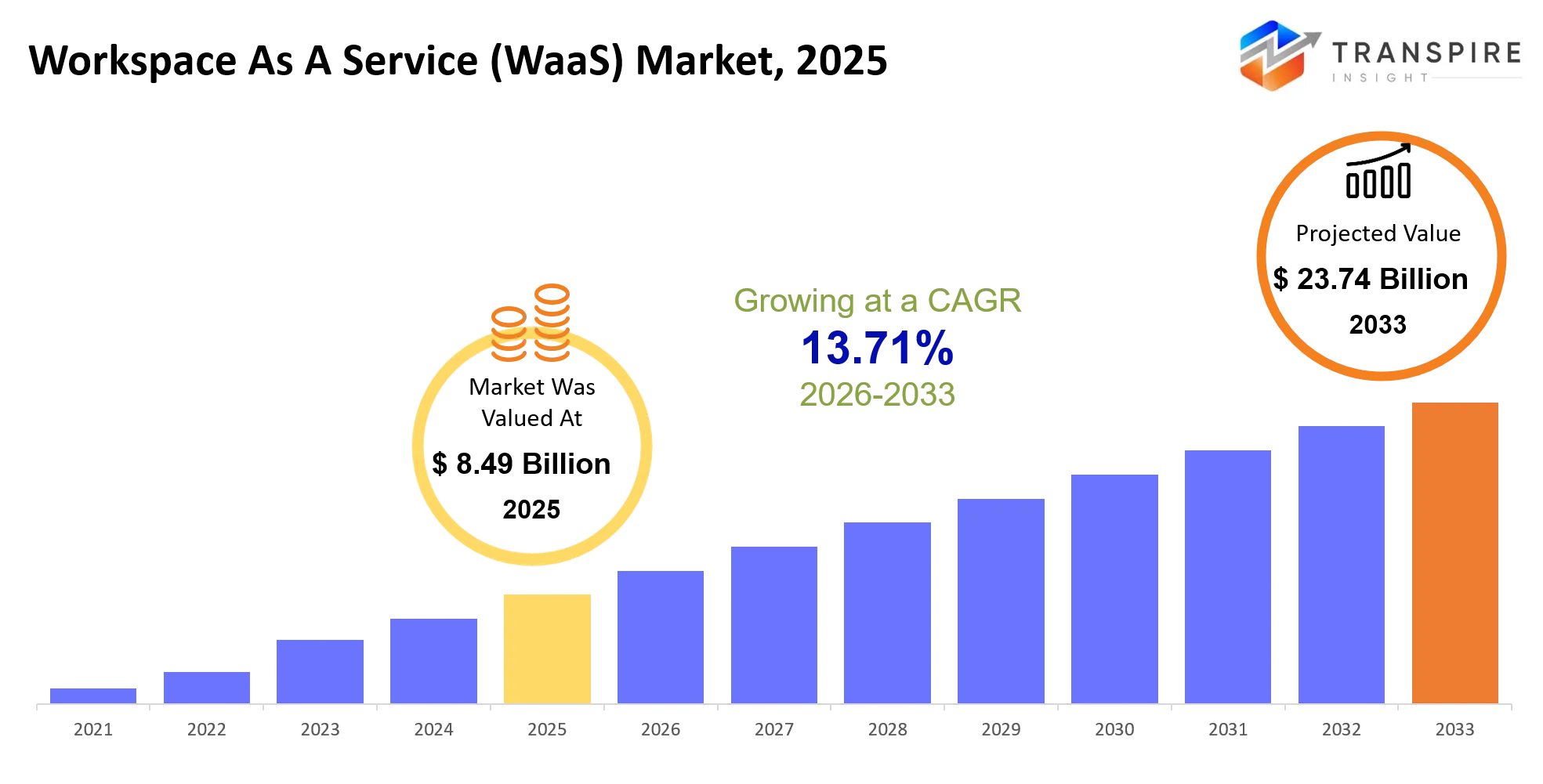
As per the Transpire Insight analysis, The Workspace As A Service (WaaS) Market size is estimated at USD 8.49 billion in 2025 and is anticipated to reach USD 23.74 billion by 2033, growing at a CAGR of 13.71% from 2026 to 2033.
The Workspace-as-a-Service is secure, cloud-based workspaces that encompass everything work-related, from desktop to apps, collaboration, identity, and security. This allows employees to work from any authorised device without burdening enterprise IT with its hardware endpoints. Over the past three to five years, the segment has transitioned from pandemic-era remote-access provisioning to a permanent hybrid-work infrastructure, with enterprises consolidating device management, security, and app delivery on a subscription platform. The major structural transition, of course, was the replacement of perimeter-based Virtual Private Network access with zero-trust, cloud-native architectures (since clearly nobody can blindly trust users, devices, or networks). The real-world cause-and-effect here was a combination of the new normal hybrid workforce and more endpoint-security events; as a result, virtual workspaces were made exponentially more commercially interesting by artificial intelligence management and security services to support faster adoption by enterprise, SME, and regulated industries.
Workspace As A Service (WaaS) Market Size & Forecast:
- Market Size 2025: USD 8.49 Billion
- Expected Market Value (2033): USD 23.74 Billion
- Forecast CAGR (2026–2033): 13.71%
- Leading Region in 2025: North America
- Fastest Growing Region: Asia Pacific
- Key Company Profiles: Microsoft, VMware, Amazon Web Services, Citrix, Google, IBM, Nutanix, Cisco, Dell Technologies, HP, HPE, Rackspace Technology, Kyndryl, NTT Data, Fujitsu.
Key Workspace As A Service (WaaS) Market Insights:
The WaaS market is evolving from virtual desktop delivery to secure, AI-powered workplace ecosystems that control applications, devices, and digital workers. Measurable cost efficiency, compliance readiness, and seamless access across distributed workforces are the two defining elements of competitive advantage.
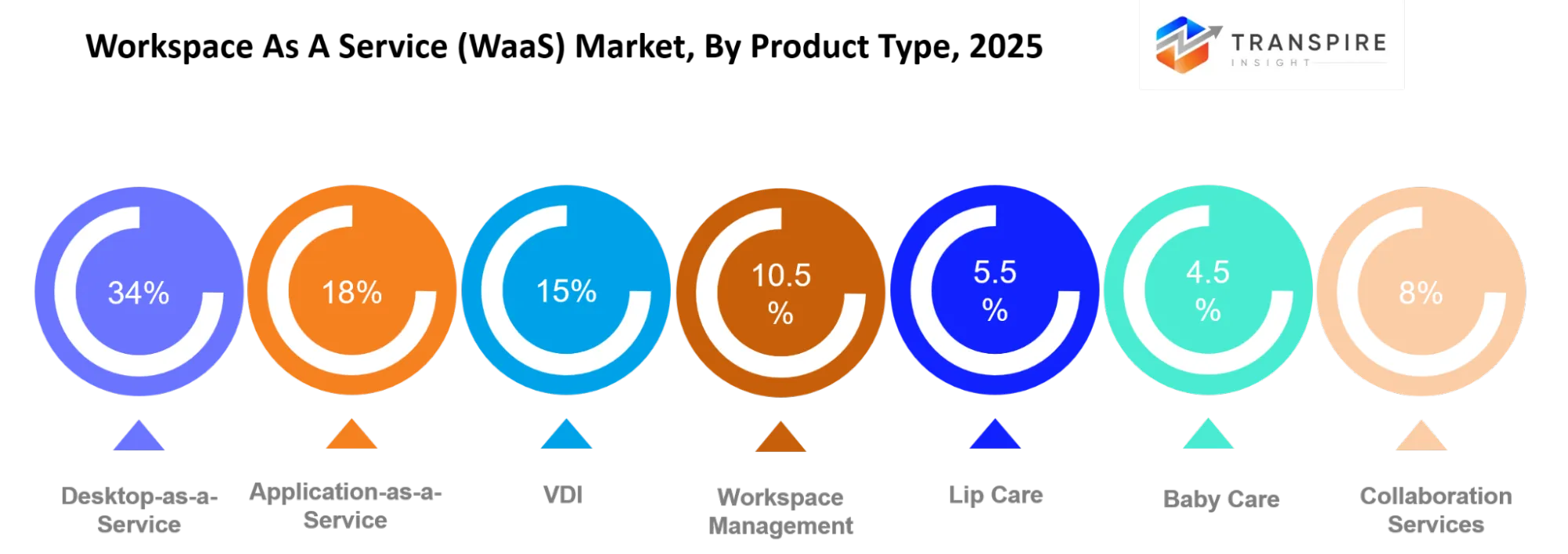
- Desktop-as-a-Service (DaaS) remains the top performer at 34.8%, while Microsoft continues to progress with Windows 365 for Agents, allowing AI agents to be governed inside secure Cloud PCs.
- Application-as-a-Service (AaaS) is taking off with growth momentum of 18.5% as companies provide legacy and SaaS applications without full desktop virtualisation.
- Virtual Desktop Infrastructure accounts for 15.0%, while Citrix and VMware/Omnissa differentiate with enterprise image management, policy control, and hybrid deployment.
- Workspace Management is at 10.5%, driven by the desire for a single provisioning, patching, identity, and endpoint lifecycle service.
- Collaboration Services is 8.0%, with Google and Cisco vying for access to workspace in communications and meetings.
- Security Services account for 6.5% of the total revenue, with the growth that comes from the zero-trust movement and behavioural analytics embedded into virtual desktops.
- AI ticket triage and self-healing remediation are driving AI automation of Support Services, which account for 4.2%.
- AWS is rolling out agent-ready managed desktops via Amazon WorkSpaces for agents, with integration of desktop applications via MCP.
- Asia Pacific is the fastest-growing region at 15.8% CAGR, driven by the growth of SME cloud adoption, digital-public infrastructure, and distributed workforce.
What are the Key Drivers, Restraints, and Opportunities in the Workspace As A Service (WaaS) Market?
Driver:
Hybrid workforce policies and cloud migration are accelerating the shift toward centrally managed digital workspaces. As distributed teams expand, traditional desktop infrastructure struggles to maintain consistent application access, security, and performance across locations. Workspace as a Service (WaaS) enables organisations to standardise workspace provisioning, simplify employee onboarding, and reduce device-management workloads. Subscription-based delivery also limits upfront infrastructure investment and supports flexible capacity planning. Consequently, enterprises are adopting WaaS to improve operational efficiency, strengthen access controls and establish more scalable, recurring IT service models for evolving workforce requirements.
Restraint:
Network dependency remains the principal constraint. WaaS performance depends on stable bandwidth and low latency, particularly for graphics-intensive design, trading, healthcare imaging, and manufacturing workloads. The issue persists because rural connectivity gaps, enterprise WAN bottlenecks, and cloud egress charges continue to affect total cost and user experience, especially in emerging markets.
Opportunity:
AI-enabled workspace operations and hybrid-cloud architectures offer providers opportunities to deliver higher-value managed services. Automated troubleshooting, predictive capacity planning, and identity-based security can improve service quality while reducing manual support requirements. For example, providers can combine cloud desktops with private infrastructure for regulated workloads and public-cloud capacity for flexible applications. Growing digital infrastructure investment in Asia-Pacific also creates opportunities to serve expanding technology, education, and business-services operations. Vendors that demonstrate measurable productivity improvements, transparent pricing, and compliance-ready deployment options can strengthen customer retention and expand recurring contracts.
Driver Impact Analysis — Workspace as a Service (WaaS) Market
|
Driver |
Relative Impact on Growth (%) |
Geographic Relevance |
Impact Timeline |
Demand Strength |
Growth Mechanism |
Key Beneficiaries |
Major Constraint |
|
Cloud migration and cost-efficient virtual desktop adoption |
28% |
North America, Europe, Asia-Pacific |
Short-term (≤2 years) |
High |
Reduces hardware expenditure and simplifies centralized desktop management |
Cloud providers, DaaS vendors, enterprise IT teams |
Unpredictable cloud consumption and migration expenses |
|
Hybrid work, workforce mobility, and BYOD expansion |
24% |
North America, Europe, Asia-Pacific |
Short-term (≤2 years) |
High |
Enables consistent application access across distributed employee devices |
WaaS providers, managed service providers, remote enterprises |
Network latency and inconsistent employee connectivity |
|
Cybersecurity, zero-trust access, and regulatory compliance |
21% |
North America, Europe |
Short-term (≤2 years) |
High |
Centralizes data controls, identity verification, and security policy enforcement |
Cybersecurity vendors, cloud providers, regulated enterprises |
Compliance complexity and evolving cyberattack techniques |
|
AI-enabled workspace automation and scalable cloud infrastructure |
17% |
North America, Asia-Pacific, Europe |
Medium-term (2–4 years) |
High |
Automates provisioning and optimizes virtual desktop resource allocation |
Hyperscalers, AI platform vendors, WaaS service providers |
GPU costs, integration complexity, and skills shortages |
|
SME digitization and managed subscription-based IT services |
10% |
Asia-Pacific, Latin America, Middle East and Africa |
Medium-term (2–4 years) |
Medium |
Expands enterprise-grade workspace access through predictable subscription pricing |
SMEs, regional cloud providers, managed IT service providers |
Budget limitations and insufficient cloud readiness |
|
Total |
100% |
Global |
— |
— |
— |
— |
— |
What has the Impact of Artificial Intelligence been on the Workspace as a Service (WaaS) Market?
Artificial intelligence is changing the nature of WaaS from a static virtual desktop delivery platform to a dynamic workspace platform. For automation and optimisation, AI assigns CPU, storage, and bandwidth according to workload. This prevents excess capacity and provides peak performance when many users access corporate resources. It can also apply predictive analytics to detect anomalous logins, device degradation, application failures, and capacity constraints before they impact employee performance. AI-enabled service desks can automate password resets, help desk segmentation, software patch prioritisation, problem ticket classification, and self-healing remediation, easing the burden on IT teams supporting remote and hybrid users. Meanwhile, by applying contextual security to home, mobile and on-site endpoints in zero-trust environments, AI can help reduce the risks of hybrid work. However, integration and expense limitations remain: legacy apps don't run well in virtualised environments, and the AI features can add to cloud usage and licensing costs. Quality telemetry and machine learning model accuracy also depend on good data, which can mean slow returns for small and midmarket businesses and organisations with complex on-premises environments. Phased deployment and expenditure monitoring are critical.
In September 2026, Omnissa announced new AI innovations including the Elara authority layer at its Omnissa ONE conference. This rollout accelerates the shift toward autonomous IT operations by giving organisations comprehensive visibility, compliance guardrails, and token consumption tracking over unsanctioned AI tools and automated agents running across distributed enterprise endpoints.
https://www.omnissa.com/newsroom/news/omnissa-one-amer-2026-autonomous-announcements-press-release/
Key Workspace As A Service (WaaS) Market Trends:
- The WaaS market is moving away from virtual desktop delivery to integrated, secure, and AI-supported digital workplace management. The balance between user experience, regulatory compliance, and predictable infrastructure costs is becoming a growing competitive advantage.
- Hybrid work has morphed from an emergency remote access to a permanent enterprise architecture, driving up the need for centrally managed workspaces.
- Organisations are moving away from VPN-based access to zero-trust identity, device-posture, and conditional-access controls.
- Cloud PC platforms and endpoint lifecycle management on a subscription basis are the enablers of DaaS, which is the core delivery layer.
- From simple IT automation, AI is progressing to predictive capacity planning, self-healing endpoints, and customized workspace experiences.
- Multi-cloud and hybrid deployment are becoming the preferred choice for enterprises looking to address data residency, performance, and vendor-lock-in issues.
- Security services are moving from add-on to embedded space capabilities, such as endpoint protection and behavioural analytics.
- Managed WaaS is being embraced by SMEs to prevent them from purchasing hardware and hiring in-house IT personnel.
- For latency-sensitive industries like manufacturing, healthcare, and financial services, edge-assisted delivery is becoming more of a trend.
- Buyers now consider employee experience, energy efficiency, compliance, and support quality as well as the desktop cost of WaaS.
Workspace As A Service (WaaS) Market Segmentation
Service Type:
Desktop-as-a-Service leads with a 34.8% share because it provides a complete, centrally managed cloud desktop that replaces traditional endpoint provisioning and supports hybrid work. Application-as-a-Service, growing at 18.5%, benefits from enterprises delivering SaaS and legacy applications without full desktop virtualization, while Virtual Desktop Infrastructure holds 15.0% due to continued demand for controlled, high-performance environments. Workspace Management accounts for 10.5%, Collaboration Services 8.0%, Security Services 6.5%, Support Services 4.2%, and Others 2.5%, reflecting a market that is expanding beyond desktops into lifecycle, governance, and employee-experience services. Cloud Workspace Services are growing at a 16.2% CAGR, indicating that integrated cloud workspace platforms are becoming the preferred operating model.
Deployment:
Public cloud supports rapid scaling and lower infrastructure commitments, whereas private cloud suits organisations requiring tighter control. Hybrid cloud balances flexibility with regulatory and performance requirements; multi-cloud reduces dependence on one provider. Hosted and on-premises arrangements remain relevant for legacy applications, while edge deployment can improve responsiveness for geographically distributed operations. Other models address specialised infrastructure requirements.
Organization Size:
Large enterprises remain important buyers because they manage complex application portfolios and geographically dispersed employees. SMEs and startups can use subscription-based workspaces to access enterprise-grade tools without substantial capital expenditure. Government, education, healthcare, and financial institutions require tailored security, access, and compliance controls, creating opportunities for specialised deployments.
End User:
IT and telecom companies use WaaS for distributed technical teams, while BFSI and healthcare prioritise controlled access to sensitive systems. Retail and manufacturing benefit from standardised workspaces across branches and operational sites. Education, government, and media and entertainment use cases range from virtual learning to secure creative workloads.
Access Device:
Desktop, laptop, and thin-client access remains central to WaaS adoption, enabling employees to use familiar devices while accessing centrally managed applications. Tablets and smartphones extend workspace availability to mobile and field-based workers. Zero clients support simplified endpoint management, while high-performance workstations serve graphics-intensive engineering and design tasks. Device selection increasingly reflects security requirements, workload complexity, mobility, and total ownership costs.
Service Model:
Fully managed WaaS suits organizations seeking outsourced administration, maintenance, and security, while co-managed services allow internal IT teams to retain oversight. Self-service models provide greater user autonomy. Subscription pricing supports predictable budgeting, whereas pay-as-you-go models accommodate fluctuating workloads. Dedicated environments offer greater isolation and customization, while shared services reduce costs through pooled infrastructure, helping businesses balance control, performance, and expenditure.
What are the Key Use Cases Driving the Workspace As A Service (WaaS) Market?
The core use case is secure virtual desktop delivery, supported by Desktop-as-a-Service's 34.8% market share. Enterprises use centralized desktops to standardize applications, simplify onboarding, and provide consistent access across locations without replicating physical IT infrastructure.
Expanding applications include remote IT support, contractor onboarding, branch-office computing, and secure access to financial and healthcare systems. Collaboration services help distributed teams share applications and coordinate work, while workspace management reduces the administrative burden of maintaining diverse endpoints.
Emerging use cases include AI-agent development environments, cloud-hosted engineering workstations and temporary computing capacity for project-based teams. Hybrid-cloud workspaces also help regulated organizations separate sensitive workloads from general productivity applications, balancing compliance, performance and operating costs.
|
Report Metrics |
Details |
|
Market size value in 2025 |
USD 8.49 Billion |
|
Market size value in 2026 |
USD 9.66 Billion |
|
Revenue forecast in 2033 |
USD 23.74 Billion |
|
Growth rate |
CAGR of 13.71% from 2026 to 2033 |
|
Base year |
2025 |
|
Historical data |
2021 - 2024 |
|
Forecast period |
2026 - 2033 |
|
Report coverage |
Revenue forecast, competitive landscape, growth factors, and trends |
|
Regional scope |
United States; Canada; Mexico; United Kingdom; Germany; France; Italy; Spain; Denmark; Sweden; Norway; China; Japan; India; Australia; South Korea; Thailand; Brazil; Argentina; South Africa; Saudi Arabia; United Arab Emirates |
|
Key companies profiled |
Microsoft, VMware, Amazon Web Services, Citrix, Google, IBM, Nutanix, Cisco, Dell Technologies, HP, HPE, Rackspace Technology, Kyndryl, NTT Data, Fujitsu |
|
Customization scope |
Free report customization (country, regional & segment scope). Available customized purchase options to meet your exact research needs. |
|
Report Segmentation |
Service Type (Desktop-as-a-Service, Application-as-a-Service, Virtual Desktop Infrastructure, Workspace Management, Collaboration Services, Security Services, Support Services, Others)Deployment (Public Cloud, Private Cloud, Hybrid Cloud, Multi-Cloud, Hosted, On-Premise, Edge, Others)Organization Size (Large Enterprises, SMEs, Startups, Government, Educational Institutions, Healthcare Organizations, Financial Institutions, Others)End User (IT & Telecom, BFSI, Healthcare, Retail, Manufacturing, Education, Government, Media & Entertainment)Access Device (Desktop, Laptop, Tablet, Smartphone, Thin Client, Zero Client, Workstation, Others)Service Model (Fully Managed, Co-Managed, Self-Service, Subscription, Pay-as-you-Go, Dedicated, Shared, Others). |
Which Regions are Driving the Workspace As A Service (WaaS) Market Growth?
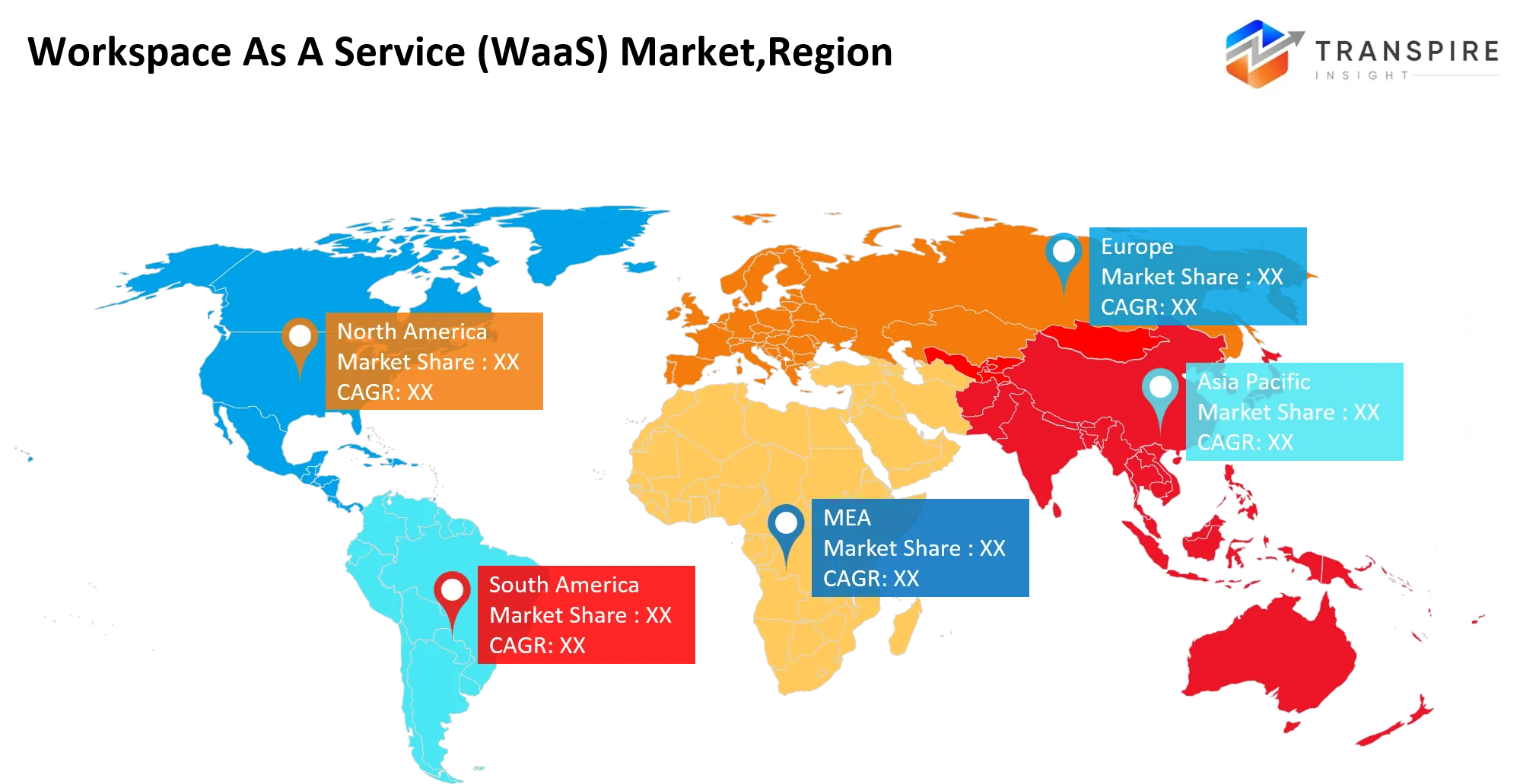
North America has the most significant regional share, accounting for 39.5%, driven by well-developed cloud infrastructure, mature enterprise software applications, and powerful managed-service capabilities. Enterprises are shifting IT investments to a centralized workspace to improve identity management, reduce endpoint management complexity, and support increasingly distributed workforces. The Windows 365 Cloud PC environment from Microsoft illustrates progress in the region towards a managed Cloud PC environment with policy-driven access, supported by commoditised cloud providers, security spending, and enterprise modernization investments.
In May 2026, Microsoft introduced an official 20% list price reduction and an on-demand boot experience for its Windows 365 Business Cloud PC ecosystem. This action lowers the entry barrier for smaller enterprises looking to scale secure remote work environments, allowing them to instantly deprovision or reassign inactive cloud computing seats via a single centralised administrative portal.
Europe comprises 27.0% of the market, where privacy, sovereignty of data and regulatory compliance are the most significant factors in adoption, and scale is the driver for enterprise adoption. GDPR obliges organisations to understand where their personal information is being processed and who has control of the data. The need for auditable and managed workspace environments is reinforced by financial services, the digitisation of the public sector and the adoption of traditional enterprise IT systems. Flexible hosting options and transparent compliance controls are key requirements for providers.
In January 2026, Amazon Web Services (AWS) officially launched the general availability of the AWS European Sovereign Cloud. This brand-new, physically and logically isolated cloud partition is situated in Potsdam, Germany, and is designed specifically to comply with Europe's stringent data residency and sovereignty requirements.
https://glesys.com/blog/eu-data-sovereignty-in-2026-new-rules-for-your-infrastructure/
Asia Pacific holds a 22.5% share and is projected to grow at a 15.8% CAGR, making it the fastest-growing region. Expansion of Capability Centres, IT services, and digitally enabled businesses is increasing demand for scalable workspace provisioning. Cloud investment and workforce digitisation create opportunities across India and Southeast Asia, where affordable subscriptions, localised support, and hybrid deployment will shape adoption.
Latin America contributes 6.2%, with potential in shared services, financial services, and customer support. The Middle East and Africa account for 4.8%, supported by digital-government initiatives and enterprise cloud investment. Managed subscriptions can reduce upfront infrastructure costs, while connectivity, compliance, and pricing flexibility will determine adoption.
In October 2026, initiated a strategic expansion in Southeast Asia by establishing its ASEAN headquarters in Singapore. Backed by investments from EDBI and SG Growth Capital, this expansion scales the company's proactive security operations and deepens partnerships with regional Managed Security Service Providers (MSSPs) and cloud providers.
Who are the Key Players in the Workspace As A Service (WaaS) market, and how do they compete?
The industry is moving away from desktop virtualization vendors as the sole endpoint solution to the digital workspace platform, where integrated AI, security, endpoint management, and managed services offer all-in-one solutions. Vendors are competing based on integrated ecosystems, workload performance, security compliance, and lower TCO, as PC prices lose their relevance. Microsoft takes an innovation-based approach to better position Windows 365 for these priorities with tight integration with Entra ID, Intune, Copilot, and secure execution of the AI agent. Expansion strategies pivot around linking Cloud PCs to ecosystems of development, security, and productivity. AWS takes a scale-and-platform approach; differentiates with cloud scale and agent-ready desktop automation enabled by MCP integration. VMware/Omnissa and Citrix have unique strengths in enterprise spaces, with a focus on hybrid deployment, applications delivery, and policy-based control of regulated and graphics workloads. Google, IBM, Nutanix, Cisco, Dell Technologies, HP, HPE, Rackspace, Kyndryl, NTT DATA, and Fujitsu compete on partnership, hardware-software integration, managed services, and vertical solutions. They focus on hybrid cloud, edge workspaces, sovereign deployment, and industry-specific managed services.
Key Players are:
- Microsoft
- Vmware
- Amazon Web Services
- Citrix
- IBM
- Nutanix
- Cisco
- Dell Technologies
- HP
- HPE
- Rackspace Technology
- Kyndryl
- NTT Data
- Fujitsu
Workspace as a Service (WaaS) Market — Enhanced Competitive Benchmarking
|
Company |
Est. Revenue Share Range |
Key Offerings |
Strategic Positioning |
Geographic Strength |
Technology Focus |
|
Microsoft |
Estimated 12–20% |
Windows 365, Azure Virtual Desktop, Microsoft 365 integration |
Ecosystem-led cloud PC adoption and enterprise bundling |
North America, Europe, Asia Pacific |
Cloud PC provisioning, identity security, AI integration |
|
Amazon Web Services (AWS) |
Estimated 9–16% |
Amazon WorkSpaces, WorkSpaces Applications, WorkSpaces Core |
Consumption-based desktops backed by hyperscale infrastructure |
North America, Europe, Asia Pacific |
Elastic cloud desktops, usage metering, GPU virtualisation |
|
Citrix (Cloud Software Group) |
Estimated 8–14% |
Citrix DaaS, Citrix Virtual Apps, Citrix Workspace |
Enterprise virtualisation with secure hybrid-cloud delivery |
North America, Europe, Asia Pacific |
HDX streaming, zero-trust access, multi-cloud orchestration |
|
Omnissa |
Estimated 6–12% |
Horizon Cloud, Horizon 8, Horizon Control Plane |
Hybrid desktop virtualisation with unified management |
North America, Europe, Asia Pacific |
Desktop orchestration, image management, dynamic scaling |
|
Broadcom (VMware infrastructure) |
Estimated 4–8% |
VMware vSphere, private-cloud infrastructure supporting VDI |
Infrastructure-led virtualisation for existing enterprise estates |
North America, Europe, Asia Pacific |
Hypervisor infrastructure, virtual networking, workload management |
|
Nutanix |
Estimated 3–6% |
Nutanix Frame, Nutanix AHV, end-user computing integrations |
Flexible desktop delivery across customer-selected infrastructure |
North America, Europe, Asia Pacific |
Hyperconverged infrastructure, browser-based desktop streaming |
|
Google Cloud |
Estimated 2–5% |
Google Cloud virtual desktop ecosystem, Cameyo, partner-hosted desktops |
Browser-first application delivery and cloud ecosystem integration |
North America, Europe, Asia Pacific |
Browser-based app delivery, cloud identity, ChromeOS integration |
|
Unisys |
Estimated 2–5% |
Digital Workplace Services, managed workplace, end-user computing |
Managed enterprise workplace services and experience optimisation |
North America, Europe, Asia Pacific |
AI-assisted IT support, endpoint management, predictive analytics |
|
Tech Mahindra |
Estimated 1–4% |
FLEX WaaS, FLEX Digital Workplace, cloud workspace services |
Outsourced digital workplace delivery with integrated support |
Asia Pacific, North America, Europe |
Persona-based workspaces, endpoint automation, hybrid delivery |
|
Dizzion |
Estimated 0.5–2% |
Dizzion DaaS, Managed DaaS, compliant virtual desktop services |
Managed desktop specialisation for complex enterprise requirements |
North America, Europe |
Managed cloud desktops, compliance controls, workload scaling |
Recent Development News
In October 2026, Multiplier launched its Office Space service in partnership with WeWork India, integrating flexible workspace bookings into its employment platform. The launch enables distributed employees to access desks and meeting rooms across more than 600 locations in 125+ cities and 35+ countries, expanding subscription-based workspace access for globally distributed workforces.
In August 2026, DXC Technology launched DXC Workplace Services, an AI-native workplace offering designed to improve employee productivity and simplify enterprise IT operations. Powered by its DXC OASIS platform, the offering uses agentic AI to anticipate employee technology needs and accelerate issue resolution, reinforcing the shift toward intelligent, service-based workplace management.
https://dxc.com/newsroom/08122026-dxc-powers-the-next-era-of-work-with-dxc-workplace-services
What Strategic Insights Define the Future of the Workspace As A Service (WaaS) Market?
The WaaS market is moving toward an AI-agent-ready, zero-trust workspace platform, making WaaS a control point for people and digital workers that they create or consume. A cloud lock-in hidden cost component is that AI compute workloads and data egress charges for high-value, highly secure workspaces will slowly erode the cost savings that made cloud desktops attractive in the first place. An emerging opportunity is for sovereign and edge-enabled WaaS solutions for highly regulated vertical markets such as health care, BFSI, government, and manufacturing, where data needs to be processed securely and protected by low-latency access and added oversight of where data resides. Vendors should aim to incorporate AI governance, transparent pricing, identity-based data security, and compliant, hybrid hosting in industry-specific solutions. Customers should be measuring a provider's results on cost, security, and performance outcomes rather than subscription levels, and testing AI-agent workloads on private Cloud PCs to validate access controls, resource usage, and outcomes before rolling out at scale to reduce deployment risk.
Key Segmentations are:
Service Type
- Desktop-as-a-Service
- Application-as-a-Service
- Virtual Desktop Infrastructure
- Workspace Management
- Collaboration Services
- Security Services
- Support Services
- Others
Deployment
- Public Cloud
- Private Cloud
- Hybrid Cloud
- Multi-Cloud
- Hosted
- On-Premise
- Edge
- Others
Organization Size
- Large Enterprises
- SMEs
- Startups
- Government
- Educational Institutions
- Healthcare Organizations
- Financial Institutions
- Others
End User
- IT & Telecom
- BFSI
- Healthcare
- Retail
- Manufacturing
- Education
- Government
- Media & Entertainment
Access Device
- Desktop
- Laptop
- Tablet
- Smartphone
- Thin Client
- Zero Client
- Workstation
- Others
Service Model
- Fully Managed
- Co-Managed
- Self-Service
- Subscription
- Pay-as-you-Go
- Dedicated
- Shared
- Others
Frequently Asked Questions
Find quick answers to common questions.
The workspace as a service (WaaS) market size was valued at USD 8.49 billion in 2025 and is poised to reach USD 23.74 billion by 2033, expanding at a 13.71% CAGR.
Key segments for the workspace as a service (WaaS) market are Service Type (Desktop-as-a-Service, Application-as-a-Service, Virtual Desktop Infrastructure, Workspace Management, Collaboration Services, Security Services, Support Services, Others)Deployment (Public Cloud, Private Cloud, Hybrid Cloud, Multi-Cloud, Hosted, On-Premise, Edge, Others)Organization Size (Large Enterprises, SMEs, Startups, Government, Educational Institutions, Healthcare Organizations, Financial Institutions, Others)End User (IT & Telecom, BFSI, Healthcare, Retail, Manufacturing, Education, Government, Media & Entertainment)Access Device (Desktop, Laptop, Tablet, Smartphone, Thin Client, Zero Client, Workstation, Others)Service Model (Fully Managed, Co-Managed, Self-Service, Subscription, Pay-as-you-Go, Dedicated, Shared, Others).
Growth is primarily driven by hybrid workforce adoption, cloud migration, centralized IT management, rising cybersecurity requirements, subscription-based workspace delivery, and AI-enabled automation.
The workspace as a service (WaaS) market is led by major manufacturers, including Microsoft, VMware, Amazon Web Services, Citrix, Google, IBM, Nutanix, Cisco, Dell Technologies, HP, HPE, Rackspace Technology, Kyndryl, NTT Data, and Fujitsu.
North America holds a 39.5% market share, supported by mature cloud infrastructure, strong enterprise IT investment, established technology providers, and widespread adoption of managed digital workspaces
Key opportunities include AI-enabled workspace management, sovereign and hybrid-cloud deployments, zero-trust security services, edge-enabled workspaces, and industry-specific solutions for regulated sectors.
About the Authors

Mayur Shinde
I am Mayur Shinde, a Senior Research Analyst at Transpire Insight, specializing in the Automotive & Transportation and Information & Communication Technology (ICT) Industry. My work focuses on analyzing emerging market trends, technological advancements, competitive landscapes, and industry developments to deliver accurate, data-driven insights. I am passionate about transforming complex market information into clear, actionable content that helps businesses, professionals, and decision-makers stay informed and make confident strategic decisions.

Chakradhar Khansole
Chakradhar serves as the Research Director at Transpire Insight, bringing over 8 years of experience in technology, innovation, and strategic market intelligence. He specializes in transforming complex market data into actionable business insights that enable organizations to make informed, growth-oriented decisions. Recognized for his strategic vision and analytical expertise, Chakradhar leads high-impact research initiatives, delivering comprehensive market assessments, competitive intelligence, and forward-looking industry analysis.
Recently Published Reports
-
Apr 2026
3D Optical Profiler Market
3D Optical Profiler Market Size, Share & Analysis Report By Type (Desktop 3D Optical Profiler, and Portable 3D Optical Profiler), By Technology (Confocal Technology, and White Light Interference), By End-Use Industry (Manufacturing, Research Institutions, Automotive, Aerospace and Defense, Medical Devices, and Other), and Geography (North America, Europe, Asia-Pacific, Middle East and Africa, South and Central America), 2021 - 2031
-
Apr 2026
Depth Sensor Market
Depth Sensor Market Size, Share & Analysis Report By Type (Infrared Depth Sensors, Time-of-Flight (ToF) Sensors, Stereo Vision Sensors, Structured Light Sensors, Ultrasonic Depth Sensors), By Application (Automotive, Robotics, Gaming, Consumer Electronics, Industrial Automation, Healthcare, Security & Surveillance, Others), By End Users (Automotive Manufacturers, Consumer Electronics Companies, Healthcare Providers, Industrial Companies, Security Agencies, Gaming Companies, Robotics Companies, Others), and Geography (North America, Europe, Asia-Pacific, Middle East and Africa, South and Central America), 2021 – 2031
-
Apr 2026
Digital Manufacturing Market
Digital Manufacturing Market Size, Share & Analysis Report By Component (Hardware, Software, and Services), By Technology (Robotics, 3D Printing, Internet of Things (IoT), and Others), By Application (Automotive and Transportation, Aerospace and Defense, Consumer Electronics, Industrial Machinery, and Others), By Process Type (Computer-Based Designing, Computer-Based Simulation, Computer 3D Visualization, Analytics, and Others), and Geography (North America, Europe, Asia-Pacific, Middle East and Africa, South and Central America), 2021 – 2031
-
Apr 2026
Digital Visa Services Market
Digital Visa Services Market Size, Share & Analysis Report By Type (Individual Travelers, Group Travelers), By Application (Tourism, Business Travel, Others), and Geography (North America, Europe, Asia-Pacific, Middle East and Africa, South and Central America), 2021 – 2031