
United States Hosting Infrastructure Services Market Summary
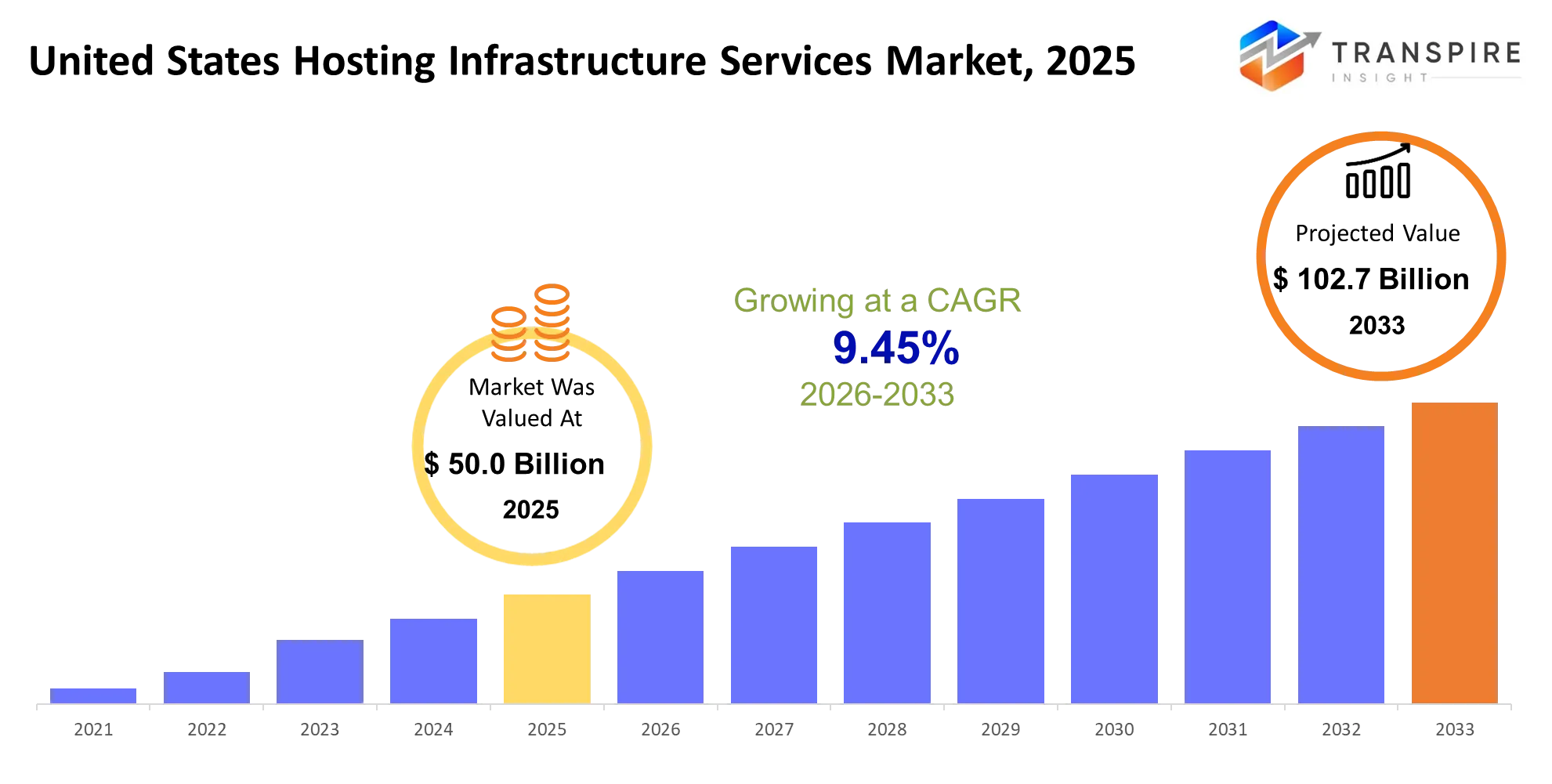
As per Transpire Insight, the United States Hosting Infrastructure Services Market size is estimated at USD 50.0 Billion in 2025 and is anticipated to reach USD 102.7 Billion by 2033, growing at a CAGR of 9.45% from 2026 to 2033.
The United States Hosting Infrastructure Services Market delivers the compute, storage, networking, security, and physical capacity things businesses need to keep websites, applications, databases, and AI workloads running in a steady way— without needing to build every infrastructure layer internally. In the last 3–5 years, it feels like the market moved away from just plain cloud migration and more into hybrid approaches, multi-cloud setups, edge expansion, and infrastructure that is AI-ready. That shift also changed how customers buy, from capacity planning toward workload-specific provisioning, which is a bit more targeted and less generic. The pace picked up a lot after the generative AI boom happened, and that event basically drove demand for high-density GPU capacity, better cooling, faster networking, and large-scale storage, all at once.
CBRE said the primary North American data center supply went up 36% in 2025, while net absorption reached 2,497.6 MW, and that’s up 38% versus 2024. So basically the market is shifting toward higher value infrastructure services , I mean, with AI workloads, enterprise modernization and low latency applications, the revenue per deployment tends to climb. And on top of that, they also push people into longer term capacity commitments.
United States Hosting Infrastructure Services Market Size & Forecast:
- United States Hosting Infrastructure Services Market Size 2025: USD 50.0 Billion
- Expected Market Value 2033: USD 102.7 Billion
- Forecast CAGR: 9.45%
- Leading region in 2025: Eastern U.S., led by Northern Virginia
- Fastest Growing region: Southern U.S., particularly Texas and Atlanta corridor
- Key Profile: Amazon Web Services, Microsoft Azure, Google Cloud, Oracle Cloud Infrastructure, IBM Cloud, DigitalOcean, Rackspace Technology, Equinix, OVHcloud, Akamai Technologies, Vultr, Linode (Akamai), Hetzner, Liquid Web, Hostwinds
Key Market Insights
- Northern Virginia basically owns the most U.S. infrastructure capacity, hitting 4,039.6 MW in 2025, while vacancy sits at just 0.5% so, that s been pretty steady despite heavy cloud commitments.
- Meanwhile the Southern markets are, sort of, running ahead of everyone else, with Dallas taking in 470.8 MW in 2025 , up a very noticeable 424 MW year over year.
- Cloud hosting is the main service driver because enterprises are moving workloads away from stubborn fixed on-premise setups, and into more scalable compute and storage environments, you know, the usual “flexibility” pitch but it actually shows up in the numbers.
- Also AI workloads are changing what buyers ask for—GPU-optimized servers, liquid cooling , faster networking , and notably higher rack power densities. It s not just compute anymore it s the full thermal and power conversation.
- Primary data center supply rose 36% in 2025, landing at 9,432 MW, and net absorption jumped 38% to 2,497.6 MW.
- Hybrid and multi-cloud tactics are picking up steam too, letting organizations spread workloads across providers while still handling resilience, compliance, and that vendor-concentration issue that keeps showing up in board decks.
- Edge infrastructure is moving past the usual pilot phase, now being fueled by AI inference, real-time analytics connected devices, plus latency-sensitive enterprise applications that can t wait around.
- Power availability has turned into a core site-selection factor. Developers are favoring places that can deliver large power blocks in shorter construction timelines, because delays are basically expensive.
- And data center scarcity is pushing infrastructure pricing higher. For 250–500 kW requirements, average asking rates climbed 6.5% year over year to $195.94 per kW/month.
- AI infrastructure is widening the whole market beyond traditional hosting too, opening new revenue streams across GPU hosting, managed AI environments, high-performance computing, and specialized storage.
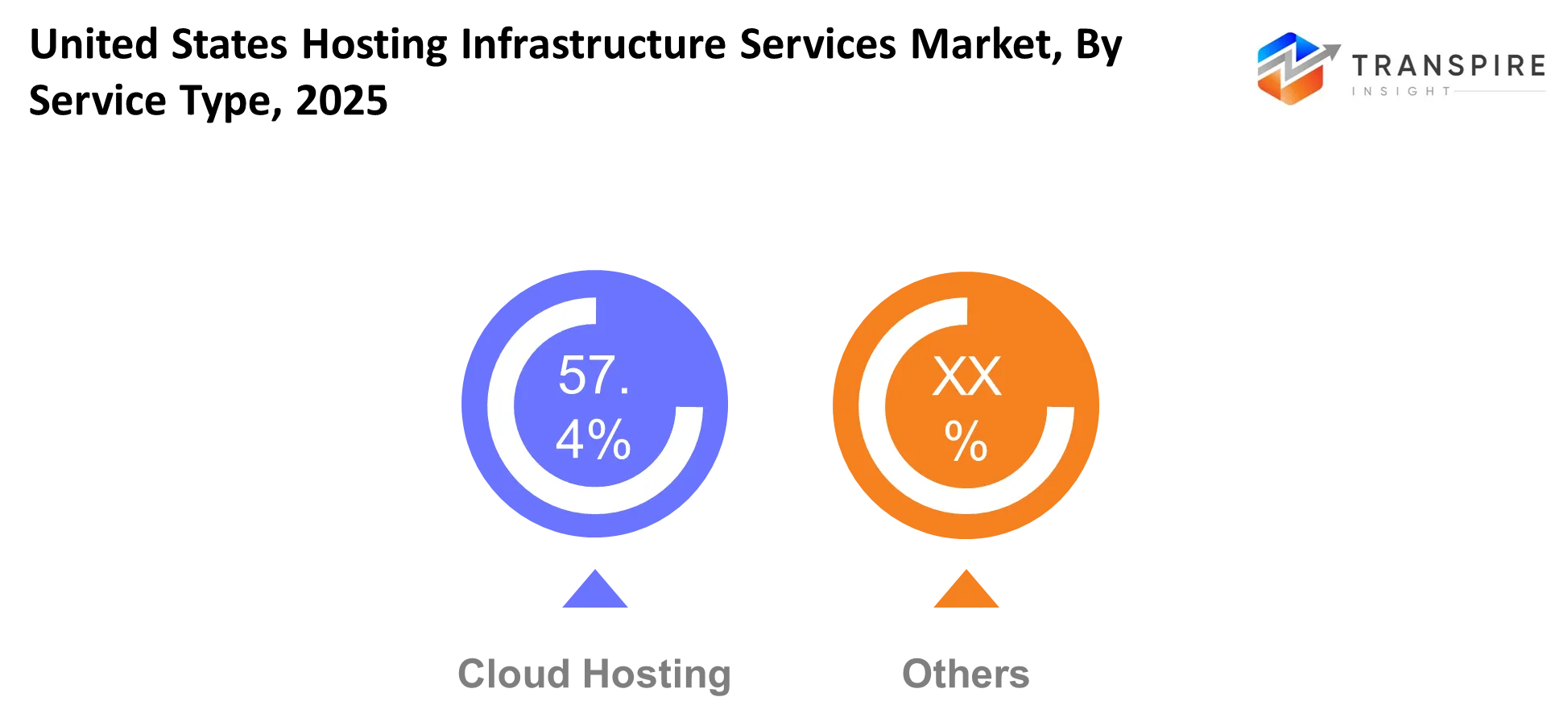
- Cloud Hosting is still the leading service segment, backed by elastic compute automated provisioning , managed services and enterprise migration programs, which together helps enterprises modernize without going fully day-0.
What are the Key Drivers, Restraints, and Opportunities in the United States Hosting Infrastructure Services Market?
Driver: Honestly the most powerful growth momentum seems to come from the move away from conventional enterprise hosting toward AI-ready and cloud-native infrastructure. Generative AI has pushed infrastructure needs up, since model training and inference call for accelerated compute, high bandwidth networking, big storage pools, and frankly higher rack power densities. McKinsey also projects that AI-ready data center capacity demand might climb around 33% each year from 2023 through 2030, so AI infrastructure ends up being a big capacity as well as a revenue driver.
Restraint: Still, there are hard limits that don’t really budge quickly—power availability, permitting hurdles, and construction timelines. Capacity that was under construction in key North American markets dropped, from 6,350.1 MW at the end of 2024 to 5,994.4 MW by the end of 2025. Developers hit delays tied to securing power, permits and appropriate sites. As a result, deployments get pushed out, and sometimes projects get re-aimed toward higher cost secondary locations, which is not ideal.
Opportunity: On the upside, AI inference is opening a meaningful opening for distributed hosting and edge infrastructure. Inference workloads are increasingly hungry for regional capacity, placed close to end users. That makes smaller data centers, edge nodes, and distributed cloud environments look commercially appealing. Operators that bundle low latency connectivity, accelerated compute, managed Kubernetes, plus AI optimization, can snag higher value workloads beyond what’s typical for conventional website hosting.
What Has the Impact of Artificial Intelligence Been on the United States Hosting Infrastructure Services Market?
Artificial intelligence is sort of moving hosting infrastructure away from general-purpose capacity, and toward more specialized compute environments. These days cloud providers are setting up GPU clusters, custom accelerators, faster-than-usual networking, advanced storage, and even liquid-cooling systems to help with model training, as well as inference. AI also sort of helps run infrastructure operations better, via automated workload scheduling, capacity forecasting, anomaly detection, and predictive maintenance for servers, cooling units, power gear, and network parts . In one 2025 field demo, a 256-GPU cluster reportedly cut total cluster power use by about 25% for roughly three hours, during the busiest grid moments, and yet it still managed to honor the AI quality of service promises.
Machine learning, in a practical sense, can forecast utilization levels , detect quirky hardware behavior, improve where tasks land, and nudge non-urgent computing toward the moments when power is actually more available. day to day, that could bump up resource utilization, curb avoidable downtime, and keep energy spend from getting out of hand as the core infrastructure becomes more power greedy. AI also helps with automated scaling, so hosting platforms can spin up capacity based on workload patterns, instead of clinging to fixed capacity beliefs.
Still, a big limitation remains: the cost and overall complexity of integrating AI infrastructure. GPU availability, specialized cooling, power constraints, networking requirements , and a shortage of operational know-how can make AI-ready setups noticeably more expensive than conventional hosting. Because of that, high-density infrastructure is still mostly concentrated among hyperscalers, large enterprises, and specialized providers, those with enough capital and technical capability to actually run it.
Key Market Trends
- Since 2022, it seems like AI has shifted most hosting investment toward GPU-ready facilities, which kind of speeds up the push for high-density compute and cooling systems that are more specialized than before , even if it feels a little obvious.
- In 2025, primary data center supply apparently expanded 36%, but the vacancy situation stayed tight, because hyperscalers pulled in that new capacity fast enough.
- From 2024 onward, Dallas-Fort Worth has gotten stronger, absorbing about 470.8 MW in 2025 as hyperscale deployments kept expanding, and it kinda kept compounding.
- What’s also changed is that power availability is now beating connectivity as the main site-selection factor , especially when the project is large-scale AI infrastructure.
- Hybrid and multi-cloud adoption has also grown, because enterprises want resilience , workload portability , compliance control , and less lock-in to a single provider.
- Meanwhile, AI inference is nudging infrastructure nearer to where people are, so edge facilities and distributed hosting architectures are getting more attention and funding.
- On the commercial side, data center pricing went up 6.5% year over year in 2025 for 250–500 kW requirements, which basically signals that capacity scarcity is still hanging around.
- Big hosting projects are increasingly locking in capacity before construction begins, and for Northern Virginia , 96% of the scheduled supply for 2026 is already committed, so there’s not much breathing room left.
- Infrastructure providers are also tweaking their strategies to optimize for energy efficiency, grid conditions , cooling loads , and compute utilization, not just raw capacity.
- Finally, competitive positioning is moving away from generic colocation talk, toward integrated AI platforms, custom accelerators, managed services, networking , security , and infrastructure automation that’s basically designed to run itself or at least close to it.
United States Hosting Infrastructure Services Market Segmentation
By Service Type:
Dedicated Hosting is for businesses that need exclusive server resources, steadier performance, firmer control, and better security. Shared Hosting , on the other hand, is the cheaper route for smaller sites and basic digital services, by putting multiple websites on the same server resources. VPS Hosting gives isolated virtual resources, but with more flexibility than the shared kind, so it fits growing businesses and people building software. Cloud Hosting lets you shift resources as needed and it can handle applications that have shifting workloads, while Colocation Services basically provide the physical data center space, power, cooling, plus connectivity for equipment the customer already owns.
Managed Hosting reduces the day to day burden of internal server administration, since monitoring, maintenance, security, and technical help are handled for you. Bare Metal Hosting delivers physical servers for high performance needs, where dedicated processing matters. Hybrid Hosting kinda mixes multiple infrastructure styles so workloads can stay flexible , and Edge Hosting pushes compute resources nearer to users, which is handy for apps that really need low latency. After that there are also the other choices , for instance more specialized hosting arrangements built around particular needs, like stronger security, added storage, quicker throughput, or maybe even a distinct type of application performance.
By Deployment:
Public Cloud offers shared infrastructure via scalable computing , storage networking, plus software services , more or less. Private Cloud on the other hand gives dedicated cloud resources to organizations that need stronger governance on security, compliance, and resource management. Hybrid Cloud sort of links private infrastructure with public cloud services, and it also helps with gradual shift of workloads, elastic workload flexibility, and capacity expansion. Then Multi-Cloud uses more than one cloud provider for workload distribution , resilience too, better service choosing and vendor diversification.
On-Premise Hosting keeps the infrastructure inside the company buildings , and it is still used for sensitive applications , legacy systems , and when strict control requirements matter a lot. Edge Infrastructure pushes compute capacity nearer to end users, connected devices and operational locations. SaaS Infrastructure is basically software applications delivered as subscription based online services , while IaaS delivers virtual computing, storage, and networking resources. Other deployment options exist as well, like models tailored for specific application needs, compliance rules, performance targets, or even infrastructure ownership preferences.
By Enterprise Size:
Large Enterprises count as a big customer segment since large application portfolios tend to need a lot of computing resources, storage, networking, security layers, plus backup capacity. In contrast, SMEs often go for hosting services so they can tap scalable infrastructure without putting much money into physical servers or those data center facilities. Startups usually lean toward flexible infrastructure, because rapid business changes can lead to sudden swings in computing and storage needs. Government Organizations want secure infrastructure for public services, internal administration systems, databases, and digital platforms, not just for speed but also for trust.
Educational Institutions use hosting to run learning platforms, research systems, student databases ,and more online services. Healthcare Organizations need sturdy and secure infrastructure for patient applications, electronic records, analytics, and digital health platforms, so everything stays consistent. Financial Institutions rely on dependable hosting for banking applications, payment processing, financial analytics, and customer support services. Retail Enterprises use hosting for e-commerce platforms, inventory systems, customer analytics, and payment applications, while “Others” covers professional services, logistics, hospitality, and technology businesses.
By End User:
IT & Telecom counts as one of the biggest end user realms, mostly because software platforms, communication services, cloud apps, and network systems all need infrastructure that can scale. In BFSI, people lean on hosting for digital banking, payment processing, financial applications , analytics, and customer-facing platforms. Healthcare is kinda different here, because it relies on stable and secure infrastructure for electronic records, clinical workloads, patient portals, plus medical analytics. Retail uses hosting for online stores, inventory systems , payment platforms, customer databases, and even digital marketing services. Manufacturing, on the other hand, takes infrastructure for production applications, supply chain systems, industrial analytics, and connected devices.
The government also taps into hosting for citizen services, administrative platforms, public databases, and digital communication systems. Media & Entertainment needs infrastructure for streaming, content storage, digital distribution, rendering, and audience analytics. Education leans on hosting for learning management systems, research platforms, online courses, and student services. E-commerce really depends on scalable app capacity, database resources, storage, and content delivery to keep transactions moving, handle promotions, and survive seasonal traffic without breaking.Then the “Others” bucket covers things like logistics, energy, automotive, hospitality, professional services, and technology companies, where the infrastructure requirements are honestly a bit all over the place.
By Application:
Website Hosting is for business sites, institutional portals, publishing platforms , and online services that really need steady access plus secure server capacity. Application Hosting fits enterprise software, mobile apps, customer portals , and digital services where you want scalable computing resources to keep up. Database Hosting gives dedicated or managed environments for transaction systems and analytical databases , helping with data heavy business processes. Disaster Recovery leans on backup infrastructure and geographically separated systems , so apps and data stay protected during outages , hardware failures, or operational disruptions.
Content Delivery helps speed things up by placing popular content nearer to end users. AI Workloads need accelerated computing, fast networking, lots of storage capacity, and specialized cooling , especially for model training and inference. Data Storage covers business records, application files, backups, media content , and analytics datasets using scalable storage environments. DevOps Infrastructure supports continuous integration, software testing, automated deployment, container management, and ongoing application monitoring. Others can include gaming, virtual desktop infrastructure, scientific computing, collaboration platforms, analytics, and also specific enterprise applications that don’t fit the usual categories.
What are the Key Use Cases Driving the United States Hosting Infrastructure Services Market?
Cloud based application hosting it’s kinda a core use case, because companies need scalable compute, databases, storage, and networking, without having to fully babysit all the physical infrastructure themselves. Big enterprises , IT providers, retailers, and financial institutions are using cloud environments more and more for apps that face customers, plus analytics and day to day digital operations. The elastic provisioning angle also helps absorb sudden traffic spikes without leaving a bunch of servers just sitting there in permanent excess capacity.
Disaster recovery plus data storage is growing right alongside application modernization. BFSI , healthcare, government, and retail orgs lean on geographically distributed infrastructure to shield critical applications and data while lowering reliance on a single physical site. And content delivery, that part really helps media, entertainment, gaming, and e-commerce platforms that need low latency access for huge customer pools.
Then there’s AI training and inference, which is becoming a high value use case. AI workloads usually need GPU clusters, faster networking, advanced cooling, and a distributed setup overall, which opens new doors for hyperscalers, colocation providers, and specialized hosting companies. Edge AI will keep pushing further into industrial analytics, telecommunications, retail automation, and real time enterprise applications, especially as inference starts happening closer to end users rather than far away.
|
Report Metrics |
Details |
|
Market size value in 2025 |
USD 50.0 Billion |
|
Market size value in 2026 |
USD 54.6 Billion |
|
Revenue forecast in 2033 |
USD 102.7 Billion |
|
Growth rate |
CAGR of 9.45% from 2026 to 2033 |
|
Base year |
2025 |
|
Historical data |
2021 - 2024 |
|
Forecast period |
2026 - 2033 |
|
Report coverage |
Revenue forecast, competitive landscape, growth factors, and trends |
|
Regional scope |
United States; Canada; Mexico; United Kingdom; Germany; France; Italy; Spain; Denmark; Sweden; Norway; China; Japan; India; Australia; South Korea; Thailand; Brazil; Argentina; South Africa; Saudi Arabia; United Arab Emirates |
|
Key company profiled |
Amazon Web Services, Microsoft Azure, Google Cloud, Oracle Cloud Infrastructure, IBM Cloud, DigitalOcean, Rackspace Technology, Equinix, OVHcloud, Akamai Technologies, Vultr, Linode (Akamai), Hetzner, Liquid Web, Hostwinds |
|
Customization scope |
Free report customization (country, regional & segment scope). Avail customized purchase options to meet your exact research needs. |
|
Report Segmentation |
By Service Type (Dedicated Hosting, Shared Hosting, VPS Hosting, Cloud Hosting, Colocation Services, Managed Hosting, Bare Metal Hosting, Hybrid Hosting, Edge Hosting, Others); By Deployment (Public Cloud, Private Cloud, Hybrid Cloud, Multi-Cloud, On-Premise Hosting, Edge Infrastructure, SaaS Infrastructure, IaaS, Others); By Enterprise Size (Large Enterprises, SMEs, Startups, Government Organizations, Educational Institutions, Healthcare Organizations, Financial Institutions, Retail Enterprises, Others); By End User (IT & Telecom, BFSI, Healthcare, Retail, Manufacturing, Government, Media & Entertainment, Education, E-commerce, Others); By Application (Website Hosting, Application Hosting, Database Hosting, Disaster Recovery, Content Delivery, AI Workloads, Data Storage, DevOps Infrastructure, Others) |
Which Regions are Driving the United States Hosting Infrastructure Services Market Growth?
Northern Virginia and the larger Eastern U.S. still feel like the main infrastructure hub, mostly because there’s just so much data center density, really solid connectivity, and closeness to big enterprise and government buyers. In 2025 Northern Virginia hit 4,039.6 MW of inventory, and that came along with 1,102 MW net absorption. Vacancy was only 0.5%, so yeah, it tightened up. A big part of it is the extensive fiber routes, plus established cloud availability zones, also carrier interconnection, and an already mature supply chain for data centers. Power delivery limits are starting to act like the brake pedal now, but strong preleasing and existing infrastructure still let the region move forward with high-value hosting deployments.
Meanwhile the Western U.S. is sort of on a different track. It’s driven by technology companies, cloud-native operators, content platforms , and ongoing enterprise computing demand. Phoenix and Silicon Valley remain major infrastructure centers. Phoenix kinda wins on land availability, tax incentives, and hyperscale expansion, while Silicon Valley keeps its edge through the wider technology ecosystem. The customer mix here is broader too, software, tech, media, and digital services, not just government and hyperscale buying. So even with power and land limitations around, steady enterprise investment plus strong interconnection generally supports a more dependable revenue base.
And the Southeast is showing the most noticeable expansion momentum, especially around Atlanta. There, hyperscale work plus AI-linked projects have sped up infrastructure buildout. Atlanta’s inventory more than tripled to 1,279.4 MW in Q1 2025. Net absorption reached 951 MW and vacancy dropped down to 3.6%.
Who are the Key Players in the United States Hosting Infrastructure Services Market and How Do They Compete?
Competition is still pretty concentrated in the hyperscale cloud folks, but then you have specialized hosting and colocation players, that kind a go after the workloads that need lower cost, more dedicated infrastructure, a bit more geography flexibility, or just specialized support. In general AWS, Microsoft Azure, and Google Cloud stay in the fight because they can lean on global infrastructure , proprietary AI technologies, developer communities, and these all-in-one platform services. Oracle Cloud Infrastructure seems to be gaining traction lately, mainly by aiming at high performance AI workloads and also enterprise database environments. Meanwhile, Equinix competes in a more physical way, think interconnection, colocation, and basically getting access to multiple cloud networks, in one place.
On the AWS side, they are pushing hybrid and AI forward through partnerships, like that 2026 agreement with AT&T, where AWS cloud infrastructure is paired with AT&T’s fiber network. Oracle is going for something else though: securing big capital for OCI expansion, and then building AI infrastructure for large contracted customers. Also, Oracle and AWS expanded multicloud networking in April 2026, which gives you private, high speed connectivity between OCI and AWS environments. Google Cloud, on the other hand, leans into AI infrastructure, networking, and large scale data services. Equinix stays focused on interconnection and carrier neutral facilities, more than “just” running compute.
Then there are DigitalOcean, Vultr, and Liquid Web, they often compete closer to the developer experience angle, easier cloud management, and workloads where cost sensitivity matters a lot. Honestly, competitive advantage is drifting toward how well you combine compute capacity with AI accelerators, plus networking, security, managed services, and regional availability, rather than trying to win on raw server pricing alone.
Company List
- Amazon Web Services
- Microsoft Azure
- Google Cloud
- Oracle Cloud Infrastructure
- IBM Cloud
- DigitalOcean
- Rackspace Technology
- Equinix
- OVHcloud
- Akamai Technologies
- Vultr
- Linode (Akamai)
- Hetzner
- Liquid Web
- Hostwinds
Recent Development News
- "In February 2026, Amazon and OpenAI announced a strategic partnership. AWS will provide 2 gigawatts of Trainium capacity for OpenAI workloads, while Amazon will invest $50 billion in OpenAI, strengthening AWS's position in large-scale AI infrastructure. https://press.aboutamazon.com/2026/2/openai-and-amazon-announce-strategic-partnership (Amazon Press Center)."
- "In March 2026, Oracle and NVIDIA expanded their AI infrastructure collaboration. The companies announced expanded OCI capabilities using NVIDIA technology, including large-scale GPU superclusters designed for frontier AI training, inference, and accelerated enterprise workloads. https://blogs.oracle.com/cloud-infrastructure/oracle-nvidia-gtc-2026-key-announcements (Oracle)."
- "In April 2026, Oracle and AWS expanded multicloud networking. The collaboration enables customers to establish private, high-speed connectivity between OCI and AWS, supporting applications and data movement across both cloud environments. https://www.oracle.com/news/announcement/oracle-and-aws-collaborate-to-expand-multicloud-networking-2026-04-16/ (Oracle)."
What Strategic Insights Define the Future of the United States Hosting Infrastructure Services Market?
The market seems, like kinda, to be shifting away from general purpose hosting toward stuff built to handle AI infrastructure, distributed applications, and hybrid work. The main pull isn’t only the idea of moving to cloud, it’s more the growing compute intensity of AI, which keeps rewriting what you need: GPUs, networking, cooling, storage, and even how much power you can realistically get on site. There’s also a quieter risk here, infrastructure concentration. If you only have access to a limited amount of power, plus you lean on a small group of hyperscale customers, that could turn into regional bottlenecks, and it may also expose providers to project delays, or even abrupt changes in how aggressively AI budgets get spent. On the other side of that, the opportunities are showing up around distributed AI inference especially across secondary U.S. markets where there’s power capacity and land available. In those areas, edge facilities can back lower latency workloads without going head to head with the most squeezed hubs. Market participants should really focus on power secured locations, modular builds, and multi-cloud connectivity, while they’re also setting up flexible capacity so it can handle both standard enterprise programs and AI workloads at the same time.
United States Hosting Infrastructure Services Market Report Segmentation
By Service Type
- Dedicated Hosting
- Shared Hosting
- VPS Hosting
- Cloud Hosting
- Colocation Services
- Managed Hosting
- Bare Metal Hosting
- Hybrid Hosting
- Edge Hosting
- Others
By Deployment
- Public Cloud
- Private Cloud
- Hybrid Cloud
- Multi-Cloud
- On-Premise Hosting
- Edge Infrastructure
- SaaS Infrastructure
- IaaS
- Others
By Enterprise Size
- Large Enterprises
- SMEs
- Startups
- Government Organizations
- Educational Institutions
- Healthcare Organizations
- Financial Institutions
- Retail Enterprises
- Others
By End User
- IT & Telecom
- BFSI
- Healthcare
- Retail
- Manufacturing
- Government
- Media & Entertainment
- Education
- E-commerce
- Others
By Application
- Website Hosting
- Application Hosting
- Database Hosting
- Disaster Recovery
- Content Delivery
- AI Workloads
- Data Storage
- DevOps Infrastructure
- Others
Frequently Asked Questions
Find quick answers to common questions.
The expected United States Hosting Infrastructure Services Market size for the market will be USD 102.7 Billion in 2033.
Key segments for the United States Hosting Infrastructure Services Market are By Service Type (Dedicated Hosting, Shared Hosting, VPS Hosting, Cloud Hosting, Colocation Services, Managed Hosting, Bare Metal Hosting, Hybrid Hosting, Edge Hosting, Others); By Deployment (Public Cloud, Private Cloud, Hybrid Cloud, Multi-Cloud, On-Premise Hosting, Edge Infrastructure, SaaS Infrastructure, IaaS, Others); By Enterprise Size (Large Enterprises, SMEs, Startups, Government Organizations, Educational Institutions, Healthcare Organizations, Financial Institutions, Retail Enterprises, Others); By End User (IT & Telecom, BFSI, Healthcare, Retail, Manufacturing, Government, Media & Entertainment, Education, E-commerce, Others); By Application (Website Hosting, Application Hosting, Database Hosting, Disaster Recovery, Content Delivery, AI Workloads, Data Storage, DevOps Infrastructure, Others).
Major United States Hosting Infrastructure Services Market players are Amazon Web Services, Microsoft Azure, Google Cloud, Oracle Cloud Infrastructure, IBM Cloud, DigitalOcean, Rackspace Technology, Equinix, OVHcloud, Akamai Technologies, Vultr, Linode (Akamai), Hetzner, Liquid Web, Hostwinds.
The United States Hosting Infrastructure Services Market size is USD 50.0 Billion in 2025.
The United States Hosting Infrastructure Services Market CAGR is 9.45%from 2026 to 2033.
- Amazon Web Services
- Microsoft Azure
- Google Cloud
- Oracle Cloud Infrastructure
- IBM Cloud
- DigitalOcean
- Rackspace Technology
- Equinix
- OVHcloud
- Akamai Technologies
- Vultr
- Linode (Akamai)
- Hetzner
- Liquid Web
- Hostwinds
About the Authors

Mayur Shinde
I am Mayur Shinde, a Senior Research Analyst at Transpire Insight, specializing in the Automotive & Transportation and Information & Communication Technology (ICT) Industry. My work focuses on analyzing emerging market trends, technological advancements, competitive landscapes, and industry developments to deliver accurate, data-driven insights. I am passionate about transforming complex market information into clear, actionable content that helps businesses, professionals, and decision-makers stay informed and make confident strategic decisions.

Chakradhar Khansole
Chakradhar serves as the Research Director at Transpire Insight, bringing over 8 years of experience in technology, innovation, and strategic market intelligence. He specializes in transforming complex market data into actionable business insights that enable organizations to make informed, growth-oriented decisions. Recognized for his strategic vision and analytical expertise, Chakradhar leads high-impact research initiatives, delivering comprehensive market assessments, competitive intelligence, and forward-looking industry analysis.
Recently Published Reports
-
Apr 2026
3D Optical Profiler Market
3D Optical Profiler Market Size, Share & Analysis Report By Type (Desktop 3D Optical Profiler, and Portable 3D Optical Profiler), By Technology (Confocal Technology, and White Light Interference), By End-Use Industry (Manufacturing, Research Institutions, Automotive, Aerospace and Defense, Medical Devices, and Other), and Geography (North America, Europe, Asia-Pacific, Middle East and Africa, South and Central America), 2021 - 2031
-
Apr 2026
Depth Sensor Market
Depth Sensor Market Size, Share & Analysis Report By Type (Infrared Depth Sensors, Time-of-Flight (ToF) Sensors, Stereo Vision Sensors, Structured Light Sensors, Ultrasonic Depth Sensors), By Application (Automotive, Robotics, Gaming, Consumer Electronics, Industrial Automation, Healthcare, Security & Surveillance, Others), By End Users (Automotive Manufacturers, Consumer Electronics Companies, Healthcare Providers, Industrial Companies, Security Agencies, Gaming Companies, Robotics Companies, Others), and Geography (North America, Europe, Asia-Pacific, Middle East and Africa, South and Central America), 2021 – 2031
-
Apr 2026
Digital Manufacturing Market
Digital Manufacturing Market Size, Share & Analysis Report By Component (Hardware, Software, and Services), By Technology (Robotics, 3D Printing, Internet of Things (IoT), and Others), By Application (Automotive and Transportation, Aerospace and Defense, Consumer Electronics, Industrial Machinery, and Others), By Process Type (Computer-Based Designing, Computer-Based Simulation, Computer 3D Visualization, Analytics, and Others), and Geography (North America, Europe, Asia-Pacific, Middle East and Africa, South and Central America), 2021 – 2031
-
Apr 2026
Digital Visa Services Market
Digital Visa Services Market Size, Share & Analysis Report By Type (Individual Travelers, Group Travelers), By Application (Tourism, Business Travel, Others), and Geography (North America, Europe, Asia-Pacific, Middle East and Africa, South and Central America), 2021 – 2031