
United States Vital Parameter Monitoring Devices And Equipment Market Size & Forecast:
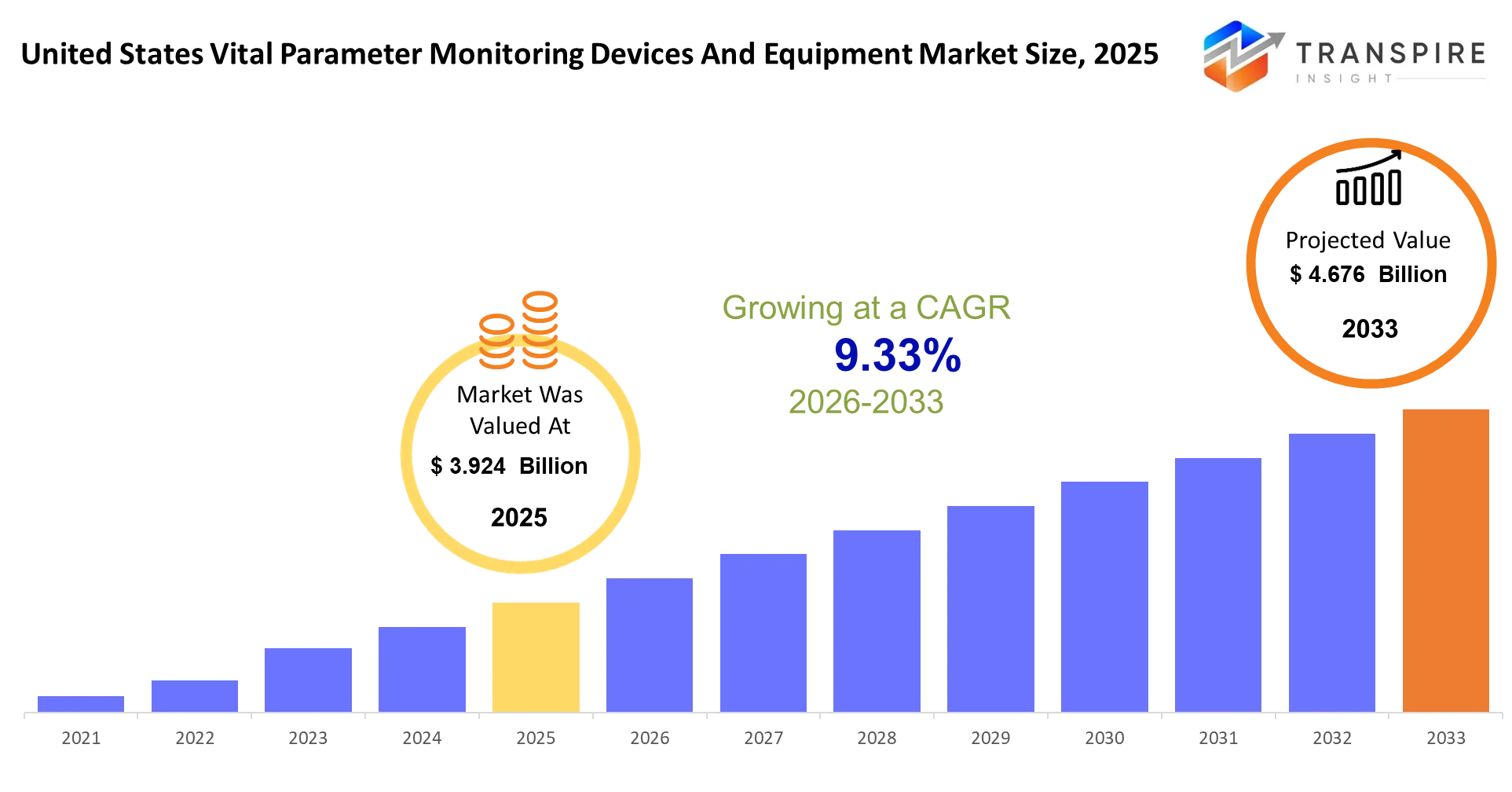
- United States Vital Parameter Monitoring Devices And Equipment Market Size 2025: USD 3.924 Billion
- United States Vital Parameter Monitoring Devices And Equipment Market Size 2033: USD 4.676 Billion
- United States Vital Parameter Monitoring Devices And Equipment Market CAGR: 9.33%
- United States Vital Parameter Monitoring Devices And Equipment Market Segments: By Product Type (Blood Pressure Monitors, Pulse Oximeters, ECG Monitors, Temperature Monitoring Devices, Respiratory Monitoring Devices, Others); By Modality (Portable Devices, Wearable Devices, Bedside Monitoring Systems, Remote Monitoring Systems, Others); By Application (Cardiology Monitoring, Respiratory Monitoring, ICU Monitoring, Home Healthcare, Others); By End User (Hospitals, Clinics, Home Care Settings, Ambulatory Surgical Centers, Others)
To learn more about this report,  Download Free Sample Report
United States Vital Parameter Monitoring Devices And Equipment Market Summary
The United States Vital Parameter Monitoring Devices And Equipment Market was valued at USD 3.924 Billion in 2025. It is forecast to reach USD 4.676 Billion by 2033. That is a CAGR of 9.33% over the period.
In US hospitals and post-acute care settings, vital parameter monitoring devices and equipment continuously track heart rate, oxygen saturation, blood pressure, and temperature, turning bedside and remote patient signals into real-time clinical alerts that help clinicians react to decline sooner. Over the last five years, the market kind of drifted away from just standalone bedside monitors and sort of wandered toward connected cloud-enabled platforms, plus wearable remote patient monitoring systems, all of it tied in with electronic health records
The COVID-19 pandemic made that shift happen faster, since hospitals widened home-based care approaches to save capacity, while nursing staffing gaps stayed pretty tight, and CMS reimbursement support for remote patient monitoring kept pushing things along. So providers are now leaning into interoperable setups that reduce manual checks, improve patient throughput, and help lower avoidable readmissions , and that loop ends up reinforcing equipment replacement calendars and those recurring software-linked revenue streams too.
Key Market Insights
- In 2025 the Northeast US holds the biggest share, around 32% , and it is supported by dense hospital networks and ongoing investment into advanced healthcare infrastructure, sort of the backbone thing.
- The Western US meanwhile is moving the quickest through 2026, mainly because digital health startup activity keeps increasing and telehealth adoption stays high, kind of a steady climb.
- At the same time, bedside vital sign monitors stay the leading segment, with almost 38% share across the United States Vital Parameter Monitoring Devices And Equipment Market.
- Wearable monitoring devices are next in line, they are growing as chronic disease management plus post-surgical care pathways get more attention.
- Remote monitoring systems are the most rapidly growing segment too, expanding quickly through 2026 , helped by reimbursement support and cloud integration working together.
- Finally ICU and emergency care applications lead overall with roughly 45% share, which shows why continuous monitoring is so crucial in critical care settings.
- Home healthcare is getting the quickest growth, driven by cost reduction pressure, and this shift toward decentralizing post-pandemic care too.
- Hospitals are still the leading end-user group, holding close to 60% share because the setup needs so much equipment intensity and infrastructure dependency.
- Ambulatory care centers along with home healthcare providers are among the fastest-growing end user categories in the United States Vital Parameter Monitoring Devices and Equipment Market.
What are the Key Drivers, Restraints, and Opportunities in the United States Vital Parameter Monitoring Devices And Equipment Market?
The United States Vital Parameter Monitoring Devices And Equipment Market is mostly driven by the quick spread of remote patient monitoring, made easier by expanded regulatory reimbursements through CMS programs. In a manner of speaking, this momentum kind of started during the COVID-19 period, when healthcare systems hit sudden capacity constraints, and so providers had to shift toward ongoing observation outside the usual hospital walls. Now, hospitals and home care providers are deploying more connected instruments that send real time physiological data, and this assists with earlier clinical reactions, while also able to reduce readmission related penalties. All that basically strengthens the recurring revenue side tied to software subscriptions and bundled monitoring platforms within the United States Vital Parameter Monitoring Devices And Equipment Market.
One notable restraint is the heavy interoperability workload across older hospital infrastructure. A lot of facilities still run on fragmented monitoring systems that do not connect smoothly with newer EHR platforms, and this leads to data silos while also raising IT modernization costs. This kind of structural snag drags procurement cycles out longer, because hospitals have to weigh device replacement alongside wider digital infrastructure investments, meaning uptake at full scale gets delayed even when the clinical need is right there.
An important opportunity is kind of coming into view through AI-enabled wearable biosensor ecosystems, with digital health venture funding backing it up. Some companies like Masimo and Medtronic are moving forward with continuous, non-invasive monitoring wearables that are able to watch multi-parameter vitals in real time. There is also expansion happening in outpatient cardiac care programs , and with that aging population management in places like California getting more attention, it sets up the conditions for large-scale deployment. So this whole innovation wave is being viewed as the next growth accelerator for the United States Vital Parameter Monitoring Devices And Equipment Market, even if people are still describing it a bit differently from report to report.
What Has the Impact of Artificial Intelligence Been on the United States Vital Parameter Monitoring Devices And Equipment Market?
Artificial intelligence is sort of reshaping the United States Vital Parameter Monitoring Devices And Equipment Market by turning what used to be passive monitoring tools into continuously more adaptive clinical decision systems, a change that feels simple but is actually kinda big. In hospital environments, AI enabled monitoring platforms automate patient surveillance by sifting physiological data streams coming from bedside monitors and wearables, this process can reduce alarm fatigue through smarter threshold adjustment and even better event prioritization, especially for clinically critical episodes. As a result, workflow efficiency in intensive care units goes up, and clinicians are able to act earlier without adding extra pressure to their day to day workload.
Machine learning models are also being used for predictive deterioration detection, in which algorithms look at past info alongside live vitals, like heart rate variability, oxygen saturation movement and respiratory habits, to estimate sepsis risk or sudden cardiac instability a few hours ahead. At the same time, device makers are starting to tuck predictive maintenance into the monitoring equipment, so the devices can automatically point out sensor drift, calibration needs or even probable component breakdown. This does a lot for device uptime, and it can cut the unplanned servicing costs, even if that sounds minor at first, it tends to matter more as time goes on.
Because of these digital upgrades, measurable operational gains are showing up, including shorter ICU response delays, better bed utilization efficiency, and lower readmission rates in remote monitoring programs. Still, one major limitation remains the high integration cost tied to connecting AI systems into fragmented hospital IT environments, especially when older EHR systems don’t play well with interoperability standards. On top of that, data inconsistency across devices can constrain model accuracy, so full scale deployment stays limited even when clinical teams are strongly interested in AI driven vital monitoring systems.
Key Market Trends
- Hospitals have moved, from those periodic manual checks into like continuous digital surveillance systems, and this has boosted response times especially in critical care units since 2021, which honestly feels faster than before.
- GE HealthCare and Philips then expanded cloud integrated monitoring platforms after 2022, swapping the kinda isolated bedside devices for interoperable hospital wide networks, and it’s not just one product now, it’s more connected.
- After 2020 , remote patient monitoring adoption jumped up kind of fast, and the Medicare reimbursement changes, sort of acted like a spark, helping home based vital sign tracking programs scale.
- Masimo and Medtronic also increased investment in wearable biosensors between 2023 and 2025 , so the attention drifted away from fixed , stationary devices toward ambulatory care monitoring that actually follows people around .
- In ICU monitoring, systems increasingly moved to AI assisted alarm filtering after 2022, which reduced those annoying false alerts, and it also helps clinicians make decisions with less friction, or at least that’s what they say.
- Supply chains for semiconductor dependent monitoring devices tightened during 2021–2022, so manufacturers got pushed into diversified sourcing, plus localized assembly in some cases, to stay on track.
- Hospitals started emphasizing interoperability compliance under the updated federal digital health guidelines introduced in 2023, and this replaced a lot of legacy siloed monitoring systems that used to not really talk to each other.
- Predictive maintenance features became standard in premium monitoring equipment after 2024, cutting device downtime, and minimizing service disruptions across bigger hospital networks.
- Overall competitive strategies shifted toward ecosystem integration, where vendors bundle hardware, analytics and cloud services, instead of just standalone monitoring devices, and that bundle approach feels like the new default.
United States Vital Parameter Monitoring Devices And Equipment Market Segmentation
By Product Type :
Blood Pressure Monitors , Pulse Oximeters, ECG Monitors Temperature Monitoring Devices, Respiratory Monitoring Devices, and others are seen as key categories in the United States Vital Parameter Monitoring Devices And Equipment Market . Each product kind of backs up basic health tracking and helps with early recognition of health shifts, in clinical and non-clinical areas, at the same time.
In that setup, Blood Pressure Monitors together with ECG Monitors support a heart rhythm and function check, while Pulse Oximeters focus on oxygen saturation within blood. Temperature Monitoring Devices, plus Respiratory Monitoring Devices help with fever screening and breathing assessment. The “others” group then spans additional observation requirements across different healthcare settings , which supports continuous patient watch and basic diagnostic support when needed.
By Modality :
Portable Devices , Wearable Devices, Bedside Monitoring Systems, Remote Monitoring Systems, and others also help define major modality categories in the United States Vital Parameter Monitoring Devices And Equipment Market. Each modality supports its own mix of mobility, connectivity, and patient interaction across everyday healthcare workflows.
Portable Devices support quick, movement-based measurement, while Wearable Devices enable ongoing tracking of health signals. Bedside Monitoring Systems provide near real-time observation in hospitals, and Remote Monitoring Systems allow off-site patient tracking and follow-up. Other formats often include hybrid designs, which make it easier to match monitoring needs in different care environments , even when the setting changes.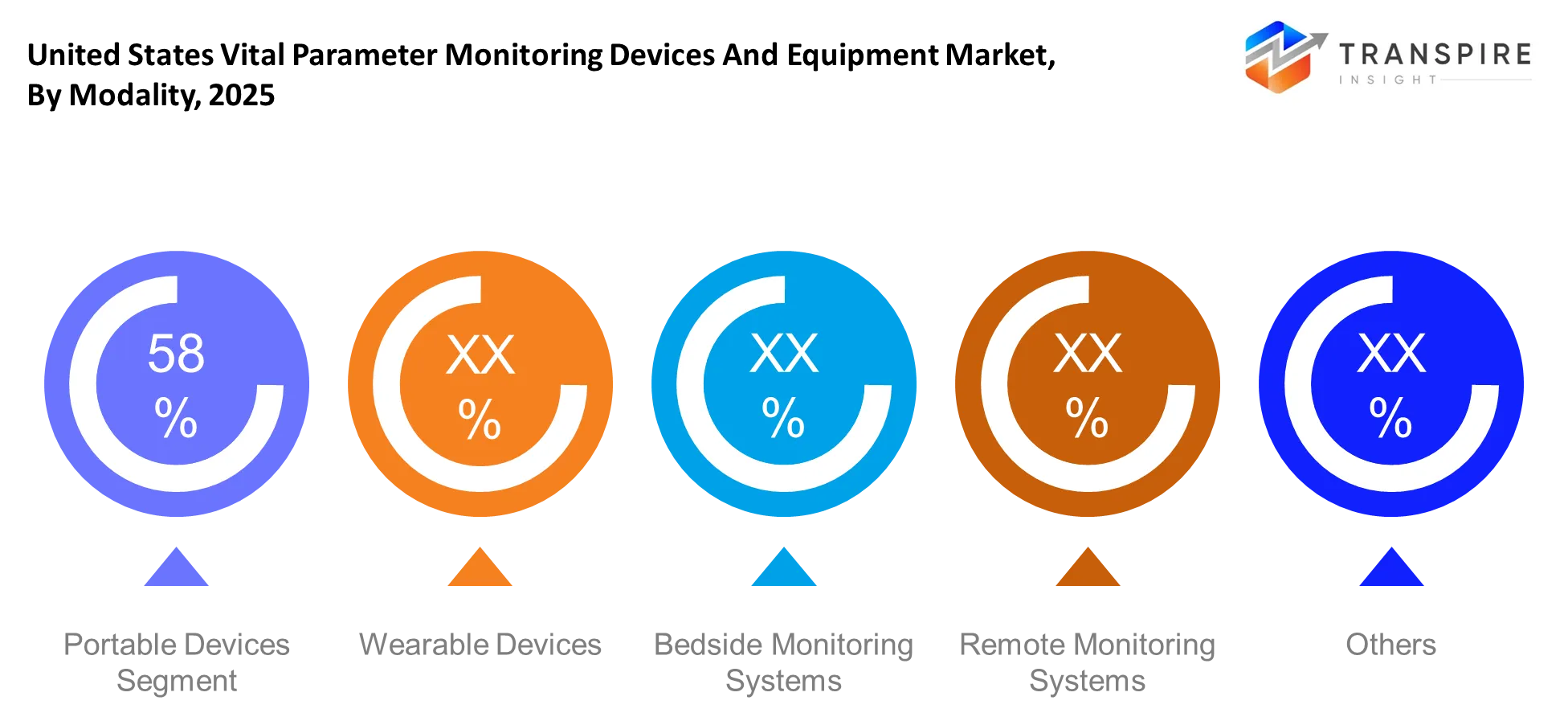
To learn more about this report, Download Free Sample Report
By Application :
Cardiology Monitoring, Respiratory Monitoring, ICU Monitoring, Home Healthcare, and Others kinda represent the big application lanes in the United States Vital Parameter Monitoring Devices And Equipment Market. Every application kind of supports patient care that is more or less targeted, depending on the particular health condition and also on how intense the monitoring needs to be.
Cardiology Monitoring mostly zeroes in on heart related conditions, while Respiratory Monitoring is there to follow lung function and oxygen performance, not just general wellbeing. ICU Monitoring helps with close watch of critical patients inside intensive care units. Home Healthcare basically moves monitoring outside the hospital walls, and Other applications cover general health tracking plus supportive clinical use across different medical settings too.
By End User :
Hospitals, Clinics, Home Care Settings, and Ambulatory Surgical Centers are the major end users in the United States Vital Parameter Monitoring Devices And Equipment Market. Each end user group reflects a different care delivery setup, so the need for patient monitoring and vital sign tracking solutions varies from place to place.
Hospitals rely on advanced monitoring systems for continuous care, while Clinics lean more toward regular checkups and diagnostic workflows. Home Care Settings enable patient managed monitoring outside clinical facilities. Ambulatory Surgical Centers use these monitoring devices for short duration surgical and recovery support, this helps keep patient safety in check during procedures and also during post care observation.
What are the Key Use Cases Driving the United States Vital Parameter Monitoring Devices And Equipment Market?
Continuous patient monitoring in intensive care units is still kind of the big dominant use case in the United States Vital Parameter Monitoring Devices And Equipment Market, where hospitals count on live tracking of cardiac and respiratory stability to keep an eye on high acuity patients and also lower mortality risk. This whole environment keeps demand steady because even those small delays in noticing physiological decline can push treatment costs up and make outcomes a bit worse.
After the ICUs, adoption keeps creeping into emergency departments and post surgical recovery wards across big hospital systems, plus ambulatory surgical centers. In these settings they increasingly put multi parameter monitors to work, so staff can make quicker triage decisions and help shorten patient length of stay, especially under value based care reimbursement rules that sort of punish inefficiency.
Some newer use cases are showing up too, like home based chronic disease management for heart failure, and COPD, where wearable vital monitors send continuous data back to the care teams. Remote maternal health monitoring is also getting more traction in rural care networks and telehealth programs, which helps catch risk early during pregnancy and cuts down on avoidable hospital visits.
|
Report Metrics |
Details |
|
Market size value in 2025 |
USD 3.924 Billion |
|
Market size value in 2026 |
USD 4.277 Billion |
|
Revenue forecast in 2033 |
USD 4.676 Billion |
|
Growth rate |
CAGR of 9.33% from 2026 to 2033 |
|
Base year |
2025 |
|
Historical data |
2021 - 2024 |
|
Forecast period |
2026 - 2033 |
|
Report coverage |
Revenue forecast, competitive landscape, growth factors, and trends |
|
Geographic scope |
United States of America |
|
Key company profiled |
Philips Healthcare, GE HealthCare, Medtronic, Nihon Kohden, Masimo, Omron Healthcare, Dräger, Mindray, Abbott Laboratories, Baxter International, Honeywell, Schiller AG, Hillrom, Nonin Medical, Contec Medical Systems |
|
Customization scope |
Free report customization (country, regional & segment scope). Avail customized purchase options to meet your exact research needs. |
|
Report Segmentation |
By Product Type (Blood Pressure Monitors, Pulse Oximeters, ECG Monitors, Temperature Monitoring Devices, Respiratory Monitoring Devices, Others); By Modality (Portable Devices, Wearable Devices, Bedside Monitoring Systems, Remote Monitoring Systems, Others); By Application (Cardiology Monitoring, Respiratory Monitoring, ICU Monitoring, Home Healthcare, Others); By End User (Hospitals, Clinics, Home Care Settings, Ambulatory Surgical Centers, Others) |
Which Regions are Driving the United States Vital Parameter Monitoring Devices And Equipment Market Growth?
In the Northeast United States, the Vital Parameter Monitoring Devices And Equipment Market is basically led because there is a lot of academic medical centers packed in and also many high-acuity hospital networks. Places like New York and Massachusetts lean on strong regulatory compliance frameworks, and that helps advanced patient monitoring systems get adopted faster. Big integrated healthcare systems keep on upgrading ICU infrastructure, with backing from federal funding for digital health modernization. So overall, you get ongoing procurement cycles for multi-parameter monitoring devices across tertiary care locations, which kind of keeps demand steady.
Meanwhile the Midwest region brings a more stable share, not so much from highly specialized tertiary centers but from its broad web of community hospitals and long-term care facilities. Compared with the Northeast, the momentum here isn’t always about rapid technological upgrades. Instead it’s more about steady replacement, meaning older medical equipment gets swapped out over time across mid-sized health systems in states like Illinois and Ohio. Hospital procurement in this area tends to value cost efficiency and operational reliability, and that results in gradual yet consistent adoption of standardized monitoring systems. Because of this, demand for essential vital monitoring equipment stays more predictable even when the economy slows down a bit, you know.
The Western United States is kind of the fastest-growing place, backed by an aggressive telehealth push and big digital health investment programs in California , and Washington. In fact, more recent state-level incentives for remote patient monitoring plus post-pandemic hospital decentralization, have sped up the uptake of wearables and cloud-connected monitoring systems. Also, more venture capital dollars, keep flowing into digital health startups, and it kind of shores up their innovation pipelines— especially when AI enabled diagnostics are involved. So yeah this momentum kind of signals real, durable long-term opportunities for technology providers aiming at integrated, and also at home based monitoring solutions, across the 2026–2033 span.
Who are the Key Players in the United States Vital Parameter Monitoring Devices And Equipment Market and How Do They Compete?
The United States Vital Parameter Monitoring Devices and Equipment Market looks pretty moderately consolidated, like a few big med-tech incumbents basically lock up the most high-value hospital contracts, while smaller digital health players try to edge them out via remote monitoring. Right now competition depends less on hardware pricing—more on how complete the whole ecosystem is, including software integration, interoperability with EHR systems, and AI-enabled clinical decision support, you know, the kind of stuff that makes workflows smoother. Hospitals increasingly pick vendors that can curb alarm fatigue, streamline the data flow , and also fit reimbursement-linked remote monitoring workflows instead of just buying a standalone device and calling it a day.
GE HealthCare basically pushes forward with integrated patient monitoring platforms built for large hospital networks, especially in ICU-heavy academic medical centers. Their edge is that they bundle hardware together with enterprise imaging and data systems that can feed centralized clinical command centers. Philips Healthcare meanwhile differentiates with its cloud-based hospital-to-home monitoring continuum, so patients can move from acute care units to remote supervision without the usual data discontinuity. They also keep expanding through strategic collaborations with health systems running hybrid care models across several major US metropolitan regions.
Medtronic keeps its focus on wearable biosensors and chronic illness monitoring, using its cardiovascular knowledge to push outpatient monitoring adoption, a bit more strongly than before. Masimo builds a more distinct edge with non-invasive pulse oximetry accuracy and hospital level wearable integrations, and that ends up improving monitoring reliability especially when people are moving a lot, like in busier settings. Nihon Kohden on the other hand goes after very specific hospital areas, bringing high-precision monitoring gear that is tuned for critical care units and emergency departments, not really the broad market. Across all these companies, growth is starting to lean more on software partnerships, on RPM platform integration, and on moving deeper into home based care ecosystems, instead of the usual device sales route.
Company List
- Philips Healthcare
- GE HealthCare
- Medtronic
- Nihon Kohden
- Masimo
- Omron Healthcare
- Dräger
- Mindray
- Abbott Laboratories
- Baxter International
- Honeywell
- Schiller AG
- Hillrom
- Nonin Medical
- Contec Medical Systems
Recent Development News
In February 2026, Danaher announced the acquisition of Masimo. The $9.9 billion deal expands Danaher’s presence in non-invasive patient monitoring technologies such as pulse oximetry and respiratory monitoring, strengthening its diagnostics and vital parameter monitoring portfolio in hospital settings across the United States.
Source https://www.reuters.com/
In April 2026, the U.S. Food and Drug Administration (FDA) launched the TEMPO pilot program for digital health devices. The initiative supports faster evaluation and deployment of wireless and AI-enabled vital parameter monitoring technologies, accelerating commercialization pathways for manufacturers in the U.S. patient monitoring device ecosystem.
Source https://www.fda.gov/medical-devices/
What Strategic Insights Define the Future of the United States Vital Parameter Monitoring Devices And Equipment Market?
The United States Vital Parameter Monitoring Devices And Equipment Market seems to be moving, kind of gradually, toward a distributed intelligence led care model where monitoring stops being mostly about hospital centered hardware and instead becomes this continuous, data driven ecosystem across hospitals, ambulatory centers and homes. This shift is usually linked to reimbursement alignment for remote patient monitoring, plus an ongoing push on providers to lower inpatient costs while still protecting clinical outcomes. Over the next five to seven years, the value is likely to end up more in platform type solutions that bring together real time vitals, predictive analytics and real time interoperability across care settings, rather than just selling standalone devices.
There is also a risk that is less in your face: vendor concentration around a small number of ecosystem providers. That could result in dependency on proprietary data architectures, and in turn it can reduce procurement flexibility for hospitals. In practice, this might slow down adoption of new innovations, especially if switching costs climb sooner than reimbursement incentives, or well, in parallel but not fast enough.
On the upside, an emerging opportunity is the spread of AI validated continuous monitoring in post acute care and skilled nursing facilities, especially while staffing shortages stay stubborn across the US healthcare system. In these settings, deployments become a practical test ground for scalable wearable monitoring networks, where the data links into centralized clinical oversight hubs. Market players should focus on modular, interoperable device architectures that can be plugged into multiple care environments, so they can capture demand across hospital, home and long term care ecosystems at the same time.
United States Vital Parameter Monitoring Devices And Equipment Market Report Segmentation
By Product Type
- Blood Pressure Monitors
- Pulse Oximeters
- ECG Monitors
- Temperature Monitoring Devices
- Respiratory Monitoring Devices
By Modality
- Portable Devices
- Wearable Devices
- Bedside Monitoring Systems
- Remote Monitoring Systems
By Application
- Cardiology Monitoring
- Respiratory Monitoring
- ICU Monitoring
- Home Healthcare
By End User
- Hospitals
- Clinics
- Home Care Settings
- Ambulatory Surgical Centers
Frequently Asked Questions
Find quick answers to common questions.
The United States Vital Parameter Monitoring Devices And Equipment Market size is USD 4.676 Billion in 2033.
Key Segments for the United States Vital Parameter Monitoring Devices And Equipment Market are By Product Type (Blood Pressure Monitors, Pulse Oximeters, ECG Monitors, Temperature Monitoring Devices, Respiratory Monitoring Devices, Others); By Modality (Portable Devices, Wearable Devices, Bedside Monitoring Systems, Remote Monitoring Systems, Others); By Application (Cardiology Monitoring, Respiratory Monitoring, ICU Monitoring, Home Healthcare, Others); By End User (Hospitals, Clinics, Home Care Settings, Ambulatory Surgical Centers, Others).
Major United States Vital Parameter Monitoring Devices And Equipment Market players are Philips Healthcare, GE HealthCare, Medtronic, Nihon Kohden, Masimo, Omron Healthcare, Dräger, Mindray, Abbott Laboratories, Baxter International, Honeywell, Schiller AG, Hillrom, Nonin Medical, Contec Medical Systems.
The Current United States Vital Parameter Monitoring Devices And Equipment Market size is USD 3.924 Billion in 2025.
The United States Vital Parameter Monitoring Devices And Equipment Market CAGR is 9.33% from 2026 to 2033.
- Philips Healthcare
- GE HealthCare
- Medtronic
- Nihon Kohden
- Masimo
- Omron Healthcare
- Dräger
- Mindray
- Abbott Laboratories
- Baxter International
- Honeywell
- Schiller AG
- Hillrom
- Nonin Medical
- Contec Medical Systems
Recently Published Reports
-
May 2026
Biosimilars Market
Biosimilars Market By Product Type (Monoclonal Antibodies, Recombinant Hormones, Erythropoietin, G-CSF, Others), By Indication (Oncology, Autoimmune Diseases, Blood Disorders, Diabetes, Others), By Manufacturing Type (In-House Manufacturing, Contract Manufacturing), By Distribution Channel (Hospital Pharmacies, Retail Pharmacies, Online Pharmacies), By Industry Analysis, Size, Share, Growth, Trends, and Forecasts 2021-2033
-
Apr 2026
Gastrointestinal Endoscopy Market
Gastrointestinal Endoscopy Market By Type (Rigid Gastrointestinal Endoscope, Flexible Gastrointestinal Endoscopes, Disposable Gastrointestinal Endoscope), By Procedure Type (Colonoscopy, Gastroscopy, Duodenoscopy, Enteroscopy, Flexible Sigmoidoscopy, Others), By Application (Diagnosis, Treatment), By End-Users (Hospitals, Ambulatory Surgical Centers, Specialty Clinics, Laboratories, Others), By Industry Analysis, Size, Share, Growth, Trends, and Forecasts 2021-2033
-
Apr 2026
Rare Inherited Metabolic Disorder Drug Market
Rare Inherited Metabolic Disorder Drug Market By Drug Class (Enzyme Replacement Drugs, Gene Therapy Drugs, Substrate Reduction Drugs, Small Module Drugs, Protein Drugs), By Route of Administration(Parenteral, Oral, Intrathecal), By Clinical Development (Marketed Drugs, Late Stage Clinical Phase III, Early Stage Clinical Phase I-II, Preclinical Candidates), By Indication (Lysosomal Storage Disorders, Urea Cycle Disorders, Amino Acid Metabolic Disorders, organic Acidemias, Peroximal Disorders), By Industry Analysis, Size, Share, Growth, Trends, and Forecasts 2021-2033
-
Jan 2026
Pharmaceutical Cleanroom Technology Market
Pharmaceutical Cleanroom Technology Market By Product (Equipment, Consumables, Services); By Cleanroom Type (Standard Cleanrooms, Modular Cleanrooms); By End Use (Pharmaceutical Companies, Biotechnology Companies), By Industry Analysis, Size, Share, Growth, Trends, and Forecasts 2021-2033