
United States Mineral Cosmetics Market Summary
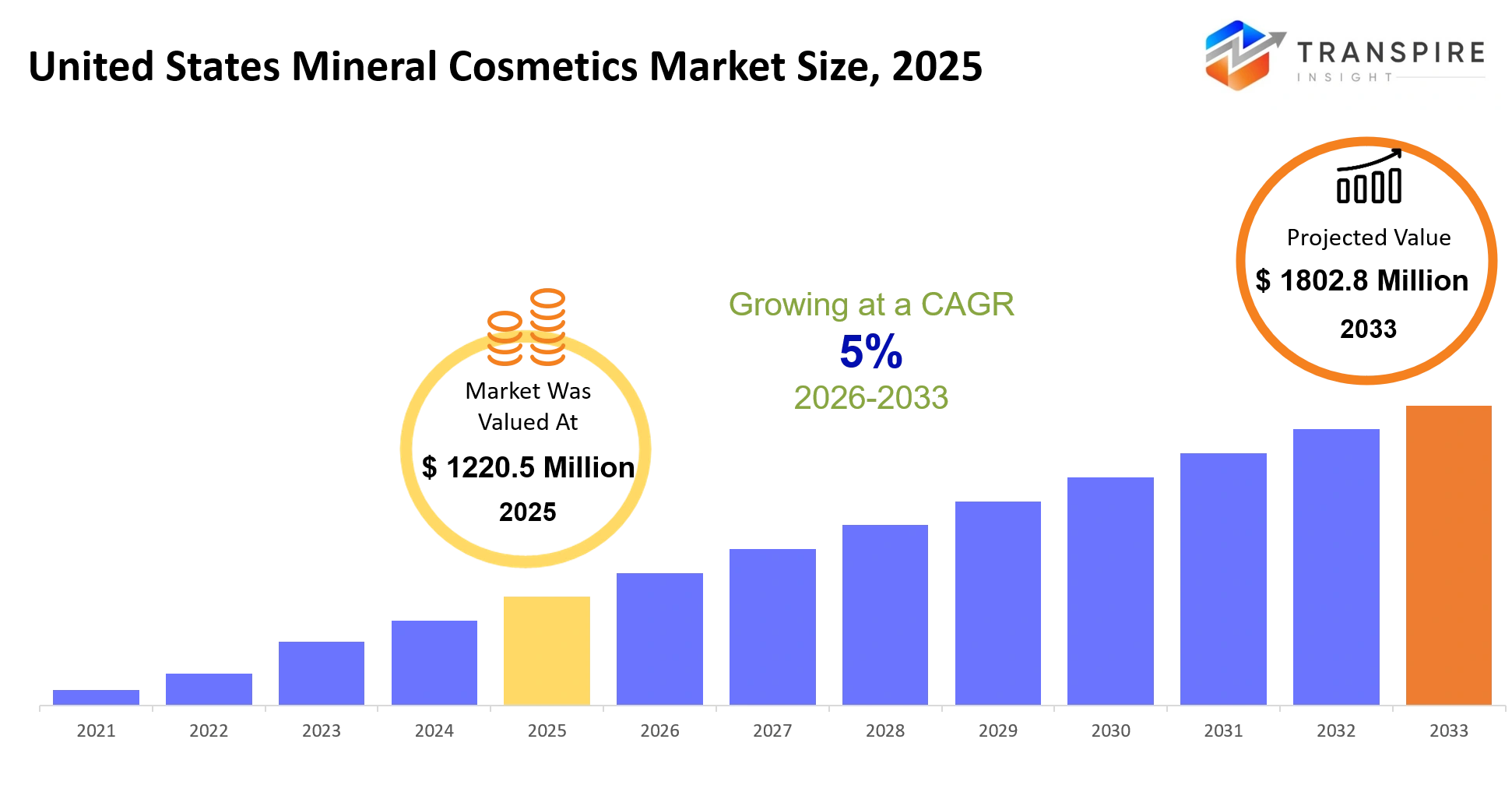
As per Transpire Insight Analysis the United States Mineral Cosmetics Market size is estimated at USD 1220.5 Million in 2025 and is anticipated to reach USD 1802.8 Million by 2033, growing at a CAGR of 5% from 2026 to 2033.
The United States Mineral Cosmetics Market is mainly for people who want makeup and personal-care goods built with mineral-based ingredients, and they’re usually marketed with statements about skin friendliness, easier formulations, and reduced amounts of man-made additives. In practice, brands and retailers often lean on mineral formulations to feel different with foundations, setting powders, blushes, and sunscreens, because the beauty scene is already packed, but they also want to catch up to the rising interest in ingredient transparency. Over the last 3–5 years, there’s been a sort of structural change toward clean label and multi-use cosmetics , so mineral products move from a small corner into more mainstream prestige, skin-doctor aligned, and even everyday beauty routines. Then during the COVID-19 period there were supply-chain interruptions, and it really brought out the fragility in pigment and specialty ingredient sourcing. After that, suppliers began to spread out their purchasing, and they leaned harder on domestic or regional supply channels, which stabilizes things a bit. Today, growth looks tied to better retailer buy-in, more space in online distribution, and continued product tweaks, especially for breathable lightweight coverage and skin-first formulas. Altogether this boosts visibility, makes it easier for customers to find items, and creates more opportunities for improved margins, with repeat buyers who come back for that same sort of soft feel.
United States Mineral Cosmetics Market Size & Forecast:
- United States Mineral Cosmetics Market Size 2025: USD 1220.5 Million
- Expected Market Value 2033: USD 1802.8 Million
- Forecast CAGR: 5%
- Key Profile: bareMinerals, Colorescience, Jane Iredale, Glo Skin Beauty, Youngblood Mineral Cosmetics, Neutrogena, L'Oréal USA, Revlon Inc., Estée Lauder Companies, Clinique, Physicians Formula, Cover FX, Almay, Mineral Fusion, Burt's Bees.
Key Market Insights
- North America pretty much dominates mineral cosmetics worldwide, it has about 35.7% market share in 2025 , and the United States is basically the regional driver.
- Asia-Pacific looks like the most accelerated regional benchmark too, forecast growth of 6.52% through 2031, so yeah it’s creating a lot of competitive pressure on U.S. brands along the way.
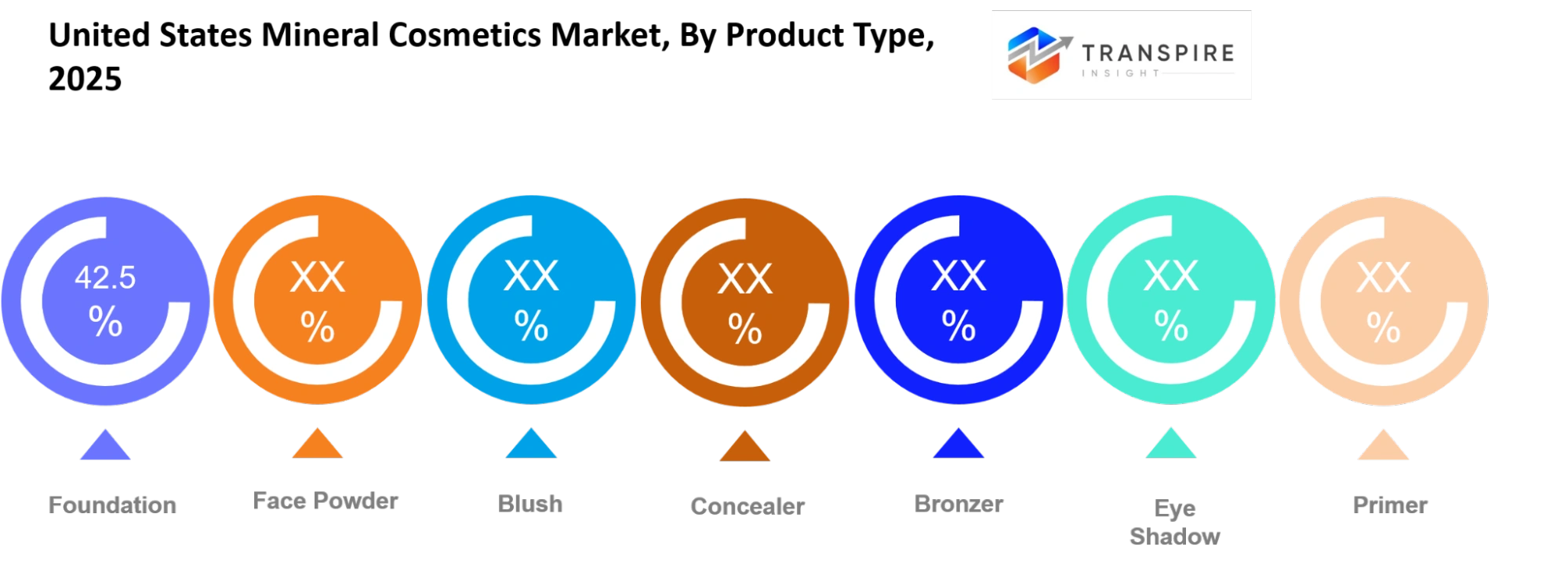
- In the U.S. segmentation, foundation takes the lead , roughly 40% market share in 2024, boosted by lightweight coverage and formulations that focus on skin health.
- For categories in the U.S. , blush comes in second, it keeps a natural finish position and that helps it keep expanding through 2034.
- Mineral powder foundation is the fastest-moving subsegment, it’s expected to reach around 6.5% CAGR over the forecast window up to 2034.
- When it comes to application, personal use still stays dominant , even if the more professional beauty routes are still broadening, you know, working through dermatology clinics, salons, spas, and specialist retail a bit more each year.
- Online retail is the fastest growing channel for application, and it’s helped by digital shade tools, influencer commerce, user reviews, plus just wider access to products in general.
- Women still make up the biggest end user group, representing 68.72% of global mineral cosmetics revenue in 2025, meanwhile male usage is growing faster.
- Men are also the fastest-growing end-user category, projected at 6.02% CAGR through 2031, as multifunctional, skin-centered formulations become more normal for adoption.
- bareMinerals rolled out Original Talc-Free Pressed Powder Foundation SPF 15 in 2025, and it basically extends pocket friendly mineral complexion coverage across more than 30 shades.
What are the Key Drivers, Restraints, and Opportunities in the United States Mineral Cosmetics Market?
The main push behind growth is the shift toward multifunctional, skin oriented formulations. It kinda gets lit up by stronger ingredient scrutiny , paired with product innovation. MoCRA, passed in 2022, basically expanded FDA reach in a material way, and also brought in safety substantiation, facility registration, product listing, adverse event reporting, plus recall obligations. When compliance pressure rises, it tends to favor established manufacturers who already have the regulatory backbone. At the same time , mineral formulations can merge complexion coverage, a skin friendly positioning, and mineral UV filters, which helps the overall value story per product. Foundation in particular was already around 40% of U.S. mineral cosmetics revenue in 2024, so there’s clear commercial pull for complexion driven formats.
The biggest structural hurdle is the regulatory, plus raw material, complexity. Talc related scrutiny is a decent example. In December 2024, FDA proposed standardized asbestos testing methods for talc containing cosmetics , then in November 2025 it withdrew that proposal, saying more assessment was needed. That kind of regulatory motion creates formulation ambiguity, adds extra testing burdens, and may force higher reformulation costs. Supply chain concentration is another constraint, because mineral pigments and specialty ingredients need steady purity, solid documentation, and tight traceability. From a Transpire Insight review of regional procurement announcements and launch calendars , supply chain concentration is still the dominant execution risk. Smaller brands also get squeezed more, since MoCRA requires documented safety substantiation and other regulatory records, yet doesn’t really provide the same scale benefits that larger manufacturers can leverage.
The most promising forward-looking opening is AI-assisted personalization, but also paired with multipurpose mineral formulations. Virtual try-on, automatic tone matching, anticipatory product suggestions, and a digital skin readout can lower the old “trial friction” tied to complexion products. L’Oréal’s 2026 OpenAI collaboration shows movement toward AI-native beauty commerce, while ModiFace already supports AI enabled virtual makeup moments. For U.S. brands, it becomes possible to weave mineral foundation together with SPF and skin care benefits, plus a tailored shade recommendation, inside one digital journey. This kind of bundling can lift online conversion, limit the number of wrong-fit buys and even back up premium pricing, overall.
What Has the Impact of Artificial Intelligence Been on the United States Mineral Cosmetics Market?
Artificial intelligence is reshaping mineral beauty mostly through digital merchandising , shade figuring , demand forecasting, and this kind of personalized product discovery, not really through factory-floor automation. Machine-learning systems can look at search habits , product feedback, shade leanings, seasonal demand cycles , and online purchase conversion patterns, then help tighten inventory planning and lessen the chances of overstock exposure. AI-driven virtual try-on also lowers the physical testing hurdle for foundation, which is a big deal for online mineral makeup sales. L’Oréal’s ModiFace tech already brings automated shade calibration and virtual makeup experiences, and then the 2026 L’Oréal-OpenAI collaboration pushes makeup discovery into conversational commerce
Predictive analytics can then further link those demand signals with formulation and replenishment decisions, so product teams can spot rising shade preferences sooner , tune production volumes accordingly , and focus on the highest-conversion SKUs. Meanwhile, digital beauty tools can lend a hand with recommendations that feel more tailored, using skin characteristics and consumer preferences. A 2025 research release showed scalable machine-learning approaches for realistic virtual foundation try-on, using product details sourced from e-commerce platforms
So the operational wins are most visible in inventory allocation, digital conversion, product discovery, and how fast customer-service gets things done— not so much in manufacturing uptime. With AI, the product-choice journey can become shorter and forecasting tends to get better, plus automated product-attribute extraction can cut down the manual cataloguing work. Still, one big limitation kind of stays put, data quality, that is. If you want dependable shade recommendations you need representative images, solid product descriptions, consistent lighting, and a diverse set of skin-tone datasets. When training data is weak or oddly assembled, the system can give inaccurate shade matches, and that knocks down trust. Even after a lot of technology investment, shoppers may convert less.
Key Market Trends
- Since 2024, the U.S. mineral makeup market has been kinda drifting toward multifunctional foundations, where coverage hydrates, includes SPF, and also wraps in skin supporting ingredients in one go, you know.
- In 2025, the whole talk around talc scrutiny feels like it sped up, formulation discussions kind of then accelerated the momentum, and it also boosted the commercial pull for talc free pressed powders + mineral complexion products overall, yeah.
- From 2022 onward, MoCRA bumped up the regulatory paperwork so manufacturers got nudged into more solid safety substantiation, stronger traceability, and compliance systems that actually hold up.
- During 2025, brands began expanding liquid mineral formats a bit more aggressively and that sort of challenged the usual hold of loose and pressed powder products in complexion categories.
- Online channels kept climbing in strategic importance, since digital shade tools, influencer content, reviews and virtual try on reduced the friction for buying cosmetics, pretty noticeably.
- In 2025, bareMinerals rolled out portable complexion formats with a talc free pressed powder foundation, helping align with the demand for convenient mineral makeup.
- During 2025, Jane Iredale went even deeper into skincare infused mineral makeup with Skintuition SPF 30 Radiance Boosting Liquid Foundation.
- In 2026, AI moved closer to everyday beauty commerce, as L’Oréal and OpenAI introduced conversational makeup discovery plus virtual try-on.
- Male consumers are showing up as a faster-growing end-user segment, with global mineral cosmetics growth for men projected at 6.02% through 2031.
- Asia-Pacific is forecast to grow 6.52% through 2031, and that should increase competitive pressure on U.S. brands, so they can keep sustaining both formulation progress and digital innovation, too.
United States Mineral Cosmetics Market Segmentation
By Product Type:
Foundation is still a big product category, mostly because foundation gives that base coverage and also backs a lot of daily plus more professional makeup routines, sorta like a start point. Face Powder, Blush, Concealer, Bronzer, Eye Shadow, Primer, BB Cream, Setting Powder, and Others each sit in their own little stage of the application flow, and that’s also how brands can stretch out their catalog, a lot. Going forward, product development will keep leaning hard into texture, coverage depth, shade range, and how easy it is to apply, plus whether it works with different skin types.
In this setup, Foundation, Concealer, BB Cream, and Primer tend to support complexion focused product lines, while Face Powder and Setting Powder are more about finishing, and longer wear. Blush and Bronzer bring color and definition, and Eye Shadow basically takes mineral style formulations into eye makeup. With this wide mix, manufacturers can aim at different consumer wants and build out complete mineral makeup collections, without it feeling random.
By Ingredient Type:
Titanium Dioxide- based, Zinc Oxide- based, Mica- based, Iron Oxide- based, Silica- based, Kaolin clay- based, and Talc- free formulations, plus Botanical mineral blends, and others, kinda mean slightly different mineral cosmetics approaches. In real use, the ingredient choices tend to nudge texture, coverage, tone, finish, and yeah the skin feel a bit too sometimes even more than people anticipate. Like titanium dioxide and zinc oxide usually support mineral complexion products and sun protection formulas, and they work well. Meanwhile mica, iron oxide, silica, and kaolin clay bring their own weight for color depth, texture control, and overall formulation behavior.
Talc-Free Formulations, and Botanical Mineral Blends in particular give brands extra levers when they want a specific ingredient preference , or a more tailored sensorial profile. Ingredient selection doesn’t just affect performance , it also impacts positioning, and formulation costs too, which is usually a big concern. So manufacturers keep remixing ingredient combinations over time, trying to boost product performance while still staying within formulation limits, safety expectations, and labeling requirements.
By Distribution Channel:
Online Retail, Specialty Beauty Stores, Supermarkets & Hypermarkets , Pharmacies & Drug Stores, Brand Stores, Department Stores, Direct Sales, E-commerce Marketplaces, and Others basically offer several ways for mineral cosmetic products to get to consumers. Online Retail and E-commerce Marketplaces help unlock wider product reach, and they let brands show more detailed product information, shade options , reviews, and even application guidance. Specialty Beauty Stores and Brand Stores also support direct product discovery, kind of keeping a premium vibe and positioning.
Meanwhile Supermarkets & Hypermarkets , Pharmacies & Drug Stores, and Department Stores give customers physical access across different retail environments. Direct Sales is another route, it lets brands meet and pull in customers without only leaning on traditional retail networks . Channel expansion should improve product availability, and at the same time it gives manufacturers more chances to reach different buying groups.
By End User:
Women, Men, Teenagers, Adults, Sensitive Skin Consumers, Professional Makeup Artists, Beauty Salons, Dermatology Clinics, and Others basically make up distinct customer clusters for mineral cosmetics. You can still see Women as a major audience, but Men and Teenagers bring extra headroom, mainly because makeup usage is spreading to wider customer groups. Meanwhile Adults and Sensitive Skin Consumers also keep the market steady, especially for lines described around mild formulations and more particular skin needs.
On the other hand, Professional Makeup Artists, Beauty Salons, and Dermatology Clinics open the door to more professional, sometimes specialist use. Those channels can help with trials, advice, and then, repeat buying. If coverage becomes broader across end-users, brands are more likely to craft different product styles, deeper or wider shade ranges, alternate application techniques, and formulation choices that fit different needs.
By Application:
Facial Makeup , Eye Makeup , Lip Products , Sun Protection , Daily Wear , Professional Makeup , Bridal Makeup, Organic Beauty, and Others cover the main kind of way mineral cosmetic products get used. Facial Makeup tends to support foundation, powder, blush , concealer , bronzer, primer,and similar face complexion items. Eye Makeup and Lip Products kind of extend mineral formulations into extra cosmetic categories, while Sun Protection ties mineral ingredients to protective beauty uses .
Daily Wear backs up regular cosmetic use , whereas Professional Makeup and Bridal Makeup fit more specialized beauty needs. Organic Beauty gives a further application area, for products that are positioned around mineral based and naturally oriented formulations. The whole scope of applications helps manufacturers work out products for everyday routines, specialist services, and for specific beauty moments.
What are the Key Use Cases Driving the United States Mineral Cosmetics Market?
Facial makeup is still the main thing, but it’s basically held up by foundation, face powder, concealer, and those other complexion products that people use every day. A lot of women, and also adult consumers in general make big purchases, because these items help with daily grooming, getting ready for work, showing up at social events, and keeping a more professional beauty rhythm. Retailers, and even brand stores, tend to get steady benefit from frequent replenishment, and the wider shade lineup really helps push repeat buying.
Meanwhile, professional makeup has been picking up speed with makeup artists, beauty salons, and bridal service providers. Sun protection adds another layer of momentum too, especially via dermatology clinics and pharmacies, where mineral based products can link cosmetic use with regular skin protection and the kind of advice specialists often suggest.
Newer directions are starting to show, like mineral formulations aimed at teenage skincare focused makeup, plus more specialized lines for sensitive skin consumers. Dermatology connected retail, along with customized beauty services, should open even more doors as product developers go after specific skin requirements and rely more on professional recommendations.
|
Report Metrics |
Details |
|
Market size value in 2025 |
USD 1220.5 Million |
|
Market size value in 2026 |
USD 1281.5 Million |
|
Revenue forecast in 2033 |
USD 1802.8 Million |
|
Growth rate |
CAGR of 5% from 2026 to 2033 |
|
Base year |
2025 |
|
Historical data |
2021 - 2024 |
|
Forecast period |
2026 - 2033 |
|
Report coverage |
Revenue forecast, competitive landscape, growth factors, and trends |
|
Geographic scope |
United States of America |
|
Key company profiled |
bareMinerals, Colorescience, Jane Iredale, Glo Skin Beauty, Youngblood Mineral Cosmetics, Neutrogena, L'Oréal USA, Revlon Inc., Estée Lauder Companies, Clinique, Physicians Formula, Cover FX, Almay, Mineral Fusion, Burt's Bees. |
|
Customization scope |
Free report customization (country, regional & segment scope). Avail customized purchase options to meet your exact research needs. |
|
Report Segmentation |
By Product Type (Foundation, Face Powder, Blush, Concealer, Bronzer, Eye Shadow, Primer, BB Cream, Setting Powder, Others); By Ingredient Type (Titanium Dioxide-Based, Zinc Oxide-Based, Mica-Based, Iron Oxide-Based, Silica-Based, Kaolin Clay-Based, Talc-Free Formulations, Botanical Mineral Blends, Others); By Distribution Channel (Online Retail, Specialty Beauty Stores, Supermarkets & Hypermarkets, Pharmacies & Drug Stores, Brand Stores, Department Stores, Direct Sales, E-commerce Marketplaces, Others); By End User (Women, Men, Teenagers, Adults, Sensitive Skin Consumers, Professional Makeup Artists, Beauty Salons, Dermatology Clinics, Others); By Application (Facial Makeup, Eye Makeup, Lip Products, Sun Protection, Daily Wear, Professional Makeup, Bridal Makeup, Organic Beauty, Others). |
Which Regions are Driving the United States Mineral Cosmetics Market Growth?
For the United States market, regional segmentation is usually discussed using broad U.S. regions rather than individual states. Publicly available sources don’t really give a dependable West, Midwest, South and Northeast market-share split, so putting exact regional percentages on top of that would be unsupported. A more defensible regional view therefore leans on the published North American stance plus the commercial personality of key U.S. beauty hubs, instead of inventing fabricated shares.
The Northeast still works as a structurally important revenue node because New York, and nearby markets, stack premium beauty retail, dermatology services, professional makeup activity, and corporate beauty operations all together. The retail groundwork is strong, and specialty-store density is high, which helps product discovery and keeps premium positioning on track. Big cosmetics companies continue marketing, product development and distribution work around established U.S. beauty centers, which means faster practical access to retailers and trade-focused buyers. With stable consumer spending and dense retail networks in place, the region’s contribution should stay resilient across the forecast horizon.
The West is sort of a major growth zone, backed up by California’s big beauty economy, clean-beauty framing, tech ecosystem, and solid online commerce uptake. Lately, the expansion of digital beauty tools ,and personalized product discovery has opened up extra avenues for mineral cosmetics brands to meet consumers, not only by leaning on brick and mortar stores. Also, California feels like a good proving ground for skin-care driven and multifunctional cosmetic formats. From 2026 to 2033, this overall setting should allow new brands to blend mineral formulations with digital customization, direct-to-consumer delivery, and a more premium product stance.
Who are the Key Players in the United States Mineral Cosmetics Market and How Do They Compete?
Competition still feels sort of fragmented, you know, with big multinational beauty groups, specialist mineral brands, dermatologist-minded companies, and then these digitally native entrants all going after the same attention, but they do it via formulation differentiation, ingredient storying, product results, and retail reach. Cost is still part of the conversation, of course , but lately the product innovation plus niche specialization really seems to be what decides who stands out. Brands are competing around talc-free formulations, mineral UV filters, skincare add-ons, wider shade breadth, and even digital shopping tools or features. The established players defend their share with quicker, more frequent launches and steadier distribution, while smaller brands lean into sharper positioning and direct online channels in order to push back against the broader portfolios.
bareMinerals competes with that mineral-first complexion focus and active formulation development, including talc-free pressed powder formats, which ends up reinforcing its portable makeup specialization. Jane Iredale differentiates by blending mineral makeup with skincare and sun protection messaging, shown in the launch of Skintuition SPF 30 Radiance-Boosting Liquid Foundation. Glo Skin Beauty brings in professional skincare positioning together with mineral complexion products, and it uses formulations meant to link makeup, SPF, and skincare benefits as one whole routine. Taken together, these strategies create differentiation by aiming at consumers who want both performance and ingredient-focused product attributes, not just one or the other.
RMS Beauty leans on clean-beauty vibes and these multifunctional formulations that basically let it go head to head with bigger cosmetic portfolios, all while keeping a really strong focus on choosing ingredients, and complexion focused products too. L'Oréal on the other hand plays on a wider playing field, they put money into beauty technology, like AI powered virtual try-on, plus more tailored product discovery via ModiFace and whatever comes next with the 2026 OpenAI collaboration. So you end up with different competitive lanes—specialist brands kind of win through smart formulation and niche credibility, whereas the larger groups rely on tech plus distribution scale , and then broader product ecosystems to get to consumers faster.
Company List
- bareMinerals
- Colorescience
- Jane Iredale
- Glo Skin Beauty
- Youngblood Mineral Cosmetics
- Neutrogena
- L'Oréal USA
- Revlon Inc.
- Estée Lauder Companies
- Clinique
- Physicians Formula
- Cover FX
- Almay
- Mineral Fusion
- Burt's Bees
Recent Development News
In April 2026, ILIA Beauty launched Sun Serum Mineral Sunscreen SPF 50. The new mineral sunscreen expands ILIA’s complexion and sun-protection portfolio with a non-comedogenic, dermatologist- and ophthalmologist-tested formulation, strengthening mineral beauty positioning in the U.S. market.
Source: https://www.prnewswire.com/
In March 2026, KYT Group completed the acquisition of Glo Skin Beauty. The transaction gives the investment firm control of a professional clean-beauty brand with mineral makeup offerings, supporting further investment in clinical innovation, professional channels, and product development.
Source: https://www.prnewswire.com/
What Strategic Insights Define the Future of the United States Mineral Cosmetics Market?
In the next 5–7 years, the U.S. mineral cosmetics sector will likely drift toward multifunctional items that blend complexion coverage, skincare perks, and sun protection, while also leaning on digital personalization and more intense product review. The biggest growth feels like it will show up for brands that tie formulation performance to quick online discovery, not just ride on “mineral positioning” alone. There’s a kind of quiet risk too, raw material concentration, especially around specialty pigments and functional mineral ingredients. That concentration can end up causing cost swings, sourcing delays and even formulation disruptions, even if shopper demand is still holding up fine.
At the same time there’s an opening, AI assisted shade matching, together with dermatologist linked recommendations. This combo helps reduce the usual online buying uncertainty, and it can reach sensitive-skin buyers in a more careful way. Players in the market should be thinking about diversified mineral ingredient sourcing, while also building their own shade libraries and consumer datasets. Done right, it should support supply continuity, lift digital conversion, and create some real, defendable differentiation as competition keeps getting louder.
United States Mineral Cosmetics Market Report Segmentation
By Product Type
- Foundation
- Face Powder
- Blush
- Concealer
- Bronzer
- Eye Shadow
- Primer
- BB Cream
- Setting Powder
By Ingredient Type
- Titanium Dioxide-Based
- Zinc Oxide-Based
- Mica-Based
- Iron Oxide-Based
- Silica-Based
- Kaolin Clay-Based
- Talc-Free Formulations
- Botanical Mineral Blends
By Distribution Channel
- Online Retail
- Specialty Beauty Stores
- Supermarkets & Hypermarkets
- Pharmacies & Drug Stores
- Brand Stores
- Department Stores
- Direct Sales
- E-commerce Marketplaces
By End User
- Women
- Men
- Teenagers
- Adults
- Sensitive Skin Consumers
- Professional Makeup Artists
- Beauty Salons
- Dermatology Clinics
By Application
- Facial Makeup
- Eye Makeup
- Lip Products
- Sun Protection
- Daily Wear
- Professional Makeup
- Bridal Makeup
- Organic Beauty
Frequently Asked Questions
Find quick answers to common questions.
The expected United States Mineral Cosmetics Market size for the market will be USD 1802.8 Million in 2033.
Key segments for the United States Mineral Cosmetics Market are By Product Type (Foundation, Face Powder, Blush, Concealer, Bronzer, Eye Shadow, Primer, BB Cream, Setting Powder, Others); By Ingredient Type (Titanium Dioxide-Based, Zinc Oxide-Based, Mica-Based, Iron Oxide-Based, Silica-Based, Kaolin Clay-Based, Talc-Free Formulations, Botanical Mineral Blends, Others); By Distribution Channel (Online Retail, Specialty Beauty Stores, Supermarkets & Hypermarkets, Pharmacies & Drug Stores, Brand Stores, Department Stores, Direct Sales, E-commerce Marketplaces, Others); By End User (Women, Men, Teenagers, Adults, Sensitive Skin Consumers, Professional Makeup Artists, Beauty Salons, Dermatology Clinics, Others); By Application (Facial Makeup, Eye Makeup, Lip Products, Sun Protection, Daily Wear, Professional Makeup, Bridal Makeup, Organic Beauty, Others).
Major United States Mineral Cosmetics Market players are bareMinerals, Colorescience, Jane Iredale, Glo Skin Beauty, Youngblood Mineral Cosmetics, Neutrogena, L'Oréal USA, Revlon Inc., Estée Lauder Companies, Clinique, Physicians Formula, Cover FX, Almay, Mineral Fusion, Burt's Bees.
The United States Mineral Cosmetics Market size is USD 1220.5 Million in 2025.
The United States Mineral Cosmetics Market CAGR is 5% from 2026 to 2033.
- bareMinerals
- Colorescience
- Jane Iredale
- Glo Skin Beauty
- Youngblood Mineral Cosmetics
- Neutrogena
- L'Oréal USA
- Revlon Inc.
- Estée Lauder Companies
- Clinique
- Physicians Formula
- Cover FX
- Almay
- Mineral Fusion
- Burt's Bees
About the Authors

Chetan Dhatrak
I’m Chetan Dhatrak, a Senior Research Analyst at Transpire Insight, specializing in the Consumer Goods, Foods and Beverages industry. I focus on analyzing market trends, consumer behavior, competitive landscapes, and industry developments to deliver accurate, data-driven insights. My research at Transpire Insight is built on credible sources and in-depth analysis, helping businesses and readers better understand market dynamics, emerging opportunities, and evolving consumer preferences. I’m committed to creating reliable, well-researched content that supports informed decision-making and reflects the latest developments in the consumer goods and food & beverage sectors.

Chakradhar Khansole
Chakradhar serves as the Research Director at Transpire Insight, bringing over 8 years of experience in technology, innovation, and strategic market intelligence. He specializes in transforming complex market data into actionable business insights that enable organizations to make informed, growth-oriented decisions. Recognized for his strategic vision and analytical expertise, Chakradhar leads high-impact research initiatives, delivering comprehensive market assessments, competitive intelligence, and forward-looking industry analysis.
Recently Published Reports
-
Apr 2026
Bottled Water Market
Bottled Water Market Size, Share & Analysis Report By Product Type (Still Bottled Water, Carbonated Bottled Water, Functional Bottled Water, and Others), By Packaging (PET, Cans, and Others), By Sales Channel (Supermarkets/Hypermarkets, Convenience Stores/Drug Stores, Grocery Stores/Club Stores, Foodservice, and Others) and Geography (North America, Europe, Asia-Pacific, Middle East and Africa, South and Central America), 2021 - 2032
-
Apr 2026
Color Cosmetic Packaging Market
Color Cosmetic Packaging Market Size, Share & Analysis Report By Application (Mascara Packaging, Liquid Packaging, and Liquid Face), By Type (Tubes & Bottles, Pens & Markers, Compacts & Containers, and Droppers & Pumps), and Geography (North America, Europe, Asia-Pacific, Middle East and Africa, South and Central America), 2021 - 2031
-
Apr 2026
External Microphone For Camera Market
External Microphone For Camera Market Size, Share & Analysis Report By Type (Shotgun Microphone, Lavalier Microphone, and Others), By Application (Digital Camera, Professional Video Camera, and Others), and Geography (North America, Europe, Asia-Pacific, Middle East and Africa, South and Central America), 2021 - 2031
-
Apr 2026
Foot Orthotic Insoles Market
Foot Orthotic Insoles Market Size, Share & Analysis Report By Type (Pre-fabricated, and Custom-made), By Material (Thermoplastic, Composite Carbon Fiber, and Others), By Distribution Channel (Drug Stores, Hospitals & Clinics, and Others), and Geography (North America, Europe, Asia-Pacific, Middle East and Africa, South and Central America), 2021 - 2031