
United States Lysosomal Storage Disorder Drugs Market Size & Forecast:
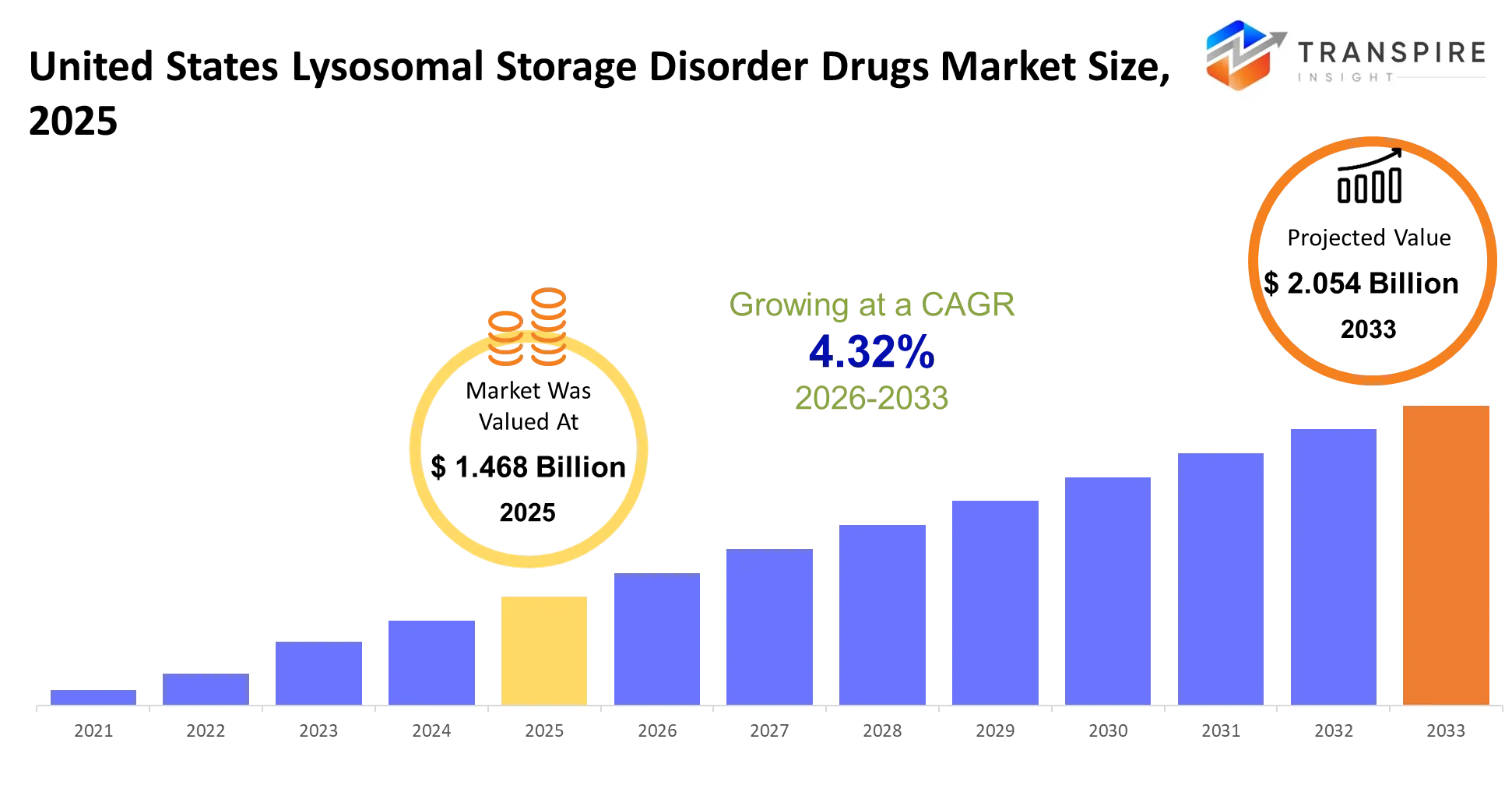
- United States Lysosomal Storage Disorder Drugs Market Size 2025: USD 1.468 Billion
- United States Lysosomal Storage Disorder Drugs Market Size 2033: USD 2.054 Billion
- United States Lysosomal Storage Disorder Drugs Market CAGR: 4.32%
- United States Lysosomal Storage Disorder Drugs Market Segments: By Drug Type (Enzyme Replacement Therapy, Substrate Reduction Therapy, Gene Therapy, Pharmacological Chaperones, Stem Cell Therapy, Others); By Disorder Type (Gaucher Disease, Fabry Disease, Pompe Disease, Niemann-Pick Disease, MPS Disorders, Others); By Distribution Channel (Hospital Pharmacies, Retail Pharmacies, Online Pharmacies, Others); By End User (Hospitals, Specialty Clinics, Research Institutes, Home Care Settings, Others)
To learn more about this report,  Download Free Sample Report
United States Lysosomal Storage Disorder Drugs Market Summary
The United States Lysosomal Storage Disorder Drugs Market was valued at USD 1.468 Billion in 2025. It is forecast to reach USD 2.054 Billion by 2033. That is a CAGR of 4.32% over the period.
The US market for lysosomal storage disorder drugs kind of supports people with rare inherited enzyme deficiencies by basically supplying treatments that replace or even augment the missing enzymes, plus they also help stop the slow organ damage that keeps getting worse. In the past five years, the whole sector has been moving away from depending so much on lifelong, hospital based enzyme replacement infusions, and instead leaning more toward gene therapy pipelines and also expanded home infusion services.
This has happened alongside tighter diagnostic screening for newborns, and more specialty genetic testing too. FDA approvals for next generation gene therapies, and also pandemic-era disruptions that limited hospital access, made the fragility of infusion dependent care more obvious, and that speeded up the change. So now treatment is usually started earlier, and delivered in more decentralized settings, which helps continuity, while also shifting revenue toward high value advanced biologics. It even pushes the model away from chronic dosing, toward maybe curative one-time therapies, or at least something closer to that.
Key Market Insights
- In 2025, the United States is basically around 38–42% of global demand for lysosomal storage disorder therapies, give or take a little.
- The Northeast US takes the lead in adoption , mostly because of a concentration of rare disease centers , and then that more advanced genetic testing infrastructure.
- Meanwhile the Western US is showing up as the fastest-growing area, backed by biotech expansion and a dense spread of clinical trials lasting through 2025–2030.
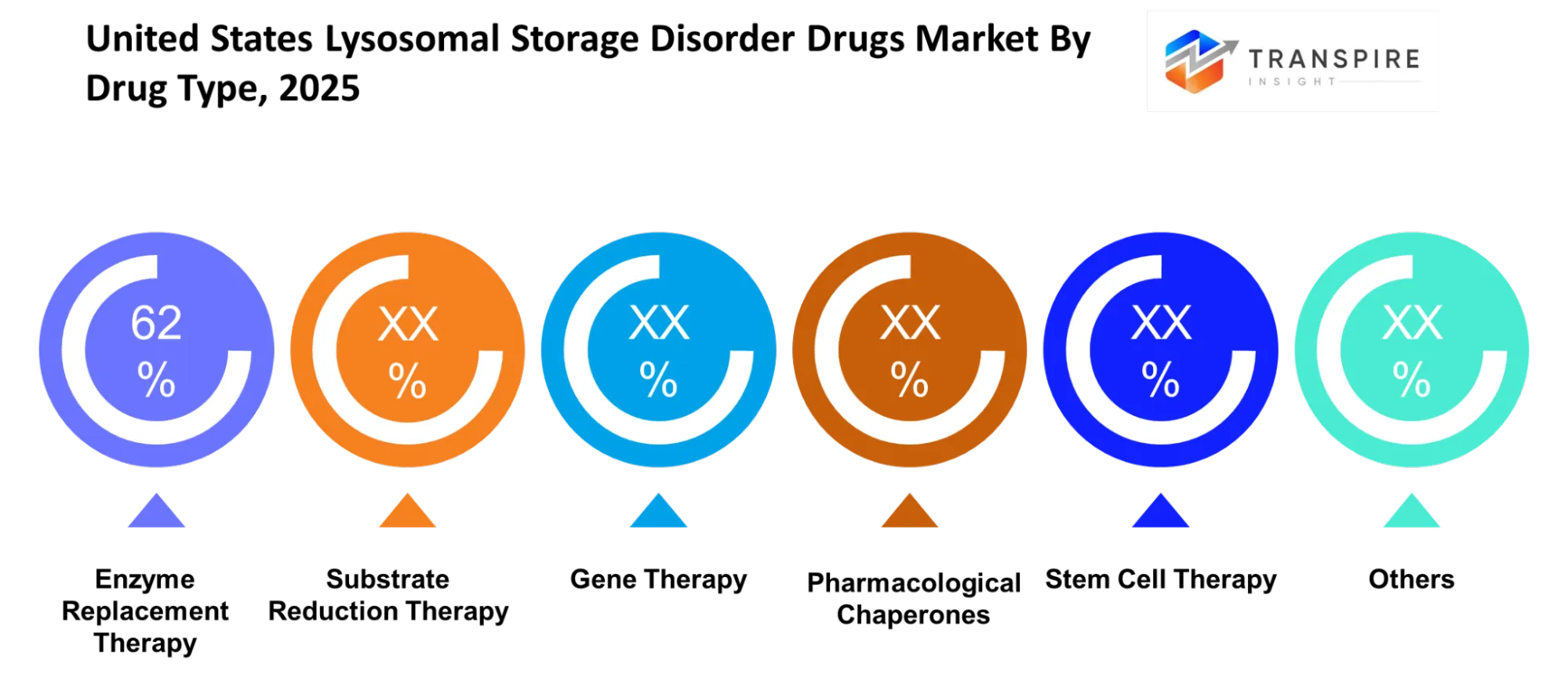
- For the most part, Enzyme Replacement Therapy stays on top, it holds roughly 55% share in the United States Lysosomal Storage Disorder Drugs Market market in 2025.
- After that, small-molecule pharmacological chaperones sit in the second position, pushed along by the convenience of oral administration and that more “outpatient friendly” preference.
- Gene therapy, it kinda is the fastest-growing segment, expected to grow very quickly through 2030 because it might offer that one time sort of curative result.
- For Gaucher disease, the treatment side leads the pack with almost 30% of the application share in the United States Lysosomal Storage Disorder Drugs Market ecosystem.
- Pompe disease management looks like the fastest mover, mainly because newborn screening has improved, and the early intervention protocols are being used sooner.
- When you look at where it’s actually delivered, hospitals and specialty metabolic clinics take the top spots at around 60% , mostly because infusion based treatment is still a big requirement.
- Meanwhile home healthcare services are the fastest-growing end-user category, expanding as infusion delivery starts to get more decentralized, and more distributed.
What are the Key Drivers, Restraints, and Opportunities in the United States Lysosomal Storage Disorder Drugs Market?
The United States Lysosomal Storage Disorder Drugs Market market is mostly pushed by that kind of accelerated blending of early genetic screening programs and the quick progress in biologic, and gene-based therapies. With broader newborn screening mandates showing up across a lot of states, people are getting conditions identified sooner, like Gaucher and Pompe disease , and this basically lifts the lifetime “start therapy” rates. At the same time, FDA backing for orphan drug work and those expedited approvals have trimmed commercialization timelines for high-cost enzyme replacement and gene therapies, so revenue feels more concentrated inside specialty biologics now.
A big pushback is still the structural need for ultra-expensive, long duration treatment plans, which keeps putting this steady stress on payer reimbursement systems. A number of therapies need lifelong intravenous administration, usually in carefully managed clinical environments , and that setup makes scaling harder and can widen access gaps between different insurance coverage tiers. Because of that cost and logistics, adoption lags in smaller treatment centers, and penetration outside major city hospital networks gets slowed too, so even when clinical demand stays strong, short term volume growth ends up more capped than you’d expect.
There’s an emerging chance in adeno-associated virus (AAV) gene therapy pipelines and these newer integrated one-time treatment models that are moving through late stage clinical trials. Some players, like BioMarin Pharmaceutical, are funding durable gene expression platforms , which could lower the reliance on continuous infusion schedules. If these products do land successfully in the market, the United States Lysosomal Storage Disorder Drugs Market market could tilt toward curative style economics, and it may widen the real patient reach by making long-term affordability and adherence far more workable.
What Has the Impact of Artificial Intelligence Been on the United States Lysosomal Storage Disorder Drugs Market?
Artificial intelligence and advanced digital technologies are reshaping the United States Lysosomal Storage Disorder Drugs Market ecosystem, in a way that kind of feels like everything moves faster yet harder to measure. For discovery work, machine learning models are now commonly used to sift through genomic and proteomic datasets, and they help surface enzyme deficiency pathways tied to conditions like Gaucher, and Fabry disease. This can shrink those early-stage research timelines, though it still takes a lot of hands-on effort. AI-driven molecular modeling also supports enzyme replacement and gene therapy design, by improving the prediction of protein folding, and even vector behavior, which is pretty central to whether a therapy actually performs as expected.
During clinical development, AI-based patient stratification tools are being used to align very small patient populations with trials that might actually fit them. That in turn improves recruitment efficiency, especially in ultra-rare disease studies. Then there are digital trial platforms, plus real-world evidence systems, which allow ongoing tracking of treatment response. So there’s less reliance on traditional site visits, and data can end up more complete, even when patients are spread across different places in the United States Lysosomal Storage Disorder Drugs Market market.
On the operations side, predictive analytics in biomanufacturing helps tune fermentation processes and strengthen quality control for biologics. The net effect is a lower batch failure risk, and more stable production. With those kinds of improvements, the sector can reach faster time-to-market, and maintain supply chains that don’t wobble as easily for enzyme replacement therapies.
Still, adoption is not fully smooth because patient datasets are limited and fragmented, which is basically baked into rare diseases. That situation reduces model training accuracy, and makes scalability tougher for AI systems overall. Also, regulatory validation for algorithm-driven clinical decisions can be slow, and it adds friction when companies try to move from pilots into commercial pipelines.
Key Market Trends
- Since 2022, expanded newborn screening programs boosted early detection rates a bit, so treatment starting has shifted away from symptomatic phases into pre-symptomatic style models , kind of like earlier intercepts.
- From 2021 to 2025, the FDA used faster approval pathways which cut down clinical timelines, letting companies commercialize high-cost enzyme replacement and gene therapies more quickly , or at least sooner than before.
- Gene therapy use has kind of moved , from experimental or research-only use around 2020 toward late stage pipelines. That change is now reshaping long term treatment expectations across different rare disease slices.
- After 2023, Sanofi added more specialty biologics investment, and that strengthened its enzyme replacement portfolio, supporting treatment continuity for lysosomal disorder care.
- Also, hospital infusion dependency dipped gradually after 2022 , as home based enzyme administration models picked up reimbursement approval across a handful of US payer systems.
- Takeda Pharmaceutical Company increased its rare disease R&D spend, which accelerated pipeline diversification into next generation substrate reduction therapies.
- Real world evidence adoption expanded after 2023 , so regulatory submissions leaned more toward continuous patient monitoring instead of relying only on trial based efficacy reports.
- And because high biologics manufacturing costs kept rising, outsourcing trends to contract development organizations increased. That helped with scalability , but it also made supply chain dependency risks feel more intense.
United States Lysosomal Storage Disorder Drugs Market Segmentation
By Drug Type :
Enzyme Replacement Therapy will probably stay as a key approach, helping patients who have missing or low enzyme activity, kind of always. Substrate Reduction Therapy will aim to reduce the buildup of harmful substances inside cells, so it doesn’t sit there for too long. Gene Therapy should get more attention because it can, potentially correct things over the long run. Pharmacological Chaperones, Stem Cell Therapy, and several other methods will also step in for more targeted care needs.
Market growth will hinge on wider adoption of advanced biologics across rare genetic conditions. In other words, enzyme based solutions will keep being used a lot in everyday clinical practice. Gene approaches will likely spread as clinical results keep improving and approvals follow. Meanwhile, other treatments will support patients with specific response requirements, and that can help expand treatment access across different healthcare systems.
To learn more about this report, Download Free Sample Report
By Disorder Type :
Gaucher Disease will remain among the major treated conditions, largely because more people are getting diagnosed. Fabry Disease and Pompe Disease are expected to hold steady in treatment demand, backed by enzyme therapies. Niemann-Pick Disease and MPS Disorders will still need specialized care, since symptom severity and overall complexity can vary across patient groups.
Treatment demand should continue to climb as awareness improves, and early diagnosis becomes more common. Each disorder category will need its own therapeutic plan depending on enzyme deficiency patterns. The clinical focus will stay on longer term symptom control, plus better patient quality of life, through steady ongoing treatment support.
By Distribution Channel :
Hospital Pharmacies will end up dominating distribution, mostly because infusion-based treatments need it, plus specialist supervision requirements are kind of non-negotiable in practice. Retail Pharmacies, on the other hand, will keep backing maintenance medicines for long term care patients. Online Pharmacies will gradually expand access for supportive drugs and repeat prescriptions, and the other channels will handle only limited supply, or maybe they will be mostly region specific depending on how things are set up.
Distribution systems will keep leaning pretty hard on hospital infrastructure, especially for rare disease management, since the workflow there is already built. Specialty treatment drugs will need careful controlled handling and expert administration during use, not just “send it and hope”. With digital health services expanding, prescription access should be supported more smoothly, yet hospital based delivery will stay central for the most advanced therapies in general.
By End User :
Hospitals will still be the main end users because they have the advanced diagnostic and treatment facilities, and that difference matters. Specialty Clinics will focus on long term management for rare genetic disorders, like monitoring over time rather than quick interventions. Research Institutes will contribute to therapy development and clinical trials, bridging what happens in labs and what happens in people. Home Care Settings will support selected maintenance treatments, but only under medical supervision.
Demand across end users will rise as more patients get diagnosed with lysosomal storage disorders. Hospitals will continue managing the severe cases that need enzyme infusions. Specialty Clinics will support continuous monitoring, so the condition doesn’t slip between visits. Home care services will grow slowly, helped along by improved drug delivery methods and patient support programs, even if it’s not instant.
What are the Key Use Cases Driving the United States Lysosomal Storage Disorder Drugs Market?
The core use case is enzyme replacement therapy delivered in hospital and specialty infusion centers, for Gaucher, Pompe, and Fabry disease. It drives demand, because patients need a lifelong intravenous enzyme correction kind of thing , to avoid organ damage and neurological decline, and that keeps the treatment cycles going nonstop across different care settings, pretty much.
Some expanding applications show up as home infusion programs and outpatient metabolic clinics, which lowers the hospital dependency. Specialty endocrinology and genetic disorder units are now handling the long term therapy administration more often, insurers are supporting lower cost decentralized care models too, across chronic rare disease populations in the United States, so it’s sort of all connected.
For emerging use cases, there’s gene therapy designed for one time functional enzyme restoration. There are also expanded newborn screening programs that allow pre-symptomatic treatment, and digital monitoring tools that measure patient response, and help improve adherence across long duration therapy pathways, throughout the United States healthcare system.
|
Report Metrics |
Details |
|
Market size value in 2025 |
USD 1.468 Billion |
|
Market size value in 2026 |
USD 1.528 Billion |
|
Revenue forecast in 2033 |
USD 2.054 Billion |
|
Growth rate |
CAGR of 4.32% from 2026 to 2033 |
|
Base year |
2025 |
|
Historical data |
2021 - 2024 |
|
Forecast period |
2026 - 2033 |
|
Report coverage |
Revenue forecast, competitive landscape, growth factors, and trends |
|
Geographic scope |
United States of America |
|
Key company profiled |
Sanofi, Takeda Pharmaceutical, Pfizer, BioMarin Pharmaceutical, Amicus Therapeutics, Chiesi Farmaceutici, Johnson & Johnson, Novartis, Orchard Therapeutics, Ultragenyx Pharmaceutical, Greenovation Biotech, ISU Abxis, Protalix BioTherapeutics, Freeline Therapeutics, Genzyme |
|
Customization scope |
Free report customization (country, regional & segment scope). Avail customized purchase options to meet your exact research needs. |
|
Report Segmentation |
By Drug Type (Enzyme Replacement Therapy, Substrate Reduction Therapy, Gene Therapy, Pharmacological Chaperones, Stem Cell Therapy, Others); By Disorder Type (Gaucher Disease, Fabry Disease, Pompe Disease, Niemann-Pick Disease, MPS Disorders, Others); By Distribution Channel (Hospital Pharmacies, Retail Pharmacies, Online Pharmacies, Others); By End User (Hospitals, Specialty Clinics, Research Institutes, Home Care Settings, Others) |
Which Regions are Driving the United States Lysosomal Storage Disorder Drugs Market Growth?
The Northeast region is still kinda the main hub in the United States Lysosomal Storage Disorder Drugs Market market, mostly because it’s got a big concentration of academic medical centers and rare disease institutes. You see it in places like Boston, New York and Philadelphia, where hospitals are pushing early adoption of enzyme replacement and even gene-based treatments. State level support, especially around newborn screening and precision medicine programs, helps diagnosis rates stay up and keeps patient inflow steady. In practice this whole network helps carry long-term demand, since research, care delivery, and clinical trial work all kind of connect and feed into each other.
The West Coast stays a fairly stable second region, backed by a solid biotechnology base, plus pretty steady private-sector investment. California’s healthcare systems tend to run on close collaboration among universities, hospitals and biotech firms, developing next generation therapies for lysosomal conditions. But unlike the Northeast, momentum here is coming more from innovation commercialization, rather than intense diagnostic activity. Reimbursement stability and already established rare disease treatment networks also help keep revenue contributions predictable across the entire United States Lysosomal Storage Disorder Drugs Market landscape.
The fastest-growing area is the Southern United States, with Texas and Florida in the lead, where hospitals keep expanding and that is improving rare disease detection capability. Newer investments in newborn screening expansion, plus Medicaid coverage, have widened treatment access since 2023. And with higher population density, plus more specialty clinics showing up, therapy adoption rates are speeding up. This change opens up strong entry chances for manufacturers aiming at underserved patient groups during the 2026–2033 growth cycle.
Who are the Key Players in the United States Lysosomal Storage Disorder Drugs Market and How Do They Compete?
Competition in the United States Lysosomal Storage Disorder Drugs Market market is kinda moderately consolidated, where a small group of established orphan drug manufacturers hold a lot of share, while specialized biotech firms tend to chase single-disease segments, kind of niche by niche. The incumbents usually defend their footing via long-term enzyme replacement portfolios and also by keeping specialty distribution networks tightly managed. Meanwhile, new entrants lean hard into gene therapy innovation and more precision targeting of enzyme deficiencies, not just incremental changes. Lately, competition really comes down to technology differentiation, like curative potential versus the chronic infusion dependence side of things, plus the regulatory exclusivity windows that shield those high-value biologic launches.
Sanofi keeps strengthening its position through large-scale enzyme replacement manufacturing and structured access programs spanning across US metabolic treatment centers, with pretty deliberate rollout planning. Takeda Pharmaceutical Company pushes further into its rare disease strategy by investing in substrate reduction and enzyme stabilization therapies, so treatment pathways get diversified beyond the traditional infusions, and it feels less linear. Amicus Therapeutics seems to stand out in the whole oral pharmacological chaperone space, and that’s likely why these approaches help pull down hospital reliance, while also bolstering longer term patient adherence in chronic-care settings, kind of quietly but consistently.
BioMarin Pharmaceutical keeps moving with gene therapy pipelines designed around a one time treatment model , and if that works at scale it may reshape the long term revenue structure for lysosomal disorders. Meanwhile Chiesi Farmaceutici leans into its niche by using targeted enzyme therapies, plus strategic collaborations with US rare disease clinics, which gives them that more specialized distribution access than most.Overall, these companies grow through clinical partnerships, licensing arrangements and pipeline diversification too, which ramps up competition across the most valuable therapeutic segments, even when the diseases themselves are rare and the timelines are not always predictable.
Company List
- Sanofi
- Takeda Pharmaceutical
- Pfizer
- BioMarin Pharmaceutical
- Amicus Therapeutics
- Chiesi Farmaceutici
- Johnson & Johnson
- Novartis
- Orchard Therapeutics
- Ultragenyx Pharmaceutical
- Greenovation Biotech
- ISU Abxis
- Protalix BioTherapeutics
- Freeline Therapeutics
- Genzyme
Recent Development News
In February 2026, Denali Therapeutics announced a presentation of updated clinical and regulatory progress for its Enzyme TransportVehicle™ lysosomal storage disorder programs. The update highlighted continued advancement of its Hunter syndrome and other LSD pipeline assets toward late-stage development and potential commercialization pathways in the U.S. Sourcehttps://www.biospace.com/
In February 2026, the U.S. Food and Drug Administration (FDA) issued draft guidance supporting accelerated approval pathways for individualized therapies targeting ultra-rare diseases, including lysosomal storage disorders. This regulatory framework is expected to significantly benefit LSD drug developers by enabling smaller, evidence-based approval approaches in rare patient populations. Source https://www.hhs.gov/press-room/
What Strategic Insights Define the Future of the United States Lysosomal Storage Disorder Drugs Market?
The United States Lysosomal Storage Disorder Drugs Market market is kind of structurally moving toward high-value, one time intervention models, driven by gene therapy innovation and earlier genetic diagnosis. Over the next 5 to 7 years, treatment economics will shift away from lifelong enzyme replacement, toward durable or maybe even curative approaches as AAV based and next generation gene editing platforms mature. That shift is also reinforced by expanded newborn screening programs and a growing willingness from payers to look at long term cost offsets, not just annual treatment expenses.
There’s a more quiet risk too, market concentration around a limited number of ultra expensive biologics. This thing raises exposure to reimbursement tightening and policy led pricing scrutiny. If payers start capping orphan drug spend, or linking reimbursement to long term efficacy uncertainty then adoption momentum could slow down, even with strong clinical demand. Also, manufacturing scalability constraints for gene therapies, add supply side bottlenecks that do not always show up clearly in today’s growth projections.
On the upside, an emerging opportunity is mixing AI guided patient stratification with gene therapy trial recruitment, especially in underserved US regional health systems where diagnosis rates are still low. That can unlock patient cohorts that were basically unidentified before, and improve trial efficiency for rare disease programs. Market players should probably focus on platform diversification into gene therapy, while also building payer aligned outcome evidence systems, to help stabilize long term reimbursement.
United States Lysosomal Storage Disorder Drugs Market Report Segmentation
By Drug Type
- Enzyme Replacement Therapy
- Substrate Reduction Therapy
- Gene Therapy
- Pharmacological Chaperones
- Stem Cell Therapy
By Disorder Type
- Gaucher Disease
- Fabry Disease
- Pompe Disease
- Niemann-Pick Disease
- MPS Disorders
By Distribution Channel
- Hospital Pharmacies
- Retail Pharmacies
- Online Pharmacies
By End User
- Hospitals
- Specialty Clinics
- Research Institutes
- Home Care Settings
Frequently Asked Questions
Find quick answers to common questions.
The United States Lysosomal Storage Disorder Drugs Market size is USD 2.054 Billion in 2033.
Key segments for the United States Lysosomal Storage Disorder Drugs Market are By Drug Type (Enzyme Replacement Therapy, Substrate Reduction Therapy, Gene Therapy, Pharmacological Chaperones, Stem Cell Therapy, Others); By Disorder Type (Gaucher Disease, Fabry Disease, Pompe Disease, Niemann-Pick Disease, MPS Disorders, Others); By Distribution Channel (Hospital Pharmacies, Retail Pharmacies, Online Pharmacies, Others); By End User (Hospitals, Specialty Clinics, Research Institutes, Home Care Settings, Others).
Major United States Lysosomal Storage Disorder Drugs Market players are Sanofi, Takeda Pharmaceutical, Pfizer, BioMarin Pharmaceutical, Amicus Therapeutics, Chiesi Farmaceutici, Johnson & Johnson, Novartis, Orchard Therapeutics, Ultragenyx Pharmaceutical, Greenovation Biotech, ISU Abxis, Protalix BioTherapeutics, Freeline Therapeutics, Genzyme.
The United States Lysosomal Storage Disorder Drugs Market size is USD 1.468 Billion in 2025.
The United States Lysosomal Storage Disorder Drugs Market CAGR is 4.32% from 2026 to 2033.
- Sanofi
- Takeda Pharmaceutical
- Pfizer
- BioMarin Pharmaceutical
- Amicus Therapeutics
- Chiesi Farmaceutici
- Johnson & Johnson
- Novartis
- Orchard Therapeutics
- Ultragenyx Pharmaceutical
- Greenovation Biotech
- ISU Abxis
- Protalix BioTherapeutics
- Freeline Therapeutics
- Genzyme
Recently Published Reports
-
May 2026
Biosimilars Market
Biosimilars Market By Product Type (Monoclonal Antibodies, Recombinant Hormones, Erythropoietin, G-CSF, Others), By Indication (Oncology, Autoimmune Diseases, Blood Disorders, Diabetes, Others), By Manufacturing Type (In-House Manufacturing, Contract Manufacturing), By Distribution Channel (Hospital Pharmacies, Retail Pharmacies, Online Pharmacies), By Industry Analysis, Size, Share, Growth, Trends, and Forecasts 2021-2033
-
Apr 2026
Gastrointestinal Endoscopy Market
Gastrointestinal Endoscopy Market By Type (Rigid Gastrointestinal Endoscope, Flexible Gastrointestinal Endoscopes, Disposable Gastrointestinal Endoscope), By Procedure Type (Colonoscopy, Gastroscopy, Duodenoscopy, Enteroscopy, Flexible Sigmoidoscopy, Others), By Application (Diagnosis, Treatment), By End-Users (Hospitals, Ambulatory Surgical Centers, Specialty Clinics, Laboratories, Others), By Industry Analysis, Size, Share, Growth, Trends, and Forecasts 2021-2033
-
Apr 2026
Rare Inherited Metabolic Disorder Drug Market
Rare Inherited Metabolic Disorder Drug Market By Drug Class (Enzyme Replacement Drugs, Gene Therapy Drugs, Substrate Reduction Drugs, Small Module Drugs, Protein Drugs), By Route of Administration(Parenteral, Oral, Intrathecal), By Clinical Development (Marketed Drugs, Late Stage Clinical Phase III, Early Stage Clinical Phase I-II, Preclinical Candidates), By Indication (Lysosomal Storage Disorders, Urea Cycle Disorders, Amino Acid Metabolic Disorders, organic Acidemias, Peroximal Disorders), By Industry Analysis, Size, Share, Growth, Trends, and Forecasts 2021-2033
-
Jan 2026
Pharmaceutical Cleanroom Technology Market
Pharmaceutical Cleanroom Technology Market By Product (Equipment, Consumables, Services); By Cleanroom Type (Standard Cleanrooms, Modular Cleanrooms); By End Use (Pharmaceutical Companies, Biotechnology Companies), By Industry Analysis, Size, Share, Growth, Trends, and Forecasts 2021-2033