
United States Electrocardiogram (ECG/EKG) Band Market Summary
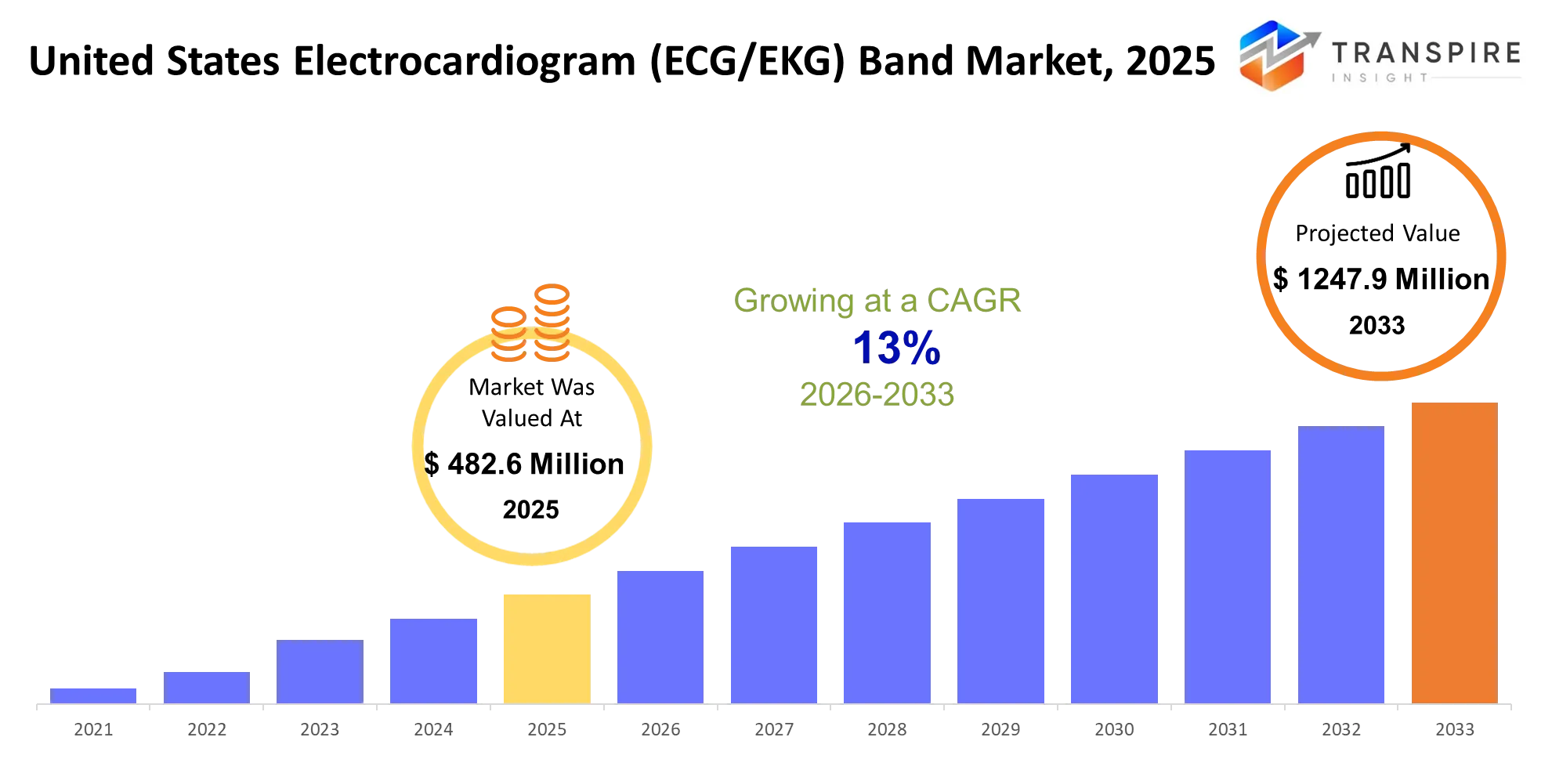
As per Transpire Insight, the United States Electrocardiogram (ECG/EKG) Band Market size is estimated at USD 482.6 Million in 2025 and is anticipated to reach USD 1247.9 Million by 2033, growing at a CAGR of 13% from 2026 to 2033.
The United States Electrocardiogram (ECG/EKG) Band Market helps clinicians catch cardiac electrical activity while someone is doing normal day to day things , so intermittent arrhythmias can be spotted even when it’s outside the usual clinical ECG testing. These wearable bands kind of push monitoring past those short appointments and they also back remote heart checks , especially for patients who need recurring rhythm inspections. Over the last 3–5 years, the whole market has moved away from just simple recording and it’s gone more toward connected monitoring , AI-assisted interpretation, cloud data exchange, and longer-duration ambulatory tracking . The COVID-19 phase really sped up remote patient monitoring , and in turn it made in person cardiac assessments feel less necessary. At the same time, sensor miniaturization improved, so the devices became more comfortable and easier to use.
AI in particular has shifted the value story, because it can classify ECG patterns and then surface clinically important moments first. AliveCor, for example, expanded FDA-cleared AI capabilities to 39 cardiac determinations in 2026 . Because of that, providers are able to pull more clinical signal from ongoing streams of data, and this supports wider adoption across hospitals, cardiology practices, home healthcare, and remote monitoring initiatives.
United States Electrocardiogram (ECG/EKG) Band Market Size & Forecast:
- United States Electrocardiogram (ECG/EKG) Band Market Size 2025: USD 482.6 Million
- Expected Market Value 2033: USD 1247.9 Million
- Forecast CAGR: 13%
- Key Profile: AliveCor Inc., iRhythm Technologies, Medtronic plc, Abbott Laboratories, Philips Healthcare, GE HealthCare, BioTelemetry (Philips), VitalConnect, Preventice Solutions, Bardy Diagnostics, Wellue Health, Polar Electro, Fitbit (Google), Garmin Ltd., Biotronik SE
Key Market Insights
- Market outlook: The United States Electrocardiogram (ECG/EKG) Band Market is expected to expand from USD 482.6 million in 2025 up to around USD 1,247.9 million by 2033, though some analysts say the path there may not be smooth.
- Regional leadership: In 2025 the Northeast takes the lead, driven by thick, hospital based networks plus cardiology centers, research organizations and a fairly strong digital-health setup, it all kind of reinforces each other.
- Regional momentum: Western states are showing the quickest growth, as remote monitoring programs and consumer-connected cardiac technologies keep spreading into more daily-use settings, and the adoption cycle seems shorter.
- Product transition: Wearable and continuous monitoring bands are picking up speed here. Providers are slowly moving away from quick, short-duration ECG sessions and leaning toward longer rhythm tracking, which sounds simple but changes workflows a lot.
- AI adoption: AliveCor in 2026 pushed its FDA-cleared Kardia 12L features further, raising it to 39 cardiac determinations, which is meant to make AI-assisted ECG interpretation feel more “doable” in routine practice.
- Continuous monitoring: iRhythm also leans into longer capture, integrating up to 14 days of uninterrupted ECG data with deep-learned AI so arrhythmia analysis becomes more efficient and less fragmented.
- Application shift: Arrhythmia monitoring remains the top clinical reason people choose these bands, but remote patient monitoring is becoming more important across outpatient routes and home-care models, kind of a quiet shift that keeps building.
- Connectivity trend: Bluetooth, cellular, Wi-Fi and cloud connectivity are increasingly linking ECG bands with electronic workflows, plus enabling remote clinical review, so the information doesn’t just sit on a device.
- Competitive strategy: AliveCor, iRhythm, Medtronic, Abbott, Philips, and GE HealthCare are working to strengthen their market positions via connected devices, analytics, monitoring services, and tighter clinical integration, each one with slightly different emphasis but similar direction.
- Technology advantage: AI-enabled interpretation, compact sensors, longer recording windows, and automated reporting are starting to separate the premium ECG monitoring solutions from the rest, overall it’s less about “just capturing” and more about turning data into something actionable.
What are the Key Drivers, Restraints, and Opportunities in the United States Electrocardiogram (ECG/EKG) Band Market?
Driver: The primary growth force is more like the move from episodic ECG checks toward longer duration ambulatory monitoring, which is kind of different day to day. Standard ECG testing captures cardiac activity at just one moment, but wearable and event-monitoring technologies can capture intermittent rhythm abnormalities while people are doing normal activity. The American Heart Association says ambulatory monitors can help identify arrhythmias that may not show up during a typical, conventional clinical ECG. This shift helps device adoption because hospitals and cardiology practices can gather more longitudinal cardiac information without having to schedule repeated clinic visits. AI-assisted interpretation adds another layer of value too, by helping process huge ECG datasets, and by surfacing the abnormalities that are more clinically relevant first.
Restraint: Regulatory validation, clinical accuracy requirements, data security, and integration with healthcare IT systems still act like structural barriers, even if the demand is there. Medical-grade ECG devices need proof around safety and effectiveness, while AI-enabled devices bring extra concerns around transparency, validation, and ongoing performance monitoring. All these things lengthen product development cycles, and they also raise commercialization costs, especially for smaller manufacturers, that have less margin to absorb delays.
Opportunity: The strongest opportunity sits in AI-enabled remote cardiac monitoring tied to cloud based clinical workflows. AliveCor moving into 39 FDA-cleared cardiac determinations shows how portable ECG technology can shift beyond basic rhythm detection toward wider clinical decision support. If remote patient monitoring platforms get more integrated with electronic health records and home-based cardiac care, it could create recurring revenue via monitoring services, analytics and subscription clinical platform offerings, which then keeps demand continuous.
What Has the Impact of Artificial Intelligence Been on the United States Electrocardiogram (ECG/EKG) Band Market?
Artificial intelligence has helped move ECG devices from just recording into something more like a system that can do automated rhythm labeling, plus kind of clinical triage, sort of. In practice, AI can scan huge batches of ECG signals, then pick up distinctive shapes that match arrhythmias and also mark recordings that might matter for a clinician to look at later. iRhythm’s Zio platform stacks up to 14 days of uninterrupted ECG data with FDA-cleared deep-learned algorithms that classify several arrhythmias and also help support interpretation. They say their system detects across 13 arrhythmia types along with sinus rhythm and artifact signals, and qualified cardiac technicians still verify the final outputs.
There’s also predictive analytics which supports earlier notice of abnormal rhythm patterns by looking at repeated cardiac measurements, instead of only judging isolated moments. AliveCor has expanded AI-supported ECG interpretation quite a bit, and Kardia 12L reached 39 FDA-cleared determinations in January 2026. With tools like this, it may lower the manual screening burden and quicken how fast clinical review happens, especially for remote monitoring programs that deal with large patient databases. Still, a major constraint stays the regulatory validation and whether the model behaves reliably across varied real-world groups, because medical AI really needs strong clinical backing, clear performance evaluation, and ongoing supervision.
Key Market Trends
- Since 2020, wearable ECG products have sort of shifted from basic heart rate tracking, into more medical grade rhythm monitoring and clinical data sharing, which is a bit more involved than it sounds.
- Since 2021, remote cardiac monitoring has grown fast as providers started using longer duration devices for symptoms that maybe don’t show up during typical appointments, or at least not reliably.
- AI adoption really picked up after 2024 as FDA cleared algorithms moved beyond narrow rhythm detection toward broader cardiac interpretation, and the scope got wider.
- iRhythm’s use of up to 14 days of uninterrupted ECG data shows how the industry is leaning into longitudinal cardiac assessment, more like a sustained view rather than snapshots.
- Cloud connectivity has replaced isolated device storage in many newer solutions, so ECG recordings can be pushed to healthcare teams much faster, without the usual delay.
- Manufacturers increasingly blend ECG sensors with mobile applications, making connected monitoring ecosystems instead of just standalone wearable hardware, you know that separate-gadget feeling is fading.
- Since 2024, AI transparency and validation have gotten more regulatory focus, especially as machine learning medical devices become more common in clinics.
- Consumer brands have edged closer to medical monitoring, while clinical manufacturers are putting even more emphasis on FDA clearance workflow integration and evidence, kinda a different kind of pitch.
- Hospitals increasingly prefer monitoring services that bundle devices, data processing, technician review, and reporting, rather than buying hardware alone and hoping the rest is handled.
- Portable ECG technology keeps drifting toward smaller form factors, shown by handheld systems that can produce diagnostic quality multi lead recordings, even with less bulk.
United States Electrocardiogram (ECG/EKG) Band Market Segmentation
By Product Type:
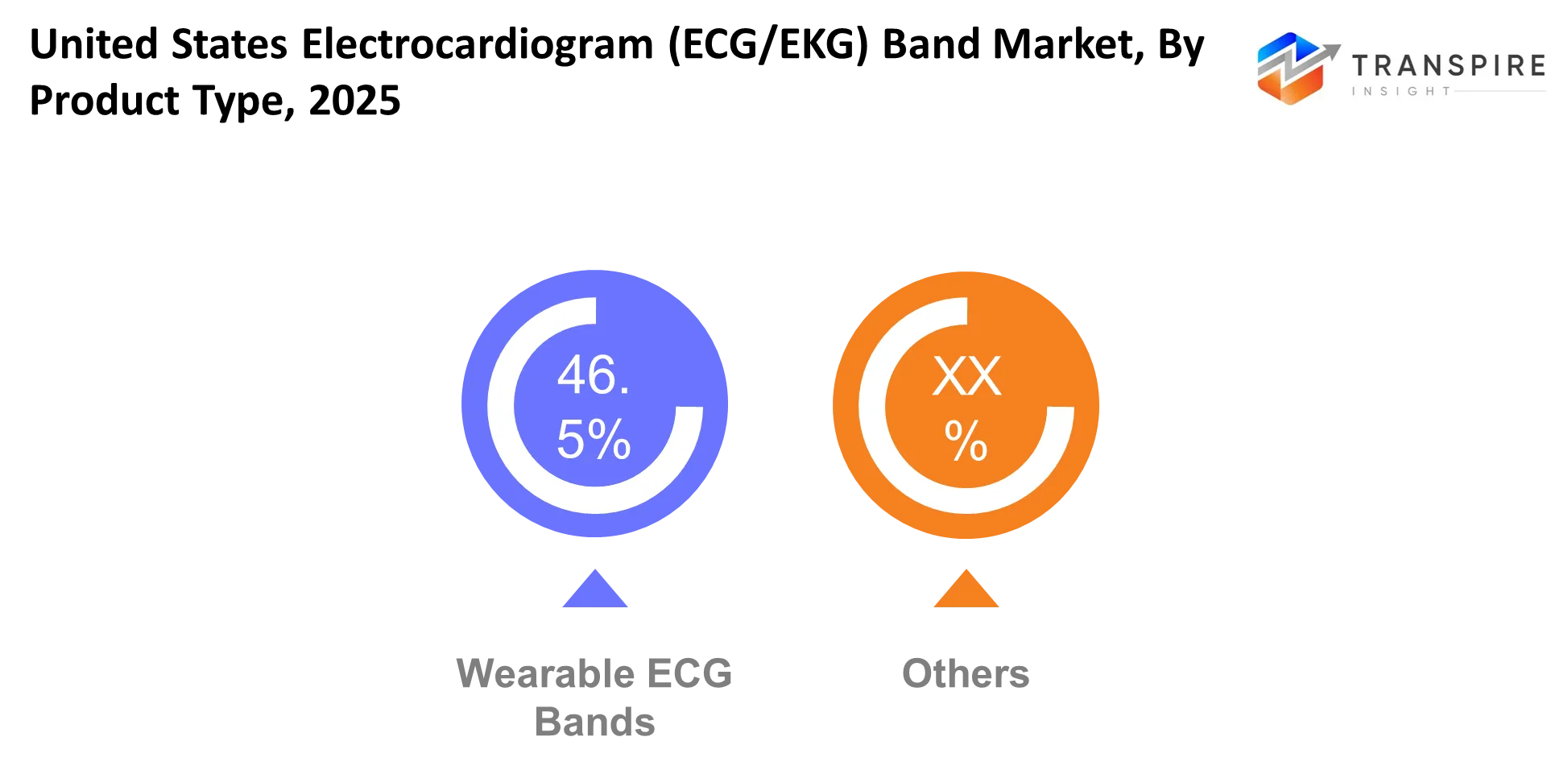
Wearable ECG Bands let you capture cardiac rhythm during everyday movement, so there is real value for ambulatory monitoring, plus remote check ups. Smart ECG Bands come with mobile applications, digital dashboards, and automated notifications, which feels more like a steady companion. Continuous ECG Monitoring Bands are aimed at longer recording sessions for those episodic, intermittent arrhythmias, whereas Disposable ECG Bands focus on short term clinical monitoring and simpler device handling. Rechargeable ECG Bands reduce repeated battery replacement, and they support ongoing monitoring programs. Bluetooth ECG Bands allow direct phone communication, and Wireless ECG Bands support wider data transmission without any cable involved.
AI Enabled ECG Bands bring automated rhythm classification, and even a kind of clinical decision support. AliveCor currently shows where this part is going , with FDA cleared AI that can identify multiple rhythm and morphology conditions. Multi Parameter Monitoring Bands blend ECG measurements with extra physiological signals, which supports a broader assessment of the patient. Other types includes specialized ECG bands built for research, clinical trials, rehabilitation, and specific patient monitoring needs.
By Application:
Arrhythmia Monitoring kinda, is the central clinical application since those intermittent rhythm irregularities can stay invisible during brief ECG checkups in clinic. Remote Patient Monitoring basically pushes cardiac surveillance into home environments, and Cardiac Rehabilitation helps with repeated re-checks while someone is in their recovery track. Fitness Monitoring leans on ECG-enabled wearables for cardio tracking related to workouts, and Preventive Cardiology backs earlier investigation of abnormal rhythms among certain groups of patients. Post-Surgical Monitoring is for rhythm viewing after cardiac procedures, also after other big surgeries.
Clinical Trials, use ECG bands for repeated cardiac measurements plus safety monitoring, especially when medications are being developed. Elderly Care supports longer time windows of observation for people who need steady cardiac assessments. Emergency Monitoring gives fast rhythm data when acute episodes happen. Others is a bit broad, it includes specialized uses across occupational health, research programs, wellness services , and digital cardiac-care platforms.
By End User:
Hospitals stand as a big end- user group, because ECG bands help with in- patient follow up , discharge monitoring, outpatient coordination, and long lasting rhythm checks. Cardiology Clinics rely on wearable ECG methods , for arrhythmia sleuthing and also treatment follow-through. Ambulatory Care Centers gain value from portable devices that cut down on the need for repeated facility based testing. Home Healthcare also supports remote cardiac observation, plus digital forwarding of patient details. Diagnostic Centers put ECG bands to use for prolonged monitoring services and a handful of diagnostic workflows.
Sports & Fitness Centers use ECG enabled devices for training metrics and cardiac watch uses. Research Institutes use wearable ECG technology for clinical research, confirmation studies, and physiological data gathering. Individual Consumers increasingly choose personal ECG products for symptom logging and well-being tracking. Others cover employers, pharmaceutical companies, rehabilitation organizations, and niche healthcare programs
By Connectivity:
Hospitals really are one of the major end user groups, because ECG bands help with inpatient follow-up, discharge checking, outpatient coordination, and that long duration rhythm review. Cardiology Clinics use wearable ECG tech for arrhythmia probing, plus ongoing treatment tracking. Ambulatory Care Centers gain from portable devices that lower the need for repeated testing inside a facility. Home Healthcare gives room for remote cardiac watching and digital sending of patient information. Diagnostic Centers rely on ECG bands for extended observation services and a few selected diagnostic processes.
Sports & Fitness Centers also take advantage of ECG enabled equipment for performance, along with heart monitoring use cases. Research Institutes bring in wearable ECG technology for clinical research, validation work, and the gathering of physiological data. Individual Consumers are using personal ECG products more often, for logging symptoms and routine wellness tracking. Others include employers, pharmaceutical firms, rehab organizations, and specific healthcare initiatives.
By Distribution Channel:
Hospital Procurement still matters a lot for medical-grade ECG bands because healthcare orgs need all that regulatory papers, clinical validation stuff, service arrangements, and even integration help. Online Retail leans more toward consumer-minded ECG products, and it makes it easier to reach connected cardiac monitoring devices, like right from home. Medical Device Distributors cover the local side, they bring in regional sales reach, hands-on training, dependable logistics, plus after-sales service. Pharmacies give practical access for certain consumer choices and home-monitoring situations. Specialty Clinics are also buying equipment straight up more and more, especially when they run cardiology- focused monitoring programs.
Direct Sales lets manufacturers keep tight control over enterprise relationships and deliver customized onboarding support. E-commerce Platforms broaden where people can find items and also back up purchasing decisions for consumers. Wholesalers work through wider distribution routes and generally help with inventory availability across the health system. Others includes research procurement, joint work with pharma, employer health initiatives, and specialized institutional buying setups, which can vary a lot.
What are the Key Use Cases Driving the United States Electrocardiogram (ECG/EKG) Band Market?
Arrhythmia monitoring is still basically the core use case, since intermittent abnormal rhythms may not show up during a short clinical ECG. Wearable bands do more lengthier observation during normal activity , so cardiology clinics and hospitals can catch episodes linked with palpitations dizziness, irregular heartbeats, and even suspected atrial fibrillation. The American Heart Association also treats ambulatory ECG monitoring as an important way to detect rhythm changes beyond the clinical appointments.
Remote Patient Monitoring and post surgical monitoring are getting momentum across home healthcare, ambulatory care centers, and cardiology practices. These connected ECG bands can transmit recordings via smartphones, cellular networks, or cloud platforms, which lets healthcare teams look at cardiac information without needing each assessment to happen onsite. This kind of setup tends to support longer monitoring windows, plus more frequent follow up sessions.
Newer directions include AI assisted preventive cardiology and clinical-trial monitoring. AI enabled portable ECG systems can sort through wider cardiac patterns and help with quicker interpretation, while pharma and research organizations can lean on wearable ECG data for repeat safety and efficacy assessments. AliveCor’s expansion to 39 FDA-cleared cardiac determinations shows there is a real possibility for portable ECG technology to drift toward broader clinical applications.
|
Report Metrics |
Details |
|
Market size value in 2025 |
USD 482.6 Million |
|
Market size value in 2026 |
USD 531.4 Million |
|
Revenue forecast in 2033 |
USD 1247.9 Million |
|
Growth rate |
CAGR of 13% from 2026 to 2033 |
|
Base year |
2025 |
|
Historical data |
2021 - 2024 |
|
Forecast period |
2026 - 2033 |
|
Report coverage |
Revenue forecast, competitive landscape, growth factors, and trends |
|
Regional scope |
United States |
|
Key company profiled |
AliveCor Inc., iRhythm Technologies, Medtronic plc, Abbott Laboratories, Philips Healthcare, GE HealthCare, BioTelemetry (Philips), VitalConnect, Preventice Solutions, Bardy Diagnostics, Wellue Health, Polar Electro, Fitbit (Google), Garmin Ltd., Biotronik SE |
|
Customization scope |
Free report customization (country, regional & segment scope). Avail customized purchase options to meet your exact research needs. |
|
Report Segmentation |
By Product Type (Wearable ECG Bands, Smart ECG Bands, Continuous ECG Monitoring Bands, Disposable ECG Bands, Rechargeable ECG Bands, Bluetooth ECG Bands, Wireless ECG Bands, AI-Enabled ECG Bands, Multi-Parameter Monitoring Bands, Others); By Application (Arrhythmia Monitoring, Remote Patient Monitoring, Cardiac Rehabilitation, Fitness Monitoring, Preventive Cardiology, Post-Surgical Monitoring, Clinical Trials, Elderly Care, Emergency Monitoring, Others); By End User (Hospitals, Cardiology Clinics, Ambulatory Care Centers, Home Healthcare, Diagnostic Centers, Sports & Fitness Centers, Research Institutes, Individual Consumers, Others); By Connectivity (Bluetooth, Wi-Fi, Cellular, NFC, Cloud-Based Connectivity, IoT Connectivity, Edge AI Connectivity, Hybrid Connectivity, Others); By Distribution Channel (Hospital Procurement, Online Retail, Medical Device Distributors, Pharmacies, Specialty Clinics, Direct Sales, E-commerce Platforms, Wholesalers, Others) |
Which Regions are Driving the United States Electrocardiogram (ECG/EKG) Band Market Growth?
The Northeast still feels like the big regional leader, mostly because there is a thick cluster of hospitals, academic medical centers, cardiology practices and digital health programs going on at once. This strong healthcare groundwork makes it easier for clinical teams to actually adopt connected ECG monitoring and to link it with the electronic health record systems they already use. On top of that, the region has a lot of research activity, so newer ECG technologies, plus AI assisted monitoring solutions, can move faster from validation into everyday clinical routines. And then there are the large provider networks, along with specialized cardiac care centers, which keeps a steady type of demand for ambulatory and remote monitoring year after year.
The Midwest is more of a steady contributor, with growth backed by established hospital systems, diagnostic networks, and a fairly consistent commitment to outpatient cardiac services. Compared with the Northeast which leans more heavily on academic and tech heavy healthcare, the Midwest comes with a wider blend—community hospitals, regional cardiology networks, and ambulatory facilities mixed together. That kind of setup generally helps practical adoption of ECG bands that can lower repeated clinic visits and also support distributed cardiac monitoring across different locations. As healthcare keeps getting digitized, and providers push harder on care coordination, this region should remain a reliable revenue base through 2033.
The West looks like the quickest mover, since digital health adoption, technology investment, and consumer driven cardiac monitoring are all converging at the same time. California, plus several other Western markets, gives a supportive setting for AI enabled ECG products, remote monitoring platforms, and technology partnerships, while manufacturers also get an advantage from being near major technology ecosystems.
Who are the Key Players in the United States Electrocardiogram (ECG/EKG) Band Market and How Do They Compete?
Competition is slowly shifting to be more technology-driven than price-driven, and you see medical-device firms, ambulatory monitoring specialists, and digital-health people battling across segments that kind of overlap. AliveCor tries to stand out with AI-based personal and clinical ECG systems, while iRhythm leans into a bundled monitoring offering, one that blends wearable ECG capture , algorithmic review, clinical workflow steps, and EHR tie-ins. iRhythm says it has more than 450 EHR integrations, including several big ambulatory platforms,so “workflow fit” is not just a buzzword but something that actually helps keep customers.
AliveCor, meanwhile, is pursuing an AI powered edge through Kardia 12L, a product that in January 2026 got FDA clearance for five more cardiac determinations, so the count now sits at 39. On top of that, the company is also moving beyond pure device sales with partnerships, such as its February 2026 agreement with Ametris,aimed at remote cardiac safety monitoring during clinical trials. At the same time iRhythm is pressing forward via evidence creation and more digital workflow reach, reporting first-quarter 2026 revenue of USD 199.4 million, up 25.7% compared with the prior year. Medtronic and Abbott compete from wider cardiovascular portfolios, they rely on long standing clinical connections, plus complementary cardiac technologies that help adoption, while Philips and GE HealthCare can lean on hospital infrastructure and connected care ecosystems to get traction.
Company List
- AliveCor Inc.
- iRhythm Technologies
- Medtronic plc
- Abbott Laboratories
- Philips Healthcare
- GE HealthCare
- BioTelemetry (Philips)
- VitalConnect
- Preventice Solutions
- Bardy Diagnostics
- Wellue Health
- Polar Electro
- Fitbit (Google)
- Garmin Ltd.
- Biotronik SE
Recent Development News
- "In January 2026, AliveCor secured FDA clearance for five additional cardiac determinations for Kardia 12L. The expansion brought the system to 39 FDA-cleared determinations and strengthened AI-supported portable ECG diagnosis for clinical users. https://alivecor.com/press/press_release/alivecor-announces-fda-clearance-new-cardiac-determinations-kardia-12l-ecg-system (AliveCor)."
- "In February 2026, Ametris entered a strategic partnership with AliveCor to expand cardiac safety monitoring capabilities in clinical research. The integration enables medical-grade ECG data collection through remote and onsite workflows, reducing trial-site burden and supporting decentralized clinical research. https://alivecor.com/press/press_release/ametris-alivecor-partnership (AliveCor)."
- "In May 2026, Diathrive Health entered a strategic partnership with AliveCor to address cardiometabolic risk through integrated diabetes and virtual cardiovascular care. The collaboration combines KardiaComplete's medical-grade EKG monitoring with diabetes-management services, opening an employer-focused channel for connected cardiac care. https://alivecor.com/uk/press/press_release/diathrive-partners-with-alivecor (AliveCor)."
What Strategic Insights Define the Future of the United States Electrocardiogram (ECG/EKG) Band Market?
The market seems to be structurally shifting away from standalone ECG hardware and more toward connected cardiac monitoring services , where you get sensors plus AI interpretation, cloud platforms, clinician review, and the sort of longitudinal patient history that actually matters. The real driver is that care is getting distributed , so providers want clinically usable cardiac insight without everything needing to happen inside a hospital or a cardiology office, every single time. A subtler risk though, is technology substitution: as smartwatches keep getting better, along with patches, handheld ECG devices, and multi-parameter wearables, some budgets could get re-routed away from dedicated ECG bands if those band makers can’t keep a crisp clinical edge.
The most compelling emerging chance I see is AI-enabled remote cardiac assessment for decentralized clinical trials and for employer-sponsored cardiometabolic programs. For example , AliveCor’s 2026 partnerships with Ametris and Diathrive kind of illustrate how ECG technology can slide into nearby healthcare workflows, beyond the usual cardiology lane. Because of that, market participants should probably double down on FDA-cleared AI, interoperable EHR connectivity, and recurring monitoring services, instead of trying to outcompete everyone mainly on device price. If they do , this path can build higher switching costs, more repeatable revenue, and a more distinct clinical value profile through 2033.
United States Electrocardiogram (ECG/EKG) Band Market Report Segmentation
By Product Type
- Wearable ECG Bands
- Smart ECG Bands
- Continuous ECG Monitoring Bands
- Disposable ECG Bands
- Rechargeable ECG Bands
- Bluetooth ECG Bands
- Wireless ECG Bands
- AI-Enabled ECG Bands
- Multi-Parameter Monitoring Bands
- Others
By Application
- Arrhythmia Monitoring
- Remote Patient Monitoring
- Cardiac Rehabilitation
- Fitness Monitoring
- Preventive Cardiology
- Post-Surgical Monitoring
- Clinical Trials
- Elderly Care
- Emergency Monitoring
- Others
By End User
- Hospitals
- Cardiology Clinics
- Ambulatory Care Centers
- Home Healthcare
- Diagnostic Centers
- Sports & Fitness Centers
- Research Institutes
- Individual Consumers
- Others
By Connectivity
- Bluetooth
- Wi-Fi
- Cellular
- NFC
- Cloud-Based Connectivity
- IoT Connectivity
- Edge AI Connectivity
- Hybrid Connectivity
- Others
By Distribution Channel
- Hospital Procurement
- Online Retail
- Medical Device Distributors
- Pharmacies
- Specialty Clinics
- Direct Sales
- E-commerce Platforms
- Wholesalers
- Others
Frequently Asked Questions
Find quick answers to common questions.
The expected United States Electrocardiogram (ECG/EKG) Band Market size for the market will be USD 1247.9 Million in 2033.
Key segments for the United States Electrocardiogram (ECG/EKG) Band Market are By Product Type (Wearable ECG Bands, Smart ECG Bands, Continuous ECG Monitoring Bands, Disposable ECG Bands, Rechargeable ECG Bands, Bluetooth ECG Bands, Wireless ECG Bands, AI-Enabled ECG Bands, Multi-Parameter Monitoring Bands, Others); By Application (Arrhythmia Monitoring, Remote Patient Monitoring, Cardiac Rehabilitation, Fitness Monitoring, Preventive Cardiology, Post-Surgical Monitoring, Clinical Trials, Elderly Care, Emergency Monitoring, Others); By End User (Hospitals, Cardiology Clinics, Ambulatory Care Centers, Home Healthcare, Diagnostic Centers, Sports & Fitness Centers, Research Institutes, Individual Consumers, Others); By Connectivity (Bluetooth, Wi-Fi, Cellular, NFC, Cloud-Based Connectivity, IoT Connectivity, Edge AI Connectivity, Hybrid Connectivity, Others); By Distribution Channel (Hospital Procurement, Online Retail, Medical Device Distributors, Pharmacies, Specialty Clinics, Direct Sales, E-commerce Platforms, Wholesalers, Others).
Major United States Electrocardiogram (ECG/EKG) Band Market players are AliveCor Inc., iRhythm Technologies, Medtronic plc, Abbott Laboratories, Philips Healthcare, GE HealthCare, BioTelemetry (Philips), VitalConnect, Preventice Solutions, Bardy Diagnostics, Wellue Health, Polar Electro, Fitbit (Google), Garmin Ltd., Biotronik SE.
The United States Electrocardiogram (ECG/EKG) Band Market size is USD 482.6 Million in 2025.
The United States Electrocardiogram (ECG/EKG) Band Market CAGR is 13%from 2026 to 2033.
- AliveCor Inc.
- iRhythm Technologies
- Medtronic plc
- Abbott Laboratories
- Philips Healthcare
- GE HealthCare
- BioTelemetry (Philips)
- VitalConnect
- Preventice Solutions
- Bardy Diagnostics
- Wellue Health
- Polar Electro
- Fitbit (Google)
- Garmin Ltd.
- Biotronik SE
About the Authors

Pankaj Ghogare Patil
I am Pankaj Ghogare Patil, a Senior Research Analyst at Transpire Insight, specializing in the Pharmaceutical, Chemicals & Materials, Healthcare IT, and Biotechnology industry. My expertise lies in conducting comprehensive market research, analyzing industry trends, evaluating competitive landscapes, and translating complex data into actionable insights. At Transpire Insight, I closely follow emerging technologies, regulatory developments, and market innovations to create accurate, well-researched, and informative content that helps businesses and professionals make informed decisions. I am committed to producing credible, evidence-based articles that reflect industry best practices while making technical topics accessible and valuable for a broad audience.

Chakradhar Khansole
Chakradhar serves as the Research Director at Transpire Insight, bringing over 8 years of experience in technology, innovation, and strategic market intelligence. He specializes in transforming complex market data into actionable business insights that enable organizations to make informed, growth-oriented decisions. Recognized for his strategic vision and analytical expertise, Chakradhar leads high-impact research initiatives, delivering comprehensive market assessments, competitive intelligence, and forward-looking industry analysis.
Recently Published Reports
-
Apr 2026
AI in Diabetic Retinopathy Market
AI in Diabetic Retinopathy Market Size, Share & Analysis Report By Type (Screening AI Systems, Diagnostic AI Systems, and Predictive AI Models), By Application Segment (Hospitals, Ophthalmology Clinics, Diagnostic Centers, and Research and Development), and Geography (North America, Europe, Asia-Pacific, Middle East and Africa, South and Central America), 2021 - 2031
-
Apr 2026
Psychometric Tests Market
Psychometric Tests Market Size, Share & Analysis Report By Type (Personality Tests, Ability/Aptitude Tests, Skill/Knowledge Tests, and Others), By Application (Talent Acquisition and Talent Management), and Geography (North America, Europe, Asia-Pacific, Middle East and Africa, South and Central America), 2021 – 2031
-
Apr 2026
Rare Biological Sample Collection Market
Rare Biological Sample Collection Market Size, Share & Analysis Report By Type (Isolation Kits & Reagent, Blood Collection Tubes, and Others), By Application (Oncology, Transcriptomics, Pharmacogenomics, and Others), and Geography (North America, Europe, Asia-Pacific, Middle East and Africa, South and Central America), 2021 – 2031
-
Jul 2026
Diabetic Retinopathy Market
Diabetic Retinopathy Market Size, Share & Analysis Report By Type (Proliferative Diabetic Retinopathy, and Diabetic Macular Edema (DME)), By Treatment Type (Anti VEGF Drug, Steroid Implants, Laser Surgeries, and Vitrectomy), and Geography (North America, Europe, Asia-Pacific, Middle East and Africa, South and Central America), 2021 – 2031
Our Clients







