

United States Construction Accounting Software Market Summary
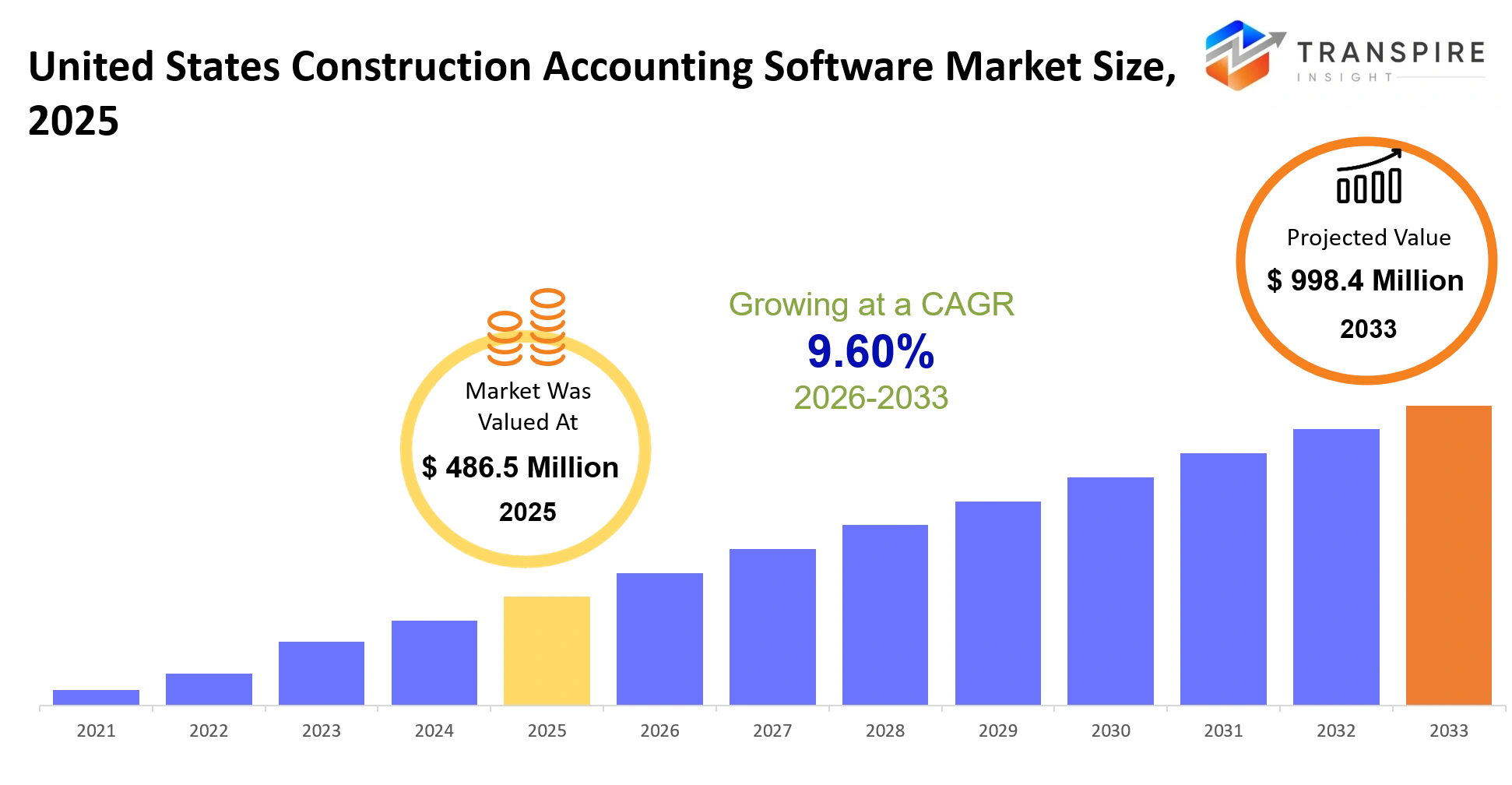
As per Transpire Insight Analysis the United States Construction Accounting Software Market size is estimated at USD 486.5 Million in 2025 and is anticipated to reach USD 998.4 Million by 2033, growing at a CAGR of 9.60% from 2026 to 2033.
The United States Construction Accounting Software Market basically helps contractors, subcontractors, and whole project teams keep job costs, billing, payroll, budgets, and cash flow in check—even when the project gets complicated. And over the past three to five years, things have moved away from desktop style, kinda fragmented accounting tools, toward cloud platforms that tie financial management into project scheduling, procurement, field updates, and payroll. The COVID-19 disruption, honestly sped this up, because it made the limits of office based systems pretty obvious, and it also made remote financial visibility feel more necessary, while centralizing the data at the same time. Meanwhile, tighter labor situations, material price swings, plus annoying project cost overruns, have pushed companies to watch margins more often instead of waiting on occasional accounting look backs. So this change is making software more likely to be adopted, since integrated systems cut down manual reconciliation, boost cost forecasting, and deliver quicker project level financial control. And as construction firms expand their digital workflows, vendors can also pull in more revenue through connected modules, subscription based pricing, and enterprise integrations, which is why the market keeps moving.
United States Construction Accounting Software Market Size & Forecast:
- United States Construction Accounting Software Market Size 2025: USD 486.5 Million
- Expected Market Value 2033: USD 998.4 Million
- Forecast CAGR: 9.60%
- Key Profile: Procore Technologies, Sage Group, Autodesk Construction Cloud, Oracle Corporation, CMiC Global, Viewpoint (Trimble), Deltek Inc., Acumatica, Foundation Software, Jonas Construction Software, Microsoft Corporation, SAP SE, QuickBooks (Intuit), Xero Ltd., ComputerEase.
Key Market Insights
- North America basically takes the lead with about 41.2% of the global market share in 2025, and that’s backed by advanced construction digitization , plus very strong U.S. uptake. It’s like everything just clicks there, more than elsewhere.
- Asia Pacific looks like the fastest mover, with an estimated 8.5% CAGR over 2026–2035 , mainly because construction finance digitization keeps picking up speed.
- On the offering side , software solutions are still the front runner, holding roughly 74% share in 2025. This is supported by subscription platforms that blend accounting with project controls , in a more seamless way than older setups.
- Services stay right behind that, as the second-largest offering. These cover implementation, migration, customization, training, upgrades, and support, especially as contractors modernize their financial systems , step by step.
- For deployment , cloud-based SaaS is the fastest-growing slice, hitting 57.6% share in 2025. After that it keeps expanding at around 9.2% through 2035, mostly because teams want easier access and smoother scaling.
- Functionality-wise , job costing and project cost management is the dominant category with a 27.1% share in 2025, which points to a stronger focus on real time project profitability.
- Audit reporting and financial analytics also sit among the quicker-growing application areas, since compliance workloads keep rising and companies want real-time reporting, not later reporting.
- Meanwhile, small and medium-sized enterprises captured about 59% share in 2025, showing a growing demand for affordable SaaS options instead of sticking with older legacy accounting systems.
- Also , Procore expanded AI financial workflows in 2025, bringing in job costing , financial analytics, and AI-driven direct cost processing features.
What are the Key Drivers, Restraints, and Opportunities in the United States Construction Accounting Software Market?
The main growth driver is sort of cloud migration together with all that compliance-heavy public construction. Back in 2021 the Infrastructure Investment and Jobs Act basically kicked off a big stream of federally funded projects, with prevailing wage and certified payroll requirements. When there is more compliance data, it usually turns into more manual work, but without specialized software. Cloud platforms help automate payroll records, job costing, billing, and those audit trail details, so the compliance pressure turns into ongoing software adoption ,and then subscription revenue that keeps showing up.
The biggest drag is legacy-system complexity. Contractors typically stitch together accounting , payroll, estimating, project management, and field apps that were built years apart. An enterprise rollout can take 6–18 months, while the mid-tier kind of deployments are more like 3–6 months. That delay slows down full adoption and it also keeps internal staff busy longer than you’d want. From a Transpire Insight look at regional procurement announcements and launch timing, supply-chain concentration is still the prime execution risk.
The most obvious opportunity is AI-enabled financial automation for mid-sized contractors. Sage and Procore are pushing AI into reconciliation, forecasting, invoice processing, job costing, and broader financial analysis. Sage said its AI tools can save hundreds of hours on manual tasks, and the newer agentic capabilities hint at automated transaction workflows, kind of end-to-end, without so much back-and-forth.
What Has the Impact of Artificial Intelligence Been on the United States Construction Accounting Software Market?
Artificial intelligence is kind of shifting construction finance software from just recording transactions, into more automated financial control. These days AI helps with invoice capture, account classification, reconciliation, payment workflows, and anomaly detection, which cuts down a lot of the repetitive grind for project accountants.
On one side, Procore has put AI powered analysis into financial management, while Sage Intacct has been expanding automated accounts-payable workflows and close-management features. Predictive abilities are moving forward too. Basically machine-learning models can look at past project costs, payment patterns, and budget outcomes, so they can flag likely overruns and make cash-flow forecasting feel a bit less speculative. Sage has introduced predictive cash-flow options tied to customer payment trends, and Procore is using AI to reinforce project forecasting and financial visibility.
The operational upside can be real. Sage says its AI tools have helped finance teams save hundreds of hours on manual steps. And in a survey Sage and Edelman ran, 26% of finance leaders said AI was already shrinking book-closing time.
That said, the biggest snag still feels like integration. Old accounting databases, inconsistent cost codes, scattered project data, and complicated implementation needs can all knock down AI accuracy, or push the deployment timeline further out. For bigger enterprise rollouts, it can easily take 6–18 months.
Key Market Trends
- In 2025, cloud deployment notched past 57.6% share, and that seems to speed up the whole move away from on-premise construction ERP setups.
- At the same time AI went from “lets just try it” to more real operational finance workflows, in 2025, including things like invoice handling, reconciliation, forecasting, plus project cost analysis, more or less tied to how teams actually work day to day.
- Also in 2025, Procore rolled out AI-powered direct-cost processing, which in practice, tightens the link between finance tasks and construction project operations.
- Then in June 2025, Foundation Software pushed further into financial automation by acquiring Vendrix, while also plugging in corporate cards, AP automation and bill-pay tools, it was pretty straightforward.
- By February 2026, Sage Intacct extended its AI-driven close analytics and cash intelligence, with the result that spreadsheet based financial processing gets reduced quite a lot.
- Compliance is starting to matter even more too, because federally funded projects now demand certified payroll, stronger documentation, and better audit trails across contractor networks, kinda everywhere.
- Job costing stayed on top through 2025, taking 27.1% share, and that points to renewed focus on real time margin and cost control.
- Meanwhile SMEs reached 59% share in 2025, suggesting cloud pricing is broadening the adoption of specialized accounting well beyond only the biggest contractors.
- For 2026, Intuit entered a tougher competitive stretch by launching an AI-native construction edition, connecting finance with operational workflows in a single thread.
- Finally, in May 2026, Procore introduced agentic AI capabilities, so digital agents can actually execute construction workflows using project information, not just analyze it.
United States Construction Accounting Software Market Segmentation
By Deployment :
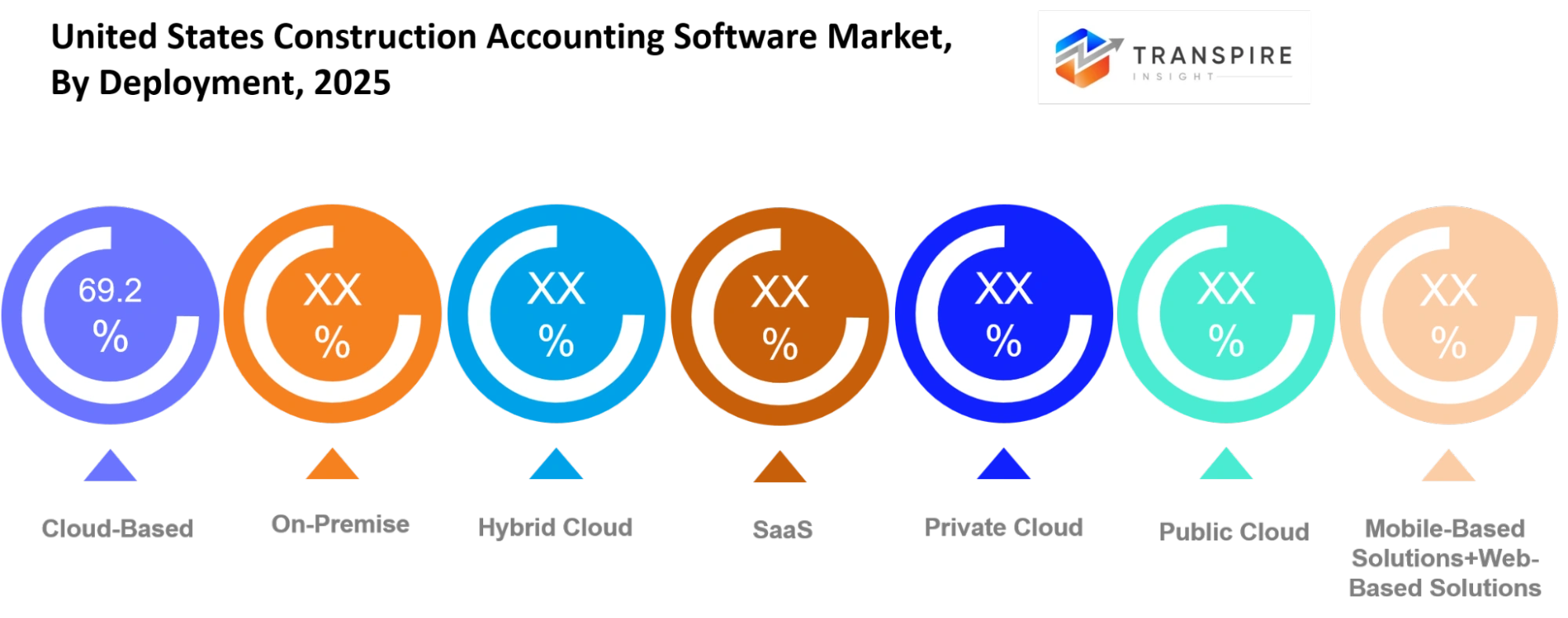
Cloud-based accounting has been getting, well, a lot more adoption lately as construction companies want quicker reach to financial records, project costs, payroll data, and billing info. These cloud systems basically make it easier for remote work to actually happen, and they tie accounting teams in with project managers in multiple places, not just one. With SaaS style models too, there is less pressure for big, upfront tech spending, so specialized accounting tools become within reach even for smaller contractors.
Still, on-premise platforms do not fully fade out, especially for larger construction businesses that have tough data control rules and already have internal technology systems in place. A hybrid cloud approach then sits in the middle, linking local accounting setup with cloud applications, kind of a balanced compromise. And you can expect mobile and web based solutions to spread further, because crews in the field need near immediate access to job costs, invoices, approvals, and payment status. Ultimately the deployment choice depends on project size, the security posture, available technology budgets, and how much integration work is required.
By Enterprise Size :
Large enterprises still need bookkeeping systems that juggle several projects, pretty intricate budget plans, payroll, agreements and different kinds of financial reporting, all at once. At the same time, medium sized enterprises, plus construction SMEs are drifting toward cloud platforms, mainly because subscription pricing keeps overall tech costs down and means less dependence on dedicated infrastructure. Even independent contractors often end up using easier accounting tools that bundle invoicing, expense tracking, payroll, and job costing into one flow , rather than stitching everything together manually.
Government contractors run into tougher reporting obligations and more documentation to keep, while infrastructure companies typically steer huge projects that come with long financial cycles. Real estate developers, on the other hand, have to watch budgets carefully across development phases and contractor payments, otherwise everything can slip. Software vendors will likely go after smaller businesses with modular products , faster setup and mobile access, and then bigger enterprises will want wider integration with ERP, project management, procurement, plus financial planning systems.
By Application :
Project costing and job cost accounting still matter a lot, because construction margins really hinge on keeping a steady eye on labor, material, gear use, subcontractor charges, and overhead , even when things shift. Budgeting and forecasting tools let finance teams line up what they expected versus what actually happened on the job, in other words the real numbers. Payroll handling also becomes a major piece of the puzzle, since contractors deal with shifting labor needs across several projects at once, not just one.
Then there’s accounts payable, plus accounts receivable tools, which speed up invoice processing and keep the payment trail clearer, so they don't lose track. Financial reporting rounds it out by giving more visibility into project profitability, not just totals, but trends too. On top of that, tax compliance and contract management bring extra value by organizing the paperwork and cutting down on manual admin work that keeps sneaking back in. Equipment cost tracking should get even more focus , as contractors want tighter control over fuel, maintenance, utilization, and ownership expenses. Finally AI based functions will help with forecasting, spotting anomalies, streamlining invoice processing, and improving financial analysis across the main accounting systems.
By End User :
General contractors still come out on top, because big projects need that kind of thorough financial grip across labor, materials, subcontractors, equipment and invoicing , you know. Subcontractors also lean on specialized bookkeeping tools, not just for job costs but for payroll, invoices, and how profitable the work is. Civil engineering firms , and infrastructure businesses too, need financial frameworks that can live with long timelines, lots of separate agreements, and very detailed cost reporting.
Residential and commercial builders are using cloud accounting platforms more and more, to keep office finance teams tied in with day to day project operations. Government construction agencies usually want structured updates, compliance documentation, and controlled financial procedures. Real estate developers also need real time budget clarity across land acquisition, building activities, payments to contractors, and finishing the whole project . Whether end users adopt these systems will depend on how complex the job is , how big the workforce is, what compliance rules show up, and also whether they truly want connected financial information across roles and departments.
By Software Type :
Standalone accounting software is still a good fit for smaller contractors, especially when project complexity stays low and the financial needs are pretty basic. On the other hand, integrated ERP options can give wider oversight because they tie accounting into procurement, project management, payroll, inventory, and even the contract side of work, so everything feels more connected, less like separate islands. Then you have project accounting software, which really leans into job costs, task budgets, billing cycles and the overall profitability of each individual construction job.
Cloud accounting platforms, plus broader financial management suites , will probably get more attention too, since many construction firms want “connected” financial operations without paying for big infrastructure. AI-enabled accounting software also keeps growing because it can handle automated invoice processing, reconciliation, forecasting, and financial insights in a more speedy way, rather than so much manual checking. For larger contractors, construction ERP systems will likely remain a major backbone for running multiple business functions at once, while mobile accounting apps will help in the field with approvals, expense reporting, and quick financial updates.
What are the Key Use Cases Driving the United States Construction Accounting Software Market?
Project costing keeps being a core use case, since contractors really need tight control over labor, materials , subcontractor charges , and also equipment expenses. General contractors and commercial builders tend to use project accounting tools so they can compare what actually happened in costs with the approved budgets and in that way protect their project margins.
Payroll management and financial forecasting are also showing more traction, especially with construction SMEs, infrastructure businesses, and government contractors. Payroll tools help track workforce changes across different projects , while forecasting gives finance teams a way to plan cash flow, and spot cost pressure before the project wraps up.
Other emerging use cases are AI based invoice review and automated compliance reporting, which is kinda more and more common lately. Government contractors and big infrastructure companies can use those functions to catch billing errors early, organize documentation in a systematic way, and improve audit readiness as reporting requirements keep getting more demanding, in general.
|
Report Metrics |
Details |
|
Market size value in 2025 |
USD 486.5 Million |
|
Market size value in 2026 |
USD 525.9 Million |
|
Revenue forecast in 2033 |
USD 998.4 Million |
|
Growth rate |
CAGR of 9.60% from 2026 to 2033 |
|
Base year |
2025 |
|
Historical data |
2021 - 2024 |
|
Forecast period |
2026 - 2033 |
|
Report coverage |
Revenue forecast, competitive landscape, growth factors, and trends |
|
Geographic scope |
United States of America |
|
Key company profiled |
Procore Technologies, Sage Group, Autodesk Construction Cloud, Oracle Corporation, CMiC Global, Viewpoint (Trimble), Deltek Inc., Acumatica, Foundation Software, Jonas Construction Software, Microsoft Corporation, SAP SE, QuickBooks (Intuit), Xero Ltd., ComputerEase. |
|
Customization scope |
Free report customization (country, regional & segment scope). Avail customized purchase options to meet your exact research needs. |
|
Report Segmentation |
By Deployment (Cloud-Based, On-Premise, Hybrid Cloud, SaaS, Private Cloud, Public Cloud, Mobile-Based Solutions, Web-Based Solutions, Others); By Enterprise Size (Large Enterprises, Medium Enterprises, Small Enterprises, Construction SMEs, Independent Contractors, Government Contractors, Real Estate Developers, Infrastructure Companies, Others); By Application (Project Costing, Payroll Management, Job Cost Accounting, Budgeting & Forecasting, Accounts Payable & Receivable, Financial Reporting, Tax Compliance, Contract Management, Equipment Cost Tracking, Others); By End User (General Contractors, Subcontractors, Civil Engineering Firms, Infrastructure Companies, Residential Builders, Commercial Builders, Government Construction Agencies, Real Estate Developers, Others); By Software Type (Standalone Accounting Software, Integrated ERP Solutions, Project Accounting Software, Cloud Accounting Platforms, Financial Management Suites, AI-Powered Accounting Software, Construction ERP, Mobile Accounting Apps, Others). |
Which Regions are Driving the United States Construction Accounting Software Market Growth?
North America really kind of dominates the construction accounting software space, holding around 41.2% of the market share in 2025, and that’s backed by more mature digital take up and those pretty complex construction needs. Federal infrastructure programs, thorough labor reporting, the whole suite of tax requirements, plus project documentation all mash together into steady demand for specialized financial systems. Also, the region tends to have a dense, interlinked software ecosystem, with recognizable names like Procore, Intuit, Sage, Trimble, and Foundation Software, and it’s further fueled by solid spending on construction technology. This strong position should stay pretty durable through 2033, since cloud migration, AI-enabled accounting, and connected project-finance platforms keep rolling out across U.S. contractors.
Europe meanwhile has a more structurally different revenue picture. Adoption there is supported by comparatively steady regulatory frameworks, well-established construction firms and a relatively consistent pace of investment in commercial as well as infrastructure builds. Because cross border reporting comes up, and accounting practices are already well set, contractors often keep specialized financial tools instead of fully switching to general purpose software. On top of that, stable enterprise software budgets help keep subscription revenues coming for vendors that serve bigger contractors and engineering businesses. Growth in Europe can feel dependable, since replacement cycles, compliance obligations, and digital finance initiatives create more predictable buying behavior, for software in general.
Asia Pacific should see the quickest, almost brisk growth, around 8.5% CAGR through 2026–2035, as construction digitization keeps speeding up across the biggest economies. New infrastructure initiatives, rising urban development and this shift toward cloud based project management is really building up the need for more integrated accounting systems , honestly it looks like a direct push. Suppliers could aim at contractors who want reduced cost SaaS offerings, mobile accounting utilities, plus automated finance summaries, all without leaning on old-school infrastructure. For people coming in, including investors, the 2026–2033 window might be a practical chance to form regional collaborations, adapt the compliance side locally, and grab early interest with construction firms that are actively moving to digital workflows.
Who are the Key Players in the United States Construction Accounting Software Market and How Do They Compete?
Competition still feels kind of fractured, not fully consolidated, with vendors that go from general accounting providers all the way to construction specific platforms and bigger enterprise ERP suppliers. Things like price, cloud strength, construction related functionality, how deep the integrations go, and how solid the implementation support is, basically drive the competition. Procore leans hard into construction workflows, and has moved from project oversight into financial management and even AI. Meanwhile, the larger tech groups push broader enterprise platforms and try to cover more ground.
Procore Technologies differentiates with a platform that stays construction centered, tying together project management, financial management, workforce functions and AI tools, all in one place. They’ve also been widening AI capabilities and tightening financial workflows, so it’s not really mainly a low-price story. Intuit leans on QuickBooks' broad small business ecosystem to reach contractors who want simpler setup. And then there’s its 2026 AI powered Enterprise Suite for construction which aims to stretch financial management into connected operational workflows. Sage, for its part, competes with construction focused financial management plus stronger enterprise accounting capabilities. More recently, they’ve put AI investments toward tighter management, cash intelligence, and automated finance processes.
Trimble, via Viewpoint, differentiates through construction ERP features. That includes general ledger, accounts payable, project costing, and payroll handled at scale. Finally, Foundation Software is more narrow in contractor accounting and it’s been expanding financial automation. A big part of that is its 2025 acquisition of Vendrix, which brings in corporate cards, expense management, accounts payable automation, and bill pay capabilities too.
Company List
- Procore Technologies
- Sage Group
- Autodesk Construction Cloud
- Oracle Corporation
- CMiC Global
- Viewpoint (Trimble)
- Deltek Inc.
- Acumatica
- Foundation Software
- Jonas Construction Software
- Microsoft Corporation
- SAP SE
- QuickBooks (Intuit)
- Xero Ltd.
- ComputerEase
Recent Development News
In February 2026, Intuit launched a new AI-powered construction edition of Intuit Enterprise Suite, bringing project, financial, and operational workflows into one platform for mid-market construction businesses. The launch adds AI-driven project management, budgeting, job costing, cost-group tracking, and AIA-style invoicing, strengthening competition for integrated construction accounting platforms.
Source: https://quickbooks.intuit.com/
In February 2026, Sage launched new AI-powered capabilities for Sage Intacct, including intelligent close analytics, AI-powered data import, cash intelligence, and connected data access. The product expansion targets manual finance processes and strengthens AI-based automation and financial visibility across accounting workflows used by construction businesses.
Source: https://www.sage.com/
What Strategic Insights Define the Future of the United States Construction Accounting Software Market?
Over the next five to seven years, construction accounting is going to drift toward connected financial operating systems that keep tying project costs, contracts, payroll, procurement, and even field data together. The main push, well it’s basically the need for faster margin control, because project complexity, labor expenses, and compliance workloads are putting more weight on financial teams . There’s also this less obvious risk—vendor concentration, meaning when you depend on only a few platforms, switching can get expensive, integration options can shrink, and contractors can get pulled into sudden pricing or service changes.
At the same time there’s an emerging chance here, especially with AI agents that can reconcile invoices, spot cost anomalies, estimate cash flow, and kick off routine accounting tasks with pretty limited human handholding. Adoption should speed up as construction firms gather cleaner project level datasets. So, software vendors and investors should really favor interoperable AI architecture, open APIs, and construction specific data models, instead of just offering isolated automation features. That way, you get more durable value, and you don’t end up as trapped inside closed technology ecosystems.
United States Construction Accounting Software Market Report Segmentation
By Deployment
- Cloud-Based
- On-Premise
- Hybrid Cloud
- SaaS
- Private Cloud
- Public Cloud
- Mobile-Based Solutions
- Web-Based Solutions
By Enterprise Size
- Large Enterprises
- Medium Enterprises
- Small Enterprises
- Construction SMEs
- Independent Contractors
- Government Contractors
- Real Estate Developers
- Infrastructure Companies
By Application
- Project Costing
- Payroll Management
- Job Cost Accounting
- Budgeting & Forecasting
- Accounts Payable & Receivable
- Financial Reporting
- Tax Compliance
- Contract Management
- Equipment Cost Tracking
By End User
- General Contractors
- Subcontractors
- Civil Engineering Firms
- Infrastructure Companies
- Residential Builders
- Commercial Builders
- Government Construction Agencies
- Real Estate Developers
By Software Type
- Standalone Accounting Software
- Integrated ERP Solutions
- Project Accounting Software
- Cloud Accounting Platforms
- Financial Management Suites
- AI-Powered Accounting Software
- Construction ERP
- Mobile Accounting Apps
Frequently Asked Questions
Find quick answers to common questions.
The expected United States Construction Accounting Software Market size for the market will be USD 998.4 Million in 2033.
Key segments for the United States Construction Accounting Software Market are By Deployment (Cloud-Based, On-Premise, Hybrid Cloud, SaaS, Private Cloud, Public Cloud, Mobile-Based Solutions, Web-Based Solutions, Others); By Enterprise Size (Large Enterprises, Medium Enterprises, Small Enterprises, Construction SMEs, Independent Contractors, Government Contractors, Real Estate Developers, Infrastructure Companies, Others); By Application (Project Costing, Payroll Management, Job Cost Accounting, Budgeting & Forecasting, Accounts Payable & Receivable, Financial Reporting, Tax Compliance, Contract Management, Equipment Cost Tracking, Others); By End User (General Contractors, Subcontractors, Civil Engineering Firms, Infrastructure Companies, Residential Builders, Commercial Builders, Government Construction Agencies, Real Estate Developers, Others); By Software Type (Standalone Accounting Software, Integrated ERP Solutions, Project Accounting Software, Cloud Accounting Platforms, Financial Management Suites, AI-Powered Accounting Software, Construction ERP, Mobile Accounting Apps, Others).
Major United States Construction Accounting Software Market players are Procore Technologies, Sage Group, Autodesk Construction Cloud, Oracle Corporation, CMiC Global, Viewpoint (Trimble), Deltek Inc., Acumatica, Foundation Software, Jonas Construction Software, Microsoft Corporation, SAP SE, QuickBooks (Intuit), Xero Ltd., ComputerEase.
The United States Construction Accounting Software Market size is USD 486.5 Million in 2025.
The United States Construction Accounting Software Market CAGR is 9.60% from 2026 to 2033.
- Procore Technologies
- Sage Group
- Autodesk Construction Cloud
- Oracle Corporation
- CMiC Global
- Viewpoint (Trimble)
- Deltek Inc.
- Acumatica
- Foundation Software
- Jonas Construction Software
- Microsoft Corporation
- SAP SE
- QuickBooks (Intuit)
- Xero Ltd.
- ComputerEase
About the Authors

Mayur Shinde
I am Mayur Shinde, a Senior Research Analyst at Transpire Insight, specializing in the Automotive & Transportation and Information & Communication Technology (ICT) Industry. My work focuses on analyzing emerging market trends, technological advancements, competitive landscapes, and industry developments to deliver accurate, data-driven insights. I am passionate about transforming complex market information into clear, actionable content that helps businesses, professionals, and decision-makers stay informed and make confident strategic decisions.

Chakradhar Khansole
Chakradhar serves as the Research Director at Transpire Insight, bringing over 8 years of experience in technology, innovation, and strategic market intelligence. He specializes in transforming complex market data into actionable business insights that enable organizations to make informed, growth-oriented decisions. Recognized for his strategic vision and analytical expertise, Chakradhar leads high-impact research initiatives, delivering comprehensive market assessments, competitive intelligence, and forward-looking industry analysis.
Recently Published Reports
-
Apr 2026
3D Optical Profiler Market
3D Optical Profiler Market Size, Share & Analysis Report By Type (Desktop 3D Optical Profiler, and Portable 3D Optical Profiler), By Technology (Confocal Technology, and White Light Interference), By End-Use Industry (Manufacturing, Research Institutions, Automotive, Aerospace and Defense, Medical Devices, and Other), and Geography (North America, Europe, Asia-Pacific, Middle East and Africa, South and Central America), 2021 - 2031
-
Apr 2026
Depth Sensor Market
Depth Sensor Market Size, Share & Analysis Report By Type (Infrared Depth Sensors, Time-of-Flight (ToF) Sensors, Stereo Vision Sensors, Structured Light Sensors, Ultrasonic Depth Sensors), By Application (Automotive, Robotics, Gaming, Consumer Electronics, Industrial Automation, Healthcare, Security & Surveillance, Others), By End Users (Automotive Manufacturers, Consumer Electronics Companies, Healthcare Providers, Industrial Companies, Security Agencies, Gaming Companies, Robotics Companies, Others), and Geography (North America, Europe, Asia-Pacific, Middle East and Africa, South and Central America), 2021 – 2031
-
Apr 2026
Digital Manufacturing Market
Digital Manufacturing Market Size, Share & Analysis Report By Component (Hardware, Software, and Services), By Technology (Robotics, 3D Printing, Internet of Things (IoT), and Others), By Application (Automotive and Transportation, Aerospace and Defense, Consumer Electronics, Industrial Machinery, and Others), By Process Type (Computer-Based Designing, Computer-Based Simulation, Computer 3D Visualization, Analytics, and Others), and Geography (North America, Europe, Asia-Pacific, Middle East and Africa, South and Central America), 2021 – 2031
-
Apr 2026
Digital Visa Services Market
Digital Visa Services Market Size, Share & Analysis Report By Type (Individual Travelers, Group Travelers), By Application (Tourism, Business Travel, Others), and Geography (North America, Europe, Asia-Pacific, Middle East and Africa, South and Central America), 2021 – 2031