

Accounting Software Market Size & Forecast:
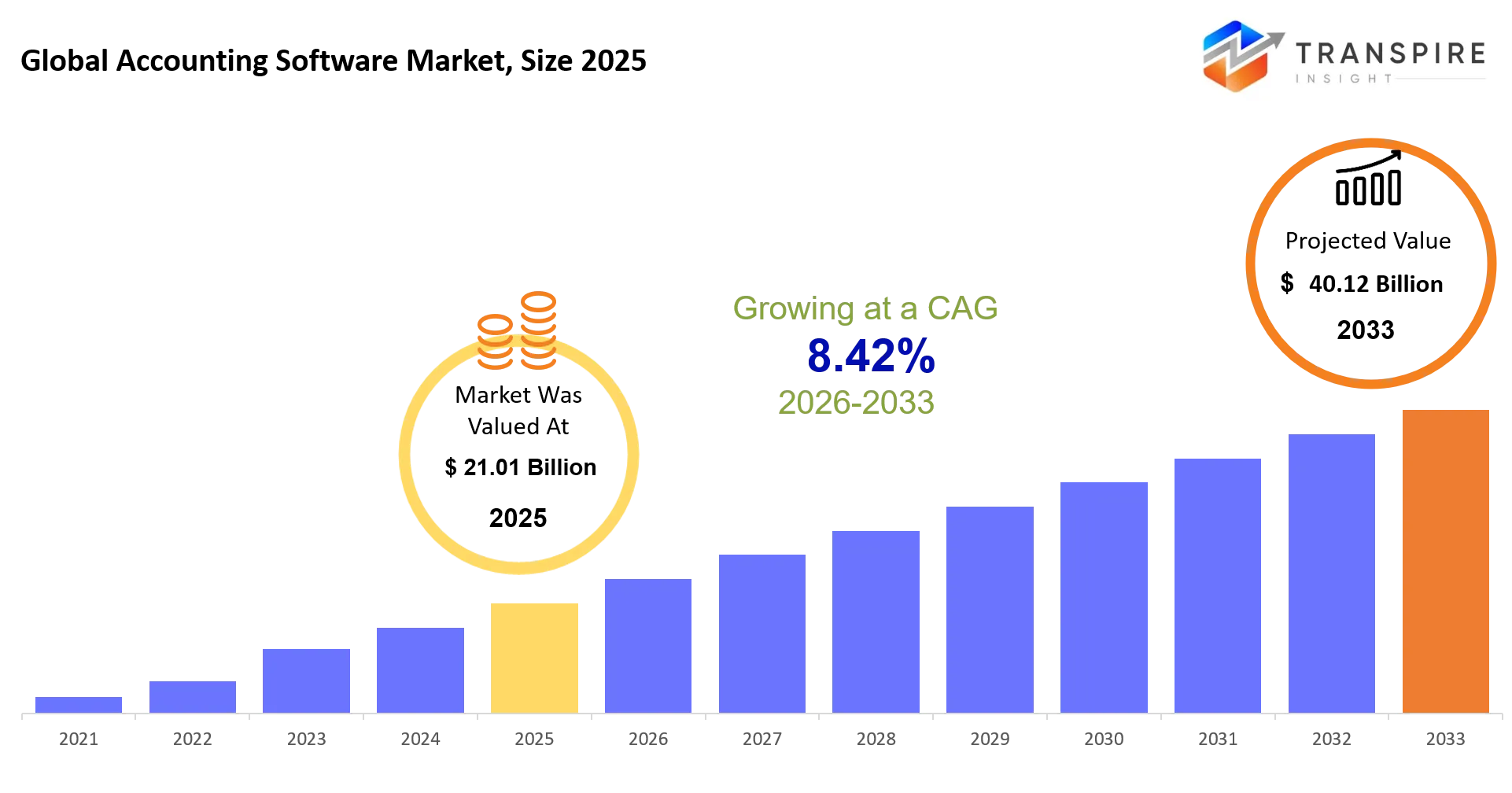
- Accounting Software Market Size 2025: USD 21.01 Billion
- Accounting Software Market Size 2033: USD 40.12 Billion
- Accounting Software Market CAGR: 8.42%
- Accounting Software Market Segments: By Deployment (Cloud, On-Premise, Hybrid), By Application (Payroll, Billing, Tax, Financial Reporting), By End-User (SMEs, Enterprises, Accountants, Freelancers).
Accounting Software Market Summary:
The Accounting Software Market size is estimated at USD 21.01 billion in 2025 and is anticipated to reach USD 40.12 billion by 2033, growing at a CAGR of 8.42% from 2026 to 2033. Global Accounting Software Market is a live control that instantly connects with physical operations. For instance, scanning a grocery item, dispatching a truck, or sending a client email) to cash reality. It changes the troublesome transaction into an automated and smooth process. It ensures that tax regulations are met, and bills are clear automatically, and executive dashboards exactly show the free cash flow in real-time.
In earlier systems, companies used to gather receipts at the end of the month for closing. But nowadays, accounting infrastructure depends upon the automated design ingestion pipelines that restore the transaction when they occur.
The Government banned simply emailing a PDF of a bill of businesses. Governments need real- time validation of any transaction directly through the state portal before an item can leave a warehouse. Businesses have been forced to rip out legacy desktop systems and replace them with API-driven cloud accounting software to prevent operational shutdown.
Key Market Insights:
The Global Accounting Software Market is expanding very fast, projected to grow 40.12 by 2033. This surge is powered by a structural pivot where traditional entry-level bookkeeping tasks are eliminated in favor of AI-driven predictive insights and instant, legally mandated cloud tax reconciliation.
- Cloud is the dominating segment with 56% share in the global market.
- Enterprise leaders like Xero and Zoho are driving this by engineering native multi-currency ledgers.
- SaaS-based deployment options command nearly two-thirds of the market share as legacy desktop clients shift entirely toward mobile-first, cloud-native subscriptions.
- Integrated Enterprise Platforms hold the largest share by solution type, which is around 43%.
- The Asia-Pacific region holds the largest market share of 40% of the Global Accounting Software Market .
- Europe holds 29% of the global Global Accounting Software Market .
- Software developers are capturing this momentum by building affordable, out-of-the-box automation suites that handle localized tax structures like GST and VAT without requiring an in-house IT team.
What are the Key Drivers, Restraints, and Opportunities in the Global Accounting Software Market ?
Drivers
The accounting software boom is largely driven by a huge worldwide movement toward digital tax reform. Increasingly, governments are taking stiffer action on reporting compliance with strict electronic invoicing rules, rendering traditional paper invoicing ledgers and simple spreadsheets essentially useless. Companies of all sizes are upgrading to automated systems as businesses can no longer legally function with manual record-keeping. The shortage of people to manage accounting processes is worsened by this transition, and firms are left with no choice but to use AI-powered software to automate their mundane invoice matching, corporate expense auditing, and complicated remote accounting for employees.
Restraints
Despite this significant momentum, the market is being hindered by deeply entrenched data security concerns and the sheer complexity of migration to tech. Conservative business owners are extremely afraid of transferring their critical business ledger histories to multi-tenant cloud servers because financial records are the most coveted commodity for cybercriminals. What's more, getting rid of old on-premise systems is a huge challenge for operations. The challenge for CFOs is that they often don't want to upgrade for years because they are afraid of losing valuable data, system crashes, or downtime.
Opportunities
The absolute best way to grow in the future is by self-learning; however, AI modules are automated and activate the protection of business capital. Modern software does not merely record the numbers, but it also uses smart optical scanners to monitor the real situation of a company's cash flow, identifying any payment irregularities or fraud within the company before the human auditor has a chance to review them. The value of creating an extremely localized, mobile-first app for a niche industry, such as healthcare, or of taking an app that does not natively support hyper-specific tax conditions and making it work in a new, fast-growing, digitalized emerging market is also very high.
What Has the Impact of Artificial Intelligence Been on the Global Accounting Software Market ?
AI has revolutionized accounting software, making the tasks quick and stress-free and handling much of the legwork. Contemporary AI-powered solutions can swiftly read paper invoices, extract expense details, and correlate transactions with bank statements, eliminating the need for hours of manual data entry for business owners. This amazing automation means that the books of companies stay clean of messy human math errors, and they are now able to close their books, at least monthly, days sooner than before. On the other hand, AI can be used to create an intuitive financial navigator that analyzes a business's past spending habits, proactively anticipating future cash-flow patterns, pinpointing budget issues, and immediately warning the proprietors of unusual transactions before they become an issue.
One of the main reasons behind businesses pushing for the adoption of AI-driven accounting solutions is the dire shortage of talent, combined with economic factors such as inflation. With almost 45% of accounting teams having massive recruitment problems, with not enough manpower to manually process data, businesses are fast integrating automated AI features into their accounting workflows to ensure continued productivity and high-level financial forecasting.
Key Market Trends:
Accounting software is no longer just a record-keeping tool; it's an active predictive engine. To cope with economic uncertainty, organizations are shifting from manual data input to intelligent, financial automation processes that operate constantly and automatically.
- What was once a desktop typing job is now an automated OCR scanning of invoices and your client's receipts.
- Historical quarterly reporting has been replaced with real-time, AI-powered cashflow forecasting.
- The software storage market has seen a decline in local software storage and a rise in cloud-based storage for immediate access.
- Sprinkle has grown into a single business platform that integrates with bank APIs.
- The process of manual expense categorization has moved to machine learning algorithms that automatically sort expenses.
- Book balancing at the end of the month is no longer necessary because of live, automatic daily reconciliation.
- Preparing tax forms has evolved from a manual process into real-time regulatory compliance and automated e-invoicing.
Global Accounting Software Market Segmentation
By Deployment
Currently, cloud deployment has the largest market share (56%) as it is extremely agile and scalable. Cloud solutions are built on the fact that people need access to data in real time, and they require collaboration remotely, which makes accounting an open, distributed operational network. The days of relying on the cloud will mean that soon it will be impossible to find accounting software vendors that aren't integrating high-end cybersecurity tools into financial workflows, making data protection a built-in accounting function.
On-Premise is the fastest growing segment in the Global Accounting Software Market with 16.0% CAGR. Growth logic is not about speed of automatic feature rollouts, but about mitigating risk; for organisations that want to have full control of local physical servers, more than fast growth. The future use case for on-premise systems is that they will eventually become deep legacy and will need to interface with modern financial APIs via special custom middleware.
Hybrid deployment sits in the middle of the two extremes, and it represents the strategic market position of mid-to-large institutions that are making a slow transition towards digital transformation. Hybrid makes up 25% of the market share. The one element that makes the hybrid model so special is flexibility: this means that the business can store sensitive, core general-ledger data on local secure networks while using cloud elasticity for lighter workloads such as employee expense tracking or client-facing portals. In the future, this will lead to highly customized multi-cloud and internal networks with financial data automatically moving to where it is needed, based on the automated risk and compliance algorithms.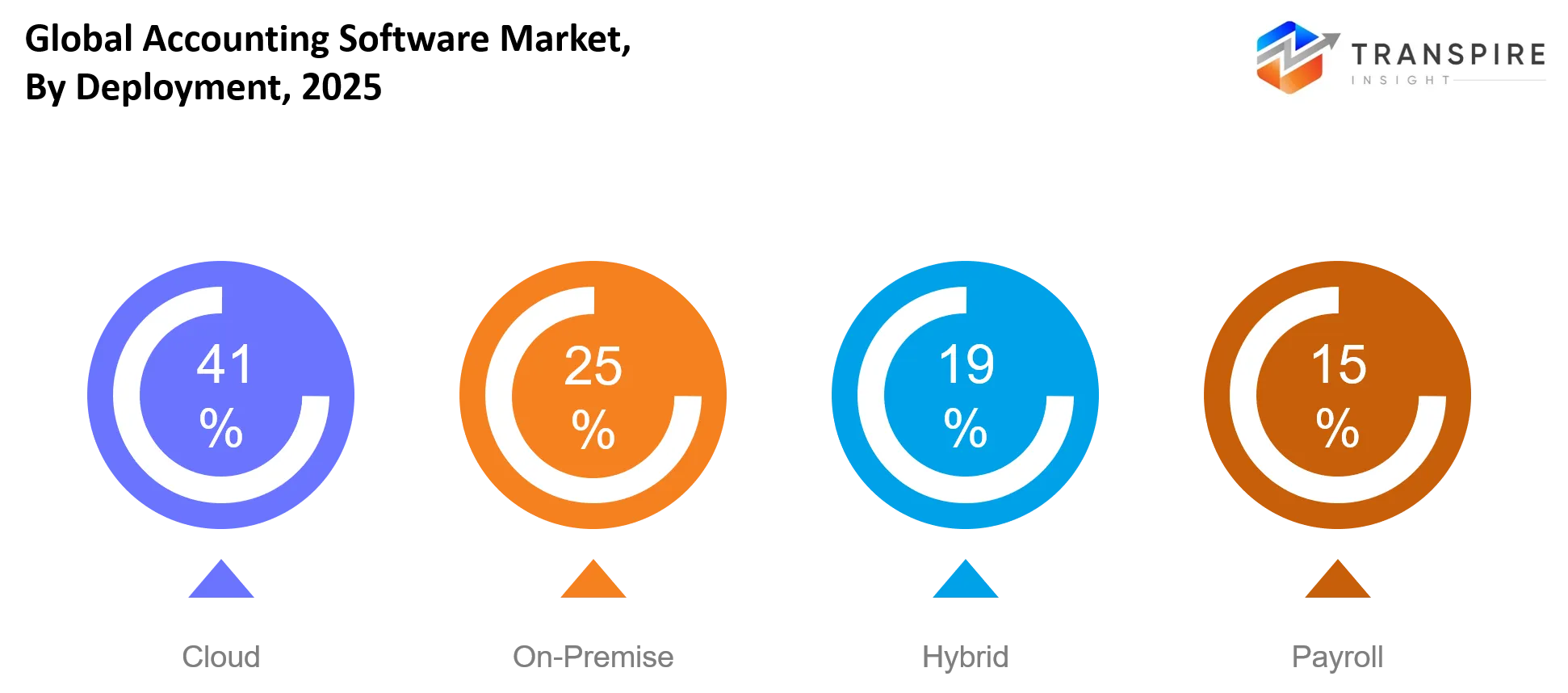
By Application
Payroll is one of the most important applications in the complex, tightly regulated application market, accounting for 15% of the overall market. Their growth drivers include the growth of the gig economy and international hiring, which requires a system of automated calculations for localized taxes, benefits, and international currency conversions. With this technology maturing, payroll will be directly connected with decentralized finance systems and payment wallets that allow workers to access their payroll instantly, instead of waiting for a traditional bi-weekly payroll.
Billing and invoicing apps are the foundation apps in the market, as they sit at the center of the cash inflow for all businesses. Here, the growth focus is on speeding up the order-to-cash cycle with frictionless digital payment links and automated payment reminders, reducing the days in accounts receivable. What the future looks like suggests a world of zero-touch billing where predictive AI manages, generates, and collects payments without human oversight, based on contract milestones.
The market position of tax management applications is quite defensive and non-negotiable due to state and federal regulations that are requirement-driven. Tax modules have a particular expected growth cycle that aligns with the frequent and erratic changes in local tax laws and international requirements, such as e-invoicing or digital VAT filing. Implications for the future are clear: from periodic tax preparation to continuous compliance, corporate tax liabilities are computed dynamically on a transaction-by-transaction basis.
Financial reporting applications are the top strategic market in organisations, converting raw transaction data into executive business intelligence. They have their growth logic built on the business demand for speed, moving from backward-looking summary reports to real-time, boardroom-ready dashboards that show the business's current financial status at a glance. Financial reporting will go beyond descriptive summaries to prescriptive strategy builders in the coming years through the use of generative AI models to perform automated stress tests and provide recommendations for real-time investment changes.
By End- User
SMEs (Small and Medium Enterprises) are the biggest volume market players, and are responsible for the majority of subscription revenue for contemporary SaaS accounting suites. The growth logic of SMEs is based on survival in the business, with the business owners having to perform complex administrative functions using basic financial software without hiring a unit of finance personnel, which is expensive. The possible implication is that the future of advanced corporate finance tools is becoming fully accessible to small storefronts, providing them with the same power in terms of forecasting cash flows that big global businesses enjoy.
Enterprises occupy a high-value, high-complexity market position, which demands huge customized software configurations, from which the whole financial base of the world is dependent. Scalability is the key growth principle for these companies, which requires a multi-currency ledger, internal control, and a strong integration with huge Enterprise Resource Planning (ERP) systems. In the future, enterprise accounting systems will be equipped with autonomous AI agents that will constantly audit the accounts and identify irregularities and errors in the ledger without interfering with regular business operations.
Professional bookkeeping companies and accountants have an influential market position, being the top channel partners and recommenders of the brands of accounting software. The growth plan for this area is a paradigm shift, moving from data entry processors to strategic business consultants, compelling a shift from basic ledger reconciliation to higher-value financial planning as a result of the impact of automation. This will require next-generation accounting software to serve as a central communication and working space, revolutionizing the way advisors and their clients communicate about financial information.
Freelancers and micro-businesses are in a rapidly expanding and mobile market position at the entry point of the software market. This group's growth mantra is simplicity and mobile, meaning people must have rapid tools for tracking expenses related to both their personal and business lives, and also have the ability to issue casual client invoices from a smartphone. The future implication is that personal banking and professional accounting will converge, and the software will automatically categorize the money going into the bank account as business or personal income.
What are the Key Use Cases Driving the Global Accounting Software Market ?
Reducing the monthly close cycle is a key focus of the dominant cloud and integrated platform segments, where core transactional automation is driving the two. The two platforms that are most dominant, cloud and integrated, are focused heavily on reducing the monthly close cycle, and core transactional automation is driving both. These platforms can be used by businesses to streamline their high-volume accounts payable invoicing workflows by using AI capabilities for data extraction and real-time bank reconciliation, which replaces manual bookkeeping with real-time updates to the ledger.
The growing use cases are driving applications beyond their usual realm of strategic operational functions, namely, cross-border payroll logistics and real-time electronic invoicing. With industries under increasing tax demands in global markets, and a non-centralized labour force, the software is used to automatically work out tax compliance in different parts of the world, facilitate international e-filing, and perform instant tax-compliant international vendor payments.
Current use cases are pushing towards predictive intelligence and self-governing financial decisions. AI tools are becoming more widespread in organizations' software and are being used for predictive cash flow forecasting, to create month-end variance explanations automatically, and to carry out continuous internal risk audits, which can spot anomalies before they appear in external reporting.
|
Report Metrics |
Details |
|
Market size value in 2025 |
USD 21.01 Billion |
|
Market size value in 2026 |
USD 22.78 Billion |
|
Revenue forecast in 2033 |
USD 40.12 Billion |
|
Growth rate |
CAGR of 8.42% from 2026 to 2033 |
|
Base year |
2025 |
|
Historical data |
2021 - 2024 |
|
Forecast period |
2026 - 2033 |
|
Report coverage |
Revenue forecast, competitive landscape, growth factors, and trends |
|
Regional scope |
United States; Canada; Mexico; United Kingdom; Germany; France; Italy; Spain; Denmark; Sweden; Norway; China; Japan; India; Australia; South Korea; Thailand; Brazil; Argentina; South Africa; Saudi Arabia; United Arab Emirates |
|
Key company profiled |
Intuit, SAP, Oracle, Microsoft, Xero, Sage, FreshBooks, Zoho, Wave, Tally Solutions, Kashoo, NetSuite, QuickBooks, Epicor, Workday. |
|
Customization scope |
Free report customization (country, regional & segment scope). Avail customized purchase options to meet your exact research needs. |
|
Report Segmentation |
By Deployment (Cloud, On-Premise, Hybrid), By Application (Payroll, Billing, Tax, Financial Reporting), By End-User (SMEs, Enterprises, Accountants, Freelancers). |
Which Regions are Driving the Global Accounting Software Market Growth?
Asia Pacific holds the largest market share of 40% because the region has a strong manufacturing base and rapidly growing industrial activities. Hitachi is the leading company in the Asia-Pacific region. This company is experiencing robust growth. The demand for advanced monitoring systems is growing with the high investment in smart factories, cold chain logistics, and industrial automation in countries like China, India, and Japan. The lower manufacturing costs, large-scale electronics manufacturing, and growing pharmaceutical and food manufacturing in the region are also beneficial. The government's support for digital infrastructure and industrial modernisation further strengthens the market ecosystem in the Asia Pacific region.
Recently, Hitachi launched HMAX solutions. It helps in industrial monitoring, predictive maintenance, and AI-driven automation markets. The launch strengthens Hitachi’s position in industrial monitoring, predictive maintenance, and AI-driven automation markets, supporting the growing demand for advanced monitoring systems across smart factories and industrial operations. In January 2026, Hitachi launched HMAX solutions at CES 2026, introducing AI-powered monitoring and automation technologies for industries, energy infrastructure, smart factories, and transportation systems.
Europe stands as the second-largest regional market with a share of 29% due to its strong regulatory framework and high focus on product quality and safety standards. To automate the business financial work, cash management, and accounting workflow, SAGE has launched AI-powered autonomous agents. This development also shows a larger market trend in Europe where accounting software companies are increasingly integrating AI, automation, and cloud technologies into finance operations. Europe's growth is steady as the market is relatively mature and already has a well-established monitoring infrastructure in various industries, as opposed to the Asia Pacific. However, in countries with stringent environmental and health standards, such as Germany, France, and the United Kingdom, adoption of advanced monitoring technologies is being sustained. The region has a high concentration of stable industries, secure supply chains, and excellent research capabilities, which add to the consistent demand for products.
Some of the leading companies of the European region are SAP, SAGE, and Xero. In February 2026, SAGE launched AI- Powered autonomous agents. It helps businesses run smoothly as it manages all the accounting workflow. In February 2026, Sage launched AI-powered autonomous agents in its Sage Intacct accounting platform. The launch helps businesses automate financial close, cash management, and accounting workflows while improving compliance, audit visibility, and operational efficiency.
North America is the fastest-growing region, expected to expand at a CAGR of 16.7% due to the rising adoption of AI-enabled and cloud-connected monitoring systems. In this region, Intuit, Microsoft Dynamics, and FreshBooks are some of the popular companies. Intuit is known for Intuit QuickBooks, one of the most widely used accounting platforms among SMEs in North America. Pharma cold chain expansion, smart warehousing, and real-time tracking systems are witnessing fast growth in the region, particularly in the United States and Canada. As investments in healthcare technology, logistical management based on data, and automation increase, companies are emerging with new growth opportunities in this market.
Intuit partnered with the company Anthropic to launch customizable AI agents and advanced financial intelligence solutions. The partnership is expected to improve automation, financial analysis, accounting workflows, and AI-driven business management, strengthening Intuit’s position in the Global Accounting Software Market.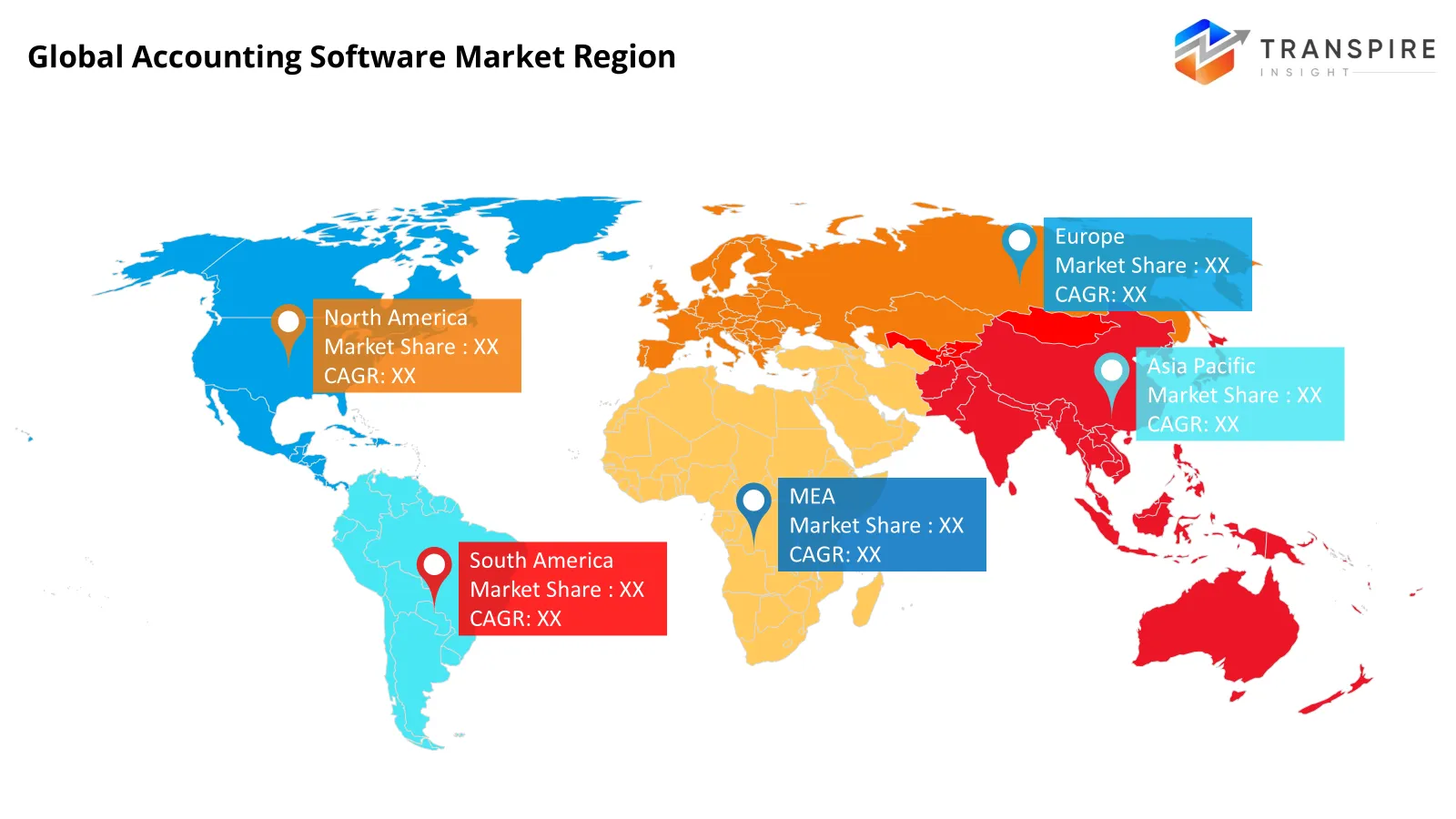
Who are the Key Players in the Global Accounting Software Market and how do they Compete?
The Global Accounting Software Market is highly competitive, offering companies the opportunity to compete for business through cloud technology, integrating AI, costing models, and industry-specific solutions. Large enterprise-focused companies like SAP, Oracle, and Microsoft Fight with sophisticated ERP integration and massive financial management platforms, whereas players like Intuit, Xero, and Zoho are more interested in SMBs and offer them cost-effective cloud ERP solutions. Meanwhile, there's a strong competition in the market for AI-driven automation, real-time analytics, and subscription-based services. Businesses are scaling up across the world in partnerships, acquisitions, fintech integration, and accounting platforms with a mobile-first approach.
Intuit steps up the innovation and ease of use side of the fight, whereas QuickBooks has the focus on SMEs with the AI-powered bookkeeping and payroll automation. SAP is a leader in enterprise-grade compliance and ERP integration, growing with industry-specific cloud solutions. The Oracle Cloud ERP and NetSuite cloud ERP both target mid-sized and large businesses and enhance their presence by broadening their cloud footprint worldwide. Microsoft's approach to competing is by leveraging its wider productivity ecosystem and AI-powered Copilot tools, which work in conjunction with Dynamics 365. At the same time, Xero and Sage are working on user-friendly cloud accounting and flexible subscription models to appeal to the hungry little businesses.
The main advantages of FreshBooks over Wave lie in its affordability and its accounting solutions for freelancers, with Zoho bolstering its standing with its strong integration across its suite of business software. Tally Solutions' emphasis is on compliance-driven accounting software for Indian businesses, and its expansion is by region-specific customization. Epicor and Workday are aimed at manufacturing and enterprise financial management, respectively; Kashoo is geared to small businesses for which the bookkeeping is simpler. The companies stand out for their niche targeting, automation features, customer support, and their ability to integrate AI into financial operations.
Key Global Accounting Software Market Companies
- Intuit
- SAP
- Oracle
- Microsoft
- Xero
- Sage
- FreshBooks
- Zoho
- Wave
- Tally Solutions
- Kashoo
- NetSuite
- QuickBooks
- Epicor
- Workday
Recent Development News
In May 2026, AiAccountant launched an AI-powered accounting platform to provide enterprise-grade finance tools such as automated bookkeeping, GST filings, reconciliation, and real-time financial insights for India’s SMEs. The launch is expected to improve financial automation and operational efficiency for small businesses, while accelerating AI adoption in India’s Global Accounting Software Market .
Source-https://www.moneycontrol.com
What Strategic Insights Define the Future of the Global Accounting Software Market Companies?
The Global Accounting Software Market is shifting towards AI-powered financial automation, cloud-based solutions, and real-time business insights. The future of competition will be more about predictive insights, cybersecurity capabilities, and ecosystem integration with payroll, banking, tax, and ERP systems, and less about the fundamental bookkeeping attribute that any bookkeeping software should have. One risk factor that needs to be addressed in the market is the growing pressure on data privacy and compliance, given that cyberattacks and tougher financial laws might cause a rise in operational expenses and decrease customer confidence in the market. Concurrently, a promising area of opportunity is AI-driven, autonomous accounting solutions that can automate invoicing, expense tracking, tax preparation, and cash flow forecasting for SMEs.
Firms that are still using only traditional accounting functions could face problems in the future as businesses increasingly require intelligent and integrated financial platforms. Automation and robust security, regional compliance support, and industry-specific customization will be key factors to strategic success. AI-driven innovation, mobile capabilities, and smart fintech partnerships should be the key elements for companies to reinforce their long-term market positioning and customer retention.
Temperature Data Logger Market Segmentation
By Deployment
- Cloud
- On-Premise
- Hybrid
By Application
- Payroll
- Billing
- Tax
- Financial Reporting
By End-User
- SMEs
- Enterprises
- Accountants
- Freelancers.
Regional Outlook
North America
- United States
- Canada
- Mexico
Europe
- Germany
- United Kingdom
- France
- Spain
- Italy
- Rest of Europe
Asia Pacific
- Japan
- China
- Australia & New Zealand
- South Korea
- India
- Rest of Asia Pacific
South America
- Brazil
- Argentina
- Rest of South America
Middle East & Africa
- Saudi Arabia
- United Arab Emirates
- South Africa
- Rest of the Middle East & Africa
Frequently Asked Questions
Find quick answers to common questions.
The Approximate Global Accounting Software Market size for the Market will be USD 40.12 Billion in 2033.
Key Segments for the Global Accounting Software Market are By Deployment (Cloud, On-Premise, Hybrid), By Application (Payroll, Billing, Tax, Financial Reporting), By End-User (SMEs, Enterprises, Accountants, Freelancers).
Major Global Accounting Software Market Players are Intuit, SAP, Oracle, Microsoft, Xero, Sage, FreshBooks, Zoho, Wave, Tally Solutions, Kashoo, NetSuite, QuickBooks, Epicor, and Workday.
The Current Global Accounting Software Market size is USD 22.78 Billion in 2026.
The Global Accounting Software Market is expected to grow 8.42% during the forecast period.
- Intuit
- SAP
- Oracle
- Microsoft
- Xero
- Sage
- FreshBooks
- Zoho
- Wave
- Tally Solutions
- Kashoo
- NetSuite
- QuickBooks
- Epicor
- Workday
About the Authors

Mayur Shinde
I am Mayur Shinde, a Senior Research Analyst at Transpire Insight, specializing in the Automotive & Transportation and Information & Communication Technology (ICT) Industry. My work focuses on analyzing emerging market trends, technological advancements, competitive landscapes, and industry developments to deliver accurate, data-driven insights. I am passionate about transforming complex market information into clear, actionable content that helps businesses, professionals, and decision-makers stay informed and make confident strategic decisions.

Chakradhar Khansole
Chakradhar serves as the Research Director at Transpire Insight, bringing over 8 years of experience in technology, innovation, and strategic market intelligence. He specializes in transforming complex market data into actionable business insights that enable organizations to make informed, growth-oriented decisions. Recognized for his strategic vision and analytical expertise, Chakradhar leads high-impact research initiatives, delivering comprehensive market assessments, competitive intelligence, and forward-looking industry analysis.
Recently Published Reports
-
Apr 2026
3D Optical Profiler Market
3D Optical Profiler Market Size, Share & Analysis Report By Type (Desktop 3D Optical Profiler, and Portable 3D Optical Profiler), By Technology (Confocal Technology, and White Light Interference), By End-Use Industry (Manufacturing, Research Institutions, Automotive, Aerospace and Defense, Medical Devices, and Other), and Geography (North America, Europe, Asia-Pacific, Middle East and Africa, South and Central America), 2021 - 2031
-
Apr 2026
Depth Sensor Market
Depth Sensor Market Size, Share & Analysis Report By Type (Infrared Depth Sensors, Time-of-Flight (ToF) Sensors, Stereo Vision Sensors, Structured Light Sensors, Ultrasonic Depth Sensors), By Application (Automotive, Robotics, Gaming, Consumer Electronics, Industrial Automation, Healthcare, Security & Surveillance, Others), By End Users (Automotive Manufacturers, Consumer Electronics Companies, Healthcare Providers, Industrial Companies, Security Agencies, Gaming Companies, Robotics Companies, Others), and Geography (North America, Europe, Asia-Pacific, Middle East and Africa, South and Central America), 2021 – 2031
-
Apr 2026
Digital Manufacturing Market
Digital Manufacturing Market Size, Share & Analysis Report By Component (Hardware, Software, and Services), By Technology (Robotics, 3D Printing, Internet of Things (IoT), and Others), By Application (Automotive and Transportation, Aerospace and Defense, Consumer Electronics, Industrial Machinery, and Others), By Process Type (Computer-Based Designing, Computer-Based Simulation, Computer 3D Visualization, Analytics, and Others), and Geography (North America, Europe, Asia-Pacific, Middle East and Africa, South and Central America), 2021 – 2031
-
Apr 2026
Digital Visa Services Market
Digital Visa Services Market Size, Share & Analysis Report By Type (Individual Travelers, Group Travelers), By Application (Tourism, Business Travel, Others), and Geography (North America, Europe, Asia-Pacific, Middle East and Africa, South and Central America), 2021 – 2031