
Global Business Process-as-a-Service Market Size & Forecast:
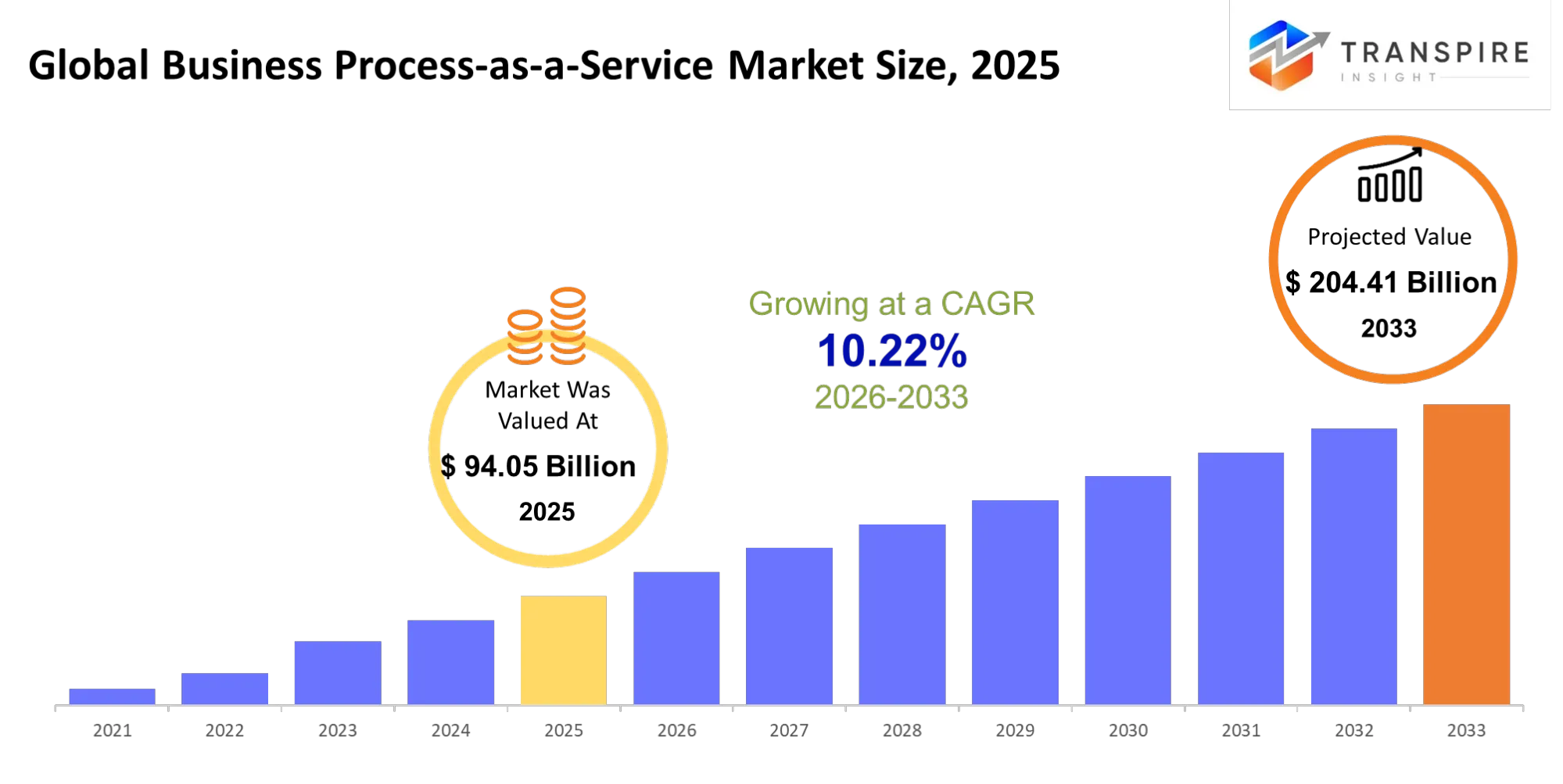
- Global Business Process-as-a-Service Market Size 2025: USD 94.05 Billion
- Global Business Process-as-a-Service Market Size 2033: USD 204.41 Billion
- Global Business Process-as-a-Service Market CAGR: 10.22%
- Global Business Process-as-a-Service Market Segments: By Type (Finance & Accounting BPaaS, HR BPaaS, Customer Service BPaaS, Procurement BPaaS, Supply Chain BPaaS, Industry-specific BPaaS, Others); By Application (Banking & Financial Services, Healthcare, Retail & E-commerce, IT & Telecom, Manufacturing, Others); By End-User (SMEs, Large Enterprises, Government Organizations, Others); By Deployment (Cloud-based BPaaS, Hybrid BPaaS, AI-driven BPaaS Platforms, SaaS-integrated BPaaS, Others).
Global Business Process-as-a-Service Market Summary:
The Global Business Process-as-a-Service Market size is estimated at USD 94.05 billion in 2025 and is anticipated to reach USD 204.41 billion by 2033, growing at a CAGR of 10.22% from 2026 to 2033.
The business process-as-a-service (BPaaS) market refers to the ability for organisations to outsource core business processes and activities, such as financial transactions, purchasing, customer care, logistics, and compliance actions, using digital services provided over the internet. In effect, this market helps businesses to optimise complicated processes more efficiently without having to invest significantly in their own IT infrastructures and operational capabilities. In the past five years, there has been a noticeable transition in the market from a mere cost-saving measure to a powerful means for transforming businesses and creating new value. There has been a major structural change due to the integration of cloud computing technology, workflow intelligence, and service platforms that make business process reengineering easier for flexibility and scalability. Some of the key triggers in the development of the market have been due to the fast-changing landscape, where distributed workspaces are now becoming the norm. There has been a growth in the market for BPaaS due to the need for better execution, visibility, and adaptability of processes.
Key Global Business Process-as-a-Service Market Insights:
Business Process-as-a-Service is progressively moving away from outsourcing economics toward being defined by platform intelligence, industry specialization, and business result accountability. The industry giants are concentrating on AI service ecosystems that help their customers to gain agility, governance, and efficiency.
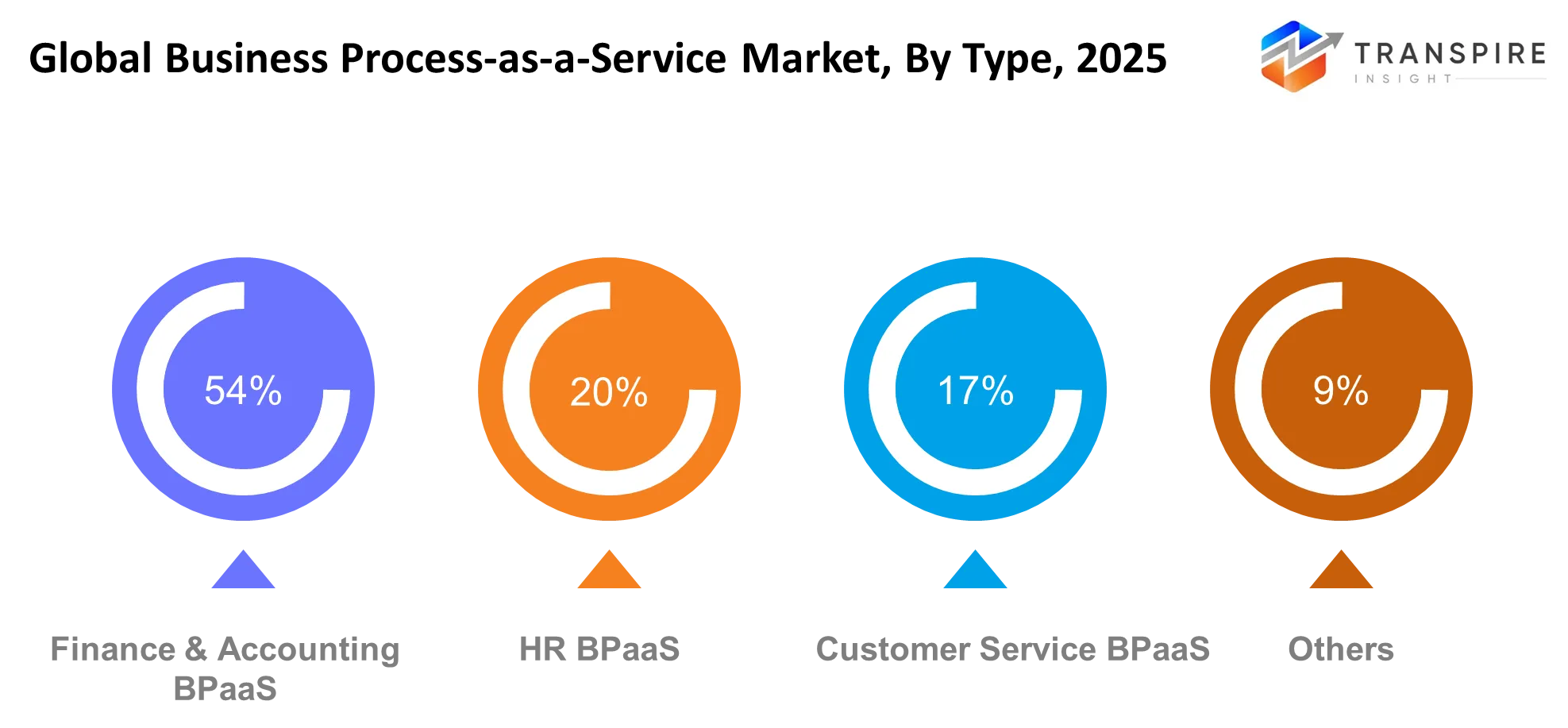
- The market share of Finance & Accounting BPaaS is 54%, and the market leaders, Genpact and EXL, have increased their investment in analytical finance processes.
- North America makes up 40% of the market, where Accenture and IBM are driving integrated cloud operating models to transform their clients.
- HR BPaaS constitutes 20% of market demand, as the leaders Infosys BPM and Wipro are enhancing digital employee life cycle management using intelligent workforce platforms.
- Customer Service BPaaS has a 17% market share, as Cognizant and Capgemini are improving customer retention using experience-oriented service ecosystems.
- Europe makes up 28% of global revenue, led by SAP and Oracle, with process platforms focused on compliance for regulated industries.
- Market share in the Asia Pacific region is 24%, and TCS and NTT Data are improving localisation of services to accelerate business modernisation processes.
- AI-based BPaaS platforms are gaining traction, posting an impressive CAGR of 13.6%, due to investment by HCLTech and DXC Technology in autonomous workflows.
- Large corporations continue to dominate in adoption, and Fujitsu and Capgemini create industry-based BPaaS platforms for functioning in the international market environment.
What are the Key Drivers, Restraints, and Opportunities in the Global Business Process-as-a-Service Market?
Driver:
The rising demand for enterprises to modernise their operating models in the face of cost volatility and workforce restrictions is another significant market growth factor driving the Global Business Process-as-a-Service Market. The catalyst has been the increasing complexity of multi-channel business operations, remote working environments, and the increasing expectations for responsiveness of services. The organisations are leveraging BPaaS platforms to simplify processes, ensure consistent operations, and streamline digital execution without significant infrastructure costs. This change is driving uptake for larger companies and mid-sized businesses, offering service providers the chance for recurring revenue streams with long-term subscription-based contracts.
- In January 2026, AnyMind Group launched a specialised BPaaS solution for cross-border commerce to enable international brands to streamline supply chain and e-commerce workflows, driving scalable OpEx growth.
Source:https://anymindgroup.com/news/press-release/bpaas-cross-border-commerce
Restraint:
Fragmentation of enterprise technology environments is one of the biggest challenges. There are still many organisations with isolated legacy applications, region-specific systems and custom workflows. This structural difficulty continues because changes to the core operational infrastructure take a lot of time, money, and organisation. This can result in deployment time delays and reduced BPaaS value-creation due to implementation complexity.
Opportunity:
The potential of a future opportunity is embedded in industry-specific BPaaS platforms in highly regulated sectors. In the field of health care administration, for example, AI-driven BPaaS can address challenges particular to the industry, paving the way for new possibilities of growth. There is an expected increase in the number of verticalized platforms that will emerge in developing countries in the coming years. Moreover, the rise of sovereign cloud infrastructures and regionally-based data-processing environments will provide additional opportunities for the BPaaS players to serve the compliance needs of the region and grow their customer base.
- In January 2026, HealthEdge launched its 2026 Health Plan Guide to offer AI-powered BPaaS capabilities that help healthcare payers automate claims processing and resolve clinical data management pain points.
What Has the Impact of Artificial Intelligence Been on the Global Business Process-as-a-Service Market?
The Artificial Intelligence in the Global Business Process-as-a-Service Market has led to a complete change in business operations and processes. This has enabled organisations to have not just automated but intelligent execution of processes in areas like claims management, document management, customer service, coordination within the supply chain, and monitoring for compliance requirements. This will enable BPaaS services to provide faster, smarter, and scalable solutions. One of the benefits provided by AI technology is that it has helped BPaaS to achieve process optimisation through the effective execution of intelligent routing of processes, automatic exception handling, and continuous monitoring of process performance. In addition, forecasting demand and detecting potential risks, predicting bottlenecks, and optimising resource management using predictive capabilities are also being achieved through artificial intelligence. In terms of process and service delivery capabilities, AI technology has led to increased efficiency, better service delivery, reduced errors, decreased response time, and improved business continuity through decision support. The challenge faced while implementing AI in the Global Business Process-as-a-Service Market is the difficulty in integrating it with existing legacy systems.
- In May 2026, Adish partnered with the AI customer service firm Fin to offer a comprehensive BPaaS model that integrates advanced AI agents with system implementation and outsourcing. This impact enables businesses to achieve full AI integration without struggling to build backend legacy tools entirely on their own.
Source:https://finance.biggo.com/news/mP6yPp4BDXrLZJaAlD07
Key Global Business Process-as-a-Service Market Trends:
The Global Business Process-as-a-Service Market is undergoing a transition, evolving from a cost-saving measure to an effective tool for transforming businesses. Increasingly, there is a preference for intelligent, adaptive and business outcome-driven process models that offer greater resilience, customer benefits, and business agility.
- There is a shift from transactional outsourcing of services to more outcome-oriented service provision that links provider performance with business results.
- Firms are switching from siloed process management to a digital operating model that provides better control and visibility.
- The requirements for service delivery are slowly changing from providing generalised services to specialised processes tailored to serve the industry.
- Sustainability is fast becoming an important aspect of process performance, which affects procurement strategies.
- Processes are slowly changing from reactive to proactive due to operational intelligence.
- Collaboration has emerged as an important feature, with organisations linking financial management, human resources, procurement, and customer management services.
- Companies are implementing systems that allow them to change processes using low-code and no-code tools, reducing dependency on IT for innovation.
- Service providers have transformed from mere process executioners to becoming advisers to their clients to redesign their operating models.
Global Business Process-as-a-Service Market Segmentation
By Type:
The market is dominated by Finance & Accounting BPaaS, with about 54% share, due to the fact that it manages important and high-volume rules-based processes in the organization. Growth here is driven not just by cost savings but by an increased need for financial visibility, auditability, and effective working capital management. HR BPaaS and Customer Service BPaaS are growing at an increasing rate of adoption, with a market share of around 20% and 17%, respectively. The adoption of these services comes from the increased need to deliver better employee experiences and better customer engagement. Procurement BPaaS, Supply Chain BPaaS, and Industry-Specific BPaaS, among others, are also witnessing significant growth as companies seek process expertise to tackle specific problems faced by each industry.
By Application:
Banking & Financial Services are the biggest segment of the market, mostly driven by risk management and regulatory reasons. The healthcare industry has witnessed significant momentum, driven by administrative efficiency and better patient service coordination. The retail and e-commerce industries use BPaaS to deal with the variability of demand, omnichannel and complex order fulfilment processes. BPaaS in IT & Telecom and Manufacturing industries helps improve consistency and agility of service delivery.
By End-User:
The leading segments for large enterprises are a result of their complexity and need for global process management in the organisation. Large enterprises adopt BPaas using strategies such as standardisation, scalability, and governance within several organisational units. Small and medium enterprises continue taking advantage of BPaaS in order to get services equivalent to those provided by enterprises at reduced infrastructural costs. Government organisations, on the other hand, are beginning to leverage the service in order to modernise their processes in the delivery of services.
By Deployment:
Cloud-based BPaaS services remain dominant due to their ability to offer flexibility, quick implementation, and low capital expenditure. Hybrid BPaaS is continuing to rise in prominence among companies trying to modernize their business through BPaaS while still utilising existing systems in the company. Intelligent BPaaS platforms, which include the AI-driven BPaaS, are experiencing the fastest growth rate in this market at 13.6% CAGR. This is mainly attributed to the rising need for intelligence and predictability in management processes.
What are the Key Use Cases Driving the Global Business Process-as-a-Service Market?
The major driver behind the growth of the BPaaS market is finance and accounting, with organizations adopting cloud-based systems to optimize their processes of accounts payable, accounts receivable, payroll management, and compliance. Such an approach provides cost optimisation, better accuracy, and visibility across enterprises.
Apart from optimising critical business operations, the scope of BPaaS is now increasing in customer support, procurement, and human resources. Organisations are making increasing use of intelligent process automation platforms that help provide employees with better work experience, faster procurement, and better customer support.
The new set of use cases for the market includes process intelligence, sector-specific automation of workflows, and predictive operations. The health care, banking, and retail sectors are adopting the BPaaS offerings to automate their decision-making processes, comply with regulations, and gain real-time insights.
|
Report Metrics |
Details |
|
Market size value in 2025 |
USD 94.05 Billion |
|
Market size value in 2026 |
USD 103.46 Billion |
|
Revenue forecast in 2033 |
USD 204.41 Billion |
|
Growth rate |
CAGR of 10.22% from 2026 to 2033 |
|
Base year |
2025 |
|
Historical data |
2021 - 2024 |
|
Forecast period |
2026 - 2033 |
|
Report coverage |
Revenue forecast, competitive landscape, growth factors, and trends |
|
Regional scope |
United States; Canada; Mexico; United Kingdom; Germany; France; Italy; Spain; Denmark; Sweden; Norway; China; Japan; India; Australia; South Korea; Thailand; Brazil; Argentina; South Africa; Saudi Arabia; United Arab Emirates |
|
Key company profiled |
Accenture, IBM, Cognizant, Capgemini, Infosys BPM, Wipro, TCS, Genpact, HCLTech, Oracle, SAP, Fujitsu, DXC Technology, NTT Data, EXL Service. |
|
Customization scope |
Free report customisation (country, regional & segment scope). Avail customised purchase options to meet your exact research needs. |
|
Report Segmentation |
By Type (Finance & Accounting BPaaS, HR BPaaS, Customer Service BPaaS, Procurement BPaaS, Supply Chain BPaaS, Industry-specific BPaaS, Others); By Application (Banking & Financial Services, Healthcare, Retail & E-commerce, IT & Telecom, Manufacturing, Others); By End-User (SMEs, Large Enterprises, Government Organizations, Others); By Deployment (Cloud-based BPaaS, Hybrid BPaaS, AI-driven BPaaS Platforms, SaaS-integrated BPaaS, Others). |
Which Regions are Driving the Global Business Process-as-a-Service Market Growth?
The North American continent continues to lead the global market of BPaaS and accounts for an estimated 40% of the total revenues. The leadership in the market is driven by a robust cloud infrastructure ecosystem, heavy investments made by enterprises in technologies, and increasing digital operating models across all industrial sectors. Large corporations operating in industries such as banking, healthcare, and retail have continued to make heavy investments in process transformation technologies to boost the productivity and resilience of their operations.
- In April 2026, Wipro announced an expansion of its next-generation BPaaS solutions targeting the financial and insurance sectors. The launch accelerates enterprise adoption of digital operating models by integrating intelligent operations and data to enable faster decision-making.
Europe accounts for about 28% of the global market share and continues to be the second largest regional contributor. In contrast to North America, Europe is characterized by rapid growth driven by the need for regulatory compliance, operational transparency, and standardization of cross-border business operations. Companies are employing the use of BPaaS to handle increasing challenges regarding governance, transparency, and processes.
- In April 2026, HR tech innovators in Europe secured several new growth investments and venture funding to expand compliance-driven HR automation tools. The funding empowered startups to develop standardised software for regional data privacy laws.
Source:https://tech.eu/2026/04/23/wenite-secures-eur18-million-to-power-the-future-of-data-driven-hr/
Asia Pacific has a market share of around 24%, but it is the most rapidly developing segment with a CAGR projection of 14.2%. The recent accelerated development is a result of a fast digital transformation in mid-market companies, cloud computing usage, and investments in technology-based enterprise services. Countries across the segment are improving their digital infrastructure and promoting the modernisation of enterprises via both governmental and corporate initiatives. With organisations trying to build scalable business operations, the Asia Pacific will prove to be a great investment destination for BPaaS vendors entering new markets.
- In April 2026, Tata Consultancy Services (TCS) deepened its ongoing enterprise partnerships across the region. Their pre-configured "ERP on Cloud" platform, delivered through business-process-as-a-service (BPaaS) models, has enabled faster deployment and resilient, scalable processes for expanding mid-market companies.
Source:https://www.tcs.com/what-we-do/products-platforms/tcs-bfsi-platforms
Who are the Key Players in the Global Business Process-as-a-Service Market and how do they Compete?
Business Process-as-a-Service (BPaaS) competition is now driven by business results, industry know-how, and innovations on platforms, not service delivery involving the workforce. Innovations in this domain include AI-based operation management, cloud-native process platforms, and verticalized solutions. In an effort to offer more value to enterprises, companies are vying to provide faster integration, intelligent processes, and flexible operations on a worldwide scale.
Accenture, IBM, Cognizant, and Capgemini compete through innovation. Accenture, for example, is known to differentiate itself through consultancy, automation, and operations management within the framework of a transformation program. On the other hand, IBM excels in hybrid cloud and AI-based processes, while Cognizant specialises in operating functions in different industrial sectors. Regarding Capgemini, their strategy relies on taking advantage of the experience that they get through digital transformation programs. These firms rely on various strategies, including geographical expansion through partnerships, growth in their cloud ecosystems, and acquisitions.
These include Infosys BPM, Wipro, TCS, Genpact, HCLTech, Oracle, SAP, Fujitsu, DXC Technology, NTT Data, and EXL Service, which emphasise scalability and domain-based platform services. Genpact and EXL have analytics-focused process management capabilities, while Oracle and SAP build in their BPaaS functionality within their software suites. On the other hand, TCS, Infosys BPM, Wipro, and HCLTech grow their businesses by means of global delivery centres and specialised offerings for particular industries.
Key Players are:
- Accenture
- IBM
- Cognizant
- Capgemini
- Infosys BPM
- Wipro
- TCS
- Genpact
- HCLTech
- Oracle
- SAP
- Fujitsu
- DXC Technology
- NTT Data
- EXL Service
Recent Development News
- In May 2026, LTM and Uniphore partnered to scale domain-specific AI across core business processes. This enhanced Global Business Process-as-a-Service Market evolution is toward secure, agentic AI workflows with stronger governance and industry-specific intelligence.
Source: https://venturebeat.com
- In April 2026, Infosys launched an upgraded version of its BPM and BPaaS suite with embedded generative AI capabilities. This enabled enterprises to shift toward autonomous, outcome-driven process management and reduced manual intervention significantly.
Source: https://www.infosys.com
What Strategic Insights Define the Future of the Global Business Process-as-a-Service Market?
The Global Business Process-as-a-Service Market solutions are trending towards cloud-native AI ecosystems, where businesses are moving away from outsourced processes to outcome-oriented automation through automation tools. Process workflows will become increasingly composable and will feature API-centric approaches coupled with real-time analytics. The biggest danger in this evolution path is the phenomenon of vendor lock-ins within hyper-automation systems, which could impede any data mobility or lack governance controls. However, there is one huge opportunity in terms of leveraging AI process intelligence where automation not only streamlines processes, but it also anticipates and eliminates bottlenecks, paving the way for new revenue streams through data intelligence. As a strategic option, organisations would benefit from adopting a hybrid Global Business Process-as-a-Service Market approach in which modularity and an API-based architecture work together with a robust governance framework. Those businesses that adopt such a strategy sooner will have a significant competitive edge in agility and faster decision-making.
Key Segmentations are:
By Type
- Finance & Accounting BPaaS
- HR BPaaS
- Customer Service BPaaS
- Procurement BPaaS
- Supply Chain BPaaS
- Industry-specific BPaaS
- Others
By Application
- Banking & Financial Services
- Healthcare
- Retail & E-commerce
- IT & Telecom
- Manufacturing
- Others
By End-User
- SMEs
- Large Enterprises
- Government Organizations
- Others
By Deployment
- Cloud-based BPaaS
- Hybrid BPaaS
- AI-driven BPaaS Platforms
- SaaS-integrated BPaaS
- Others
Regional Outlook
North America
- United States
- Canada
- Mexico
Europe
- Germany
- United Kingdom
- France
- Spain
- Italy
- Rest of Europe
Asia Pacific
- Japan
- China
- Australia & New Zealand
- South Korea
- India
- Rest of Asia Pacific
South America
- Brazil
- Argentina
- Rest of South America
Middle East & Africa
- Saudi Arabia
- United Arab Emirates
- South Africa
- Rest of the Middle East & Africa
Frequently Asked Questions
Find quick answers to common questions.
The Global Business Process-as-a-Service Market size was valued at USD 94.05 billion in 2025 and is poised to reach USD 204.41 billion by 2033, expanding at a 10.22% CAGR.
Key segments for the Global Business Process-as-a-Service Market are By Type (Finance & Accounting BPaaS, HR BPaaS, Customer Service BPaaS, Procurement BPaaS, Supply Chain BPaaS, Industry-specific BPaaS, Others); By Application (Banking & Financial Services, Healthcare, Retail & E-commerce, IT & Telecom, Manufacturing, Others); By End-User (SMEs, Large Enterprises, Government Organizations, Others); By Deployment (Cloud-based BPaaS, Hybrid BPaaS, AI-driven BPaaS Platforms, SaaS-integrated BPaaS, Others).
Growth is primarily driven by the increasing need for cost-efficient business operations, rapid digital transformation, cloud-based process automation, and the demand for scalable solutions that enhance operational agility and service efficiency.
The Global Business Process-as-a-Service Market is led by major manufacturers, including Accenture, IBM, Cognizant, Capgemini, Infosys BPM, Wipro, TCS, Genpact, HCLTech, Oracle, SAP, Fujitsu, DXC Technology, NTT Data, and EXL Service.
North America influences global business process-as-a-service (BPaaS) market dynamics by holding 40% of the market share, supported by widespread cloud adoption, strong digital transformation initiatives, advanced IT infrastructure, high demand for outsourced business processes, and the presence of leading BPaaS providers.
Commercial opportunities in the Global Business Process-as-a-Service Market are expanding through the development of industry-focused AI-enabled solutions, growing adoption in emerging economies, and increasing demand for compliant, region-specific cloud-based business process platforms.
- Accenture
- IBM
- Cognizant
- Capgemini
- Infosys BPM
- Wipro
- TCS
- Genpact
- HCLTech
- Oracle
- SAP
- Fujitsu
- DXC Technology
- NTT Data
- EXL Service
About the Authors

Mayur Shinde
I am Mayur Shinde, a Senior Research Analyst at Transpire Insight, specializing in the Automotive & Transportation and Information & Communication Technology (ICT) Industry. My work focuses on analyzing emerging market trends, technological advancements, competitive landscapes, and industry developments to deliver accurate, data-driven insights. I am passionate about transforming complex market information into clear, actionable content that helps businesses, professionals, and decision-makers stay informed and make confident strategic decisions.

Chakradhar Khansole
Chakradhar serves as the Research Director at Transpire Insight, bringing over 8 years of experience in technology, innovation, and strategic market intelligence. He specializes in transforming complex market data into actionable business insights that enable organizations to make informed, growth-oriented decisions. Recognized for his strategic vision and analytical expertise, Chakradhar leads high-impact research initiatives, delivering comprehensive market assessments, competitive intelligence, and forward-looking industry analysis.
Recently Published Reports
-
Apr 2026
3D Optical Profiler Market
3D Optical Profiler Market Size, Share & Analysis Report By Type (Desktop 3D Optical Profiler, and Portable 3D Optical Profiler), By Technology (Confocal Technology, and White Light Interference), By End-Use Industry (Manufacturing, Research Institutions, Automotive, Aerospace and Defense, Medical Devices, and Other), and Geography (North America, Europe, Asia-Pacific, Middle East and Africa, South and Central America), 2021 - 2031
-
Apr 2026
Depth Sensor Market
Depth Sensor Market Size, Share & Analysis Report By Type (Infrared Depth Sensors, Time-of-Flight (ToF) Sensors, Stereo Vision Sensors, Structured Light Sensors, Ultrasonic Depth Sensors), By Application (Automotive, Robotics, Gaming, Consumer Electronics, Industrial Automation, Healthcare, Security & Surveillance, Others), By End Users (Automotive Manufacturers, Consumer Electronics Companies, Healthcare Providers, Industrial Companies, Security Agencies, Gaming Companies, Robotics Companies, Others), and Geography (North America, Europe, Asia-Pacific, Middle East and Africa, South and Central America), 2021 – 2031
-
Apr 2026
Digital Manufacturing Market
Digital Manufacturing Market Size, Share & Analysis Report By Component (Hardware, Software, and Services), By Technology (Robotics, 3D Printing, Internet of Things (IoT), and Others), By Application (Automotive and Transportation, Aerospace and Defense, Consumer Electronics, Industrial Machinery, and Others), By Process Type (Computer-Based Designing, Computer-Based Simulation, Computer 3D Visualization, Analytics, and Others), and Geography (North America, Europe, Asia-Pacific, Middle East and Africa, South and Central America), 2021 – 2031
-
Apr 2026
Digital Visa Services Market
Digital Visa Services Market Size, Share & Analysis Report By Type (Individual Travelers, Group Travelers), By Application (Tourism, Business Travel, Others), and Geography (North America, Europe, Asia-Pacific, Middle East and Africa, South and Central America), 2021 – 2031