
United States Business Process as a Service (BPaaS) Market Size & Forecast:
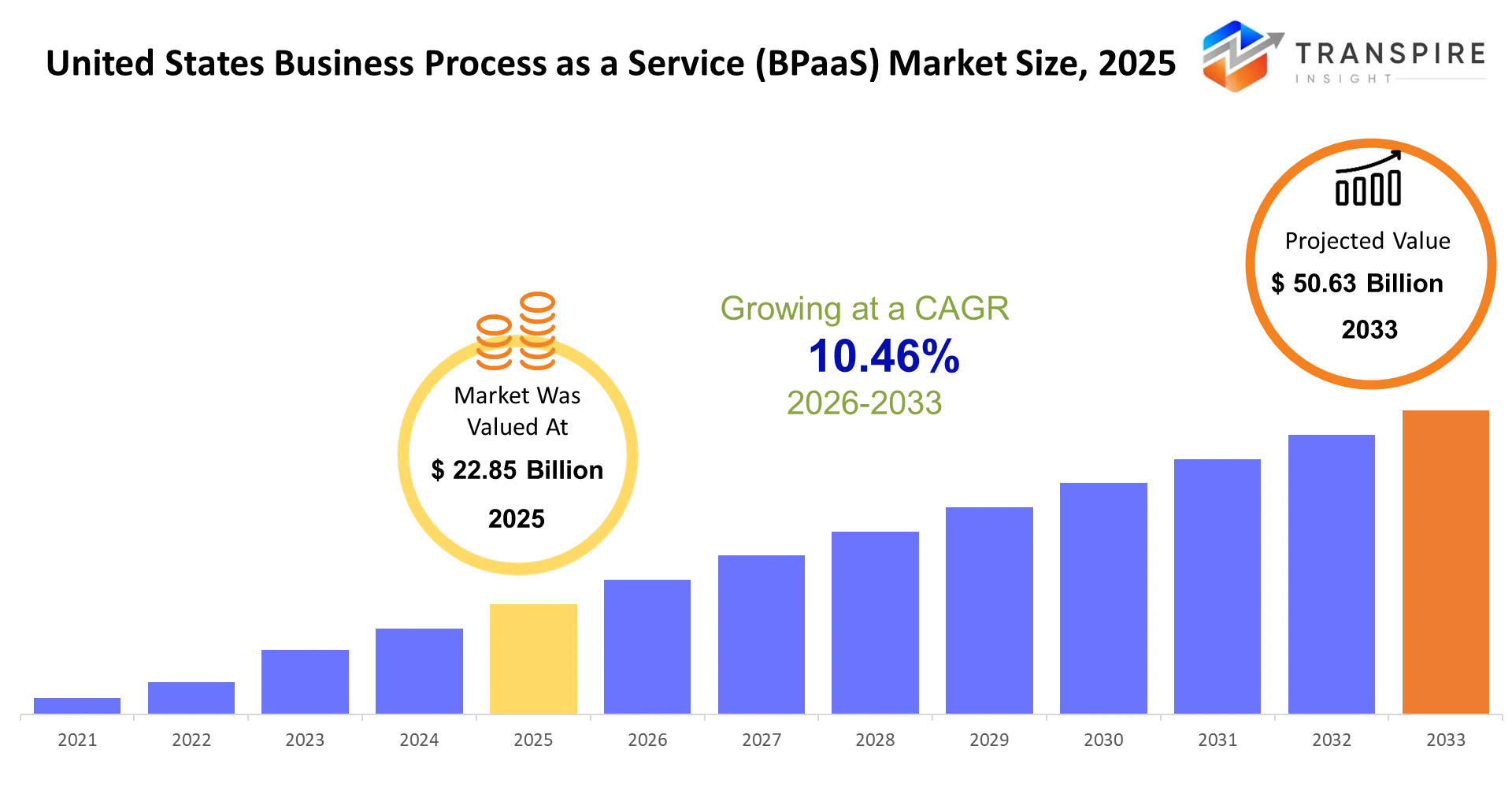
- United States Business Process as a Service (BPaaS) Market Size 2025: USD 22.85 Billion
- United States Business Process as a Service (BPaaS) Market Size 2033: USD 50.63 Billion
- United States Business Process as a Service (BPaaS) Market CAGR: 10.46%
- United States Business Process as a Service (BPaaS) Market Segments: By Type (Finance BPaaS, HR BPaaS, Procurement BPaaS, Customer Service BPaaS, Supply Chain BPaaS, Others); By Deployment (Cloud, On-premises, Hybrid, SaaS, Platforms, Others); By Application (BFSI, Healthcare, Retail, IT, Manufacturing, Others); By End-User (Enterprises, SMEs, Govt, IT Firms, Startups, Others)
To learn more about this report,  Download Free Sample Report
United States Business Process as a Service (BPaaS) Market Summary
The United States Business Process as a Service (BPaaS) Market was valued at USD 22.85 Billion in 2025. It is forecast to reach USD 50.63 Billion by 2033. That is a CAGR of 10.46% over the period.
The United States Business Process as a Service (BPaaS) market has turned into one of those critical operating layers for organizations that need to run complex back-office work without having to build pricey in-house systems. Basically, BPaaS can take care of workflows like finance processing, procurement support for customers, HR administration, and compliance management, all through cloud-based delivery modes. In doing that, companies often lower operational friction, while also boosting speed, and consistency that feels more steady. Over the last five years, the whole market moved away from older labor-arbitrage outsourcing and started leaning more toward AI-enabled, outcome- driven service platforms. These platforms blend automation , analytics, and real-time decision assistance, kind of like a guided engine instead of just extra labor.
This change sped up a lot during the post-pandemic restructuring period, when supply chain instability and workforce disruptions made it obvious how weak fragmented legacy systems can be. Enterprises were then under pressure to keep continuity but with leaner operating models. So, BPaaS adoption shifted from being only a cost- control choice into something closer to a strategic resilience investment. Right now, that same shift is opening up more revenue possibilities for providers that bring industry specific platforms, and can prove measurable process efficiency, regulatory flexibility, and quicker day-to-day execution.
Key Market Insights
- The Northeast region kinda dominates the United States Business Process as a Service (BPaaS) Market, grabbing close to 34% market share in 2025, mostly because there’s a pretty dense cluster of enterprises.
- Meanwhile, the Western United States is the fastest growing regional market through 2032 , pushed by aggressive cloud migration among technology players and digital-first organizations.
- Southern states are also seeing notable share gains, as mid market firms ramp up BPaaS use for things like finance, HR, and customer engagement activities.
- On the solution side, finance and accounting BPaaS is leading, with roughly 29% market share in 2025, which shows the strong need for automated invoice processing and compliance oriented workflows.
- For segments, AI powered customer service BPaaS is set to be the fastest growing between 2026 and 2032, enabled by conversational automation plus predictive service analytics.
- Large enterprise process transformation pretty much leads with around 46% share, as corporations keep pushing for unified cloud operations and company wide workflow visibility.
- Supply chain orchestration applications are, by far, the quickest rising use case too, because after the post 2021 logistics disruption, operational priorities got reworked, and adoption moved fast.
- Procurement automation is showing up with growing demand. Enterprises want near real-time vendor intelligence, plus better contract lifecycle optimization, so the momentum keeps building.
- BFSI takes the top spot in the United States Business Process as a Service (BPaaS) Market with roughly 31% share in 2025, mainly due to tight compliance constraints.
- Healthcare sits as the second largest end-user segment, largely from claims processing automation and digitized patient data workflow management.
What are the Key Drivers, Restraints, and Opportunities in the United States Business Process as a Service (BPaaS) Market?
The strongest force pushing the United States Business Process as a Service (BPaaS) market forward is this enterprise wide swing toward AI enabled operational automation. It really caught steam after the pandemic, because it basically highlighted the financial inefficiency of split back-office setups, plus all those manual, process dependencies. At the same time , cloud infrastructure costs started looking more predictable, and that made outsourced digital process platforms feel financially workable even for mid sized organizations. Right now, companies lean on BPaaS to run claims processing, procurement approvals, payroll administration, and customer support workflows at scale. In practice, this lowers operating costs while also boosting speed and precision, and it expands provider earnings directly through multi year subscription agreements, plus usage based service models.
The biggest structural obstacle still seems to be legacy system integration. A lot of large U.S. enterprises keep using decades old ERP platforms and workflow architectures, they were never actually built for cloud native interoperability. If they want to replace or modernize those systems, it can mean multimillion dollar spending, long migration timelines, and some temporary operational turbulence. That drags adoption down, especially in heavily regulated environments such as banking, and healthcare, where continuity of process is non-negotiable. So, near term market revenue gets suppressed because implementation decisions are repeatedly postponed.
The next big growth chance is in those vertical specific generative AI BPaaS platforms, you know, the ones that just fit. I’m seeing investment ramp up, for things like healthcare claims automation , financial compliance monitoring, and legal document processing, all of it. And as enterprise trust in domain trained AI models keeps getting better, the providers that ship really specialized process intelligence are the ones that’ll get picked faster. They should also be able to sign premium value contracts, especially across those underserved mid market segments where the demand is kinda there but the options are fewer.
What Has the Impact of Artificial Intelligence Been on the United States Business Process as a Service (BPaaS) Market?
Artificial intelligence and advanced digital technologies are really starting to shift the way Business Process as a Service platforms run across U.S. enterprises, in practice it’s like process execution moves away from strict rules-based automation, and goes toward intelligent decision orchestration, kind of more fluid. AI-powered robotic process automation is now managing invoice reconciliation, claims validation, procurement approvals, and handling customer query resolution with pretty minimal human intervention. As a result, many high-volume workflows see processing times shrink by something like 40% to 60% which is not small. Also, advanced control systems that are embedded inside the service delivery platforms keep watching process health all the time, then they flag anomalies and automatically reroute workloads so compliance stays intact with both internal service-level agreements and external regulatory standards.
Then machine learning models are adding predictive power too. Providers look at historical workflow data to forecast processing bottlenecks, they can detect fraud patterns, improve resource allocation, and even anticipate compliance risks before they turn into operational disruption. In financial services and healthcare administration, predictive analytics has helped workflow uptime, while at the same time cutting error correction costs by double-digit percentages. Put together, these abilities help enterprises keep operations more continuous, reduce labor-heavy overhead, and speed up response across distributed business functions.
Still, there’s a big limitation that keeps coming up, integration complexity. A lot of enterprises continue relying on legacy ERP and process management systems that end up producing fragmented or low-quality data. When AI models get trained on inconsistent datasets, prediction accuracy drops, and often expensive middleware investments become necessary, which then slows deployment timelines and basically limits the full operational value of intelligent process automation overall.
Key Market Trends
- Since 2022, over 60% of big U.S. companies have, more or less, leaned their BPaaS checks toward AI-enabled workflow orchestration, instead of the old style transaction outsourcing contracts.
- After the post pandemic reshuffle providers like Accenture and Genpact started pushing outcome driven pricing models, swapping fixed volume service agreements across enterprise clients , and honestly it looks more “results first” now.
- From 2021 to 2025, robotic process automation within finance BPaaS environments climbed by nearly 35% , which has cut down reliance on manual invoice processing.
- Meanwhile regulatory attention around financial reporting and healthcare claims has nudged buyers toward compliance-first platforms, with built in audit trails and automated exception handling.
- Mid-market adoption picked up speed once cloud implementation costs fell by almost 20% since 2020 , so enterprise grade process automation became more than just a big company luxury.
- In 2024, generative AI pilots moved from “try it” mode into real operations, with providers embedding intelligent document processing into both claims and procurement workflows.
- Also vendor rivalry has shifted away from offshore labor size, and toward proprietary AI assets, so players like IBM and Cognizant are going deeper into platform specialization.
- At the same time demand for stand-alone HR and payroll BPaaS tools has softened, because enterprises keep consolidating vendors into one multi-process cloud setup.
- Finally, strategic partnerships with hyperscale cloud providers grew pretty sharply after 2023, helping shorten deployment cycles, and trimming enterprise onboarding timelines by around 30% .
United States Business Process as a Service (BPaaS) Market Segmentation
By Type:
Finance BPaaS, supports stuff like accounting, payroll processing, and compliance management using automated workflows that cut down on manual work and, in turn, help reporting come out more accurate. Lately there’s also more pressure on companies to keep costs under control while they speed up day to day operations. So the demand for these solutions has been rising across different industries in the United States, and it’s tied to the Business Process as a Service (BPaaS) Market.
HR BPaaS usually handles talent acquisition, employee record maintenance, payroll support, and workforce analytics. Procurement BPaaS improves supplier coordination, and it refines purchasing workflows too. Customer Service BPaaS strengthens consumer engagement with automated support systems, while Supply Chain BPaaS helps boost inventory visibility, and logistics coordination. Other categories keep expanding as companies look for more flexible process outsourcing for specific operational needs, like narrow use cases or targeted back office tasks.
By Deployment:
Cloud deployment still seems to be the default choice because cloud systems make access easier, require less infrastructure spending, and can be rolled out faster—especially for organizations dealing with large volumes of process activity. Businesses keep moving in this direction to improve scalability and keep workflow access steady across distributed work setups in the United States Business Process as a Service (BPaaS) Market.
On-premises deployment still pulls in organizations that want firmer control over operational data and their internal systems. Hybrid deployment, meanwhile, feels like a middle ground between flexibility and security. With hybrid, businesses can manage selected processes internally, while outsourcing the rest. Also, SaaS and platform style models are still growing, because providers bring ready-to-use process solutions that cut setup time and help organizations run more efficiently.
By Application:
BFSI is still a pretty solid application area , mainly because companies have a growing need for secure transaction handling, regulatory reporting, and also more automated customer support. Healthcare organizations lean on BPaaS for claims processing , billing systems and patient record management, yes. Retail companies keep moving toward service-based process management, to make customer interactions feel smoother, and to streamline supply operations at the same time.
In IT and manufacturing these services help a lot with workflow management, procurement efficiency and resource planning. Manufacturing firms get smoother production coordination, while IT companies rely on BPaaS to run the repetitive operational tasks without the usual hassle. And other sectors keep jumping in too, because automation and process optimization are now close to mandatory if they want business continuity and fewer operational delays.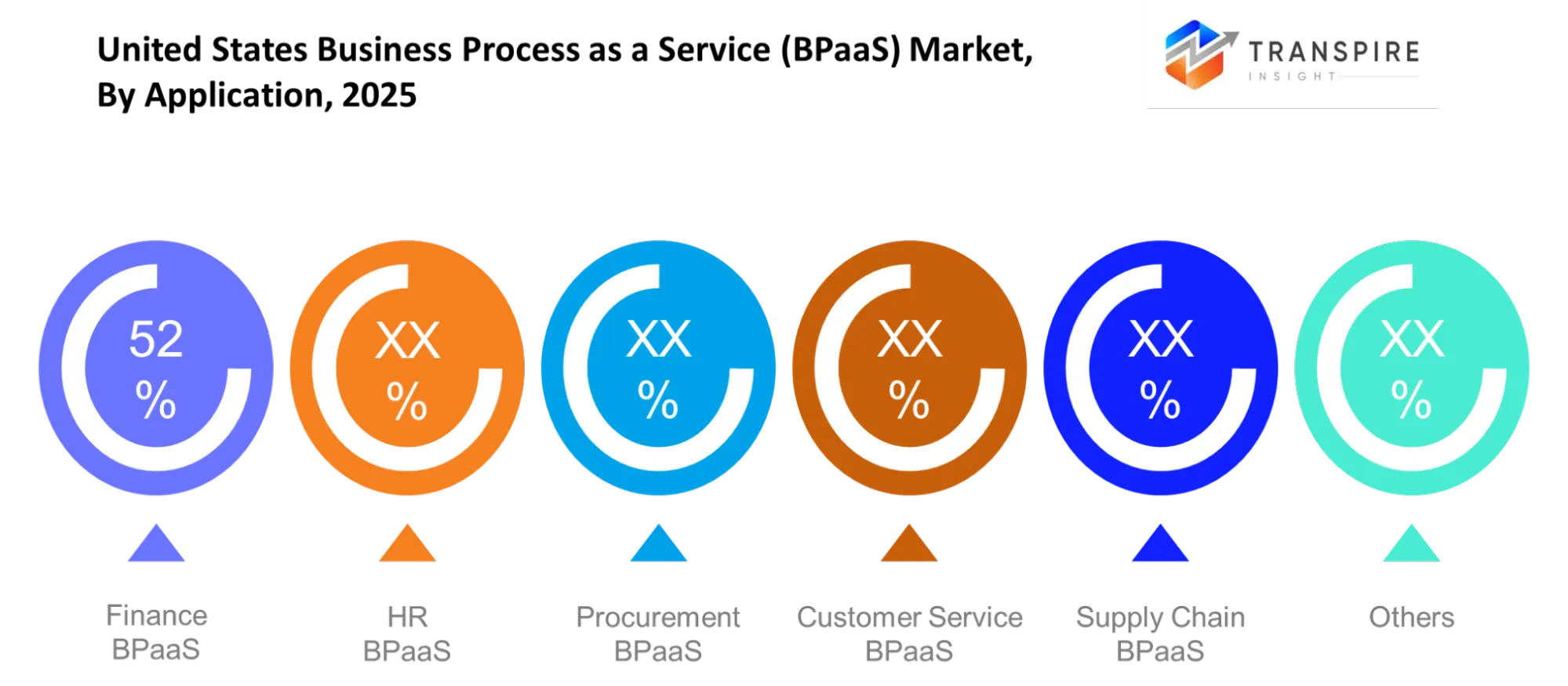
To learn more about this report, Download Free Sample Report
By End-User:
Big enterprises typically lead adoption because when operations are large , you really need strong process standardization , advanced analytics, and continuous workflow monitoring. A lot of those organizations pay for full-service BPaaS models so operations stay consistent across multiple business units , while also cutting down on the administrative weight. All of this is happening alongside the United States Business Process as a Service (BPaaS) Market momentum.
SMEs are also increasingly adopting these services, largely because affordable subscription based models make advanced process management available , without forcing huge infrastructure spending. Government organizations use BPaaS to boost administrative efficiency , and improve the way services get delivered. Meanwhile IT firms and startups show up as well, since outsourced process solutions let them scale faster, keep operational complexity lower, and stay more focused on innovation-driven business development.
What are the Key Use Cases Driving the United States Business Process as a Service (BPaaS) Market?
Finance and accounting automation stays the biggest BPaaS use case across U.S. enterprises, at least for now. Big banks, insurers, and healthcare payers lean on outsourced cloud processing for accounts payable, claims validation, reconciliation, and compliance reporting, because these chores carry huge transaction volumes and they have strict accuracy needs so, basically no wiggle room.
Then there are the nearby applications that are moving fast, kind of like they’re overlapping in practice. Human resources and customer service operations are getting more attention. Retail and e-commerce brands are using BPaaS platforms for payroll administration, workforce scheduling, and benefits processing, while telecom and healthcare providers roll out smart service desks that handle customer interactions and case resolution.
Newer use cases are starting to cluster around AI-driven legal workflow automation and predictive procurement orchestration. Financial institutions are piloting contract intelligence platforms that spot compliance risks in real time, and manufacturing companies are testing predictive sourcing systems that foresee supplier disruptions, before they can impact production continuity .
|
Report Metrics |
Details |
|
Market size value in 2025 |
USD 22.85 Billion |
|
Market size value in 2026 |
USD 25.24 Billion |
|
Revenue forecast in 2033 |
USD 50.63 Billion |
|
Growth rate |
CAGR of 10.46% from 2026 to 2033 |
|
Base year |
2025 |
|
Historical data |
2021 - 2024 |
|
Forecast period |
2026 - 2033 |
|
Report coverage |
Revenue forecast, competitive landscape, growth factors, and trends |
|
Geographic scope |
United States of America |
|
Key company profiled |
Accenture, IBM, Cognizant, TCS, Infosys, Wipro, Capgemini, Genpact, DXC Technology, Oracle, SAP, Microsoft, ADP, Workday, Conduent |
|
Customization scope |
Free report customization (country, regional & segment scope). Avail customized purchase options to meet your exact research needs. |
|
Report Segmentation |
By Type (Finance BPaaS, HR BPaaS, Procurement BPaaS, Customer Service BPaaS, Supply Chain BPaaS, Others); By Deployment (Cloud, On-premises, Hybrid, SaaS, Platforms, Others); By Application (BFSI, Healthcare, Retail, IT, Manufacturing, Others); By End-User (Enterprises, SMEs, Govt, IT Firms, Startups, Others) |
Which Regions are Driving the United States Business Process as a Service (BPaaS) Market Growth?
The Northeast still feels like the major regional market for Business Process as a Service in the United States, mainly because it keeps the largest cluster of financial institutions, insurance providers, and multinational corporate headquarters around. There is also strong regulatory monitoring in places like New York and Massachusetts, and that has kind of pushed companies into using very structured digital process platforms that can help with compliance and audit readiness, pretty directly. On top of that, the region gets a strong advantage from a fairly mature cloud infrastructure landscape supported by hyperscale data centers, capable cybersecurity providers, and a lot of consulting know-how. And since global service integrators plus enterprise software vendors are already here, the whole BPaaS ecosystem tends to roll out complicated deployments quicker, then keeps producing stable contract value over time.
The Midwest, meanwhile, shows up as the second most meaningful regional contributor, but that impact feels more about operational steadiness than heavy enterprise density. Manufacturing, logistics, and healthcare networks across states like Illinois, Ohio, and Minnesota have kept putting money into process modernization, aiming for stronger resilience and better cost efficiency. In contrast with the Northeast, where regulatory complexity often becomes the main trigger, Midwest firms tend to favor workflow standardization and protect long term operating margins. This more practical investment style leads to dependable recurring demand, so the region becomes a pretty steady revenue base for established providers.
The Western United States is becoming the fastest-grow regional market, spurred by that accelerated digital transformation across technology, retail, and platform service businesses ( kind of ). Since 2023, enterprise investment in AI-native automation across California, Washington, and Texas has scaled up quickly, as cloud migration programs got more mature. Because of this, there’s now solid demand for flexible BPaaS platforms that can weave in advanced analytics and generative AI abilities. For the market folks who want to enter, plus the investors , this area shows the best upside through 2033, as innovation cycles tend to move faster and enterprise buyers are more open to adopting next generation operating models.
Who are the Key Players in the United States Business Process as a Service (BPaaS) Market and How Do They Compete?
The competitive terrain of the United States Business Process as a Service market is, in practice, moderately consolidated. A few global consulting and digital transformation firms hold a solid slice of enterprise agreements, while specialized automation providers still push back on the older service templates. The overall fight has moved, almost decisively, away from labor-cost arbitrage, and now it’s more about AI integration, platform interoperability, and delivering business results you can actually measure. The incumbents defend their footing by weaving intelligent automation straight into the service delivery platforms, and meanwhile newer players go after narrow workflow areas, like healthcare claims handling and financial compliance automation.
Accenture shows up with broad enterprise transformation muscle, plus the ability to stitch advisory work together with scalable automation rollouts. What sets it apart is how it folds proprietary AI frameworks into complicated, multi-process contracts. That helps clients step from legacy outsourcing toward predictive operations management. Ongoing strategic cloud partnerships also seem to reinforce its standing in heavily regulated areas.
IBM leans into hybrid cloud process orchestration, running an AI-driven automation stack for firms that insist on strong data governance. Genpact differentiates with domain-focused process intelligence, especially across banking and insurance workflows. Cognizant is expanding through focused acquisitions and industry-tailored BPaaS accelerators, while Capgemini is putting serious investment into generative AI enabled process redesign. The intent there is to win higher-value modernization deals across large enterprises.
Company List
- Accenture
- IBM
- Cognizant
- TCS
- Infosys
- Wipro
- Capgemini
- Genpact
- DXC Technology
- Oracle
- SAP
- Microsoft
- ADP
- Workday
- Conduent
Recent Development News
In May 2026, ServiceNow launched Workflow Data Network and expanded its partner ecosystem with integrated data-governance capabilities, strengthening AI-enabled BPaaS delivery across enterprise operations and accelerating cloud-native process automation adoption in the United States market. Source https://newsroom.servicenow.com/
In May 2026, Boomi entered a partnership with ServiceNow as a launch partner for the Workflow Data Network Passport Program. The collaboration enhances enterprise-wide data activation and strengthens BPaaS interoperability by enabling unified workflow orchestration and faster AI-driven business process execution. Source https://boomi.com/
What Strategic Insights Define the Future of the United States Business Process as a Service (BPaaS) Market?
Over the next five to seven years, the United States Business Process as a Service market is kind of structurally moving toward autonomous process ecosystems where AI agents will manage, optimize and continuously refine business workflows with minimal human intervention. This shift will be driven by enterprise pressure to pull measurable productivity gains out of digital transformation investments, not just digitize old school operations. Providers that can blend domain-specific knowledge with real-time orchestration capabilities will pull in disproportionate value, because enterprises are pushing for outcome-based operating models.
A quieter risk is how the market can slowly concentrate around a small group of hyperscale cloud and AI infrastructure providers. As BPaaS platforms get more dependent on proprietary large language models, and on cloud-native ecosystems, some service providers may see margin compression, plus less differentiation, if infrastructure costs climb or if platform dependencies deepen.
One emerging opportunity sits in sector-specific compliance automation for mid-market healthcare and regional financial institutions, where regulatory complexity is increasing but internal automation maturity is still pretty limited. Market participants should invest now in modular, API-first BPaaS architectures, so they can integrate third-party AI capabilities without falling into vendor lock-in. That way they are positioned to adapt quickly too as enterprise procurement shifts toward interoperability-driven buying decisions.
United States Business Process as a Service (BPaaS) Market Report Segmentation
By Type
- Finance BPaaS
- HR BPaaS
- Procurement BPaaS
- Customer Service BPaaS
- Supply Chain BPaaS
By Deployment
- Cloud
- On-premises
- Hybrid
- SaaS
- Platforms
By Application
- BFSI
- Healthcare
- Retail
- IT
- Manufacturing
By End-User
- Enterprises
- SMEs
- Govt
- IT Firms
- Startups
Frequently Asked Questions
Find quick answers to common questions.
The United States Business Process as a Service (BPaaS) Market size is USD 50.63 Billion in 2033.
Key Segments for the United States Business Process as a Service (BPaaS) Market are By Type (Finance BPaaS, HR BPaaS, Procurement BPaaS, Customer Service BPaaS, Supply Chain BPaaS, Others); By Deployment (Cloud, On-premises, Hybrid, SaaS, Platforms, Others); By Application (BFSI, Healthcare, Retail, IT, Manufacturing, Others); By End-User (Enterprises, SMEs, Govt, IT Firms, Startups, Others).
Major United States Business Process as a Service (BPaaS) Market Players are Accenture, IBM, Cognizant, TCS, Infosys, Wipro, Capgemini, Genpact, DXC Technology, Oracle, SAP, Microsoft, ADP, Workday, Conduent.
The United States Business Process as a Service (BPaaS) Market size is USD 22.85 Billion in 2025.
The United States Business Process as a Service (BPaaS) Market CAGR is 10.46% from 2026 to 2033.
- Accenture
- IBM
- Cognizant
- TCS
- Infosys
- Wipro
- Capgemini
- Genpact
- DXC Technology
- Oracle
- SAP
- Microsoft
- ADP
- Workday
- Conduent
Recently Published Reports
-
Apr 2026
3D Optical Profiler Market
3D Optical Profiler Market Size, Share & Analysis Report By Type (Desktop 3D Optical Profiler, and Portable 3D Optical Profiler), By Technology (Confocal Technology, and White Light Interference), By End-Use Industry (Manufacturing, Research Institutions, Automotive, Aerospace and Defense, Medical Devices, and Other), and Geography (North America, Europe, Asia-Pacific, Middle East and Africa, South and Central America), 2021 - 2031
-
Apr 2026
Depth Sensor Market
Depth Sensor Market Size, Share & Analysis Report By Type (Infrared Depth Sensors, Time-of-Flight (ToF) Sensors, Stereo Vision Sensors, Structured Light Sensors, Ultrasonic Depth Sensors), By Application (Automotive, Robotics, Gaming, Consumer Electronics, Industrial Automation, Healthcare, Security & Surveillance, Others), By End Users (Automotive Manufacturers, Consumer Electronics Companies, Healthcare Providers, Industrial Companies, Security Agencies, Gaming Companies, Robotics Companies, Others), and Geography (North America, Europe, Asia-Pacific, Middle East and Africa, South and Central America), 2021 – 2031
-
Apr 2026
Digital Manufacturing Market
Digital Manufacturing Market Size, Share & Analysis Report By Component (Hardware, Software, and Services), By Technology (Robotics, 3D Printing, Internet of Things (IoT), and Others), By Application (Automotive and Transportation, Aerospace and Defense, Consumer Electronics, Industrial Machinery, and Others), By Process Type (Computer-Based Designing, Computer-Based Simulation, Computer 3D Visualization, Analytics, and Others), and Geography (North America, Europe, Asia-Pacific, Middle East and Africa, South and Central America), 2021 – 2031
-
Apr 2026
Digital Visa Services Market
Digital Visa Services Market Size, Share & Analysis Report By Type (Individual Travelers, Group Travelers), By Application (Tourism, Business Travel, Others), and Geography (North America, Europe, Asia-Pacific, Middle East and Africa, South and Central America), 2021 – 2031