
France Cloud Computing Market Size & Forecast:
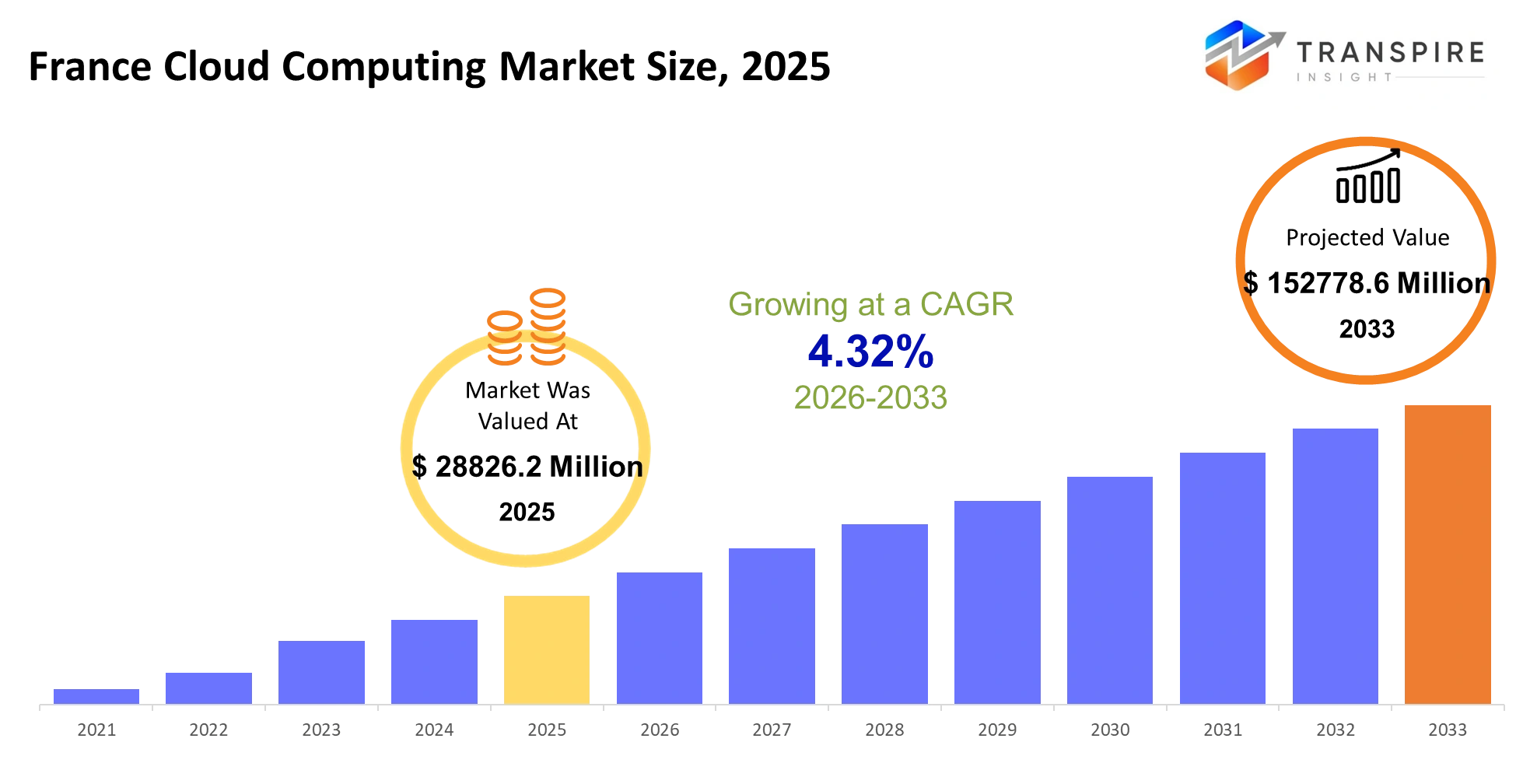
- France Cloud Computing Market Size 2025: USD 28826.2 Million
- France Cloud Computing Market Size 2033: USD 152778.6 Million
- France Cloud Computing Market CAGR: 4.32%
- France Cloud Computing Market Segments: By Type (Public Cloud, Private Cloud, Hybrid Cloud, Multi-cloud, Others); By Application (Data Storage, Disaster Recovery, Application Hosting, Big Data Analytics, AI & ML, Others); By End-User (Enterprises, SMEs, BFSI, Healthcare, IT & Telecom, Government, Others); By Service Model (IaaS, PaaS, SaaS, Others).
To learn more about this report,  Download Free Sample Report
France Cloud Computing Market Summary
The France Cloud Computing Market was valued at USD 28826.2 Million in 2025. It is forecast to reach USD 152778.6 Million by 2033. That is a CAGR of 4.32% over the period.
The France Cloud Computing Market kinda delivers the whole digital backing that helps companies, government offices, manufacturers, banking entities , and hospitals store their information, run applications, and oversee daily ops without having to depend only on local, on-site servers. A lot of organizations go to these cloud platforms to push up scalability, keep remote work moving, speed up software rollouts, and then handle huge chunks of operational data in real time, basically without delays. In the last five years, the market seems to have moved away from simple “just storage” style adoption toward AI-enabled hybrid and multi-cloud setups. These newer environments are more tuned for heavy data workloads , and also for cybersecurity resilience and that kind of protection.
On top of that, European data sovereignty rules plus tougher digital compliance expectations made many firms lean harder into regional cloud hosting, and choose trusted infrastructure providers. Also, the pandemic made remote work patterns more normal and it boosted enterprise digitization projects which, in practice, raised demand for scalable computing capacity in a lasting way. Right now, cloud adoption ties directly into quicker product development, reduced infrastructure spending, and better operational flexibility so enterprises end up increasing long-term budgets for managed cloud services and more advanced analytics platforms.
Key Market Insights
- Northern France is basically dominating the France Cloud Computing Market, with about 41% share, mostly because Paris-based enterprise IT infrastructure and the heavy concentration of hyperscale data centers kinda pull everything together.
- Western France looks like the fastest mover through 2033, driven by how regional enterprises pushed harder on digital transformation and cloud migration initiatives, over the last period and onwards.
- When it comes to service models , Infrastructure-as-a-Service leads with more than 38% market share, mainly because companies want scalable computing and also pretty flexible storage control features.
- Platform-as-a-Service still holds the second biggest slice, as software developers keep increasing the release of cloud-native applications and AI powered analytics workspaces.
- Software-as-a-Service is set to grow the quickest through 2033, fueled by the continued rise in enterprise demand for subscription style business tools.
- For applications, data storage plus disaster recovery take the lead in revenue, because financial services providers and healthcare organizations need uninterrupted operational resilience, without much delay.
- In application categories , AI workload management and edge computing are the fastest-growing, since organizations are handling larger streams of real-time operational information.
- BFSI stays in the top end-user segment, close to 30% share, largely because banks push secure digital banking infrastructure and regulatory compliance systems.
- Healthcare and manufacturing are also ramping up cloud spending quickly, to support connected operations, predictive analytics, and remote monitoring platforms that actually work in practice.
- And finally, strategic partnerships between telecom operators and hyperscale providers helped speed up the deployment of low-latency cloud setups, plus whole edge computing ecosystems.
What are the Key Drivers, Restraints, and Opportunities in the France Cloud Computing Market?
The strongest driver shaping the France Cloud Computing Market is this pretty fast shift by enterprises toward AI-enabled digital operations plus hybrid work infrastructure. Big organizations sped up migration from their older on-premise setups once remote work models showed the real limitations in traditional IT during the pandemic. Financial institutions, manufacturers, and retailers are now using cloud infrastructure more often because cloud-native systems help with scalability, they lower hardware dependency, and they also enable real-time analytics across distributed operations. So in practice this movement boosted recurring revenue for managed cloud providers, cybersecurity vendors , and enterprise software platforms too.
Still, data sovereignty and cybersecurity concerns are the biggest kind of structural hurdle, which kinda slows down broader adoption. French companies in banking, healthcare, and public administration are dealing with strict compliance rules about data localization and even third-party cloud access. Moving sensitive workloads is not simple, it usually needs serious spending on encryption, compliance auditing, and secure multi-cloud architecture. Also a lot of mid-sized organizations tend to postpone migration because swapping legacy infrastructure and retraining internal IT teams carries high long-term operational costs, plus there’s real technical complexity involved.
There is a major long-term opportunity around sovereign AI cloud infrastructure. France, and honestly the wider European Union too, are backing these regional cloud eco systems, more and more, to lessen dependence on foreign hyperscale providers. Lately the money is moving fast into AI centered data centers, plus edge computing networks, and low latency cloud infrastructure. You see this expanding across industrial, and research clusters .
What Has the Impact of Artificial Intelligence Been on the France Cloud Computing Market?
Artificial intelligence has really reshaped cloud infrastructure management, enterprise analytics, and operational automation across the French cloud computing ecosystem, kinda at once. Cloud providers now use AI driven orchestration systems more and more, to automate workload balancing, cyber security monitoring, server optimization, and energy management across hyperscale data centers. Machine learning models keep analyzing infrastructure performance all the time so they can forecast hardware failures, lower the downtime risk, and adjust computing resource allocation in real time , even when conditions shift fast.
Also AI powered predictive analytics platforms support more advanced business apps in banking, manufacturing, retail, and healthcare. For example financial institutions use cloud based AI engines to detect fraudulent transactions and to automate risk analysis, while manufacturers deploy predictive maintenance systems that watch industrial equipment behavior via connected sensors. Healthcare providers increasingly lean on AI enabled cloud infrastructure for medical imaging analysis plus remote patient monitoring systems.
In practice these capabilities improve operational efficiency , help uptime reliability stay strong and reduce infrastructure management costs, thanks to automation and more optimized resource consumption.On the operational side, teams get faster application deployment cycles, less server maintenance work, and a stronger cybersecurity response capability. Still, AI integration remains limited by big computing costs, data governance constraints, and a shortage of advanced cloud engineering talent. A lot of enterprises have trouble training highly effective AI models because fragmented data environments and compliance obligations make it hard to access large-scale operational datasets, and even when data is available it often isn’t in the right format.
Key Market Trends
- In 2022 , French companies moved faster away from old legacy servers toward hybrid cloud setups to get more operational flexibility, and also better disaster recovery resilience. Kind of like, less friction later when something goes wrong.
- Sovereign cloud spending really picked up a lot once European data localization rules became stricter, so compliance expectations for public and regulated industry workloads got tougher.
- From around 2023 until 2025 , AI-driven cloud optimization platforms started seeing more momentum. Enterprises automated balancing of workloads , plus cybersecurity monitoring roles, and that seemed to help adoption.
- Financial organizations then leaned harder into secure multi-cloud environments so they would not rely too much on only one infrastructure supplier, and so they could also meet regulatory compliance better.
- In manufacturing, firms expanded edge computing rollouts to support predictive maintenance systems and real-time industrial analytics across their connected sites. This felt very incremental but steady.
- Telecom operators also teamed up with hyperscale providers, aiming to improve low latency cloud infrastructure, especially for 5G-enabled enterprise applications.
- Healthcare groups shifted larger portions of workloads toward cloud-native platforms for medical imaging analytics and remote patient monitoring systems, essentially moving toward more elastic processing.
- Sustainability targets pushed data center operators to switch to energy-efficient cooling systems and renewable-powered cloud infrastructure after 2024, because power use became a bigger pressure.
- At the same time , regional cloud providers improved their market position by stressing sovereign hosting capabilities and compliance-driven cybersecurity services, not just raw capacity.
- Generative AI workloads then sped up investment into GPU-centric data centers, plus high-performance cloud computing infrastructure across France.
France Cloud Computing Market Segmentation
By Type
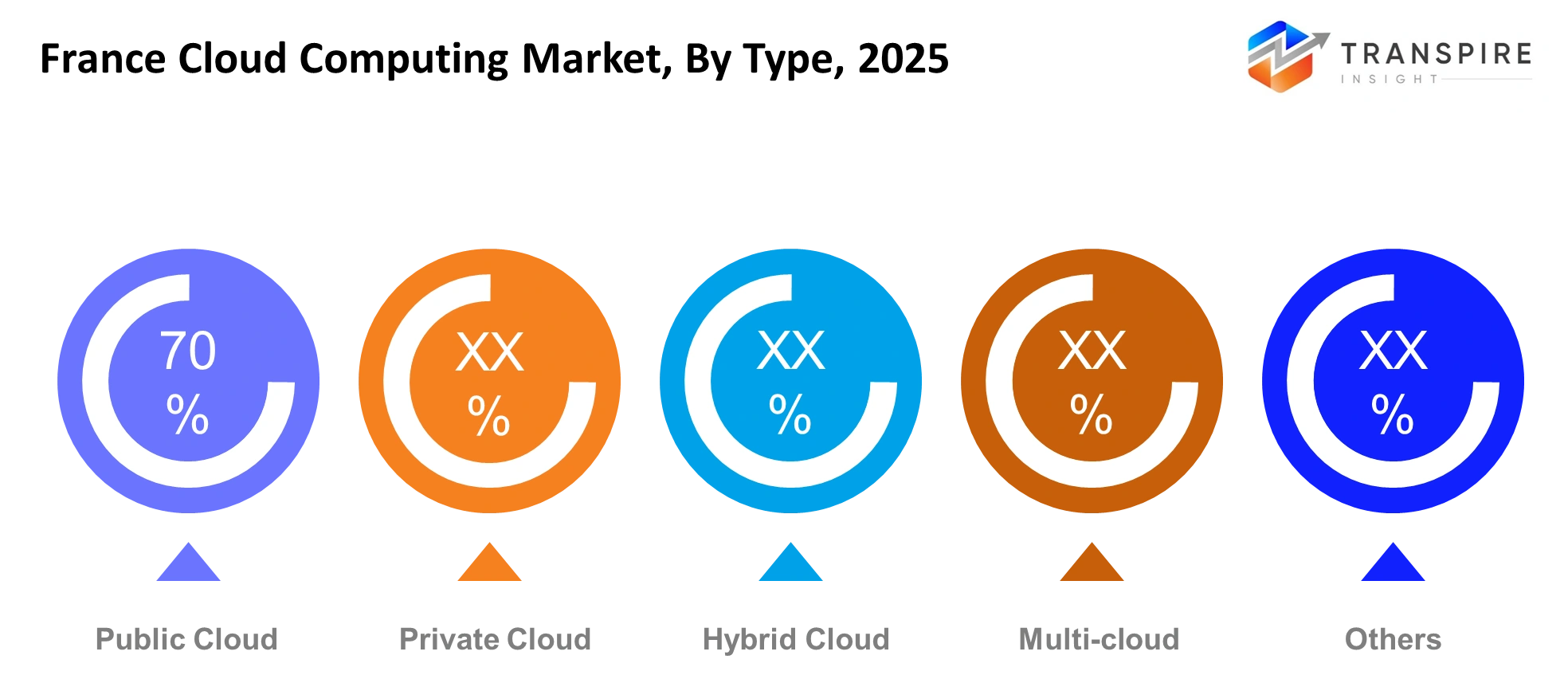
Public cloud sort of holds the dominant position since enterprises, retailers and digital service providers really want scalable infrastructure, with lower upfront capital needs. Big organizations are also moving more workloads into public cloud setups, to keep remote operations running smoothly, for AI processing , and for real time analytics, without having to carry and maintain a huge physical server base. The quicker deployment cycles matter too, plus the flexible subscription pricing, it all helped adoption across tech driven businesses that chase operational agility.
Hybrid cloud stays in a strong secondary role because regulated industries need more control over sensitive workloads, but they still want cloud scalability in the background. Private cloud environments keep being used by financial institutions, healthcare providers, and government agencies that must follow strict data governance requirements. Multi cloud adoption is growing steadily, too, as enterprises reduce their reliance on one single infrastructure vendor, while also boosting operational resilience across distributed environments. The other deployment models remain smaller, however they do fit certain niche enterprise needs tied to specialized security , or older legacy infrastructure integration. Over the forecast period, hybrid and multi-cloud environments should see stronger investment momentum as organizations focus on cybersecurity, AI integration, and sovereign data hosting approaches.
To learn more about this report, Download Free Sample Report
By Application
Data storage is still, by far the biggest slice of the market segment. the main reason is that enterprises keep dealing with larger and larger quantities of operational details , financial records, and customer information, so they need secure , scalable, and pretty much always-on infrastructure. For example, banks, health care orgs, and retail firms are leaning more and more on cloud based storage platforms so they can satisfy compliance obligations, keep backup systems reliable , and make sure critical business data stays reachable without interruptions. In the same way, disaster recovery has become more of a priority too, since many companies improved business continuity plans after big cybersecurity incidents and those unexpected operational disruptions that just come out of nowhere.
Application hosting also keeps a strong market standing, because more enterprises are shifting software workloads away from traditional on-site servers and into cloud native surroundings. At the same time, big data analytics platforms are spreading fast. Manufacturers, telecom providers, and retailers really want near real time insights taken from operational data along with consumer data streams. Then AI and machine learning applications are picking up even more momentum , mainly due to predictive analytics, automated threat identification, and smarter workflow automation systems. Other application categories are smaller, but they still benefit from broader adoption of edge computing and the connected device infrastructure that supports it. Through out the forecast period, AI driven analytics and automated cloud optimization platforms are expected to draw serious investment, since companies keep pushing their digital transformation goals ahead at a faster pace.
By End-User
Enterprises end up holding the dominant end-user share, mainly because big orgs need scalable computing infrastructure that can handle global operations, AI workloads, and those high volume data processing environments . Banks, retailers, and industrial firms are also putting more money into cloud migration plans , partly to gain operational flexibility and less reliance on outdated server infrastructure. At the same time, longer term digital transformation keeps driving recurring spend around cybersecurity, analytics, and cloud native software deployment.
BFSI stays in a steadier secondary position, because financial institutions need secure computing setups that follow very tight European data protection rules. Healthcare providers are pushing cloud adoption with investments in digital patient records, medical imaging analytics, and remote monitoring systems. Meanwhile IT and telecom companies keep raising infrastructure budgets to support 5G services, low latency applications, and distributed computing networks. Government agencies are another meaningful growth area too, since public sector modernization efforts tend to favor sovereign hosting and safer digital administration platforms. Through the forecast period , healthcare organizations and public sector institutions will likely speed up adoption of compliance focused cloud systems built for secure AI processing and long term operational resilience.
By Service Model
Infrastructure as a Service kind of dominates the market, since most enterprises usually want scalable computing power, flexible approaches to storage management, and also lower costs tied to owning physical hardware. Big organizations are now putting IaaS environments to work more and more, to help with AI processing, application migration, and distributed workforce operations without having to sink in huge capital spending for the actual physical infrastructure. At the same time, demand for automated infrastructure oversight, plus high performance computing, has really pushed adoption across industrial and financial sectors too.
Platform as a Service keeps a solid secondary position, mostly because software developers and digital businesses need cloud-native development settings that can speed up the application deployment cadence. Software as a Service keeps growing in a steady, predictable way, as organizations choose subscription-based productivity platforms, cybersecurity tools, and systems for customer management, all while dealing with fewer maintenance headaches. The other service models stay smaller, but they still help with more customized enterprise integration and consulting needs. During the forecast period, AI-enabled SaaS applications, along with developer oriented PaaS ecosystems, will pull in more investment activity, because enterprises lean toward automation, operational elasticity, and quicker software innovation cycles.
What are the Key Use Cases Driving the France Cloud Computing Market?
Enterprise data storage, and business application hosting kind of end up being the main use, mainly because banks , retailers, and manufacturers need infrastructure that can scale up— and keep running with no real breaks, for their digital operations. Cloud platforms let organizations process big data flows, provide remote access more easily, and lessen their reliance on expensive, in-house hardware systems. On top of that, real time analytics plus disaster recovery options have also made more people, especially in heavily regulated industries, more comfortable adopting these platforms.
AI-powered analytics, and cybersecurity management applications are growing pretty fast in healthcare organizations and in industrial firms. Manufacturers are leaning on cloud infrastructure for predictive maintenance and for connected factory workflows. At the same time, healthcare teams deploy cloud-based medical imaging tools and remote monitoring platforms, aiming to boost day-to-day operational efficiency and workflow speed.
More emerging patterns include sovereign AI cloud environments, along with edge computing systems that are built for low-latency industrial automation. Telecom providers, and even smart city projects, are testing distributed cloud networks that handle data from connected devices nearer to where operations actually happen, which may open long-term doors for advanced infrastructure providers.
|
Report Metrics |
Details |
|
Market size value in 2025 |
USD 28826.2 Million |
|
Market size value in 2026 |
USD 35455.4 Million |
|
Revenue forecast in 2033 |
USD 152778.6 Million |
|
Growth rate |
CAGR of 4.32% from 2026 to 2033 |
|
Base year |
2025 |
|
Historical data |
2021 - 2024 |
|
Forecast period |
2026 - 2033 |
|
Report coverage |
Revenue forecast, competitive landscape, growth factors, and trends |
|
Regional scope |
France |
|
Key company profiled |
AWS, Microsoft Azure, Google Cloud, IBM, Oracle, SAP, OVHcloud, Alibaba Cloud, VMware, Salesforce, Cisco, Dell, HPE, Atos, Capgemini. |
|
Customization scope |
Free report customization (country, regional & segment scope). Avail customized purchase options to meet your exact research needs. |
|
Report Segmentation |
By Type (Public Cloud, Private Cloud, Hybrid Cloud, Multi-cloud, Others); By Application (Data Storage, Disaster Recovery, Application Hosting, Big Data Analytics, AI & ML, Others); By End-User (Enterprises, SMEs, BFSI, Healthcare, IT & Telecom, Government, Others); By Service Model (IaaS, PaaS, SaaS, Others). |
Which Regions are Driving the France Cloud Computing Market Growth?
Northern France is still the dominant regional market, because Paris basically acts like the country’s main financial engine, enterprise technology center, and even the major hyperscale data center hub. A lot of major cloud suppliers, telecom operators, and digital infrastructure firms keep expanding local computing capacity to back banking, retail, and public sector workloads. There is also strong regulatory alignment with European data sovereignty directions, which really pushed companies to favor locally hosted cloud infrastructure. On top of that, the region has dense fiber connectivity, a pretty mature cybersecurity ecosystem, and a concentration of AI research centers that keep long-term cloud spending going.
Western France works more like a stable secondary market, driven by industrial modernization and a fairly balanced approach to enterprise digitization across manufacturing, logistics, and telecommunications. Compared with Northern France, growth here relies less on hyperscale infrastructure concentration, and more on steady migration efforts from mid-sized enterprises. Regional organizations are increasingly leaning into hybrid cloud environments, to improve supply chain visibility, manage remote staff, and enable industrial analytics applications. With stable economic conditions and ongoing digital transformation funding, Western France keeps showing up as a dependable contributor to national cloud service revenue.
Southern France is projected to deliver the fastest growth through 2033, since technology parks, smart city programs, and AI-oriented infrastructure investments got moving quite a bit after 2023. Local administrations and telecom providers widened their edge computing footprint and low-latency cloud networks, to support connected mobility, tourism platforms, and healthcare digitization initiatives.
Who are the Key Players in the France Cloud Computing Market and How Do They Compete?
Competition in the France Cloud Computing Market still stays pretty concentrated, mainly among global hyperscale infrastructure providers, enterprise software firms, and those regional sovereign cloud specialists. What actually matters now, more than plain pricing, is the overall technological capability , cybersecurity performance, how well AI is integrated, and whether the provider can meet regulatory compliance requirements without drama. The biggest multinational players keep pushing to hold on to market share via aggressive data center growth and extra AI service bundling, but the regional companies sort of lean on sovereign hosting abilities and hands on localized compliance support. Meanwhile, enterprise customers are evaluating vendors with more focus on workload flexibility, hybrid deployment compatibility and also longer term cybersecurity resilience, not just cost.
Amazon Web Services plays the game with massive infrastructure capacity, advanced AI cloud services, and a wide developer ecosystem that helps enterprises run digital transformation at scale, in practice. Microsoft Azure, for its part, leans into strong hybrid cloud compatibility, plus deeper integration with enterprise productivity tools that are widely used by financial institutions and government organizations. Google Cloud is going hard on AI optimization, machine learning infrastructure, and data analytics capabilities, which tends to pull in retailers, media businesses, and other digital-native enterprises that want high-performance computing environments.
OVHcloud, though, improves its position with sovereign cloud hosting and European data compliance services, especially for organizations that care about local infrastructure control. IBM keeps extending hybrid cloud options alongside cybersecurity consulting, targeting regulated industries that often live with complicated legacy infrastructure setups.
Company List
- AWS
- Microsoft Azure
- Google Cloud
- IBM
- Oracle
- SAP
- OVHcloud
- Alibaba Cloud
- VMware
- Salesforce
- Cisco
- Dell
- HPE
- Atos
- Capgemini
Recent Development News
In February 2025, Oracle launched Oracle Fusion Cloud Applications on Oracle EU Sovereign Cloud. The expansion improved compliance-focused cloud deployment for European enterprises and public sector organizations.
Source: http://www.oracle.com
In February 2026, French AI company Mistral AI acquired cloud startup Koyeb to strengthen sovereign AI infrastructure and cloud computing capabilities across Europe.
Source: http://www.reuters.com
What Strategic Insights Define the Future of the France Cloud Computing Market?
France’s cloud computing market is kind of shifting , toward AI-centric sovereign infrastructure, where companies want secure hosting in the region, plus hybrid cloud flexibility , and better high-performance computing features instead of the old storage-focused kind of rollouts. In the next five to seven years generative AI workloads, and also tougher European data governance rules, will likely push spending into more local cloud environments that can handle sensitive business stuff. There is also a not-so-obvious risk here, because ownership of infrastructure is getting more concentrated among a handful of hyperscale providers , and that can lead to pricing pressure, plus it may weaken the enterprise customers' negotiating position.
Still, edge AI infrastructure that’s tied into industrial automation, healthcare analytics, and smart city services feels like an emerging chance with solid long-term commercial upside. Market participants should really aim for strategic collaborations that blend sovereign hosting, AI optimization, and cybersecurity offerings, since enterprises seem to prefer integrated infrastructure ecosystems, rather than isolated cloud deployment solutions, all by themselves.
France Cloud Computing Market Report Segmentation
By Type
- Public Cloud
- Private Cloud
- Hybrid Cloud
- Multi-cloud
- Others
By Application
- Data Storage
- Disaster Recovery
- Application Hosting
- Big Data Analytics
- AI & ML
- Others
By End-User
- Enterprises
- SMEs
- BFSI
- Healthcare
- IT & Telecom
- Government
- Others
By Service Model
- IaaS
- PaaS
- SaaS
- Others
Frequently Asked Questions
Find quick answers to common questions.
The approximate France Cloud Computing Market size for the market will be USD 152778.6 Million in 2033.
Key segments for the France Cloud Computing Market are By Type (Public Cloud, Private Cloud, Hybrid Cloud, Multi-cloud, Others); By Application (Data Storage, Disaster Recovery, Application Hosting, Big Data Analytics, AI & ML, Others); By End-User (Enterprises, SMEs, BFSI, Healthcare, IT & Telecom, Government, Others); By Service Model (IaaS, PaaS, SaaS, Others).
Major France Cloud Computing Market players are AWS, Microsoft Azure, Google Cloud, IBM, Oracle, SAP, OVHcloud, Alibaba Cloud, VMware, Salesforce, Cisco, Dell, HPE, Atos, Capgemini.
The France Cloud Computing Market size is USD 28826.2 Million in 2025.
The France Cloud Computing Market CAGR is 4.32% from 2026 to 2033.
- AWS
- Microsoft Azure
- Google Cloud
- IBM
- Oracle
- SAP
- OVHcloud
- Alibaba Cloud
- VMware
- Salesforce
- Cisco
- Dell
- HPE
- Atos
- Capgemini
Recently Published Reports
-
Apr 2026
3D Optical Profiler Market
3D Optical Profiler Market Size, Share & Analysis Report By Type (Desktop 3D Optical Profiler, and Portable 3D Optical Profiler), By Technology (Confocal Technology, and White Light Interference), By End-Use Industry (Manufacturing, Research Institutions, Automotive, Aerospace and Defense, Medical Devices, and Other), and Geography (North America, Europe, Asia-Pacific, Middle East and Africa, South and Central America), 2021 - 2031
-
Apr 2026
Depth Sensor Market
Depth Sensor Market Size, Share & Analysis Report By Type (Infrared Depth Sensors, Time-of-Flight (ToF) Sensors, Stereo Vision Sensors, Structured Light Sensors, Ultrasonic Depth Sensors), By Application (Automotive, Robotics, Gaming, Consumer Electronics, Industrial Automation, Healthcare, Security & Surveillance, Others), By End Users (Automotive Manufacturers, Consumer Electronics Companies, Healthcare Providers, Industrial Companies, Security Agencies, Gaming Companies, Robotics Companies, Others), and Geography (North America, Europe, Asia-Pacific, Middle East and Africa, South and Central America), 2021 – 2031
-
Apr 2026
Digital Manufacturing Market
Digital Manufacturing Market Size, Share & Analysis Report By Component (Hardware, Software, and Services), By Technology (Robotics, 3D Printing, Internet of Things (IoT), and Others), By Application (Automotive and Transportation, Aerospace and Defense, Consumer Electronics, Industrial Machinery, and Others), By Process Type (Computer-Based Designing, Computer-Based Simulation, Computer 3D Visualization, Analytics, and Others), and Geography (North America, Europe, Asia-Pacific, Middle East and Africa, South and Central America), 2021 – 2031
-
Apr 2026
Digital Visa Services Market
Digital Visa Services Market Size, Share & Analysis Report By Type (Individual Travelers, Group Travelers), By Application (Tourism, Business Travel, Others), and Geography (North America, Europe, Asia-Pacific, Middle East and Africa, South and Central America), 2021 – 2031