

United Kingdom Spa and Salon Software Market Summary
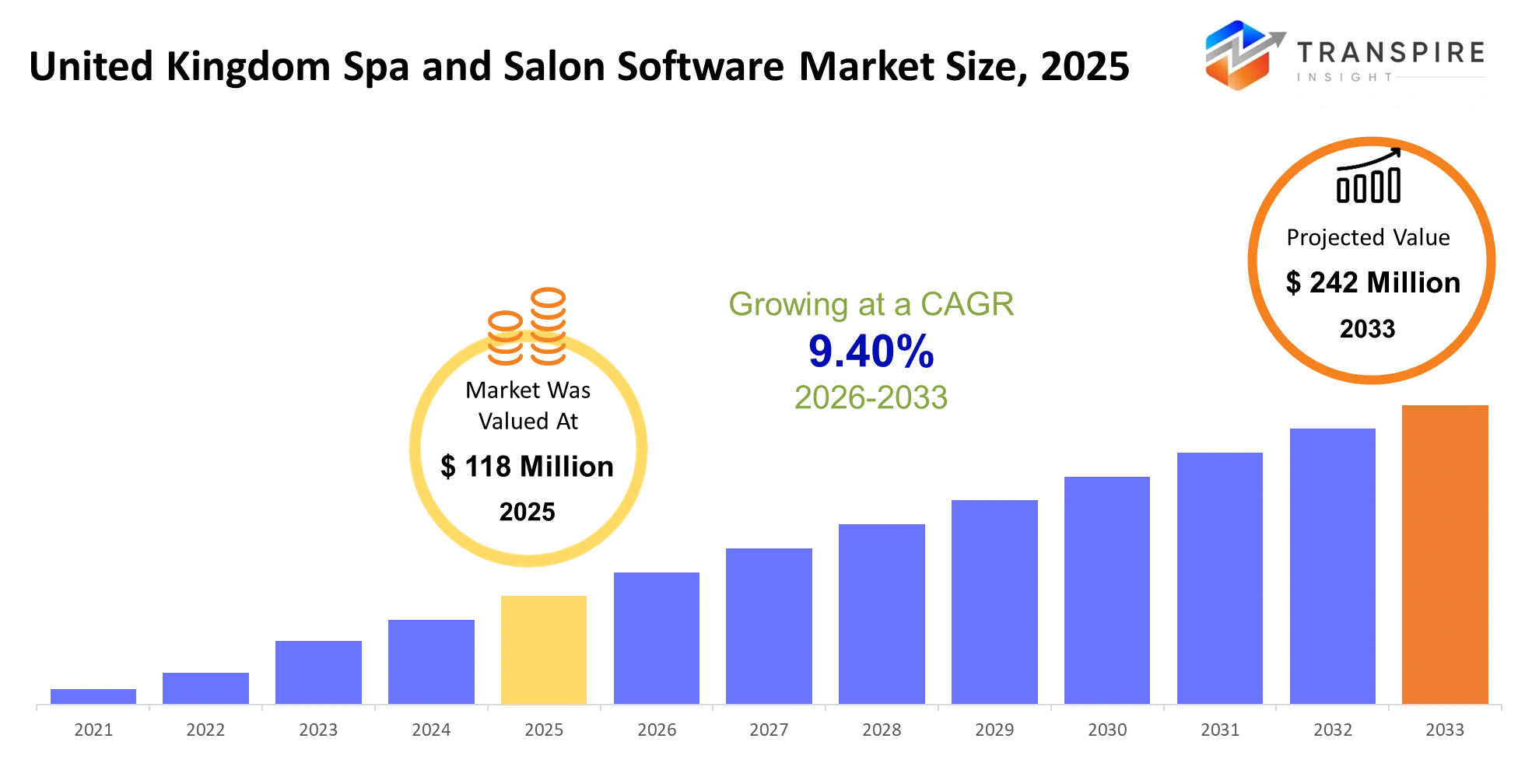
As per Transpire Insight Analysis the United Kingdom Spa and Salon Software Market size is estimated at USD 118 Million in 2025 and is anticipated to reach USD 242 Million by 2033, growing at a CAGR of 9.40% from 2026 to 2033.
The United Kingdom Spa and Salon Software Market helps operators sort out bookings, staff schedules, payments, customer records, memberships, and inventory using connected digital systems, so less admin time, and a smoother day-to-day service flow. In the last 3–5 years things kind of moved, from simple appointment calendars toward cloud based platforms that bundle payments, customer engagement, reporting, and automated marketing. One big real world trigger was the COVID-19 disruption. It forced salons and spas to switch toward online booking, contactless payments, and digital customer communication, because in person operations had limits. And that shift did not just fade out. It kept going, since operators now expect software to link what happens at the front desk with revenue management and customer retention. Also, as labor costs climb, and the fight for repeat clients gets sharper, automation gives businesses better control of staff utilization, deal with cancellations more cleanly, run memberships, and push promotional campaigns. So adoption supports operational efficiency , but also more predictable revenue generation.
United Kingdom Spa and Salon Software Market Size & Forecast:
- United Kingdom Spa and Salon Software Market Size 2025: USD 118 Million
- Expected Market Value 2033: USD 242 Million
- Forecast CAGR: 9.40%
- Leading region in 2025: England
- Fastest Growing region: Scotland
- Key Profile: Zenoti, Mindbody, Vagaro, Fresha, Phorest, Booksy, Rosy Salon Software, Square, Boulevard, Salon Iris, Timely, Shedul, SimplyBook.me, DaySmart Salon, Treatwell.
Key Market Insights
- England is really dominating the UK market, with an estimated 85%+ share in 2025, backed by London having this dense clump of premium salons , spas and multi-site operators.
- Scotland looks among the fastest-growing regions through 2026–2030, mainly because independent operators are taking up cloud booking, cloud payments, customer analytics, and some automated marketing stuff, pretty steadily.
- When it comes to what people actually buy, appointment and booking management leads with an estimated 35% share, and that’s basically due to the ongoing switch from manual diaries to 24/7 digital scheduling.
- Integrated payment and point-of-sale software sits in the second-largest spot, since operators connect transactions, customer records, inventory and reporting, as one smoother flow.
- AI-enabled management is the fastest-growing product segment through 2030, with platforms adding automated messaging, client insights, appointment handling, and retention tools that kind of “keep working” in the background.
- Appointment scheduling is the big one in applications too, at an estimated 40% share, while online booking adoption keeps widening across websites, apps, and social channels, without slowing.
- Customer retention and personalised marketing is also growing the fastest, because software is increasingly using booking histories to kick off targeted rebooking campaigns, kind of automatically.
- For end users, multi-location salon and spa groups lead with an estimated 30% share, and they tend to need centralized scheduling, reporting, payments, and workforce controls all tied together.
- And independent salons are the fastest-growing end-user category too, since lower-cost cloud platforms reduce the upfront tech obstacles and the admin workload, in a pretty noticeable way.
What are the Key Drivers, Restraints, and Opportunities in the United Kingdom Spa and Salon Software Market?
The main growth engine is basically this move from manual administration to more connected cloud software. COVID-19 kind of pushed online booking ahead and sped up contactless workflows, and at the same time tighter operating margins made automated scheduling, payment processing, reminder nudges, and reporting much more financially valuable. Treatwell’s reported 5% online-booking penetration also suggests there is real conversion headroom still sitting there. And as more digital bookings shift transactions into software platforms, vendors end up collecting recurring subscription income, payment revenue, marketplace fees, plus extra marketing spend and demand generation dollars.
The big structural obstacle is fragmented technology adoption across smaller independent operators. You still see legacy diaries, spreadsheets, standalone payment systems, and limited digital proficiency. Migration gets expensive, because customer records, pricing rules, staff rosters, and historical information all have to be transferred carefully. Treatwell also says that 80% of salons still use pen and paper , which really shows how big the conversion task is. When a migration is delayed, subscription revenue slips, and the addressable pool for more advanced software shrinks too. Also, based on Transpire Insight’s review of regional procurement notices and launch timing, supply chain concentration looks like the biggest execution risk.
The real, strongest opportunity seems to be with AI powered revenue management for independent operators, and also those running multi site setups. Phorest already uses AI for things like client summaries , and automated front desk conversations, then retention nudges, plus business insights, so it shows how the software can move past simple record keeping and into more active revenue optimisation. If that same approach gets rolled out more widely across UK operators it could, in practice, lift schedule utilisation, cut down missed enquiries. It might also help with personalised rebooking, and in the end create extra recurring income as software revenue, not just one off wins.
What Has the Impact of Artificial Intelligence Been on the United Kingdom Spa and Salon Software Market?
AI and digital tech are kinda pushing salon software away from just admin recording, and more into real operational decisions, day to day. With Phorest, their AI tools can summarise a clients history, tastes and even possible upsell ideas before the appointment, which sounds simple but it helps a lot. Then Front Desk AI basically deals with booking, rescheduling, rebooking and those routine questions, all via SMS and WhatsApp. There are also machine-learning functions aimed at client reconnect campaigns, by spotting which customers have slipped past their usual booking interval. On top of that smart scheduling can reduce empty gaps by arranging appointments more efficiently, and when point-of-sale plus inventory data is integrated it can signal products that are getting close to reorder levels. Overall this should reduce the reception workload, bump booking utilisation, and help keep customers coming back, without needing to add the same level of staffing costs.
Treatwell also ties together marketplace bookings with salon management, marketing, and reporting, so it further supports that integrated digital workflow shift. The main snag, well the main limitation is integration quality. Smaller operators might not have clean historical customer data, or they could be missing compatible systems, or they just don’t have the technical resources you need for dependable AI rollout. When the data is messy, recommendations get weaker, and if integrations are complex it can raise implementation costs and slow adoption down.
Key Market Trends
- Since 2022, UK salon software has gradually veered away from those plain digital diaries, toward a more stitched together set-up, like integrated booking, payment flows, marketing hooks, reporting dashboards and customer-management platforms or whatever you want to call it.
- In 2025, Phorest looked at consumer behaviour across 716 UK and Irish salon guests, and it really pointed to online booking ,and also AI as the biggest tech themes right now.
- Treatwell says only 5% of bookings were online, which basically screams there’s lots of space for digital booking migration among salons that still run on manual routines ,and yes that includes operators with very human processes.
- Fresha then tightened its UK industry stance in 2026, via a five-year HairCon partnership centered on technology, learning, and ongoing professional connection rather than just “tools” in the abstract.
- AI also moved nearer to front desk operations in 2026, after Phorest rolled out automated responses covering booking, rescheduling, rebooking, and those everyday customer questions.
- Retention tech is starting to act more predictive too, with platforms spotting missed booking windows and then firing off personalised reconnect messages automatically, kind of like a gentle nudge without the awkwardness.
- Meanwhile, integrated POS and inventory systems are replacing separate little tools, so operators can link product sales, stock levels, marketing activity, and customer behaviour in one place—rather than hopping between screens .
- In 2026, Fresha broadened workforce-management features using flexible commission tiers, add-on pricing, and day-based incentives for enterprise operators, which makes the whole labor math feel slightly less painful.
- Treatwell’s collaboration with Nouveau HD Beauty Group also showed a pattern: software providers are embedding digital scheduling, stock control, reporting, and marketing across professional beauty networks, not just in one salon bubble .
- Online booking, marketplace discovery, and software management are converging now, as platforms connect consumer acquisition straight into the salon’s operating workflows, so everything happens with less gap in between, even if it’s a bit messy at first.
United Kingdom Spa and Salon Software Market Segmentation
By Component :
Software stays the backbone of the whole operation since salons and spas require booking, customer records, payments, staff management, and reporting all in one place, not separate bits. Services come along for the ride with implementation, plus staff training , system integration, ongoing maintenance, and the technical assistance part. Consulting services also matter, because operators usually need help picking the most suitable platform, reworking the way work flows, and linking the software with their existing business systems without too much friction.
Analytics Solutions will get more weight over time, as businesses want sharper visibility into bookings, staff productivity, customer retention, sales numbers , and how services are actually performing. Integration Services will support that adoption too , by tying booking platforms to payment systems, accounting tools, marketing platforms, and customer databases. Support & Maintenance will still be needed for steady day to day operations, while Training makes sure the team can use the new features, and not just click around. Consulting will continue to help bigger operators during platform selection and when doing technology upgrades.
By Deployment :
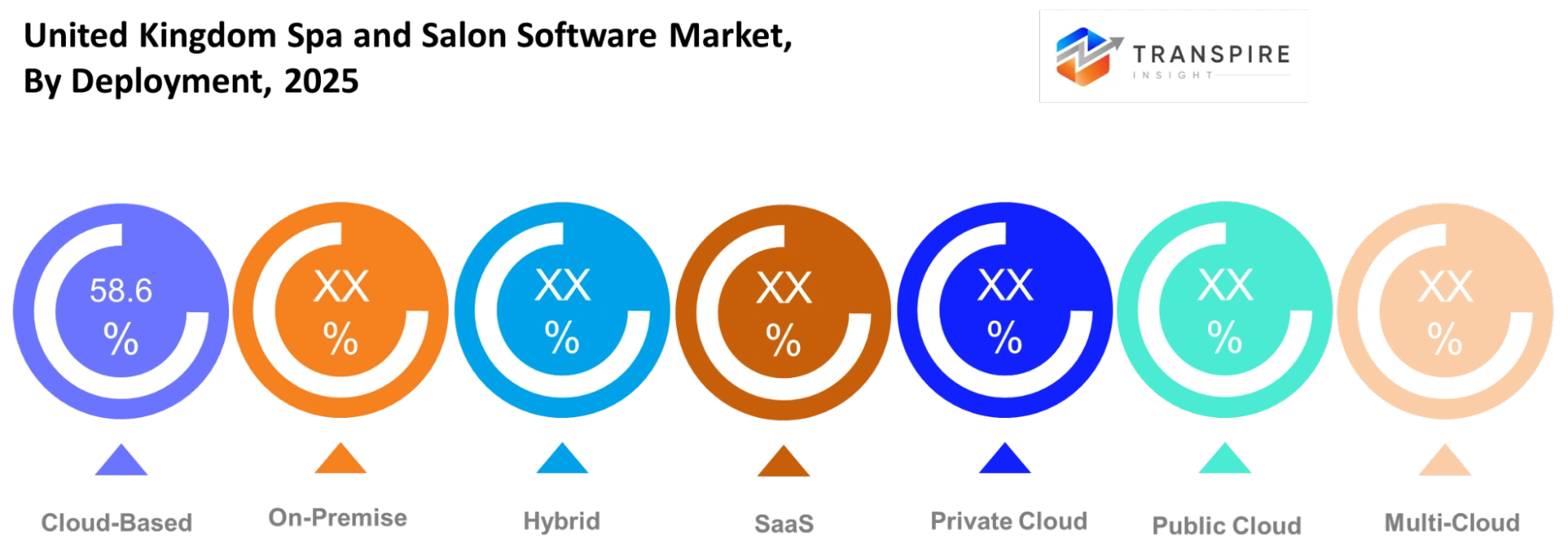
Cloud Based deployment keeps gaining ground, because salon and spa operators can reach booking, clients, payment and reporting systems from different locations, kind of anywhere. With SaaS platforms, the initial technology costs are lower , and teams get steady software updates without having to build a big local infrastructure. Public cloud solutions can fit smaller businesses that want flexible access while keeping costs in a manageable range.
Meanwhile, On-Premise deployment is still quite relevant for companies that need direct control over data plus their internal systems. A Hybrid model can help operators blend local applications with cloud services, so they are not fully locked in one approach. A Private cloud setup might appeal to larger groups that want stronger security and more control over where everything lives. And Multi-Cloud adoption can work well for businesses that use different cloud environments for specialised apps , maybe to separate workloads or compliance needs.In the end, deployment decisions will increasingly come down to business scale, data needs , day to day operating complexity , and what the technology budget looks like, not just what sounds easiest.
By Function :
Appointment Scheduling stays a key activity, since digital calendars cut booking missteps, tracks team availability, and lets customers book services even past business hours. Customer Relationship Management basically keeps customer files, preferences, service history, loyalty actions, and sends more directed messages. Billing & Payments is where operators process money, handle deposits, and reduce the whole manual payment admin, no one likes that.
Marketing Automation will only get more important, because operators want automatic nudges, rebooking notes, promotional outreach, and more personalized deals. Reporting & Analytics will help guide decisions about sales, staff results, what services people actually want, and customer sticking around. Inventory Management helps keep product stock not just “somehow” available, but properly timed, and purchasing under control. Employee Management supports rosters, attendance, commissions, and overall workforce planning.If these areas get better integrated , operators can link customer behavior with revenue, plus operational performance too, kind of end-to-end.
By End User :
Beauty Salons are a big end user group, because everyday operations need appointment routing, client management, payment handling, staff coordination, and a bit of marketing. Spas and Wellness Centers instead need wider scheduling, like treatment room timing, therapists assignments, memberships, packages, and several service categories all at once. Barber Shops and Nail Salons usually lean toward very straightforward booking and payment tools , with approachable pricing and simpler staff oversight.
Cosmetic Clinics, on the other hand, really need sturdier customer files and tighter appointment controls, plus solid payment functions and reporting. Massage Centers tend to gain a lot from automatic scheduling, reminder pings, customer history tracking, and repeat booking tools that just help. Big Wellness Centers will keep moving toward joined up platforms for many services, and even separate staff groups. Smaller operators often prefer cloud based solutions with low setup requirements , while bigger companies will insist on deeper reporting, better integration, and stronger workforce-management capabilities.
By Enterprise Size :
Big salon chains, usually want centralized platforms spanning many places, staff groups, customer records, payments, inventory, plus performance reporting. Medium salons sometimes look for more integrated systems, that can back a growing team without the tech expenses tied to huge enterprise platforms, you know. Small salons and independent professionals often lean toward affordable SaaS tools for booking, payments, customer management, and automated follow-up reminders.
Meanwhile, franchise salons need consistent systems between locations, so operations stay standardized, with clean reporting, solid customer management, and brand controls. Wellness resorts, on the other hand, need extra breadth for treatment bookings, memberships, staff scheduling, bundles or packages, and guest services. Home-based salons typically like uncomplicated cloud tools, low onboarding costs, and mobile access.Overall, enterprise size keeps steering the software choice, because budgets differ, staffing differs, location count changes, integration requirements vary, and operational complexity adds up.
What are the Key Use Cases Driving the United Kingdom Spa and Salon Software Market?
Appointment arranging is still the core use case, and it sorta supports Beauty Salons, Spas, Barber Shops, plus Nail Salons. Operators lean on digital calendars, to handle staff availability, treatment spaces, cancellations deposits, and customer bookings. Small businesses and solo specialists create strong demand too, since automated scheduling cuts down the front desk bother, and keeps booking access open even after the place closes.
Now, customer keeping campaigns, together with workforce planning are picking up steam, for Medium Salons, Large Salon Chains, and franchise salons. Automated nudges, rebooking notes and more specific offers help keep customers around, while workforce tools back commission math, shift setup, and staff utilisation across several locations.
Also, AI-assisted reception and predictive revenue management are kinda emerging. Bigger salon chains, plus Wellness Resorts can use automated customer chats, demand prediction, and service suggestions, to make better scheduling calls and spot revenue that might’ve been missed.
|
Report Metrics |
Details |
|
Market size value in 2025 |
USD 118 Million |
|
Market size value in 2026 |
USD 129 Million |
|
Revenue forecast in 2033 |
USD 242 Million |
|
Growth rate |
CAGR of 9.40% from 2026 to 2033 |
|
Base year |
2025 |
|
Historical data |
2021 - 2024 |
|
Forecast period |
2026 - 2033 |
|
Report coverage |
Revenue forecast, competitive landscape, growth factors, and trends |
|
Regional scope |
United Kingdom (England, Scotland, Wales, Northern Ireland) |
|
Key company profiled |
Zenoti, Mindbody, Vagaro, Fresha, Phorest, Booksy, Rosy Salon Software, Square, Boulevard, Salon Iris, Timely, Shedul, SimplyBook.me, DaySmart Salon, Treatwell. |
|
Customization scope |
Free report customization (country, regional & segment scope). Avail customized purchase options to meet your exact research needs. |
|
Report Segmentation |
By Component (Software, Services, Consulting, Training, Integration Services, Support & Maintenance, Analytics Solutions, Others); By Deployment (Cloud-Based, On-Premise, Hybrid, SaaS, Private Cloud, Public Cloud, Multi-Cloud, Others); By Function (Appointment Scheduling, Customer Relationship Management, Billing & Payments, Inventory Management, Employee Management, Marketing Automation, Reporting & Analytics, Others); By End User (Beauty Salons, Spas, Wellness Centers, Barber Shops, Nail Salons, Cosmetic Clinics, Massage Centers, Others); By Enterprise Size (Large Salon Chains, Medium Salons, Small Salons, Independent Professionals, Franchise Salons, Wellness Resorts, Home-Based Salons, Others). |
Which Regions are Driving the United Kingdom Spa and Salon Software Market Growth?
London is kind of taking the lead in the UK spa and salon software world, with an estimated 18%+ share in 2025, mostly because the capital has the biggest clump of salons. When you look at the premium salons, beauty businesses, clinics, plus the multi-site operators all in one place, it drives solid need for cloud booking, CRM, payment tools and analytics. And since London has a pretty dense tech ecosystem, vendors get not only access to well known operators but also specialist tech partners, which is a nice combo. London’s top position should stay fairly durable through 2033 too, since the big business base, high service intensity, and those multi location operations keep fueling recurring software spending.
The South East should keep giving steady revenue because the regional market includes 6,310 salons, alongside established consumer services and business activity that isn’t too fragile. There’s also a broad variety of independent salons, bigger outfits, and professional beauty operators, so it’s not overly dependent on a single customer group. With consistent take up of cloud scheduling, payments, and customer management, you can expect those recurring subscriptions and routine software upgrades to keep flowing. Plus, being close to London helps tech spillover, but the area still keeps its own local operator base, so it doesn’t feel fully absorbed.
Scotland is seeing what feels like the fastest growing regional chance, because independent salons and wellness businesses keep moving away from manual booking, and toward cloud platforms plus integrated payments. A lot of SaaS tools are now nationally available so even smaller operators can use features that were mostly for bigger businesses before, which definitely lowers the tech barriers. This change also makes space for vendors who can bundle affordable services, provide local help, support mobile booking, and handle automated customer messages. Between 2026–2033, new entrants and investors can aim at independent operators that are still kind of underserved where software penetration stays under the major urban centres.
Who are the Key Players in the United Kingdom Spa and Salon Software Market and How Do They Compete?
Competition looks pretty fragmented, not fully consolidated. You’ve got Fresha, Phorest, Treatwell, Booksy, Timely, Square, Vagaro, and a bunch of other platforms going after different operator sizes, and even different business models. The real battleground is cost, marketplace access, booking functionality, payments, CRM depth, and those customer-retention tools— not just one thing. Fresha tends to play with a broad all-in-one platform plus marketplace reach, while Phorest leans more into premium salon operations, loyalty, acquisition, retention, and overall business management.
Fresha goes after smaller operators with “easy to start” software, integrated payments, online booking, marketing features, and marketplace-led customer pull. But at the same time, they keep expanding the product, so larger businesses can still fit in. Phorest, on the other hand, differentiates with salon-specific CRM, loyalty features, branded apps, reporting, and AI-enabled front-desk style support. It’s less about basic scheduling and more about helping operators stick with stronger retention. Treatwell leans on marketplace visibility, basically tying consumer discovery to booking and salon-management services. Booksy is more mobile-first in the marketplace sense, mixing appointment management with customer acquisition. Timely, meanwhile, is built around straightforward adoption for salons who want practical booking and management functions, without all that enterprise-level complexity.
Company List
- Zenoti
- Mindbody
- Vagaro
- Fresha
- Phorest
- Booksy
- Rosy Salon Software
- Square
- Boulevard
- Salon Iris
- Timely
- Shedul
- SimplyBook.me
- DaySmart Salon
- Treatwell
Recent Development News
In January 2026, Fresha announced a five-year Premier Partnership with HairCon. The agreement launched HairCon powered by Fresha and strengthened Fresha’s presence across the UK hair and barbering sector through industry events, education, and technology engagement.
Source: https://www.fresha.com/
In March 2026, Fresha joined Amazon Alexa+ in the UK, enabling voice-powered beauty and wellness bookings through next-generation AI. The integration extends salon software into conversational booking and gives UK businesses another digital channel for customer appointments.
Source: https://www.fresha.com/
What Strategic Insights Define the Future of the United Kingdom Spa and Salon Software Market?
Over the next 5–7 years, the United Kingdom Spa and Salon Software market is going to lean toward AI enabled platforms that sort of connect booking, payments, customer outreach, workforce management, and revenue optimisation. The main pull seems to be the shift from software used mainly for administration to systems that actually generate bookings and sort out which operating choices to make. Fresha’s February 2026 data already shows this shift, where AI driven referrals are up 50% month on month, and over 1.2 million monthly appointments are coming through its Google booking infrastructure.
There’s also a less obvious risk: platform concentration. If more operators depend on a few marketplaces and software providers, switching costs can climb, transaction fees can get sticky, and there’s added sensitivity to pricing changes, especially for smaller businesses.
At the same time, a fresh opportunity is agentic booking, where customers use AI assistants like Alexa+ to discover, choose, and book services via natural conversation, kind of like a guided chat.
Market participants should really focus on open integrations, first party customer data, and AI ready booking infrastructure rather than leaning only on marketplace traffic.
United Kingdom Spa and Salon Software Market Report Segmentation
By Component
- Software
- Services
- Consulting
- Training
- Integration Services
- Support & Maintenance
- Analytics Solutions
By Deployment
- Cloud-Based
- On-Premise
- Hybrid
- SaaS
- Private Cloud
- Public Cloud
- Multi-Cloud
By Function
- Appointment Scheduling
- Customer Relationship Management
- Billing & Payments
- Inventory Management
- Employee Management
- Marketing Automation
- Reporting & Analytics
By End User
- Beauty Salons
- Spas
- Wellness Centers
- Barber Shops
- Nail Salons
- Cosmetic Clinics
- Massage Centers
By Enterprise Size
- Large Salon Chains
- Medium Salons
- Small Salons
- Independent Professionals
- Franchise Salons
- Wellness Resorts
- Home-Based Salons
Frequently Asked Questions
Find quick answers to common questions.
The expected United Kingdom Spa and Salon Software Market size for the market will be USD 242 Million in 2033.
Key segments for the United Kingdom Spa and Salon Software Market are By Component (Software, Services, Consulting, Training, Integration Services, Support & Maintenance, Analytics Solutions, Others); By Deployment (Cloud-Based, On-Premise, Hybrid, SaaS, Private Cloud, Public Cloud, Multi-Cloud, Others); By Function (Appointment Scheduling, Customer Relationship Management, Billing & Payments, Inventory Management, Employee Management, Marketing Automation, Reporting & Analytics, Others); By End User (Beauty Salons, Spas, Wellness Centers, Barber Shops, Nail Salons, Cosmetic Clinics, Massage Centers, Others); By Enterprise Size (Large Salon Chains, Medium Salons, Small Salons, Independent Professionals, Franchise Salons, Wellness Resorts, Home-Based Salons, Others).
Major United Kingdom Spa and Salon Software Market players are Zenoti, Mindbody, Vagaro, Fresha, Phorest, Booksy, Rosy Salon Software, Square, Boulevard, Salon Iris, Timely, Shedul, SimplyBook.me, DaySmart Salon, Treatwell.
The United Kingdom Spa and Salon Software Market size is USD 118 Million in 2025.
The United Kingdom Spa and Salon Software Market CAGR is 9.40% from 2026 to 2033.
- Zenoti
- Mindbody
- Vagaro
- Fresha
- Phorest
- Booksy
- Rosy Salon Software
- Square
- Boulevard
- Salon Iris
- Timely
- Shedul
- SimplyBook.me
- DaySmart Salon
- Treatwell
About the Authors

Mayur Shinde
I am Mayur Shinde, a Senior Research Analyst at Transpire Insight, specializing in the Automotive & Transportation and Information & Communication Technology (ICT) Industry. My work focuses on analyzing emerging market trends, technological advancements, competitive landscapes, and industry developments to deliver accurate, data-driven insights. I am passionate about transforming complex market information into clear, actionable content that helps businesses, professionals, and decision-makers stay informed and make confident strategic decisions.

Chakradhar Khansole
Chakradhar serves as the Research Director at Transpire Insight, bringing over 8 years of experience in technology, innovation, and strategic market intelligence. He specializes in transforming complex market data into actionable business insights that enable organizations to make informed, growth-oriented decisions. Recognized for his strategic vision and analytical expertise, Chakradhar leads high-impact research initiatives, delivering comprehensive market assessments, competitive intelligence, and forward-looking industry analysis.
Recently Published Reports
-
Apr 2026
3D Optical Profiler Market
3D Optical Profiler Market Size, Share & Analysis Report By Type (Desktop 3D Optical Profiler, and Portable 3D Optical Profiler), By Technology (Confocal Technology, and White Light Interference), By End-Use Industry (Manufacturing, Research Institutions, Automotive, Aerospace and Defense, Medical Devices, and Other), and Geography (North America, Europe, Asia-Pacific, Middle East and Africa, South and Central America), 2021 - 2031
-
Apr 2026
Depth Sensor Market
Depth Sensor Market Size, Share & Analysis Report By Type (Infrared Depth Sensors, Time-of-Flight (ToF) Sensors, Stereo Vision Sensors, Structured Light Sensors, Ultrasonic Depth Sensors), By Application (Automotive, Robotics, Gaming, Consumer Electronics, Industrial Automation, Healthcare, Security & Surveillance, Others), By End Users (Automotive Manufacturers, Consumer Electronics Companies, Healthcare Providers, Industrial Companies, Security Agencies, Gaming Companies, Robotics Companies, Others), and Geography (North America, Europe, Asia-Pacific, Middle East and Africa, South and Central America), 2021 – 2031
-
Apr 2026
Digital Manufacturing Market
Digital Manufacturing Market Size, Share & Analysis Report By Component (Hardware, Software, and Services), By Technology (Robotics, 3D Printing, Internet of Things (IoT), and Others), By Application (Automotive and Transportation, Aerospace and Defense, Consumer Electronics, Industrial Machinery, and Others), By Process Type (Computer-Based Designing, Computer-Based Simulation, Computer 3D Visualization, Analytics, and Others), and Geography (North America, Europe, Asia-Pacific, Middle East and Africa, South and Central America), 2021 – 2031
-
Apr 2026
Digital Visa Services Market
Digital Visa Services Market Size, Share & Analysis Report By Type (Individual Travelers, Group Travelers), By Application (Tourism, Business Travel, Others), and Geography (North America, Europe, Asia-Pacific, Middle East and Africa, South and Central America), 2021 – 2031