

Asia Pacific Customer Relationship Management Market Size & Forecast:
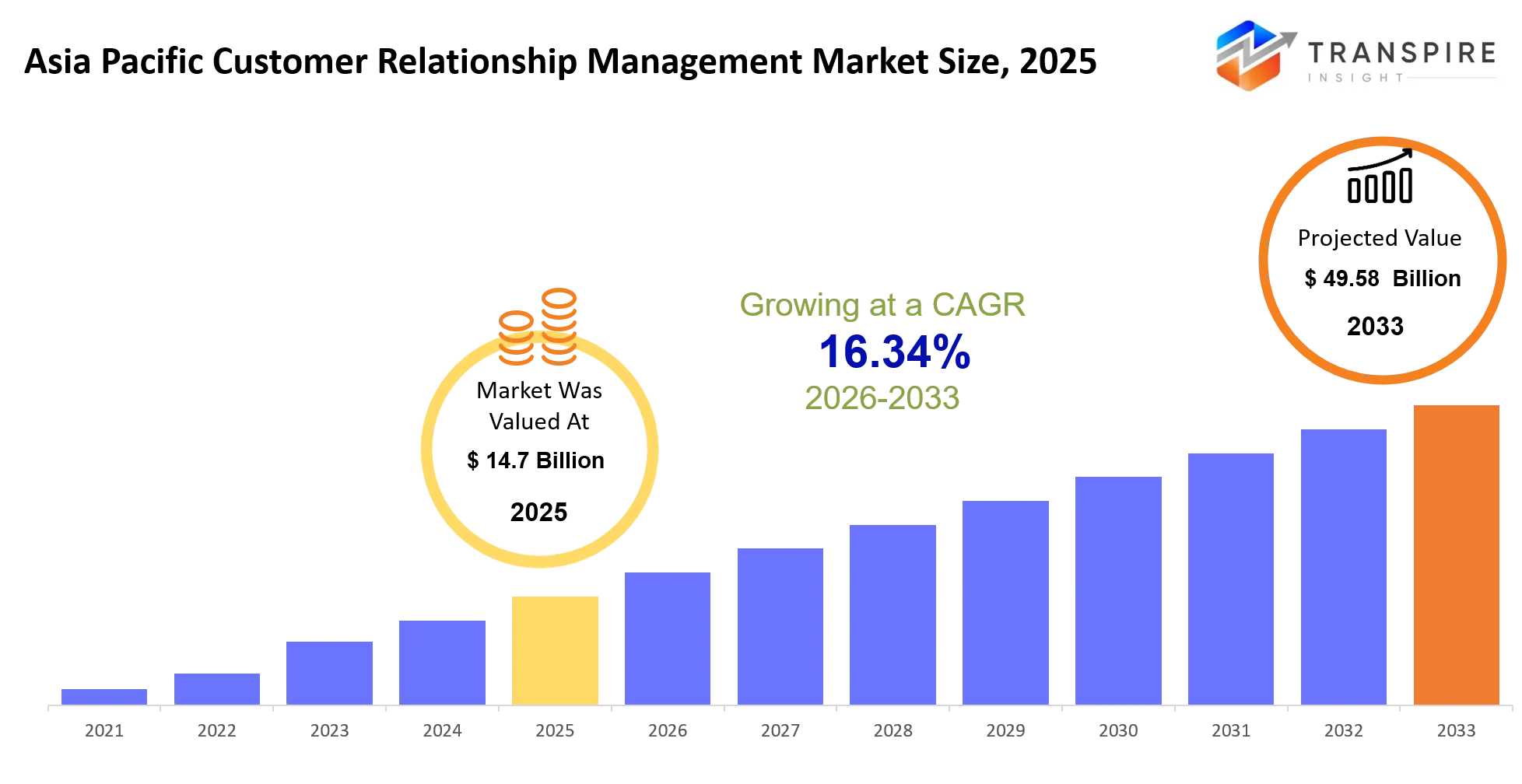
- Asia Pacific Customer Relationship Management Market Size 2025: USD 14.7 Billion
- Asia Pacific Customer Relationship Management Market Size 2033: USD 49.58 Billion
- Asia Pacific Customer Relationship Management Market CAGR: 16.34%
- Asia Pacific Customer Relationship Management Market Segments: By Deployment (Cloud-based CRM, On-premise CRM, Hybrid CRM, Mobile CRM, AI-powered CRM, Others); By Application (Sales Automation, Marketing Automation, Customer Support, Lead Management, Contact Management, Others); By End User (Large Enterprises, SMEs, BFSI Sector, Retail Sector, Healthcare Sector, Others)
To learn more about this report,  Download Free Sample Report
Asia Pacific Customer Relationship Management Market Summary
The Asia Pacific Customer Relationship Management Market was valued at USD 14.7 Billion in 2025. It is forecast to reach USD 49.58 Billion by 2033. That is a CAGR of 16.34% over the period.
Asia-Pacific CRM systems allow businesses to orchestrate the way it acquires, serves and retains customers using its dispersed sales teams, service networks and industrial account structure. Operationally, it brings together fragmented customer information across email, field sales, call centers, and e-commerce onto an operative view of the customer allowing rapid decision making and service delivery across the manufacturing, logistics, telecom and maritime sectors. The region, five years ago, consisted of solely on-premise deployments, while the past half-decade has witnessed a dramatic shift towards cloud-native, AI-enabled SaaS services that offer real-time analytics and automation capabilities. The primary trigger for this rapid transition has been the pandemic which impacted in-person sales cycles and expedited digitization efforts for customer engagement, spurring the need for on-demand, remote CRM systems to continue operations. Beyond the large enterprises of Asia Pacific, its adoption is widening to the mid-market, as the need for CRM as part of revenue operations and the enterprise resource planning ecosystem, and not as an individual product, takes hold.
Key Market Insights
- The China and India will dominate Asia Pacific Customer Relationship Management Market in 2025 with close to 45% combined share owing to the large scale enterprise digitalization efforts.
- The Southeast Asia region is estimated to exhibit the fastest growth owing to higher adoption of cloud services in the SMEs and the increasing demand for mobile-first CRM deployment solutions.
- Demand is expected to grow steadily in Japan and South Korea driven by industrial automation needs and demands for sophisticated enterprise software integrations.
- Cloud based CRM solutions is the leading segment in Asia Pacific Customer Relationship Management Market with close to 62% share in 2025 due to the scalability and lower implementation costs.
- The on premise CRM solutions segment would remain the second dominant segment with steady demand from regulated industries in need of stringent data governance and control.
- The fastest growing segment in Asia Pacific Customer Relationship Management Market is estimated to be AI enabled CRM platforms through 2030 due to increased demand for prediction and workflow automation.
- Sales management applications hold a dominant share of the Asia Pacific Customer Relationship Management Market with nearly 38% of the total CRM application deployments in 2025.
- Customer service and support applications is the fastest growing segment through 2030 due to the rising need for omnichannel customer engagements and real time support response times.
- Retail and e-commerce is the fastest growing end user segment due to the increasing rise of digital commerce and growing need for customer data integration.
- Manufacturing sector adopting CRM to manage B2B relations and distributor collaborations.
What are the Key Drivers, Restraints, and Opportunities in the Asia Pacific Customer Relationship Management Market?
The Asia Pacific CRM Market is evolving under the strongest catalyst – a clear tendency towards a cloud-first enterprise architecture. The trigger for that evolution has been the general replacement of legacy, on-premise solutions by SaaS tools, as organizations from China, India and South Asia tap into the faster go-to-market and optimizing IT infrastructure benefits. The result has been an immediate rise in subscription-related revenues, alongside a first time usage penetration of mid-sized companies that could not afford very complex implementations or needed nimbler solutions. Therefore, CRM is no more a sales pipeline tracking tool, but a platform for analytics-as-a-service, delivering new ways of automating the customer lifecycle management in BFSI, retail and manufacturing.
The primary constraint in the Asian-Pacific Customer Relationship Management Market is disaggregated data governance practices and unequal digital infrastructure in emerging economies. A significant proportion of companies run hybrid IT landscapes where customer data remains segregated in traditional ERP mechanisms limiting CRM adoption. This organizational bottleneck hampers early release within the organization as companies need significant investments to integrate and comply with regulations leading to suboptimal near-term revenue growth in emerging enterprise segments.
One great opportunity is in the promise of AI-assisted CRM augmentation – especially for predictive customer intelligence and multi-channel engagement workflows. Given strong enterprise AI adoption trajectories in India and Singapore, vendors such as salesforce Einstein and Microsoft Dynamics 365 AI modules should be able to find success in this market.
What Has the Impact of Artificial Intelligence Been on the Asia Pacific Customer Relationship Management Market?
The Asia Pacific Customer Relationship Management Market for industrial fleet operations has seen artificial intelligence becoming increasingly embedded within marine emission control systems, with the utilization of smart technology in scrubber performance systems. Operators are utilizing AI-controlled platforms which are integrating IoT sensors with their in-engine exhaust gas cleaning system to monitor SOx concentrations, fuel sulfur ratios, and the state of components throughout their fleet.
This automation has reduced the frequency of manual inspection routines and is enabling real-time regulatory reporting under IMO guidelines to keep ships traveling on busy Asia Pacific routes compliant. Machine learning has also been applied for proactive maintenance and prediction of emissions. Systems are analyzing historical engine loads, in engine seawater alkalinity and scrubber pressure differentials to forecast and predict wear and tear or fouling before critical failure of a system, shipping companies can optimize fuel switching schemes and stabilize output, to assist fleet wide operational planning and eliminate unforeseen downtime for individual ships.
Benefits from the implementation of such technologies include reduced fleet down time, fewer maintenance interruptions and more fuel efficient operations with cost optimization as high as 5-10% in large fleets. However adoption is currently limited due to a lack of adequate satellite connectivity on open sea routes and the cost of integrating them with existing shipboard systems. High quality, readily available datasets for maritime emissions are lacking, limiting the accuracy of machine learning algorithms and hindering large scale implementation within the Asia Pacific market for exhaust gas cleaning technology.
Key Market Trends
- Since 2019-2025, Asia Pacific Customer Relationship Management Market saw a trend from on-premise to cloud SaaS systems to reduce infrastructure costs and deployment times.
- Integration of generative AI post-2022 reshaped Asia Pacific Customer Relationship Management Market by facilitating predictive insights, automated workflows, and real-time customer engagement across businesses.
- Data localization regulations like China PIPL 2021 and India DPDP Act 2023 led a structural change in the architecture and cloud deployment models in Asia Pacific Customer Relationship Management Market.
- Asia Pacific Customer Relationship Management Market witnesses companies moving away from sales-specific tools toward revenue operations platforms that integrate marketing, sales, and customer service data into a unified view.
- Southeast Asian SMEs began to embrace mobile-first CRM solutions after 2020 that boosted cloud CRM adoption and enable real-time customer interaction among spread salesforces.
- The integration between CRM solutions and enterprise resource planning systems like SAP and Oracle expanded in Asia Pacific Customer Relationship Management Market to provide consistent data access across the entire organization.
- Microsoft, Salesforce and Zoho intensified the competition within Asia Pacific Customer Relationship Management Market through their targeted mid-market companies with flexible subscription-based CRM services.
- Low-code and no-code CRM customization platforms became popular after 2021 to decrease deployment time and empowerment the non-technical users to independently configure their desired workflows.
Asia Pacific Customer Relationship Management Market Segmentation
By Deployment :
Adoption of Cloud CRM across Asia Pacific Customer Relationship Management Market because of cost-effective infrastructure, quick scalability and ease of onboarding enterprise users. On-Premise CRM presence is maintained due to regulation-based strict data control, and internal hosting needs within the Banking and Government sectors remain consistent with the traditional systems. Hybrid CRM supported by mixed IT system landscapes with legacy systems & migration to cloud solutions in place.
Mobile CRM used in the field sales process and with the growing number of distributed workforces in the retail and services industries. AI-powered CRM offers greater velocity in decision-making, through the deployment of automation, predictive analytics and customer behavior modeling within the systems. OtherCRM formats such as customization tools aimed at providing niche workflows or modules aimed at linking within enterprise systems are also found in the systems.
By Application :
Sales Automation drives usage across Asia Pacific Customer Relationship Management Market through streamlined tracking of the pipeline and optimization of the revenue workflow among enterprise sales teams. Marketing Automation enables personalization of campaign interactions with customers by analyzing data driven inputs and segmented targeting for each customer. Customer
Support enhances the efficiency of customer response by managing the use of a centralized ticketing system and a mix of communication channels to cater to various types of support channels. Lead Management enables effective conversion tracking of individual prospects into customers. Contact Management centralizes customer data across departments. Other usages of the systems involve usage of analytics dashboards, and a number of tools integrated within each enterprise system for better system coordination and collaboration across the organization.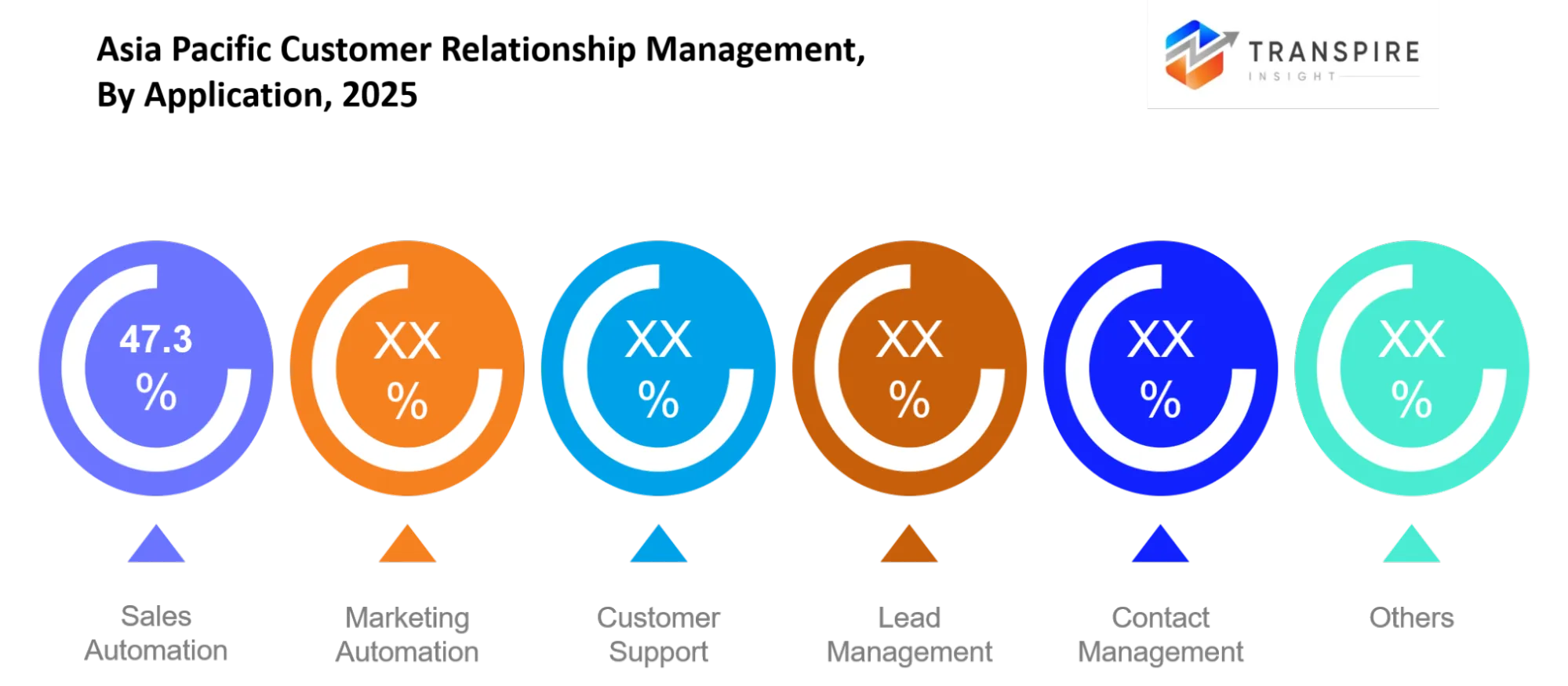
To learn more about this report, Download Free Sample Report
By End User :
Adoption dominated by large enterprises is attributed to vast customer networks and the need for integrated CRM across all departments. BFSI usage is very prevalent owing to huge customer transactions and compliances. Retail usage sees steady increase due to omni-channel services and customer engagement initiatives.
SME usage is seeing significant increase owing to the feasibility and ease of SaaS adoption. Usage of CRM in the healthcare industry is predominantly in the patient engagement and appointment scheduling domains. CRM adoption by other users span across industries like manufacturing, services industries utilizing it for internal and customer interaction synchronization.
What are the Key Use Cases Driving the Asia Pacific Customer Relationship Management Market?
Sales automation is a key driver of CRM adoption in the Asia Pacific customer relationship management market, where businesses leverage CRM systems for pipeline management, revenue cycle management and enabling geographically dispersed sales teams. Demand in the BFSI and large enterprises sectors, in particular, is high, as these businesses typically have a high number of transactions which need tracking in a structured way to expedite conversion processes.
Other application areas are now becoming prevalent, customer support automation and personalized marketing, particularly among retail & e-commerce companies. CRM solutions are being combined with chat and other digital payment channels to shorten response times and leverage buying patterns to develop personalized promotions. Further future use cases emerging in this sector are; the utilization of AI based models to accurately forecast revenue, real time analysis of customer sentiment to anticipate customer behavior in the market place and predict churn rates.
The latter two are being widely deployed among BFSI sector players and telecommunication providers with healthcare and pharmaceutical industries also researching CRM capabilities for their predictive approach to patient outreach and optimizing patient appointments within the forecast timeframe.
|
Report Metrics |
Details |
|
Market size value in 2025 |
USD 14.7 Billion |
|
Market size value in 2026 |
USD 17.19 Billion |
|
Revenue forecast in 2033 |
USD 49.58 Billion |
|
Growth rate |
CAGR of 16.34% from 2026 to 2033 |
|
Base year |
2025 |
|
Historical data |
2021 - 2024 |
|
Forecast period |
2026 - 2033 |
|
Report coverage |
Revenue forecast, competitive landscape, growth factors, and trends |
|
Regional scope |
Asia Pacific (India, China, Japan, Australia,South Korea, Rest of Asia Pacific) |
|
Key company profiled |
Salesforce, Microsoft, SAP, Oracle, HubSpot, Zoho, Freshworks, Zendesk, Adobe, SugarCRM, Pipedrive, Monday.com, Creatio, Nimble, Insightly |
|
Customization scope |
Free report customization (country, regional & segment scope). Avail customized purchase options to meet your exact research needs. |
|
Report Segmentation |
By Deployment (Cloud-based CRM, On-premise CRM, Hybrid CRM, Mobile CRM, AI-powered CRM, Others); By Application (Sales Automation, Marketing Automation, Customer Support, Lead Management, Contact Management, Others); By End User (Large Enterprises, SMEs, BFSI Sector, Retail Sector, Healthcare Sector, Others) |
Which Regions are Driving the Asia Pacific Customer Relationship Management Market Growth?
Asia Pacific Customer Relationship Management Market, East Asia stands as the key dominant region, driven primarily by China and Japan. Government-backed digital enterprise initiatives and a strong base of the industrial ecosystem provide significant impetus for wide-spread CRM implementation among big enterprises. Given the manufacturing and service scale of the Chinese economy, sustained need for the integration of customer data across sales and support networks remains. Japan adds to its strength through well-established enterprise IT infrastructure and high compliance norms that create a favorable environment for organized customer management platforms.
South Asia along with some parts of Southeast Asia emerge as the second dominant contributors, driven largely by sustained enterprise digitisation efforts rather than significant pressure from regulations. India's CRM adoption remains consistent across IT Services, BFSI and Telecom segments. Its strength in outsourcing and services economy drives continuous need for CRM. This region relies more on efficiency gains and cloud feasibility than rigorous regulatory frameworks. The Indonesian, Malaysian and Thailand markets ensure a stable revenue stream driven by their gradual digitisation efforts across retail and logistics segments, thereby generating less volatile and more balanced revenue streams.
Southeast Asia appears as the fastest growing region owing to rapidly escalating investment in cloud infrastructure and swift implementation of digital programs for SMEs. Factors like the increased focus on Digital Trade Policies and high levels of internet penetrations in the Philippines and Vietnam contribute towards a rapid pace of adoption for CRM solutions. Recent Government-backed digital economy initiatives and FDIs in the SaaS segment have further consolidated this trend, creating tremendous market entry potential for vendors offering mobile-first CRM solutions and scalable SaaS platforms for the period of 2026 to 2033.
Who are the Key Players in the Asia Pacific Customer Relationship Management Market and How Do They Compete?
Market competition is moderately consolidated in the APAC CRM Market. Massive global SaaS vendors maintain a decisive presence in large enterprise accounts, while regional players escalate the battle in mid-market segments. Competition is largely determined by technology depth, AI-enablement, price adaptability, as well as the mutual compatibility of ecosystems between CRM and ERP/Cloud infrastructure. Large companies prefer to retain the existing architecture due to huge depth of integration, while emerging SMEs tend to move toward light, subscription-based SaaS CRM solutions. The two-tier structure not only presents a high entry barrier in enterprise accounts but also poses a rapid churn dynamic in segmented market with low-cost models, prompting vendors to iterate their automation & data analytics features.
- Salesforce's Einstein platform led in CRM AI-first, further entrenching its leadership in predictive and workflow automation innovation for large companies in Asia Pacific. Salesforce carves out an expansion strategy through deep integrations between telecom and consulting partners which deepen local deployments into regulated markets.- Microsoft has differentiated through deep integration of Dynamics 365 with Azure cloud and Office productivity applications, facilitating a seamless flow of information across work automation workloads and CRM data. It also provide enterprise license bundles to ensure broad adoption in large clients.- SAP is building its CRM position through operation-linked integration with ERP modules to farm out a complete view of customer and supply chains in manufacturing clients.- Zoho can offer cheap SaaS delivery and leverage dominant presence of SMEs in India, scaling via local prices and data servers in Asia infrastructure region.- HubSpot grows through marketing automation inbound focus, complemented by channel partners serving digitally native startup client base across SEA.
Company List
- Salesforce
- Microsoft
- SAP
- Oracle
- HubSpot
- Zoho
- Freshworks
- Zendesk
- Adobe
- SugarCRM
- Pipedrive
- Monday.com
- Creatio
- Nimble
- Insightly
Recent Development News
In January 2026, Salesforce announced the appointment of Paul Carvouni as Senior Vice President and General Manager for ASEAN." The leadership expansion is aimed at accelerating Salesforce’s “agentic enterprise” strategy across Southeast Asia, strengthening CRM adoption and enterprise AI transformation in the Asia Pacific region.
Source https://www.salesforce.com/
What Strategic Insights Define the Future of the Asia Pacific Customer Relationship Management Market?
Structure is reorienting the Asia Pacific Customer Relationship Management Market towards AI orchestrated cloud native customer intelligence solutions that are re-orienting from record management to real-time customer decision engine solutions based on the enterprise requirements to build a single data store connecting sales, service and marketing across diverse digital channels.
Future value will be delivered from those platform solution providers over the next five to seven years by those that automate and orchestrate customer life cycle decisions over storing interactions. Another underlying, non visible risk is rising reliance upon a small few of hyper scale cloud and SAAS providers increasing vulnerability around pricing concentration and lock in creating friction for flexibility over the long run by mid-market firms that typically have less leverage when it comes to contract renewal or data migration planning.
A more visible opportunity lies in regional localized AI CRm solutions for Southeast Asia and India to train AI models from localized datasets for multilingual customer interactions, a major void which remains mostly commercially undelivered and is beginning to be piloted in large enterprises. Businesses ought to focus upon module, cloud neutral architectures for its AI solutions in addition to regional data partnership to increase bargaining power against cloud providers as well as ensure regulatory compliant scalable market access.
Asia Pacific Customer Relationship Management Market Report Segmentation
By Deployment
- Cloud-based CRM
- On-premise CRM
- Hybrid CRM
- Mobile CRM
- AI-powered CRM
By Application
- Sales Automation
- Marketing Automation
- Customer Support
- Lead Management
- Contact Management
By End User
- Large Enterprises
- SMEs
- BFSI Sector
- Retail Sector
- Healthcare Sector
Frequently Asked Questions
Find quick answers to common questions.
The Asia Pacific Customer Relationship Management Market size is USD 49.58 Billion in 2033.
Key Segments for the Asia Pacific Customer Relationship Management Market are By Deployment (Cloud-based CRM, On-premise CRM, Hybrid CRM, Mobile CRM, AI-powered CRM, Others); By Application (Sales Automation, Marketing Automation, Customer Support, Lead Management, Contact Management, Others); By End User (Large Enterprises, SMEs, BFSI Sector, Retail Sector, Healthcare Sector, Others).
Major Asia Pacific Customer Relationship Management Market players are Salesforce, Microsoft, SAP, Oracle, HubSpot, Zoho, Freshworks, Zendesk, Adobe, SugarCRM, Pipedrive, Monday.com, Creatio, Nimble, Insightly.
The Current Asia Pacific Customer Relationship Management Market size is USD 14.7 Billion in 2025.
The Asia Pacific Customer Relationship Management Market CAGR is 16.34% from 2026 to 2033.
- Salesforce
- Microsoft
- SAP
- Oracle
- HubSpot
- Zoho
- Freshworks
- Zendesk
- Adobe
- SugarCRM
- Pipedrive
- Monday.com
- Creatio
- Nimble
- Insightly
About the Authors

Mayur Shinde
I am Mayur Shinde, a Senior Research Analyst at Transpire Insight, specializing in the Automotive & Transportation and Information & Communication Technology (ICT) Industry. My work focuses on analyzing emerging market trends, technological advancements, competitive landscapes, and industry developments to deliver accurate, data-driven insights. I am passionate about transforming complex market information into clear, actionable content that helps businesses, professionals, and decision-makers stay informed and make confident strategic decisions.

Chakradhar Khansole
Chakradhar serves as the Research Director at Transpire Insight, bringing over 8 years of experience in technology, innovation, and strategic market intelligence. He specializes in transforming complex market data into actionable business insights that enable organizations to make informed, growth-oriented decisions. Recognized for his strategic vision and analytical expertise, Chakradhar leads high-impact research initiatives, delivering comprehensive market assessments, competitive intelligence, and forward-looking industry analysis.
Recently Published Reports
-
Apr 2026
3D Optical Profiler Market
3D Optical Profiler Market Size, Share & Analysis Report By Type (Desktop 3D Optical Profiler, and Portable 3D Optical Profiler), By Technology (Confocal Technology, and White Light Interference), By End-Use Industry (Manufacturing, Research Institutions, Automotive, Aerospace and Defense, Medical Devices, and Other), and Geography (North America, Europe, Asia-Pacific, Middle East and Africa, South and Central America), 2021 - 2031
-
Apr 2026
Depth Sensor Market
Depth Sensor Market Size, Share & Analysis Report By Type (Infrared Depth Sensors, Time-of-Flight (ToF) Sensors, Stereo Vision Sensors, Structured Light Sensors, Ultrasonic Depth Sensors), By Application (Automotive, Robotics, Gaming, Consumer Electronics, Industrial Automation, Healthcare, Security & Surveillance, Others), By End Users (Automotive Manufacturers, Consumer Electronics Companies, Healthcare Providers, Industrial Companies, Security Agencies, Gaming Companies, Robotics Companies, Others), and Geography (North America, Europe, Asia-Pacific, Middle East and Africa, South and Central America), 2021 – 2031
-
Apr 2026
Digital Manufacturing Market
Digital Manufacturing Market Size, Share & Analysis Report By Component (Hardware, Software, and Services), By Technology (Robotics, 3D Printing, Internet of Things (IoT), and Others), By Application (Automotive and Transportation, Aerospace and Defense, Consumer Electronics, Industrial Machinery, and Others), By Process Type (Computer-Based Designing, Computer-Based Simulation, Computer 3D Visualization, Analytics, and Others), and Geography (North America, Europe, Asia-Pacific, Middle East and Africa, South and Central America), 2021 – 2031
-
Apr 2026
Digital Visa Services Market
Digital Visa Services Market Size, Share & Analysis Report By Type (Individual Travelers, Group Travelers), By Application (Tourism, Business Travel, Others), and Geography (North America, Europe, Asia-Pacific, Middle East and Africa, South and Central America), 2021 – 2031