
Asia Pacific Call Center AI Market Size & Forecast:
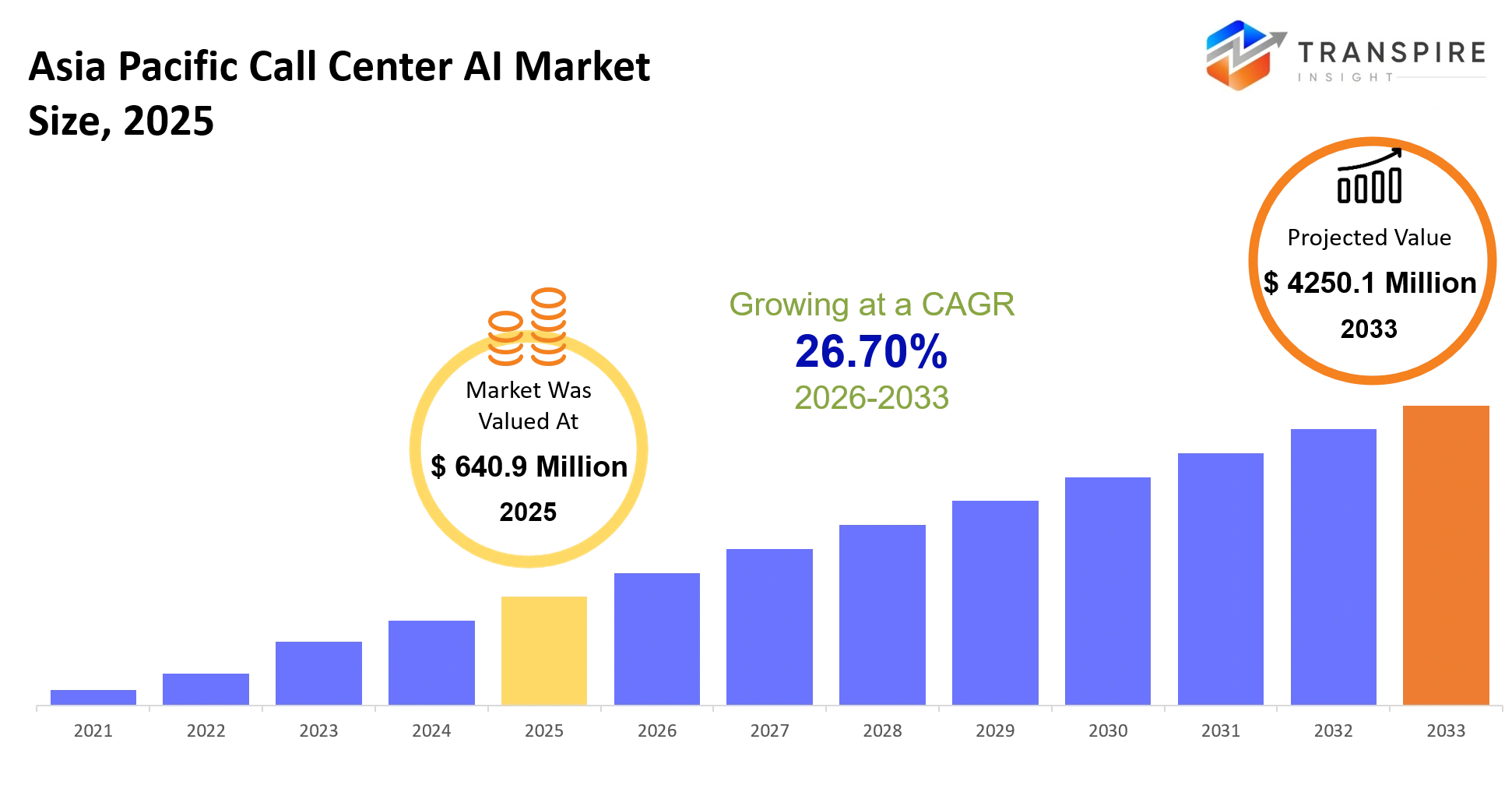
- Asia Pacific Call Center AI Market Size 2025: USD 640.9 Million
- Asia Pacific Call Center AI Market Size 2033: USD 4250.1 Million
- Asia Pacific Call Center AI Market CAGR: 26.70%
- Asia Pacific Call Center AI Market Segments: By Technology (Chatbots, Voice Assistants, Predictive Analytics, Speech Recognition, NLP Platforms, Others); By Application (Customer Support Automation, Sales Assistance, Fraud Detection, Workforce Management, Others); By End User (BFSI, Retail, Telecom, Healthcare, IT & Telecom, Others)
To learn more about this report,  Download Free Sample Report
Asia Pacific Call Center AI Market Summary
The Asia Pacific Call Center AI Market was valued at USD 640.9 Million in 2025. It is forecast to reach USD 4250.1 Million by 2033. That is a CAGR of 26.70% over the period.
The Asia Pacific Call Center AI Market plays a critical part in helping organizations deal with huge flows of customer interactions across voice, chat, email, and social channels, while at the same time shrinking response times and operating expenses. Companies lean on AI-driven virtual agents, speech analytics, smarter call directing, and workforce optimization tools—mostly because they want steadier service quality, and also multilingual customer conversations that can be maintained at scale, even when volumes go up fast.
In the last five years, the whole market vibe has changed. It moved from simple rule-based automation to generative AI and agent-assist platforms that can manage complicated, back and forth conversations. During and after the COVID-19 pandemic, digital services were adopted extremely quickly, and that kind of momentum acted like a catalyst, sort of pushing enterprises to modernize their customer care operations and expand self service options, even when they didn’t plan to. At the same time, labor costs keep climbing in many major outsourcing locations and customer expectations stay higher than before. So organizations are putting money into AI-first contact center platforms that boost agent productivity, and automate the same repetitive tasks again and again.
This shift is also broadening spending on software subscriptions, cloud deployments, and analytics work. So, revenue opportunities feel more durable across banking, telecom, retail, healthcare, and business process outsourcing.
Key Market Insights
- East Asia seems to dominate the Asia Pacific Call Center AI Market, with roughly 42% share in 2025, and this is backed by solid cloud uptake plus enterprise digitalization, not just one thing.
- Southeast Asia is expected to grow the quickest all the way to 2033, mainly because BPO operations keep widening and companies continue pushing AI investment.
- Cloud based AI offerings still make up close to 60% of the whole industry revenue, so yeah they are the main deployment track.
- Conversational AI platforms hang in as the second biggest segment, supported by the common roll out of chatbots and virtual assistants, across many firms.
- Generative AI agent help is likely to show the strongest growth, between 2026 and 2033, at least that’s the outlook.
- On the use case side, customer service automation takes over 35% of application demand, so it stays the most dominant theme among enterprises.
- Real time speech analytics is also becoming a notable growth application, organizations are paying more attention to compliance, and also how customers feel, which matters.
- Big enterprises bring in more than 55% of market revenue, helped by their wide omnichannel customer service setups.
- Meanwhile, small to medium businesses are jumping on AI contact center platforms more often too, usually via subscription style cloud models.
- Overall, the strategic competition is mostly about better AI innovation, multilingual skills, cloud integration, and broader regional expansion across Asia Pacific markets.
What are the Key Drivers, Restraints, and Opportunities in the Asia Pacific Call Center AI Market?
The main driver of market growth seems to be the quick adoption of generative AI alongside cloud-based customer engagement platforms. In banking, telecommunications, e-commerce, and healthcare, enterprises are kind of forced under pressure to manage a rising amount of customer interactions without boosting staffing costs in the same way. With improvements in large language models, speech recognition, and conversational AI, automated customer service has become much more accurate and also more commercially worthwhile. because of that, companies are now rolling out AI agents and agent-assist tools that cut down on average handling time, raise first-contact resolution rates, and boost day-to-day operational efficiency. That in turn supports higher software spending, and it makes platform adoption easier overall.
The biggest brake on the market is usually the difficulty of integrating AI systems with older contact center infrastructure. A lot of bigger organizations still rely on split up customer databases, on-premise telephony setups, and outdated workflow platforms. To replace, or even just connect, these systems takes a lot of capital, long cycles for extensive customization, and then workforce retraining too. This kind of structural snag stretches deployment timelines, and it also discourages adoption by organizations that have constrained technology budgets.
One major opening comes from multilingual generative AI solutions, built with Asia-Pacific needs in mind. The region is linguistically diverse, so there is genuine demand for AI platforms that can understand local dialects and regional languages. As foundation models keep getting better, and regional cloud infrastructure continues to expand, vendors that can provide truly accurate multilingual customer engagement capabilities will likely open up new revenue opportunities. This will show up especially across emerging Southeast Asian economies, and across service industries that are rapidly digitizing.
What Has the Impact of Artificial Intelligence Been on the Asia Pacific Call Center AI Market?
Artificial intelligence has, in a pretty fundamental way, changed how contact centers work all over Asia Pacific. Now AI driven virtual agents handle a lot of the usual questions, like routine customer inquiries, setting up appointments, account verification, billing requests and order tracking,often without anyone on the human side. At the same time, smarter routing systems read what the customer seems to mean, and they automatically send the conversation to the best possible agent, so service feels faster and customers are generally happier.
On top of that, machine learning is being used more and more to guess call volumes, forecast staffing needs, spot churn risk early, and fine tune resource use. There are also advanced speech analytics tools that keep an eye on calls in real time, they can notice shifts in sentiment and then suggest responses to agents during the interaction. With all of this, organizations can shrink average handling times, raise first call resolution, and keep service levels more consistent across different channels.
Generative AI, meanwhile, pushes things further by doing things like automatically summarizing what was said, producing follow up actions, and giving agents contextual suggestions. Lots of enterprises say they see a real reduction in the after call paperwork type workload, plus better agent productivity overall.
Still, for all the upsides, integration is kind of the big hurdle. Putting these advanced AI systems in place usually means updating older telephony setups, customer databases, and workflow systems that were built long ago. Data quality issues, language complexity, and the regulatory rules around customer information also keep slowing adoption in some markets, sometimes quite a bit.
Key Market Trends
- Since 2022, generative AI adoption in contact centers has been speeding up a bit, because enterprises want more natural customer interactions and also push for higher automation rates, you know.
- By 2025, cloud based deployments will have passed 60% of new implementations, so a lot of teams have been moving away from the old on-premise contact center setup.
- AI powered self-service channels have reportedly cut routine agent workloads about 20%–30% across big enterprises.
- Also, real-time speech analytics started showing up more often, especially from 2023 to 2025, as compliance monitoring rules kept getting broader.
- Big vendors like Microsoft, Genesys, NICE, and Google Cloud have kept rolling out generative AI features across their customer service platforms, sort of all at once.
- Meanwhile contact centers are using multilingual AI models more and more, to handle regional languages across India, Southeast Asia, and East Asia, without forcing customers into one “main” language.
- Workforce optimization tools that include predictive analytics gained traction too, since many organizations were focused on staffing efficiency.
- And customer experience efforts have shifted from doing everything by channel, toward more unified omnichannel engagement platforms.
- On the agent side, AI assisted agents are increasingly getting real time recommendations, which in practice reduces training needs, and makes service consistency a little easier to maintain.
- Finally, partnerships between cloud providers and customer experience software vendors grew a lot after 2024, mainly to accelerate AI deployment.
Asia Pacific Call Center AI Market Segmentation
By Technology
Chatbots are taking a solid, kinda obvious role in call center work, because they just handle the everyday stuff like routine customer questions, account updates, and service requests without someone actively jumping in. Companies tend to lean on chatbot solutions to shrink response times and keep service available all day, not just during office hours. And then there’s the ongoing tuning of conversational skills, plus language understanding too, which basically makes it easier to expand these systems across more customer-facing areas.
Voice Assistants are also getting more and more traction, since many organizations want interactions that feel more natural, even when they are automated through voice channels. Predictive Analytics helps contact centers estimate customer behavior, expected call volumes, and operational needs, which supports calmer resource planning and smoother service efficiency. Speech Recognition then turns spoken conversations into usable information, accurately enough to matter. Meanwhile, NLP Platforms strengthen the grasp of customer intent and sentiment across a mix of communication channels. There are also other pieces, like AI based monitoring tools, recommendation engines, and smart routing systems, all of which together improve the overall performance of the contact center.
By Application
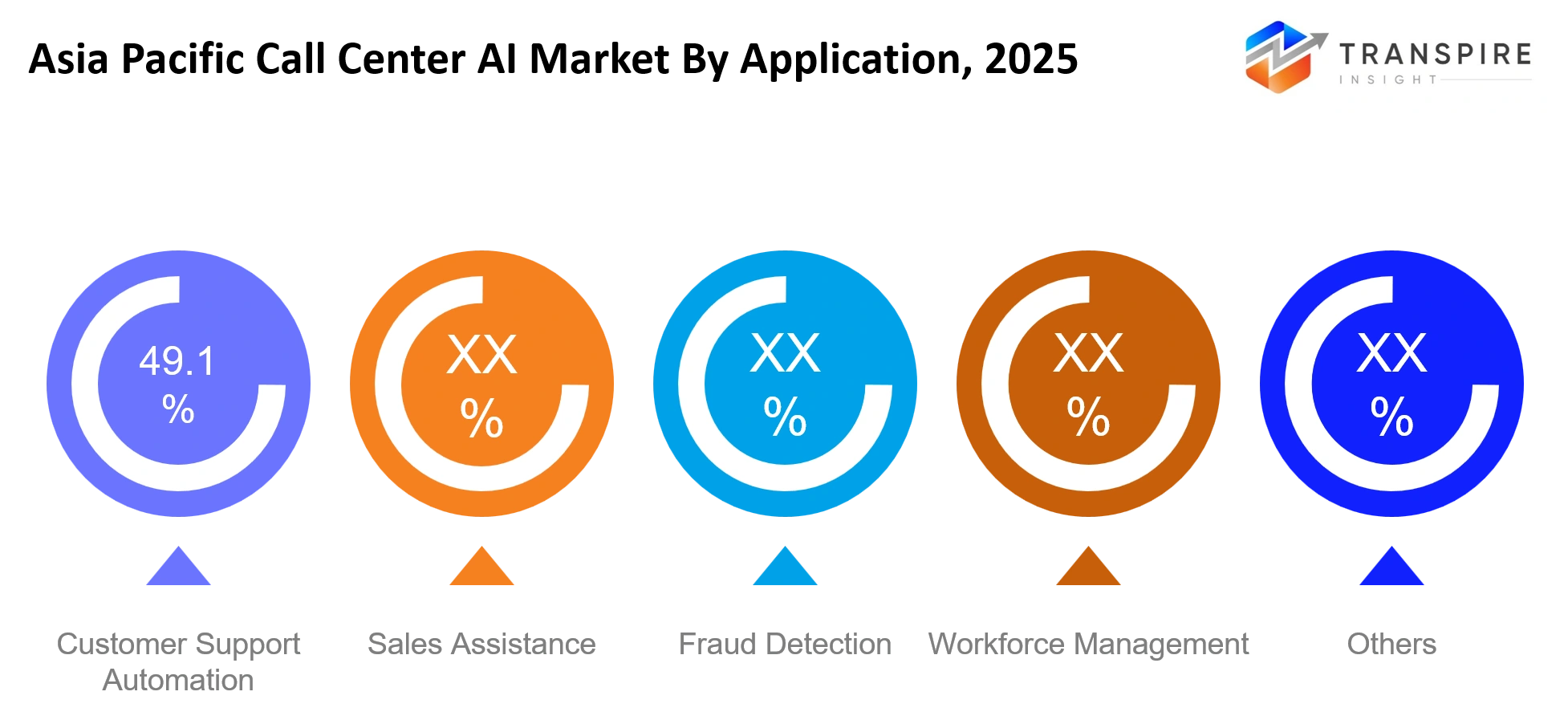
Customer Support Automation is a big application area, you know, because companies want faster resolution and more consistent service. In real life, it really matters. Automated systems handle routine requests, they cut down on waiting times and also help keep ongoing customer contact. When you see strong adoption in financial services, retail, and telecommunications it all adds up to steady growth in this part of the market.
Sales Assistance supports getting new customers in, and also keeping existing ones, by using tailored recommendations and automated follow ups for leads. Fraud Detection works by spotting questionable customer interactions and weird transaction sequences, this makes the security side better and improves risk management. Workforce Management helps contact centers with scheduling, monitoring performance, and boosting productivity so service quality stays in place. Other uses are things like sentiment or customer feedback analysis, compliance observation, and outbound message handling, which in turn support broader operational goals.
To learn more about this report, Download Free Sample Report
By End User
BFSI is still a big end-user category, mostly because of the huge amount of customer interaction and the fact that service needs are really strict. Many financial institutions roll out advanced AI systems to make customer support better, reinforce security procedures, and boost operational efficiency, in a more steady way. And there is consistent funding behind digital transformation efforts which keeps adoption moving across both banking and insurance operations, even when things get complex.
Retail players use AI tools for customer inquiries, order tracking, and a kind of tailored shopping guidance. Telecom companies also lean on intelligent customer engagement instruments to process service requests, so subscriber experiences get better across several channels. In healthcare, providers increasingly adopt automated messaging and outreach for appointment scheduling, patient helpdesk support, and smoother information management, without as much friction.
Meanwhile, IT & Telecom organizations depend on AI-driven contact center platforms to lift service delivery quality. Others includes things like education, travel, government, and utility segments, which keep expanding their digital customer engagement abilities.
What are the Key Use Cases Driving the Asia Pacific Call Center AI Market?
The biggest use case is kinda customer service automation, plus virtual assistants. Basically, organizations roll out AI chatbots and voice bots to handle routine questions, account changes, payment requests, and those service type problems. This particular application seems to get the most pull, because it cuts operational expenses while still keeping 24- hour customer support available, pretty much all day.
Another big area is real time support for agents and speech analytics. In practice, banks, telecom providers, and e-commerce companies use AI systems to break down what people are saying, suggest better replies, and keep an eye on compliance rules during those live customer moments. Workforce management and predictive staffing solutions are also getting more noticeable among large contact center operators.
Newer applications show up as more proactive customer engagement and more tailored outbound outreach. More advanced generative AI platforms are starting to guess what customers might need, suggest an action before a service issue actually appears, and enable heavily customized engagement styles. Those use cases are still kind of early-stage, but they’re expected to matter more as the forecast period goes on.
|
Report Metrics |
Details |
|
Market size value in 2025 |
USD 640.9 Million |
|
Market size value in 2026 |
USD 810.8 Million |
|
Revenue forecast in 2033 |
USD 4250.1 Million |
|
Growth rate |
CAGR of 26.70% from 2026 to 2033 |
|
Base year |
2025 |
|
Historical data |
2021 - 2024 |
|
Forecast period |
2026 - 2033 |
|
Report coverage |
Revenue forecast, competitive landscape, growth factors, and trends |
|
Regional scope |
Asia Pacific (India, China, Japan, Australia, South Korea, Rest of Asia Pacific) |
|
Key company profiled |
Google Cloud, Microsoft, Amazon Web Services, IBM, NICE, Five9, Genesys, Cisco Systems, Salesforce, Oracle, SAP, Avaya, Talkdesk, Zendesk, Nuance Communications |
|
Customization scope |
Free report customization (country, regional & segment scope). Avail customized purchase options to meet your exact research needs. |
|
Report Segmentation |
By Technology (Chatbots, Voice Assistants, Predictive Analytics, Speech Recognition, NLP Platforms, Others); By Application (Customer Support Automation, Sales Assistance, Fraud Detection, Workforce Management, Others); By End User (BFSI, Retail, Telecom, Healthcare, IT & Telecom, Others) |
Which Regions are Driving the Asia Pacific Call Center AI Market Growth?
East Asia pretty much leads the market, mostly because it has solid digital infrastructure, big enterprise tech budgets, and pretty high cloud adoption numbers. So places like China, Japan, and South Korea keep putting serious money into artificial intelligence plus customer experience technologies. A lot of big telecom operators, financial groups, and e-commerce players are still modernizing their customer service workflows, bit by bit, not all at once. There’s also a mature tech ecosystem and strong enterprise software spending that just keeps the regional advantage going.
South Asia comes in as the second-largest source of market revenue. But unlike East Asia, it’s really more about large business process outsourcing efforts, along with huge customer service workforces. India stays a key base for contact center services, and that helps push early adoption of AI tools, because agents can be more productive and service quality stays steadier. Ongoing digital transformation programs, plus enterprises leaning harder into technology investments, are what keep the market moving forward in a stable way.
Then there’s Southeast Asia, which is starting to look like the fastest-growing regional area. New investments around cloud infrastructure, digital banking, e-commerce, and telecom services are speeding up AI usage across customer engagement roles. Countries like Indonesia, Vietnam, and Philippines are growing digital service capacity while updating contact center operations, sometimes in waves. That overall momentum is creating real, interesting openings for software vendors, cloud providers, and investors during the 2026–2033 period.
Who are the Key Players in the Asia Pacific Call Center AI Market and How Do They Compete?
In the Asia Pacific Call Center AI market, competition feels sort of moderately concentrated, where big global cloud providers and a few specialized customer experience software folks push forward. They tend to compete on tech muscle, and not just on price alone, which is kind of what you’d expect. Lately the market seems to favor vendors who put generative AI, multilingual help, analytics, and omnichannel outreach into one unified platform, so everything connects more smoothly. In practice, “how fast you innovate” and how easily you can scale in the cloud, plus whether you can deploy in local regions, has turned into the real competitive edge.
Microsoft is mainly centered on weaving generative AI, including Copilot-type features, directly into contact center routines. The approach is pretty tied to making it work effortlessly with enterprise productivity tools and customer relationship management environments. More recently, their updates have rolled out extra AI-driven self service features, smarter routing, and assistance for agents, so people can handle conversations with less friction.
Genesys goes another route, by leaning into AI experience orchestration and cloud native customer engagement platforms. They keep enlarging ecosystem partnerships, which helps them improve automation levels and makes workflow integration feel more consistent.
Google Cloud and Amazon Web Services lean hard on their cloud infrastructure advantages, to provide scalable AI offerings and more advanced machine learning capabilities. At the same time, NICE, Five9, and Talkdesk emphasize customer experience innovation, workforce optimization, analytics, and AI based automation, all to reinforce how they position themselves competitively.
Company List
- Google Cloud
- Microsoft
- Amazon Web Services (AWS)
- IBM
- NICE
- Five9
- Genesys
- Cisco Systems
- Salesforce
- Oracle
- SAP
- Avaya
- Talkdesk
- Zendesk
- Nuance Communications
Recent Development News
"In September 2025, Genesys entered an expanded strategic partnership with ServiceNow. The collaboration introduced new AI-powered Agent2Agent orchestration capabilities designed to connect customer engagement, workflow, and service operations platforms, strengthening enterprise automation initiatives.https://www.genesys.com
"In March 2025, Microsoft announced Team Phone extensibility for Dynamics 365 Contact Center. The integration allows organizations to combine Teams telephony capabilities with AI-powered contact center operations, supporting more unified customer engagement environments.https://www.microsoft.com
"In April 2025, Microsoft began rolling out new Dynamics 365 Contact Center release wave features focused on AI-powered call quality summaries, intelligent routing enhancements, conversational automation, and expanded Copilot capabilities. These additions strengthen enterprise adoption of AI-driven customer service workflows.https://learn.microsoft.com
What Strategic Insights Define the Future of the Asia Pacific Call Center AI Market?
Over the next five to seven years, the market is expected to move past basic automation toward something more autonomous in customer engagement ecosystems, all powered by generative and agentic AI. The main push behind this shift is basically the need to deal with ever growing customer interaction volumes while still keeping service quality steady, and yes also controlling labor costs. In many cases AI platforms will start covering end to end service journeys instead of handling only disconnected tasks.
One risk that tends to get overlooked is how the market might cluster around just a few big cloud and AI platform providers. If most players are leaning on a narrow technology ecosystem, the whole thing can quietly raise vendor lock in exposure. It can also drive pricing pressure, and even bring extra regulatory scrutiny into the picture.
At the same time there is an emerging opportunity that looks pretty solid. Industry specific AI models, tuned for banking, healthcare, telecommunications, and government services. These specialized offerings can deliver better accuracy and more dependable compliance features than general purpose AI systems.
For market participants, the most practical strategy may be to invest in multilingual generative AI capabilities, build open integration architectures, and support industry specific workflows. Vendors that can balance innovation with compliance, security, and localization requirements will likely be the ones best placed to win and hold long term market share.
Asia Pacific Call Center AI Market Report Segmentation
By Technology
- Chatbots
- Voice Assistants
- Predictive Analytics
- Speech Recognition
- NLP Platforms
- Others
By Application
- Customer Support Automation
- Sales Assistance
- Fraud Detection
- Workforce Management
- Others
By End User
- BFSI
- Retail
- Telecom
- Healthcare
- IT & Telecom
- Others
Frequently Asked Questions
Find quick answers to common questions.
The expected Asia Pacific Call Center AI Market size for the market will be USD 4250.1 Million in 2033.
Key segments for the Asia Pacific Call Center AI Market are By Technology (Chatbots, Voice Assistants, Predictive Analytics, Speech Recognition, NLP Platforms, Others); By Application (Customer Support Automation, Sales Assistance, Fraud Detection, Workforce Management, Others); By End User (BFSI, Retail, Telecom, Healthcare, IT & Telecom, Others)
Major Asia Pacific Call Center AI Market players are Google Cloud, Microsoft, Amazon Web Services, IBM, NICE, Five9, Genesys, Cisco Systems, Salesforce, Oracle, SAP, Avaya, Talkdesk, Zendesk, Nuance Communications
The Asia Pacific Call Center AI Market size is USD 640.9 Million in 2025.
The Asia Pacific Call Center AI Market CAGR is 26.70% from 2026 to 2033.
- Google Cloud
- Microsoft
- Amazon Web Services (AWS)
- IBM
- NICE
- Five9
- Genesys
- Cisco Systems
- Salesforce
- Oracle
- SAP
- Avaya
- Talkdesk
- Zendesk
- Nuance Communications
About the Authors

Mayur Shinde
I am Mayur Shinde, a Senior Research Analyst at Transpire Insight, specializing in the Automotive & Transportation and Information & Communication Technology (ICT) Industry. My work focuses on analyzing emerging market trends, technological advancements, competitive landscapes, and industry developments to deliver accurate, data-driven insights. I am passionate about transforming complex market information into clear, actionable content that helps businesses, professionals, and decision-makers stay informed and make confident strategic decisions.

Chakradhar Khansole
Chakradhar serves as the Research Director at Transpire Insight, bringing over 8 years of experience in technology, innovation, and strategic market intelligence. He specializes in transforming complex market data into actionable business insights that enable organizations to make informed, growth-oriented decisions. Recognized for his strategic vision and analytical expertise, Chakradhar leads high-impact research initiatives, delivering comprehensive market assessments, competitive intelligence, and forward-looking industry analysis.
Recently Published Reports
-
Apr 2026
3D Optical Profiler Market
3D Optical Profiler Market Size, Share & Analysis Report By Type (Desktop 3D Optical Profiler, and Portable 3D Optical Profiler), By Technology (Confocal Technology, and White Light Interference), By End-Use Industry (Manufacturing, Research Institutions, Automotive, Aerospace and Defense, Medical Devices, and Other), and Geography (North America, Europe, Asia-Pacific, Middle East and Africa, South and Central America), 2021 - 2031
-
Apr 2026
Depth Sensor Market
Depth Sensor Market Size, Share & Analysis Report By Type (Infrared Depth Sensors, Time-of-Flight (ToF) Sensors, Stereo Vision Sensors, Structured Light Sensors, Ultrasonic Depth Sensors), By Application (Automotive, Robotics, Gaming, Consumer Electronics, Industrial Automation, Healthcare, Security & Surveillance, Others), By End Users (Automotive Manufacturers, Consumer Electronics Companies, Healthcare Providers, Industrial Companies, Security Agencies, Gaming Companies, Robotics Companies, Others), and Geography (North America, Europe, Asia-Pacific, Middle East and Africa, South and Central America), 2021 – 2031
-
Apr 2026
Digital Manufacturing Market
Digital Manufacturing Market Size, Share & Analysis Report By Component (Hardware, Software, and Services), By Technology (Robotics, 3D Printing, Internet of Things (IoT), and Others), By Application (Automotive and Transportation, Aerospace and Defense, Consumer Electronics, Industrial Machinery, and Others), By Process Type (Computer-Based Designing, Computer-Based Simulation, Computer 3D Visualization, Analytics, and Others), and Geography (North America, Europe, Asia-Pacific, Middle East and Africa, South and Central America), 2021 – 2031
-
Apr 2026
Digital Visa Services Market
Digital Visa Services Market Size, Share & Analysis Report By Type (Individual Travelers, Group Travelers), By Application (Tourism, Business Travel, Others), and Geography (North America, Europe, Asia-Pacific, Middle East and Africa, South and Central America), 2021 – 2031