

South Korea Speech and Voice Recognition Market Size & Forecast:
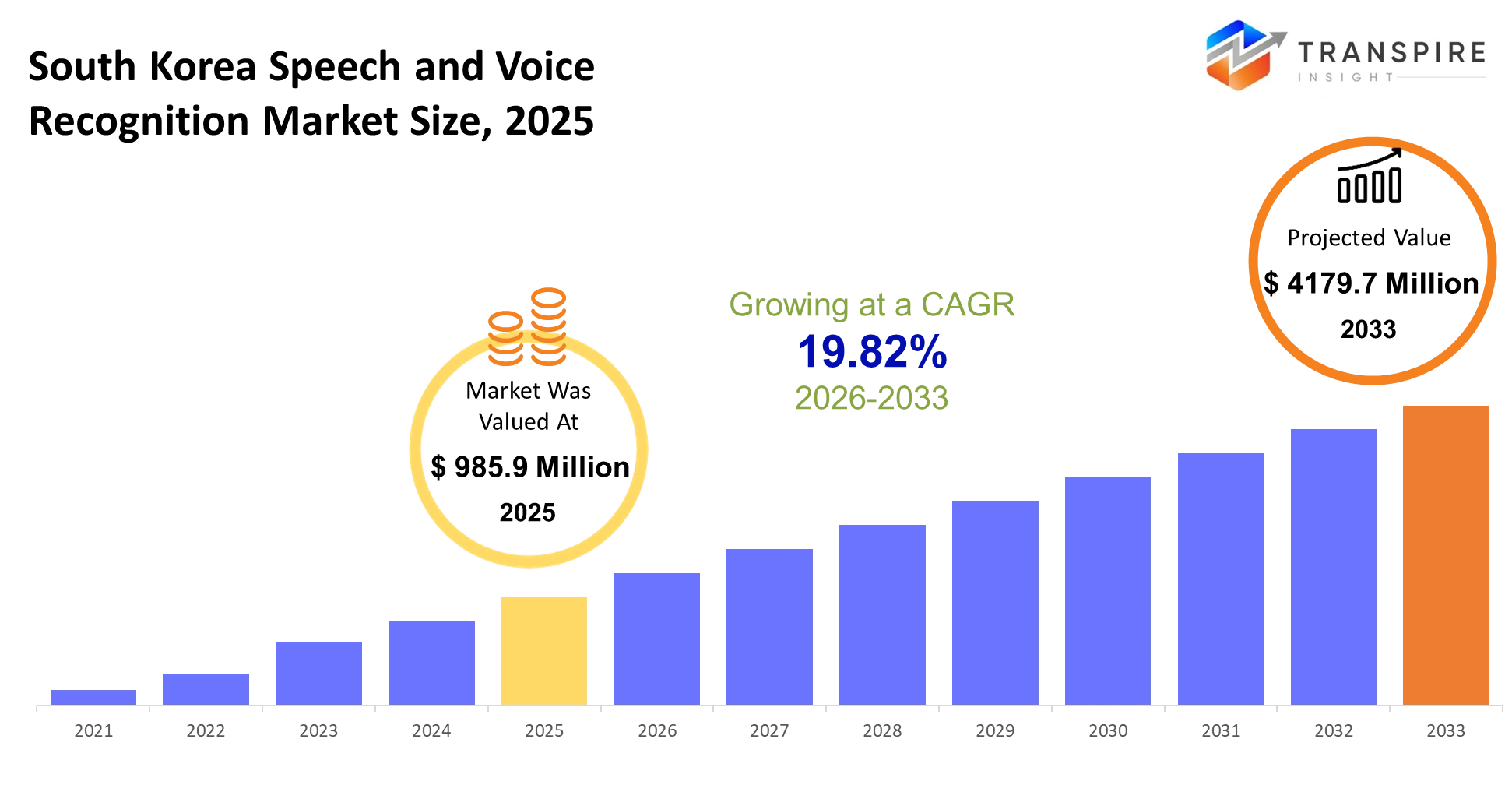
- South Korea Speech and Voice Recognition Market Size 2025: USD 985.9 Million
- South Korea Speech and Voice Recognition Market Size 2033: USD 4179.7 Million
- South Korea Speech and Voice Recognition Market CAGR: 19.82%
- South Korea Speech and Voice Recognition Market Segments: By Component (Software Solutions, Hardware Devices, Cloud Services, AI Engines, Others); By Technology (Automatic Speech Recognition, Natural Language Processing, Speaker Verification, Voice Biometrics, Others); By Application (Virtual Assistants, Customer Service, Healthcare Transcription, Automotive Voice Control, Others); By Deployment (Cloud-based, On-premise, Hybrid Systems, Others); By End User (BFSI, Healthcare, Retail, Automotive, Others)
To learn more about this report,  Download Free Sample Report
South Korea Speech and Voice Recognition Market Summary
The South Korea Speech and Voice Recognition Market was valued at USD 985.9 Million in 2025. It is forecast to reach USD 4179.7 Million by 2033. That is a CAGR of 19.82% over the period.
South Korea’s speech and voice recognition market has kind of moved past the simple voice assistant thing and call center automation and into a more general operational role across banking, automotive systems, healthcare, logistics, and even smart manufacturing. Lots of businesses are turning to voice enabled setups to cut down on manual data entry, help with multilingual customer conversations, and push worker productivity higher in places where hands free operation is really the key. In factories and mobility platforms, these speech interfaces are now tied directly to workflow software, so voice commands become part of everyday operations instead of something that sits on the side like a standalone feature.
Over the last five years, the whole market seems to have shifted from rule based recognition systems to AI driven natural language processing models that can handle conversational Korean dialects, plus context, with noticeably better precision. Then after 2023, the fast rise of generative AI basically sped up enterprise investment because companies started connecting voice systems with real time analytics and automated decision support tools. And South Korea’s solid semiconductor and telecom infrastructure also made it easier for cloud based voice platforms to scale, which lowered the deployment barrier for mid sized firms, while also opening up more recurring software revenue for technology providers.
Key Market Insights
- In 2025 the Seoul metropolitan region dominated the South Korea Speech and Voice Recognition Market, with almost 48% share , mostly because AI infrastructure investments got concentrated there.
- Meanwhile, Busan and Incheon showed noteworthy growth—especially in logistics and port automation, where real-time multilingual voice recognition platforms are being used more and more.
- When it comes to revenue , software solutions took the lead, grabbing over 57% of the South Korea Speech and Voice Recognition Market in 2025 , largely driven by enterprise AI integration demand.
- Cloud based speech analytics platforms were the second major segment , particularly as financial institutions pushed ahead with digital customer engagement strategies.
- And looking ahead , AI powered conversational voice assistants are expected to stay the fastest growing segment through 2030, supported by strong adoption across mobility and healthcare sectors.
- Natural language processing engines picked up big market share, because Korean dialect recognition accuracy got noticeably better after generative AI improvements, like real i t helped.
- In 2025, customer service and contact center automation made up almost 34% of the industry size, enterprises cut operational response times, pretty quickly really.
- Automotive voice interface systems had the quickest growth rate in the forecast period due to connected vehicle commitments and autonomous mobility investments, basically the usual loop.
- Healthcare transcription along with diagnostic voice tools saw rising demand too as hospitals expanded digital workflow management and telemedicine services.
- Meanwhile BFSI companies stayed in the lead for end-user adoption with roughly 29% market share in 2025, since banks leaned hard on AI-enabled customer interaction systems.
What are the Key Drivers, Restraints, and Opportunities in the South Korea Speech and Voice Recognition Market?
The main thing pushing the South Korea Speech and Voice Recognition Market forward is how fast generative AI got folded into enterprise software ecosystems after 2023, like really quickly. South Korean banks, telecom operators and mobility companies started moving away from older rule-based voice setups, and instead using AI models that can handle contextual Korean language understanding, then answer in real time. That change didn’t happen in a vacuum advances in large language models, plus the growth of high-speed cloud infrastructure, made it cheaper to roll out voice platforms at an enterprise level. Because of this, companies have been increasing spending on automated customer service, voice biometrics, and AI assistant features, partly because these tools shorten the time to respond, lower the need for human labor, and generally lift customer retention.
On the other side, the largest brake is still the structural complexity of processing Korean across dialects, specific industry vocabulary, and noisy day to day environments. Even today, speech recognition can show accuracy gaps in manufacturing sites, logistics hubs, and situations where customers switch between languages or just speak messier than usual. To fix those issues, it takes long term investment in proprietary language datasets, edge computing infrastructure, and sector focused AI training models. A lot of mid-sized firms end up delaying deployments, because wrong voice interpretation can create operational exposure, compliance headaches, and extra integration expenses, which all together dampen the near term revenue momentum.
A big opportunity is kind of slowly emerging from South Korea’s smart manufacturing sector. Industrial operators are investing into voice- enabled factory management systems, where speech interfaces link with robotics, predictive maintenance software and digital twins. As semiconductor and electronics manufacturers are ramping up their automation spend, the need for hands free AI control systems is expected to create a brand new, high value enterprise revenue stream for voice technology providers.
What Has the Impact of Artificial Intelligence Been on the South Korea Speech and Voice Recognition Market?
Artificial intelligence and more advanced digital technologies are basically reshaping South Korea’s speech , and voice recognition business. It's like voice interfaces are turning into real operational instruments, not just simple customer service add-ons. Enterprises are now leaning on AI-driven speech platforms to do stuff such as call routing automation, multilingual transcription, voice authentication, plus workflow documentation across banking, healthcare, logistics, and manufacturing settings. In smart factories , voice-enabled control systems help technicians reach machine diagnostics and maintenance histories hands-free. This cuts down on manual input time a bit and supports operational continuity, even when things get busy.
On top of that, machine learning models are strengthening predictive capabilities across enterprise communication systems. Financial companies and telecom providers inspect voice patterns and conversational data to flag fraud risks, guess customer intent earlier, and tune service response performance before issues grow out of control. Healthcare organizations also use AI transcription engines to shrink administrative load and raise the reliability of medical documentation. For large enterprises, these tools have been reported to lower customer handling times and operational expenses, mainly because query resolution moves faster and automated reporting functions do more of the work.
Cloud-based voice analytics platforms are then improving compliance monitoring and workforce productivity by producing live performance views from recorded interactions. Still, there are obstacles: integration costs can feel heavy, and language accuracy has limits. Korean dialect differences , noisy industrial environments, and a shortage of sector-specific training datasets continue to weaken recognition quality in real deployments, especially for mid-sized businesses that don’t have big AI infrastructure budgets to spend on.
Key Market Trends
- Between 2021 and 2025, some South Korean banks moved away from older IVR stuff and swapped in conversational AI platforms, just to shave off customer handling times and also keep labor costs down a bit.
- From 2023 onward, the way companies spend money on generative AI has kinda changed, they put more budget into integrated workflow automation and predictive analytics systems, instead of only standalone voice tools, which is sort of the point.
- Samsung Electronics then pushed its on-device voice AI further, after both smartphone users and automotive customers kept asking for lower latency plus tighter data privacy controls, like, right.
- Manufacturing companies started using hands-free voice interfaces more often, largely because labor shortages got more serious and that created pressure for factory automation and better operational efficiency improvements, all at once.
- Korean-language speech models actually improved a lot after 2022, since domestic firms invested heavily in dialect recognition, and also in contextual natural language processing engines that help it sound less robotic.
- Healthcare providers sped up AI transcription deployment during 2024 to reduce what physicians have to type and rewrite, and to make telemedicine consultations feel faster and more efficient overall.
- Cloud-based voice recognition platforms gained a bigger slice of the market after mid-sized enterprises backed away from pricey on-premise infrastructure somewhere between 2022 and 2025, and honestly it makes sense.
- And Naver Corporation alongside Kakao, they intensified their competition by rolling out Korean-language large language models aimed at enterprise conversational AI applications, like it was kind of inevitable.
South Korea Speech and Voice Recognition Market Segmentation
By Component:
Software solutions can support voice processing, language comprehension, and speech analytics across business workflows, kinda end to end. A lot of enterprises use software platforms to auto run customer interactions , handle document processing , and enable voice based search functions too. The demand for cloud connected applications has expanded quite a bit, because businesses want systems that are more elastic and flexible, and they expect less manual work , plus faster communication.
On the hardware side, you’ll usually find microphones, smart speakers, voice terminals, and embedded devices. These show up in offices, hospitals, and even vehicles, where constant sensing matters. The AI engines inside the stack run learning models that refine language recognition and also improve contextual understanding over time. Cloud services let companies manage huge speech datasets without having to invest heavily in on premise infrastructure, and then other supporting tools help with integration, storage, and security management across the broader digital environment.
By Technology:
Automatic speech recognition technology translates spoken language into written text, mainly for customer support, virtual assistance, and workflow automation. Lots of organizations now lean on recognition systems, not just because it cuts processing delay but also because it boosts operational accuracy in practice. In particular, improved Korean-language processing models have boosted adoption across banking, healthcare, and public services within the last few years.
Natural language processing helps systems grasp conversational intent, instead of treating everything as single word commands. Speaker verification, along with voice biometrics, improves security by matching individual voice traits during authentication. There are also related capabilities like emotion analysis, multilingual processing, and real time translation functions, which helps enterprises coordinate communication more effectively across different business channels.
By Application:
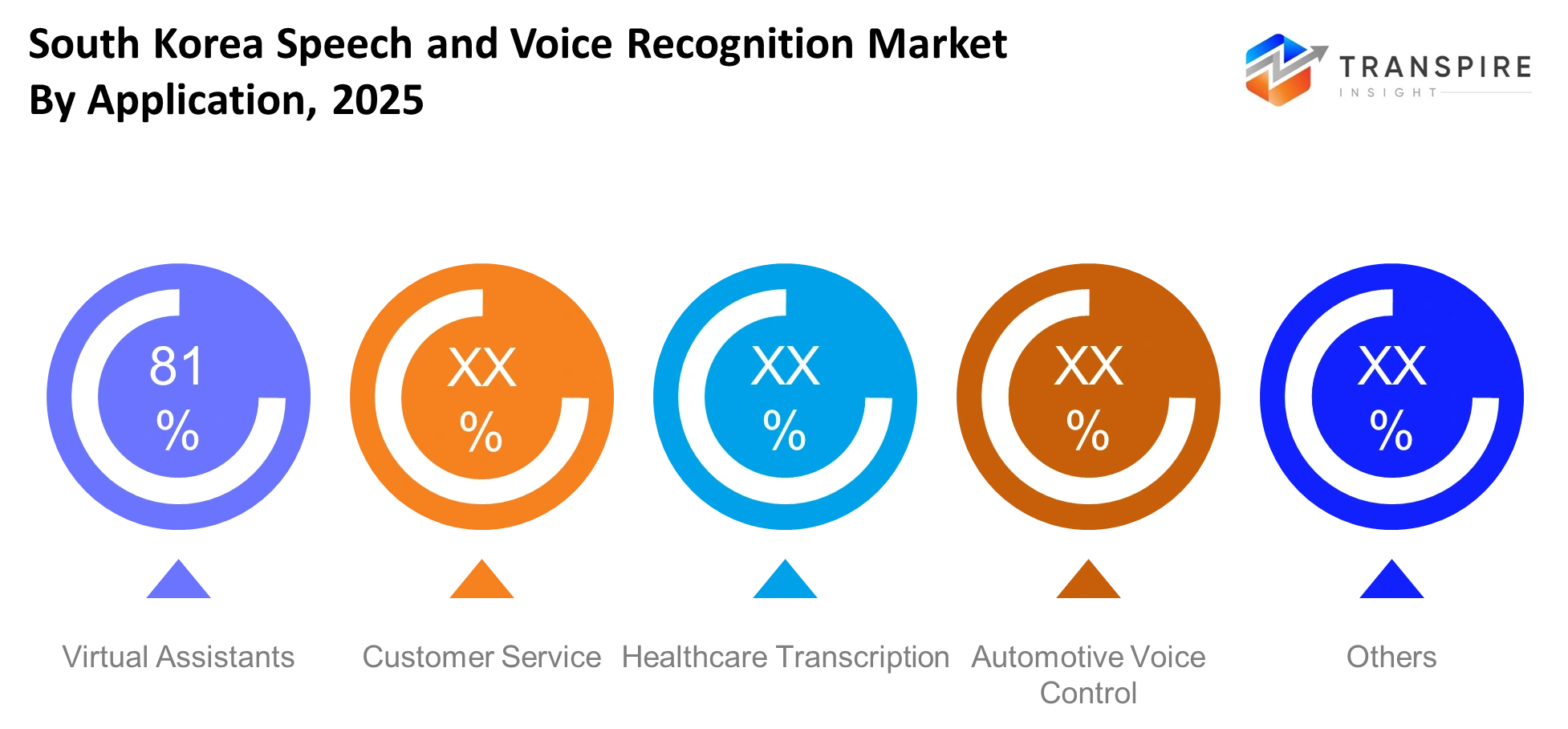
Virtual assistants help with planning, pulling up data, and basically controlling automated conversations across phones, cars, and bigger enterprise setups. Customer service applications keep growing, because companies want quicker replies handling and reduced day to day workload pressure. The AI voice systems can now run inquiries, handle complaints, and even support transactions more efficiently than older, mostly rule based platforms.
Healthcare transcription tools let clinicians cut down the paperwork time, while also improving the accuracy of patient records. In connected cars, voice control systems support navigation, infotainment access, and hands free communication options. Beyond that, there are voice enabled retail services, education platforms, and industrial workflow management systems, which improve operational coordination during routine daily activities.
To learn more about this report, Download Free Sample Report
By Deployment:
Cloud based deployment makes it possible for organizations to use scalable speech recognition, without needing heavy front loaded infrastructure spending. A lot of mid sized companies go for cloud systems because software updates, storage management, and analytics integration feel less complicated to steer. Also, cloud deployment gives remote access, and tends to speed up integration with AI driven enterprise applications.
On premise deployment is still a big deal in industries that deal with sensitive financial, healthcare, or government information. Hybrid systems mix cloud flexibility with local security oversight, so businesses can sort of balance performance along with compliance requirements. Other deployment formats exist too, for specialized operational environments where organizations need customized processing capabilities, and stronger internal system management.
By End User:
BFSI organizations use speech and voice recognition tools to help automate customer interaction, double-check identity and somehow improve transaction support services. Banks and insurance companies keep investing in AI communication systems, because quicker response management will help keep customers around, and it should also lower operational pressure at service centers, a bit less chaos in general.
In healthcare, providers lean on voice systems for clinical documentation, appointment handling, and telemedicine support, plus those functions tend to run smoother. Retail groups use speech recognition for customer engagement and voice-enabled shopping experiences. Automotive companies, meanwhile, fold voice control into connected mobility platforms so drivers can navigate things without too much friction.
What are the Key Use Cases Driving the South Korea Speech and Voice Recognition Market?
Customer service automation still seems like the most powerful, and honestly most obvious use case, in South Korea’s speech and voice recognition space. Banks, telecom operators and e-commerce firms are already leaning on AI voice systems to sort out huge amounts of questions, cut down call handling time and make multilingual conversations feel more efficient. Between strong digital banking adoption, and the steady pace of large scale online retail activity, enterprise demand keeps showing up fairly consistently.
At the same time, healthcare transcription and automotive voice control are getting more attention, especially across hospitals and connected mobility platforms. In practice, medical institutions use speech recognition tools to reduce the physician documentation burden, while automotive makers integrate voice based navigation and infotainment systems into their nicer trims and especially electric vehicle models. Retailers too, are adding voice enabled search capabilities, so the digital shopping experience gets a bit smoother.
Newer ideas keep appearing as well. For example voice biometrics is being explored for financial fraud prevention, and AI driven industrial voice assistants are starting to show up in smart factories. Manufacturing companies are testing hands free operational setups that link speech commands with machine diagnostics as well as workflow management platforms. These efforts are still at an early stage, but the long term outlook looks strong, since industrial automation spending continues expanding across South Korea, with no big pause in sight.
|
Report Metrics |
Details |
|
Market size value in 2025 |
USD 985.9 Million |
|
Market size value in 2026 |
USD 4.56 Million |
|
Revenue forecast in 2033 |
USD 4179.7 Million |
|
Growth rate |
CAGR of 19.82% from 2026 to 2033 |
|
Base year |
2025 |
|
Historical data |
2021 - 2024 |
|
Forecast period |
2026 - 2033 |
|
Report coverage |
Revenue forecast, competitive landscape, growth factors, and trends |
|
Country scope |
South Korea |
|
Key company profiled |
Samsung Electronics, Naver Corporation, Kakao Corp, Google, Microsoft, IBM, Amazon Web Services, Nuance Communications, SoundHound AI, Cerence, Apple, Baidu, LG Electronics, iFLYTEK, Sensory |
|
Customization scope |
Free report customization (country, regional & segment scope). Avail customized purchase options to meet your exact research needs. |
|
Report Segmentation |
By Component (Software Solutions, Hardware Devices, Cloud Services, AI Engines, Others); By Technology (Automatic Speech Recognition, Natural Language Processing, Speaker Verification, Voice Biometrics, Others); By Application (Virtual Assistants, Customer Service, Healthcare Transcription, Automotive Voice Control, Others); By Deployment (Cloud-based, On-premise, Hybrid Systems, Others); By End User (BFSI, Healthcare, Retail, Automotive, Others) |
Which Regions are Driving the South Korea Speech and Voice Recognition Market Growth?
The Seoul metropolitan region seems to lead the South Korea speech and voice recognition market , since the major AI developers, cloud providers, telecom firms, and also financial institutions are all operating inside a tightly knit digital ecosystem. And yes, the government keeps pushing artificial intelligence commercialization along with the smart city programs, so enterprise adoption of conversational AI platforms and voice analytics systems has picked up quite a lot. On top of that, large data center capacity plus advanced 5G infrastructure makes it easier for companies to run real-time speech processing applications with smaller delays and steadier operational reliability. This kind of regional clumping of technology firms, research bodies, and enterprise buyers keeps feeding long-term market strength, not only in software development, but also in AI integration services too.
Meanwhile, Gyeonggi Province stays as the second-largest contributor, though the momentum there feels a bit more tied to industrial firmness and manufacturing integration than pure digital service density. The area has a strong semiconductor, electronics, and automotive production base that keeps investing in factory automation and voice-enabled operational systems. If you compare it to Seoul, where customer interaction platforms take center stage for deployment, Gyeonggi companies tend to lean toward productivity improvement, machine coordination, and industrial workflow optimization, not so much the front-end user conversations. Also, ongoing funding from big manufacturing groups has formed a solid revenue foundation that helps sustain long-term technology adoption, even when economic weather gets a little shaky, or uncertain.
Busan seems to be emerging as the fastest-growing regional market, because logistics modernization and smart mobility investments have been expanding pretty quickly since 2023. Port operators, shipping companies and transportation providers are also moving toward multilingual voice recognition systems so they can improve cargo coordination, manage routes more cleanly , and keep real-time communication more efficient. Then, the cities widening smart port infrastructure along with the digital logistics programs is basically generating new demand for AI-driven operational platforms, not just the old fashioned enterprise applications. And over the 2026–2033 period , this whole trajectory should produce solid opportunities for software vendors, cloud providers, and AI developers who want to expand into transport and logistics focused voice technologies.
Who are the Key Players in the South Korea Speech and Voice Recognition Market and How Do They Compete?
The South Korea speech and voice recognition market shows some moderate consolidation, like big technology firms controlling enterprise-scale rollouts while smaller AI developers push in with very targeted language models and industry-specific tools. Over time, the fight seems to be less about pricing and more about language correctness, real-time responsiveness, cloud interconnectivity, and data protection. The homegrown players often have an edge in Korean-language contextual nuance, but global cloud providers can counter with elastic infrastructure and enterprise AI platforms. At the same time, new entrants keep arriving, bringing niche solutions for healthcare, mobility, and industrial automation, so established vendors feel pressure to move faster, and also to deepen partnerships and ongoing collaboration
Naver Corporation keeps putting a lot of weight on Korean-language AI tuning and hyperscale language model efforts. It stands out by handling context exceptionally well, including regional dialect patterns, and by offering cloud-backed AI services that are tuned for local companies. Naver is still extending its reach via partnerships with banks, retailers , and public sector groups that need localized conversational AI. Kakao plays a different game, mostly through platform interlinking, connecting voice recognition tech with mobility, communications, and digital payment surroundings. This connected setup helps Kakao keep people engaged across multiple apps and services while also boosting the adoption of enterprise AI offerings.
Samsung Electronics is basically strengthening its market position by pushing device-level AI integration across smartphones, home appliances , and also automotive systems, too. The whole idea works kind of well because they have vertical integration, so hardware plus semiconductor development and AI software skills all live in the same ecosystem. That means faster processing efficiency and better data control, without too much back-and-forth. Google, on the other hand, is competing by leaning into cloud native speech analytics and that multilingual AI infrastructure, which helps global enterprises operate with less friction. Meanwhile Microsoft keeps expanding through enterprise productivity integration, embedding speech recognition along with generative AI functions into workplace collaboration and business automation platforms that are already used by major South Korean corporations.
Company List
- Samsung Electronics
- Naver Corporation
- Kakao Corp
- Microsoft
- IBM
- Amazon Web Services
- Nuance Communications
- SoundHound AI
- Cerence
- Apple
- Baidu
- LG Electronics
- iFLYTEK
- Sensory
Recent Development News
Prompt: Research and write 2–3 verified recent developments in the South Korea Speech and Voice Recognition Market from 2025 or 2026 (prioritize April 2026 and earlier 2026 events where available).
Format each entry exactly as:
"In [Month Year], [Company/Entity] [specific action — e.g., 'announced acquisition of,' 'launched,' 'entered a partnership with,' 'secured funding of']. [One-sentence description of the development and its market impact]. [Source URL] ([Source name])."
Include only:
- Acquisitions or mergers
- Product launches or technology certifications
- Strategic partnerships or joint ventures
- Significant funding rounds or investment commitments
Exclude: General industry trends, analyst predictions, or non-company-specific market commentary. All events must be verifiable and sourced. Do not fabricate URLs or source names.
What Strategic Insights Define the Future of the South Korea Speech and Voice Recognition Market?
The South Korea speech and voice recognition market is kind of moving toward deeply embedded AI communication infrastructure, instead of just standalone voice applications. In the next five to seven years, most of the growth will come more and more from enterprise workflow integration, industrial automation, and multimodal AI systems that blend voice with vision, plus predictive analytics within one operational platform. The main push behind this change is South Korea’s broader drive for AI-led productivity improvements across manufacturing, finance, healthcare, and mobility, where labor efficiency and real-time decision support are turning into day to day requirements, not something optional you can bolt on later.
There’s also another less visible risk, and it’s not talked about enough. Namely, AI training data and cloud infrastructure are becoming more and more concentrated among a small set of domestic, as well as global, technology providers. That kind of concentration could squeeze competition, raise dependency on proprietary ecosystems, and quietly lift long-term enterprise switching costs. Still, industrial voice AI for smart factories and logistics hubs looks like a solid emerging opening, especially in areas where semiconductor production and automation spending are expanding. Companies that want to enter this space should focus on sector-specific Korean-language models and hybrid deployment systems, to balance operational precision with enterprise data protection requirements.
South Korea Speech and Voice Recognition Market Report Segmentation
By Component
- Software Solutions
- Hardware Devices
- Cloud Services
- AI Engines
By Technology
- Automatic Speech Recognition
- Natural Language Processing
- Speaker Verification
- Voice Biometrics
By Application
- Virtual Assistants
- Customer Service
- Healthcare Transcription
- Automotive Voice Control
By Deployment
- Cloud-based
- On-premise
- Hybrid Systems
By End User
- BFSI
- Healthcare
- Retail
- Automotive
Frequently Asked Questions
Find quick answers to common questions.
The South Korea Speech and Voice Recognition Market size is USD 4179.7 Million in 2033.
Key segments for the South Korea Speech and Voice Recognition Market are By Component (Software Solutions, Hardware Devices, Cloud Services, AI Engines, Others); By Technology (Automatic Speech Recognition, Natural Language Processing, Speaker Verification, Voice Biometrics, Others); By Application (Virtual Assistants, Customer Service, Healthcare Transcription, Automotive Voice Control, Others); By Deployment (Cloud-based, On-premise, Hybrid Systems, Others); By End User (BFSI, Healthcare, Retail, Automotive, Others).
Major South Korea Speech and Voice Recognition Market players are Samsung Electronics, Naver Corporation, Kakao Corp, Google, Microsoft, IBM, Amazon Web Services, Nuance Communications, SoundHound AI, Cerence, Apple, Baidu, LG Electronics, iFLYTEK, Sensory.
The South Korea Speech and Voice Recognition Market size is USD 985.9 Million in 2025.
The South Korea Speech and Voice Recognition Market CAGR is 19.82% from 2026 to 2033.
- Samsung Electronics
- Naver Corporation
- Kakao Corp
- Microsoft
- IBM
- Amazon Web Services
- Nuance Communications
- SoundHound AI
- Cerence
- Apple
- Baidu
- LG Electronics
- iFLYTEK
- Sensory
Recently Published Reports
-
Apr 2026
3D Optical Profiler Market
3D Optical Profiler Market Size, Share & Analysis Report By Type (Desktop 3D Optical Profiler, and Portable 3D Optical Profiler), By Technology (Confocal Technology, and White Light Interference), By End-Use Industry (Manufacturing, Research Institutions, Automotive, Aerospace and Defense, Medical Devices, and Other), and Geography (North America, Europe, Asia-Pacific, Middle East and Africa, South and Central America), 2021 - 2031
-
Apr 2026
Depth Sensor Market
Depth Sensor Market Size, Share & Analysis Report By Type (Infrared Depth Sensors, Time-of-Flight (ToF) Sensors, Stereo Vision Sensors, Structured Light Sensors, Ultrasonic Depth Sensors), By Application (Automotive, Robotics, Gaming, Consumer Electronics, Industrial Automation, Healthcare, Security & Surveillance, Others), By End Users (Automotive Manufacturers, Consumer Electronics Companies, Healthcare Providers, Industrial Companies, Security Agencies, Gaming Companies, Robotics Companies, Others), and Geography (North America, Europe, Asia-Pacific, Middle East and Africa, South and Central America), 2021 – 2031
-
Apr 2026
Digital Manufacturing Market
Digital Manufacturing Market Size, Share & Analysis Report By Component (Hardware, Software, and Services), By Technology (Robotics, 3D Printing, Internet of Things (IoT), and Others), By Application (Automotive and Transportation, Aerospace and Defense, Consumer Electronics, Industrial Machinery, and Others), By Process Type (Computer-Based Designing, Computer-Based Simulation, Computer 3D Visualization, Analytics, and Others), and Geography (North America, Europe, Asia-Pacific, Middle East and Africa, South and Central America), 2021 – 2031
-
Apr 2026
Digital Visa Services Market
Digital Visa Services Market Size, Share & Analysis Report By Type (Individual Travelers, Group Travelers), By Application (Tourism, Business Travel, Others), and Geography (North America, Europe, Asia-Pacific, Middle East and Africa, South and Central America), 2021 – 2031