

Europe System Integration Services Market Summary
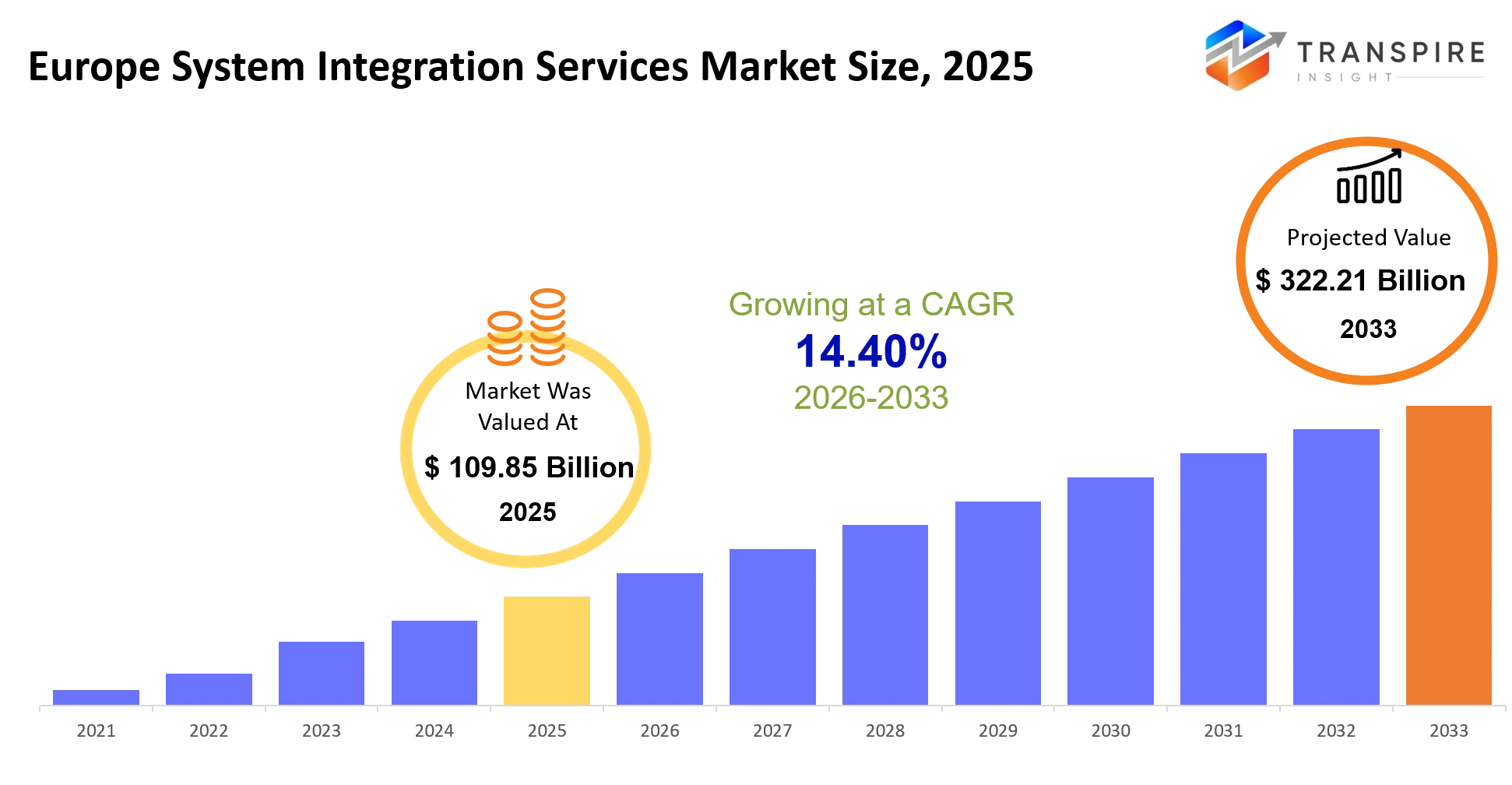
As per Transpire Insight Analysis the Europe System Integration Services Market size is estimated at USD 109.85 Billion in 2025 and is anticipated to reach USD 322.21 Billion by 2033, growing at a CAGR of 14.40% from 2026 to 2033.
The Europe System Integration Services Market sorta helps manufacturers, utilities, transport operators, healthcare providers, and public agencies tie together software, hardware, cloud platforms, industrial gear, and data systems into a single working environment, more or less. With effective integration, those operational silos get less stubborn, decision-making tends to get better , and secure information flow moves more smoothly across complicated business and industrial processes. Over the last five years, the whole market sort of slid away from mostly conventional on-premises integration projects, and it has leaned more toward hybrid cloud, industrial IoT, and AI-enabled digital transformation programs. Also, the energy transition, more strict cybersecurity rules, and the supply chain disruptions after the Russia-Ukraine conflict, kinda pushed modernization faster. Organizations wanted extra operational resilience and that real-time visibility, you know. Because of that, integration projects grew wider than just IT infrastructure, and now they often involve connected production assets , automation platforms, and digital services. And as enterprises modernize legacy setups while still keeping business continuity, system integration engagements have become bigger, longer-term , and more strategic, so service revenues rise, plus more companies adopt advanced integration solutions.
Europe System Integration Services Market Size & Forecast:
- Europe System Integration Services Market Size 2025: USD 109.85 Billion
- Expected Market Value 2033: USD 322.21 Billion
- Forecast CAGR: 14.40%
- Leading region in 2025: Germany, United Kingdom, France, Netherlands, Switzerland, Belgium
- Fastest Growing region: Poland, Czech Republic, Romania, Hungary, Slovakia
- Key Profile: Accenture, Capgemini, IBM, Tata Consultancy Services, Infosys, Wipro, HCLTech, Cognizant, Atos, DXC Technology, Fujitsu, NTT DATA, CGI, Tech Mahindra, Kyndryl.
Key Market Insights
- In 2025, Western Europe kinda led the Europe System Integration Services Market with around 64% market share, and you can see backing from Germany, the United Kingdom, France, and the Netherlands , like there is clear momentum there.
- Central and Eastern Europe is expected to be the fastest growing regional slice during 2025–2033, mostly pushed by manufacturing expansion, EU digital funding, and industrial modernization.
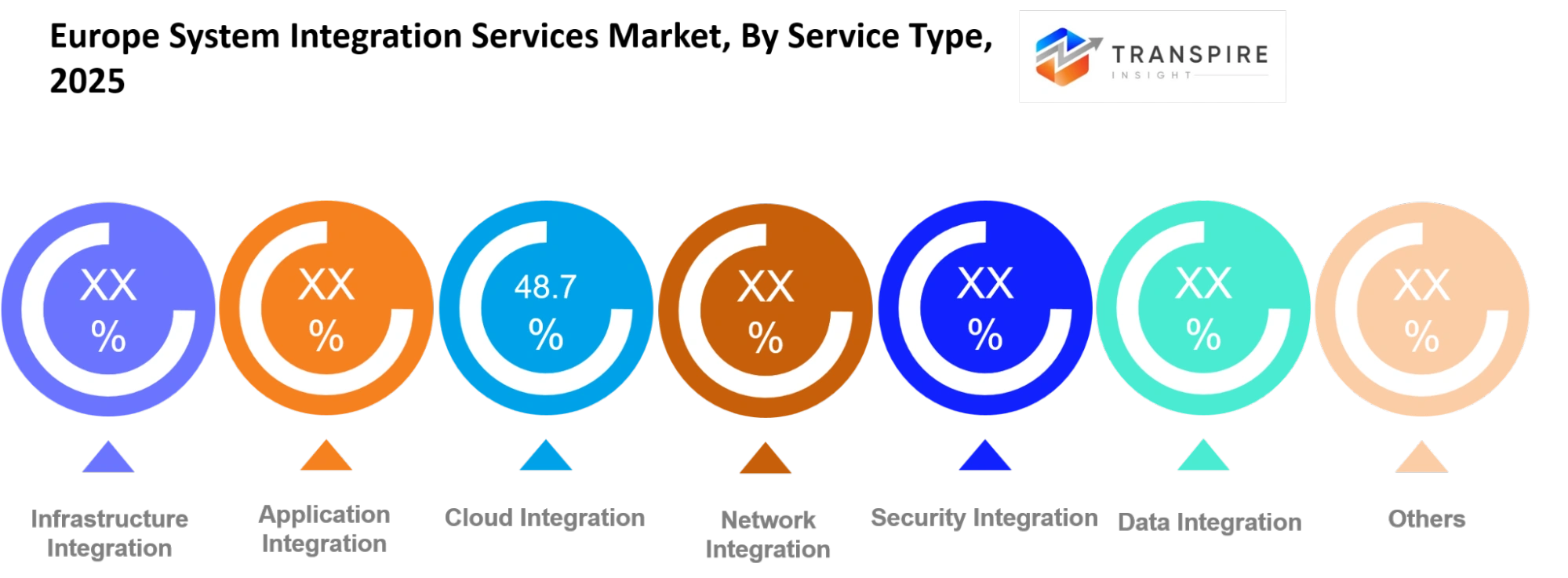
- When it comes to services, infrastructure integration services were the top pick, taking nearly 38% market share in 2025 , because many enterprises were modernizing both hybrid IT , and operational technology environments.
- Application integration services sat in the second position, powered by enterprise cloud adoption and digital workflow modernization across financial services, manufacturing and healthcare.
- Cloud integration services are forecast to be the fastest-growing segment through 2033, with help from multi-cloud strategies, AI deployment , and software modernization efforts.
- By industry, manufacturing accounted for about 29% market share in 2025, as smart factories kept expanding connected automation, industrial IoT , and production visibility platforms.
- Energy and utilities is projected to be the fastest-moving application area during the forecast period, largely due to renewable energy integration, grid modernization , and asset digitization.
- On the end user side, large enterprises led demand, grabbing roughly 68% market share in 2025, which lines up with complex digital transformation programs and stronger ability to spend on technology.
- Small and medium-sized enterprises should show the fastest growth through 2033, supported by cloud based integration platforms and the increasing use of managed services.
What are the Key Drivers, Restraints, and Opportunities in the Europe System Integration Services Market?
Digital transformation programs still feel like the most powerful push, accelerating the Europe System Integration Services Market. Lately, stricter cyber security regulations, Industry 4.0 adoption, and the enterprise shift toward hybrid cloud environments have sort of rewritten what buyers prioritize. Instead of simply throwing out what is already there, organizations now combine operational technology with enterprise software, and yes that comes with different procurement logic. Done this way, downtime tends to drop, operational visibility goes up , and the long term service contracts become easier to keep. And as the integration challenge keeps getting bigger, project deal sizes climb, while recurring managed services keep pulling in more revenue across manufacturing, healthcare, banking, and public sector rollouts.
Legacy infrastructure, however, is still the biggest kind of structural obstacle. A large number of industrial sites continue running proprietary control systems, which cannot be removed without risking production interruptions. So integration efforts often need tailored engineering, longer validation cycles, and focused cybersecurity testing. Those realities stretch the timelines a bit, and they also add cost. From what Transpire Insight observed in regional procurement notices and go live timing, the supply chain concentration issue stays the top execution risk. Plus, when there are too few experienced specialists, deployments get delayed. That lowers near term revenue capture, even though investment pipelines look strong on paper.
The strongest opportunity is really in AI enabled industrial integration, kind of alongside edge computing and the deployment of digital twins. In Europe, manufacturers, utilities ,and transport operators keep investing in connected production assets, and they need a single data platform that works across everything. Germany, Poland, and the Netherlands keep rolling out smart manufacturing programs, mostly backed by EU digital investment initiatives. What comes out of these efforts is bigger multi year integration agreements, plus fresh chances for predictive analytics, cybersecurity services and lifecycle support, not just the usual infrastructure implementation stuff.
What Has the Impact of Artificial Intelligence Been on the Europe System Integration Services Market?
Artificial intelligence is, in a way, reshaping the Europe System Integration Services Market by enabling automated monitoring, some kind of smarter workflow orchestration, and real time management for complicated enterprise and industrial settings. AI powered platforms keep analyzing operational signals coming from cloud systems, factory tools, enterprise applications, and the connected infrastructure layer. This helps integration providers spot configuration problems early, before they turn into business disruptions. At the same time, machine learning models, (kind of) make predictive upkeep better by observing abnormal equipment behavior, estimating what future capacity looks like, and adjusting resource allocation across distributed IT and operational technology environments. Because of that, organizations can drive system availability up , cut the number of accidental outages, react to incidents faster, and lower day to day operational spending through automated diagnostics and more sensible process tuning.
AI also helps with cybersecurity, catching odd network activity and also backing automated compliance monitoring across industries that are heavily regulated. Meanwhile, digital twins and advanced analytics are nudging integration projects toward ongoing optimization services, not just one time deployments. Still, even with all these upsides, broad adoption is slowed down by pricey integration effort, plus uneven data quality inside older platforms. A lot of enterprises stay on fragmented stacks with conflicting architectures, so training and rolling out AI models becomes harder, slower, and honestly more painful.That is why integration specialists keep investing in standardized data frameworks first, before organizations can really harvest AI driven operational value.
Key Market Trends
- Since 2022, hybrid cloud integration has kind of replaced the classic on-premises initiatives, as companies modernize old infrastructure without causing, you know, disruption to the critical business workflows.
- Industrial IoT integration was ramped up across Germany and France from 2023 until 2025, where production assets get connected to enterprise planning, and also analytics platforms, in a more direct way.
- Zero-trust cybersecurity architectures became a sort of baseline requirement after the NIS2 rollout, which then broadened security-centered integration contracts across regulated industries.
- AI-enabled integration platforms are now more and more handling incident detection on their own, cutting down manual monitoring effort, and supporting higher system availability during deployments in 2024–2025.
- Edge computing adoption spread into manufacturing facilities, so teams can handle data in real time, while also shaving cloud latency down for industrial automation.
- Accenture, IBM, and Capgemini put more money into generative AI integration services in 2024, and that basically boosted enterprise modernization know-how in the real world.
- European utilities also pushed smart grid integration projects faster after energy market disruptions, and that created bigger multi-year contracts for providers building digital infrastructure.
- Low-code plus API-based integration platforms started getting adopted more widely between 2023 and 2025, so implementation schedules got shorter while customization needs reduced, at least in many programs.
- Finally, managed integration services kept replacing the one-time deployment model, and that generates recurring revenue streams via continuous optimization, cybersecurity monitoring, and cloud lifecycle management, almost like a steady operating cycle.
Europe System Integration Services Market Segmentation
By Service Type :
Infrastructure Integration kind of held the lead because huge organizations kept on connecting older legacy systems with newer digital platforms but didn’t really replace the existing assets. In manufacturing, utilities, healthcare, and financial institutions there was this push toward unified infrastructure, so they could get better operational visibility and also reduce maintenance complexity, not just slightly but in a practical way. Enterprise spending on digital transformation stayed relatively stable, which supported fairly steady growth in this space. At the same time long-term modernization programs kept generating recurring opportunities for integration providers, which feels like the main driver.
Application Integration landed in second place, mainly because companies were linking enterprise software, customer platforms, and operational applications into one workflow. Cloud Integration was the fastest expanding, since hybrid plus multi-cloud setups basically forced seamless data exchange across different platforms. Network Integration, Security Integration, and Data Integration also picked up and kept going, driven by cybersecurity needs industrial connectivity, and real-time analytics, all of which became more central in enterprise technology plans. And then the other specialized integration services kept supporting more niche operational requirements across multiple industries, even when those needs were a bit unusual.
By Deployment :
Hybrid deployment accounted for the largest share because enterprises kinda balanced what they already had in their existing infrastructure with cloud-based services, all while keeping business continuity. In more complex industries, teams often leaned toward gradual modernization not a full on infrastructure replacement. Those hybrid environments also made it easier to tighten cybersecurity controls and link up with operational technology systems without too much drama. Plus, the more flexible deployment models helped reduce disruption during digital transformation efforts, even when timelines were kind of tight.
Cloud-Based deployment showed up as the fastest-growing category, since organizations pushed harder on migration toward scalable digital platforms and subscription based software. On-Premise deployment still held relevance in highly regulated industries where keeping data control was non-negotiable for compliance and operational security. And because demand for flexibility kept growing, service providers started building more customized integration strategies. Other deployment approaches continued to fit organizations with specialized technical and operational requirements, even if they were smaller in number.
By Enterprise Size :
Large Enterprises were kind of the dominant segment, since multinational organizations managed huge IT environments, many business applications and complicated operational networks. Big digital transformation budgets pushed enterprise-wide modernization efforts across manufacturing, finance, healthcare, and government. The long implementation cycles also helped keep the recurring consulting stream going, plus maintenance and managed service revenue, which adds up over time. With strong investment capacity, leadership in this segment was reinforced, sort of naturally.
SMEs are expected to show the fastest growth, mostly because affordable cloud platforms cut down implementation costs and made technology adoption simpler. Managed integration services gave smaller businesses a way to modernize operations without having to build large internal technical teams. Digital expansion across regional businesses then created extra openings for scalable integration solutions. Meanwhile, the other enterprise categories kept moving forward with targeted integration projects, based on operational priorities.
By End User :
Manufacturing stayed the leading end user segment, since connected production systems, industrial automation, and smart factory initiatives needed a kind of seamless integration between operational technology and enterprise software. Like real time production monitoring ,and predictive maintenance that sort of thing, increased spending on connected digital infrastructure. Then continuous modernization programs, basically helped lock in longer term service chances for integration providers. In other words industrial digitalization kept being a major revenue contributor across European economies, generally.
Healthcare and BFSI kept strong adoption too, driven by secure data exchange and regulatory compliance initiatives, all of that. Government agencies sped up modernization of digital public services, while Retail expanded omnichannel integration and customer data platforms. IT and Telecom supported widespread deployment of cloud infrastructure, plus network modernization and advanced connectivity services. Other industries kept investing in customized integration projects, tied to sector specific operational needs, kind of aligned with what each domain actually requires.
By Technology :
ERP Integration still held the largest share, mostly because orgs kept connecting finance, supply chain, procurement, and production systems into one kinda unified workflow, you know, more or less. At the same time enterprise modernization programs leaned on centralized operational visibility, and better, faster data exchange between departments. The steady ERP investments also meant there was constant demand for implementation, migration, and integration services which kinda makes sense. Bigger organizations were further expanding connected business applications by building integrated enterprise platforms, and so on.
Meanwhile AI Integration is projected to grow the quickest, since intelligent automation, predictive analytics, and automated decision assistance are becoming a core part of digital transformation strategies. IoT Integration also moved fast across manufacturing, energy, and logistics, driven by connected equipment and real-time monitoring solutions. API Integration meanwhile really boosted interoperability between cloud platforms, enterprise applications, and customer-facing services, while also lowering development complexity. And then other emerging technologies kept opening up more niche opportunities, for advanced system integration projects, that’s about it.
What are the Key Use Cases Driving the Europe System Integration Services Market?
Manufacturing is still the main use case for system integration services, since connected production setups need continuous communication between industrial hardware, enterprise software, and operational data platforms. Big manufacturers pay for these services so they can get better production visibility, cut downtime, and enable smart factory operations , all while stretching the usefulness of what they already have in place.
In healthcare, providers keep rolling out more integration work that links electronic health records, diagnostic platforms,and hospital management systems so clinicians can move faster through workflows. At the same time BFSI organizations are leaning into more advanced integration, bringing together digital banking platforms, payment infrastructure, and compliance systems , plus that added focus on cybersecurity and overall operational resilience.
New openings are popping up too, especially around AI-enabled industrial digital twins, and integrated energy management platforms tailored to renewable power sites. Public infrastructure operators and transport authorities are also looking at connected data ecosystems that blend edge computing with IoT devices, and predictive analytics , aiming for real-time decision-making and those next wave smart infrastructure initiatives.
|
Report Metrics |
Details |
|
Market size value in 2025 |
USD 109.85 Billion |
|
Market size value in 2026 |
USD 125.67 Billion |
|
Revenue forecast in 2033 |
USD 322.21 Billion |
|
Growth rate |
CAGR of 14.40% from 2026 to 2033 |
|
Base year |
2025 |
|
Historical data |
2021 - 2024 |
|
Forecast period |
2026 - 2033 |
|
Report coverage |
Revenue forecast, competitive landscape, growth factors, and trends |
|
Country scope |
Europe (Germany, United Kingdom, France, Italy, Spain and Rest of Europe) |
|
Key company profiled |
Accenture, Capgemini, IBM, Tata Consultancy Services, Infosys, Wipro, HCLTech, Cognizant, Atos, DXC Technology, Fujitsu, NTT DATA, CGI, Tech Mahindra, Kyndryl. |
|
Customization scope |
Free report customization (country, regional & segment scope). Avail customized purchase options to meet your exact research needs. |
|
Report Segmentation |
By Service Type (Infrastructure Integration, Application Integration, Cloud Integration, Network Integration, Security Integration, Data Integration, Others); By Deployment (Cloud-Based, On-Premise, Hybrid, Others); By Enterprise Size (Large Enterprises, SMEs, Others); By End User (BFSI, Healthcare, Manufacturing, Retail, Government, IT & Telecom, Others); By Technology (AI Integration, IoT Integration, ERP Integration, API Integration, Others). |
Which Regions are Driving the Europe System Integration Services Market Growth?
Western Europe comes in at around 64% of the regional market, so it’s sort of the main reason for most of the industry revenue, in a very clear way. There are solid cybersecurity rules, pretty advanced digital infrastructure, and widespread take-up of Industry 4.0 initiatives, all of which keep backing big, multi step integration programs across Germany, the United Kingdom, France , and the Netherlands. Plus, global technology providers, engineering firms, cloud vendors, and specific integration specialists have built fairly mature delivery networks, that can handle the complicated enterprise deployments across several industries. With ongoing funding toward industrial automation, artificial intelligence, and hybrid cloud modernization the region should stay in the lead for pretty much the whole forecast period.
Northern Europe is second in size, largely because the digital transformation activities are reinforced by steady public investment, dependable regulatory setups, and generally high enterprise technology adoption. Sweden, Denmark, Finland, and Norway are still expanding secure digital infrastructure , while also holding on to stable economic conditions that make long term technology spending feel more realistic. Adoption is strong across public services, telecommunications, healthcare, and advanced manufacturing. So instead of relying on one single vertical, demand is more evenly spread. That mixed investment style makes Northern Europe a reliable, repeat revenue base for integration service providers.
Central and Eastern Europe i s expected to see the fastest growth between 2026 and 2033, as industrial modernization, EU backed digital spending, and manufacturing expansion start to really accelerate technology adoption across Poland, Czech Republic, Romania, Hungary and Slovakia. At the same time, the rise in foreign direct investment into production sites has made the whole question of integrated factory automation more urgent, plus there is more demand for cloud platforms and also connected enterprise systems. Newer industrial parks and digital infrastructure programs are turning up fresh openings that frankly were not there, at the same scale, a few years back. This overall momentum should then unlock attractive chances for new service providers, technology partners, and investors looking for longer term growth across the more emerging European industrial markets.
Who are the Key Players in the Europe System Integration Services Market and How Do They Compete?
Competition across the Europe System Integration Services Market is still kind of moderately fragmented, mostly because international technology firms sit next to local integration specialists and also a few consulting companies that are very industry focused. What really shapes how these players position themselves isn't only price, it’s the actual technology know-how , cybersecurity maturity, cloud integration track record, and those service frameworks that fit a particular industry. Big providers keep rolling out broader digital transformation portfolios, while smaller, specialized teams often win work by offering tuned, bespoke solutions for regulated sectors, manufacturing setups, and even public infrastructure initiatives.
Accenture manages to stand out via huge digital transformation efforts, where cloud migration, artificial intelligence, cybersecurity, and consulting get bundled into one delivery approach. They lean on strategic partnerships with major cloud providers , and that helps push enterprise modernization programs across Europe. Capgemini tends to emphasize integration that’s connected to specific industries, reinforced by engineering know-how and cloud services, so clients in manufacturing, automotive, and the public sector can modernize those complicated operational environments. More spending on AI capabilities plus continued collaboration with ecosystem partners expands the overall service value across different regional markets.
IBM competes with a hybrid cloud setup, plus automation software and those enterprise AI platforms, that makes it easier to connect legacy systems with newer environments. NTT DATA, in turn, boosts its position via localized delivery hubs and managed services, along with long term enterprise support across several European countries. Tata Consultancy Services grows the regional footprint by putting money into digital engineering, cloud transformation, and innovation centers that are built around what the customer actually needs, so it can provide scalable integration services, supported by broader global technical resources.
Company List
- Accenture
- Capgemini
- IBM
- Tata Consultancy Services
- Infosys
- Wipro
- HCLTech
- Cognizant
- Atos
- DXC Technology
- Fujitsu
- NTT DATA
- CGI
- Tech Mahindra
- Kyndryl
Recent Development News
In April 2025, Accenture expanded its strategic partnership with Google Cloud and launched new AI, networking, and mainframe modernization capabilities. The initiative strengthened enterprise system integration by accelerating cloud migration, agentic AI deployment, and hybrid infrastructure modernization across multiple industries.
Source: https://newsroom.accenture.com/
In August 2025, NTT DATA announced a strategic partnership with Google Cloud to develop industry-specific AI and cloud solutions. The collaboration expanded enterprise system integration offerings through AI-powered cloud modernization, application modernization, and secure digital transformation services across sectors including manufacturing, banking, healthcare, and the public sector.
Source: https://www.nttdata.com/
What Strategic Insights Define the Future of the Europe System Integration Services Market?
Over the next five to seven years, the Europe System Integration Services Market, is going to lean more and more toward a kind of clever software-defined integration that ties artificial intelligence, industrial automation, cloud platforms, and edge computing together into one unified operating environment. And it’s not just a trend headline , it’s basically being pulled by tighter cybersecurity requirements, industrial digitalization, and still ongoing money put into resilient infrastructure, rather than quick isolated tech upgrades.
There’s also a quieter risk, the kind nobody notices right away, where advanced cloud platforms and specialized integration talent get concentrated among a smaller set of providers. When that happens it can push project expenses up , make implementations run longer , and lower the usual procurement flexibility.
At the same time, an emerging opportunity is starting to show up more clearly, namely the joining of AI-enabled digital twins with industrial and energy infrastructure across Central and Eastern Europe. This comes as new manufacturing investments accelerate, so demand is moving. Companies that grow their regional delivery ability, develop industry focused integration know-how, and set up durable, long-term relationships with cloud and cybersecurity providers, will likely land in a stronger spot to win bigger multi-year transformation programs and also secure more recurring service revenue.
Europe System Integration Services Market Report Segmentation
By Service Type
- Infrastructure Integration
- Application Integration
- Cloud Integration
- Network Integration
- Security Integration
- Data Integration
By Deployment
- Cloud-Based
- On-Premise
- Hybrid
By Enterprise Size
- Large Enterprises
- SMEs
By End User
- BFSI
- Healthcare
- Manufacturing
- Retail
- Government
- IT & Telecom
By Technology
- AI Integration
- IoT Integration
- ERP Integration
- API Integration
Frequently Asked Questions
Find quick answers to common questions.
The expected Europe System Integration Services Market size for the market will be USD 322.21 Billion in 2033.
Key segments for the Europe System Integration Services Market are By Service Type (Infrastructure Integration, Application Integration, Cloud Integration, Network Integration, Security Integration, Data Integration, Others); By Deployment (Cloud-Based, On-Premise, Hybrid, Others); By Enterprise Size (Large Enterprises, SMEs, Others); By End User (BFSI, Healthcare, Manufacturing, Retail, Government, IT & Telecom, Others); By Technology (AI Integration, IoT Integration, ERP Integration, API Integration, Others).
Major Europe System Integration Services Market players are Accenture, Capgemini, IBM, Tata Consultancy Services, Infosys, Wipro, HCLTech, Cognizant, Atos, DXC Technology, Fujitsu, NTT DATA, CGI, Tech Mahindra, Kyndryl.
The Europe System Integration Services Market size is USD 109.85 Billion in 2025.
The Europe System Integration Services Market CAGR is 14.40% from 2026 to 2033.
- Accenture
- Capgemini
- IBM
- Tata Consultancy Services
- Infosys
- Wipro
- HCLTech
- Cognizant
- Atos
- DXC Technology
- Fujitsu
- NTT DATA
- CGI
- Tech Mahindra
- Kyndryl
About the Authors

Mayur Shinde
I am Mayur Shinde, a Senior Research Analyst at Transpire Insight, specializing in the Automotive & Transportation and Information & Communication Technology (ICT) Industry. My work focuses on analyzing emerging market trends, technological advancements, competitive landscapes, and industry developments to deliver accurate, data-driven insights. I am passionate about transforming complex market information into clear, actionable content that helps businesses, professionals, and decision-makers stay informed and make confident strategic decisions.

Chakradhar Khansole
Chakradhar serves as the Research Director at Transpire Insight, bringing over 8 years of experience in technology, innovation, and strategic market intelligence. He specializes in transforming complex market data into actionable business insights that enable organizations to make informed, growth-oriented decisions. Recognized for his strategic vision and analytical expertise, Chakradhar leads high-impact research initiatives, delivering comprehensive market assessments, competitive intelligence, and forward-looking industry analysis.
Recently Published Reports
-
Apr 2026
3D Optical Profiler Market
3D Optical Profiler Market Size, Share & Analysis Report By Type (Desktop 3D Optical Profiler, and Portable 3D Optical Profiler), By Technology (Confocal Technology, and White Light Interference), By End-Use Industry (Manufacturing, Research Institutions, Automotive, Aerospace and Defense, Medical Devices, and Other), and Geography (North America, Europe, Asia-Pacific, Middle East and Africa, South and Central America), 2021 - 2031
-
Apr 2026
Depth Sensor Market
Depth Sensor Market Size, Share & Analysis Report By Type (Infrared Depth Sensors, Time-of-Flight (ToF) Sensors, Stereo Vision Sensors, Structured Light Sensors, Ultrasonic Depth Sensors), By Application (Automotive, Robotics, Gaming, Consumer Electronics, Industrial Automation, Healthcare, Security & Surveillance, Others), By End Users (Automotive Manufacturers, Consumer Electronics Companies, Healthcare Providers, Industrial Companies, Security Agencies, Gaming Companies, Robotics Companies, Others), and Geography (North America, Europe, Asia-Pacific, Middle East and Africa, South and Central America), 2021 – 2031
-
Apr 2026
Digital Manufacturing Market
Digital Manufacturing Market Size, Share & Analysis Report By Component (Hardware, Software, and Services), By Technology (Robotics, 3D Printing, Internet of Things (IoT), and Others), By Application (Automotive and Transportation, Aerospace and Defense, Consumer Electronics, Industrial Machinery, and Others), By Process Type (Computer-Based Designing, Computer-Based Simulation, Computer 3D Visualization, Analytics, and Others), and Geography (North America, Europe, Asia-Pacific, Middle East and Africa, South and Central America), 2021 – 2031
-
Apr 2026
Digital Visa Services Market
Digital Visa Services Market Size, Share & Analysis Report By Type (Individual Travelers, Group Travelers), By Application (Tourism, Business Travel, Others), and Geography (North America, Europe, Asia-Pacific, Middle East and Africa, South and Central America), 2021 – 2031