

United Kingdom Smart Room Heater Market Size & Forecast:
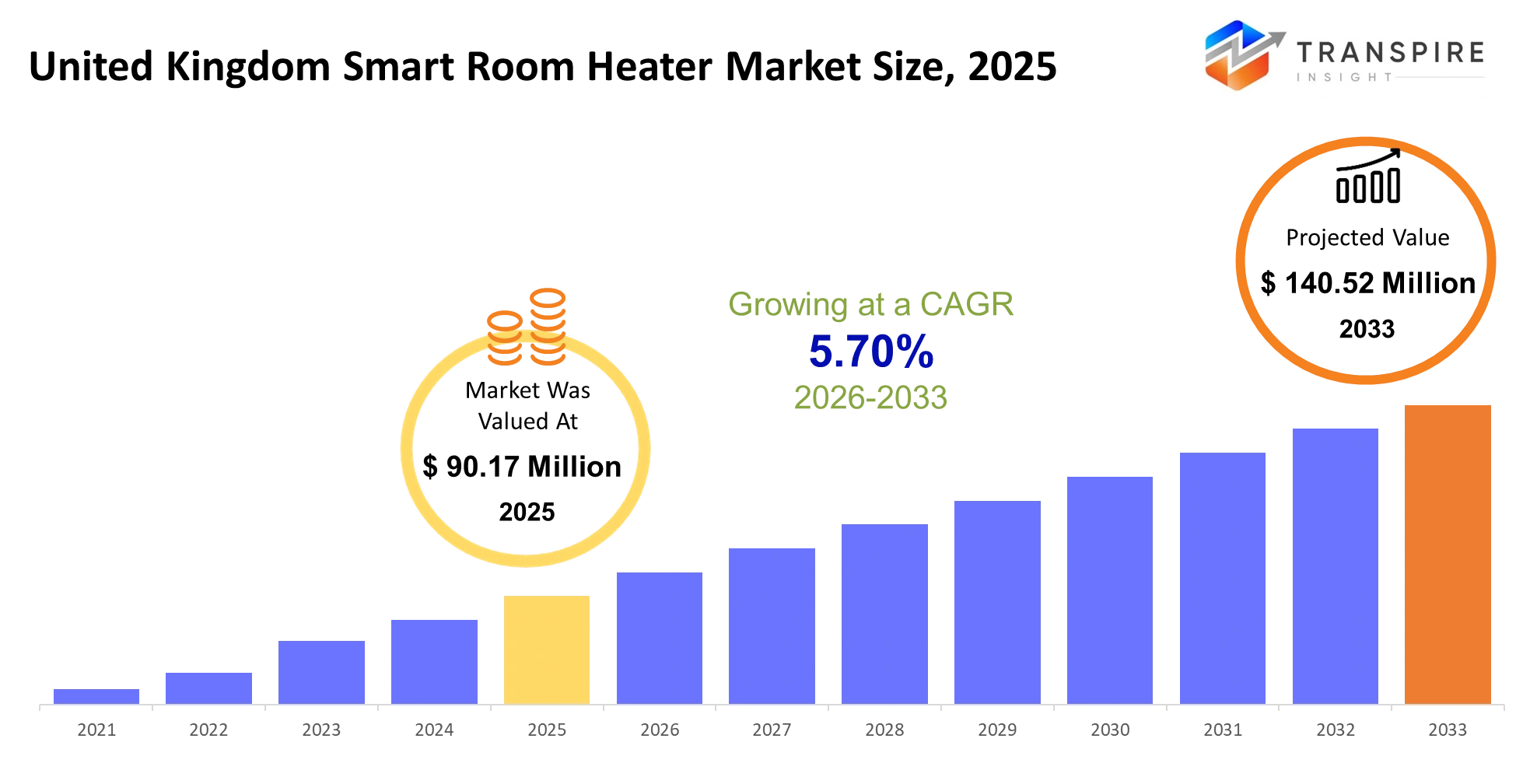
- United Kingdom Smart Room Heater Market Size 2025: USD 90.17 Million
- United Kingdom Smart Room Heater Market Size 2033: USD 140.52 Million
- United Kingdom Smart Room Heater Market CAGR: 5.70%
- United Kingdom Smart Room Heater Market Segments: By Product Type (Convection Heaters, Radiant Heaters, Fan Heaters, Oil-filled Heaters, Ceramic Heaters, Infrared Heaters, Smart Panel Heaters, Others); By Technology (Wi‑Fi-enabled Heaters, AI-powered Heating Systems, IoT-connected Heaters, Voice-controlled Heaters, App-controlled Heaters, Others); By Application (Residential Heating, Commercial Heating, Hospitality Heating, Office Heating, Smart Homes, Others); By Distribution Channel (Online Retail, Electronics Stores, Supermarkets, Specialty Stores, Others).
To learn more about this report,  Download Free Sample Report
United Kingdom Smart Room Heater Market Summary
The United Kingdom Smart Room Heater Market was valued at USD 90.17 Million in 2025. It is forecast to reach USD 140.52 Million by 2033. That is a CAGR of 5.70% over the period.
The United Kingdom smart room heater market is really talking to a practical headache households and small offices still feel: keeping thermal comfort steady while also managing electricity use when energy prices jump around, and not in a predictable way. Usually, these setups mix localised warmth with app-led settings, occupancy detection, programmable thermostats, and smart home linking. In the end they try to cut down wasted heating hours, and they push better room-level energy efficiency, kind of the whole point.
Over the past five years, the direction of the market has moved away from basic standalone portable heaters toward connected climate-management devices that plug into bigger ecosystems. Think Matter support, plus Alexa and Google Home compatibility, that sort of thing. The really noticeable shift came after UK household energy bills climbed hard, especially after the European energy crisis. That pressure made people favor heating that can be controlled and optimized, rather than sticking with older conventional fan heaters or oil heaters that are less adjustable.
Manufacturers then started stacking more advanced features into higher-end models. You see AI-assisted temperature regulation, geofencing, and adaptive scheduling show up more and more on premium devices. And as efficiency standards keep getting stricter, while smart home adoption keeps spreading, vendors are also aiming for higher-value income. They’re doing this through connected ecosystems, subscription-style control options, and multi-function heating devices that do more than just warm a room.
Key Market Insights
- England basically owned nearly 68% of the market share in 2025 , mostly because of higher smart home penetration and a more serious adoption of connected HVAC technologies.
- Scotland is, like, the fastest-growing regional market out to 2033 due to colder climate conditions and residential energy-efficiency retrofit programs that keep rolling out.
- Wi-Fi enabled convection heaters took the lead, grabbing around 42% of revenue in 2025.
- This happened because people are leaning more toward app controlled room-level heating management, rather than older modes.
- Smart ceramic heaters meanwhile became the fastest-growing product category after 2024, pushed by quicker heating response, and also a lower energy consumption profile.
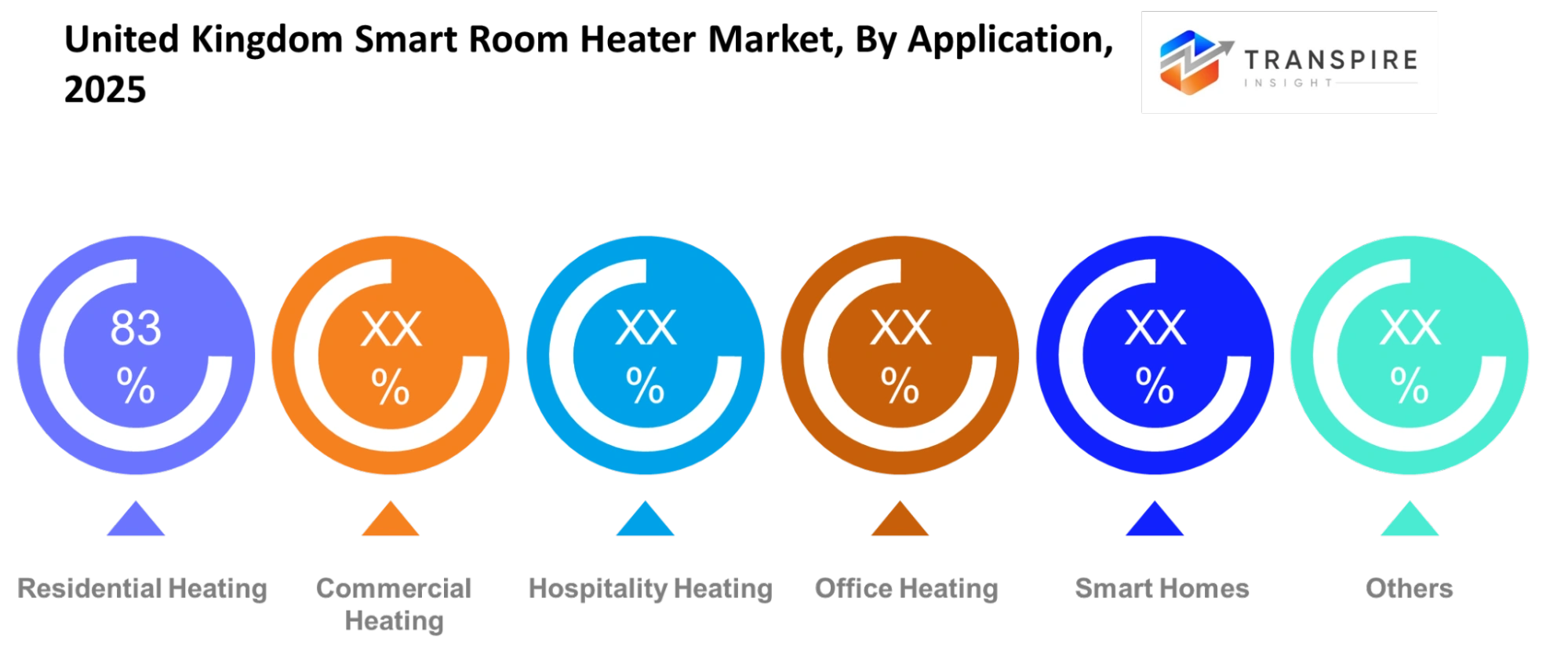
- For the year 2025, residential applications generated more than 74% of the United Kingdom Smart Room Heater Market revenue, since households wanted heating zones that are controllable.
- Then small offices and hybrid workspace installations expanded noticeably after 2023 , as companies adopted localized heating to cut down central HVAC operating costs.
- Connected heaters that include AI scheduling plus geofencing capabilities showed over 25% higher consumer preference compared with non-connected premium models in 2025.
- Dyson, Honeywell, LG Electronics, Samsung Electronics, and De'Longhi basically intensified competition using AI enabled heating controls and tighter smart ecosystem integration.
- Matter-enabled thermostat integration also picked up pace after CES 2025, which improved interoperability between heaters, smart assistants, and energy management platforms.
- Lastly, manufacturers are increasingly bundling purification, heating, and occupancy-tracking functions into one premium device, to protect margins and keep customers around longer.
What are the Key Drivers, Restraints, and Opportunities in the United Kingdom Smart Room Heater Market?
The main driver behind the United Kingdom smart room heater market is basically the big structural change toward energy managed residential heating after the UK energy price shock in the 2022 to 2024 range. Households used to see portable heaters as kind of temporary winter things, but now they don’t really, at least not the same way. Instead, the connected units have become controllable energy management tools that can reduce wasted heating hours using occupancy sensing, smart scheduling, and remote operation… kind of like, always-on but smarter. This trend sped up after electricity and gas costs jumped across Europe, so families had to move to room-by-room heating methods instead of just relying on whole home heating habits. Companies that added app based controls plus geofencing, and even AI assisted temperature optimization, ended up with better pricing strength. They also build steadier, recurring engagement inside the wider home ecosystem.
Still, the biggest restraint is the high upfront cost of premium connected heating systems when compared with conventional electric heaters. And yeah, it’s not just one thing, it’s structural. It blends hardware expenses, the requirement for smart home compatibility, installation difficulty, and some software integration headaches. Lots of lower income households keep putting cost first and they stick to cheaper heating appliances even if that choice can mean higher long term energy use. So penetration stays limited outside affluent urban areas, where budgets and adoption are more willing.
On the opportunity side, there’s a clear opening coming from integration with broader residential energy management systems. Smart room heaters tied into dynamic electricity tariffs, home batteries, and solar setups could automatically tune heating cycles during lower cost energy windows. As UK utilities push forward with smarter grid infrastructure and time of use pricing, manufacturers who can connect heating devices with predictive energy management platforms may be able to create a new premium service tier.
What Has the Impact of Artificial Intelligence Been on the United Kingdom Smart Room Heater Market?
Artificial intelligence is kind of reshaping the United Kingdom smart room heater market, by turning what used to be standalone appliances into more adaptive indoor climate management systems. Manufacturers are more and more deploying AI-enabled occupancy sensing, plus those behavioral learning algorithms, and then predictive temperature control, so heating cycles run automatically based on user routines weather changes , and how the room is actually being used. With machine learning on board, systems can look at historical heating preferences and then tweak the output by themselves, keeping thermal comfort in place while also avoiding unnecessary energy waste.
On top of that, advanced digital platforms help operational efficiency in a smoother way through remote diagnostics and predictive maintenance. Connected heating setups can notice odd fan behavior, overheating risks, airflow restrictions, or even sensor failures before performance starts to slip. That sort of predictive awareness cuts down on service interruptions, and it also helps extend the product lifespan. Meanwhile AI-assisted scheduling and geofencing type technology improve energy optimization too, by dialing down heat output when occupants leave the property, even if they did not manually change anything. For example, Honeywell’s smart thermostat ecosystem reports that average heating energy savings come out around 22% when automated scheduling features are actually kept on and used consistently.
Dyson and Honeywell Home among others, are rolling intelligent sensing and adaptive airflow techniques into connected climate products, which helps sharpen ecosystem differentiation. Still, AI adoption doesn’t move without friction, because there are interoperability gaps, high integration costs, and smart home connectivity that is sometimes inconsistent across older residential infrastructure. And yes, user feedback about device compatibility problems, plus control limitations, keeps pointing toward ecosystem fragmentation as an ongoing challenge, not something that’s fully solved yet.
Key Market Trends
- After the 2022–2024 energy pricing disruption, UK households sorta moved away from full-home heating habits, and more toward room specific tactics. It’s like people started thinking, “Okay we only need this bit, right now,” instead of heating everything, always.
- Also, premium heater makers increasingly merged purification, cooling, and heating into a single connected appliance after 2024. Less clutter, one system, more features, kinda all-in-one.
- By 2025, AI driven occupancy sensing got real traction, since consumers wanted automated temperature tuning, and also lower electricity consumption. The logic sounded simple, but the results seemed better than the old schedules.
- Connected heating products with geofencing and remote scheduling ended up with noticeably stronger conversion rates compared to non-connected portable heaters, especially in urban markets.
- Retail competition kept ramping up too. Asian consumer electronics brands rolled out more affordable smart heating portfolios across UK e-commerce channels, and that pressure didn’t really ease.
- On the high end, smart climate products using adaptive airflow and behavioral tracking started showing up as a premium differentiator. High-end appliance manufacturers leaned on that idea, like it was the main proof of value.
- During 2025, subscription-linked energy optimization services began appearing inside larger residential smart energy ecosystems, rather than standing alone.
- Commercial hybrid workspaces also leaned into localized smart heating solutions. The goal was to cut down centralized HVAC operating costs, mostly after 2023.
- Finally, manufacturers started putting more effort into app ecosystems and over-the-air software updates, aiming to improve retention and strengthen long-term ecosystem monetization.
United Kingdom Smart Room Heater Market Segmentation
By Product Type
Convection Heaters hold the leading market position, basically because they provide consistent room-wide warmth and also stay suitable for long indoor use, that part keeps residential demand strong. In the United Kingdom households are moving more and more toward convection systems for bedrooms, living areas, and even insulated apartments where steady thermal comfort feels more crucial than quick spot heating . Fan Heaters keep the second-largest share because they come in compact layouts , cost less upfront , and warm up rapidly , so they fit nicely for smaller rooms and short-term heating needs during the seasons. Ceramic Heaters and Smart Panel Heaters are still showing better growth in the premium range , mainly because shoppers increasingly want energy optimization, connected controls, and quieter day to day operation in newer homes.
Convection Heaters are expected to stay in front , since energy-minded people keep choosing adjustable heaters that can hold a stable indoor temperature, with less annoying operating swings. Smart Panel Heaters are likely to grow the fastest over time, driven by smart home integration , plus the appetite for neat wall mounted heating solutions that look built in. Infrared Heaters are also picking up momentum in home offices , hospitality venues , and specific commercial set ups where localized heat helps everyday operational efficiency . Product developers are expected to step up investment in AI assisted controls, slimmer profiles, and hybrid multifunction heating systems, to sharpen differentiation across the more premium consumer segments.
By Technology
Wi-Fi-enabled heaters keep the leading spot, mostly because remote control , smartphone links, and working smoothly with the already installed home automation setups keep pulling in consumers. In many urban homes the smart ecosystem stuff is pretty strong so demand stays high for app-synced heating units that help tune energy usage by each room. App controlled heaters still sit in the second spot, because people seem to want “easy” warmth personalization, without going all-in on full smart home integration. Meanwhile, AI-based heating systems and IoT linked heaters are still growing fast, as brands roll out predictive temperature optimization, occupancy sensing, and automated timing features across their higher tier heating collections.
For the near term, Wi-Fi-enabled systems are expected to stay ahead in shipment volume , since they are relatively affordable and users already feel comfortable with them. AI-powered heating systems are seen as the fastest-growing segment across the forecast window because adaptive learning is improving at reducing energy use, running heating cycles in a more hands-off way, and adapting to dynamic electricity pricing. Voice-controlled heaters are also getting more attention inside connected homes, largely because they match Amazon Alexa, Google Assistant, and Apple Home. Tech suppliers and appliance manufacturers are likely to put more focus on interoperability norms, predictive energy management features, and software ecosystem monetization approaches, so they can hold stronger competitive ground over time.
By Application
Residential Heating keeps the dominant role, mostly because household energy costs keep going up and that nudges people toward room-by-room strategies inside apartments, detached houses, and various retrofit housing plans. Lately, many consumers seem to lean to localized control, not that whole-property central heating running all the time, especially in winter when utility pricing gets unstable. Commercial Heating stays in the second-largest spot as small businesses, retail stores, and hybrid working spaces carry on adopting portable smart heating setups, mainly to trim the bill tied to centralized HVAC. Meanwhile, Smart Homes and Hospitality Heating are seeing faster momentum because connected climate management is becoming more deeply embedded in higher-end homes and guest accommodations.
Residential Heating should remain structurally on top, too, since smart meter rollouts and home energy-management adoption keep backing connected appliance behavior. Smart Homes are likely to grow at the fastest rate, largely due to tighter linkages between heating systems, occupancy sensors, and the bigger residential automation ecosystem. Office Heating is also expected to strengthen gradually, since flexible workplace models keep favoring zone based temperature management inside commercial buildings.Product manufacturers and investors will likely keep putting more attention on energy monitoring features, subscription enabled control platforms, and AI assisted automation approaches that raise long-term operating efficiency over time.
To learn more about this report, Download Free Sample Report
By Distribution Channel
Online Retail kinda holds the top market position, mostly because digital comparison platforms, direct-to-consumer sales moves, and solid e-commerce adoption still keep reshaping how people buy appliances. Shoppers seem to lean more toward online channels to check product details and specs, compare energy-efficiency grades, and grab promotional prices across connected heating systems. Electronics Stores hold the second-biggest spot since in-store demos and technical guidance still matter, especially for premium smart heating models that come with advanced connectivity features. Specialty Stores then keep a steadier demand pace by offering personalized recommendations and installation-related help, which really supports higher-end residential buyers.
Online Retail should, uh, get even stronger next because manufacturers are increasingly focusing on direct digital interaction, app-based ecosystem selling, and more specific online promotional tactics. Speciality Stores are also expected to remain relevant, particularly in premium segments where buyers continue to value technical know-how and reliable post-purchase support. Supermarkets are expanding too, but only in certain ways—mostly within entry-level and seasonal heating categories—using sharper pricing and promotional bundle packages. Over the forecast period, distribution networks will likely favor companies that can blend quicker fulfillment with digital product education and connected appliance ecosystem after-sales support, all in one go.
What are the Key Use Cases Driving the United Kingdom Smart Room Heater Market?
The dominant use case still is residential room level heating, especially in apartments, semi-detached homes, and older UK housing stock, where insulation is a bit hit-and-miss. More and more consumers end up using smart heaters to warm the rooms that are actually occupied, instead of letting central heating run nonstop. This approach helps reduce electricity and gas spending, especially during the winter months.
On the expansion side, the same concept is landing in hybrid offices, small retail outlets, and hospitality locations that want flexible climate control without having to overhaul centralized HVAC systems. In addition, property managers and landlords are increasingly rolling out connected heating setups across rental properties, so they can track energy use better and tweak tenant heating activity remotely, using mobile platforms.
A few newer use cases are also starting to show up, like smart heaters that integrate with residential solar storage systems and dynamic energy tariff platforms. Models that can sync up with low-cost off-peak electricity windows, or with home energy management software, are likely to see more adoption over the forecast period. That’s because UK utilities keep pushing forward with smart grid features and time-of-use pricing setups.
|
Report Metrics |
Details |
|
Market size value in 2025 |
USD 90.17 Million |
|
Market size value in 2026 |
USD 95.31 Million |
|
Revenue forecast in 2033 |
USD 140.52 Million |
|
Growth rate |
CAGR of 5.70%from 2026 to 2033 |
|
Base year |
2025 |
|
Historical data |
2021 - 2024 |
|
Forecast period |
2026 - 2033 |
|
Report coverage |
Revenue forecast, competitive landscape, growth factors, and trends |
|
Regional scope |
United Kingdom |
|
Key company profiled |
Dyson, Honeywell, De'Longhi, Philips, Xiaomi, LG Electronics, Samsung Electronics, Havells, Morphy Richards, Vornado, Glen Dimplex, Stadler Form, Lasko, Pelonis, Midea. |
|
Customization scope |
Free report customization (country, regional & segment scope). Avail customized purchase options to meet your exact research needs. |
|
Report Segmentation |
By Product Type (Convection Heaters, Radiant Heaters, Fan Heaters, Oil-filled Heaters, Ceramic Heaters, Infrared Heaters, Smart Panel Heaters, Others); By Technology (Wi‑Fi-enabled Heaters, AI-powered Heating Systems, IoT-connected Heaters, Voice-controlled Heaters, App-controlled Heaters, Others); By Application (Residential Heating, Commercial Heating, Hospitality Heating, Office Heating, Smart Homes, Others); By Distribution Channel (Online Retail, Electronics Stores, Supermarkets, Specialty Stores, Others). |
Which Regions are Driving the United Kingdom Smart Room Heater Market Growth?
England still comes across as the biggest regional market, mostly because the concentration of urban households is high, disposable income sits higher than in much of the rest, and smart home penetration is just stronger overall. London, Manchester, Birmingham, and nearby metropolitan areas continue to show the most momentum in adopting app-connected heating appliances, but they’re not doing it alone these are often integrated into broader home automation ecosystems. Also the region has a mature retail and e-commerce layout, which in practice speeds up the movement of premium appliances. On top of that, consumers are regularly exposed to energy-efficiency programs and smart metering systems. That combination really keeps England in the leading position.
Scotland ends up as the second-largest contributor, though the “why” behind growth feels different compared to England. In Scotland, demand is backed more by local climatic conditions, residential heating intensity, and steady spending on energy-efficiency upgrades, especially across older housing stock. People there tend to lean toward high-performance, programmable heating systems that preserve thermal efficiency even when winter stretches on. Government-linked decarbonization directions stay fairly stable, and home insulation schemes are also active, so the region continues to see consistent revenue generation.
Wales looks like it could be the fastest-growing regional market during the 2026–2033 window, mainly because residential modernization is accelerating, and energy-transition initiatives are gaining traction. Smart meter deployment has been expanding, and local retrofit funding programs are making the conditions for connected heating technologies easier to access. Plus, smaller regional markets in general are starting to look like sensible entry points for mid-tier manufacturers, since competitive saturation is usually lower than in England. That shift is creating room for companies that offer affordable connected heating solutions, tuned for energy-aware households.
Who are the Key Players in the United Kingdom Smart Room Heater Market and How Do They Compete?
Competition in the United Kingdom smart room heater space still looks kind of moderately fragmented, not fully merged or anything, with premium appliance brands trading spots alongside consumer electronics companies and some value-oriented makers. Most firms tend to stand out through smart ecosystem fit, AI-enabled controls, design engineering, and energy optimization, rather than just raw heating capacity or whatever. Even so, premium incumbents keep defending their share via proprietary software ecosystems, while lower-cost Asian manufacturers push hard with connected functionality but at lower price points, which is where they get people.
Dyson presents itself as engineering-led, blending air purification, intelligent airflow management, and adaptive climate controls in premium multifunction devices. Its more recent Find+Follow airflow technology, kind of signals a plan built around intelligent thermal personalization and high-margin innovation. Honeywell Home keeps its focus on interoperability and energy management, using Matter-enabled thermostats, geofencing, and occupancy-based heating optimization, all tied into broader smart home ecosystems.
Samsung Electronics and LG Electronics lean on their wider smart appliance ecosystems, plus mobile connectivity platforms, to tighten cross-device integration. De'Longhi and Midea, in contrast, compete through energy-efficient portable heating formats that sit between pure affordability and genuinely connected features. Meanwhile, Xiaomi keeps building momentum with cost-sensitive consumers, by selling app-enabled heating products that connect with its broader IoT ecosystem, at pretty aggressive pricing.
Company List
- Dyson
- Honeywell
- De'Longhi
- Philips
- Xiaomi
- LG Electronics
- Samsung Electronics
- Havells
- Morphy Richards
- Vornado
- Glen Dimplex
- Stadler Form
- Lasko
- Pelonis
- Midea
Recent Development News
"In January 2025, Resideo introduced the Honeywell Home X2S Smart Thermostat at CES 2025. The Matter-enabled and ENERGY STAR-certified thermostat expanded smart heating interoperability across Apple Home, Google Home, and Amazon Alexa ecosystems, strengthening connected home heating adoption in the United Kingdom smart room heater market.
Source: http://https://www.resideo.com/
"In January 2025, LG Electronics showcased its AI-powered ‘Affectionate Intelligence’ home climate ecosystem at CES 2025. The company demonstrated advanced AI-enabled smart home solutions capable of adaptive environmental control and personalized indoor comfort optimization, supporting the evolution of connected residential heating technologies.
Source: http://https://www.lg.com
"In May 2026, Dyson launched the Find+Follow Purifier Cool intelligent climate device with adaptive airflow tracking technology. The launch strengthened Dyson’s premium smart heating and air-treatment portfolio by integrating AI-assisted sensing, personalized airflow management, and connected smart home functionality.
Source: http://https://www.dyson.com
What Strategic Insights Define the Future of the United Kingdom Smart Room Heater Market?
In the United Kingdom, the smart room heater market is slowly but structurally moving toward integrated home energy orchestration, not really standalone appliance purchases, or at least not as the main story. Over the next five to seven years, competitive edge is going to hinge more and more on how well manufacturers link heating devices with smart grids, shifting tariff structures, occupancy insights and then the wider home automation ecosystem. AI aided thermal optimization and energy scheduling will basically turn from a “nice add on” into something normal, not a premium checkbox.
One risk that people tend to gloss over is ecosystem fragmentation, and yeah it can sound boring but it matters. When manufacturers create proprietary software settings, you can run into compatibility headaches across devices, apps, and smart assistants. That kind of friction may slow consumer adoption and raise switching costs, because once you’re in, getting out isn’t simple. This gets worse as interoperability expectations increase, especially with Matter enabled smart home standards in the picture.
At the same time, there’s an emerging opening that feels pretty real: connected heating setups that are optimized for decentralized residential energy infrastructure. Think homes with rooftop solar, battery storage and time-of-use electricity pricing. If vendors choose to position their products inside residential energy management ecosystems instead of treating them like just another appliance category, they might unlock stronger recurring revenue, over time not just upfront sales.
So market players should probably focus on open platform compatibility, real software update capability and also partnerships with utilities, just to keep long term relevance as the connected heating ecosystem keeps evolving.
United Kingdom Smart Room Heater Market Report Segmentation
By Product Type
- Convection Heaters
- Radiant Heaters
- Fan Heaters
- Oil-filled Heaters
- Ceramic Heaters
- Infrared Heaters
- Smart Panel Heaters
- Others
By Technology
- Wi-Fi-enabled Heaters
- AI-powered Heating Systems
- IoT-connected Heaters
- Voice-controlled Heaters
- App-controlled Heaters
- Others
By Application
- Residential Heating
- Commercial Heating
- Hospitality Heating
- Office Heating
- Smart Homes
- Others
By Distribution Channel
- Online Retail
- Electronics Stores
- Supermarkets
- Specialty Stores
- Others
Frequently Asked Questions
Find quick answers to common questions.
The expected United Kingdom Smart Room Heater Market size for the market will be USD 140.52 Million in 2033.
Key segments for the United Kingdom Smart Room Heater Market are By Product Type (Convection Heaters, Radiant Heaters, Fan Heaters, Oil-filled Heaters, Ceramic Heaters, Infrared Heaters, Smart Panel Heaters, Others); By Technology (Wi‑Fi-enabled Heaters, AI-powered Heating Systems, IoT-connected Heaters, Voice-controlled Heaters, App-controlled Heaters, Others); By Application (Residential Heating, Commercial Heating, Hospitality Heating, Office Heating, Smart Homes, Others); By Distribution Channel (Online Retail, Electronics Stores, Supermarkets, Specialty Stores, Others).
Major United Kingdom Smart Room Heater Market players are Dyson, Honeywell, De'Longhi, Philips, Xiaomi, LG Electronics, Samsung Electronics, Havells, Morphy Richards, Vornado, Glen Dimplex, Stadler Form, Lasko, Pelonis, Midea.
The United Kingdom Smart Room Heater Market size is USD 90.17 Million in 2025.
The United Kingdom Smart Room Heater Market CAGR is 5.70% from 2026 to 2033.
- Dyson
- Honeywell
- De'Longhi
- Philips
- Xiaomi
- LG Electronics
- Samsung Electronics
- Havells
- Morphy Richards
- Vornado
- Glen Dimplex
- Stadler Form
- Lasko
- Pelonis
- Midea
About the Authors

Chetan Dhatrak
I’m Chetan Dhatrak, a Senior Research Analyst at Transpire Insight, specializing in the Consumer Goods, Foods and Beverages industry. I focus on analyzing market trends, consumer behavior, competitive landscapes, and industry developments to deliver accurate, data-driven insights. My research at Transpire Insight is built on credible sources and in-depth analysis, helping businesses and readers better understand market dynamics, emerging opportunities, and evolving consumer preferences. I’m committed to creating reliable, well-researched content that supports informed decision-making and reflects the latest developments in the consumer goods and food & beverage sectors.

Chakradhar Khansole
Chakradhar serves as the Research Director at Transpire Insight, bringing over 8 years of experience in technology, innovation, and strategic market intelligence. He specializes in transforming complex market data into actionable business insights that enable organizations to make informed, growth-oriented decisions. Recognized for his strategic vision and analytical expertise, Chakradhar leads high-impact research initiatives, delivering comprehensive market assessments, competitive intelligence, and forward-looking industry analysis.
Recently Published Reports
-
Apr 2026
Bottled Water Market
Bottled Water Market Size, Share & Analysis Report By Product Type (Still Bottled Water, Carbonated Bottled Water, Functional Bottled Water, and Others), By Packaging (PET, Cans, and Others), By Sales Channel (Supermarkets/Hypermarkets, Convenience Stores/Drug Stores, Grocery Stores/Club Stores, Foodservice, and Others) and Geography (North America, Europe, Asia-Pacific, Middle East and Africa, South and Central America), 2021 - 2032
-
Apr 2026
Color Cosmetic Packaging Market
Color Cosmetic Packaging Market Size, Share & Analysis Report By Application (Mascara Packaging, Liquid Packaging, and Liquid Face), By Type (Tubes & Bottles, Pens & Markers, Compacts & Containers, and Droppers & Pumps), and Geography (North America, Europe, Asia-Pacific, Middle East and Africa, South and Central America), 2021 - 2031
-
Apr 2026
External Microphone For Camera Market
External Microphone For Camera Market Size, Share & Analysis Report By Type (Shotgun Microphone, Lavalier Microphone, and Others), By Application (Digital Camera, Professional Video Camera, and Others), and Geography (North America, Europe, Asia-Pacific, Middle East and Africa, South and Central America), 2021 - 2031
-
Apr 2026
Foot Orthotic Insoles Market
Foot Orthotic Insoles Market Size, Share & Analysis Report By Type (Pre-fabricated, and Custom-made), By Material (Thermoplastic, Composite Carbon Fiber, and Others), By Distribution Channel (Drug Stores, Hospitals & Clinics, and Others), and Geography (North America, Europe, Asia-Pacific, Middle East and Africa, South and Central America), 2021 - 2031